Conservation of Energy in
Simple Harmonic Motion
By: Devin Gamble
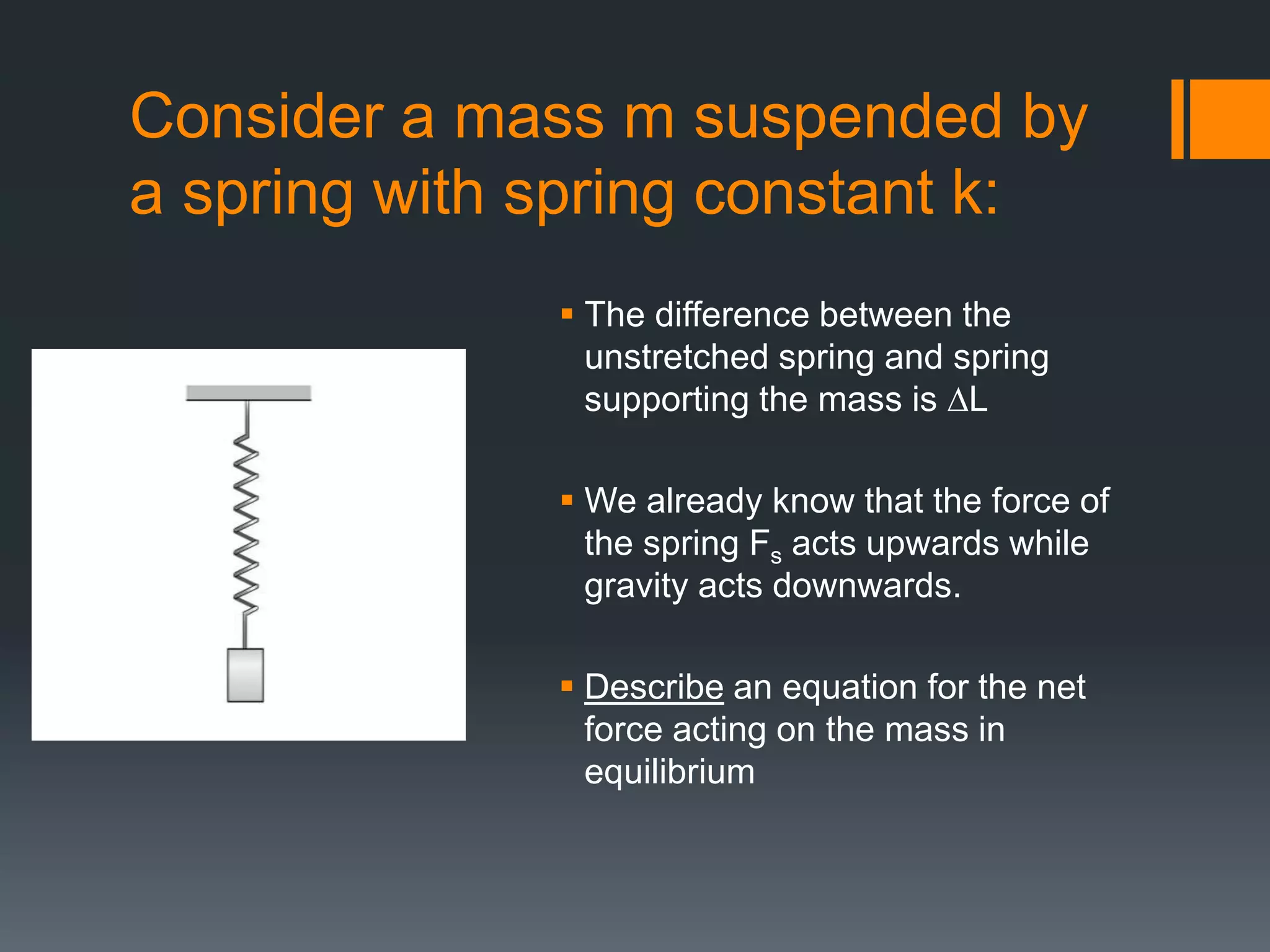
Consider a mass m suspended by
a spring with spring constant k:
 The difference between the
unstretched spring and spring
supporting the mass is ∆L
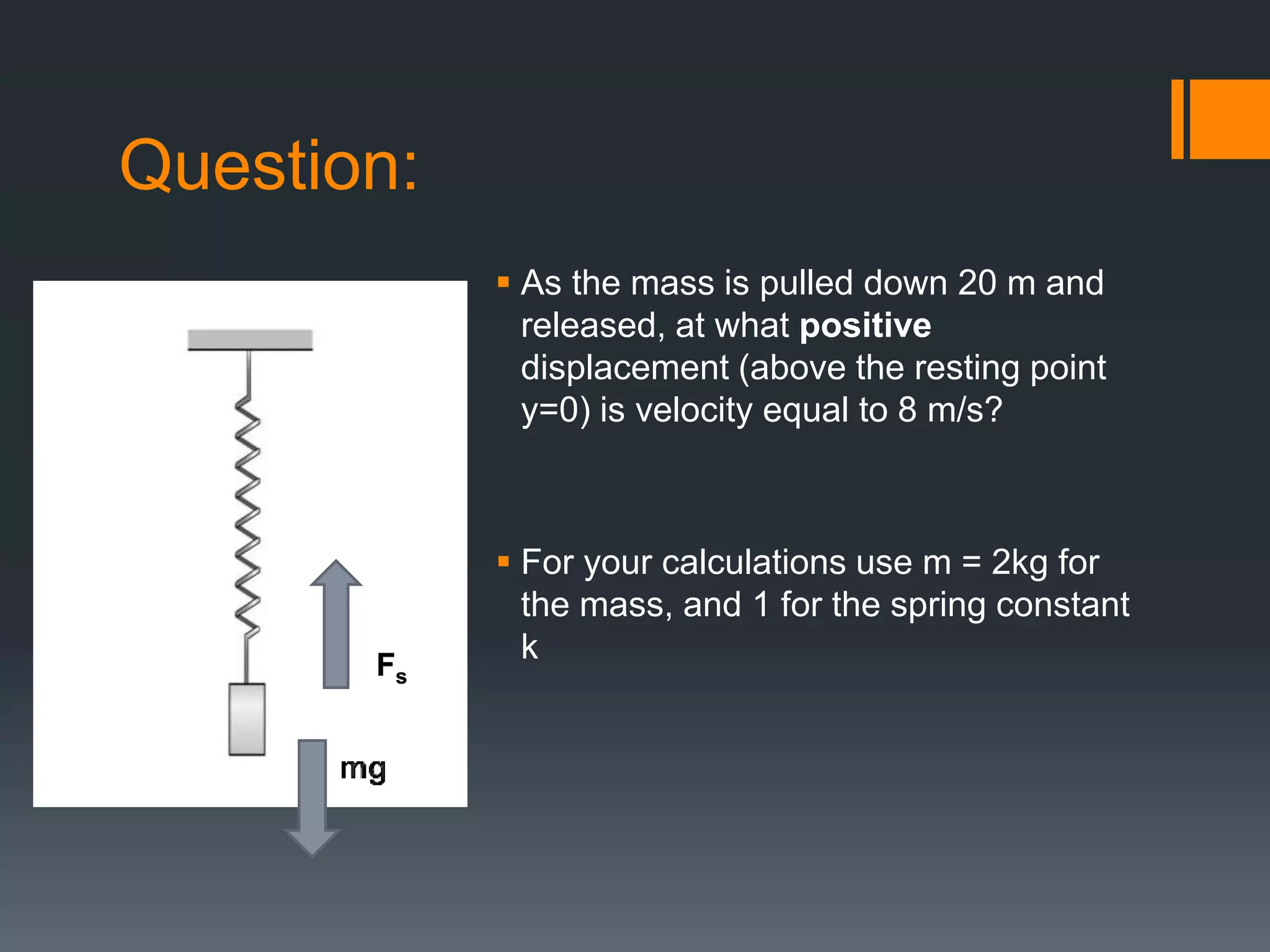
 We already know that the force of
the spring Fs acts upwards while
gravity acts downwards.
 Describe an equation for the net
force acting on the mass in
equilibrium
Question:
 As the mass is pulled down 20 m and
released, at what positive
displacement (above the resting point
y=0) is velocity equal to 8 m/s?
 For your calculations use m = 2kg for
the mass, and 1 for the spring constant
kFs
Follow Up Question:
 With the velocity and displacement
from the previous problem, calculate
the Kinetic and Potential energies at
these instances and thus the Total
energy of the system.
 Consider how the Potential and Kinetic
energies in this system compare to
those in other models of simple
harmonic motion, such as a horizontal
spring or a point travelling around a
circle.
Solutions
 The net force acting on a mass held by a vertical spring can be
expressed as the elastic force and the force of weight:
Fnet = k(∆L – y) – mg = k ∆L – ky – mg
Fnet = -ky
- Where ∆L – y denotes the change in the spring’s length after the mass
is added. The relation k∆L – mg = 0 can be used to simplify the
expression to Fnet = -ky.
Solutions (con’t)
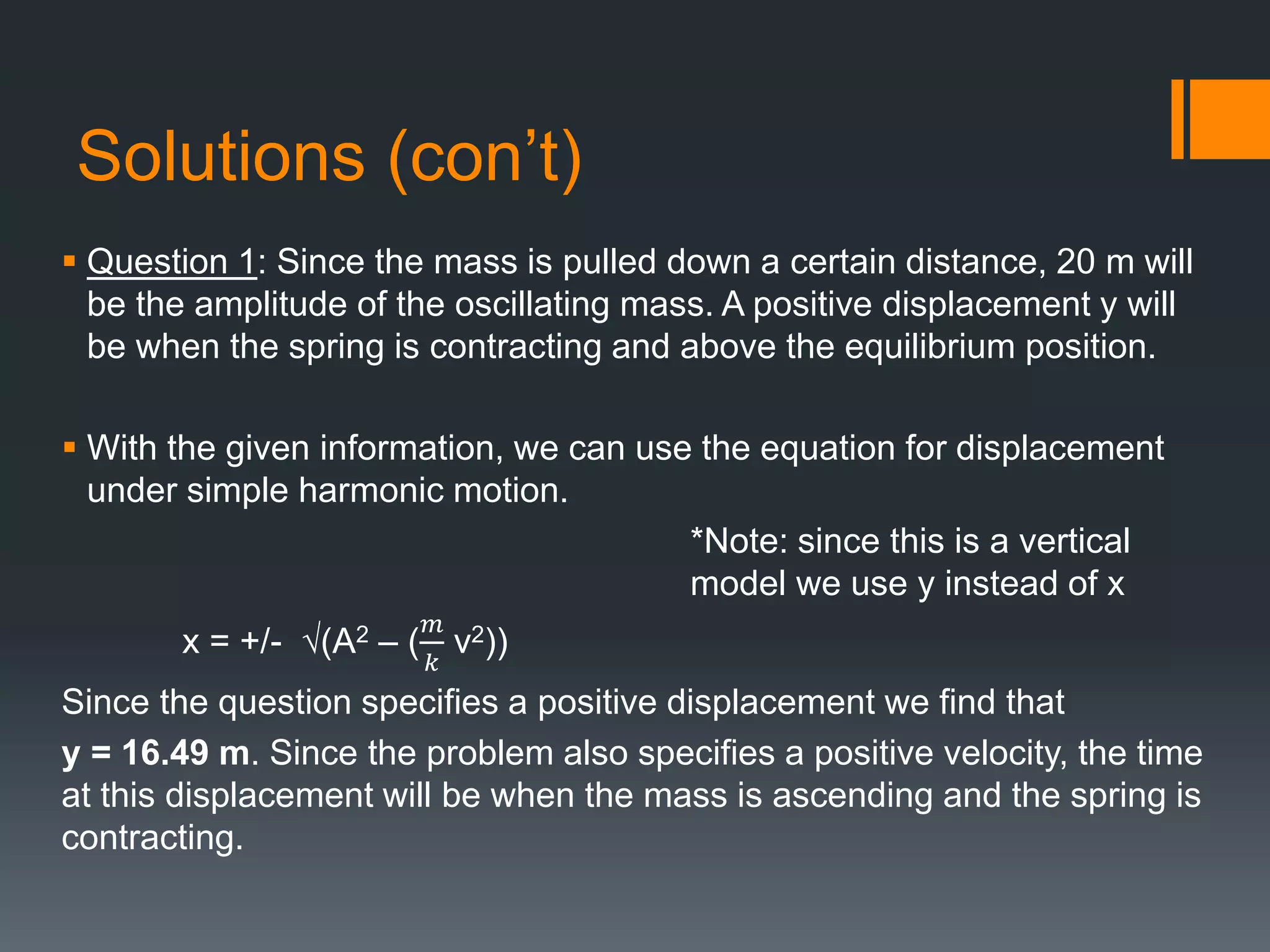
 Question 1: Since the mass is pulled down a certain distance, 20 m will
be the amplitude of the oscillating mass. A positive displacement y will
be when the spring is contracting and above the equilibrium position.
 With the given information, we can use the equation for displacement
under simple harmonic motion.
*Note: since this is a vertical
model we use y instead of x
x = +/- √(A2 – (
𝑚
𝑘
v2))
Since the question specifies a positive displacement we find that
y = 16.49 m. Since the problem also specifies a positive velocity, the time
at this displacement will be when the mass is ascending and the spring is
contracting.
Solutions (con’t)
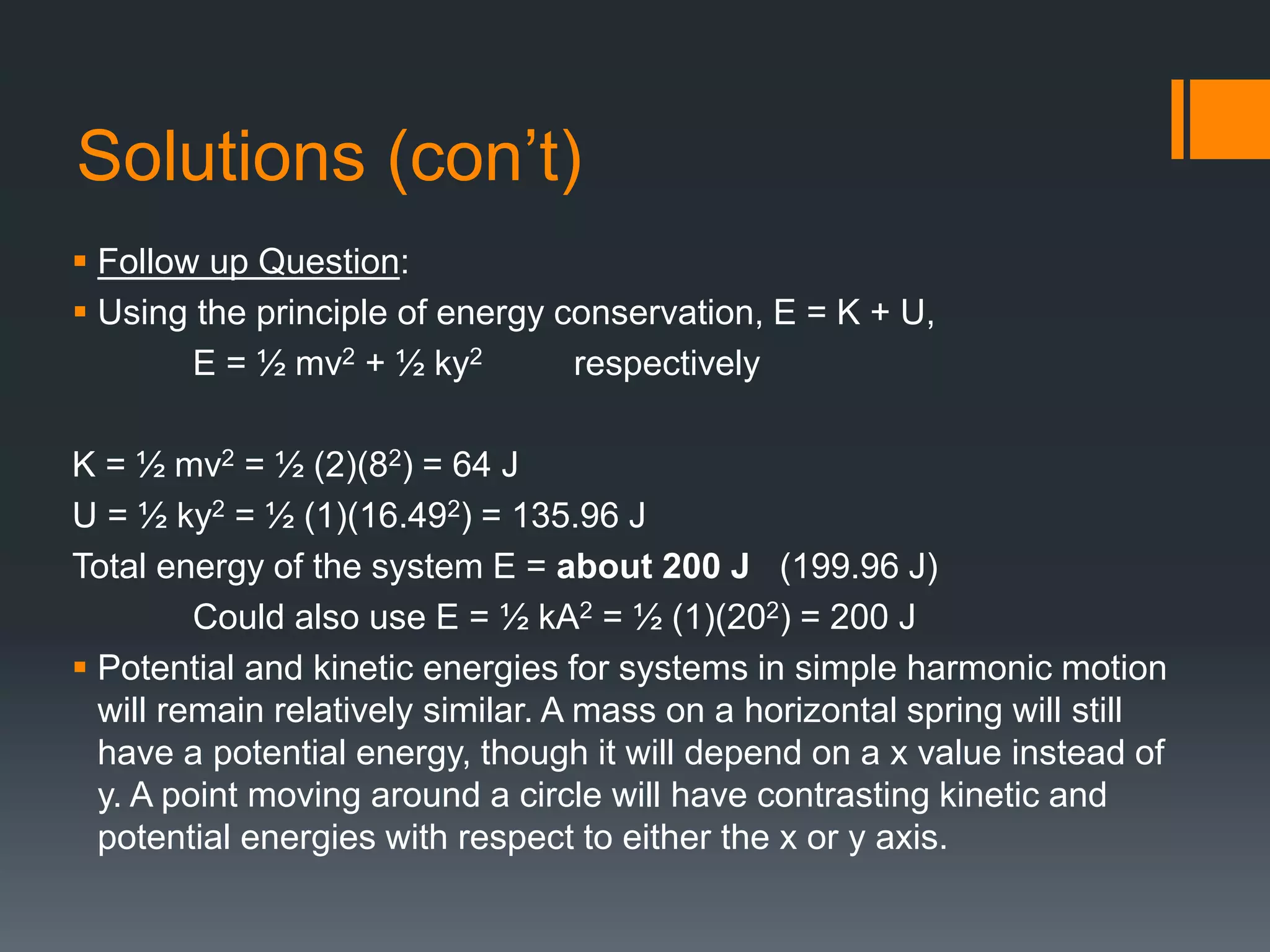
 Follow up Question:
 Using the principle of energy conservation, E = K + U,
E = ½ mv2 + ½ ky2 respectively
K = ½ mv2 = ½ (2)(82) = 64 J
U = ½ ky2 = ½ (1)(16.492) = 135.96 J
Total energy of the system E = about 200 J (199.96 J)
Could also use E = ½ kA2 = ½ (1)(202) = 200 J
 Potential and kinetic energies for systems in simple harmonic motion
will remain relatively similar. A mass on a horizontal spring will still
have a potential energy, though it will depend on a x value instead of
y. A point moving around a circle will have contrasting kinetic and
potential energies with respect to either the x or y axis.

Phys101 lo1 shm

  • 1.
    Conservation of Energyin Simple Harmonic Motion By: Devin Gamble
  • 2.
    Consider a massm suspended by a spring with spring constant k:  The difference between the unstretched spring and spring supporting the mass is ∆L  We already know that the force of the spring Fs acts upwards while gravity acts downwards.  Describe an equation for the net force acting on the mass in equilibrium
  • 3.
    Question:  As themass is pulled down 20 m and released, at what positive displacement (above the resting point y=0) is velocity equal to 8 m/s?  For your calculations use m = 2kg for the mass, and 1 for the spring constant kFs
  • 4.
    Follow Up Question: With the velocity and displacement from the previous problem, calculate the Kinetic and Potential energies at these instances and thus the Total energy of the system.  Consider how the Potential and Kinetic energies in this system compare to those in other models of simple harmonic motion, such as a horizontal spring or a point travelling around a circle.
  • 5.
    Solutions  The netforce acting on a mass held by a vertical spring can be expressed as the elastic force and the force of weight: Fnet = k(∆L – y) – mg = k ∆L – ky – mg Fnet = -ky - Where ∆L – y denotes the change in the spring’s length after the mass is added. The relation k∆L – mg = 0 can be used to simplify the expression to Fnet = -ky.
  • 6.
    Solutions (con’t)  Question1: Since the mass is pulled down a certain distance, 20 m will be the amplitude of the oscillating mass. A positive displacement y will be when the spring is contracting and above the equilibrium position.  With the given information, we can use the equation for displacement under simple harmonic motion. *Note: since this is a vertical model we use y instead of x x = +/- √(A2 – ( 𝑚 𝑘 v2)) Since the question specifies a positive displacement we find that y = 16.49 m. Since the problem also specifies a positive velocity, the time at this displacement will be when the mass is ascending and the spring is contracting.
  • 7.
    Solutions (con’t)  Followup Question:  Using the principle of energy conservation, E = K + U, E = ½ mv2 + ½ ky2 respectively K = ½ mv2 = ½ (2)(82) = 64 J U = ½ ky2 = ½ (1)(16.492) = 135.96 J Total energy of the system E = about 200 J (199.96 J) Could also use E = ½ kA2 = ½ (1)(202) = 200 J  Potential and kinetic energies for systems in simple harmonic motion will remain relatively similar. A mass on a horizontal spring will still have a potential energy, though it will depend on a x value instead of y. A point moving around a circle will have contrasting kinetic and potential energies with respect to either the x or y axis.