Tumor Lysis Syndrome
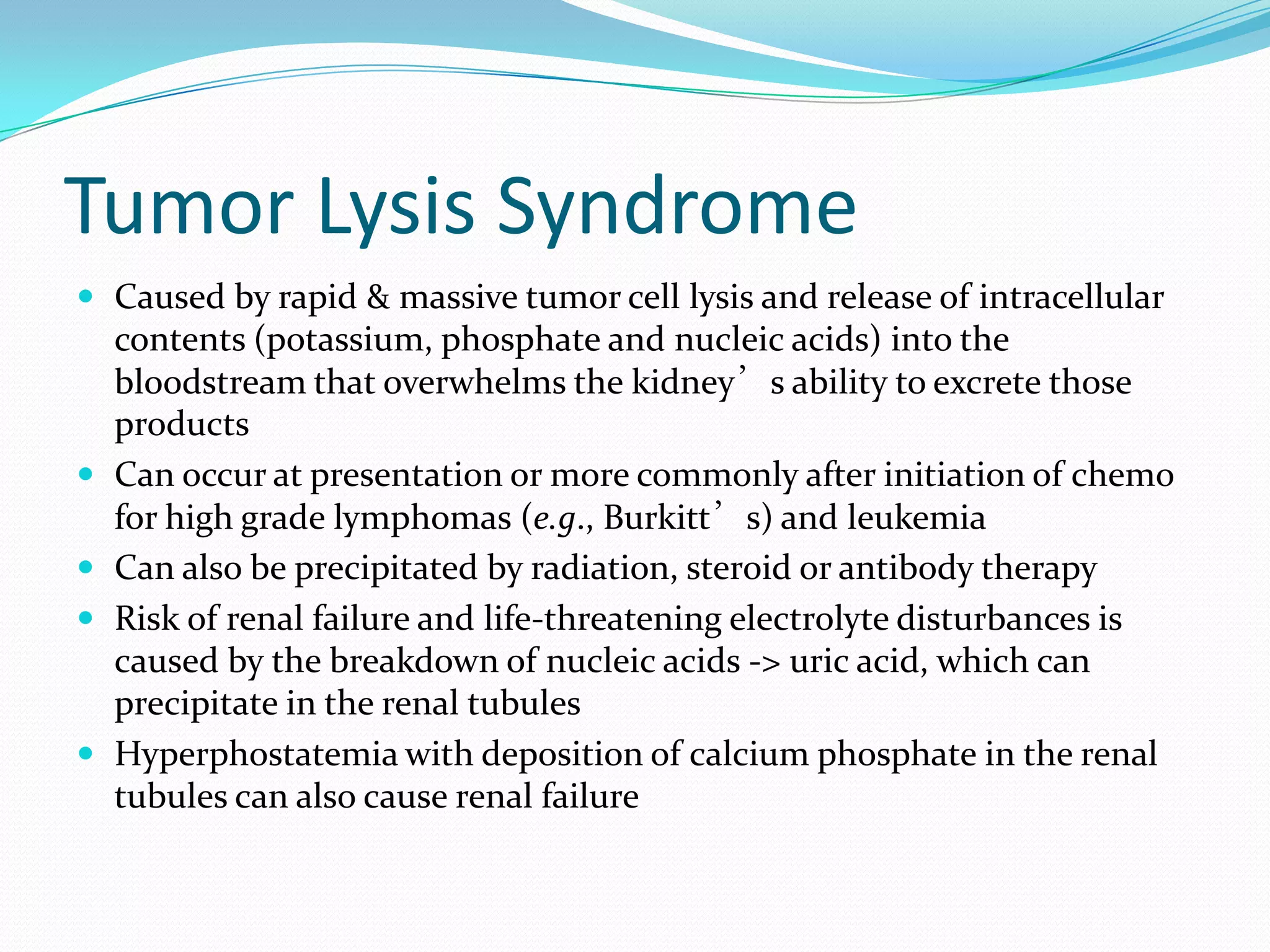
 Caused by rapid & massive tumor cell lysis and release of intracellular
contents (potassium, phosphate and nucleic acids) into the
bloodstream that overwhelms the kidney’s ability to excrete those
products
 Can occur at presentation or more commonly after initiation of chemo
for high grade lymphomas (e.g., Burkitt’s) and leukemia
 Can also be precipitated by radiation, steroid or antibody therapy
 Risk of renal failure and life-threatening electrolyte disturbances is
caused by the breakdown of nucleic acids -> uric acid, which can
precipitate in the renal tubules
 Hyperphostatemia with deposition of calcium phosphate in the renal
tubules can also cause renal failure
Common Tumors Associated with
TLS
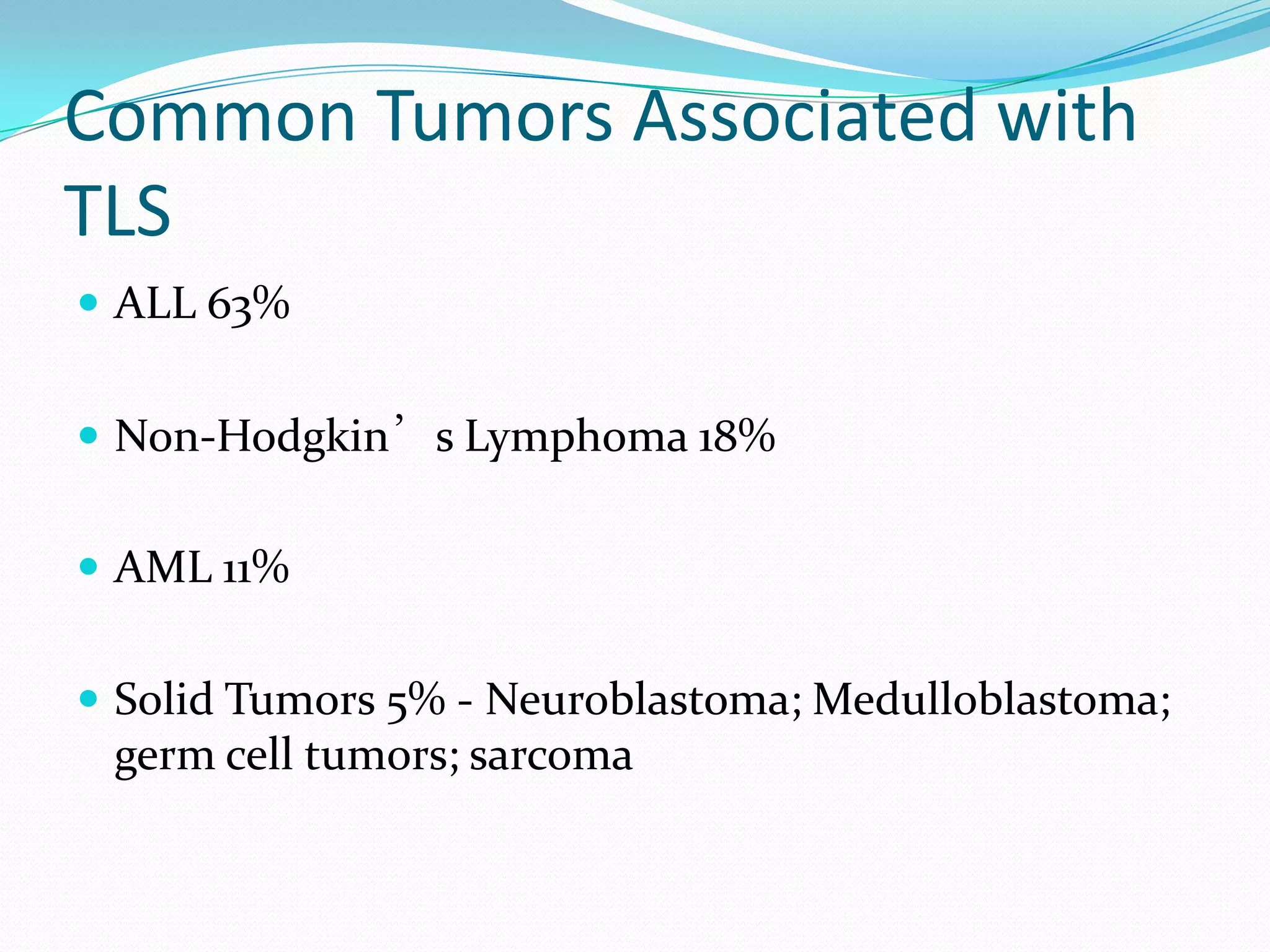
 ALL 63%
 Non-Hodgkin’s Lymphoma 18%
 AML 11%
 Solid Tumors 5% - Neuroblastoma; Medulloblastoma;
germ cell tumors; sarcoma
Risk Factors
 Patients with highly proliferative tumors and/or high
tumor burden (>10cm diameter; WBC>50,000)
 Pretreatment LDH > 2x upper limit of normal
 Pre-existing renal insufficiency
 Tumor with high sensitivity to treatment
Cairo Bishop Grading System
 Laboratory TLS requires 2 or more abnormal serum
values be present 3 days before or 7 days after
instituting chemotherapy in the setting of adequate
hydration and use of a hypouricemic agent
 Adopted by COG
Cairo Bishop Grading System
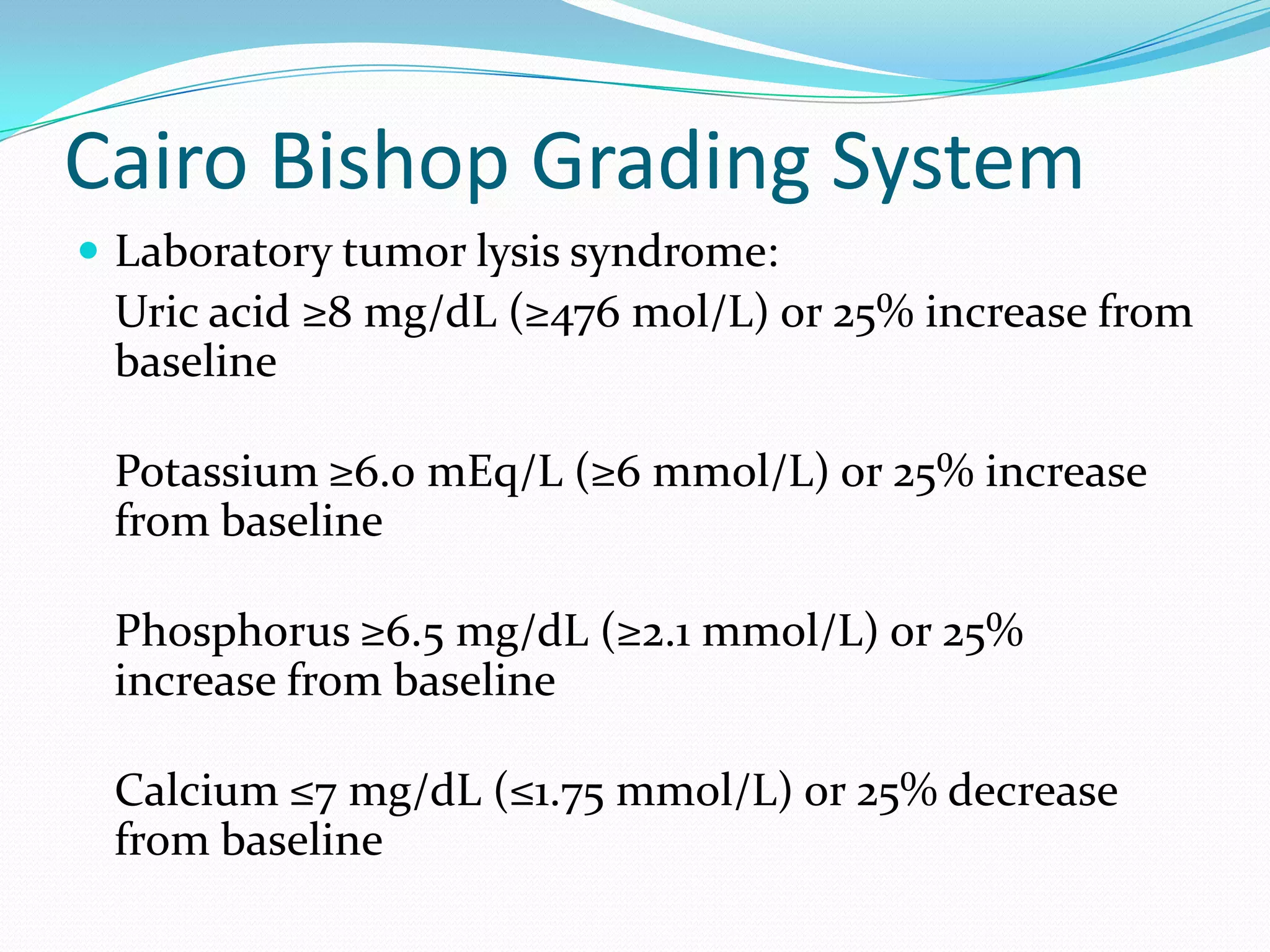
 Laboratory tumor lysis syndrome:
Uric acid ≥8 mg/dL (≥476 mol/L) or 25% increase from
baseline
Potassium ≥6.0 mEq/L (≥6 mmol/L) or 25% increase
from baseline
Phosphorus ≥6.5 mg/dL (≥2.1 mmol/L) or 25%
increase from baseline
Calcium ≤7 mg/dL (≤1.75 mmol/L) or 25% decrease
from baseline
Clinical TLS
 Clinical TLS constitutes laboratory TLS plus at least
one of the following:
 serum Creatinine > 1.5 x ULN
 cardiac arrythmia/sudden death
 seizure
Clinical TLS
Grade 0† Grade I Grade II Grade III Grade IV Grade V
LTLS No Yes Yes Yes Yes Yes
Creatinine‡ ≤1.5 × ULN 1.5 × ULN
>1.5–3.0 ×
ULN
>3.0–6.0 ×
ULN
>6 × ULN Death§
Cardiac
arrhythmia‡ None
Intervention
not needed
Nonurgent
intervention
needed
Symptomatic
and
incompletely
controlled
medically or
controlled with
a device
Life-
threatening
(eg, arrhythmia
associated
with CHF,
hypotension,
or shock)
Death§
Seizures‡ None None
One brief,
generalized
seizure,
seizures
controlled with
anticonvulsant
drugs, or
infrequent
motor seizures
Seizures with
impaired
consciousness
, poorly
controlled
seizures,
generalized
seizures
despite
medical
interventions
Status
epilepticus
Death§
Clinical Manifestations of TLS
 Nausea/Vomiting, diarrhea, anoxeria
 Hyperkalemia weakness, dysrhythmias
 Hyperphosphatemia hypocalcemia, renal failure
 Hypocalcemia muscle cramps, tetany, mental status
changes, seizures
 Hyperuricemia “uric acid nephropathy” =
oliguria, renal failure
Hyperuricemia
Hyperuricemia
Hyperphosphatemia
 Malignant cells contain higher concentration of
phosphorus
 Hyperphosphatemia causes hypocalcemia
(precipitation in renal tubules/heart is increased when
phos*ca product > 60 mg/dL)
 More common cause of renal failure since the use of
Allopurinol and UO
Prevention - Monitoring
 Follow laboratory parameters (UA, phosphate,
potassium, calcium, creatinine, LDH) closely, starting
4-6 hours after initiation of chemo & then every 6
hours therafter
 Monitor UOP/Intake; monitor for seizures/cardiac
arrthymias
 Monitor for 24-72 hours after intiation of chemo
Prevention - Hydration
 Hydration to produce high urine output
 Fluid intake = 2-3 L/m2/day (or 200 ml/kg/day for
patients <10kg) enhances uric acid excretion, phosphate
excretion
 Goal UOP of 80-100 ml/m2 per hour (or 4-6 ml/kg/hr if
patient < 10kg)
 Use isotonic fluid: D5 1/4 NS or NS if hyponatremic
 Do not add calcium or potassium
 Monitor for fluid overload in patients with underlying
cardiac dysfunction or renal insufficiency
Prevention - Urinary Alkalinization
 Urine alkalinization - add NaHCO3 to IVF
 Uric acid more soluble at urine pH = 7.0 vs 5.0
 Goal of urine specific gravity 1.015 and pH 7.0-7.5
 Caution -- hypoxanthine and Ca-PO4 stones possible if
urine pH >7.5
 Fallen out of favor as no demonstrated advantage; may
be appropriate for patients with underlying metabolic
acidosis
Prevention - Hypouricemic Agents
 Allopurinol – a hypoxanthine analog that inhibits XO
producing more hypoxanthine and xanthine which are
more soluble in acidic urine; takes 2-3 days to be
effective
 Urate Oxidase/Rasburicase – breaks down uric acid to
allantoin which is more soluble in urine; acts within
several hours
 UO has significantly reduced the need for rescue
dialysis therapy for TLS
Prevention - Allopurinol
 Decrease production of
uric acid
 allopurinol inhibits
xanthine oxidase
 300 mg/m2/day
divided tid PO/IV
 Dose reduction in
renal insufficiency
 Long-time standard
Rx
Xanthine Hypoxanthine
xanthine
oxidase
Uric acid
Allopurinol
Prevention - Urate Oxidase
 Present in other
mammalian species
 Catalyzes conversion of
uric acid to allantoin
 Allantoin more soluble,
easily excreted by
kidneys
 Urine alkalinization
unnecessary if used
 Recombinant urate oxidase
(rasburicase) more
effective than allopurinol
in prevention and
treatment of
hyperuricemia
 Goldman SC et al. A randomized
comparison between rasburicase and
allopurinol in children with lymphoma or
leukemia at high risk for tumor lysis.
Blood. 2001;97:2998-3003.
 Contraindicated with
G6PD deficiency, asthma
Treatment of Established TLS
 Hyperphosphatemia
Hyperkalemia
 Moderate and Asymptomatic (K>6.0): remove all K from IVF; ECG
monitoring. May give Sodium Polystyrene sulfonate (1 gram/kg) every
4-6 hours until normalized
 Severe and/or symptomatic (K>7.0; loss of p waves, widened QRS,
peaked T waves):
 Ca Gluconate (50-100 mg/kg) slow IVP
 IV Insulin (0.1 unit/kg) and D25 (0.5 gram/kg = 2 ml/kg) over 30
minutes. Monitor blood glucose level.
 If acidotic, may give NaHCO3 1-2 meq/kg over 5-10 minutes
 Albuterol inhaled
 Dialysis
Hypocalcemia
 No treatment needed if asymptomatic
 Administer Calcium Gluconate with ECG monitoring
(50-100 mg/kg) if symptomatic, however,
 If the patient is hyperphosphatemic, then correct
before giving Ca unless clinically unstable
Dialysis for Tumor Lysis Syndrome
 Indications
 oliguria
 hyperkalemia
 azotemia
 hyperphosphatemia
 refractory hyperuricemia
 Hemodialysis or continuous veno-venous
hemofiltration with dialysis most effective
Hyperleukocytosis
5%-20% of children with
new Dx of leukemia have
WBC count >100,000/mm3
These patients at risk of
severe complications
from hyperviscosity of
blood
Hyperleukocytosis - Complications
 Blasts interact with endothelium to form aggregates,
thrombi in microcirculation
 Most problems in CNS and pulmonary circulation
 Complications more common with AML than ALL
 myeloblasts and monoblasts larger, less deformable,
“stickier”
Pulmonary Leukostasis
Pulmonary arteriole
with leukostatic
thrombus in patient
with AML and
hyperleukocytosis
Pulmonary Leukostasis
 Sx: dyspnea, tachypnea,
hypoxemia, acidosis, cor
pulmonale
 CXR: diffuse interstitial
infiltrates
CNS Leukostasis
 Headache, mental status
changes, seizures, coma in
spectrum of symptoms
 High risk of intracranial
hemorrhage, especially
with AML and
thrombocytopenia
Therapy for Hyperleukocytosis
 Decrease blood viscosity (directly related to
morbidity)
 Hydration
 AVOID use of diuretics
 AVOID PRBC transfusion (Hb goal <10gm/dL for
viscosity)
 Transfuse platelets to keep >20,000/mm3 and treat
coagulopathy (common with AML) to decrease risk of
intracranial hemorrhage
Therapy for Hyperleukocytosis
 Initiation of chemotherapy
 Urine alkalinization?, hydration, etc., as with tumor
lysis syndrome
 Consider leukapheresis or exchange transfusion
 Supportive care - mechanical ventilation,
hemodynamic support, etc.

TUMOR LYSIS SYNDROME

  • 2.
    Tumor Lysis Syndrome Caused by rapid & massive tumor cell lysis and release of intracellular contents (potassium, phosphate and nucleic acids) into the bloodstream that overwhelms the kidney’s ability to excrete those products  Can occur at presentation or more commonly after initiation of chemo for high grade lymphomas (e.g., Burkitt’s) and leukemia  Can also be precipitated by radiation, steroid or antibody therapy  Risk of renal failure and life-threatening electrolyte disturbances is caused by the breakdown of nucleic acids -> uric acid, which can precipitate in the renal tubules  Hyperphostatemia with deposition of calcium phosphate in the renal tubules can also cause renal failure
  • 4.
    Common Tumors Associatedwith TLS  ALL 63%  Non-Hodgkin’s Lymphoma 18%  AML 11%  Solid Tumors 5% - Neuroblastoma; Medulloblastoma; germ cell tumors; sarcoma
  • 5.
    Risk Factors  Patientswith highly proliferative tumors and/or high tumor burden (>10cm diameter; WBC>50,000)  Pretreatment LDH > 2x upper limit of normal  Pre-existing renal insufficiency  Tumor with high sensitivity to treatment
  • 6.
    Cairo Bishop GradingSystem  Laboratory TLS requires 2 or more abnormal serum values be present 3 days before or 7 days after instituting chemotherapy in the setting of adequate hydration and use of a hypouricemic agent  Adopted by COG
  • 7.
    Cairo Bishop GradingSystem  Laboratory tumor lysis syndrome: Uric acid ≥8 mg/dL (≥476 mol/L) or 25% increase from baseline Potassium ≥6.0 mEq/L (≥6 mmol/L) or 25% increase from baseline Phosphorus ≥6.5 mg/dL (≥2.1 mmol/L) or 25% increase from baseline Calcium ≤7 mg/dL (≤1.75 mmol/L) or 25% decrease from baseline
  • 8.
    Clinical TLS  ClinicalTLS constitutes laboratory TLS plus at least one of the following:  serum Creatinine > 1.5 x ULN  cardiac arrythmia/sudden death  seizure
  • 9.
    Clinical TLS Grade 0†Grade I Grade II Grade III Grade IV Grade V LTLS No Yes Yes Yes Yes Yes Creatinine‡ ≤1.5 × ULN 1.5 × ULN >1.5–3.0 × ULN >3.0–6.0 × ULN >6 × ULN Death§ Cardiac arrhythmia‡ None Intervention not needed Nonurgent intervention needed Symptomatic and incompletely controlled medically or controlled with a device Life- threatening (eg, arrhythmia associated with CHF, hypotension, or shock) Death§ Seizures‡ None None One brief, generalized seizure, seizures controlled with anticonvulsant drugs, or infrequent motor seizures Seizures with impaired consciousness , poorly controlled seizures, generalized seizures despite medical interventions Status epilepticus Death§
  • 10.
    Clinical Manifestations ofTLS  Nausea/Vomiting, diarrhea, anoxeria  Hyperkalemia weakness, dysrhythmias  Hyperphosphatemia hypocalcemia, renal failure  Hypocalcemia muscle cramps, tetany, mental status changes, seizures  Hyperuricemia “uric acid nephropathy” = oliguria, renal failure
  • 11.
  • 12.
  • 13.
    Hyperphosphatemia  Malignant cellscontain higher concentration of phosphorus  Hyperphosphatemia causes hypocalcemia (precipitation in renal tubules/heart is increased when phos*ca product > 60 mg/dL)  More common cause of renal failure since the use of Allopurinol and UO
  • 15.
    Prevention - Monitoring Follow laboratory parameters (UA, phosphate, potassium, calcium, creatinine, LDH) closely, starting 4-6 hours after initiation of chemo & then every 6 hours therafter  Monitor UOP/Intake; monitor for seizures/cardiac arrthymias  Monitor for 24-72 hours after intiation of chemo
  • 16.
    Prevention - Hydration Hydration to produce high urine output  Fluid intake = 2-3 L/m2/day (or 200 ml/kg/day for patients <10kg) enhances uric acid excretion, phosphate excretion  Goal UOP of 80-100 ml/m2 per hour (or 4-6 ml/kg/hr if patient < 10kg)  Use isotonic fluid: D5 1/4 NS or NS if hyponatremic  Do not add calcium or potassium  Monitor for fluid overload in patients with underlying cardiac dysfunction or renal insufficiency
  • 17.
    Prevention - UrinaryAlkalinization  Urine alkalinization - add NaHCO3 to IVF  Uric acid more soluble at urine pH = 7.0 vs 5.0  Goal of urine specific gravity 1.015 and pH 7.0-7.5  Caution -- hypoxanthine and Ca-PO4 stones possible if urine pH >7.5  Fallen out of favor as no demonstrated advantage; may be appropriate for patients with underlying metabolic acidosis
  • 18.
    Prevention - HypouricemicAgents  Allopurinol – a hypoxanthine analog that inhibits XO producing more hypoxanthine and xanthine which are more soluble in acidic urine; takes 2-3 days to be effective  Urate Oxidase/Rasburicase – breaks down uric acid to allantoin which is more soluble in urine; acts within several hours  UO has significantly reduced the need for rescue dialysis therapy for TLS
  • 19.
    Prevention - Allopurinol Decrease production of uric acid  allopurinol inhibits xanthine oxidase  300 mg/m2/day divided tid PO/IV  Dose reduction in renal insufficiency  Long-time standard Rx Xanthine Hypoxanthine xanthine oxidase Uric acid Allopurinol
  • 20.
    Prevention - UrateOxidase  Present in other mammalian species  Catalyzes conversion of uric acid to allantoin  Allantoin more soluble, easily excreted by kidneys  Urine alkalinization unnecessary if used  Recombinant urate oxidase (rasburicase) more effective than allopurinol in prevention and treatment of hyperuricemia  Goldman SC et al. A randomized comparison between rasburicase and allopurinol in children with lymphoma or leukemia at high risk for tumor lysis. Blood. 2001;97:2998-3003.  Contraindicated with G6PD deficiency, asthma
  • 21.
    Treatment of EstablishedTLS  Hyperphosphatemia
  • 22.
    Hyperkalemia  Moderate andAsymptomatic (K>6.0): remove all K from IVF; ECG monitoring. May give Sodium Polystyrene sulfonate (1 gram/kg) every 4-6 hours until normalized  Severe and/or symptomatic (K>7.0; loss of p waves, widened QRS, peaked T waves):  Ca Gluconate (50-100 mg/kg) slow IVP  IV Insulin (0.1 unit/kg) and D25 (0.5 gram/kg = 2 ml/kg) over 30 minutes. Monitor blood glucose level.  If acidotic, may give NaHCO3 1-2 meq/kg over 5-10 minutes  Albuterol inhaled  Dialysis
  • 23.
    Hypocalcemia  No treatmentneeded if asymptomatic  Administer Calcium Gluconate with ECG monitoring (50-100 mg/kg) if symptomatic, however,  If the patient is hyperphosphatemic, then correct before giving Ca unless clinically unstable
  • 24.
    Dialysis for TumorLysis Syndrome  Indications  oliguria  hyperkalemia  azotemia  hyperphosphatemia  refractory hyperuricemia  Hemodialysis or continuous veno-venous hemofiltration with dialysis most effective
  • 25.
    Hyperleukocytosis 5%-20% of childrenwith new Dx of leukemia have WBC count >100,000/mm3 These patients at risk of severe complications from hyperviscosity of blood
  • 26.
    Hyperleukocytosis - Complications Blasts interact with endothelium to form aggregates, thrombi in microcirculation  Most problems in CNS and pulmonary circulation  Complications more common with AML than ALL  myeloblasts and monoblasts larger, less deformable, “stickier”
  • 27.
    Pulmonary Leukostasis Pulmonary arteriole withleukostatic thrombus in patient with AML and hyperleukocytosis
  • 28.
    Pulmonary Leukostasis  Sx:dyspnea, tachypnea, hypoxemia, acidosis, cor pulmonale  CXR: diffuse interstitial infiltrates
  • 29.
    CNS Leukostasis  Headache,mental status changes, seizures, coma in spectrum of symptoms  High risk of intracranial hemorrhage, especially with AML and thrombocytopenia
  • 30.
    Therapy for Hyperleukocytosis Decrease blood viscosity (directly related to morbidity)  Hydration  AVOID use of diuretics  AVOID PRBC transfusion (Hb goal <10gm/dL for viscosity)  Transfuse platelets to keep >20,000/mm3 and treat coagulopathy (common with AML) to decrease risk of intracranial hemorrhage
  • 31.
    Therapy for Hyperleukocytosis Initiation of chemotherapy  Urine alkalinization?, hydration, etc., as with tumor lysis syndrome  Consider leukapheresis or exchange transfusion  Supportive care - mechanical ventilation, hemodynamic support, etc.

Editor's Notes

  • #4 Caused by rapid &amp; massive tumor cell lysis and release of intracellular contents (potassium, phosphate and nucleic acids) into the bloodstream that overwhelms the kidney’s ability to excrete those productsCan occur at presentation or more commonly after initiation of chemo for high grade lymphomas (e.g., Burkitt’s) and leukemiaCan also be precipitated by radiation, steroid or antibody therapyRisk of renal failure and life-threatening electrolyte disturbances is caused by the breakdown of nucleic acids -&gt; uric acid, which can precipitate in the renal tubulesHyperphostatemia with deposition of calcium phosphate in the renal tubules can also cause renal failure