Oncologic Emergencies
Juanita Madison, RN, MN, AOCN
CHI Franciscan Health
Oncologic Emergencies
Life-threatening medical emergencies causedby:
Malignancy
Treatment of malignancy
When do they occur?
Initial manifestations of malignancy
or
Late in disease process
Oncologic Emergencies
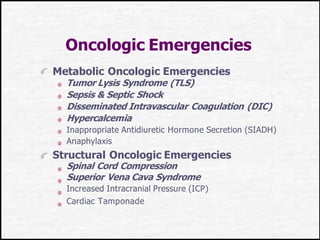
Metabolic Oncologic Emergencies
Tumor Lysis Syndrome (TLS)
Sepsis & Septic Shock
Disseminated Intravascular Coagulation (DIC)
Hypercalcemia
Inappropriate Antidiuretic Hormone Secretion (SIADH)
Anaphylaxis
Structural Oncologic Emergencies
Spinal Cord Compression
Superior Vena Cava Syndrome
Increased Intracranial Pressure (ICP)
Cardiac Tamponade
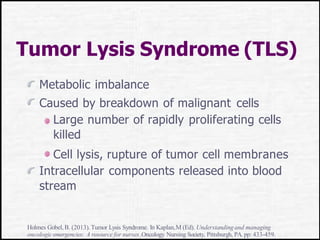
Tumor Lysis Syndrome (TLS)
Metabolic imbalance
Caused by breakdown of malignant cells
Large number of rapidly proliferating cells
killed
Cell lysis, rupture of tumor cell membranes
Intracellular components released into blood
stream
Holmes Gobel,B. (2013). Tumor Lysis Syndrome. In Kaplan,M (Ed). Understandingand managing
oncologicemergencies: A resource for nurses.Oncology Nursing Society, Pittsburgh, PA.pp: 433-459.
TLS: Pathophysiology
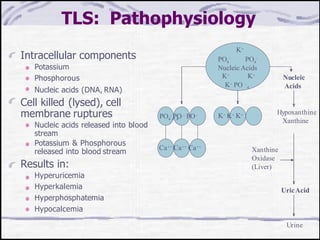
Intracellular components
Potassium
Phosphorous
Nucleic acids (DNA, RNA)
Cell killed (lysed), cell
membrane ruptures
Nucleic acids released into blood
stream
Potassium & Phosphorous
released into blood stream
Results in:
Hyperuricemia
Hyperkalemia
Hyperphosphatemia
Hypocalcemia
K+
4 4
PO - PO -
Nucleic Acids
K+ K+
4
K+ PO -
Nucleic
Acids
Hypoxanthine
Xanthine
UricAcid
Urine
K+ K+ K+
4 4 4
PO - PO - PO -
Ca++ Ca++ Ca++
Xanthine
Oxidase
(Liver)
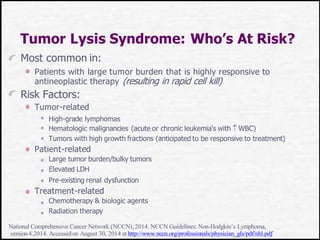
Tumor Lysis Syndrome: Who’s At Risk?
Most common in:
Patients with large tumor burden that is highly responsive to
antineoplastic therapy (resulting in rapid cell kill)
Risk Factors:
Tumor-related
High-grade lymphomas
Hematologic malignancies (acute or chronic leukemia's with  WBC)
Tumors with high growth fractions (anticipated to be responsive to treatment)
Patient-related
Large tumor burden/bulky tumors
Elevated LDH
Pre-existing renal dysfunction
Treatment-related
Chemotherapy & biologic agents
Radiation therapy
National Comprehensive Cancer Network (NCCN),2014. NCCN Guidelines:Non-Hodgkin’s Lymphoma,
version4.2014. Accessedon August 30, 2014 at http://www.nccn.org/professionals/physician_gls/pdf/nhl.pdf
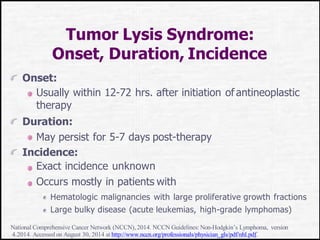
Tumor Lysis Syndrome:
Onset, Duration, Incidence
Onset:
Usually within 12-72 hrs. after initiation of antineoplastic
therapy
Duration:
May persist for 5-7 days post-therapy
Incidence:
Exact incidence unknown
Occurs mostly in patients with
Hematologic malignancies with large proliferative growth fractions
Large bulky disease (acute leukemias, high-grade lymphomas)
National Comprehensive Cancer Network (NCCN),2014. NCCN Guidelines:Non-Hodgkin’s Lymphoma, version
4.2014. Accessed on August 30, 2014 at http://www.nccn.org/professionals/physician_gls/pdf/nhl.pdf.
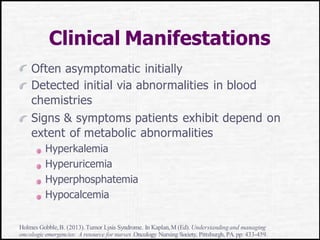
Clinical Manifestations
Often asymptomatic initially
Detected initial via abnormalities in blood
chemistries
Signs & symptoms patients exhibit depend on
extent of metabolic abnormalities
Hyperkalemia
Hyperuricemia
Hyperphosphatemia
Hypocalcemia
Holmes Gobble,B. (2013).Tumor Lysis Syndrome. In Kaplan,M (Ed). Understandingand managing
oncologicemergencies: A resource for nurses.Oncology Nursing Society, Pittsburgh, PA.pp: 433-459.
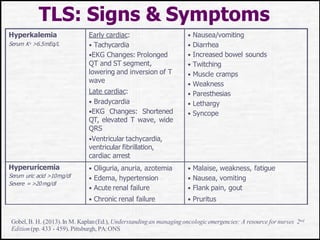
TLS: Signs & Symptoms
Hyperkalemia
Serum K+ >6.5mEq/L
Early cardiac:
• Tachycardia
• Nausea/vomiting
• Diarrhea
• Increased bowel sounds
• Twitching
• Muscle cramps
• Weakness
• Paresthesias
• Lethargy
• Syncope
•EKG Changes: Prolonged
QT and ST segment,
lowering and inversion of T
wave
Late cardiac:
• Bradycardia
•EKG Changes: Shortened
QT, elevated T wave, wide
QRS
•Ventricular tachycardia,
ventricular fibrillation,
cardiac arrest
Hyperuricemia
Serum uric acid >10mg/dl
Severe = >20mg/dl
• Oliguria, anuria, azotemia
• Edema, hypertension
• Acute renal failure
• Malaise, weakness, fatigue
• Nausea, vomiting
• Flank pain, gout
• Chronic renal failure • Pruritus
Gobel,B. H. (2013).In M. Kaplan(Ed.), Understandingan managing oncologicemergencies: A resource for nurses 2nd
Edition(pp. 433 - 459).Pittsburgh, PA:ONS
TLS: Signs & Symptoms
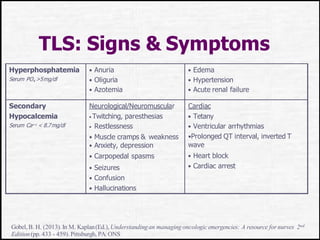
Hyperphosphatemia
Serum PO4 >5mg/dl
• Anuria
• Oliguria
• Azotemia
• Edema
• Hypertension
• Acute renal failure
Secondary Neurological/Neuromuscular Cardiac
Hypocalcemia
Serum Ca++ < 8.7mg/dl
• Twitching, paresthesias
• Restlessness
• Tetany
• Ventricular arrhythmias
• Muscle cramps & weakness
• Anxiety, depression
•Prolonged QT interval, inverted T
wave
• Carpopedal spasms • Heart block
• Seizures • Cardiac arrest
• Confusion
• Hallucinations
Gobel, B. H. (2013).In M. Kaplan(Ed.), Understandingan managing oncologicemergencies: A resource for nurses 2nd
Edition(pp. 433 - 459).Pittsburgh, PA:ONS
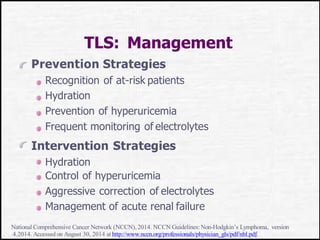
TLS: Management
Prevention Strategies
Recognition of at-risk patients
Hydration
Prevention of hyperuricemia
Frequent monitoring of electrolytes
Intervention Strategies
Hydration
Control of hyperuricemia
Aggressive correction of electrolytes
Management of acute renal failure
National Comprehensive Cancer Network (NCCN),2014. NCCN Guidelines:Non-Hodgkin’s Lymphoma, version
4.2014. Accessed on August 30, 2014 at http://www.nccn.org/professionals/physician_gls/pdf/nhl.pdf.
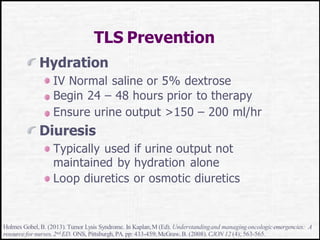
TLS Prevention
Hydration
IV Normal saline or 5% dextrose
Begin 24 – 48 hours prior to therapy
Ensure urine output >150 – 200 ml/hr
Diuresis
Typically used if urine output not
maintained by hydration alone
Loop diuretics or osmotic diuretics
Holmes Gobel, B. (2013).Tumor Lysis Syndrome. In Kaplan,M (Ed). Understandingand managing oncologicemergencies: A
resource for nurses, 2nd ED. ONS, Pittsburgh, PA. pp: 433-459;McGraw,B. (2008).CJON 12 (4); 563-565.
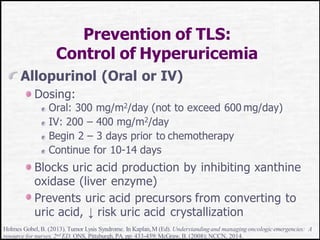
Prevention of TLS:
Control of Hyperuricemia
Allopurinol (Oral or IV)
Dosing:
Oral: 300 mg/m2/day (not to exceed 600 mg/day)
IV: 200 – 400 mg/m2/day
Begin 2 – 3 days prior to chemotherapy
Continue for 10-14 days
Blocks uric acid production by inhibiting xanthine
oxidase (liver enzyme)
Prevents uric acid precursors from converting to
uric acid, ↓ risk uric acid crystallization
Holmes Gobel,B. (2013). Tumor Lysis Syndrome. In Kaplan,M (Ed). Understandingand managing oncologicemergencies: A
resource for nurses,2nd ED. ONS, Pittsburgh,PA. pp: 433-459;McGraw,B. (2008);NCCN, 2014.
Control of Hyperuricemia
Rasburicase (Elitek®) IV
Recombinant urate-oxidase
Catalyzes the oxidation of uric acid into allantoin
(which has a much greater solubility than uric
acid)
Recommendations for preventative therapy
(NCCN, 2014):
Patients with any high-risk features
Urgent need to initiate therapy in high-bulk patient
Situations where adequate hydration may be difficult
Acute renal failure
Sanofi-AventisUS, 2011.ElitekPackage Insert. Bridgewater,NJ.;NCCN, 2014. NCCN Guidelines: Non-Hodgkin’s
Lymphoma,v4.2014. Accessed on August 30, 2014 at http://www.nccn.org/professionals/physician_gls/pdf/nhl.pd
f.
Rasburicase (Elitek®)
FDA approved dosing
0.2 mg/kg IV as a 30 minute infusion daily for up
to 5 days
NCCN dosing recommendations
One dose frequently adequate
Doses of 3 – 6 mg IV usually effective
Uric acid levels decrease within 4 hours of
injection
Sanofi-AventisUS, 2011.ElitekPackage Insert. Bridgewater,NJ.;NCCN, 2014. NCCN Guidelines: Non-Hodgkin’s
Lymphoma,v4.2014. Accessed on August 30, 2014 at http://www.nccn.org/professionals/physician_gls/pdf/nhl.pdf.
Prevention TLS
Urinary Alkalinization
Sodium bicarbonate added to IV fluid
(50-100 meq/liter)
Goal: urine pH level > 7.0
Use is controversial
Potential complications associated with
alkalinization
Metabolic alkalosis
Calcium phosphate precipitation
Holmes Gobel, B. (2013).Tumor Lysis Syndrome. In Kaplan,M (Ed). Understandingand managing oncologicemergencies: A
resource for nurses, 2nd ED. ONS, Pittsburgh, PA. pp: 433-459;McGraw,B. (2008).CJON 12 (4); 563-565.
TLS Preventative Measures
Monitor serial lab values
Serum potassium, phosphorous, calcium, uric acid
Renal function studies – BUN & creatinine
Frequency of monitoring
Prior to initiation of therapy
Every 8 – 12 hours during the first 48 – 72 hours
of treatment
Holmes Gobel, B. (2013).Tumor Lysis Syndrome. In Kaplan,M (Ed). Understandingand managing oncologicemergencies: A
resource for nurses, 2nd ED. ONS, Pittsburgh, PA. pp: 433-459;McGraw,B. (2008).CJON 12 (4); 563-565.
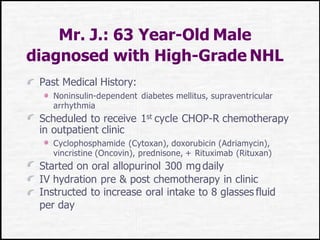
Mr. J.: 63 Year-Old Male
diagnosed with High-Grade NHL
Past Medical History:
Noninsulin-dependent diabetes mellitus, supraventricular
arrhythmia
Scheduled to receive 1st cycle CHOP-R chemotherapy
in outpatient clinic
Cyclophosphamide (Cytoxan), doxorubicin (Adriamycin),
vincristine (Oncovin), prednisone, + Rituximab (Rituxan)
Started on oral allopurinol 300 mgdaily
IV hydration pre & post chemotherapy in clinic
Instructed to increase oral intake to 8 glasses fluid
per day
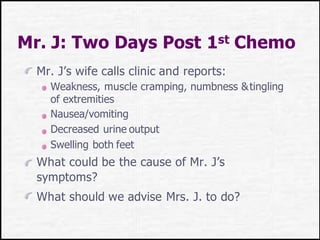
Mr. J: Two Days Post 1st Chemo
Mr. J’s wife calls clinic and reports:
Weakness, muscle cramping, numbness &tingling
of extremities
Nausea/vomiting
Decreased urine output
Swelling both feet
What could be the cause of Mr. J’s
symptoms?
What should we advise Mrs. J. to do?
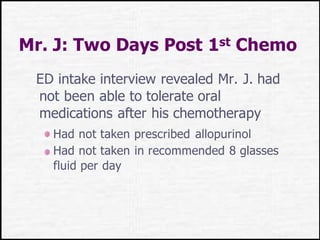
Mr. J: Two Days Post 1st Chemo
ED intake interview revealed Mr. J. had
not been able to tolerate oral
medications after his chemotherapy
Had not taken prescribed allopurinol
Had not taken in recommended 8 glasses
fluid per day
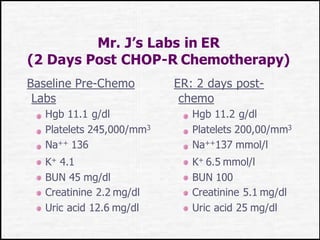
Mr. J’s Labs in ER
(2 Days Post CHOP-R Chemotherapy)
Baseline Pre-Chemo
Labs
Hgb 11.1 g/dl
Platelets 245,000/mm3
Na++ 136
K+ 4.1
BUN 45 mg/dl
Creatinine 2.2 mg/dl
Uric acid 12.6 mg/dl
ER: 2 days post-
chemo
Hgb 11.2 g/dl
Platelets 200,00/mm3
Na++137 mmol/l
K+ 6.5 mmol/l
BUN 100
Creatinine 5.1 mg/dl
Uric acid 25 mg/dl
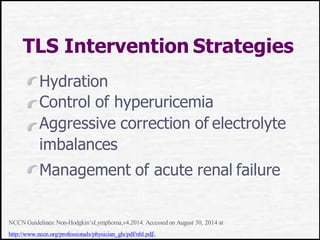
TLS Intervention Strategies
Hydration
Control of hyperuricemia
Aggressive correction of electrolyte
imbalances
Management of acute renal failure
NCCN Guidelines: Non-Hodgkin’sLymphoma,v4.2014. Accessed on August 30, 2014 at
http://www.nccn.org/professionals/physician_gls/pdf/nhl.pdf.
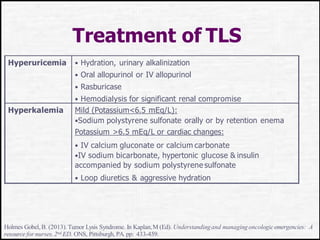
Treatment of TLS
Hyperuricemia • Hydration, urinary alkalinization
• Oral allopurinol or IV allopurinol
• Rasburicase
• Hemodialysis for significant renal compromise
Hyperkalemia Mild (Potassium<6.5 mEq/L):
•Sodium polystyrene sulfonate orally or by retention enema
Potassium >6.5 mEq/L or cardiac changes:
• IV calcium gluconate or calcium carbonate
•IV sodium bicarbonate, hypertonic glucose & insulin
accompanied by sodium polystyrene sulfonate
• Loop diuretics & aggressive hydration
Holmes Gobel, B. (2013).Tumor Lysis Syndrome. In Kaplan,M (Ed). Understandingand managing oncologicemergencies: A
resource for nurses, 2nd ED. ONS, Pittsburgh, PA. pp: 433-459.
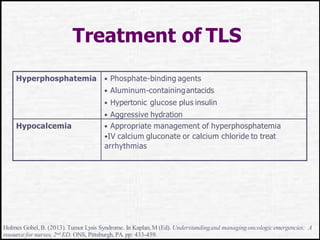
Treatment of TLS
Hyperphosphatemia • Phosphate-binding agents
• Aluminum-containingantacids
• Hypertonic glucose plus insulin
• Aggressive hydration
Hypocalcemia • Appropriate management of hyperphosphatemia
•IV calcium gluconate or calcium chloride to treat
arrhythmias
Holmes Gobel, B. (2013).Tumor Lysis Syndrome. In Kaplan,M (Ed). Understandingand managing oncologicemergencies: A
resource for nurses, 2nd ED. ONS, Pittsburgh, PA. pp: 433-459.
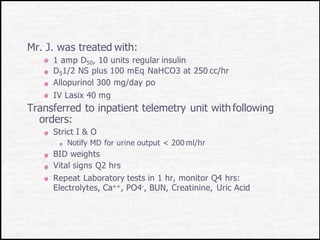
Mr. J. was treated with:
1 amp D50, 10 units regular insulin
D51/2 NS plus 100 mEq NaHCO3 at 250 cc/hr
Allopurinol 300 mg/day po
IV Lasix 40 mg
Transferred to inpatient telemetry unit with following
orders:
Strict I & O
Notify MD for urine output < 200 ml/hr
BID weights
Vital signs Q2 hrs
Repeat Laboratory tests in 1 hr, monitor Q4 hrs:
Electrolytes, Ca++, PO4-, BUN, Creatinine, Uric Acid
TLS: Nursing Interventions
Recognize patients at risk
Leukemia, lymphoma, small-cell lung cancer
Large tumors with large growth fractions or elevated LDH
Recent chemo or radiation therapy
High LDH, concurrent renal disease
Careful assessment of fluid balance
Patient teaching – strategies to reduce incidence or
severity of symptoms
Maintain adequate oral fluid intake
Take Allopurinol as ordered
Signs & symptoms to report to health care team
Written instructions
Holmes Gobel, B. (2013).Tumor Lysis Syndrome. In Kaplan,M (Ed). Understandingand managing oncologicemergencies: A
resource for nurses, 2nd ED. ONS, Pittsburgh, PA. pp: 433-459.
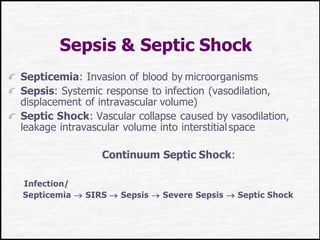
Sepsis & Septic Shock
Septicemia: Invasion of blood by microorganisms
Sepsis: Systemic response to infection (vasodilation,
displacement of intravascular volume)
Septic Shock: Vascular collapse caused by vasodilation,
leakage intravascular volume into interstitialspace
Continuum Septic Shock:
Infection/
Septicemia  SIRS  Sepsis  Severe Sepsis  Septic Shock
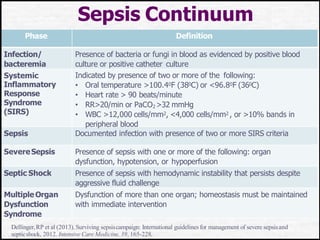
Sepsis Continuum
Phase Definition
Infection/
bacteremia
Presence of bacteria or fungi in blood as evidenced by positive blood
culture or positive catheter culture
Systemic
Inflammatory
Response
Syndrome
(SIRS)
Indicated by presence of two or more of the following:
• Oral temperature >100.40F (380C) or <96.80F (360C)
• Heart rate > 90 beats/minute
• RR>20/min or PaCO2 >32 mmHg
• WBC >12,000 cells/mm2, <4,000 cells/mm2 , or >10% bands in
peripheral blood
Sepsis Documented infection with presence of two or more SIRS criteria
SevereSepsis Presence of sepsis with one or more of the following: organ
dysfunction, hypotension, or hypoperfusion
Septic Shock Presence of sepsis with hemodynamic instability that persists despite
aggressive fluid challenge
MultipleOrgan
Dysfunction
Syndrome
Dysfunction of more than one organ; homeostasis must be maintained
with immediate intervention
Dellinger,RP et al (2013). Surviving sepsiscampaign: International guidelines for management of severe sepsisand
septicshock, 2012. Intensive Care Medicine,39, 165-228.
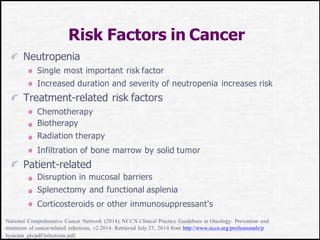
Risk Factors in Cancer
Neutropenia
Single most important risk factor
Increased duration and severity of neutropenia increases risk
Treatment-related risk factors
Chemotherapy
Biotherapy
Radiation therapy
Infiltration of bone marrow by solid tumor
Patient-related
Disruption in mucosal barriers
Splenectomy and functional asplenia
Corticosteroids or other immunosuppressant's
National Comprehensive Cancer Network (2014). NCCN Clinical Practice Guidelines in Oncology: Prevention and
treatment of cancer-related infections, v2.2014. Retrieved July 25, 2014 from http://www.nccn.org/professionals/p
hysician_gls/pdf/infections.pdf.
Incidence and Mortality
Incidence in cancer patients
Bacteremia or sepsis: 10-20% of patients with febrile
neutropenia
Hematologic Malignancies have higher incidence than solid
tumors
Hematologic malignancies: 66.4 per 1,000 hospitalized
patients
Solid tumors: 7.6 per 1,000 hospitalized patients
Mortality in cancer patients
Approximately 28%, same mortality rates for hematologic
malignancies & solid tumors
Courtney, et al (2007). Oncologist, 12, 1019-1026; Shelton, B.K. (2011), in Yarbro et al (eds), Cancer Nursing: Principles and Practice
(7th ed., pp 713-744). Jones & Bartlett.; Williams, et al (2004).Critical Care 8, 291-298.
Sepsis and Septic Shock
Incidence in cancer patients
Bacteremia or sepsis:
Occurs in 10-20% of patients with febrile neutropenia
Severe Sepsis
Hematologic Malignancies have higher incidence than solid
tumors
Hematologic malignancies: 66.4 per 1,000 hospitalized
patients
Solid tumors: 7.6 per 1,000 hospitalized patients
Mortality in cancer patients
Approximately 28%, same mortality rates for hematologic
malignancies & solid tumors
Courtney, et al (2007). Oncologist, 12, 1019-1026; Shelton, B.K. (2011), in Yarbro et al (eds), Cancer Nursing: Principles and Practice
(7th ed., pp 713-744). Jones & Bartlett.; Williams, et al (2004).Critical Care 8, 291-298.
Septic Shock: Pathophysiology
Micro-organisms in blood stream release chemical
mediators & hormones
Endotoxins – released by gram negative bacteria
Exotoxins – released by gram positive bacteria
Profound systemic vasodilation
Hypotension
Tachycardia
Increased vascular permeability
Fluid leaks from vascular space to interstitial space
Decreases circulating blood volume
Hypoxic tissues
Metabolic acidosis
Holmes Gobel,et al (2013).Sepsis& septicshock. In Kaplan,M (Ed). Understandingand managingoncologicemergencies: A
resource for nurses,2nd ED. ONS, Pittsburgh, PA. pp: 287-335.
Causes of Sepsis
Bacterial organisms (most common cause of sepsis)
Gram-negative bacteria (responsible for 50-60%
cases of septic shock)
Escherichia coli
Klebsiella pneumoniae
Pseudomonas aeruginosa
Gram-positive bacteria (increased incidence due to
use of vascular access devices)
Streptococcus pneumoniae
Staphylococcus aureus
Corynebavcterium
Other organisms
Invasive fungal infections, viruses
Lewis, et al (2011). Oncologic emergencies: Pathophysiology, presentation, diagnosis, and treatment. CA: A Cancer Journal for
Clinicians, 61, 287-314.
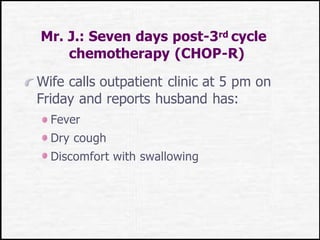
Mr. J.: Seven days post-3rd cycle
chemotherapy (CHOP-R)
Wife calls outpatient clinic at 5 pm on
Friday and reports husband has:
Fever
Dry cough
Discomfort with swallowing
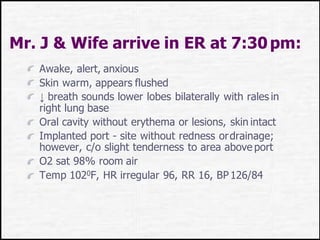
Mr. J & Wife arrive in ER at 7:30pm:
Awake, alert, anxious
Skin warm, appears flushed
↓ breath sounds lower lobes bilaterally with rales in
right lung base
Oral cavity without erythema or lesions, skin intact
Implanted port - site without redness ordrainage;
however, c/o slight tenderness to area above port
O2 sat 98% room air
Temp 1020F, HR irregular 96, RR 16, BP126/84
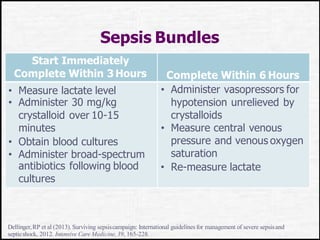
Sepsis Bundles
Start Immediately
Complete Within 3 Hours Complete Within 6 Hours
• Measure lactate level
• Administer 30 mg/kg
crystalloid over 10-15
minutes
• Obtain blood cultures
• Administer broad-spectrum
antibiotics following blood
cultures
• Administer vasopressors for
hypotension unrelieved by
crystalloids
• Measure central venous
pressure and venous oxygen
saturation
• Re-measure lactate
Dellinger,RP et al (2013). Surviving sepsiscampaign: International guidelines for management of severe sepsisand
septicshock, 2012. Intensive Care Medicine,39, 165-228.
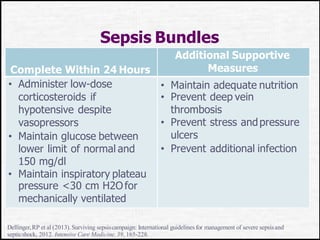
Sepsis Bundles
Complete Within 24 Hours
Additional Supportive
Measures
• Administer low-dose
corticosteroids if
hypotensive despite
vasopressors
• Maintain glucose between
lower limit of normal and
150 mg/dl
• Maintain inspiratory plateau
pressure <30 cm H2Ofor
mechanically ventilated
• Maintain adequate nutrition
• Prevent deep vein
thrombosis
• Prevent stress andpressure
ulcers
• Prevent additional infection
Dellinger,RP et al (2013).Surviving sepsiscampaign: International guidelines for management of severe sepsisand
septicshock, 2012. Intensive Care Medicine,39, 165-228.
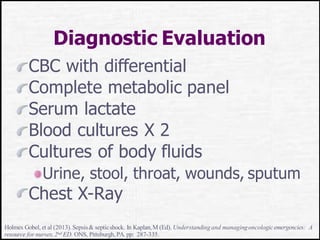
Diagnostic Evaluation
CBC with differential
Complete metabolic panel
Serum lactate
Blood cultures X 2
Cultures of body fluids
Urine, stool, throat, wounds, sputum
Chest X-Ray
Holmes Gobel,et al (2013).Sepsis& septicshock. In Kaplan,M (Ed). Understandingand managingoncologicemergencies: A
resource for nurses,2nd ED. ONS, Pittsburgh, PA. pp: 287-335.
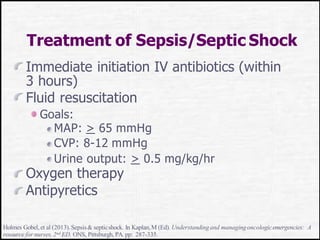
Treatment of Sepsis/Septic Shock
Immediate initiation IV antibiotics (within
3 hours)
Fluid resuscitation
Goals:
MAP: > 65 mmHg
CVP: 8-12 mmHg
Urine output: > 0.5 mg/kg/hr
Oxygen therapy
Antipyretics
Holmes Gobel,et al (2013).Sepsis& septicshock. In Kaplan,M (Ed). Understandingand managingoncologicemergencies: A
resource for nurses,2nd ED. ONS, Pittsburgh, PA. pp: 287-335.
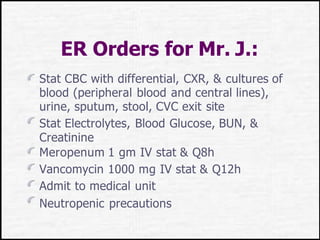
ER Orders for Mr. J.:
Stat CBC with differential, CXR, & cultures of
blood (peripheral blood and central lines),
urine, sputum, stool, CVC exit site
Stat Electrolytes, Blood Glucose, BUN, &
Creatinine
Meropenum 1 gm IV stat & Q8h
Vancomycin 1000 mg IV stat & Q12h
Admit to medical unit
Neutropenic precautions
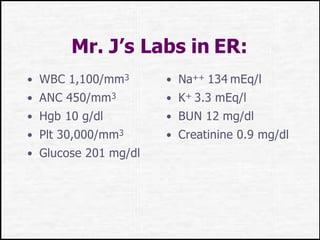
Mr. J’s Labs in ER:
• WBC 1,100/mm3
• ANC 450/mm3
• Hgb 10 g/dl
• Plt 30,000/mm3
• Glucose 201 mg/dl
• Na++ 134 mEq/l
• K+ 3.3 mEq/l
• BUN 12 mg/dl
• Creatinine 0.9 mg/dl
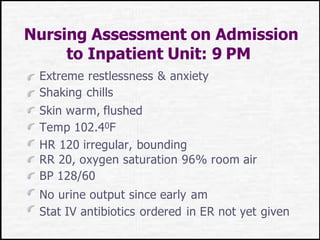
Nursing Assessment on Admission
to Inpatient Unit: 9 PM
Extreme restlessness & anxiety
Shaking chills
Skin warm, flushed
Temp 102.40F
HR 120 irregular, bounding
RR 20, oxygen saturation 96% room air
BP 128/60
No urine output since early am
Stat IV antibiotics ordered in ER not yet given
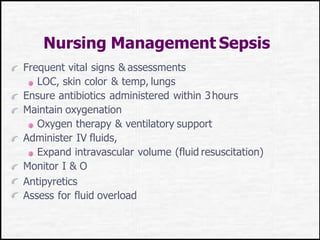
Nursing Management Sepsis
Frequent vital signs & assessments
LOC, skin color & temp, lungs
Ensure antibiotics administered within 3hours
Maintain oxygenation
Oxygen therapy & ventilatory support
Administer IV fluids,
Expand intravascular volume (fluid resuscitation)
Monitor I & O
Antipyretics
Assess for fluid overload
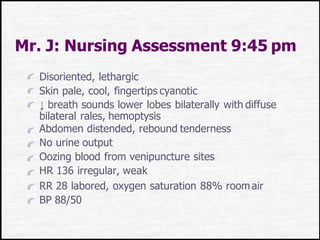
Mr. J: Nursing Assessment 9:45 pm
Disoriented, lethargic
Skin pale, cool, fingertips cyanotic
↓ breath sounds lower lobes bilaterally with diffuse
bilateral rales, hemoptysis
Abdomen distended, rebound tenderness
No urine output
Oozing blood from venipuncture sites
HR 136 irregular, weak
RR 28 labored, oxygen saturation 88% roomair
BP 88/50
Nursing Interventions
Neutropenic patients with fever
Must be assessed immediately
Started on broad spectrum antibiotics
Monitor for sequelae of septic shock
Frequent vital signs
Assess tissue perfusion (skin color, temperature, capillary refill)
Lung assessments
I & O – report urine output < 30cc/hr
Monitor for symptoms of DIC
Monitor response to medical treatment
Assess for fluid overload
Monitor lab values, especially renal function & culture reports
Infection control measures
Holmes Gobel,et al (2013).Sepsis& septicshock. In Kaplan,M (Ed). Understandingand managingoncologicemergencies: A
resource for nurses,2nd ED. ONS, Pittsburgh, PA. pp: 287-335.
Possible Complications of
Sepsis/Septic Shock
DIC
Multiple organ dysfunction syndrome
Death
Disseminated Intravascular
Coagulation (DIC)
Syndrome of:
Thrombus formation (clotting)
Simultaneous Hemorrhage
Caused by over stimulation of normal
coagulation processes
Kaplan,M. (2013).Disseminated Intravascular Coagulation. In Kaplan,M (Ed). Understandingand managingoncologic
emergencies: A resource for nurses,2nd ED. ONS, Pittsburgh, PA.pp: 69 – 102.
Pathophysiology DIC
Paradox of DIC: bleeding & clotting
Triggered by:
Intrinsic coagulation system activation
(damage to blood vessels)
Transfusion reactions
Endotoxins/Septicemia
Sickle Cell Disease
Malignant hypothermia
Extrinsic coagulation system activation (tissue injury)
Obstetrical Conditions
Extensive surgery
Crush injuries
Malignancies
Kaplan,M. (2013).Disseminated Intravascular Coagulation. In Kaplan,M (Ed). Understandingand managingoncologic
emergencies: A resource for nurses,2nd ED. ONS, Pittsburgh,PA. pp: 69 – 102.
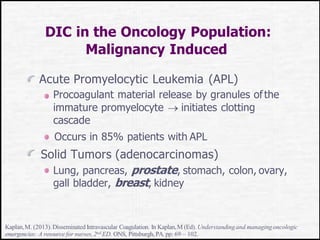
DIC in the Oncology Population:
Malignancy Induced
Acute Promyelocytic Leukemia (APL)
Procoagulant material release by granules ofthe
immature promyelocyte  initiates clotting
cascade
Occurs in 85% patients with APL
Solid Tumors (adenocarcinomas)
Lung, pancreas, prostate, stomach, colon, ovary,
gall bladder, breast, kidney
Kaplan,M. (2013). Disseminated Intravascular Coagulation. In Kaplan,M (Ed). Understandingand managingoncologic
emergencies: A resource for nurses,2nd ED. ONS, Pittsburgh,PA. pp: 69 – 102.
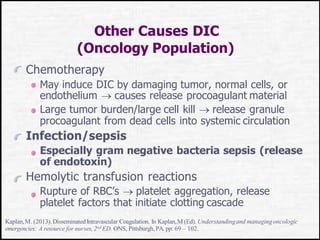
Other Causes DIC
(Oncology Population)
Chemotherapy
May induce DIC by damaging tumor, normal cells, or
endothelium  causes release procoagulant material
Large tumor burden/large cell kill  release granule
procoagulant from dead cells into systemic circulation
Infection/sepsis
Especially gram negative bacteria sepsis (release
of endotoxin)
Hemolytic transfusion reactions
Rupture of RBC’s  platelet aggregation, release
platelet factors that initiate clotting cascade
Kaplan,M. (2013).Disseminated Intravascular Coagulation. In Kaplan,M (Ed). Understandingand managingoncologic
emergencies: A resource for nurses,2nd ED. ONS, Pittsburgh, PA. pp: 69 – 102.
Types of DIC
Acute DIC
Medical emergency
Chronic DIC
Produces coagulation abnormalities, with
or without clinical manifestations, that can
be medically managed
Most cases of chronic DIC due to
underlying malignancy
Laboratory Values in DIC
Laboratory Test Result Comments or Cause
Prothrombin Time (PT) Prolonged Nonspecific in DIC
Activated Partial Thromboplastin
time (APPT)
Prolonged Nonspecific in DIC
International normalized ratio
(INR)
Prolonged Nonspecific in DIC
Fibrin Degradation Products Elevated Indicates breakdown of
fibrin & fibrinogen
D-Dimer Elevated Indicates hyperfibrinolysis
Platelet Count Decreased Platelets consumed
Fibrinogen Decreased Fibrinolysis; decreases very
slowly only in severe DIC
Antithrombin Decreased Anticoagulant activity
inhibited
Accelerated coagulation
Kaplan, M. (2013). Disseminated Intravascular Coagulation. In Kaplan, M (Ed). Understanding and managing oncologic
emergencies: A resource for nurses, 2nd ED. ONS, Pittsburgh, PA. pp: 69 –102.
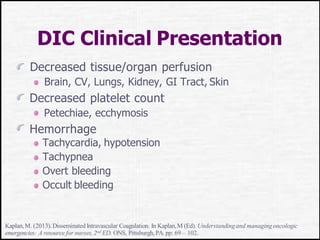
DIC Clinical Presentation
Decreased tissue/organ perfusion
Brain, CV, Lungs, Kidney, GI Tract, Skin
Decreased platelet count
Petechiae, ecchymosis
Hemorrhage
Tachycardia, hypotension
Tachypnea
Overt bleeding
Occult bleeding
Kaplan,M. (2013). Disseminated Intravascular Coagulation. In Kaplan,M (Ed). Understandingand managingoncologic
emergencies: A resource for nurses,2nd ED. ONS, Pittsburgh,PA. pp: 69 – 102.
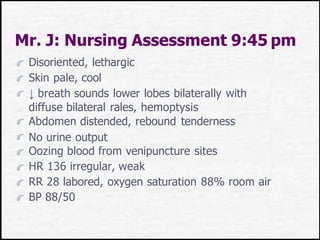
Mr. J: Nursing Assessment 9:45 pm
Disoriented, lethargic
Skin pale, cool
↓ breath sounds lower lobes bilaterally with
diffuse bilateral rales, hemoptysis
Abdomen distended, rebound tenderness
No urine output
Oozing blood from venipuncture sites
HR 136 irregular, weak
RR 28 labored, oxygen saturation 88% room air
BP 88/50
Mr. J’s Labs at 10:00 pm
Lab 7:30 pm 10:00 pm Normals
Hemoglobin 10 g/dl 8.9 g/dl 14-18 g/dl male
Platelets 30,000/mm3 12,000/mm3 150,000 –
400,000/mm3
Fibrinogen 96 mg/dl 170 – 410 mg/dl
PT 15.8 sec 11.3 – 13.1sec
Fibrin
Degradation
Products
60 mcg/ml <10mcg/mL
Treatment of DIC
Early recognition & treatment of underlying
disorder
Chemotherapy for malignancy
Antibiotics for infection
Correct hypoxia
Oxygen to maintain saturation >95%
Correct hypovolemia, hypotension, &
acidosis
NS until type & cross match completed &blood
available
Kaplan,M. (2013).Disseminated Intravascular Coagulation. In Kaplan,M (Ed). Understandingand managingoncologic
emergencies: A resource for nurses,2nd ED. ONS, Pittsburgh,PA. pp: 69 – 102.
Treatment of DIC
Stop the micro clotting to maintain perfusion &
protect vital function
IV Heparin
Antithrombin III (inhibits action of thrombin)
Stop the bleeding
Pressure to active sites of bleeding
Blood products (FFP, cryoprecipitate, platelets,
red blood cells)
Antifibrinolytic agents (EACA)
Kaplan,M. (2013). Disseminated Intravascular Coagulation. In Kaplan,M (Ed). Understandingand managingoncologic
emergencies: A resource for nurses,2nd ED. ONS, Pittsburgh,PA. pp: 69 – 102.
Nursing Interventions
Prevent severity of symptoms
Direct pressure sites of bleeding, pressure dressings, sand bags
Monitor for progression DIC
Worsening vital signs, hypotension, anuria, ’s LOC
Monitor response to therapy
Sites & amounts ofbleeding
Changes in lab values
Assess tissue perfusion parameters – color, temperature, peripheral
pulses
Patient Teaching
Avoid ASA or NSAID’s (effects on platelet aggregation)
Signs and symptoms of DIC (bleeding and/or clotting)
Kaplan,M. (2013). Disseminated Intravascular Coagulation. In Kaplan,M (Ed). Understandingand managingoncologic
emergencies: A resource for nurses,2nd ED. ONS, Pittsburgh,PA. pp: 69 – 102.
Hypercalcemia of
Malignancy (HCM)
Metabolic disorder
Most commonly develops as a
consequence of pathologic destruction of
bone, mediated by factors released by
malignant cells
One of the most common, life-threatening
complications of malignancy
Kaplan, M. (2013) Hypercalcemia of malignancy. In Kaplan, M (Ed). Understanding and managing oncologic
emergencies:A resourcefor nurses, 2nd Ed., 103-155, ONS, Pittsburgh, PA.; Makras, P & Papapoulous, SE (2009).
Medical treatment of hypercalcemia. Hormones, 8, 83-95.
HCM: Incidence
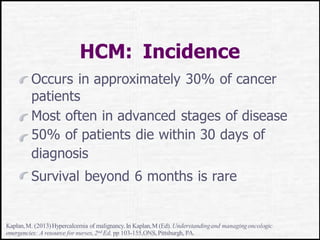
Occurs in approximately 30% of cancer
patients
Most often in advanced stages of disease
50% of patients die within 30 days of
diagnosis
Survival beyond 6 months is rare
Kaplan,M. (2013)Hypercalcemia of malignancy.In Kaplan,M (Ed). Understandingand managingoncologic
emergencies: A resource for nurses,2nd Ed, pp 103-155,ONS,Pittsburgh, PA.
Normal Regulation of Ca++
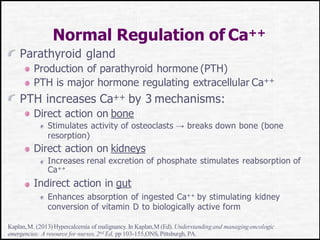
Parathyroid gland
Production of parathyroid hormone (PTH)
PTH is major hormone regulating extracellular Ca++
PTH increases Ca++ by 3 mechanisms:
Direct action on bone
Stimulates activity of osteoclasts → breaks down bone (bone
resorption)
Direct action on kidneys
Increases renal excretion of phosphate stimulates reabsorption of
Ca++
Indirect action in gut
Enhances absorption of ingested Ca++ by stimulating kidney
conversion of vitamin D to biologically active form
Kaplan,M. (2013)Hypercalcemia of malignancy.In Kaplan,M (Ed). Understandingand managingoncologic
emergencies: A resource for nurses,2nd Ed, pp 103-155,ONS,Pittsburgh, PA.
Normal Regulation of Ca++
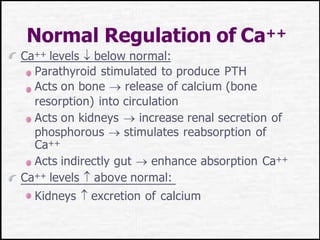
Ca++ levels  below normal:
Parathyroid stimulated to produce PTH
Acts on bone  release of calcium (bone
resorption) into circulation
Acts on kidneys  increase renal secretion of
phosphorous  stimulates reabsorption of
Ca++
Acts indirectly gut  enhance absorption Ca++
Ca++ levels  above normal:
Kidneys  excretion of calcium
Distribution of Calcium
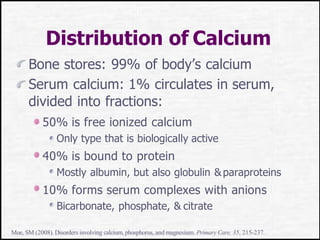
Bone stores: 99% of body’s calcium
Serum calcium: 1% circulates in serum,
divided into fractions:
50% is free ionized calcium
Only type that is biologically active
40% is bound to protein
Mostly albumin, but also globulin &paraproteins
10% forms serum complexes with anions
Bicarbonate, phosphate, & citrate
Moe, SM (2008).Disorders involving calcium,phosphorus, and magnesium. Primary Care, 35, 215-237.
Measuring Serum Calcium
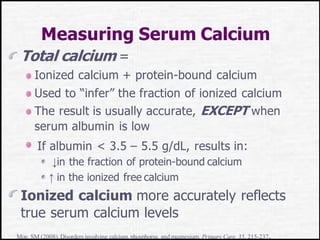
Total calcium =
Ionized calcium + protein-bound calcium
Used to “infer” the fraction of ionized calcium
The result is usually accurate, EXCEPT when
serum albumin is low
If albumin < 3.5 – 5.5 g/dL, results in:
↓in the fraction of protein-bound calcium
↑ in the ionized free calcium
Ionized calcium more accurately reflects
true serum calcium levels
Moe, SM (2008).Disorders involving calcium,phosphorus, and magnesium. Primary Care, 35, 215-237.
Corrected Serum Ca++
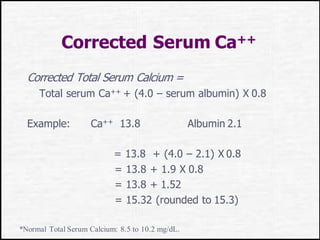
Corrected Total Serum Calcium =
Total serum Ca++ + (4.0 – serum albumin) X 0.8
Example: Ca++ 13.8 Albumin 2.1
= 13.8 + (4.0 – 2.1) X 0.8
= 13.8 + 1.9 X 0.8
= 13.8 + 1.52
= 15.32 (rounded to 15.3)
*Normal Total Serum Calcium: 8.5 to 10.2 mg/dL.
HCM: Etiology
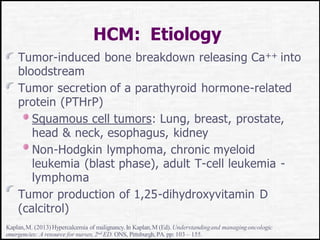
Tumor-induced bone breakdown releasing Ca++ into
bloodstream
Tumor secretion of a parathyroid hormone-related
protein (PTHrP)
Squamous cell tumors: Lung, breast, prostate,
head & neck, esophagus, kidney
Non-Hodgkin lymphoma, chronic myeloid
leukemia (blast phase), adult T-cell leukemia -
lymphoma
Tumor production of 1,25-dihydroxyvitamin D
(calcitrol)
Kaplan,M. (2013)Hypercalcemia of malignancy.In Kaplan,M (Ed). Understandingand managingoncologic
emergencies: A resource for nurses,2nd ED. ONS, Pittsburgh,PA. pp: 103 – 155.
Hypercalcemia:
Clinical Presentation
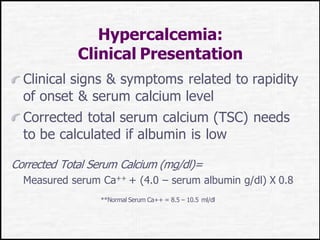
Clinical signs & symptoms related to rapidity
of onset & serum calcium level
Corrected total serum calcium (TSC) needs
to be calculated if albumin is low
Corrected Total Serum Calcium (mg/dl)=
Measured serum Ca++ + (4.0 – serum albumin g/dl) X 0.8
**Normal Serum Ca++ = 8.5 – 10.5 ml/dl
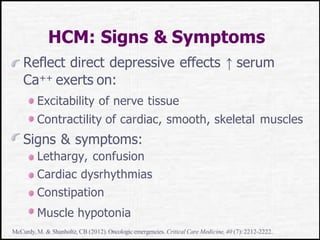
HCM: Signs & Symptoms
Reflect direct depressive effects ↑ serum
Ca++ exerts on:
Excitability of nerve tissue
Contractility of cardiac, smooth, skeletal muscles
Signs & symptoms:
Lethargy, confusion
Cardiac dysrhythmias
Constipation
Muscle hypotonia
McCurdy,M. & Shanholtz, CB (2012).Oncologic emergencies. Critical Care Medicine,40 (7):2212-2222.
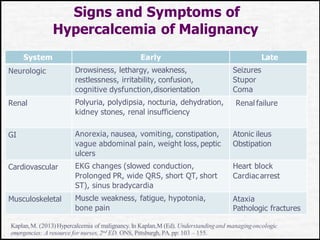
Signs and Symptoms of
Hypercalcemia of Malignancy
System Early Late
Neurologic Drowsiness, lethargy, weakness,
restlessness, irritability, confusion,
cognitive dysfunction,disorientation
Seizures
Stupor
Coma
Renal Polyuria, polydipsia, nocturia, dehydration,
kidney stones, renal insufficiency
Renal failure
GI Anorexia, nausea, vomiting, constipation,
vague abdominal pain, weight loss, peptic
ulcers
Atonic ileus
Obstipation
Cardiovascular EKG changes (slowed conduction,
Prolonged PR, wide QRS, short QT, short
ST), sinus bradycardia
Heart block
Cardiacarrest
Musculoskeletal Muscle weakness, fatigue, hypotonia,
bone pain
Ataxia
Pathologic fractures
Kaplan,M. (2013)Hypercalcemia of malignancy.In Kaplan,M (Ed). Understandingand managingoncologic
emergencies: A resource for nurses,2nd ED. ONS, Pittsburgh, PA.pp: 103 – 155.
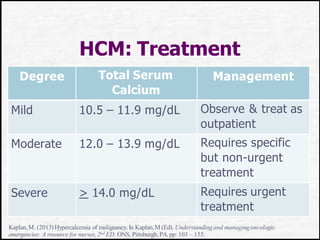
HCM: Treatment
Degree Total Serum
Calcium
Management
Mild 10.5 – 11.9 mg/dL Observe & treat as
outpatient
Moderate 12.0 – 13.9 mg/dL Requires specific
but non-urgent
treatment
Severe > 14.0 mg/dL Requires urgent
treatment
Kaplan,M. (2013)Hypercalcemia of malignancy.In Kaplan,M (Ed). Understandingand managingoncologic
emergencies: A resource for nurses, 2nd ED. ONS, Pittsburgh, PA.pp: 103 – 155.
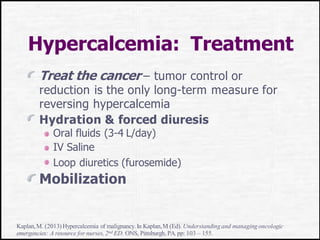
Hypercalcemia: Treatment
Treat the cancer – tumor control or
reduction is the only long-term measure for
reversing hypercalcemia
Hydration & forced diuresis
Oral fluids (3-4 L/day)
IV Saline
Loop diuretics (furosemide)
Mobilization
Kaplan,M. (2013)Hypercalcemia of malignancy.In Kaplan,M (Ed). Understandingand managingoncologic
emergencies: A resource for nurses, 2nd ED. ONS, Pittsburgh, PA.pp: 103 – 155.
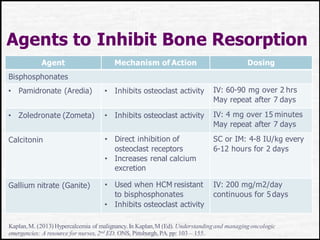
Agents to Inhibit Bone Resorption
Agent Mechanism of Action Dosing
Bisphosphonates
• Pamidronate (Aredia) • Inhibits osteoclast activity IV: 60-90 mg over 2 hrs
May repeat after 7 days
• Zoledronate (Zometa) • Inhibits osteoclast activity IV: 4 mg over 15 minutes
May repeat after 7 days
Calcitonin • Direct inhibition of
osteoclast receptors
• Increases renal calcium
excretion
SC or IM: 4-8 IU/kg every
6-12 hours for 2 days
Gallium nitrate (Ganite) • Used when HCM resistant
to bisphosphonates
• Inhibits osteoclast activity
IV: 200 mg/m2/day
continuous for 5days
Kaplan,M. (2013)Hypercalcemia of malignancy.In Kaplan,M (Ed). Understandingand managingoncologic
emergencies: A resource for nurses, 2nd ED. ONS, Pittsburgh, PA.pp: 103 – 155.
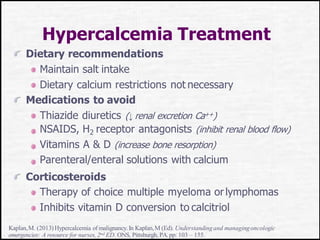
Hypercalcemia Treatment
Dietary recommendations
Maintain salt intake
Dietary calcium restrictions not necessary
Medications to avoid
Thiazide diuretics (↓ renal excretion Ca++)
NSAIDS, H2 receptor antagonists (inhibit renal blood flow)
Vitamins A & D (increase bone resorption)
Parenteral/enteral solutions with calcium
Corticosteroids
Therapy of choice multiple myeloma orlymphomas
Inhibits vitamin D conversion to calcitriol
Kaplan,M. (2013)Hypercalcemia of malignancy.In Kaplan,M (Ed). Understandingand managingoncologic
emergencies: A resource for nurses,2nd ED. ONS, Pittsburgh, PA.pp: 103 – 155.
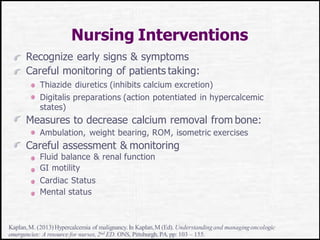
Nursing Interventions
Recognize early signs & symptoms
Careful monitoring of patients taking:
Thiazide diuretics (inhibits calcium excretion)
Digitalis preparations (action potentiated in hypercalcemic
states)
Measures to decrease calcium removal from bone:
Ambulation, weight bearing, ROM, isometric exercises
Careful assessment & monitoring
Fluid balance & renal function
GI motility
Cardiac Status
Mental status
Kaplan,M. (2013)Hypercalcemia of malignancy.In Kaplan,M (Ed). Understandingand managingoncologic
emergencies: A resource for nurses, 2nd ED. ONS, Pittsburgh, PA.pp: 103 – 155.
Mr. C: Hypercalcemia
62-year-old male diagnosed with stage IV
squamous cell cancer of lung
CT of spine showed metastatic disease in
thoracic & lumbar spine at T1 & L3 vertebrae
Based on extent of disease & poor pulmonary
function, Mr. C. was not a surgical candidate.
Scheduled for second course of palliative
chemotherapy
Also receiving concurrent radiation for the
spinal metastasis
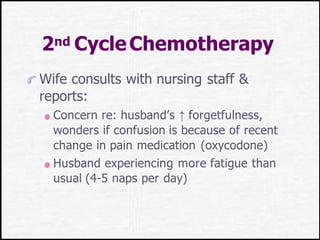
2nd CycleChemotherapy
Wife consults with nursing staff &
reports:
Concern re: husband’s ↑ forgetfulness,
wonders if confusion is because of recent
change in pain medication (oxycodone)
Husband experiencing more fatigue than
usual (4-5 naps per day)
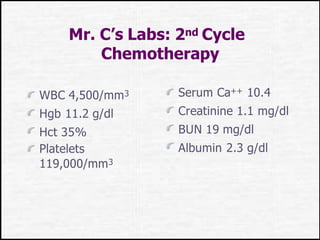
Mr. C’s Labs: 2nd Cycle
Chemotherapy
WBC 4,500/mm3
Hgb 11.2 g/dl
Hct 35%
Platelets
119,000/mm3
Serum Ca++ 10.4
Creatinine 1.1 mg/dl
BUN 19 mg/dl
Albumin 2.3 g/dl
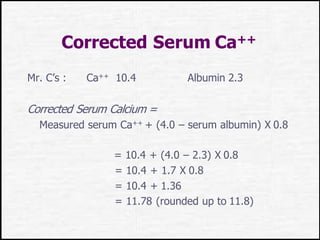
Corrected Serum Ca++
Mr. C’s : Ca++ 10.4 Albumin 2.3
Corrected Serum Calcium =
Measured serum Ca++ + (4.0 – serum albumin) X 0.8
= 10.4 + (4.0 – 2.3) X 0.8
= 10.4 + 1.7 X 0.8
= 10.4 + 1.36
= 11.78 (rounded up to 11.8)
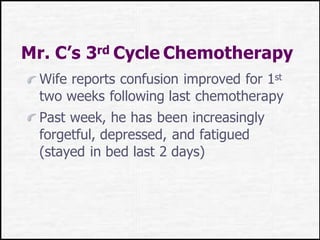
Mr. C’s 3rd Cycle Chemotherapy
Wife reports confusion improved for 1st
two weeks following last chemotherapy
Past week, he has been increasingly
forgetful, depressed, and fatigued
(stayed in bed last 2 days)
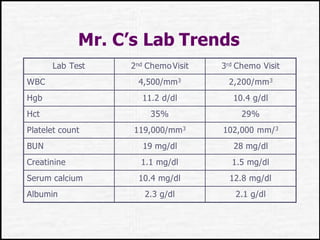
Mr. C’s Lab Trends
Lab Test 2nd ChemoVisit 3rd Chemo Visit
WBC 4,500/mm3 2,200/mm3
Hgb 11.2 d/dl 10.4 g/dl
Hct 35% 29%
Platelet count 119,000/mm3 102,000 mm/3
BUN 19 mg/dl 28 mg/dl
Creatinine 1.1 mg/dl 1.5 mg/dl
Serum calcium 10.4 mg/dl 12.8 mg/dl
Albumin 2.3 g/dl 2.1 g/dl
Corrected Serum Ca++
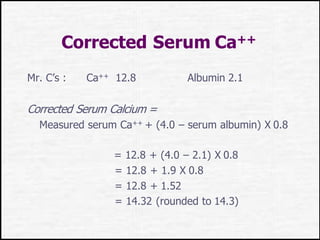
Mr. C’s : Ca++ 12.8 Albumin 2.1
Corrected Serum Calcium =
Measured serum Ca++ + (4.0 – serum albumin) X 0.8
= 12.8 + (4.0 – 2.1) X 0.8
= 12.8 + 1.9 X 0.8
= 12.8 + 1.52
= 14.32 (rounded to 14.3)
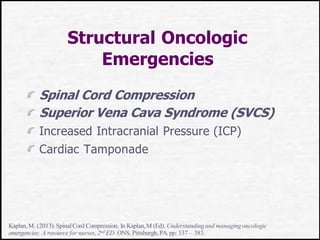
Structural Oncologic
Emergencies
Spinal Cord Compression
Superior Vena Cava Syndrome (SVCS)
Increased Intracranial Pressure (ICP)
Cardiac Tamponade
Kaplan,M. (2013).SpinalCord Compression. In Kaplan,M (Ed). Understandingand managingoncologic
emergencies: A resource for nurses, 2nd ED. ONS, Pittsburgh, PA.pp: 337 – 383.
Spinal Cord Compression
Compression of spinal cord
Direct tumor pressure on cord
Tumor invasion of the vertebral column causing
collapse & pressure on cord
Compression causes:
Edema
Inflammation
Mechanical compression
Leads to:
Direct neural injury to cord
Vascular Damage
Kaplan,M. (2013). SpinalCord Compression. In Kaplan,M (Ed). Understandingand managingoncologic
emergencies: A resource for nurses,2nd ED. ONS, Pittsburgh,PA. pp: 337 – 383.
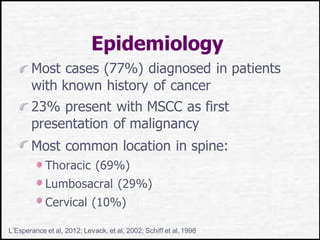
Epidemiology
Most cases (77%) diagnosed in patients
with known history of cancer
23% present with MSCC as first
presentation of malignancy
Most common location in spine:
Thoracic (69%)
Lumbosacral (29%)
Cervical (10%)
L’Esperance et al, 2012; Levack, et al, 2002; Schiff et al,1998
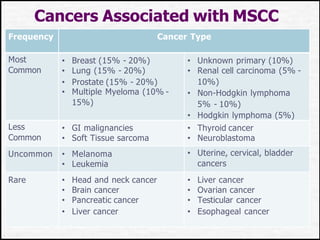
Cancers Associated with MSCC
Frequency Cancer Type
Most
Common
• Breast (15% - 20%)
• Lung (15% - 20%)
• Prostate (15% - 20%)
• Multiple Myeloma (10% -
15%)
• Unknown primary (10%)
• Renal cell carcinoma (5% -
10%)
• Non-Hodgkin lymphoma
5% - 10%)
• Hodgkin lymphoma (5%)
Less
Common
• GI malignancies
• Soft Tissue sarcoma
• Thyroid cancer
• Neuroblastoma
Uncommon • Melanoma
• Leukemia
• Uterine, cervical, bladder
cancers
Rare • Head and neck cancer
• Brain cancer
• Pancreatic cancer
• Liver cancer
• Liver cancer
• Ovarian cancer
• Testicular cancer
• Esophageal cancer
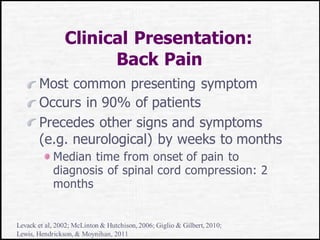
Clinical Presentation:
Back Pain
Most common presenting symptom
Occurs in 90% of patients
Precedes other signs and symptoms
(e.g. neurological) by weeks to months
Median time from onset of pain to
diagnosis of spinal cord compression: 2
months
Levack et al, 2002; McLinton & Hutchison, 2006; Giglio & Gilbert, 2010;
Lewis, Hendrickson, & Moynihan, 2011
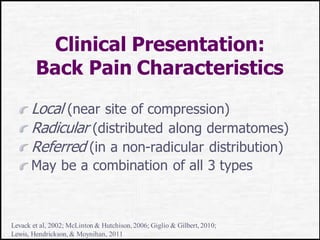
Clinical Presentation:
Back Pain Characteristics
Local (near site of compression)
Radicular (distributed along dermatomes)
Referred (in a non-radicular distribution)
May be a combination of all 3 types
Levack et al, 2002; McLinton & Hutchison, 2006; Giglio & Gilbert, 2010;
Lewis, Hendrickson, & Moynihan, 2011
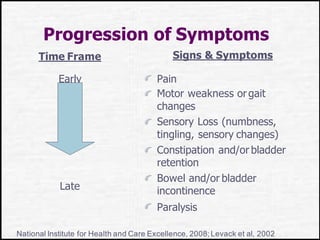
Progression of Symptoms
Time Frame
Early
Late
Signs & Symptoms
Pain
Motor weakness orgait
changes
Sensory Loss (numbness,
tingling, sensory changes)
Constipation and/or bladder
retention
Bowel and/or bladder
incontinence
Paralysis
National Institute for Health and Care Excellence, 2008; Levack et al, 2002
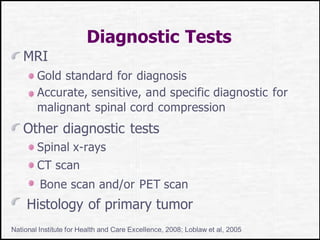
Diagnostic Tests
MRI
Gold standard for diagnosis
Accurate, sensitive, and specific diagnostic for
malignant spinal cord compression
Other diagnostic tests
Spinal x-rays
CT scan
Bone scan and/or PET scan
Histology of primary tumor
National Institute for Health and Care Excellence, 2008; Loblaw et al, 2005
Treatment of MSCC
IMMEDIATE & aggressive
Corticosteroids – usually initial treatment
High-dose steroids to  spinal cord
edema & inflammation
High-dose Dexamethasone (16 mg
loading, short course of 16 mg daily)
followed by tapering doses over several
days
Kaplan,M. (2013).SpinalCord Compression. In Kaplan,M (Ed). Understandingand managingoncologic
emergencies: A resource for nurses, 2nd ED. ONS, Pittsburgh, PA. pp: 337 – 383.
Surgery
Primary purposes
Preserve or recover neurological function
Maintain functional independence
Achieve highest possible quality of life
May include separately or in combination:
Spinal cord decompression: avert or treat MSCC
Spinal column stabilization: treat mechanical pain
or bone instability)
Resection/reconstruction of spinal column
National Institute for Health Care and Excellence,2008
Surgical Techniques
Laminectomy (no longer typically
performed)
Anterior vertebral body resection with
stabilization
Vertebroplasty
Kyphoplasty
Kaplan, M. (2013). Spinal Cord Compression. In Kaplan, M (Ed). Understanding and managing
oncologic emergencies: A resource for nurses, 2nd ED. ONS, Pittsburgh, PA. pp: 337 – 383.
Radiation Therapy
First-line treatment in asymptomatic MSCC
Dose of 30 Gy administered in 10 fractions is
most widely used regimen in North America
Combined with surgery (multimodal therapy)
Radiation therapy alone
Pain relief may not be achieved for up to two
weeks
Does not correct spinal instability or prevent
vertebral body collapse
L’Esperance, et al, 2012; National Institute for Health and Care Excellence, 2008;
Gregory, 2008
Chemotherapy
Acute management of MSCC
Response to treatment slow
In combination with radiation therapy for
chemo-sensitive tumors
Hodgkin disease
Non-Hodgkin lymphoma
Neurobastoma
Germ cell tumors
Breast cancer
Sun & Nemeck,2009
Nursing Interventions
Early recognition:
Thorough assessment of neck & back pain in
high risk patients
Neurological assessments
Assess effectiveness pain control
Monitor bowel & bladder function
PT, OT referrals, as appropriate
Assess need for home care referrals and
supportive medical equipment
Kaplan,M. (2013).SpinalCord Compression. In Kaplan,M (Ed). Understandingand managingoncologic
emergencies: A resource for nurses, 2nd ED. ONS, Pittsburgh,PA. pp: 337 – 383.
Superior Vena Cava
Syndrome (SVCS)
Obstruction of blood flow through the
superior vena cava (SVC)
Obstruction  venous return from head,
neck, upper arms, upper thorax impaired
Venous pressure increases
Cardiac output decreases
May be caused by:
Invasion or compression of SVC
Thrombosis within SVC
Shelton, BK, (2013).Superiorvena cava syndrome. In Kaplan,M (Ed). Understandingand managing oncologic
emergencies: A resource for nurses, 2nd Ed., pp 385 - 410, ONS, Pittsburgh, PA.
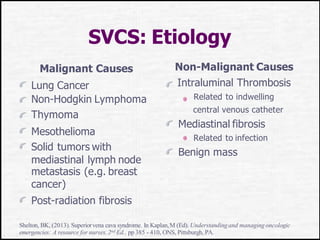
SVCS: Etiology
Malignant Causes
Lung Cancer
Non-Hodgkin Lymphoma
Thymoma
Mesothelioma
Solid tumors with
mediastinal lymph node
metastasis (e.g. breast
cancer)
Post-radiation fibrosis
Non-Malignant Causes
Intraluminal Thrombosis
Related to indwelling
central venous catheter
Mediastinal fibrosis
Related to infection
Benign mass
Shelton, BK, (2013).Superiorvena cava syndrome. In Kaplan,M (Ed). Understandingand managing oncologic
emergencies: A resource for nurses, 2nd Ed., pp 385 - 410, ONS, Pittsburgh, PA.
SVCS: Incidence
Occurs in 3 – 4% of oncology
population
Majority of cases (70% - 95%) related
to underlying malignancy
Shelton, BK, (2013).Superiorvena cava syndrome. In Kaplan,M (Ed). Understandingand managing oncologic
emergencies: A resource for nurses, 2nd Ed., pp 385 - 410, ONS, Pittsburgh, PA.
Clinical Presentation
Gradual onset (rarely occurs rapidly)
Symptoms vary depending on extent of
obstruction, location, collateral
circulation
Shelton, B. (2013).SpinalCord Compression. In Kaplan,M (Ed). Understandingand managing oncologic
emergencies: A resource for nurses,2nd ED. ONS, Pittsburgh, PA.pp: 385 - 410.
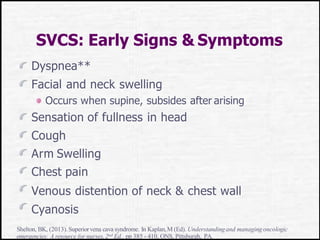
SVCS: Early Signs & Symptoms
Dyspnea**
Facial and neck swelling
Occurs when supine, subsides after arising
Sensation of fullness in head
Cough
Arm Swelling
Chest pain
Venous distention of neck & chest wall
Cyanosis
Shelton, BK, (2013). Superiorvena cava syndrome. In Kaplan,M (Ed). Understandingand managing oncologic
emergencies: A resource for nurses,2nd Ed., pp 385 - 410, ONS, Pittsburgh, PA.
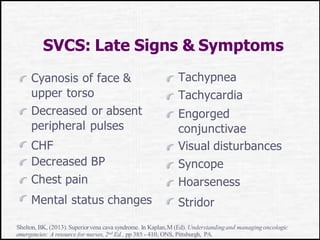
SVCS: Late Signs & Symptoms
Cyanosis of face &
upper torso
Decreased or absent
peripheral pulses
CHF
Decreased BP
Chest pain
Mental status changes
Tachypnea
Tachycardia
Engorged
conjunctivae
Visual disturbances
Syncope
Hoarseness
Stridor
Shelton, BK, (2013).Superiorvena cava syndrome. In Kaplan,M (Ed). Understandingand managing oncologic
emergencies: A resource for nurses, 2nd Ed., pp 385 - 410, ONS, Pittsburgh, PA.
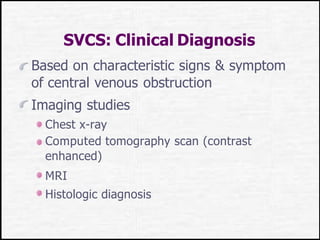
SVCS: Clinical Diagnosis
Based on characteristic signs & symptom
of central venous obstruction
Imaging studies
Chest x-ray
Computed tomography scan (contrast
enhanced)
MRI
Histologic diagnosis
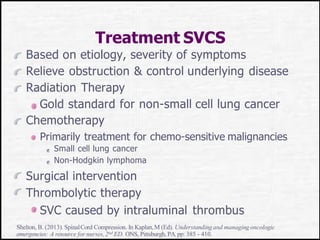
Treatment SVCS
Based on etiology, severity of symptoms
Relieve obstruction & control underlying disease
Radiation Therapy
Gold standard for non-small cell lung cancer
Chemotherapy
Primarily treatment for chemo-sensitive malignancies
Small cell lung cancer
Non-Hodgkin lymphoma
Surgical intervention
Thrombolytic therapy
SVC caused by intraluminal thrombus
Shelton, B. (2013). SpinalCord Compression. In Kaplan,M (Ed). Understandingand managing oncologic
emergencies: A resource for nurses,2nd ED. ONS, Pittsburgh, PA.pp: 385 - 410.
SVCS: Radiotherapy
Most malignancies causing SVCS are radiation
sensitive
Currently, no standard regarding dose and
schedule of radiation therapy
Generally provides good to excellent relief of
symptoms
70% of patients with lung cancer
90% of patients with lymphoma
Initial symptom relief within 2 weeks,
Choe, KS & SalamaJK (2009).Advances inradiotherapy for tumors involvingthe mediastinum.ThoracicSurgery
Clinics,19, 133 – 141.
SVCS: Chemotherapy
Primary treatment for chemo-sensitive tumors
Small cell lung cancer (SCLC)
Non-Hodgin lymphoma (NHL)
Germ cell tumors
Possibly breast cancer
May be used for less chemo-sensitive tumors
Non-small cell lung cancer (NSCLC)
Symptom relief within 7-14 days
Drews, RE & Rabkin, DJ. (2014, June 25). Malignancy-related superior vena cava syndrome. Retrievedfrom
http://www.uptodate.com/contents/malignancy-related-superior-vena-cava-syndrome.
SVCS: Interventions
Endovenous stenting
Preferred initial approach
In conjunction with thrombolytic therapy or
venous angioplasty
Surgical venous bypass
Reserved for patients with severe, persistent
symptoms
Rarely used
Drews, RE & Rabkin, DJ. (2014, June 25). Malignancy-related superior vena cava syndrome. Retrievedfrom
http://www.uptodate.com/contents/malignancy-related-superior-vena-cava-syndrome.
Nursing Interventions
Assess for signs & symptoms in patients at risk
Non-small cell lung cancer, small cell lung cancer, non-Hodkgin
lymphoma
Central venous access devices
Interventions to relieve symptoms
Elevate HOB, avoid supine position & elevation oflower
extremities
Avoid venipuncture, BP, IV therapy upper extremities
Monitor responses to treatment
Assess for progressive respiratory distress or edema
Monitor tolerance of activities
Monitor fluid status (over hydration exacerbates symptoms)
Assess CNS (LOS, mental status changes, visual changes, headache)
Shelton, B. (2013). SpinalCord Compression. In Kaplan,M (Ed). Understandingand managing oncologic
emergencies: A resource for nurses,2nd ED. ONS, Pittsburgh, PA.pp: 385 - 410.

22-Oncologic-Emergencies-Madison-March-2105-Syllabus-converted.pptx

  • 1.
    Oncologic Emergencies Juanita Madison,RN, MN, AOCN CHI Franciscan Health
  • 2.
    Oncologic Emergencies Life-threatening medicalemergencies causedby: Malignancy Treatment of malignancy When do they occur? Initial manifestations of malignancy or Late in disease process
  • 3.
    Oncologic Emergencies Metabolic OncologicEmergencies Tumor Lysis Syndrome (TLS) Sepsis & Septic Shock Disseminated Intravascular Coagulation (DIC) Hypercalcemia Inappropriate Antidiuretic Hormone Secretion (SIADH) Anaphylaxis Structural Oncologic Emergencies Spinal Cord Compression Superior Vena Cava Syndrome Increased Intracranial Pressure (ICP) Cardiac Tamponade
  • 4.
    Tumor Lysis Syndrome(TLS) Metabolic imbalance Caused by breakdown of malignant cells Large number of rapidly proliferating cells killed Cell lysis, rupture of tumor cell membranes Intracellular components released into blood stream Holmes Gobel,B. (2013). Tumor Lysis Syndrome. In Kaplan,M (Ed). Understandingand managing oncologicemergencies: A resource for nurses.Oncology Nursing Society, Pittsburgh, PA.pp: 433-459.
  • 5.
    TLS: Pathophysiology Intracellular components Potassium Phosphorous Nucleicacids (DNA, RNA) Cell killed (lysed), cell membrane ruptures Nucleic acids released into blood stream Potassium & Phosphorous released into blood stream Results in: Hyperuricemia Hyperkalemia Hyperphosphatemia Hypocalcemia K+ 4 4 PO - PO - Nucleic Acids K+ K+ 4 K+ PO - Nucleic Acids Hypoxanthine Xanthine UricAcid Urine K+ K+ K+ 4 4 4 PO - PO - PO - Ca++ Ca++ Ca++ Xanthine Oxidase (Liver)
  • 6.
    Tumor Lysis Syndrome:Who’s At Risk? Most common in: Patients with large tumor burden that is highly responsive to antineoplastic therapy (resulting in rapid cell kill) Risk Factors: Tumor-related High-grade lymphomas Hematologic malignancies (acute or chronic leukemia's with  WBC) Tumors with high growth fractions (anticipated to be responsive to treatment) Patient-related Large tumor burden/bulky tumors Elevated LDH Pre-existing renal dysfunction Treatment-related Chemotherapy & biologic agents Radiation therapy National Comprehensive Cancer Network (NCCN),2014. NCCN Guidelines:Non-Hodgkin’s Lymphoma, version4.2014. Accessedon August 30, 2014 at http://www.nccn.org/professionals/physician_gls/pdf/nhl.pdf
  • 7.
    Tumor Lysis Syndrome: Onset,Duration, Incidence Onset: Usually within 12-72 hrs. after initiation of antineoplastic therapy Duration: May persist for 5-7 days post-therapy Incidence: Exact incidence unknown Occurs mostly in patients with Hematologic malignancies with large proliferative growth fractions Large bulky disease (acute leukemias, high-grade lymphomas) National Comprehensive Cancer Network (NCCN),2014. NCCN Guidelines:Non-Hodgkin’s Lymphoma, version 4.2014. Accessed on August 30, 2014 at http://www.nccn.org/professionals/physician_gls/pdf/nhl.pdf.
  • 8.
    Clinical Manifestations Often asymptomaticinitially Detected initial via abnormalities in blood chemistries Signs & symptoms patients exhibit depend on extent of metabolic abnormalities Hyperkalemia Hyperuricemia Hyperphosphatemia Hypocalcemia Holmes Gobble,B. (2013).Tumor Lysis Syndrome. In Kaplan,M (Ed). Understandingand managing oncologicemergencies: A resource for nurses.Oncology Nursing Society, Pittsburgh, PA.pp: 433-459.
  • 9.
    TLS: Signs &Symptoms Hyperkalemia Serum K+ >6.5mEq/L Early cardiac: • Tachycardia • Nausea/vomiting • Diarrhea • Increased bowel sounds • Twitching • Muscle cramps • Weakness • Paresthesias • Lethargy • Syncope •EKG Changes: Prolonged QT and ST segment, lowering and inversion of T wave Late cardiac: • Bradycardia •EKG Changes: Shortened QT, elevated T wave, wide QRS •Ventricular tachycardia, ventricular fibrillation, cardiac arrest Hyperuricemia Serum uric acid >10mg/dl Severe = >20mg/dl • Oliguria, anuria, azotemia • Edema, hypertension • Acute renal failure • Malaise, weakness, fatigue • Nausea, vomiting • Flank pain, gout • Chronic renal failure • Pruritus Gobel,B. H. (2013).In M. Kaplan(Ed.), Understandingan managing oncologicemergencies: A resource for nurses 2nd Edition(pp. 433 - 459).Pittsburgh, PA:ONS
  • 10.
    TLS: Signs &Symptoms Hyperphosphatemia Serum PO4 >5mg/dl • Anuria • Oliguria • Azotemia • Edema • Hypertension • Acute renal failure Secondary Neurological/Neuromuscular Cardiac Hypocalcemia Serum Ca++ < 8.7mg/dl • Twitching, paresthesias • Restlessness • Tetany • Ventricular arrhythmias • Muscle cramps & weakness • Anxiety, depression •Prolonged QT interval, inverted T wave • Carpopedal spasms • Heart block • Seizures • Cardiac arrest • Confusion • Hallucinations Gobel, B. H. (2013).In M. Kaplan(Ed.), Understandingan managing oncologicemergencies: A resource for nurses 2nd Edition(pp. 433 - 459).Pittsburgh, PA:ONS
  • 11.
    TLS: Management Prevention Strategies Recognitionof at-risk patients Hydration Prevention of hyperuricemia Frequent monitoring of electrolytes Intervention Strategies Hydration Control of hyperuricemia Aggressive correction of electrolytes Management of acute renal failure National Comprehensive Cancer Network (NCCN),2014. NCCN Guidelines:Non-Hodgkin’s Lymphoma, version 4.2014. Accessed on August 30, 2014 at http://www.nccn.org/professionals/physician_gls/pdf/nhl.pdf.
  • 12.
    TLS Prevention Hydration IV Normalsaline or 5% dextrose Begin 24 – 48 hours prior to therapy Ensure urine output >150 – 200 ml/hr Diuresis Typically used if urine output not maintained by hydration alone Loop diuretics or osmotic diuretics Holmes Gobel, B. (2013).Tumor Lysis Syndrome. In Kaplan,M (Ed). Understandingand managing oncologicemergencies: A resource for nurses, 2nd ED. ONS, Pittsburgh, PA. pp: 433-459;McGraw,B. (2008).CJON 12 (4); 563-565.
  • 13.
    Prevention of TLS: Controlof Hyperuricemia Allopurinol (Oral or IV) Dosing: Oral: 300 mg/m2/day (not to exceed 600 mg/day) IV: 200 – 400 mg/m2/day Begin 2 – 3 days prior to chemotherapy Continue for 10-14 days Blocks uric acid production by inhibiting xanthine oxidase (liver enzyme) Prevents uric acid precursors from converting to uric acid, ↓ risk uric acid crystallization Holmes Gobel,B. (2013). Tumor Lysis Syndrome. In Kaplan,M (Ed). Understandingand managing oncologicemergencies: A resource for nurses,2nd ED. ONS, Pittsburgh,PA. pp: 433-459;McGraw,B. (2008);NCCN, 2014.
  • 14.
    Control of Hyperuricemia Rasburicase(Elitek®) IV Recombinant urate-oxidase Catalyzes the oxidation of uric acid into allantoin (which has a much greater solubility than uric acid) Recommendations for preventative therapy (NCCN, 2014): Patients with any high-risk features Urgent need to initiate therapy in high-bulk patient Situations where adequate hydration may be difficult Acute renal failure Sanofi-AventisUS, 2011.ElitekPackage Insert. Bridgewater,NJ.;NCCN, 2014. NCCN Guidelines: Non-Hodgkin’s Lymphoma,v4.2014. Accessed on August 30, 2014 at http://www.nccn.org/professionals/physician_gls/pdf/nhl.pd f.
  • 15.
    Rasburicase (Elitek®) FDA approveddosing 0.2 mg/kg IV as a 30 minute infusion daily for up to 5 days NCCN dosing recommendations One dose frequently adequate Doses of 3 – 6 mg IV usually effective Uric acid levels decrease within 4 hours of injection Sanofi-AventisUS, 2011.ElitekPackage Insert. Bridgewater,NJ.;NCCN, 2014. NCCN Guidelines: Non-Hodgkin’s Lymphoma,v4.2014. Accessed on August 30, 2014 at http://www.nccn.org/professionals/physician_gls/pdf/nhl.pdf.
  • 16.
    Prevention TLS Urinary Alkalinization Sodiumbicarbonate added to IV fluid (50-100 meq/liter) Goal: urine pH level > 7.0 Use is controversial Potential complications associated with alkalinization Metabolic alkalosis Calcium phosphate precipitation Holmes Gobel, B. (2013).Tumor Lysis Syndrome. In Kaplan,M (Ed). Understandingand managing oncologicemergencies: A resource for nurses, 2nd ED. ONS, Pittsburgh, PA. pp: 433-459;McGraw,B. (2008).CJON 12 (4); 563-565.
  • 17.
    TLS Preventative Measures Monitorserial lab values Serum potassium, phosphorous, calcium, uric acid Renal function studies – BUN & creatinine Frequency of monitoring Prior to initiation of therapy Every 8 – 12 hours during the first 48 – 72 hours of treatment Holmes Gobel, B. (2013).Tumor Lysis Syndrome. In Kaplan,M (Ed). Understandingand managing oncologicemergencies: A resource for nurses, 2nd ED. ONS, Pittsburgh, PA. pp: 433-459;McGraw,B. (2008).CJON 12 (4); 563-565.
  • 18.
    Mr. J.: 63Year-Old Male diagnosed with High-Grade NHL Past Medical History: Noninsulin-dependent diabetes mellitus, supraventricular arrhythmia Scheduled to receive 1st cycle CHOP-R chemotherapy in outpatient clinic Cyclophosphamide (Cytoxan), doxorubicin (Adriamycin), vincristine (Oncovin), prednisone, + Rituximab (Rituxan) Started on oral allopurinol 300 mgdaily IV hydration pre & post chemotherapy in clinic Instructed to increase oral intake to 8 glasses fluid per day
  • 19.
    Mr. J: TwoDays Post 1st Chemo Mr. J’s wife calls clinic and reports: Weakness, muscle cramping, numbness &tingling of extremities Nausea/vomiting Decreased urine output Swelling both feet What could be the cause of Mr. J’s symptoms? What should we advise Mrs. J. to do?
  • 20.
    Mr. J: TwoDays Post 1st Chemo ED intake interview revealed Mr. J. had not been able to tolerate oral medications after his chemotherapy Had not taken prescribed allopurinol Had not taken in recommended 8 glasses fluid per day
  • 21.
    Mr. J’s Labsin ER (2 Days Post CHOP-R Chemotherapy) Baseline Pre-Chemo Labs Hgb 11.1 g/dl Platelets 245,000/mm3 Na++ 136 K+ 4.1 BUN 45 mg/dl Creatinine 2.2 mg/dl Uric acid 12.6 mg/dl ER: 2 days post- chemo Hgb 11.2 g/dl Platelets 200,00/mm3 Na++137 mmol/l K+ 6.5 mmol/l BUN 100 Creatinine 5.1 mg/dl Uric acid 25 mg/dl
  • 22.
    TLS Intervention Strategies Hydration Controlof hyperuricemia Aggressive correction of electrolyte imbalances Management of acute renal failure NCCN Guidelines: Non-Hodgkin’sLymphoma,v4.2014. Accessed on August 30, 2014 at http://www.nccn.org/professionals/physician_gls/pdf/nhl.pdf.
  • 23.
    Treatment of TLS Hyperuricemia• Hydration, urinary alkalinization • Oral allopurinol or IV allopurinol • Rasburicase • Hemodialysis for significant renal compromise Hyperkalemia Mild (Potassium<6.5 mEq/L): •Sodium polystyrene sulfonate orally or by retention enema Potassium >6.5 mEq/L or cardiac changes: • IV calcium gluconate or calcium carbonate •IV sodium bicarbonate, hypertonic glucose & insulin accompanied by sodium polystyrene sulfonate • Loop diuretics & aggressive hydration Holmes Gobel, B. (2013).Tumor Lysis Syndrome. In Kaplan,M (Ed). Understandingand managing oncologicemergencies: A resource for nurses, 2nd ED. ONS, Pittsburgh, PA. pp: 433-459.
  • 24.
    Treatment of TLS Hyperphosphatemia• Phosphate-binding agents • Aluminum-containingantacids • Hypertonic glucose plus insulin • Aggressive hydration Hypocalcemia • Appropriate management of hyperphosphatemia •IV calcium gluconate or calcium chloride to treat arrhythmias Holmes Gobel, B. (2013).Tumor Lysis Syndrome. In Kaplan,M (Ed). Understandingand managing oncologicemergencies: A resource for nurses, 2nd ED. ONS, Pittsburgh, PA. pp: 433-459.
  • 25.
    Mr. J. wastreated with: 1 amp D50, 10 units regular insulin D51/2 NS plus 100 mEq NaHCO3 at 250 cc/hr Allopurinol 300 mg/day po IV Lasix 40 mg Transferred to inpatient telemetry unit with following orders: Strict I & O Notify MD for urine output < 200 ml/hr BID weights Vital signs Q2 hrs Repeat Laboratory tests in 1 hr, monitor Q4 hrs: Electrolytes, Ca++, PO4-, BUN, Creatinine, Uric Acid
  • 26.
    TLS: Nursing Interventions Recognizepatients at risk Leukemia, lymphoma, small-cell lung cancer Large tumors with large growth fractions or elevated LDH Recent chemo or radiation therapy High LDH, concurrent renal disease Careful assessment of fluid balance Patient teaching – strategies to reduce incidence or severity of symptoms Maintain adequate oral fluid intake Take Allopurinol as ordered Signs & symptoms to report to health care team Written instructions Holmes Gobel, B. (2013).Tumor Lysis Syndrome. In Kaplan,M (Ed). Understandingand managing oncologicemergencies: A resource for nurses, 2nd ED. ONS, Pittsburgh, PA. pp: 433-459.
  • 27.
    Sepsis & SepticShock Septicemia: Invasion of blood by microorganisms Sepsis: Systemic response to infection (vasodilation, displacement of intravascular volume) Septic Shock: Vascular collapse caused by vasodilation, leakage intravascular volume into interstitialspace Continuum Septic Shock: Infection/ Septicemia  SIRS  Sepsis  Severe Sepsis  Septic Shock
  • 28.
    Sepsis Continuum Phase Definition Infection/ bacteremia Presenceof bacteria or fungi in blood as evidenced by positive blood culture or positive catheter culture Systemic Inflammatory Response Syndrome (SIRS) Indicated by presence of two or more of the following: • Oral temperature >100.40F (380C) or <96.80F (360C) • Heart rate > 90 beats/minute • RR>20/min or PaCO2 >32 mmHg • WBC >12,000 cells/mm2, <4,000 cells/mm2 , or >10% bands in peripheral blood Sepsis Documented infection with presence of two or more SIRS criteria SevereSepsis Presence of sepsis with one or more of the following: organ dysfunction, hypotension, or hypoperfusion Septic Shock Presence of sepsis with hemodynamic instability that persists despite aggressive fluid challenge MultipleOrgan Dysfunction Syndrome Dysfunction of more than one organ; homeostasis must be maintained with immediate intervention Dellinger,RP et al (2013). Surviving sepsiscampaign: International guidelines for management of severe sepsisand septicshock, 2012. Intensive Care Medicine,39, 165-228.
  • 29.
    Risk Factors inCancer Neutropenia Single most important risk factor Increased duration and severity of neutropenia increases risk Treatment-related risk factors Chemotherapy Biotherapy Radiation therapy Infiltration of bone marrow by solid tumor Patient-related Disruption in mucosal barriers Splenectomy and functional asplenia Corticosteroids or other immunosuppressant's National Comprehensive Cancer Network (2014). NCCN Clinical Practice Guidelines in Oncology: Prevention and treatment of cancer-related infections, v2.2014. Retrieved July 25, 2014 from http://www.nccn.org/professionals/p hysician_gls/pdf/infections.pdf.
  • 30.
    Incidence and Mortality Incidencein cancer patients Bacteremia or sepsis: 10-20% of patients with febrile neutropenia Hematologic Malignancies have higher incidence than solid tumors Hematologic malignancies: 66.4 per 1,000 hospitalized patients Solid tumors: 7.6 per 1,000 hospitalized patients Mortality in cancer patients Approximately 28%, same mortality rates for hematologic malignancies & solid tumors Courtney, et al (2007). Oncologist, 12, 1019-1026; Shelton, B.K. (2011), in Yarbro et al (eds), Cancer Nursing: Principles and Practice (7th ed., pp 713-744). Jones & Bartlett.; Williams, et al (2004).Critical Care 8, 291-298.
  • 31.
    Sepsis and SepticShock Incidence in cancer patients Bacteremia or sepsis: Occurs in 10-20% of patients with febrile neutropenia Severe Sepsis Hematologic Malignancies have higher incidence than solid tumors Hematologic malignancies: 66.4 per 1,000 hospitalized patients Solid tumors: 7.6 per 1,000 hospitalized patients Mortality in cancer patients Approximately 28%, same mortality rates for hematologic malignancies & solid tumors Courtney, et al (2007). Oncologist, 12, 1019-1026; Shelton, B.K. (2011), in Yarbro et al (eds), Cancer Nursing: Principles and Practice (7th ed., pp 713-744). Jones & Bartlett.; Williams, et al (2004).Critical Care 8, 291-298.
  • 32.
    Septic Shock: Pathophysiology Micro-organismsin blood stream release chemical mediators & hormones Endotoxins – released by gram negative bacteria Exotoxins – released by gram positive bacteria Profound systemic vasodilation Hypotension Tachycardia Increased vascular permeability Fluid leaks from vascular space to interstitial space Decreases circulating blood volume Hypoxic tissues Metabolic acidosis Holmes Gobel,et al (2013).Sepsis& septicshock. In Kaplan,M (Ed). Understandingand managingoncologicemergencies: A resource for nurses,2nd ED. ONS, Pittsburgh, PA. pp: 287-335.
  • 33.
    Causes of Sepsis Bacterialorganisms (most common cause of sepsis) Gram-negative bacteria (responsible for 50-60% cases of septic shock) Escherichia coli Klebsiella pneumoniae Pseudomonas aeruginosa Gram-positive bacteria (increased incidence due to use of vascular access devices) Streptococcus pneumoniae Staphylococcus aureus Corynebavcterium Other organisms Invasive fungal infections, viruses Lewis, et al (2011). Oncologic emergencies: Pathophysiology, presentation, diagnosis, and treatment. CA: A Cancer Journal for Clinicians, 61, 287-314.
  • 34.
    Mr. J.: Sevendays post-3rd cycle chemotherapy (CHOP-R) Wife calls outpatient clinic at 5 pm on Friday and reports husband has: Fever Dry cough Discomfort with swallowing
  • 35.
    Mr. J &Wife arrive in ER at 7:30pm: Awake, alert, anxious Skin warm, appears flushed ↓ breath sounds lower lobes bilaterally with rales in right lung base Oral cavity without erythema or lesions, skin intact Implanted port - site without redness ordrainage; however, c/o slight tenderness to area above port O2 sat 98% room air Temp 1020F, HR irregular 96, RR 16, BP126/84
  • 36.
    Sepsis Bundles Start Immediately CompleteWithin 3 Hours Complete Within 6 Hours • Measure lactate level • Administer 30 mg/kg crystalloid over 10-15 minutes • Obtain blood cultures • Administer broad-spectrum antibiotics following blood cultures • Administer vasopressors for hypotension unrelieved by crystalloids • Measure central venous pressure and venous oxygen saturation • Re-measure lactate Dellinger,RP et al (2013). Surviving sepsiscampaign: International guidelines for management of severe sepsisand septicshock, 2012. Intensive Care Medicine,39, 165-228.
  • 37.
    Sepsis Bundles Complete Within24 Hours Additional Supportive Measures • Administer low-dose corticosteroids if hypotensive despite vasopressors • Maintain glucose between lower limit of normal and 150 mg/dl • Maintain inspiratory plateau pressure <30 cm H2Ofor mechanically ventilated • Maintain adequate nutrition • Prevent deep vein thrombosis • Prevent stress andpressure ulcers • Prevent additional infection Dellinger,RP et al (2013).Surviving sepsiscampaign: International guidelines for management of severe sepsisand septicshock, 2012. Intensive Care Medicine,39, 165-228.
  • 38.
    Diagnostic Evaluation CBC withdifferential Complete metabolic panel Serum lactate Blood cultures X 2 Cultures of body fluids Urine, stool, throat, wounds, sputum Chest X-Ray Holmes Gobel,et al (2013).Sepsis& septicshock. In Kaplan,M (Ed). Understandingand managingoncologicemergencies: A resource for nurses,2nd ED. ONS, Pittsburgh, PA. pp: 287-335.
  • 39.
    Treatment of Sepsis/SepticShock Immediate initiation IV antibiotics (within 3 hours) Fluid resuscitation Goals: MAP: > 65 mmHg CVP: 8-12 mmHg Urine output: > 0.5 mg/kg/hr Oxygen therapy Antipyretics Holmes Gobel,et al (2013).Sepsis& septicshock. In Kaplan,M (Ed). Understandingand managingoncologicemergencies: A resource for nurses,2nd ED. ONS, Pittsburgh, PA. pp: 287-335.
  • 40.
    ER Orders forMr. J.: Stat CBC with differential, CXR, & cultures of blood (peripheral blood and central lines), urine, sputum, stool, CVC exit site Stat Electrolytes, Blood Glucose, BUN, & Creatinine Meropenum 1 gm IV stat & Q8h Vancomycin 1000 mg IV stat & Q12h Admit to medical unit Neutropenic precautions
  • 41.
    Mr. J’s Labsin ER: • WBC 1,100/mm3 • ANC 450/mm3 • Hgb 10 g/dl • Plt 30,000/mm3 • Glucose 201 mg/dl • Na++ 134 mEq/l • K+ 3.3 mEq/l • BUN 12 mg/dl • Creatinine 0.9 mg/dl
  • 42.
    Nursing Assessment onAdmission to Inpatient Unit: 9 PM Extreme restlessness & anxiety Shaking chills Skin warm, flushed Temp 102.40F HR 120 irregular, bounding RR 20, oxygen saturation 96% room air BP 128/60 No urine output since early am Stat IV antibiotics ordered in ER not yet given
  • 43.
    Nursing Management Sepsis Frequentvital signs & assessments LOC, skin color & temp, lungs Ensure antibiotics administered within 3hours Maintain oxygenation Oxygen therapy & ventilatory support Administer IV fluids, Expand intravascular volume (fluid resuscitation) Monitor I & O Antipyretics Assess for fluid overload
  • 44.
    Mr. J: NursingAssessment 9:45 pm Disoriented, lethargic Skin pale, cool, fingertips cyanotic ↓ breath sounds lower lobes bilaterally with diffuse bilateral rales, hemoptysis Abdomen distended, rebound tenderness No urine output Oozing blood from venipuncture sites HR 136 irregular, weak RR 28 labored, oxygen saturation 88% roomair BP 88/50
  • 45.
    Nursing Interventions Neutropenic patientswith fever Must be assessed immediately Started on broad spectrum antibiotics Monitor for sequelae of septic shock Frequent vital signs Assess tissue perfusion (skin color, temperature, capillary refill) Lung assessments I & O – report urine output < 30cc/hr Monitor for symptoms of DIC Monitor response to medical treatment Assess for fluid overload Monitor lab values, especially renal function & culture reports Infection control measures Holmes Gobel,et al (2013).Sepsis& septicshock. In Kaplan,M (Ed). Understandingand managingoncologicemergencies: A resource for nurses,2nd ED. ONS, Pittsburgh, PA. pp: 287-335.
  • 46.
    Possible Complications of Sepsis/SepticShock DIC Multiple organ dysfunction syndrome Death
  • 47.
    Disseminated Intravascular Coagulation (DIC) Syndromeof: Thrombus formation (clotting) Simultaneous Hemorrhage Caused by over stimulation of normal coagulation processes Kaplan,M. (2013).Disseminated Intravascular Coagulation. In Kaplan,M (Ed). Understandingand managingoncologic emergencies: A resource for nurses,2nd ED. ONS, Pittsburgh, PA.pp: 69 – 102.
  • 48.
    Pathophysiology DIC Paradox ofDIC: bleeding & clotting Triggered by: Intrinsic coagulation system activation (damage to blood vessels) Transfusion reactions Endotoxins/Septicemia Sickle Cell Disease Malignant hypothermia Extrinsic coagulation system activation (tissue injury) Obstetrical Conditions Extensive surgery Crush injuries Malignancies Kaplan,M. (2013).Disseminated Intravascular Coagulation. In Kaplan,M (Ed). Understandingand managingoncologic emergencies: A resource for nurses,2nd ED. ONS, Pittsburgh,PA. pp: 69 – 102.
  • 49.
    DIC in theOncology Population: Malignancy Induced Acute Promyelocytic Leukemia (APL) Procoagulant material release by granules ofthe immature promyelocyte  initiates clotting cascade Occurs in 85% patients with APL Solid Tumors (adenocarcinomas) Lung, pancreas, prostate, stomach, colon, ovary, gall bladder, breast, kidney Kaplan,M. (2013). Disseminated Intravascular Coagulation. In Kaplan,M (Ed). Understandingand managingoncologic emergencies: A resource for nurses,2nd ED. ONS, Pittsburgh,PA. pp: 69 – 102.
  • 50.
    Other Causes DIC (OncologyPopulation) Chemotherapy May induce DIC by damaging tumor, normal cells, or endothelium  causes release procoagulant material Large tumor burden/large cell kill  release granule procoagulant from dead cells into systemic circulation Infection/sepsis Especially gram negative bacteria sepsis (release of endotoxin) Hemolytic transfusion reactions Rupture of RBC’s  platelet aggregation, release platelet factors that initiate clotting cascade Kaplan,M. (2013).Disseminated Intravascular Coagulation. In Kaplan,M (Ed). Understandingand managingoncologic emergencies: A resource for nurses,2nd ED. ONS, Pittsburgh, PA. pp: 69 – 102.
  • 51.
    Types of DIC AcuteDIC Medical emergency Chronic DIC Produces coagulation abnormalities, with or without clinical manifestations, that can be medically managed Most cases of chronic DIC due to underlying malignancy
  • 52.
    Laboratory Values inDIC Laboratory Test Result Comments or Cause Prothrombin Time (PT) Prolonged Nonspecific in DIC Activated Partial Thromboplastin time (APPT) Prolonged Nonspecific in DIC International normalized ratio (INR) Prolonged Nonspecific in DIC Fibrin Degradation Products Elevated Indicates breakdown of fibrin & fibrinogen D-Dimer Elevated Indicates hyperfibrinolysis Platelet Count Decreased Platelets consumed Fibrinogen Decreased Fibrinolysis; decreases very slowly only in severe DIC Antithrombin Decreased Anticoagulant activity inhibited Accelerated coagulation Kaplan, M. (2013). Disseminated Intravascular Coagulation. In Kaplan, M (Ed). Understanding and managing oncologic emergencies: A resource for nurses, 2nd ED. ONS, Pittsburgh, PA. pp: 69 –102.
  • 53.
    DIC Clinical Presentation Decreasedtissue/organ perfusion Brain, CV, Lungs, Kidney, GI Tract, Skin Decreased platelet count Petechiae, ecchymosis Hemorrhage Tachycardia, hypotension Tachypnea Overt bleeding Occult bleeding Kaplan,M. (2013). Disseminated Intravascular Coagulation. In Kaplan,M (Ed). Understandingand managingoncologic emergencies: A resource for nurses,2nd ED. ONS, Pittsburgh,PA. pp: 69 – 102.
  • 54.
    Mr. J: NursingAssessment 9:45 pm Disoriented, lethargic Skin pale, cool ↓ breath sounds lower lobes bilaterally with diffuse bilateral rales, hemoptysis Abdomen distended, rebound tenderness No urine output Oozing blood from venipuncture sites HR 136 irregular, weak RR 28 labored, oxygen saturation 88% room air BP 88/50
  • 55.
    Mr. J’s Labsat 10:00 pm Lab 7:30 pm 10:00 pm Normals Hemoglobin 10 g/dl 8.9 g/dl 14-18 g/dl male Platelets 30,000/mm3 12,000/mm3 150,000 – 400,000/mm3 Fibrinogen 96 mg/dl 170 – 410 mg/dl PT 15.8 sec 11.3 – 13.1sec Fibrin Degradation Products 60 mcg/ml <10mcg/mL
  • 56.
    Treatment of DIC Earlyrecognition & treatment of underlying disorder Chemotherapy for malignancy Antibiotics for infection Correct hypoxia Oxygen to maintain saturation >95% Correct hypovolemia, hypotension, & acidosis NS until type & cross match completed &blood available Kaplan,M. (2013).Disseminated Intravascular Coagulation. In Kaplan,M (Ed). Understandingand managingoncologic emergencies: A resource for nurses,2nd ED. ONS, Pittsburgh,PA. pp: 69 – 102.
  • 57.
    Treatment of DIC Stopthe micro clotting to maintain perfusion & protect vital function IV Heparin Antithrombin III (inhibits action of thrombin) Stop the bleeding Pressure to active sites of bleeding Blood products (FFP, cryoprecipitate, platelets, red blood cells) Antifibrinolytic agents (EACA) Kaplan,M. (2013). Disseminated Intravascular Coagulation. In Kaplan,M (Ed). Understandingand managingoncologic emergencies: A resource for nurses,2nd ED. ONS, Pittsburgh,PA. pp: 69 – 102.
  • 58.
    Nursing Interventions Prevent severityof symptoms Direct pressure sites of bleeding, pressure dressings, sand bags Monitor for progression DIC Worsening vital signs, hypotension, anuria, ’s LOC Monitor response to therapy Sites & amounts ofbleeding Changes in lab values Assess tissue perfusion parameters – color, temperature, peripheral pulses Patient Teaching Avoid ASA or NSAID’s (effects on platelet aggregation) Signs and symptoms of DIC (bleeding and/or clotting) Kaplan,M. (2013). Disseminated Intravascular Coagulation. In Kaplan,M (Ed). Understandingand managingoncologic emergencies: A resource for nurses,2nd ED. ONS, Pittsburgh,PA. pp: 69 – 102.
  • 59.
    Hypercalcemia of Malignancy (HCM) Metabolicdisorder Most commonly develops as a consequence of pathologic destruction of bone, mediated by factors released by malignant cells One of the most common, life-threatening complications of malignancy Kaplan, M. (2013) Hypercalcemia of malignancy. In Kaplan, M (Ed). Understanding and managing oncologic emergencies:A resourcefor nurses, 2nd Ed., 103-155, ONS, Pittsburgh, PA.; Makras, P & Papapoulous, SE (2009). Medical treatment of hypercalcemia. Hormones, 8, 83-95.
  • 60.
    HCM: Incidence Occurs inapproximately 30% of cancer patients Most often in advanced stages of disease 50% of patients die within 30 days of diagnosis Survival beyond 6 months is rare Kaplan,M. (2013)Hypercalcemia of malignancy.In Kaplan,M (Ed). Understandingand managingoncologic emergencies: A resource for nurses,2nd Ed, pp 103-155,ONS,Pittsburgh, PA.
  • 61.
    Normal Regulation ofCa++ Parathyroid gland Production of parathyroid hormone (PTH) PTH is major hormone regulating extracellular Ca++ PTH increases Ca++ by 3 mechanisms: Direct action on bone Stimulates activity of osteoclasts → breaks down bone (bone resorption) Direct action on kidneys Increases renal excretion of phosphate stimulates reabsorption of Ca++ Indirect action in gut Enhances absorption of ingested Ca++ by stimulating kidney conversion of vitamin D to biologically active form Kaplan,M. (2013)Hypercalcemia of malignancy.In Kaplan,M (Ed). Understandingand managingoncologic emergencies: A resource for nurses,2nd Ed, pp 103-155,ONS,Pittsburgh, PA.
  • 62.
    Normal Regulation ofCa++ Ca++ levels  below normal: Parathyroid stimulated to produce PTH Acts on bone  release of calcium (bone resorption) into circulation Acts on kidneys  increase renal secretion of phosphorous  stimulates reabsorption of Ca++ Acts indirectly gut  enhance absorption Ca++ Ca++ levels  above normal: Kidneys  excretion of calcium
  • 63.
    Distribution of Calcium Bonestores: 99% of body’s calcium Serum calcium: 1% circulates in serum, divided into fractions: 50% is free ionized calcium Only type that is biologically active 40% is bound to protein Mostly albumin, but also globulin &paraproteins 10% forms serum complexes with anions Bicarbonate, phosphate, & citrate Moe, SM (2008).Disorders involving calcium,phosphorus, and magnesium. Primary Care, 35, 215-237.
  • 64.
    Measuring Serum Calcium Totalcalcium = Ionized calcium + protein-bound calcium Used to “infer” the fraction of ionized calcium The result is usually accurate, EXCEPT when serum albumin is low If albumin < 3.5 – 5.5 g/dL, results in: ↓in the fraction of protein-bound calcium ↑ in the ionized free calcium Ionized calcium more accurately reflects true serum calcium levels Moe, SM (2008).Disorders involving calcium,phosphorus, and magnesium. Primary Care, 35, 215-237.
  • 65.
    Corrected Serum Ca++ CorrectedTotal Serum Calcium = Total serum Ca++ + (4.0 – serum albumin) X 0.8 Example: Ca++ 13.8 Albumin 2.1 = 13.8 + (4.0 – 2.1) X 0.8 = 13.8 + 1.9 X 0.8 = 13.8 + 1.52 = 15.32 (rounded to 15.3) *Normal Total Serum Calcium: 8.5 to 10.2 mg/dL.
  • 66.
    HCM: Etiology Tumor-induced bonebreakdown releasing Ca++ into bloodstream Tumor secretion of a parathyroid hormone-related protein (PTHrP) Squamous cell tumors: Lung, breast, prostate, head & neck, esophagus, kidney Non-Hodgkin lymphoma, chronic myeloid leukemia (blast phase), adult T-cell leukemia - lymphoma Tumor production of 1,25-dihydroxyvitamin D (calcitrol) Kaplan,M. (2013)Hypercalcemia of malignancy.In Kaplan,M (Ed). Understandingand managingoncologic emergencies: A resource for nurses,2nd ED. ONS, Pittsburgh,PA. pp: 103 – 155.
  • 67.
    Hypercalcemia: Clinical Presentation Clinical signs& symptoms related to rapidity of onset & serum calcium level Corrected total serum calcium (TSC) needs to be calculated if albumin is low Corrected Total Serum Calcium (mg/dl)= Measured serum Ca++ + (4.0 – serum albumin g/dl) X 0.8 **Normal Serum Ca++ = 8.5 – 10.5 ml/dl
  • 68.
    HCM: Signs &Symptoms Reflect direct depressive effects ↑ serum Ca++ exerts on: Excitability of nerve tissue Contractility of cardiac, smooth, skeletal muscles Signs & symptoms: Lethargy, confusion Cardiac dysrhythmias Constipation Muscle hypotonia McCurdy,M. & Shanholtz, CB (2012).Oncologic emergencies. Critical Care Medicine,40 (7):2212-2222.
  • 69.
    Signs and Symptomsof Hypercalcemia of Malignancy System Early Late Neurologic Drowsiness, lethargy, weakness, restlessness, irritability, confusion, cognitive dysfunction,disorientation Seizures Stupor Coma Renal Polyuria, polydipsia, nocturia, dehydration, kidney stones, renal insufficiency Renal failure GI Anorexia, nausea, vomiting, constipation, vague abdominal pain, weight loss, peptic ulcers Atonic ileus Obstipation Cardiovascular EKG changes (slowed conduction, Prolonged PR, wide QRS, short QT, short ST), sinus bradycardia Heart block Cardiacarrest Musculoskeletal Muscle weakness, fatigue, hypotonia, bone pain Ataxia Pathologic fractures Kaplan,M. (2013)Hypercalcemia of malignancy.In Kaplan,M (Ed). Understandingand managingoncologic emergencies: A resource for nurses,2nd ED. ONS, Pittsburgh, PA.pp: 103 – 155.
  • 70.
    HCM: Treatment Degree TotalSerum Calcium Management Mild 10.5 – 11.9 mg/dL Observe & treat as outpatient Moderate 12.0 – 13.9 mg/dL Requires specific but non-urgent treatment Severe > 14.0 mg/dL Requires urgent treatment Kaplan,M. (2013)Hypercalcemia of malignancy.In Kaplan,M (Ed). Understandingand managingoncologic emergencies: A resource for nurses, 2nd ED. ONS, Pittsburgh, PA.pp: 103 – 155.
  • 71.
    Hypercalcemia: Treatment Treat thecancer – tumor control or reduction is the only long-term measure for reversing hypercalcemia Hydration & forced diuresis Oral fluids (3-4 L/day) IV Saline Loop diuretics (furosemide) Mobilization Kaplan,M. (2013)Hypercalcemia of malignancy.In Kaplan,M (Ed). Understandingand managingoncologic emergencies: A resource for nurses, 2nd ED. ONS, Pittsburgh, PA.pp: 103 – 155.
  • 72.
    Agents to InhibitBone Resorption Agent Mechanism of Action Dosing Bisphosphonates • Pamidronate (Aredia) • Inhibits osteoclast activity IV: 60-90 mg over 2 hrs May repeat after 7 days • Zoledronate (Zometa) • Inhibits osteoclast activity IV: 4 mg over 15 minutes May repeat after 7 days Calcitonin • Direct inhibition of osteoclast receptors • Increases renal calcium excretion SC or IM: 4-8 IU/kg every 6-12 hours for 2 days Gallium nitrate (Ganite) • Used when HCM resistant to bisphosphonates • Inhibits osteoclast activity IV: 200 mg/m2/day continuous for 5days Kaplan,M. (2013)Hypercalcemia of malignancy.In Kaplan,M (Ed). Understandingand managingoncologic emergencies: A resource for nurses, 2nd ED. ONS, Pittsburgh, PA.pp: 103 – 155.
  • 73.
    Hypercalcemia Treatment Dietary recommendations Maintainsalt intake Dietary calcium restrictions not necessary Medications to avoid Thiazide diuretics (↓ renal excretion Ca++) NSAIDS, H2 receptor antagonists (inhibit renal blood flow) Vitamins A & D (increase bone resorption) Parenteral/enteral solutions with calcium Corticosteroids Therapy of choice multiple myeloma orlymphomas Inhibits vitamin D conversion to calcitriol Kaplan,M. (2013)Hypercalcemia of malignancy.In Kaplan,M (Ed). Understandingand managingoncologic emergencies: A resource for nurses,2nd ED. ONS, Pittsburgh, PA.pp: 103 – 155.
  • 74.
    Nursing Interventions Recognize earlysigns & symptoms Careful monitoring of patients taking: Thiazide diuretics (inhibits calcium excretion) Digitalis preparations (action potentiated in hypercalcemic states) Measures to decrease calcium removal from bone: Ambulation, weight bearing, ROM, isometric exercises Careful assessment & monitoring Fluid balance & renal function GI motility Cardiac Status Mental status Kaplan,M. (2013)Hypercalcemia of malignancy.In Kaplan,M (Ed). Understandingand managingoncologic emergencies: A resource for nurses, 2nd ED. ONS, Pittsburgh, PA.pp: 103 – 155.
  • 75.
    Mr. C: Hypercalcemia 62-year-oldmale diagnosed with stage IV squamous cell cancer of lung CT of spine showed metastatic disease in thoracic & lumbar spine at T1 & L3 vertebrae Based on extent of disease & poor pulmonary function, Mr. C. was not a surgical candidate. Scheduled for second course of palliative chemotherapy Also receiving concurrent radiation for the spinal metastasis
  • 76.
    2nd CycleChemotherapy Wife consultswith nursing staff & reports: Concern re: husband’s ↑ forgetfulness, wonders if confusion is because of recent change in pain medication (oxycodone) Husband experiencing more fatigue than usual (4-5 naps per day)
  • 77.
    Mr. C’s Labs:2nd Cycle Chemotherapy WBC 4,500/mm3 Hgb 11.2 g/dl Hct 35% Platelets 119,000/mm3 Serum Ca++ 10.4 Creatinine 1.1 mg/dl BUN 19 mg/dl Albumin 2.3 g/dl
  • 78.
    Corrected Serum Ca++ Mr.C’s : Ca++ 10.4 Albumin 2.3 Corrected Serum Calcium = Measured serum Ca++ + (4.0 – serum albumin) X 0.8 = 10.4 + (4.0 – 2.3) X 0.8 = 10.4 + 1.7 X 0.8 = 10.4 + 1.36 = 11.78 (rounded up to 11.8)
  • 79.
    Mr. C’s 3rdCycle Chemotherapy Wife reports confusion improved for 1st two weeks following last chemotherapy Past week, he has been increasingly forgetful, depressed, and fatigued (stayed in bed last 2 days)
  • 80.
    Mr. C’s LabTrends Lab Test 2nd ChemoVisit 3rd Chemo Visit WBC 4,500/mm3 2,200/mm3 Hgb 11.2 d/dl 10.4 g/dl Hct 35% 29% Platelet count 119,000/mm3 102,000 mm/3 BUN 19 mg/dl 28 mg/dl Creatinine 1.1 mg/dl 1.5 mg/dl Serum calcium 10.4 mg/dl 12.8 mg/dl Albumin 2.3 g/dl 2.1 g/dl
  • 81.
    Corrected Serum Ca++ Mr.C’s : Ca++ 12.8 Albumin 2.1 Corrected Serum Calcium = Measured serum Ca++ + (4.0 – serum albumin) X 0.8 = 12.8 + (4.0 – 2.1) X 0.8 = 12.8 + 1.9 X 0.8 = 12.8 + 1.52 = 14.32 (rounded to 14.3)
  • 82.
    Structural Oncologic Emergencies Spinal CordCompression Superior Vena Cava Syndrome (SVCS) Increased Intracranial Pressure (ICP) Cardiac Tamponade Kaplan,M. (2013).SpinalCord Compression. In Kaplan,M (Ed). Understandingand managingoncologic emergencies: A resource for nurses, 2nd ED. ONS, Pittsburgh, PA.pp: 337 – 383.
  • 83.
    Spinal Cord Compression Compressionof spinal cord Direct tumor pressure on cord Tumor invasion of the vertebral column causing collapse & pressure on cord Compression causes: Edema Inflammation Mechanical compression Leads to: Direct neural injury to cord Vascular Damage Kaplan,M. (2013). SpinalCord Compression. In Kaplan,M (Ed). Understandingand managingoncologic emergencies: A resource for nurses,2nd ED. ONS, Pittsburgh,PA. pp: 337 – 383.
  • 84.
    Epidemiology Most cases (77%)diagnosed in patients with known history of cancer 23% present with MSCC as first presentation of malignancy Most common location in spine: Thoracic (69%) Lumbosacral (29%) Cervical (10%) L’Esperance et al, 2012; Levack, et al, 2002; Schiff et al,1998
  • 85.
    Cancers Associated withMSCC Frequency Cancer Type Most Common • Breast (15% - 20%) • Lung (15% - 20%) • Prostate (15% - 20%) • Multiple Myeloma (10% - 15%) • Unknown primary (10%) • Renal cell carcinoma (5% - 10%) • Non-Hodgkin lymphoma 5% - 10%) • Hodgkin lymphoma (5%) Less Common • GI malignancies • Soft Tissue sarcoma • Thyroid cancer • Neuroblastoma Uncommon • Melanoma • Leukemia • Uterine, cervical, bladder cancers Rare • Head and neck cancer • Brain cancer • Pancreatic cancer • Liver cancer • Liver cancer • Ovarian cancer • Testicular cancer • Esophageal cancer
  • 86.
    Clinical Presentation: Back Pain Mostcommon presenting symptom Occurs in 90% of patients Precedes other signs and symptoms (e.g. neurological) by weeks to months Median time from onset of pain to diagnosis of spinal cord compression: 2 months Levack et al, 2002; McLinton & Hutchison, 2006; Giglio & Gilbert, 2010; Lewis, Hendrickson, & Moynihan, 2011
  • 87.
    Clinical Presentation: Back PainCharacteristics Local (near site of compression) Radicular (distributed along dermatomes) Referred (in a non-radicular distribution) May be a combination of all 3 types Levack et al, 2002; McLinton & Hutchison, 2006; Giglio & Gilbert, 2010; Lewis, Hendrickson, & Moynihan, 2011
  • 88.
    Progression of Symptoms TimeFrame Early Late Signs & Symptoms Pain Motor weakness orgait changes Sensory Loss (numbness, tingling, sensory changes) Constipation and/or bladder retention Bowel and/or bladder incontinence Paralysis National Institute for Health and Care Excellence, 2008; Levack et al, 2002
  • 89.
    Diagnostic Tests MRI Gold standardfor diagnosis Accurate, sensitive, and specific diagnostic for malignant spinal cord compression Other diagnostic tests Spinal x-rays CT scan Bone scan and/or PET scan Histology of primary tumor National Institute for Health and Care Excellence, 2008; Loblaw et al, 2005
  • 90.
    Treatment of MSCC IMMEDIATE& aggressive Corticosteroids – usually initial treatment High-dose steroids to  spinal cord edema & inflammation High-dose Dexamethasone (16 mg loading, short course of 16 mg daily) followed by tapering doses over several days Kaplan,M. (2013).SpinalCord Compression. In Kaplan,M (Ed). Understandingand managingoncologic emergencies: A resource for nurses, 2nd ED. ONS, Pittsburgh, PA. pp: 337 – 383.
  • 91.
    Surgery Primary purposes Preserve orrecover neurological function Maintain functional independence Achieve highest possible quality of life May include separately or in combination: Spinal cord decompression: avert or treat MSCC Spinal column stabilization: treat mechanical pain or bone instability) Resection/reconstruction of spinal column National Institute for Health Care and Excellence,2008
  • 92.
    Surgical Techniques Laminectomy (nolonger typically performed) Anterior vertebral body resection with stabilization Vertebroplasty Kyphoplasty Kaplan, M. (2013). Spinal Cord Compression. In Kaplan, M (Ed). Understanding and managing oncologic emergencies: A resource for nurses, 2nd ED. ONS, Pittsburgh, PA. pp: 337 – 383.
  • 93.
    Radiation Therapy First-line treatmentin asymptomatic MSCC Dose of 30 Gy administered in 10 fractions is most widely used regimen in North America Combined with surgery (multimodal therapy) Radiation therapy alone Pain relief may not be achieved for up to two weeks Does not correct spinal instability or prevent vertebral body collapse L’Esperance, et al, 2012; National Institute for Health and Care Excellence, 2008; Gregory, 2008
  • 94.
    Chemotherapy Acute management ofMSCC Response to treatment slow In combination with radiation therapy for chemo-sensitive tumors Hodgkin disease Non-Hodgkin lymphoma Neurobastoma Germ cell tumors Breast cancer Sun & Nemeck,2009
  • 95.
    Nursing Interventions Early recognition: Thoroughassessment of neck & back pain in high risk patients Neurological assessments Assess effectiveness pain control Monitor bowel & bladder function PT, OT referrals, as appropriate Assess need for home care referrals and supportive medical equipment Kaplan,M. (2013).SpinalCord Compression. In Kaplan,M (Ed). Understandingand managingoncologic emergencies: A resource for nurses, 2nd ED. ONS, Pittsburgh,PA. pp: 337 – 383.
  • 96.
    Superior Vena Cava Syndrome(SVCS) Obstruction of blood flow through the superior vena cava (SVC) Obstruction  venous return from head, neck, upper arms, upper thorax impaired Venous pressure increases Cardiac output decreases May be caused by: Invasion or compression of SVC Thrombosis within SVC Shelton, BK, (2013).Superiorvena cava syndrome. In Kaplan,M (Ed). Understandingand managing oncologic emergencies: A resource for nurses, 2nd Ed., pp 385 - 410, ONS, Pittsburgh, PA.
  • 97.
    SVCS: Etiology Malignant Causes LungCancer Non-Hodgkin Lymphoma Thymoma Mesothelioma Solid tumors with mediastinal lymph node metastasis (e.g. breast cancer) Post-radiation fibrosis Non-Malignant Causes Intraluminal Thrombosis Related to indwelling central venous catheter Mediastinal fibrosis Related to infection Benign mass Shelton, BK, (2013).Superiorvena cava syndrome. In Kaplan,M (Ed). Understandingand managing oncologic emergencies: A resource for nurses, 2nd Ed., pp 385 - 410, ONS, Pittsburgh, PA.
  • 98.
    SVCS: Incidence Occurs in3 – 4% of oncology population Majority of cases (70% - 95%) related to underlying malignancy Shelton, BK, (2013).Superiorvena cava syndrome. In Kaplan,M (Ed). Understandingand managing oncologic emergencies: A resource for nurses, 2nd Ed., pp 385 - 410, ONS, Pittsburgh, PA.
  • 99.
    Clinical Presentation Gradual onset(rarely occurs rapidly) Symptoms vary depending on extent of obstruction, location, collateral circulation Shelton, B. (2013).SpinalCord Compression. In Kaplan,M (Ed). Understandingand managing oncologic emergencies: A resource for nurses,2nd ED. ONS, Pittsburgh, PA.pp: 385 - 410.
  • 100.
    SVCS: Early Signs& Symptoms Dyspnea** Facial and neck swelling Occurs when supine, subsides after arising Sensation of fullness in head Cough Arm Swelling Chest pain Venous distention of neck & chest wall Cyanosis Shelton, BK, (2013). Superiorvena cava syndrome. In Kaplan,M (Ed). Understandingand managing oncologic emergencies: A resource for nurses,2nd Ed., pp 385 - 410, ONS, Pittsburgh, PA.
  • 101.
    SVCS: Late Signs& Symptoms Cyanosis of face & upper torso Decreased or absent peripheral pulses CHF Decreased BP Chest pain Mental status changes Tachypnea Tachycardia Engorged conjunctivae Visual disturbances Syncope Hoarseness Stridor Shelton, BK, (2013).Superiorvena cava syndrome. In Kaplan,M (Ed). Understandingand managing oncologic emergencies: A resource for nurses, 2nd Ed., pp 385 - 410, ONS, Pittsburgh, PA.
  • 102.
    SVCS: Clinical Diagnosis Basedon characteristic signs & symptom of central venous obstruction Imaging studies Chest x-ray Computed tomography scan (contrast enhanced) MRI Histologic diagnosis
  • 103.
    Treatment SVCS Based onetiology, severity of symptoms Relieve obstruction & control underlying disease Radiation Therapy Gold standard for non-small cell lung cancer Chemotherapy Primarily treatment for chemo-sensitive malignancies Small cell lung cancer Non-Hodgkin lymphoma Surgical intervention Thrombolytic therapy SVC caused by intraluminal thrombus Shelton, B. (2013). SpinalCord Compression. In Kaplan,M (Ed). Understandingand managing oncologic emergencies: A resource for nurses,2nd ED. ONS, Pittsburgh, PA.pp: 385 - 410.
  • 104.
    SVCS: Radiotherapy Most malignanciescausing SVCS are radiation sensitive Currently, no standard regarding dose and schedule of radiation therapy Generally provides good to excellent relief of symptoms 70% of patients with lung cancer 90% of patients with lymphoma Initial symptom relief within 2 weeks, Choe, KS & SalamaJK (2009).Advances inradiotherapy for tumors involvingthe mediastinum.ThoracicSurgery Clinics,19, 133 – 141.
  • 105.
    SVCS: Chemotherapy Primary treatmentfor chemo-sensitive tumors Small cell lung cancer (SCLC) Non-Hodgin lymphoma (NHL) Germ cell tumors Possibly breast cancer May be used for less chemo-sensitive tumors Non-small cell lung cancer (NSCLC) Symptom relief within 7-14 days Drews, RE & Rabkin, DJ. (2014, June 25). Malignancy-related superior vena cava syndrome. Retrievedfrom http://www.uptodate.com/contents/malignancy-related-superior-vena-cava-syndrome.
  • 106.
    SVCS: Interventions Endovenous stenting Preferredinitial approach In conjunction with thrombolytic therapy or venous angioplasty Surgical venous bypass Reserved for patients with severe, persistent symptoms Rarely used Drews, RE & Rabkin, DJ. (2014, June 25). Malignancy-related superior vena cava syndrome. Retrievedfrom http://www.uptodate.com/contents/malignancy-related-superior-vena-cava-syndrome.
  • 107.
    Nursing Interventions Assess forsigns & symptoms in patients at risk Non-small cell lung cancer, small cell lung cancer, non-Hodkgin lymphoma Central venous access devices Interventions to relieve symptoms Elevate HOB, avoid supine position & elevation oflower extremities Avoid venipuncture, BP, IV therapy upper extremities Monitor responses to treatment Assess for progressive respiratory distress or edema Monitor tolerance of activities Monitor fluid status (over hydration exacerbates symptoms) Assess CNS (LOS, mental status changes, visual changes, headache) Shelton, B. (2013). SpinalCord Compression. In Kaplan,M (Ed). Understandingand managing oncologic emergencies: A resource for nurses,2nd ED. ONS, Pittsburgh, PA.pp: 385 - 410.