OGAREV MORDOVIA STATE UNIVERSITY
ESSAY ---- ENDOCRINE SYSTEM
SUBMITTED BY- DEENANATH
GROUP-127A
SUBMITTED TO—KADYROV ALISHER SHAVKATOVICH
SARANSK 2020
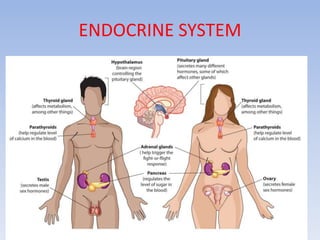
ENDOCRINE SYSTEM
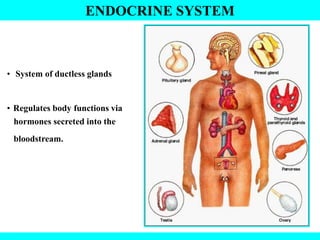
ENDOCRINE SYSTEM
• System of ductless glands
• Regulates body functions via
hormones secreted into the
bloodstream.
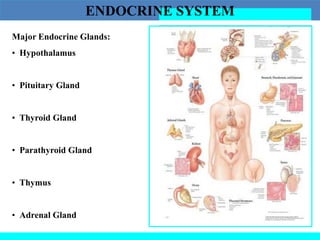
ENDOCRINE SYSTEM
Major Endocrine Glands:
• Hypothalamus
• Pituitary Gland
• Thyroid Gland
• Parathyroid Gland
• Thymus
• Adrenal Gland
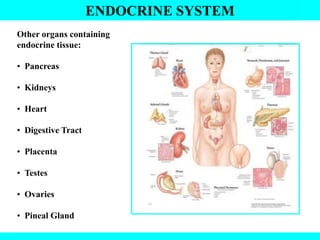
ENDOCRINE SYSTEM
Other organs containing
endocrine tissue:
• Pancreas
• Kidneys
• Heart
• Digestive Tract
• Placenta
• Testes
• Ovaries
• Pineal Gland
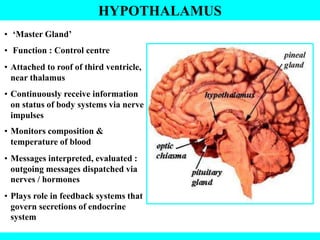
HYPOTHALAMUS
• ‘Master Gland’
• Function : Control centre
• Attached to roof of third ventricle,
near thalamus
• Continuously receive information
on status of body systems via nerve
impulses
• Monitors composition &
temperature of blood
• Messages interpreted, evaluated :
outgoing messages dispatched via
nerves / hormones
• Plays role in feedback systems that
govern secretions of endocrine
system
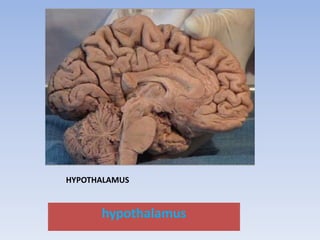
HYPOTHALAMUS
hypothalamus
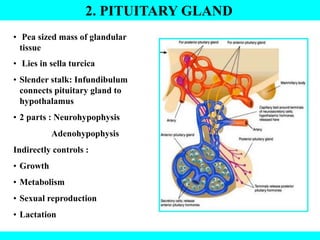
2. PITUITARY GLAND
• Pea sized mass of glandular
tissue
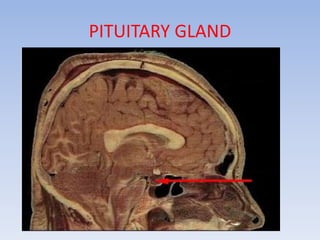
• Lies in sella turcica
• Slender stalk: Infundibulum
connects pituitary gland to
hypothalamus
• 2 parts : Neurohypophysis
Adenohypophysis
Indirectly controls :
• Growth
• Metabolism
• Sexual reproduction
• Lactation
PITUITARY GLAND
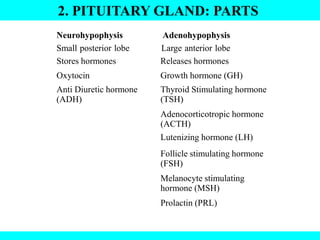
2. PITUITARY GLAND: PARTS
Neurohypophysis Adenohypophysis
Small posterior lobe Large anterior lobe
Stores hormones Releases hormones
Oxytocin Growth hormone (GH)
Anti Diuretic hormone
(ADH)
Thyroid Stimulating hormone
(TSH)
Adenocorticotropic hormone
(ACTH)
Lutenizing hormone (LH)
Follicle stimulating hormone
(FSH)
Melanocyte stimulating
hormone (MSH)
Prolactin (PRL)
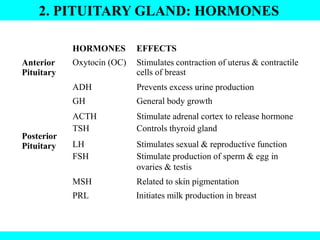
2. PITUITARY GLAND: HORMONES
Anterior
Pituitary
Posterior
Pituitary
HORMONES EFFECTS
Oxytocin (OC) Stimulates contraction of uterus & contractile
cells of breast
ADH Prevents excess urine production
GH General body growth
ACTH Stimulate adrenal cortex to release hormone
TSH Controls thyroid gland
LH Stimulates sexual & reproductive function
FSH Stimulate production of sperm & egg in
ovaries & testis
MSH Related to skin pigmentation
PRL Initiates milk production in breast
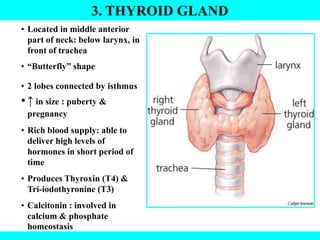
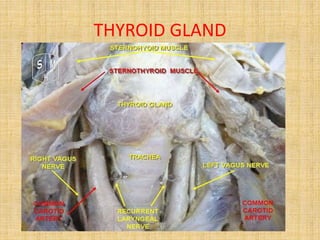
3. THYROID GLAND
• Located in middle anterior
part of neck: below larynx, in
front of trachea
• “Butterfly” shape
• 2 lobes connected by isthmus
• ↑ in size : puberty &
pregnancy
• Rich blood supply: able to
deliver high levels of
hormones in short period of
time
• Produces Thyroxin (T4) &
Tri-iodothyronine (T3)
• Calcitonin : involved in
calcium & phosphate
homeostasis
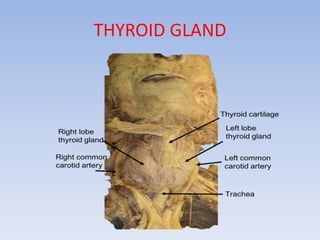
THYROID GLAND
THYROID GLAND
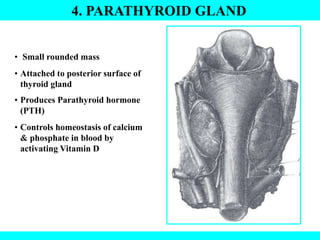
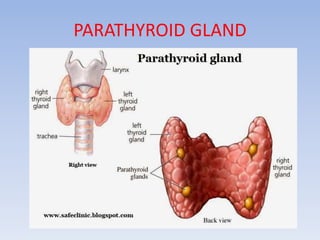
4. PARATHYROID GLAND
• Small rounded mass
• Attached to posterior surface of
thyroid gland
• Produces Parathyroid hormone
(PTH)
• Controls homeostasis of calcium
& phosphate in blood by
activating Vitamin D
PARATHYROID GLAND
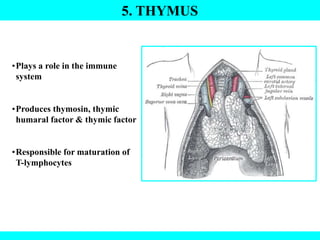
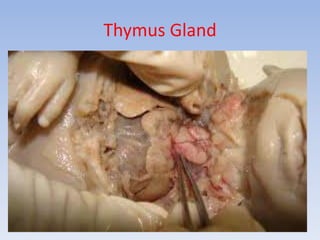
5. THYMUS
•Plays a role in the immune
system
•Produces thymosin, thymic
humaral factor & thymic factor
•Responsible for maturation of
T-lymphocytes
Thymus Gland
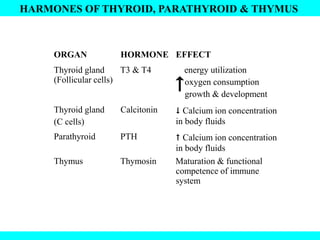
HARMONES OF THYROID, PARATHYROID & THYMUS
↑(Follicular cells)
ORGAN HORMONE EFFECT
Thyroid gland T3 & T4 energy utilization
oxygen consumption
growth & development
Thyroid gland Calcitonin ↓ Calcium ion concentration
(C cells)
Parathyroid PTH
in body fluids
↑ Calcium ion concentration
in body fluids
Thymus Thymosin Maturation & functional
competence of immune
system
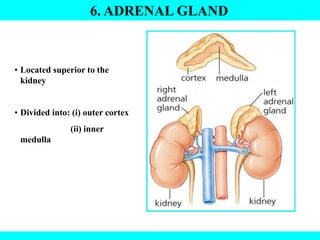
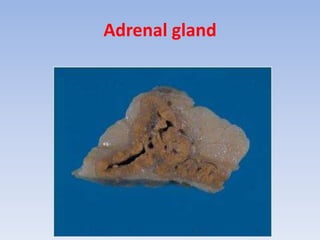
6. ADRENAL GLAND
• Located superior to the
kidney
• Divided into: (i) outer cortex
(ii) inner
medulla
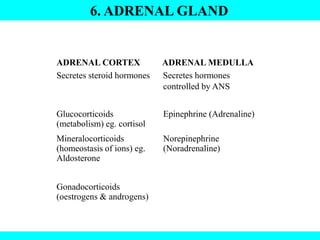
6. ADRENAL GLAND
ADRENAL CORTEX ADRENAL MEDULLA
Secretes steroid hormones Secretes hormones
controlled by ANS
Glucocorticoids
(metabolism) eg. cortisol
Mineralocorticoids
(homeostasis of ions) eg.
Aldosterone
Gonadocorticoids
(oestrogens & androgens)
Epinephrine (Adrenaline)
Norepinephrine
(Noradrenaline)
Adrenal gland
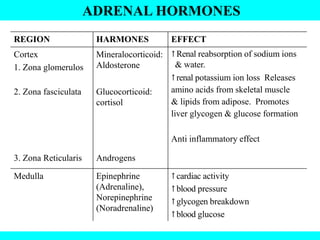
ADRENAL HORMONES
HARMONESREGION
Cortex
1. Zona glomerulos
2. Zona fasciculata
3. Zona Reticularis
Medulla
Mineralocorticoid:
Aldosterone
Glucocorticoid:
cortisol
Androgens
Epinephrine
(Adrenaline),
Norepinephrine
(Noradrenaline)
EFFECT
↑Renal reabsorption of sodium ions
& water.
↑renal potassium ion loss Releases
amino acids from skeletal muscle
& lipids from adipose. Promotes
liver glycogen & glucose formation
Anti inflammatory effect
↑cardiac activity
↑blood pressure
↑glycogen breakdown
↑blood glucose
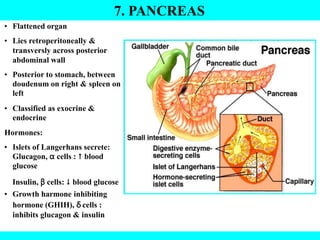
7. PANCREAS
• Flattened organ
• Lies retroperitoneally &
transversly across posterior
abdominal wall
• Posterior to stomach, between
doudenum on right & spleen on
left
• Classified as exocrine &
endocrine
Hormones:
• Islets of Langerhans secrete:
Glucagon, α cells : ↑ blood
glucose
Insulin, β cells: ↓ blood glucose
• Growth harmone inhibiting
hormone (GHIH), δ cells :
inhibits glucagon & insulin
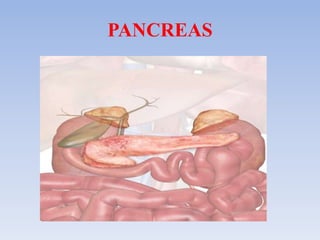
PANCREAS
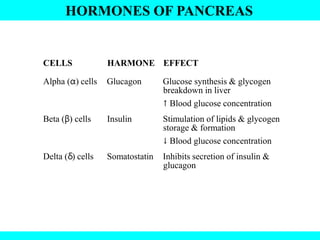
HORMONES OF PANCREAS
CELLS HARMONE EFFECT
Alpha (α) cells Glucagon Glucose synthesis & glycogen
breakdown in liver
↑ Blood glucose concentration
Beta (β) cells Insulin Stimulation of lipids & glycogen
storage & formation
↓ Blood glucose concentration
Delta (δ) cells Somatostatin Inhibits secretion of insulin &
glucagon
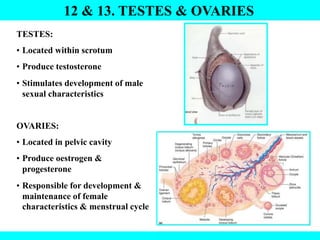
12 & 13. TESTES & OVARIES
TESTES:
• Located within scrotum
• Produce testosterone
• Stimulates development of male
sexual characteristics
OVARIES:
• Located in pelvic cavity
• Produce oestrogen &
progesterone
• Responsible for development &
maintenance of female
characteristics & menstrual cycle
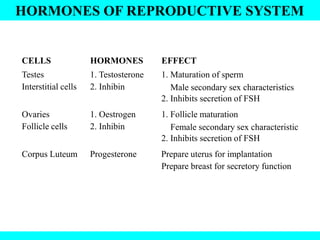
HORMONES OF REPRODUCTIVE SYSTEM
CELLS HORMONES EFFECT
Testes
Interstitial cells
Ovaries
Follicle cells
1. Testosterone
2. Inhibin
1. Oestrogen
2. Inhibin
1. Maturation of sperm
Male secondary sex characteristics
2. Inhibits secretion of FSH
1. Follicle maturation
Female secondary sex characteristic
2. Inhibits secretion of FSH
Corpus Luteum Progesterone Prepare uterus for implantation
Prepare breast for secretory function
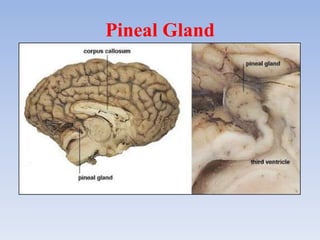
Pineal Gland
Pineal Gland
Pineal gland, also called conarium, epiphysis
cerebri, pineal organ, or pineal
body, endocrine gland found in vertebrates that is the
source of melatonin, a hormone derived
from tryptophan that plays a central role in the
regulation of circadian rhythm (the roughly 24-hour cycle
of biological activities associated with natural periods of
light and darkness).
OTHER ENDOCRINE TISSUES
KIDNEYS:
• Renal Erythropoietic factor: erythropoietin
HEART:
• Atrial Natriuretic factor (ANF)
GIT:
• Stomach gastrin, enteric gastrin, secretin, cholecystokinin,
enterocinin, gastric inhibiting hormone
PLACENTA:
• Human chorionic gonadotropin, oestrogen, progesterone,
relaxin
ENDOCRINE DISORDERS
2 Categories:
• Abnormal hormone production
• Abnormal cellular sensitivity
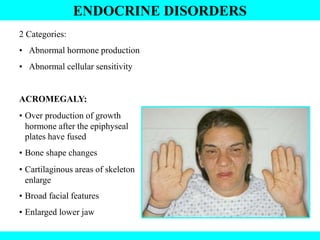
ACROMEGALY:
• Over production of growth
hormone after the epiphyseal
plates have fused
• Bone shape changes
• Cartilaginous areas of skeleton
enlarge
• Broad facial features
• Enlarged lower jaw
2
ENDOCRINE DISORDERS
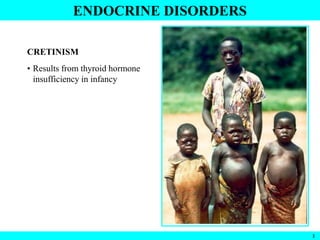
CRETINISM
• Results from thyroid hormone
insufficiency in infancy
ENDOCRINE DISORDERS
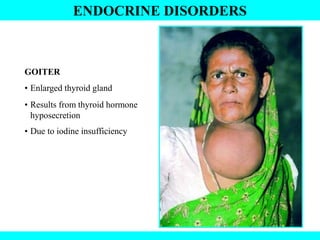
GOITER
• Enlarged thyroid gland
• Results from thyroid hormone
hyposecretion
• Due to iodine insufficiency
ENDOCRINE DISORDERS
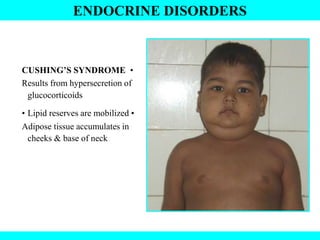
CUSHING’S SYNDROME •
Results from hypersecretion of
glucocorticoids
• Lipid reserves are mobilized •
Adipose tissue accumulates in
cheeks & base of neck
PROSTAGLANDINS
• Regulators of cell metabolism
Important in normal physiology of:
• Smooth muscle
• Blood flow
• Platelet function
• Nerve transmission
• Immune response
• Secretion
• Reproduction
• Respiration
• Fat Metabolism
• Inflammation
Pathology:
• Induce Inflammation
• Promote fever
• Intensify pain
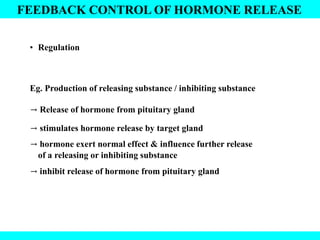
FEEDBACK CONTROL OF HORMONE RELEASE
• Regulation
Eg. Production of releasing substance / inhibiting substance
→ Release of hormone from pituitary gland
→ stimulates hormone release by target gland
→ hormone exert normal effect & influence further release
of a releasing or inhibiting substance
→ inhibit release of hormone from pituitary gland
THANK YOU
IMAGE COLLECTION WEBSITES
https://i0.wp.com/www.aplustopper.com/wp-content/uploads/2016/11/endocrine-glands-1.jpg?resize=2374%2C1448&ssl=1
https://lh3.googleusercontent.com/proxy/KG7AnVhohU0GpwKo_ChjI73Ao8glNraBJ9_H8XRti76_uT0Xgn9t9UbQB0U-
lD1o0n9hpbbnQ9tEW4rttqr4xBE1JCq9eiqxz47L8HtuDsxg0PeapbMmiOqHiDQStE1lxBMadwl7ylJF
https://www.innerbody.com/assets/pancreas.png
https://www.apsubiology.org/anatomy/2010/2010_Exam_Reviews/Exam_5_Final_Review/adrenal_gland_gross.jpg
https://encrypted-tbn0.gstatic.com/images?q=tbn%3AANd9GcQxEr-lpr-
SS0V_aMKfetvNABIQrwVgMwprzgWccSzOearhdUhd&usqp=CAU

endocrine system report PPT ANATOMY

  • 1.
    OGAREV MORDOVIA STATEUNIVERSITY ESSAY ---- ENDOCRINE SYSTEM SUBMITTED BY- DEENANATH GROUP-127A SUBMITTED TO—KADYROV ALISHER SHAVKATOVICH SARANSK 2020
  • 2.
  • 3.
    ENDOCRINE SYSTEM • Systemof ductless glands • Regulates body functions via hormones secreted into the bloodstream.
  • 4.
    ENDOCRINE SYSTEM Major EndocrineGlands: • Hypothalamus • Pituitary Gland • Thyroid Gland • Parathyroid Gland • Thymus • Adrenal Gland
  • 5.
    ENDOCRINE SYSTEM Other organscontaining endocrine tissue: • Pancreas • Kidneys • Heart • Digestive Tract • Placenta • Testes • Ovaries • Pineal Gland
  • 6.
    HYPOTHALAMUS • ‘Master Gland’ •Function : Control centre • Attached to roof of third ventricle, near thalamus • Continuously receive information on status of body systems via nerve impulses • Monitors composition & temperature of blood • Messages interpreted, evaluated : outgoing messages dispatched via nerves / hormones • Plays role in feedback systems that govern secretions of endocrine system
  • 7.
  • 8.
    2. PITUITARY GLAND •Pea sized mass of glandular tissue • Lies in sella turcica • Slender stalk: Infundibulum connects pituitary gland to hypothalamus • 2 parts : Neurohypophysis Adenohypophysis Indirectly controls : • Growth • Metabolism • Sexual reproduction • Lactation
  • 9.
  • 10.
    2. PITUITARY GLAND:PARTS Neurohypophysis Adenohypophysis Small posterior lobe Large anterior lobe Stores hormones Releases hormones Oxytocin Growth hormone (GH) Anti Diuretic hormone (ADH) Thyroid Stimulating hormone (TSH) Adenocorticotropic hormone (ACTH) Lutenizing hormone (LH) Follicle stimulating hormone (FSH) Melanocyte stimulating hormone (MSH) Prolactin (PRL)
  • 11.
    2. PITUITARY GLAND:HORMONES Anterior Pituitary Posterior Pituitary HORMONES EFFECTS Oxytocin (OC) Stimulates contraction of uterus & contractile cells of breast ADH Prevents excess urine production GH General body growth ACTH Stimulate adrenal cortex to release hormone TSH Controls thyroid gland LH Stimulates sexual & reproductive function FSH Stimulate production of sperm & egg in ovaries & testis MSH Related to skin pigmentation PRL Initiates milk production in breast
  • 12.
    3. THYROID GLAND •Located in middle anterior part of neck: below larynx, in front of trachea • “Butterfly” shape • 2 lobes connected by isthmus • ↑ in size : puberty & pregnancy • Rich blood supply: able to deliver high levels of hormones in short period of time • Produces Thyroxin (T4) & Tri-iodothyronine (T3) • Calcitonin : involved in calcium & phosphate homeostasis
  • 13.
  • 14.
  • 15.
    4. PARATHYROID GLAND •Small rounded mass • Attached to posterior surface of thyroid gland • Produces Parathyroid hormone (PTH) • Controls homeostasis of calcium & phosphate in blood by activating Vitamin D
  • 16.
  • 17.
    5. THYMUS •Plays arole in the immune system •Produces thymosin, thymic humaral factor & thymic factor •Responsible for maturation of T-lymphocytes
  • 18.
  • 19.
    HARMONES OF THYROID,PARATHYROID & THYMUS ↑(Follicular cells) ORGAN HORMONE EFFECT Thyroid gland T3 & T4 energy utilization oxygen consumption growth & development Thyroid gland Calcitonin ↓ Calcium ion concentration (C cells) Parathyroid PTH in body fluids ↑ Calcium ion concentration in body fluids Thymus Thymosin Maturation & functional competence of immune system
  • 20.
    6. ADRENAL GLAND •Located superior to the kidney • Divided into: (i) outer cortex (ii) inner medulla
  • 21.
    6. ADRENAL GLAND ADRENALCORTEX ADRENAL MEDULLA Secretes steroid hormones Secretes hormones controlled by ANS Glucocorticoids (metabolism) eg. cortisol Mineralocorticoids (homeostasis of ions) eg. Aldosterone Gonadocorticoids (oestrogens & androgens) Epinephrine (Adrenaline) Norepinephrine (Noradrenaline)
  • 22.
  • 23.
    ADRENAL HORMONES HARMONESREGION Cortex 1. Zonaglomerulos 2. Zona fasciculata 3. Zona Reticularis Medulla Mineralocorticoid: Aldosterone Glucocorticoid: cortisol Androgens Epinephrine (Adrenaline), Norepinephrine (Noradrenaline) EFFECT ↑Renal reabsorption of sodium ions & water. ↑renal potassium ion loss Releases amino acids from skeletal muscle & lipids from adipose. Promotes liver glycogen & glucose formation Anti inflammatory effect ↑cardiac activity ↑blood pressure ↑glycogen breakdown ↑blood glucose
  • 24.
    7. PANCREAS • Flattenedorgan • Lies retroperitoneally & transversly across posterior abdominal wall • Posterior to stomach, between doudenum on right & spleen on left • Classified as exocrine & endocrine Hormones: • Islets of Langerhans secrete: Glucagon, α cells : ↑ blood glucose Insulin, β cells: ↓ blood glucose • Growth harmone inhibiting hormone (GHIH), δ cells : inhibits glucagon & insulin
  • 25.
  • 26.
    HORMONES OF PANCREAS CELLSHARMONE EFFECT Alpha (α) cells Glucagon Glucose synthesis & glycogen breakdown in liver ↑ Blood glucose concentration Beta (β) cells Insulin Stimulation of lipids & glycogen storage & formation ↓ Blood glucose concentration Delta (δ) cells Somatostatin Inhibits secretion of insulin & glucagon
  • 27.
    12 & 13.TESTES & OVARIES TESTES: • Located within scrotum • Produce testosterone • Stimulates development of male sexual characteristics OVARIES: • Located in pelvic cavity • Produce oestrogen & progesterone • Responsible for development & maintenance of female characteristics & menstrual cycle
  • 28.
    HORMONES OF REPRODUCTIVESYSTEM CELLS HORMONES EFFECT Testes Interstitial cells Ovaries Follicle cells 1. Testosterone 2. Inhibin 1. Oestrogen 2. Inhibin 1. Maturation of sperm Male secondary sex characteristics 2. Inhibits secretion of FSH 1. Follicle maturation Female secondary sex characteristic 2. Inhibits secretion of FSH Corpus Luteum Progesterone Prepare uterus for implantation Prepare breast for secretory function
  • 29.
  • 30.
    Pineal Gland Pineal gland,also called conarium, epiphysis cerebri, pineal organ, or pineal body, endocrine gland found in vertebrates that is the source of melatonin, a hormone derived from tryptophan that plays a central role in the regulation of circadian rhythm (the roughly 24-hour cycle of biological activities associated with natural periods of light and darkness).
  • 31.
    OTHER ENDOCRINE TISSUES KIDNEYS: •Renal Erythropoietic factor: erythropoietin HEART: • Atrial Natriuretic factor (ANF) GIT: • Stomach gastrin, enteric gastrin, secretin, cholecystokinin, enterocinin, gastric inhibiting hormone PLACENTA: • Human chorionic gonadotropin, oestrogen, progesterone, relaxin
  • 32.
    ENDOCRINE DISORDERS 2 Categories: •Abnormal hormone production • Abnormal cellular sensitivity ACROMEGALY: • Over production of growth hormone after the epiphyseal plates have fused • Bone shape changes • Cartilaginous areas of skeleton enlarge • Broad facial features • Enlarged lower jaw
  • 33.
    2 ENDOCRINE DISORDERS CRETINISM • Resultsfrom thyroid hormone insufficiency in infancy
  • 34.
    ENDOCRINE DISORDERS GOITER • Enlargedthyroid gland • Results from thyroid hormone hyposecretion • Due to iodine insufficiency
  • 35.
    ENDOCRINE DISORDERS CUSHING’S SYNDROME• Results from hypersecretion of glucocorticoids • Lipid reserves are mobilized • Adipose tissue accumulates in cheeks & base of neck
  • 36.
    PROSTAGLANDINS • Regulators ofcell metabolism Important in normal physiology of: • Smooth muscle • Blood flow • Platelet function • Nerve transmission • Immune response • Secretion • Reproduction • Respiration • Fat Metabolism • Inflammation Pathology: • Induce Inflammation • Promote fever • Intensify pain
  • 37.
    FEEDBACK CONTROL OFHORMONE RELEASE • Regulation Eg. Production of releasing substance / inhibiting substance → Release of hormone from pituitary gland → stimulates hormone release by target gland → hormone exert normal effect & influence further release of a releasing or inhibiting substance → inhibit release of hormone from pituitary gland
  • 38.
    THANK YOU IMAGE COLLECTIONWEBSITES https://i0.wp.com/www.aplustopper.com/wp-content/uploads/2016/11/endocrine-glands-1.jpg?resize=2374%2C1448&ssl=1 https://lh3.googleusercontent.com/proxy/KG7AnVhohU0GpwKo_ChjI73Ao8glNraBJ9_H8XRti76_uT0Xgn9t9UbQB0U- lD1o0n9hpbbnQ9tEW4rttqr4xBE1JCq9eiqxz47L8HtuDsxg0PeapbMmiOqHiDQStE1lxBMadwl7ylJF https://www.innerbody.com/assets/pancreas.png https://www.apsubiology.org/anatomy/2010/2010_Exam_Reviews/Exam_5_Final_Review/adrenal_gland_gross.jpg https://encrypted-tbn0.gstatic.com/images?q=tbn%3AANd9GcQxEr-lpr- SS0V_aMKfetvNABIQrwVgMwprzgWccSzOearhdUhd&usqp=CAU