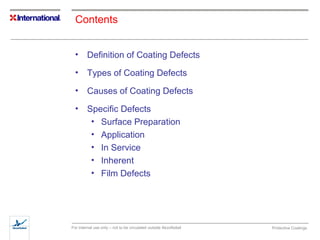
Coating Defects 
For internal use only – not to be circulated outside AkzoNobel Protective Coatings
Contents 
• Definition of Coating Defects 
• Types of Coating Defects 
• Causes of Coating Defects 
• Specific Defects 
• Surface Preparation 
• Application 
• In Service 
• Inherent 
• Film Defects 
For internal use only – not to be circulated outside AkzoNobel Protective Coatings
Definition & Types of Coating Defects 
Flaw that spoils the required appearance and specified 
performance of a painted surface 
Types of Defects 
• Blistering 
• Bleeding 
• Poor Coverage 
• Loss of Gloss 
• Loss of Adhesion 
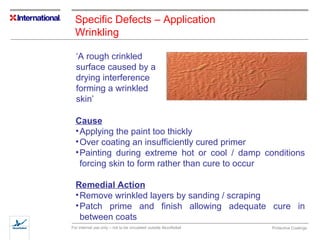
• Wrinkling 
• Spray dust/Overspray 
• Rash Rusting 
• Pinholes 
• Cratering 
• Chalking 
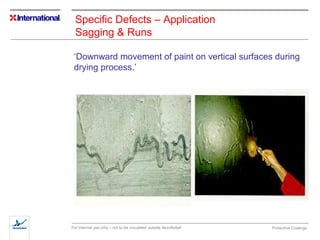
• Runs 
• Orange Peel 
For internal use only – not to be circulated outside AkzoNobel Protective Coatings
Causes of Coating Defects 
 Poor surface preparation 
• Surface contamination 
• Surface profile 
 Poor application 
• Mixing (1-pack & 2-pack) 
• Use of brush & roller (low dft per coat) 
• Use of spraying (low or high dft per coat) 
For internal use only – not to be circulated outside AkzoNobel Protective Coatings
Causes of Coating Defects 
 Incorrect Paint Systems 
• eg 2-pack over 1-pack systems 
• Incorrect system for the environment 
• eg Anticorrosive or Antifouling performance needs 
 Poor Engineering Design 
• Inherent design defects (eg stitch welding) 
 Poor Quality of Paints 
• Product/batch related problems 
For internal use only – not to be circulated outside AkzoNobel Protective Coatings
Specific Defects – Surface Preparation 
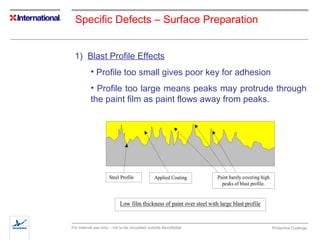
1) Blast Profile Effects 
• Profile too small gives poor key for adhesion 
• Profile too large means peaks may protrude through 
the paint film as paint flows away from peaks. 
Steel Profile Paint barely covering high 
peaks of blast profile. 
Applied Coating 
Low film thickness of paint over steel with large blast profile 
For internal use only – not to be circulated outside AkzoNobel Protective Coatings
Specific Defects – Surface Preparation 
2) Cissing 
• Due to contamination of the surface, (eg where paint 
can not wet the surface fully) or in the paint. 
• The wet paint appears to retract from some areas, 
and this is often associated with oil or other 
contamination of the surface 
3) Millscale effects 
• Detachment & Galvanic Corrosion. 
For internal use only – not to be circulated outside AkzoNobel Protective Coatings
Specific Defects – Surface Preparation 
4) Welding Issues 
• Painting over weld flux residues can cause problems 
as it is hygroscopic (absorbs water and then dissolves 
in it) and corrosion will break through the coating at 
these points 
• Paint applied over weld spatter will show early 
breakdown, due to shrinkage stress in the coating. 
For internal use only – not to be circulated outside AkzoNobel Protective Coatings
Specific Defects – Application 
1) Blooming 
• surface effect if amine & amine-adduct cured 
epoxies contact with water before full cure. 
• unreacted curing agent takes up moisture. 
• not detrimental to film performance but must be 
removed (solvent wiping) before painting. 
2) Blushing 
• White surface film soon after application at high 
humidity due to condensation in the film. 
For internal use only – not to be circulated outside AkzoNobel Protective Coatings
Specific Defects – Application 
3) Dry Spray 
• To coalesce and form a continuous film, paint must 
still be fluid when it reaches the surface. 
Target steel 
(panel, ship etc) 
Spray 
Gun 
Wet Paint merging 
from spray tip. 
Evapouration of solvent from 
atomised droplets before they 
can reach the surface.. 
For internal use only – not to be circulated outside AkzoNobel Protective Coatings
Specific Defects – Application 
4) Lapping 
• Brush strokes & spray pass stay visible after drying. 
• Most obvious on paints with fast solvents on hot 
steel - especially if aluminium pigmented. 
• Adding slow solvents can help - or end passes at 
welds. 
5) Pin holing 
• Circular pits which appear to be free of paint. 
• Bubbles break at a stage where the coating has 
already dried too much for it to flow and repair the 
broken surface. 
For internal use only – not to be circulated outside AkzoNobel Protective Coatings
Specific Defects – Application 
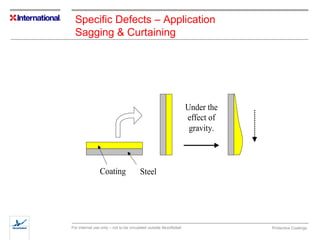
6) Sagging & Curtaining 
Weight of paint on a surface is too much for the flow 
properties of the paint to support, due to:- 
a) Too high thickness applied. 
b) Too much thinner added to the paint. 
c) Not enough thixotropy for expected wft. 
d) Temperature too low / solvent too slow. 
7) Wrinkling 
Common on alkyds at high dft, where surface drying 
of the film occurs while the under portion of the film 
remains soft for a longer time 
For internal use only – not to be circulated outside AkzoNobel Protective Coatings
Specific Defects – Application 
Sagging & Curtaining 
Under the 
effect of 
gravity. 
Coating Steel 
For internal use only – not to be circulated outside AkzoNobel Protective Coatings
Specific Defects – Application 
Sagging & Runs 
‘Downward movement of paint on vertical surfaces during 
drying process.’ 
For internal use only – not to be circulated outside AkzoNobel Protective Coatings
Specific Defects – Application 
Wrinkling 
‘A rough crinkled 
surface caused by a 
drying interference 
forming a wrinkled 
skin’ 
Cause 
•Applying the paint too thickly 
•Over coating an insufficiently cured primer 
•Painting during extreme hot or cool / damp conditions 
forcing skin to form rather than cure to occur 
Remedial Action 
•Remove wrinkled layers by sanding / scraping 
•Patch prime and finish allowing adequate cure in 
between coats 
For internal use only – not to be circulated outside AkzoNobel Protective Coatings
Specific Defects – In Service 
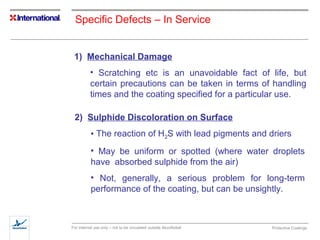
1) Mechanical Damage 
• Scratching etc is an unavoidable fact of life, but 
certain precautions can be taken in terms of handling 
times and the coating specified for a particular use. 
2) Sulphide Discoloration on Surface 
• The reaction of H2S with lead pigments and driers 
• May be uniform or spotted (where water droplets 
have absorbed sulphide from the air) 
• Not, generally, a serious problem for long-term 
performance of the coating, but can be unsightly. 
For internal use only – not to be circulated outside AkzoNobel Protective Coatings
Specific Defects – Inherent 
1) Bleeding 
• some pigments are solvent soluble 
• Tar & Bituminous coatings will bleed through if next 
coat has strong solvents 
2) Chalking 
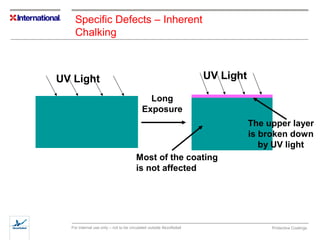
• Common for epoxies, as UV degradation of the resin 
at the surface causes breakdown and the release of 
pigment particles. 
• It is a surface effect only, and not associated with a 
true failure. However, surface dust must be washed off 
before applying further coats. 
For internal use only – not to be circulated outside AkzoNobel Protective Coatings
Specific Defects – Inherent 
Chalking 
UV Light 
Long 
Exposure 
UV Light 
Most of the coating 
is not affected 
The upper layer 
is broken down 
by UV light 
For internal use only – not to be circulated outside AkzoNobel Protective Coatings
Specific Defects – Inherent 
3) Reduced inhibiting effect on weathering 
• Primers are formulated to protect steel from 
corroding, and topcoats are to protect the primers 
from weathering. 
• If primer is exposed, soluble salts will be leached 
away. 
• In red oxide primers, effect might not be obvious, 
but when they are overcoated, rapid breakdown 
occurs. 
For internal use only – not to be circulated outside AkzoNobel Protective Coatings
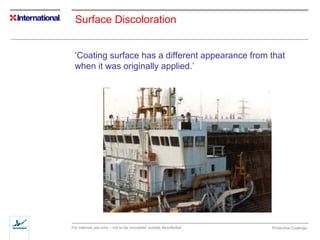
Surface Discoloration 
‘Coating surface has a different appearance from that 
when it was originally applied.’ 
For internal use only – not to be circulated outside AkzoNobel Protective Coatings
Specific Defects – Film Defects 
1) Blistering 
Caused by:- 
• painting over moisture 
• painting over soluble salts 
• solvent entrapment 
• coating permeability to gas 
• excessive Cathodic Protection 
• painting over porous surfaces 
For internal use only – not to be circulated outside AkzoNobel Protective Coatings
Specific Defects – Film Defects 
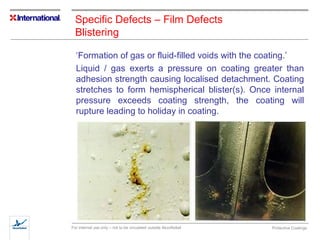
Blistering 
‘Formation of gas or fluid-filled voids with the coating.’ 
Liquid / gas exerts a pressure on coating greater than 
adhesion strength causing localised detachment. Coating 
stretches to form hemispherical blister(s). Once internal 
pressure exceeds coating strength, the coating will 
rupture leading to holiday in coating. 
For internal use only – not to be circulated outside AkzoNobel Protective Coatings
Specific Defects – Film Defects 
2) Bubbling 
Caused by:- 
• Painting over porous substrates (eg Zinc Silicate) 
and displacement of air - Mist Coats. 
• Wrong application method - some enamels bubble if 
applied by roller if warm and windy. 
• Applying low solids coatings at high dft where 
surface dries while solvent is still trying to escape, 
resulting in a mass of tiny bubbles. 
For internal use only – not to be circulated outside AkzoNobel Protective Coatings
Specific Defects – Film Defects 
3) Checking 
• Surface cracking which does not penetrate right 
through the topcoat - and may need a lens to see it. 
• Caused by contraction of the topcoat of paint, and 
common in dark chlorinated rubbers in hot climates. 
For internal use only – not to be circulated outside AkzoNobel Protective Coatings
Specific Defects – Film Defects 
4) Cracking 
• Fracture of at least the topcoat of paint with ageing, 
and occurs when the substrate and coating expand 
and contract at different rates. 
• As paint films age, they become harder and less 
flexible and so “Something has to give”. 
• Thin films tend to crack less than thick films. 
For internal use only – not to be circulated outside AkzoNobel Protective Coatings
Specific Defects – Film Defects 
Cracking 
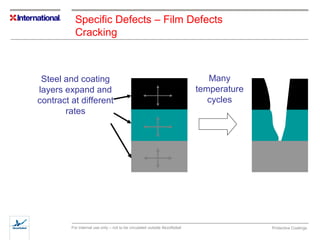
Steel and coating 
layers expand and 
contract at different 
rates 
Many 
temperature 
cycles 
For internal use only – not to be circulated outside AkzoNobel Protective Coatings
Different Types of Cracking 
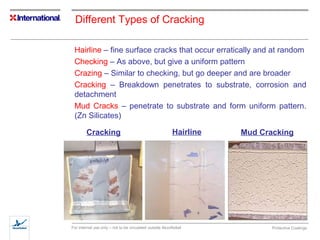
Hairline – fine surface cracks that occur erratically and at random 
Checking – As above, but give a uniform pattern 
Crazing – Similar to checking, but go deeper and are broader 
Cracking – Breakdown penetrates to substrate, corrosion and 
detachment 
Mud Cracks – penetrate to substrate and form uniform pattern. 
(Zn Silicates) 
Cracking Hairline Mud Cracking 
For internal use only – not to be circulated outside AkzoNobel Protective Coatings
Specific Defects – Film Defects 
5) Corrosion (Rash Rusting) 
Caused by:- 
• low film thickness 
• poor surface preparation 
• Wrong selection of coating system 
For internal use only – not to be circulated outside AkzoNobel Protective Coatings
Specific Defects – Film Defects 
Liquid Paint 
6) Edge & Corner failure 
• Liquids draw away from sharp points. 
• Use Stripe Coating to can overcome this. 
For internal use only – not to be circulated outside AkzoNobel Protective Coatings
Specific Defects – Film Defects 
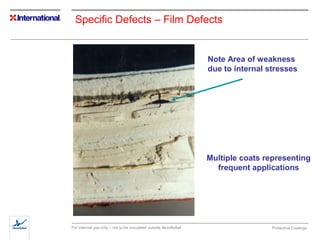
7) Peeling, Flaking & Delaminating (Detaching) 
• Reporting “there is serious detachment” does not 
give much information - or help to provide a solution. 
• Peeling - when paint curls off a substrate. 
• Flaking - when paint detaches in flakes. 
• Delaminating - intercoat adhesion failure. 
For internal use only – not to be circulated outside AkzoNobel Protective Coatings
Specific Defects – Film Defects 
Note Area of weakness 
due to internal stresses 
Multiple coats representing 
frequent applications 
For internal use only – not to be circulated outside AkzoNobel Protective Coatings
Specific Defects – Film Defects 
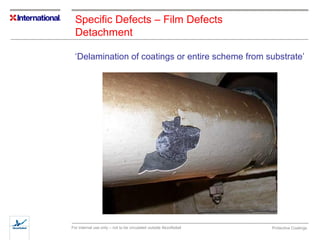
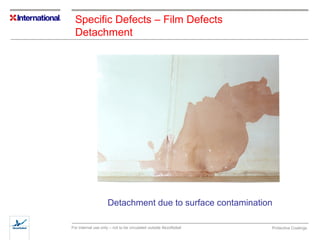
Detachment 
‘Delamination of coatings or entire scheme from substrate’ 
For internal use only – not to be circulated outside AkzoNobel Protective Coatings
Specific Defects – Film Defects 
Detachment 
Detachment due to surface contamination 
For internal use only – not to be circulated outside AkzoNobel Protective Coatings
Specific Defects – Film Defects 
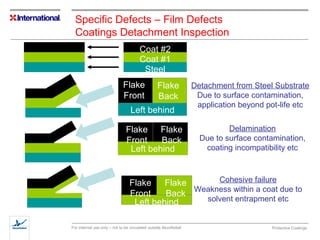
Coatings Detachment Inspection 
Coat #2 
Coat #1 
Steel 
Flake 
Front 
Flake 
Back 
Left behind 
Flake 
Front 
Flake 
Back 
Left behind 
Flake 
Front 
Flake 
Back 
Left behind 
Detachment from Steel Substrate 
Due to surface contamination, 
application beyond pot-life etc 
Delamination 
Due to surface contamination, 
coating incompatibility etc 
Cohesive failure 
Weakness within a coat due to 
solvent entrapment etc 
For internal use only – not to be circulated outside AkzoNobel Protective Coatings
Final Thoughts & Suggestions 
• Zinc-rich coatings such as epoxy zinc and zinc 
silicates have quite a number of advantages where top 
coating is to be performed, as these do not suffer most 
of the problems described. 
• Do not allow subcontractors to amend or adjust any 
surface preparation or coating system specified, 
however well-meaning their intentions may be. 
• It is the usual practices that have been followed for 
years that are as wrong now as they were then. 
• Always seek professional and reliable advice while 
preparing coating specifications. 
For internal use only – not to be circulated outside AkzoNobel Protective Coatings
www.international-pc.com 
Thank You 
For internal use only – not to be circulated outside AkzoNobel Protective Coatings

coating defects

  • 1.
    Coating Defects Forinternal use only – not to be circulated outside AkzoNobel Protective Coatings
  • 2.
    Contents • Definitionof Coating Defects • Types of Coating Defects • Causes of Coating Defects • Specific Defects • Surface Preparation • Application • In Service • Inherent • Film Defects For internal use only – not to be circulated outside AkzoNobel Protective Coatings
  • 3.
    Definition & Typesof Coating Defects Flaw that spoils the required appearance and specified performance of a painted surface Types of Defects • Blistering • Bleeding • Poor Coverage • Loss of Gloss • Loss of Adhesion • Wrinkling • Spray dust/Overspray • Rash Rusting • Pinholes • Cratering • Chalking • Runs • Orange Peel For internal use only – not to be circulated outside AkzoNobel Protective Coatings
  • 4.
    Causes of CoatingDefects  Poor surface preparation • Surface contamination • Surface profile  Poor application • Mixing (1-pack & 2-pack) • Use of brush & roller (low dft per coat) • Use of spraying (low or high dft per coat) For internal use only – not to be circulated outside AkzoNobel Protective Coatings
  • 5.
    Causes of CoatingDefects  Incorrect Paint Systems • eg 2-pack over 1-pack systems • Incorrect system for the environment • eg Anticorrosive or Antifouling performance needs  Poor Engineering Design • Inherent design defects (eg stitch welding)  Poor Quality of Paints • Product/batch related problems For internal use only – not to be circulated outside AkzoNobel Protective Coatings
  • 6.
    Specific Defects –Surface Preparation 1) Blast Profile Effects • Profile too small gives poor key for adhesion • Profile too large means peaks may protrude through the paint film as paint flows away from peaks. Steel Profile Paint barely covering high peaks of blast profile. Applied Coating Low film thickness of paint over steel with large blast profile For internal use only – not to be circulated outside AkzoNobel Protective Coatings
  • 7.
    Specific Defects –Surface Preparation 2) Cissing • Due to contamination of the surface, (eg where paint can not wet the surface fully) or in the paint. • The wet paint appears to retract from some areas, and this is often associated with oil or other contamination of the surface 3) Millscale effects • Detachment & Galvanic Corrosion. For internal use only – not to be circulated outside AkzoNobel Protective Coatings
  • 8.
    Specific Defects –Surface Preparation 4) Welding Issues • Painting over weld flux residues can cause problems as it is hygroscopic (absorbs water and then dissolves in it) and corrosion will break through the coating at these points • Paint applied over weld spatter will show early breakdown, due to shrinkage stress in the coating. For internal use only – not to be circulated outside AkzoNobel Protective Coatings
  • 9.
    Specific Defects –Application 1) Blooming • surface effect if amine & amine-adduct cured epoxies contact with water before full cure. • unreacted curing agent takes up moisture. • not detrimental to film performance but must be removed (solvent wiping) before painting. 2) Blushing • White surface film soon after application at high humidity due to condensation in the film. For internal use only – not to be circulated outside AkzoNobel Protective Coatings
  • 10.
    Specific Defects –Application 3) Dry Spray • To coalesce and form a continuous film, paint must still be fluid when it reaches the surface. Target steel (panel, ship etc) Spray Gun Wet Paint merging from spray tip. Evapouration of solvent from atomised droplets before they can reach the surface.. For internal use only – not to be circulated outside AkzoNobel Protective Coatings
  • 11.
    Specific Defects –Application 4) Lapping • Brush strokes & spray pass stay visible after drying. • Most obvious on paints with fast solvents on hot steel - especially if aluminium pigmented. • Adding slow solvents can help - or end passes at welds. 5) Pin holing • Circular pits which appear to be free of paint. • Bubbles break at a stage where the coating has already dried too much for it to flow and repair the broken surface. For internal use only – not to be circulated outside AkzoNobel Protective Coatings
  • 12.
    Specific Defects –Application 6) Sagging & Curtaining Weight of paint on a surface is too much for the flow properties of the paint to support, due to:- a) Too high thickness applied. b) Too much thinner added to the paint. c) Not enough thixotropy for expected wft. d) Temperature too low / solvent too slow. 7) Wrinkling Common on alkyds at high dft, where surface drying of the film occurs while the under portion of the film remains soft for a longer time For internal use only – not to be circulated outside AkzoNobel Protective Coatings
  • 13.
    Specific Defects –Application Sagging & Curtaining Under the effect of gravity. Coating Steel For internal use only – not to be circulated outside AkzoNobel Protective Coatings
  • 14.
    Specific Defects –Application Sagging & Runs ‘Downward movement of paint on vertical surfaces during drying process.’ For internal use only – not to be circulated outside AkzoNobel Protective Coatings
  • 15.
    Specific Defects –Application Wrinkling ‘A rough crinkled surface caused by a drying interference forming a wrinkled skin’ Cause •Applying the paint too thickly •Over coating an insufficiently cured primer •Painting during extreme hot or cool / damp conditions forcing skin to form rather than cure to occur Remedial Action •Remove wrinkled layers by sanding / scraping •Patch prime and finish allowing adequate cure in between coats For internal use only – not to be circulated outside AkzoNobel Protective Coatings
  • 16.
    Specific Defects –In Service 1) Mechanical Damage • Scratching etc is an unavoidable fact of life, but certain precautions can be taken in terms of handling times and the coating specified for a particular use. 2) Sulphide Discoloration on Surface • The reaction of H2S with lead pigments and driers • May be uniform or spotted (where water droplets have absorbed sulphide from the air) • Not, generally, a serious problem for long-term performance of the coating, but can be unsightly. For internal use only – not to be circulated outside AkzoNobel Protective Coatings
  • 17.
    Specific Defects –Inherent 1) Bleeding • some pigments are solvent soluble • Tar & Bituminous coatings will bleed through if next coat has strong solvents 2) Chalking • Common for epoxies, as UV degradation of the resin at the surface causes breakdown and the release of pigment particles. • It is a surface effect only, and not associated with a true failure. However, surface dust must be washed off before applying further coats. For internal use only – not to be circulated outside AkzoNobel Protective Coatings
  • 18.
    Specific Defects –Inherent Chalking UV Light Long Exposure UV Light Most of the coating is not affected The upper layer is broken down by UV light For internal use only – not to be circulated outside AkzoNobel Protective Coatings
  • 19.
    Specific Defects –Inherent 3) Reduced inhibiting effect on weathering • Primers are formulated to protect steel from corroding, and topcoats are to protect the primers from weathering. • If primer is exposed, soluble salts will be leached away. • In red oxide primers, effect might not be obvious, but when they are overcoated, rapid breakdown occurs. For internal use only – not to be circulated outside AkzoNobel Protective Coatings
  • 20.
    Surface Discoloration ‘Coatingsurface has a different appearance from that when it was originally applied.’ For internal use only – not to be circulated outside AkzoNobel Protective Coatings
  • 21.
    Specific Defects –Film Defects 1) Blistering Caused by:- • painting over moisture • painting over soluble salts • solvent entrapment • coating permeability to gas • excessive Cathodic Protection • painting over porous surfaces For internal use only – not to be circulated outside AkzoNobel Protective Coatings
  • 22.
    Specific Defects –Film Defects Blistering ‘Formation of gas or fluid-filled voids with the coating.’ Liquid / gas exerts a pressure on coating greater than adhesion strength causing localised detachment. Coating stretches to form hemispherical blister(s). Once internal pressure exceeds coating strength, the coating will rupture leading to holiday in coating. For internal use only – not to be circulated outside AkzoNobel Protective Coatings
  • 23.
    Specific Defects –Film Defects 2) Bubbling Caused by:- • Painting over porous substrates (eg Zinc Silicate) and displacement of air - Mist Coats. • Wrong application method - some enamels bubble if applied by roller if warm and windy. • Applying low solids coatings at high dft where surface dries while solvent is still trying to escape, resulting in a mass of tiny bubbles. For internal use only – not to be circulated outside AkzoNobel Protective Coatings
  • 24.
    Specific Defects –Film Defects 3) Checking • Surface cracking which does not penetrate right through the topcoat - and may need a lens to see it. • Caused by contraction of the topcoat of paint, and common in dark chlorinated rubbers in hot climates. For internal use only – not to be circulated outside AkzoNobel Protective Coatings
  • 25.
    Specific Defects –Film Defects 4) Cracking • Fracture of at least the topcoat of paint with ageing, and occurs when the substrate and coating expand and contract at different rates. • As paint films age, they become harder and less flexible and so “Something has to give”. • Thin films tend to crack less than thick films. For internal use only – not to be circulated outside AkzoNobel Protective Coatings
  • 26.
    Specific Defects –Film Defects Cracking Steel and coating layers expand and contract at different rates Many temperature cycles For internal use only – not to be circulated outside AkzoNobel Protective Coatings
  • 27.
    Different Types ofCracking Hairline – fine surface cracks that occur erratically and at random Checking – As above, but give a uniform pattern Crazing – Similar to checking, but go deeper and are broader Cracking – Breakdown penetrates to substrate, corrosion and detachment Mud Cracks – penetrate to substrate and form uniform pattern. (Zn Silicates) Cracking Hairline Mud Cracking For internal use only – not to be circulated outside AkzoNobel Protective Coatings
  • 28.
    Specific Defects –Film Defects 5) Corrosion (Rash Rusting) Caused by:- • low film thickness • poor surface preparation • Wrong selection of coating system For internal use only – not to be circulated outside AkzoNobel Protective Coatings
  • 29.
    Specific Defects –Film Defects Liquid Paint 6) Edge & Corner failure • Liquids draw away from sharp points. • Use Stripe Coating to can overcome this. For internal use only – not to be circulated outside AkzoNobel Protective Coatings
  • 30.
    Specific Defects –Film Defects 7) Peeling, Flaking & Delaminating (Detaching) • Reporting “there is serious detachment” does not give much information - or help to provide a solution. • Peeling - when paint curls off a substrate. • Flaking - when paint detaches in flakes. • Delaminating - intercoat adhesion failure. For internal use only – not to be circulated outside AkzoNobel Protective Coatings
  • 31.
    Specific Defects –Film Defects Note Area of weakness due to internal stresses Multiple coats representing frequent applications For internal use only – not to be circulated outside AkzoNobel Protective Coatings
  • 32.
    Specific Defects –Film Defects Detachment ‘Delamination of coatings or entire scheme from substrate’ For internal use only – not to be circulated outside AkzoNobel Protective Coatings
  • 33.
    Specific Defects –Film Defects Detachment Detachment due to surface contamination For internal use only – not to be circulated outside AkzoNobel Protective Coatings
  • 34.
    Specific Defects –Film Defects Coatings Detachment Inspection Coat #2 Coat #1 Steel Flake Front Flake Back Left behind Flake Front Flake Back Left behind Flake Front Flake Back Left behind Detachment from Steel Substrate Due to surface contamination, application beyond pot-life etc Delamination Due to surface contamination, coating incompatibility etc Cohesive failure Weakness within a coat due to solvent entrapment etc For internal use only – not to be circulated outside AkzoNobel Protective Coatings
  • 35.
    Final Thoughts &Suggestions • Zinc-rich coatings such as epoxy zinc and zinc silicates have quite a number of advantages where top coating is to be performed, as these do not suffer most of the problems described. • Do not allow subcontractors to amend or adjust any surface preparation or coating system specified, however well-meaning their intentions may be. • It is the usual practices that have been followed for years that are as wrong now as they were then. • Always seek professional and reliable advice while preparing coating specifications. For internal use only – not to be circulated outside AkzoNobel Protective Coatings
  • 36.
    www.international-pc.com Thank You For internal use only – not to be circulated outside AkzoNobel Protective Coatings