@agilesensei

After reading this,

introduce yourself
to a person seated
next to you.
Tell this person
why you are here
and what you want
to learn.
written, illustrated and
performed by

Claudio Perrone
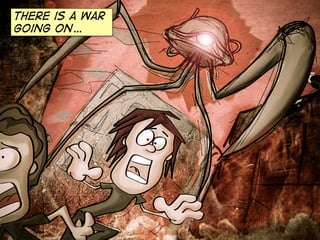
There is a war
Going on…
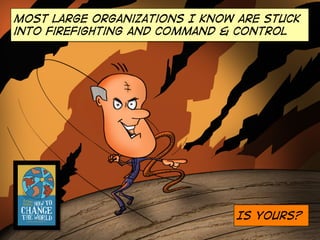
Most large organizations I know are stuck
into firefighting and command & control

Is Yours?
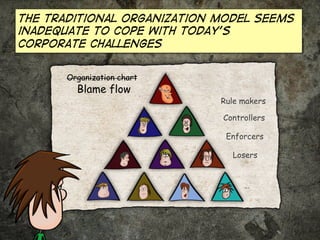
The traditional organization model seems
inadequate to cope with today’s
corporate challenges
Organization chart

Blame flow

Rule makers
Controllers
Enforcers
Losers
…
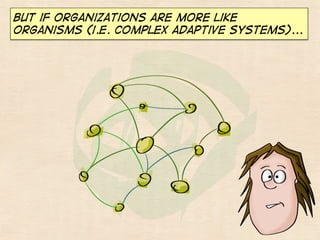
But if organizations are more like
organisms (i.e. complex adaptive systems)...
... How can we encourage and support
everyone to be responsible for change?
I looked for clues when I attempted to...
1
Leverage and
celebrate
everyone’s
improvement
ideas
Who are the
heroes in a
firefighting
company?
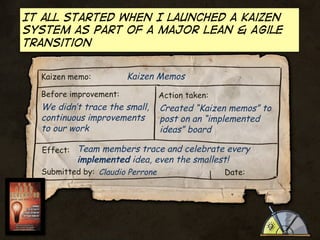
It all started when I launched a kaizen
system as part of a major Lean & Agile
transition
Kaizen memo:

Kaizen Memos

Before improvement:

We didn’t trace the small,
continuous improvements
to our work

Action taken:

Created “Kaizen memos” to
post on an “implemented
ideas” board

Effect: Team members trace and celebrate every

implemented idea, even the smallest!

Submitted by: Claudio Perrone

Date:
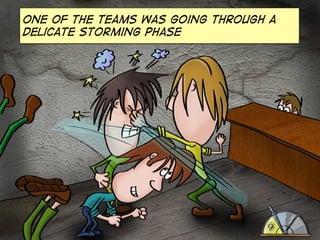
One of the teams was going through a
delicate storming phase
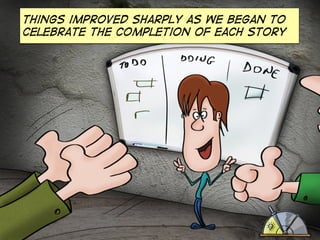
Things improved sharply as we began to
celebrate the completion of each story
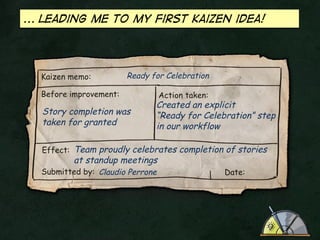
... leading me to my first kaizen idea!

Kaizen memo:

Ready for Celebration

Before improvement:

Story completion was
taken for granted

Action taken:

Created an explicit
“Ready for Celebration” step
in our workflow

Effect: Team proudly celebrates completion of stories

at standup meetings

Submitted by: Claudio Perrone

Date:
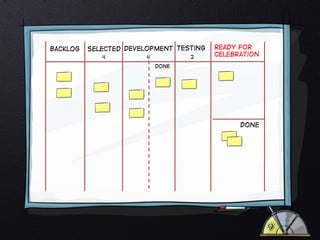
Backlog

Selected Development Testing
4

2

4

Ready for
celebration

Done

Done
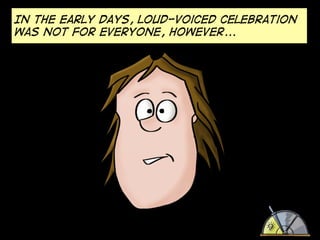
In the early days, loud-voiced celebration
was not for everyone, however...
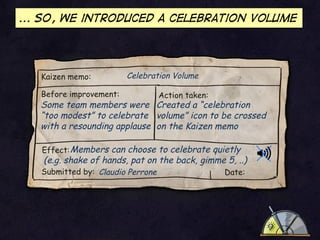
... So, we introduced a celebration volume

Kaizen memo:

Celebration Volume

Before improvement:

Action taken:

Some team members were Created a “celebration
“too modest” to celebrate volume” icon to be crossed
with a resounding applause on the Kaizen memo
Effect: Members can choose to celebrate quietly

(e.g. shake of hands, pat on the back, gimme 5, ..)

Submitted by: Claudio Perrone

Date:
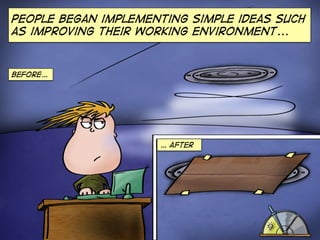
People began implementing simple ideas such
as improving their working environment...

Before…

… AFTEr
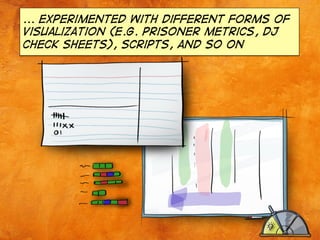
... Experimented with different forms of
visualization (e.g. prisoner metrics, dj
check sheets), scripts, and so on
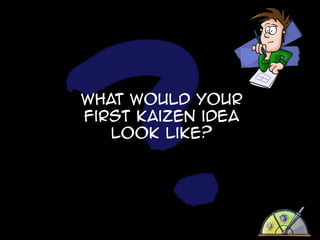
What would your
first kaizen idea
look like?
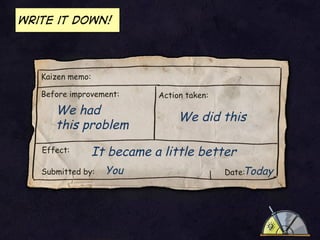
Write it down!

Kaizen memo:
Before improvement:

We had
this problem
Effect:

Action taken:

We did this

It became a little better

Submitted by:

You

Today
Date:
Unfortunately, Management’s initial
reaction wasn’t exactly what I expected...
“Seeds of a revolution?
Yeah right.”

Who can yawn
the loudest?
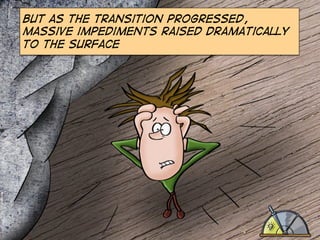
But as the transition progressed,
massive impediments raised dramatically
to the surface
Like never before,
we badly needed
to develop our
ability to...
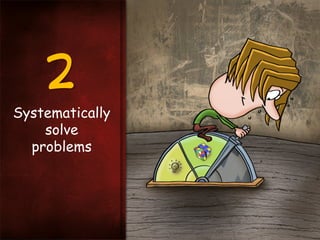
2
Systematically
solve
problems
What do
You
know about
A3 thinking?
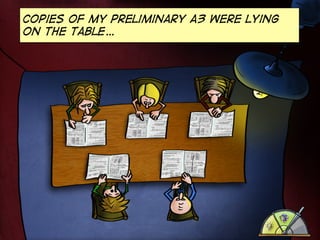
Copies of my preliminary A3 were lying
on the table…
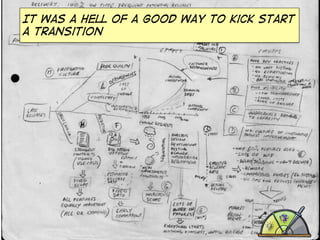
It was a hell of a good way to kick start
a transition
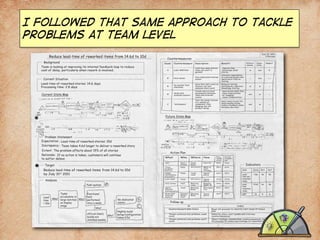
I followed that same approach to tackle
problems at team level
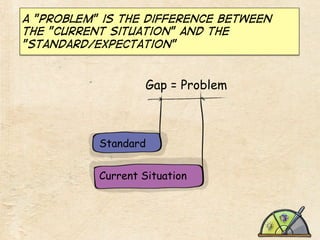
a "problem" is the difference between
the "current situation" and the
"standard/expectation"

Gap = Problem

Standard
Current Situation
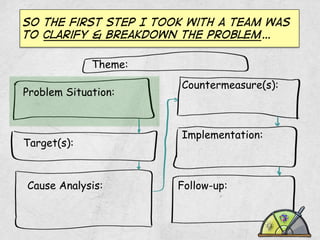
So the first step I took with a team was
to clarify & breakdown the problem…
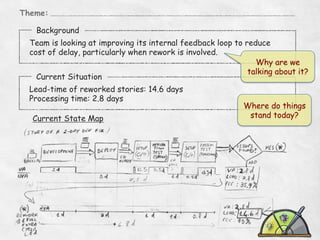
Theme:
Problem Situation:

Target(s):

Cause Analysis:

Countermeasure(s):

Implementation:

Follow-up:
Theme:	
  
Background	
  
Team is looking at improving its internal feedback loop to reduce
cost of delay, particularly when rework is involved.
Why are we
talking about it?
Current Situation	
  
Lead-time of reworked stories: 14.6 days
Processing time: 2.8 days
Current State Map

Where do things
stand today?
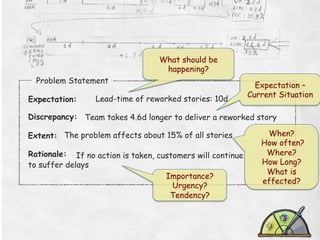
What should be
happening?
Problem Statement	
  
Expectation: 	
  

Lead-time of reworked stories: 10d

Expectation –
Current Situation

Discrepancy: 	
   Team takes 4.6d longer to deliver a reworked story
Extent: 	
   The problem affects about 15% of all stories
Rationale: 	
   If no action is taken, customers will continue
to suffer delays
Importance?
Urgency?
Tendency?

When?
How often?
Where?
How Long?
What is
effected?
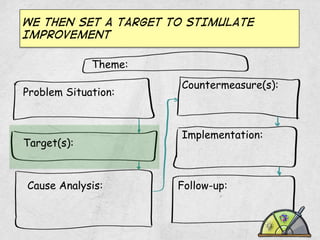
WE THEN SET A TARGET TO STIMULATE
IMPROVEMENT
Theme:
Problem Situation:

Target(s):

Cause Analysis:

Countermeasure(s):

Implementation:

Follow-up:
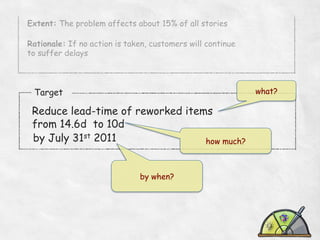
Extent: The problem affects about 15% of all stories
Rationale: If no action is taken, customers will continue
to suffer delays

what?

Target	
  

Reduce lead-time of reworked items
from 14.6d to 10d
by July 31st 2011
how much?
by when?
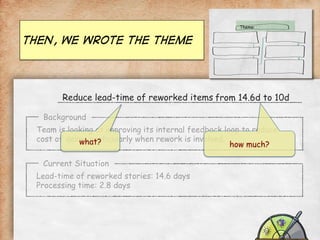
Theme:

Then, we wrote the theme

Reduce lead-time of reworked items from 14.6d to 10d
Background	
  
Team is looking at improving its internal feedback loop to reduce
cost of delay, particularly when rework is involved.
what?
how much?
Current Situation	
  
Lead-time of reworked stories: 14.6 days
Processing time: 2.8 days
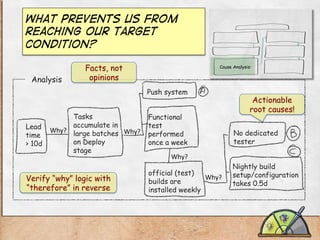
What prevents us from
reaching our target
Condition?
Analysis	
  

Facts, not
opinions

Cause Analysis:

Push system

Lead
time
> 10d

Tasks
Functional
accumulate in
test
Why?	
   large batches Why?	
  
performed
on Deploy
once a week
stage
Why?	
  

Verify “why” logic with
“therefore” in reverse

official (test)
Why?	
  
builds are
installed weekly

Actionable
root causes!
No dedicated
tester
Nightly build
setup/configuration
takes 0.5d
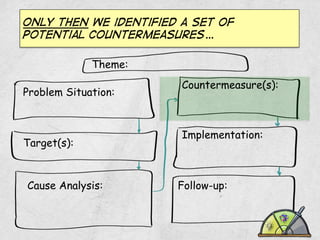
Only then we identified a set of
potential countermeasures…
Theme:
Problem Situation:

Target(s):

Cause Analysis:

Countermeasure(s):

Implementation:

Follow-up:
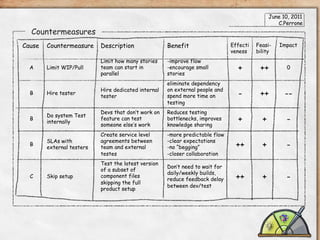
June 10, 2011
C.Perrone

Countermeasures	
  
Cause
A

Countermeasure

Description

Benefit

Limit WIP/Pull

Limit how many stories
team can start in
parallel

Effecti
veness

Feasibility

Impact

-improve flow
-encourage small
stories

+

++

0

-

++

--

B

Hire tester

Hire dedicated internal
tester

eliminate dependency
on external people and
spend more time on
testing

B

Do system Test
internally

Devs that don’t work on
feature can test
someone else’s work

Reduces testing
bottlenecks, improves
knowledge sharing

+

+

-

SLAs with
external testers

Create service level
agreements between
team and external
testes

-more predictable flow
-clear expectations
-no “begging”
-closer collaboration

++

+

-

Skip setup

Test the latest version
of a subset of
component files
skipping the full
product setup

Don’t need to wait for
daily/weekly builds,
reduce feedback delay
between dev/test

++

+

-

B

C
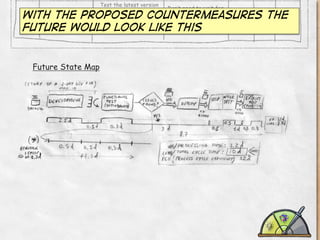
With the proposed countermeasures the
future would look like this

Future State Map
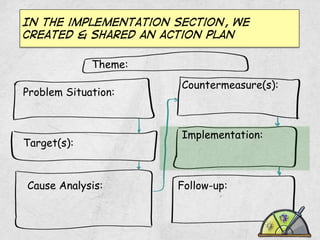
In the implementation section, we
created & shared an action plan
Theme:
Problem Situation:

Target(s):

Cause Analysis:

Countermeasure(s):

Implementation:

Follow-up:
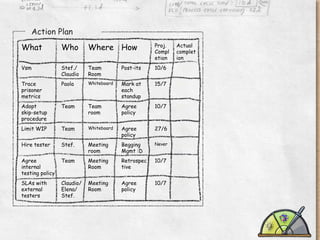
Action Plan	
  
What

Who

Where How

Proj.
Compl
etion

Actual
complet
ion

Vsm

Stef./
Claudio

Team
Room

Post-its

10/6

10/6

Trace
prisoner
metrics

Paola

Whiteboard

Mark at
each
standup

15/7

N/A

Adopt
skip-setup
procedure

Team

Team
room

Agree
policy

10/7

10/7

Limit WIP

Team

Whiteboard

Agree
policy

27/6

27/6

Hire tester

Stef.

Meeting
room

Begging
Mgmt :D

Never

29/6

Agree
internal
testing policy

Team

Meeting
Room

Retrospec
tive

10/7

10/7

SLAs with
external
testers

Claudio/
Elena/
Stef.

Meeting
Room

Agree
policy

10/7

15/7
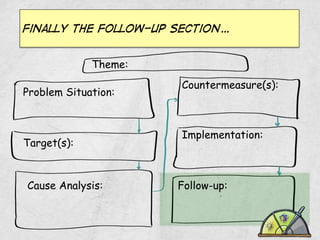
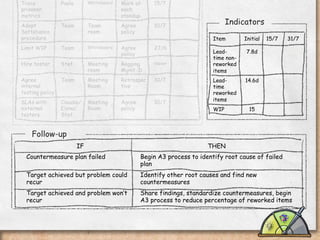
Finally the follow-up section…
Theme:
Problem Situation:

Target(s):

Cause Analysis:

Countermeasure(s):

Implementation:

Follow-up:
Indicators	
  
Item

Initial

15/7

31/7

Leadtime nonreworked
items

7.8d

5d

5d

Leadtime
reworked
items

14.6d

6d

5d

15

5

6

WIP

Follow-up	
  
IF

THEN

Countermeasure plan failed

Begin A3 process to identify root cause of failed
plan

Target achieved but problem could
recur

Identify other root causes and find new
countermeasures

Target achieved and problem won’t
recur

Share findings, standardize countermeasures, begin
A3 process to reduce percentage of reworked items
We posted the A3 on the wall, right
beside the kanban board
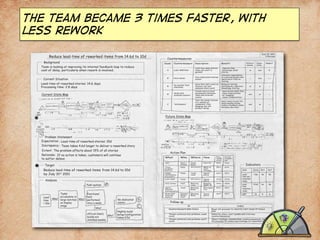
the team became 3 times faster, with
less rework
The new state became the new "baseline
for improvement”
We shared our findings with our
communities of practice to let the
acquired knowledge spread “laterally”
What problems
would you
tackle?
More importantly, management saw what
it means to "remove impediments”
… making me
realize that
I had chance to...
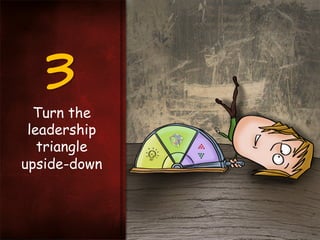
3
Turn the
leadership
triangle
upside-down
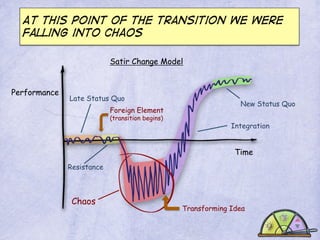
At this point of the transition we were
falling into chaos
Satir Change Model
Performance

Late Status Quo
Foreign Element
(transition begins)

New Status Quo
Integration

Time
Resistance

Chaos

Transforming Idea
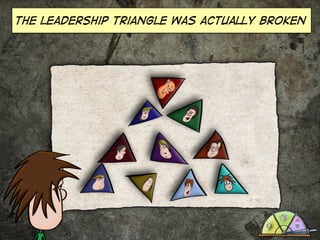
The leadership triangle was actually broken
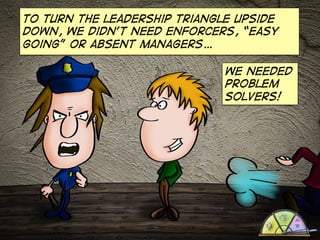
To turn the leadership triangle upside
down, we didn’t need enforcers, “easy
going” or absent managers…
we needed
problem
solvers!
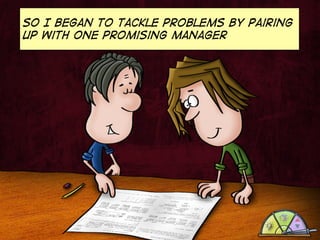
So I began to tackle problems by pairing
up with one promising manager
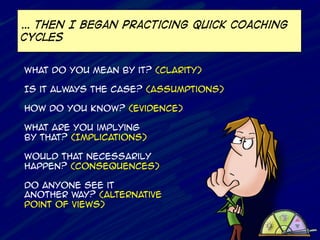
… Then I began practicing quick coaching
cycles
What do you mean by it? (Clarity)
Is it always the case? (Assumptions)
How do you know? (Evidence)
What are you implying
by that? (Implications)
Would that necessarily
happen? (consequences)
Do anyone see it
another way? (Alternative
Point of views)


Today more managers
,
are beginning their a3
thinking journey
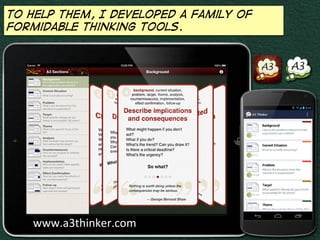
So, I released a family of thinking tools…

www.a3thinker.com	
  
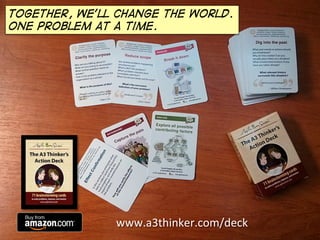
To help them change the world.
one problem at a time.

www.a3thinker.com/deck	
  
Final Thoughts
“

If you want 1 year of prosperity,
grow seeds.
If you want 10 years of prosperity,
grow trees.
If you want 100 years of prosperity,
grow people.
-- Chinese proverb
Thank You!

Claudio	
  Perrone	
  

claudio@agilesensei.com	
  
www.agilesensei.com	
  
www.a3thinker.com	
  
www.twi<er.com/agilesensei	
  
A3 & Kaizen: Here's How

A3 & Kaizen: Here's How

  • 1.
    @agilesensei After reading this, introduceyourself to a person seated next to you. Tell this person why you are here and what you want to learn. written, illustrated and performed by Claudio Perrone
  • 2.
    There is awar Going on…
  • 3.
    Most large organizationsI know are stuck into firefighting and command & control Is Yours?
  • 4.
    The traditional organizationmodel seems inadequate to cope with today’s corporate challenges Organization chart Blame flow Rule makers Controllers Enforcers Losers …
  • 5.
    But if organizationsare more like organisms (i.e. complex adaptive systems)...
  • 6.
    ... How canwe encourage and support everyone to be responsible for change?
  • 7.
    I looked forclues when I attempted to...
  • 8.
  • 9.
    Who are the heroesin a firefighting company?
  • 10.
    It all startedwhen I launched a kaizen system as part of a major Lean & Agile transition Kaizen memo: Kaizen Memos Before improvement: We didn’t trace the small, continuous improvements to our work Action taken: Created “Kaizen memos” to post on an “implemented ideas” board Effect: Team members trace and celebrate every implemented idea, even the smallest! Submitted by: Claudio Perrone Date:
  • 11.
    One of theteams was going through a delicate storming phase
  • 12.
    Things improved sharplyas we began to celebrate the completion of each story
  • 13.
    ... leading meto my first kaizen idea! Kaizen memo: Ready for Celebration Before improvement: Story completion was taken for granted Action taken: Created an explicit “Ready for Celebration” step in our workflow Effect: Team proudly celebrates completion of stories at standup meetings Submitted by: Claudio Perrone Date:
  • 14.
  • 15.
    In the earlydays, loud-voiced celebration was not for everyone, however...
  • 16.
    ... So, weintroduced a celebration volume Kaizen memo: Celebration Volume Before improvement: Action taken: Some team members were Created a “celebration “too modest” to celebrate volume” icon to be crossed with a resounding applause on the Kaizen memo Effect: Members can choose to celebrate quietly (e.g. shake of hands, pat on the back, gimme 5, ..) Submitted by: Claudio Perrone Date:
  • 17.
    People began implementingsimple ideas such as improving their working environment... Before… … AFTEr
  • 18.
    ... Experimented withdifferent forms of visualization (e.g. prisoner metrics, dj check sheets), scripts, and so on
  • 19.
    What would your firstkaizen idea look like?
  • 20.
    Write it down! Kaizenmemo: Before improvement: We had this problem Effect: Action taken: We did this It became a little better Submitted by: You Today Date:
  • 21.
    Unfortunately, Management’s initial reactionwasn’t exactly what I expected...
  • 22.
    “Seeds of arevolution? Yeah right.” Who can yawn the loudest?
  • 23.
    But as thetransition progressed, massive impediments raised dramatically to the surface
  • 24.
    Like never before, webadly needed to develop our ability to...
  • 25.
  • 26.
  • 27.
    Copies of mypreliminary A3 were lying on the table…
  • 28.
    It was ahell of a good way to kick start a transition
  • 29.
    I followed thatsame approach to tackle problems at team level
  • 30.
    a "problem" isthe difference between the "current situation" and the "standard/expectation" Gap = Problem Standard Current Situation
  • 31.
    So the firststep I took with a team was to clarify & breakdown the problem… Theme: Problem Situation: Target(s): Cause Analysis: Countermeasure(s): Implementation: Follow-up:
  • 32.
    Theme:   Background   Teamis looking at improving its internal feedback loop to reduce cost of delay, particularly when rework is involved. Why are we talking about it? Current Situation   Lead-time of reworked stories: 14.6 days Processing time: 2.8 days Current State Map Where do things stand today?
  • 33.
    What should be happening? ProblemStatement   Expectation:   Lead-time of reworked stories: 10d Expectation – Current Situation Discrepancy:   Team takes 4.6d longer to deliver a reworked story Extent:   The problem affects about 15% of all stories Rationale:   If no action is taken, customers will continue to suffer delays Importance? Urgency? Tendency? When? How often? Where? How Long? What is effected?
  • 34.
    WE THEN SETA TARGET TO STIMULATE IMPROVEMENT Theme: Problem Situation: Target(s): Cause Analysis: Countermeasure(s): Implementation: Follow-up:
  • 35.
    Extent: The problemaffects about 15% of all stories Rationale: If no action is taken, customers will continue to suffer delays what? Target   Reduce lead-time of reworked items from 14.6d to 10d by July 31st 2011 how much? by when?
  • 36.
    Theme: Then, we wrotethe theme Reduce lead-time of reworked items from 14.6d to 10d Background   Team is looking at improving its internal feedback loop to reduce cost of delay, particularly when rework is involved. what? how much? Current Situation   Lead-time of reworked stories: 14.6 days Processing time: 2.8 days
  • 37.
    What prevents usfrom reaching our target Condition? Analysis   Facts, not opinions Cause Analysis: Push system Lead time > 10d Tasks Functional accumulate in test Why?   large batches Why?   performed on Deploy once a week stage Why?   Verify “why” logic with “therefore” in reverse official (test) Why?   builds are installed weekly Actionable root causes! No dedicated tester Nightly build setup/configuration takes 0.5d
  • 38.
    Only then weidentified a set of potential countermeasures… Theme: Problem Situation: Target(s): Cause Analysis: Countermeasure(s): Implementation: Follow-up:
  • 39.
    June 10, 2011 C.Perrone Countermeasures   Cause A Countermeasure Description Benefit Limit WIP/Pull Limit how many stories team can start in parallel Effecti veness Feasibility Impact -improve flow -encourage small stories + ++ 0 - ++ -- B Hire tester Hire dedicated internal tester eliminate dependency on external people and spend more time on testing B Do system Test internally Devs that don’t work on feature can test someone else’s work Reduces testing bottlenecks, improves knowledge sharing + + - SLAs with external testers Create service level agreements between team and external testes -more predictable flow -clear expectations -no “begging” -closer collaboration ++ + - Skip setup Test the latest version of a subset of component files skipping the full product setup Don’t need to wait for daily/weekly builds, reduce feedback delay between dev/test ++ + - B C
  • 40.
    With the proposedcountermeasures the future would look like this Future State Map
  • 41.
    In the implementationsection, we created & shared an action plan Theme: Problem Situation: Target(s): Cause Analysis: Countermeasure(s): Implementation: Follow-up:
  • 42.
    Action Plan   What Who WhereHow Proj. Compl etion Actual complet ion Vsm Stef./ Claudio Team Room Post-its 10/6 10/6 Trace prisoner metrics Paola Whiteboard Mark at each standup 15/7 N/A Adopt skip-setup procedure Team Team room Agree policy 10/7 10/7 Limit WIP Team Whiteboard Agree policy 27/6 27/6 Hire tester Stef. Meeting room Begging Mgmt :D Never 29/6 Agree internal testing policy Team Meeting Room Retrospec tive 10/7 10/7 SLAs with external testers Claudio/ Elena/ Stef. Meeting Room Agree policy 10/7 15/7
  • 43.
    Finally the follow-upsection… Theme: Problem Situation: Target(s): Cause Analysis: Countermeasure(s): Implementation: Follow-up:
  • 44.
    Indicators   Item Initial 15/7 31/7 Leadtime nonreworked items 7.8d 5d 5d Leadtime reworked items 14.6d 6d 5d 15 5 6 WIP Follow-up   IF THEN Countermeasure plan failed Begin A3 process to identify root cause of failed plan Target achieved but problem could recur Identify other root causes and find new countermeasures Target achieved and problem won’t recur Share findings, standardize countermeasures, begin A3 process to reduce percentage of reworked items
  • 45.
    We posted theA3 on the wall, right beside the kanban board
  • 46.
    the team became3 times faster, with less rework
  • 47.
    The new statebecame the new "baseline for improvement”
  • 48.
    We shared ourfindings with our communities of practice to let the acquired knowledge spread “laterally”
  • 49.
  • 50.
    More importantly, managementsaw what it means to "remove impediments”
  • 51.
    … making me realizethat I had chance to...
  • 52.
  • 53.
    At this pointof the transition we were falling into chaos Satir Change Model Performance Late Status Quo Foreign Element (transition begins) New Status Quo Integration Time Resistance Chaos Transforming Idea
  • 54.
    The leadership trianglewas actually broken
  • 55.
    To turn theleadership triangle upside down, we didn’t need enforcers, “easy going” or absent managers… we needed problem solvers!
  • 56.
    So I beganto tackle problems by pairing up with one promising manager
  • 57.
    … Then Ibegan practicing quick coaching cycles What do you mean by it? (Clarity) Is it always the case? (Assumptions) How do you know? (Evidence) What are you implying by that? (Implications) Would that necessarily happen? (consequences) Do anyone see it another way? (Alternative Point of views)    
  • 58.
    Today more managers , arebeginning their a3 thinking journey
  • 59.
    So, I releaseda family of thinking tools… www.a3thinker.com  
  • 60.
    To help themchange the world. one problem at a time. www.a3thinker.com/deck  
  • 61.
  • 62.
    “ If you want1 year of prosperity, grow seeds. If you want 10 years of prosperity, grow trees. If you want 100 years of prosperity, grow people. -- Chinese proverb
  • 63.
    Thank You! Claudio  Perrone   claudio@agilesensei.com   www.agilesensei.com   www.a3thinker.com   www.twi<er.com/agilesensei