By: CorrinBowmanPeriod 6Renaissance Medicine
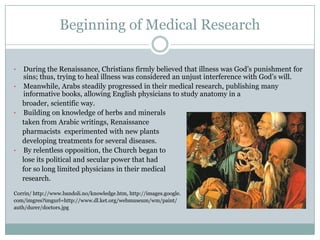
Beginning of Medical ResearchDuring the Renaissance, Christians firmly believed that illness was God’s punishment for sins; thus, trying to heal illness was considered an unjust interference with God’s will.
Meanwhile, Arabs steadily progressed in their medical research, publishing many informative books, allowing English physicians to study anatomy in a      broader, scientific way.Building on knowledge of herbs and minerals      taken from Arabic writings, Renaissance      pharmacists  experimented with new plants      developing treatments for several diseases.By relentless opposition, the Church began to     lose its political and secular power that had      for so long limited physicians in their medical      research.Corrin/ http://www.bandoli.no/knowledge.htm, http://images.google.com/imgres?imgurl=http://www.dl.ket.org/webmuseum/wm/paint/auth/durer/doctors.jpg
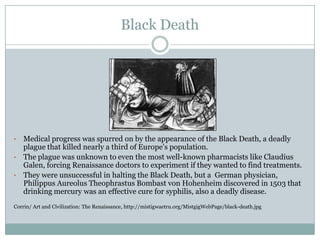
Black DeathMedical progress was spurred on by the appearance of the Black Death, a deadly plague that killed nearly a third of Europe’s population.
The plague was unknown to even the most well-known pharmacists like Claudius Galen, forcing Renaissance doctors to experiment if they wanted to find treatments.
They were unsuccessful in halting the Black Death, but a  German physician, Philippus Aureolus Theophrastus Bombast von Hohenheim discovered in 1503 that drinking mercury was an effective cure for syphilis, also a deadly disease.Corrin/ Art and Civilization: The Renaissance, http://mistigwaetru.org/MistgigWebPage/black-death.jpg
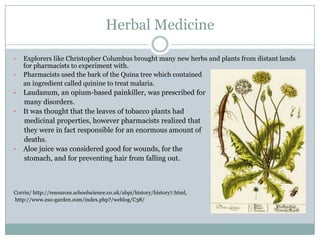
Herbal MedicineExplorers like Christopher Columbus brought many new herbs and plants from distant lands for pharmacists to experiment with.
Pharmacists used the bark of the Quina tree which contained       an ingredient called quinine to treat malaria.Laudanum, an opium-based painkiller, was prescribed for       many disorders.It was thought that the leaves of tobacco plants had       medicinal properties, however pharmacists realized that       they were in fact responsible for an enormous amount of       deaths.Aloe juice was considered good for wounds, for the       stomach, and for preventing hair from falling out.Corrin/ http://resources.schoolscience.co.uk/abpi/history/history7.html,http://www.eso-garden.com/index.php?/weblog/C38/
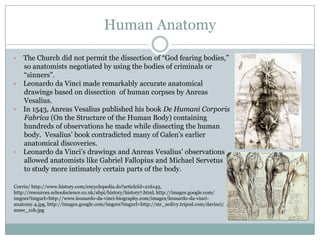
Human Anatomy   The Church did not permit the dissection of “God fearing bodies,”      so anatomists negotiated by using the bodies of criminals or      “sinners”.Leonardo da Vinci made remarkably accurate anatomical       drawings based on dissection  of human corpses by Anreas       Vesalius.In 1543, Anreas Vesalius published his book De Humani Corporis       Fabrica (On the Structure of the Human Body) containing       hundreds of observations he made while dissecting the human      body.  Vesalius’ book contradicted many of Galen’s earlier      anatomical discoveries.Leonardo da Vinci’s drawings and Anreas Vesalius’ observations      allowed anatomists like Gabriel Fallopius and Michael Servetus       to study more intimately certain parts of the body.Corrin/ http://www.history.com/encyclopedia.do?articleId=216145,http://resources.schoolscience.co.uk/abpi/history/history7.html,http://images.google.com/imgres?imgurl=http://www.leonardo-da-vinci-biography.com/images/leonardo-da-vinci-anatomy.4.jpg, http://images.google.com/imgres?imgurl=http://mr_sedivy.tripod.com/davinci/anaw_10b.jpg
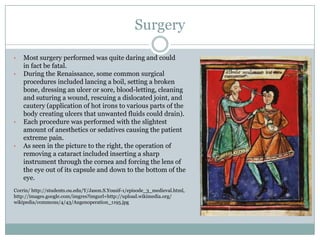
Surgery Most surgery performed was quite daring and could       in fact be fatal.During the Renaissance, some common surgical       procedures included lancing a boil, setting a broken       bone, dressing an ulcer or sore, blood-letting, cleaning       and suturing a wound, rescuing a dislocated joint, and      cautery (application of hot irons to various parts of the      body creating ulcers that unwanted fluids could drain).Each procedure was performed with the slightest       amount of anesthetics or sedatives causing the patient       extreme pain.As seen in the picture to the right, the operation of      removing a cataract included inserting a sharp       instrument through the cornea and forcing the lens of       the eye out of its capsule and down to the bottom of the      eye. Corrin/ http://students.ou.edu/Y/Jason.S.Yousif-1/episode_3_medieval.html,http://images.google.com/imgres?imgurl=http://upload.wikimedia.org/wikipedia/commons/4/43/Augenoperation_1195.jpg
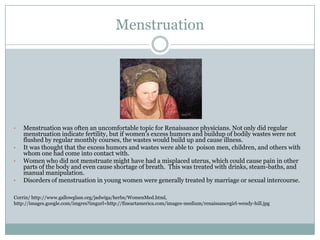
MenstruationMenstruation was often an uncomfortable topic for Renaissance physicians. Not only did regular menstruation indicate fertility, but if women's excess humors and buildup of bodily wastes were not flushed by regular monthly courses, the wastes would build up and cause illness.

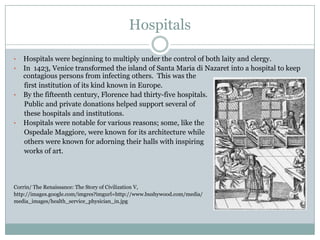
Renaissance Medicine

  • 1.
  • 2.
    Beginning of MedicalResearchDuring the Renaissance, Christians firmly believed that illness was God’s punishment for sins; thus, trying to heal illness was considered an unjust interference with God’s will.
  • 3.
    Meanwhile, Arabs steadilyprogressed in their medical research, publishing many informative books, allowing English physicians to study anatomy in a broader, scientific way.Building on knowledge of herbs and minerals taken from Arabic writings, Renaissance pharmacists experimented with new plants developing treatments for several diseases.By relentless opposition, the Church began to lose its political and secular power that had for so long limited physicians in their medical research.Corrin/ http://www.bandoli.no/knowledge.htm, http://images.google.com/imgres?imgurl=http://www.dl.ket.org/webmuseum/wm/paint/auth/durer/doctors.jpg
  • 4.
    Black DeathMedical progresswas spurred on by the appearance of the Black Death, a deadly plague that killed nearly a third of Europe’s population.
  • 5.
    The plague wasunknown to even the most well-known pharmacists like Claudius Galen, forcing Renaissance doctors to experiment if they wanted to find treatments.
  • 6.
    They were unsuccessfulin halting the Black Death, but a German physician, Philippus Aureolus Theophrastus Bombast von Hohenheim discovered in 1503 that drinking mercury was an effective cure for syphilis, also a deadly disease.Corrin/ Art and Civilization: The Renaissance, http://mistigwaetru.org/MistgigWebPage/black-death.jpg
  • 7.
    Herbal MedicineExplorers likeChristopher Columbus brought many new herbs and plants from distant lands for pharmacists to experiment with.
  • 8.
    Pharmacists used thebark of the Quina tree which contained an ingredient called quinine to treat malaria.Laudanum, an opium-based painkiller, was prescribed for many disorders.It was thought that the leaves of tobacco plants had medicinal properties, however pharmacists realized that they were in fact responsible for an enormous amount of deaths.Aloe juice was considered good for wounds, for the stomach, and for preventing hair from falling out.Corrin/ http://resources.schoolscience.co.uk/abpi/history/history7.html,http://www.eso-garden.com/index.php?/weblog/C38/
  • 9.
    Human Anatomy The Church did not permit the dissection of “God fearing bodies,” so anatomists negotiated by using the bodies of criminals or “sinners”.Leonardo da Vinci made remarkably accurate anatomical drawings based on dissection of human corpses by Anreas Vesalius.In 1543, Anreas Vesalius published his book De Humani Corporis Fabrica (On the Structure of the Human Body) containing hundreds of observations he made while dissecting the human body. Vesalius’ book contradicted many of Galen’s earlier anatomical discoveries.Leonardo da Vinci’s drawings and Anreas Vesalius’ observations allowed anatomists like Gabriel Fallopius and Michael Servetus to study more intimately certain parts of the body.Corrin/ http://www.history.com/encyclopedia.do?articleId=216145,http://resources.schoolscience.co.uk/abpi/history/history7.html,http://images.google.com/imgres?imgurl=http://www.leonardo-da-vinci-biography.com/images/leonardo-da-vinci-anatomy.4.jpg, http://images.google.com/imgres?imgurl=http://mr_sedivy.tripod.com/davinci/anaw_10b.jpg
  • 10.
    Surgery Most surgeryperformed was quite daring and could in fact be fatal.During the Renaissance, some common surgical procedures included lancing a boil, setting a broken bone, dressing an ulcer or sore, blood-letting, cleaning and suturing a wound, rescuing a dislocated joint, and cautery (application of hot irons to various parts of the body creating ulcers that unwanted fluids could drain).Each procedure was performed with the slightest amount of anesthetics or sedatives causing the patient extreme pain.As seen in the picture to the right, the operation of removing a cataract included inserting a sharp instrument through the cornea and forcing the lens of the eye out of its capsule and down to the bottom of the eye. Corrin/ http://students.ou.edu/Y/Jason.S.Yousif-1/episode_3_medieval.html,http://images.google.com/imgres?imgurl=http://upload.wikimedia.org/wikipedia/commons/4/43/Augenoperation_1195.jpg
  • 11.
    MenstruationMenstruation was oftenan uncomfortable topic for Renaissance physicians. Not only did regular menstruation indicate fertility, but if women's excess humors and buildup of bodily wastes were not flushed by regular monthly courses, the wastes would build up and cause illness.