Arabic medicines 
Discoveries and scientists of 700-1500 AD
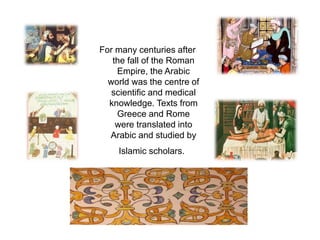
For many centuries after 
the fall of the Roman 
Empire, the Arabic 
world was the centre of 
scientific and medical 
knowledge. Texts from 
Greece and Rome 
were translated into 
Arabic and studied by 
Islamic scholars.
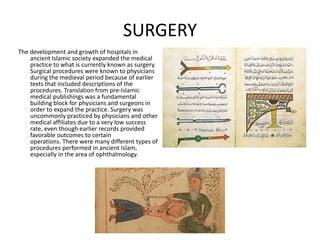
SURGERY 
The development and growth of hospitals in 
ancient Islamic society expanded the medical 
practice to what is currently known as surgery. 
Surgical procedures were known to physicians 
during the medieval period because of earlier 
texts that included descriptions of the 
procedures. Translation from pre-Islamic 
medical publishings was a fundamental 
building block for physicians and surgeons in 
order to expand the practice. Surgery was 
uncommonly practiced by physicians and other 
medical affiliates due to a very low success 
rate, even though earlier records provided 
favorable outcomes to certain 
operations. There were many different types of 
procedures performed in ancient Islam, 
especially in the area of ophthalmology.
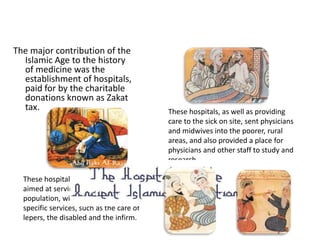
The major contribution of the 
Islamic Age to the history 
of medicine was the 
establishment of hospitals, 
paid for by the charitable 
donations known as Zakat 
tax. These hospitals, as well as providing 
care to the sick on site, sent physicians 
and midwives into the poorer, rural 
areas, and also provided a place for 
physicians and other staff to study and 
research. 
These hospitals varied in role, some 
aimed at serving the general 
population, with others providing 
specific services, such as the care of 
lepers, the disabled and the infirm.
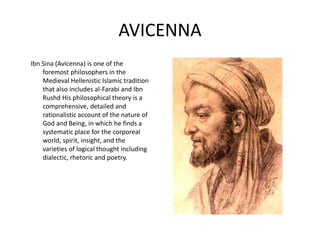
AVICENNA 
Ibn Sina (Avicenna) is one of the 
foremost philosophers in the 
Medieval Hellenistic Islamic tradition 
that also includes al-Farabi and Ibn 
Rushd His philosophical theory is a 
comprehensive, detailed and 
rationalistic account of the nature of 
God and Being, in which he finds a 
systematic place for the corporeal 
world, spirit, insight, and the 
varieties of logical thought including 
dialectic, rhetoric and poetry.
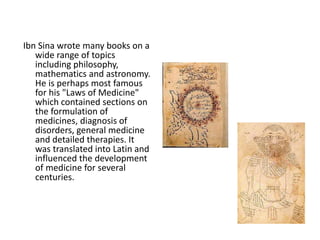
Ibn Sina wrote many books on a 
wide range of topics 
including philosophy, 
mathematics and astronomy. 
He is perhaps most famous 
for his "Laws of Medicine" 
which contained sections on 
the formulation of 
medicines, diagnosis of 
disorders, general medicine 
and detailed therapies. It 
was translated into Latin and 
influenced the development 
of medicine for several 
centuries.
Arabic medicines1

Arabic medicines1

  • 1.
    Arabic medicines Discoveriesand scientists of 700-1500 AD
  • 2.
    For many centuriesafter the fall of the Roman Empire, the Arabic world was the centre of scientific and medical knowledge. Texts from Greece and Rome were translated into Arabic and studied by Islamic scholars.
  • 3.
    SURGERY The developmentand growth of hospitals in ancient Islamic society expanded the medical practice to what is currently known as surgery. Surgical procedures were known to physicians during the medieval period because of earlier texts that included descriptions of the procedures. Translation from pre-Islamic medical publishings was a fundamental building block for physicians and surgeons in order to expand the practice. Surgery was uncommonly practiced by physicians and other medical affiliates due to a very low success rate, even though earlier records provided favorable outcomes to certain operations. There were many different types of procedures performed in ancient Islam, especially in the area of ophthalmology.
  • 4.
    The major contributionof the Islamic Age to the history of medicine was the establishment of hospitals, paid for by the charitable donations known as Zakat tax. These hospitals, as well as providing care to the sick on site, sent physicians and midwives into the poorer, rural areas, and also provided a place for physicians and other staff to study and research. These hospitals varied in role, some aimed at serving the general population, with others providing specific services, such as the care of lepers, the disabled and the infirm.
  • 5.
    AVICENNA Ibn Sina(Avicenna) is one of the foremost philosophers in the Medieval Hellenistic Islamic tradition that also includes al-Farabi and Ibn Rushd His philosophical theory is a comprehensive, detailed and rationalistic account of the nature of God and Being, in which he finds a systematic place for the corporeal world, spirit, insight, and the varieties of logical thought including dialectic, rhetoric and poetry.
  • 6.
    Ibn Sina wrotemany books on a wide range of topics including philosophy, mathematics and astronomy. He is perhaps most famous for his "Laws of Medicine" which contained sections on the formulation of medicines, diagnosis of disorders, general medicine and detailed therapies. It was translated into Latin and influenced the development of medicine for several centuries.