Chapter:  Exploring Space Table of Contents Section 3:  Current and Future Section 1:  Radiation From Space Section 2:  Early Space Missions Space Missions
With the help of telescopes like  Hubble , we can see far into space, but if you’ve ever thought of racing toward distant parts of the universe, think again. Even at the speed of light it would take many years to reach even the nearest stars. Electromagnetic Waves 1 Radiation From Space
Although light travels fast, distances between objects in space are so great that it sometimes takes millions of years for the light to reach Earth. The light and other energy leaving a star are forms of radiation. Light from the Past 1 Radiation From Space
Radiation is energy that is transmitted from one place to another by electromagnetic waves. Electromagnetic waves carry energy through empty space and through matter. Light from the Past 1 Radiation From Space
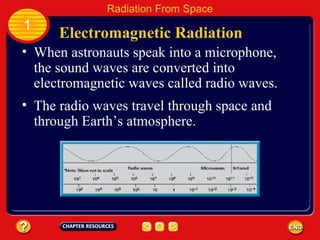
When astronauts speak into a microphone, the sound waves are converted into electromagnetic waves called radio waves. The radio waves travel through space and through Earth’s atmosphere. Electromagnetic Radiation 1 Radiation From Space
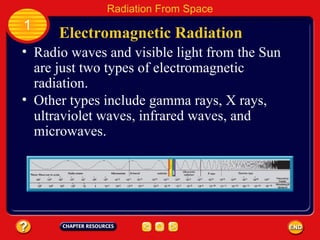
Radio waves and visible light from the Sun are just two types of electromagnetic radiation. Other types include gamma rays, X rays, ultraviolet waves, infrared waves, and microwaves. Electromagnetic Radiation 1 Radiation From Space
This arrangement of electromagnetic radiation is called the  electromagnetic spectrum . Forms of electromagnetic radiation also differ in their frequencies. Electromagnetic Radiation 1 Radiation From Space Frequency is the number of wave crests that pass a given point per unit of time.
Although the various electromagnetic waves differ in their wavelengths, they all travel at 300,000 km/s in a vacuum. This is called the speed of light. Speed of Light 1 Radiation From Space Visible light and other forms of electromagnetic radiation travel at this incredible speed.
Optical telescopes use light to produce magnified images of objects. Light is collected by an objective lens or mirror, which then forms an image at the focal point of the telescope. Optical Telescopes 1 Radiation From Space The eyepiece lens then magnifies the image.
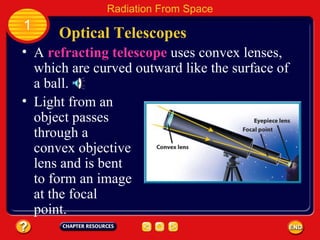
A  refracting telescope  uses convex lenses, which are curved outward like the surface of a ball. Light from an object passes through a convex objective lens and is bent to form an image at the focal point. Optical Telescopes 1 Radiation From Space
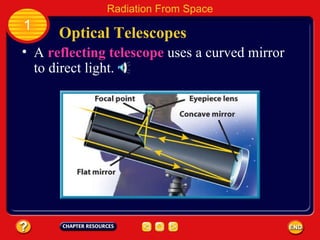
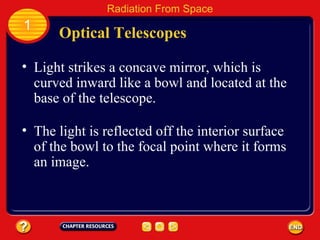
A  reflecting telescope  uses a curved mirror to direct light. Optical Telescopes 1 Radiation From Space
Light strikes a concave mirror, which is curved inward like a bowl and located at the base of the telescope. Optical Telescopes 1 Radiation From Space The light is reflected off the interior surface of the bowl to the focal point where it forms an image.
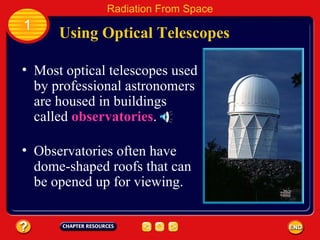
Most optical telescopes used by professional astronomers are housed in buildings called  observatories . Using Optical Telescopes 1 Radiation From Space Observatories often have dome-shaped roofs that can be opened up for viewing.
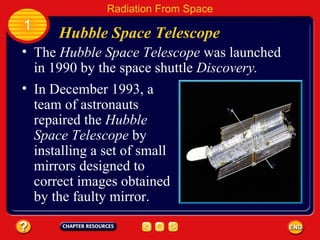
The  Hubble Space Telescope  was launched in 1990 by the space shuttle  Discovery. Hubble Space Telescope 1 Radiation From Space In December 1993, a team of astronauts repaired the  Hubble Space Telescope  by installing a set of small mirrors designed to correct images obtained by the faulty mirror.
Two more missions to service  Hubble  were carried out in 1997 and 1999. Hubble Space Telescope 1 Radiation From Space Among the objects viewed by  Hubble  after it was repaired in 1999 was a large cluster of galaxies known as Abell 2218.
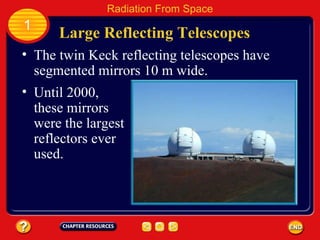
The twin Keck reflecting telescopes have segmented mirrors 10 m wide. Large Reflecting Telescopes 1 Radiation From Space Until 2000, these mirrors were the largest reflectors ever used.
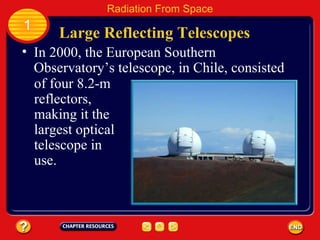
Large Reflecting Telescopes 1 Radiation From Space In 2000, the European Southern Observatory’s telescope, in Chile, consisted of four 8.2-m reflectors, making it the largest optical telescope in use.
With active optics, a computer corrects for changes in temperature, mirror distortions, and bad viewing conditions.   Active and Adaptive Optics 1 Radiation From Space Adaptive optics uses a laser to probe the atmosphere and relay information to a computer about air turbulence. In 2000, the European Southern Telescope images are clearer when corrections for air turbulence, temperature changes, and mirror-shape changes are made.
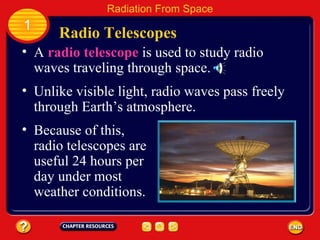
A  radio telescope  is used to study radio waves traveling through space. Radio Telescopes 1 Radiation From Space Unlike visible light, radio waves pass freely through Earth’s atmosphere. Because of this, radio telescopes are useful 24 hours per day under most weather conditions.
Radio waves reaching Earth’s surface strike the large, concave dish of a radio telescope. Radio Telescopes 1 Radiation From Space This dish reflects the waves to a focal point where a receiver is located.
1 Section Check Question 1 Which type of telescope uses convex lenses to  form images? A. Keck B. radio C. reflecting D. refracting NC: 5.04
1 Answer Section Check The answer is D. Refracting telescopes use convex lenses; reflecting telescopes use concave mirrors. NC: 5.04
1 Question 2 Section Check Answer What is meant by the term “active optics”? Active optics uses computers to correct for  changes in temperature and distortions,  improving telescope images. NC: 5.04
1 Question 3 Section Check Radio telescopes study waves with  wavelengths of _______.   A. 10-15 m B. 10-10 m C. 10-5 m D. 105 m NC: 5.04
1 Answer Section Check The answer is D. Radio waves are long- wavelength electromagnetic waves. Radio  telescopes use large, concave dishes to reflect  radio waves to a receiver. NC: 5.04
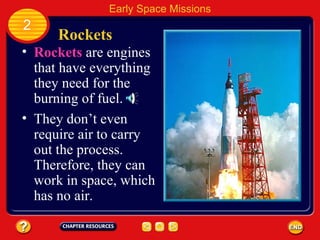
The First Missions into Space— Rockets   To break free of gravity and enter Earth’s orbit, spacecraft must travel at speeds greater than 11 km/s. The space shuttle and several other spacecrafts are equipped with special engines that carry their own fuel. 2 Early Space Missions
Rockets   Rockets  are engines that have everything they need for the burning of fuel. They don’t even require air to carry out the process.  Therefore, they can work in space, which has no air. 2 Early Space Missions
Rocket Types Two types of rockets are distinguished by the type of fuel they use. Solid-propellant rockets are generally simpler but they can’t be shut down after they are ignited. 2 Early Space Missions Liquid-propellant rockets can be shut down after they are ignited and can be restarted.
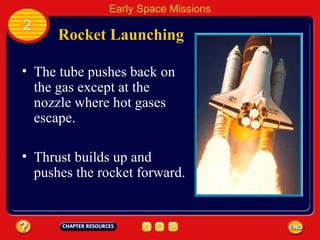
Rocket Launching Solid-propellant rockets use a rubberlike fuel that contains its own oxidizer. As the solid propellant burns, hot gases exert pressure on all inner surfaces of the tube. 2 Early Space Missions
Rocket Launching The tube pushes back on the gas except at the nozzle where hot gases escape. Thrust builds up and pushes the rocket forward. 2 Early Space Missions
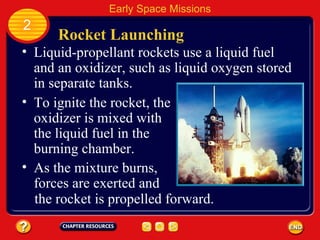
Rocket Launching Liquid-propellant rockets use a liquid fuel and an oxidizer, such as liquid oxygen stored in separate tanks. To ignite the rocket, the oxidizer is mixed with the liquid fuel in the burning chamber. 2 Early Space Missions As the mixture burns, forces are exerted and the rocket is propelled forward.
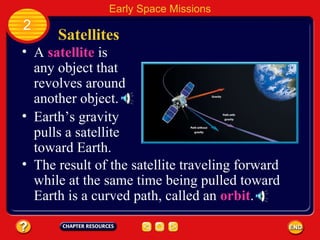
Satellites A  satellite  is any object that revolves around another object. Earth’s gravity pulls a satellite toward Earth. 2 Early Space Missions The result of the satellite traveling forward while at the same time being pulled toward Earth is a curved path, called an  orbit .
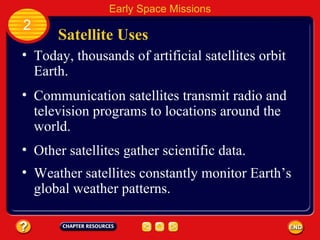
Satellite Uses Today, thousands of artificial satellites orbit Earth. Communication satellites transmit radio and television programs to locations around the world. 2 Early Space Missions Other satellites gather scientific data. Weather satellites constantly monitor Earth’s global weather patterns.
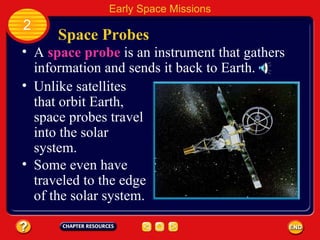
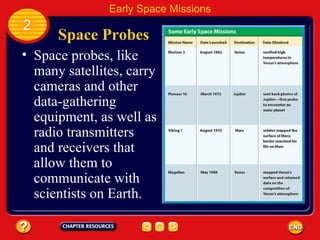
Space Probes A  space probe  is an instrument that gathers information and sends it back to Earth. Unlike satellites that orbit Earth, space probes travel into the solar system. 2 Early Space Missions Some even have traveled to the edge of the solar system.
Space Probes Space probes, like many satellites, carry cameras and other data-gathering equipment, as well as radio transmitters and receivers that allow them to communicate with scientists on Earth. 2 Early Space Missions
Voyager  and  Pioneer  Probes Space probes  Voyager 1  and  Voyager 2  were launched in 1977 and now are heading toward deep space. 2 Early Space Missions Voyager 1  flew past Jupiter and Saturn. Voyager 2  flew past Jupiter, Saturn, Uranus, and Neptune. Scientists expect these probes to continue to transmit data to Earth for at least 20 more years.
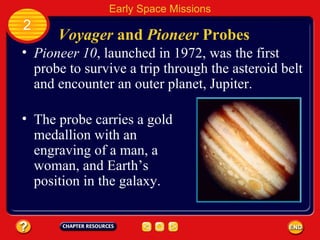
Voyager  and  Pioneer  Probes Pioneer 10 , launched in 1972, was the first probe to survive a trip through the asteroid belt and encounter an outer planet, Jupiter. 2 Early Space Missions The probe carries a gold medallion with an engraving of a man, a woman, and Earth’s position in the galaxy.
Galileo Launched in 1989,  Galileo  reached Jupiter in 1995. 2 Early Space Missions Galileo  released a smaller probe that began a five-month approach to Jupiter. Before being crushed by the atmospheric pressure, it transmitted information about Jupiter’s composition, temperature, and pressure to the satellite orbiting above.
Galileo Studies of Jupiter’s moon Europa by  Galileo  indicate than an ocean of water may exist under the surface of Europa. 2 Early Space Missions A cracked outer layer of ice makes up Europa’s surface.
Galileo The cracks in the surface may be caused by geologic activity that heats the ocean underneath the surface. 2 Early Space Missions Sunlight penetrates these cracks, further heating the ocean and setting the stage for the possible existence of life on Europa.
Galileo In October and November of 1999,  Galileo  approached Io, another one of Jupiter’s moons.  It took photographs of a volcanic vent named Loki. 2 Early Space Missions Galileo  also discovered eruption plumes that shoot gas made of sulfur and oxygen.
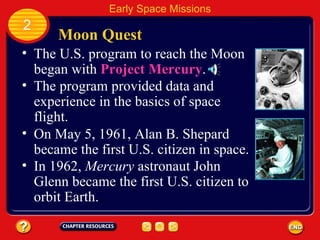
Moon Quest The U.S. program to reach the Moon began with  Project Mercury . 2 Early Space Missions The program provided data and experience in the basics of space flight. On May 5, 1961, Alan B. Shepard became the first U.S. citizen in space. In 1962,  Mercury  astronaut John Glenn became the first U.S. citizen to orbit Earth.
Project Gemini The next step in reaching the Moon was called  Project Gemini . 2 Early Space Missions Teams of two astronauts in the same  Gemini  spacecraft orbited Earth. One  Gemini  team met and connected with another spacecraft in orbit—a skill that would be needed on a voyage to the Moon.
Project Gemini In addition to connecting spacecraft in orbit, another goal of Project Gemini was to investigate the effects of space travel on the human body. 2 Early Space Missions Along with the  Mercury  and  Gemini  programs, a series of robotic probes was sent to the Moon.
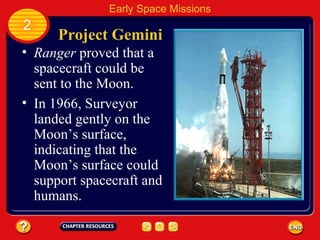
Project Gemini Ranger  proved that a spacecraft could be sent to the Moon. 2 Early Space Missions In 1966, Surveyor landed gently on the Moon’s surface, indicating that the Moon’s surface could support spacecraft and humans.
Project Apollo The final stage of the U.S. program to reach the Moon was  Project Apollo . 2 Early Space Missions On July 20, 1969,  Apollo 11  landed on the Moon’s surface.   Neil Armstrong was the first human to set foot on the Moon.
Project Apollo Edwin Aldrin, the second of the three  Apollo 11  astronauts, joined Armstrong on the Moon, and they explored its surface for two hours. 2 Early Space Missions A total of six lunar landings brought back more than 2,000 samples of moon rock and soil for study before the program ended in 1972.
2 Section Check Question 1 Which cannot be shut down after it is ignited? A.  Galileo B. Liquid-propellant rocket C. Solid-propellant rocket D.  Voyager NC: 2.03, 5.04
2 Answer Section Check The answer is C.  Galileo  and  Voyager  are examples of liquid-propellant rockets, which can be shut down after they are ignited. NC: 2.03, 5.04
2 Question 2 Section Check Any object that revolves around another object is a(n) _______. A. orbit B. probe  C. rocket D. satellite NC: 5.04
2 Answer Section Check The answer is D. The curved path of a satellite  is its orbit. NC: 5.04
2 Question 3 Section Check The goal of Project Mercury was to ________. A. design a reusable spacecraft  B. land on the Moon C. orbit a piloted spacecraft around Earth D. repair the space station  Mir NC: 5.04
2 Answer Section Check The answer is C. Project Mercury was the first  in a series of missions leading up to the first  Moon landing. In 1962,  Mercury  astronaut  John Glenn became the first U.S. citizen to  orbit Earth. NC: 5.04
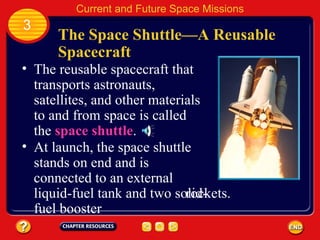
The Space Shuttle—A Reusable Spacecraft The reusable spacecraft that transports astronauts, satellites, and other materials to and from space is called the  space shuttle . 3 Current and Future Space Missions At launch, the space shuttle stands on end and is connected to an external liquid-fuel tank and two solid-fuel booster rockets.
A Reusable Spacecraft When the shuttle reaches an altitude of about 45 km, the emptied, solid-fuel booster rockets drop off and parachute back to Earth. These are recovered and used again. 3 Current and Future Space Missions The external liquid-fuel tank separates and falls back to Earth, but it isn’t recovered.
Work on the Shuttle After the space shuttle reaches space, it begins to orbit Earth. In the cargo bay, astronauts can conduct scientific experiments and determine the effects of spaceflight on the human body. 3 Current and Future Space Missions
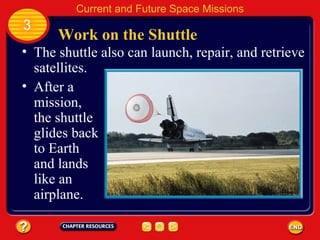
Work on the Shuttle The shuttle also can launch, repair, and retrieve satellites. After a mission, the shuttle glides back to Earth and lands like an airplane. 3 Current and Future Space Missions
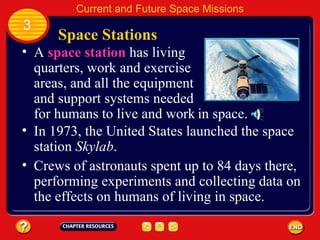
Space Stations In 1973, the United States launched the space station  Skylab . 3 Current and Future Space Missions Crews of astronauts spent up to 84 days there, performing experiments and collecting data on the effects on humans of living in space. A  space station  has living quarters, work and exercise areas, and all the equipment and support systems needed for humans to live and work in space.
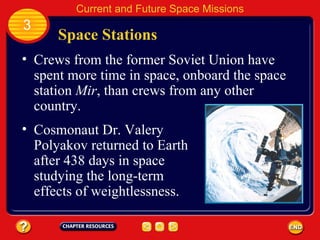
Space Stations Crews from the former Soviet Union have spent more time in space, onboard the space station  Mir , than crews from any other country. Cosmonaut Dr. Valery Polyakov returned to Earth after 438 days in space studying the long-term effects of weightlessness. 3 Current and Future Space Missions
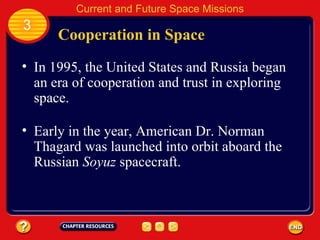
Cooperation in Space In 1995, the United States and Russia began an era of cooperation and trust in exploring space. Early in the year, American Dr. Norman Thagard was launched into orbit aboard the Russian  Soyuz  spacecraft. 3 Current and Future Space Missions
Cooperation in Space In June 1995, Russian cosmonauts rode into orbit onboard the space shuttle  Atlantis . The cooperation that existed on this mission continued through eight more space shuttle- Mir  docking missions. 3 Current and Future Space Missions Each of the eight missions was an important step toward building and operating the  International Space Station .
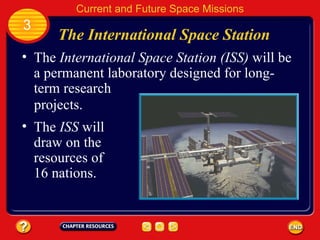
The International Space Station The  ISS  will draw on the resources of 16 nations. 3 Current and Future Space Missions The  International Space Station   (ISS)  will be a permanent laboratory designed for long-term research projects.
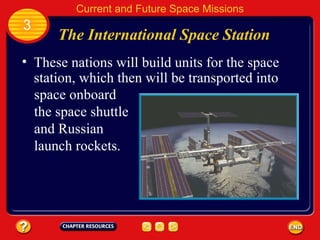
The International Space Station 3 Current and Future Space Missions These nations will build units for the space station, which then will be transported into space onboard the space shuttle and Russian launch rockets.
Phases of  ISS Phase One, now concluded, involved the space shuttle- Mir  docking missions. Phase Two began in 1998 with the launch of the Russian-built  Zarya Module . 3 Current and Future Space Missions
Phases of  ISS In December 1998, the first assembly of  ISS  occurred when a space shuttle mission attached the Unity module to  Zarya . Phase Two ended in 2001 with the addition of a U.S. laboratory. 3 Current and Future Space Missions
Living in Space The project will continue with Phase Three when the Japanese Experiment Module, the European Columbus Orbiting Facility, and another Russian lab will be delivered. It is hoped that the  International Space Station  will be completed in 2006. 3 Current and Future Space Missions
Living in Space A total of 47 separate launches will be required to take all the components of the  ISS  into space and prepare it for permanent habitation. One day, the station could be a construction site for ships that will travel to the Moon and Mars. 3 Current and Future Space Missions
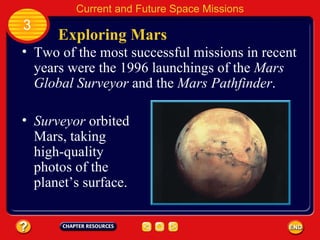
Exploring Mars Two of the most successful missions in recent years were the 1996 launchings of the  Mars Global Surveyor  and the  Mars Pathfinder . Surveyor  orbited Mars, taking high-quality photos of the planet’s surface. 3 Current and Future Space Missions
Exploring Mars Pathfinder  descended to the Martian surface, using rockets and a parachute system to slow its descent. Pathfinder  carried technology to study the surface of the planet, including a remote-controlled robot rover called Sojourner. 3 Current and Future Space Missions
Exploring Mars Another orbiting spacecraft, the  Mars Odyssey  began mapping the surface of Mars in 2002. The next step was to send robots to explore the surface of Mars. 3 Current and Future Space Missions
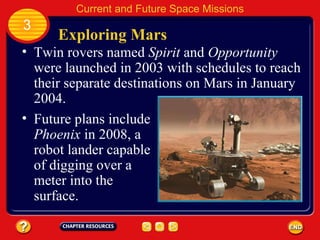
Exploring Mars Twin rovers named  Spirit  and  Opportunity  were launched in 2003 with schedules to reach their separate destinations on Mars in January 2004. Future plans include  Phoenix  in 2008, a robot lander capable of digging over a meter into the surface. 3 Current and Future Space Missions
New Millennium Program To continue space missions into the future, NASA has created the New Millennium Program (NMP). The goal of the NMP is to develop advanced technology that will let NASA send smart spacecraft into the solar system. 3 Current and Future Space Missions This will reduce the amount of ground control needed.
Exploring the Moon Launched in 1998, the  Lunar Prospector’s  one-year mission was to orbit the Moon, mapping its structure and composition. Data obtained from the spacecraft indicate that water ice might be present in the craters at the Moon’s poles. 3 Current and Future Space Missions
Exploring the Moon At the end of its mission,  Lunar Prospector  was deliberately crashed into a lunar crater. Using special telescopes, scientists hoped to see evidence of water vapor thrown up by the collision. 3 Current and Future Space Missions
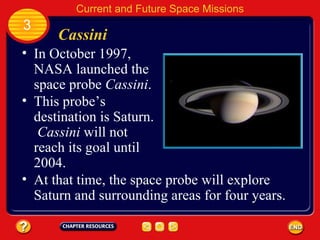
Cassini In October 1997, NASA launched the space probe  Cassini . This probe’s destination is Saturn.  Cassini  will not reach its goal until 2004. 3 Current and Future Space Missions At that time, the space probe will explore Saturn and surrounding areas for four years.
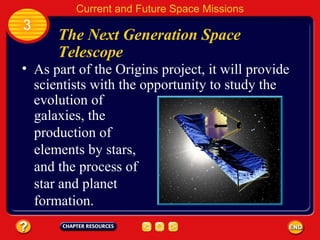
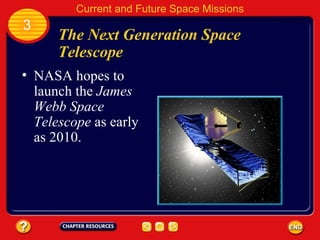
The Next Generation Space Telescope Plans are being made to launch a new space telescope that is capable of observing the first stars and galaxies in the universe. 3 Current and Future Space Missions The  James Webb Space Telescope  will be the successor to the  Hubble Space Telescope .
The Next Generation Space Telescope 3 Current and Future Space Missions As part of the Origins project, it will provide scientists with the opportunity to study the evolution of galaxies, the production of elements by stars, and the process of star and planet formation.
The Next Generation Space Telescope 3 Current and Future Space Missions NASA hopes to launch the  James Webb Space Telescope  as early as 2010.
Everyday Space Technology Medicine has gained much from space technology. 3 Current and Future Space Missions Space medicine led to better ways to diagnose and treat heart disease here on Earth and to better heart pacemakers. Cochlear implants that help thousands of deaf people hear were developed using knowledge gained during the space shuttle program.
Everyday Space Technology Space technology can even help catch criminals and prevent accidents.   3 Current and Future Space Missions For example, a method to sharpen images that was devised for space studies is being used by police to read numbers on blurry photos of license plates.
3 Section Check Question 1 Which was a space station? A . Galileo B . Pioneer 10 C . Skylab D . Sputnik I NC: 5.04
3 Answer Section Check The answer is C. The U.S. launched  Skylab  in 1973 and used it to perform experiments and collect data on the effects on humans of living in space. NC: 5.04
3 Question 2 Section Check The destination of the space probe  Cassini  is __________. Jupiter B. Neptune C. Pluto D. Saturn NC: 5.04
3 Answer Section Check The answer is D. This probe is expected to  reach its goal in 2004, and will explore  Saturn and the surrounding areas for four  years. NC: 5.04
3 Question 3 Section Check The remote-controlled robot that was used to collect data about the surface of Mars was  ________. A.  Odyssey B.  Pathfinder C.  Sojourner D.  Surveyor NC: 5.04
3 Answer Section Check The answer is C. Sojourner was the remote- controlled robot rover used on Mars. NC: 5.04
To advance to the next item or next page click on any of the following keys: mouse, space bar, enter, down or forward arrow.  Click on this icon to return to the table of contents Click on this icon to return to the previous slide Click on this icon to move to the next slide Click on this icon to open the resources file. Help Click on this icon to go to the end of the presentation.
End of Chapter Summary File

08 Chapter

  • 1.
  • 2.
    Chapter: ExploringSpace Table of Contents Section 3: Current and Future Section 1: Radiation From Space Section 2: Early Space Missions Space Missions
  • 3.
    With the helpof telescopes like Hubble , we can see far into space, but if you’ve ever thought of racing toward distant parts of the universe, think again. Even at the speed of light it would take many years to reach even the nearest stars. Electromagnetic Waves 1 Radiation From Space
  • 4.
    Although light travelsfast, distances between objects in space are so great that it sometimes takes millions of years for the light to reach Earth. The light and other energy leaving a star are forms of radiation. Light from the Past 1 Radiation From Space
  • 5.
    Radiation is energythat is transmitted from one place to another by electromagnetic waves. Electromagnetic waves carry energy through empty space and through matter. Light from the Past 1 Radiation From Space
  • 6.
    When astronauts speakinto a microphone, the sound waves are converted into electromagnetic waves called radio waves. The radio waves travel through space and through Earth’s atmosphere. Electromagnetic Radiation 1 Radiation From Space
  • 7.
    Radio waves andvisible light from the Sun are just two types of electromagnetic radiation. Other types include gamma rays, X rays, ultraviolet waves, infrared waves, and microwaves. Electromagnetic Radiation 1 Radiation From Space
  • 8.
    This arrangement ofelectromagnetic radiation is called the electromagnetic spectrum . Forms of electromagnetic radiation also differ in their frequencies. Electromagnetic Radiation 1 Radiation From Space Frequency is the number of wave crests that pass a given point per unit of time.
  • 9.
    Although the variouselectromagnetic waves differ in their wavelengths, they all travel at 300,000 km/s in a vacuum. This is called the speed of light. Speed of Light 1 Radiation From Space Visible light and other forms of electromagnetic radiation travel at this incredible speed.
  • 10.
    Optical telescopes uselight to produce magnified images of objects. Light is collected by an objective lens or mirror, which then forms an image at the focal point of the telescope. Optical Telescopes 1 Radiation From Space The eyepiece lens then magnifies the image.
  • 11.
    A refractingtelescope uses convex lenses, which are curved outward like the surface of a ball. Light from an object passes through a convex objective lens and is bent to form an image at the focal point. Optical Telescopes 1 Radiation From Space
  • 12.
    A reflectingtelescope uses a curved mirror to direct light. Optical Telescopes 1 Radiation From Space
  • 13.
    Light strikes aconcave mirror, which is curved inward like a bowl and located at the base of the telescope. Optical Telescopes 1 Radiation From Space The light is reflected off the interior surface of the bowl to the focal point where it forms an image.
  • 14.
    Most optical telescopesused by professional astronomers are housed in buildings called observatories . Using Optical Telescopes 1 Radiation From Space Observatories often have dome-shaped roofs that can be opened up for viewing.
  • 15.
    The HubbleSpace Telescope was launched in 1990 by the space shuttle Discovery. Hubble Space Telescope 1 Radiation From Space In December 1993, a team of astronauts repaired the Hubble Space Telescope by installing a set of small mirrors designed to correct images obtained by the faulty mirror.
  • 16.
    Two more missionsto service Hubble were carried out in 1997 and 1999. Hubble Space Telescope 1 Radiation From Space Among the objects viewed by Hubble after it was repaired in 1999 was a large cluster of galaxies known as Abell 2218.
  • 17.
    The twin Keckreflecting telescopes have segmented mirrors 10 m wide. Large Reflecting Telescopes 1 Radiation From Space Until 2000, these mirrors were the largest reflectors ever used.
  • 18.
    Large Reflecting Telescopes1 Radiation From Space In 2000, the European Southern Observatory’s telescope, in Chile, consisted of four 8.2-m reflectors, making it the largest optical telescope in use.
  • 19.
    With active optics,a computer corrects for changes in temperature, mirror distortions, and bad viewing conditions. Active and Adaptive Optics 1 Radiation From Space Adaptive optics uses a laser to probe the atmosphere and relay information to a computer about air turbulence. In 2000, the European Southern Telescope images are clearer when corrections for air turbulence, temperature changes, and mirror-shape changes are made.
  • 20.
    A radiotelescope is used to study radio waves traveling through space. Radio Telescopes 1 Radiation From Space Unlike visible light, radio waves pass freely through Earth’s atmosphere. Because of this, radio telescopes are useful 24 hours per day under most weather conditions.
  • 21.
    Radio waves reachingEarth’s surface strike the large, concave dish of a radio telescope. Radio Telescopes 1 Radiation From Space This dish reflects the waves to a focal point where a receiver is located.
  • 22.
    1 Section CheckQuestion 1 Which type of telescope uses convex lenses to form images? A. Keck B. radio C. reflecting D. refracting NC: 5.04
  • 23.
    1 Answer SectionCheck The answer is D. Refracting telescopes use convex lenses; reflecting telescopes use concave mirrors. NC: 5.04
  • 24.
    1 Question 2Section Check Answer What is meant by the term “active optics”? Active optics uses computers to correct for changes in temperature and distortions, improving telescope images. NC: 5.04
  • 25.
    1 Question 3Section Check Radio telescopes study waves with wavelengths of _______. A. 10-15 m B. 10-10 m C. 10-5 m D. 105 m NC: 5.04
  • 26.
    1 Answer SectionCheck The answer is D. Radio waves are long- wavelength electromagnetic waves. Radio telescopes use large, concave dishes to reflect radio waves to a receiver. NC: 5.04
  • 27.
    The First Missionsinto Space— Rockets To break free of gravity and enter Earth’s orbit, spacecraft must travel at speeds greater than 11 km/s. The space shuttle and several other spacecrafts are equipped with special engines that carry their own fuel. 2 Early Space Missions
  • 28.
    Rockets Rockets are engines that have everything they need for the burning of fuel. They don’t even require air to carry out the process. Therefore, they can work in space, which has no air. 2 Early Space Missions
  • 29.
    Rocket Types Twotypes of rockets are distinguished by the type of fuel they use. Solid-propellant rockets are generally simpler but they can’t be shut down after they are ignited. 2 Early Space Missions Liquid-propellant rockets can be shut down after they are ignited and can be restarted.
  • 30.
    Rocket Launching Solid-propellantrockets use a rubberlike fuel that contains its own oxidizer. As the solid propellant burns, hot gases exert pressure on all inner surfaces of the tube. 2 Early Space Missions
  • 31.
    Rocket Launching Thetube pushes back on the gas except at the nozzle where hot gases escape. Thrust builds up and pushes the rocket forward. 2 Early Space Missions
  • 32.
    Rocket Launching Liquid-propellantrockets use a liquid fuel and an oxidizer, such as liquid oxygen stored in separate tanks. To ignite the rocket, the oxidizer is mixed with the liquid fuel in the burning chamber. 2 Early Space Missions As the mixture burns, forces are exerted and the rocket is propelled forward.
  • 33.
    Satellites A satellite is any object that revolves around another object. Earth’s gravity pulls a satellite toward Earth. 2 Early Space Missions The result of the satellite traveling forward while at the same time being pulled toward Earth is a curved path, called an orbit .
  • 34.
    Satellite Uses Today,thousands of artificial satellites orbit Earth. Communication satellites transmit radio and television programs to locations around the world. 2 Early Space Missions Other satellites gather scientific data. Weather satellites constantly monitor Earth’s global weather patterns.
  • 35.
    Space Probes A space probe is an instrument that gathers information and sends it back to Earth. Unlike satellites that orbit Earth, space probes travel into the solar system. 2 Early Space Missions Some even have traveled to the edge of the solar system.
  • 36.
    Space Probes Spaceprobes, like many satellites, carry cameras and other data-gathering equipment, as well as radio transmitters and receivers that allow them to communicate with scientists on Earth. 2 Early Space Missions
  • 37.
    Voyager and Pioneer Probes Space probes Voyager 1 and Voyager 2 were launched in 1977 and now are heading toward deep space. 2 Early Space Missions Voyager 1 flew past Jupiter and Saturn. Voyager 2 flew past Jupiter, Saturn, Uranus, and Neptune. Scientists expect these probes to continue to transmit data to Earth for at least 20 more years.
  • 38.
    Voyager and Pioneer Probes Pioneer 10 , launched in 1972, was the first probe to survive a trip through the asteroid belt and encounter an outer planet, Jupiter. 2 Early Space Missions The probe carries a gold medallion with an engraving of a man, a woman, and Earth’s position in the galaxy.
  • 39.
    Galileo Launched in1989, Galileo reached Jupiter in 1995. 2 Early Space Missions Galileo released a smaller probe that began a five-month approach to Jupiter. Before being crushed by the atmospheric pressure, it transmitted information about Jupiter’s composition, temperature, and pressure to the satellite orbiting above.
  • 40.
    Galileo Studies ofJupiter’s moon Europa by Galileo indicate than an ocean of water may exist under the surface of Europa. 2 Early Space Missions A cracked outer layer of ice makes up Europa’s surface.
  • 41.
    Galileo The cracksin the surface may be caused by geologic activity that heats the ocean underneath the surface. 2 Early Space Missions Sunlight penetrates these cracks, further heating the ocean and setting the stage for the possible existence of life on Europa.
  • 42.
    Galileo In Octoberand November of 1999, Galileo approached Io, another one of Jupiter’s moons. It took photographs of a volcanic vent named Loki. 2 Early Space Missions Galileo also discovered eruption plumes that shoot gas made of sulfur and oxygen.
  • 43.
    Moon Quest TheU.S. program to reach the Moon began with Project Mercury . 2 Early Space Missions The program provided data and experience in the basics of space flight. On May 5, 1961, Alan B. Shepard became the first U.S. citizen in space. In 1962, Mercury astronaut John Glenn became the first U.S. citizen to orbit Earth.
  • 44.
    Project Gemini Thenext step in reaching the Moon was called Project Gemini . 2 Early Space Missions Teams of two astronauts in the same Gemini spacecraft orbited Earth. One Gemini team met and connected with another spacecraft in orbit—a skill that would be needed on a voyage to the Moon.
  • 45.
    Project Gemini Inaddition to connecting spacecraft in orbit, another goal of Project Gemini was to investigate the effects of space travel on the human body. 2 Early Space Missions Along with the Mercury and Gemini programs, a series of robotic probes was sent to the Moon.
  • 46.
    Project Gemini Ranger proved that a spacecraft could be sent to the Moon. 2 Early Space Missions In 1966, Surveyor landed gently on the Moon’s surface, indicating that the Moon’s surface could support spacecraft and humans.
  • 47.
    Project Apollo Thefinal stage of the U.S. program to reach the Moon was Project Apollo . 2 Early Space Missions On July 20, 1969, Apollo 11 landed on the Moon’s surface. Neil Armstrong was the first human to set foot on the Moon.
  • 48.
    Project Apollo EdwinAldrin, the second of the three Apollo 11 astronauts, joined Armstrong on the Moon, and they explored its surface for two hours. 2 Early Space Missions A total of six lunar landings brought back more than 2,000 samples of moon rock and soil for study before the program ended in 1972.
  • 49.
    2 Section CheckQuestion 1 Which cannot be shut down after it is ignited? A. Galileo B. Liquid-propellant rocket C. Solid-propellant rocket D. Voyager NC: 2.03, 5.04
  • 50.
    2 Answer SectionCheck The answer is C. Galileo and Voyager are examples of liquid-propellant rockets, which can be shut down after they are ignited. NC: 2.03, 5.04
  • 51.
    2 Question 2Section Check Any object that revolves around another object is a(n) _______. A. orbit B. probe C. rocket D. satellite NC: 5.04
  • 52.
    2 Answer SectionCheck The answer is D. The curved path of a satellite is its orbit. NC: 5.04
  • 53.
    2 Question 3Section Check The goal of Project Mercury was to ________. A. design a reusable spacecraft B. land on the Moon C. orbit a piloted spacecraft around Earth D. repair the space station Mir NC: 5.04
  • 54.
    2 Answer SectionCheck The answer is C. Project Mercury was the first in a series of missions leading up to the first Moon landing. In 1962, Mercury astronaut John Glenn became the first U.S. citizen to orbit Earth. NC: 5.04
  • 55.
    The Space Shuttle—AReusable Spacecraft The reusable spacecraft that transports astronauts, satellites, and other materials to and from space is called the space shuttle . 3 Current and Future Space Missions At launch, the space shuttle stands on end and is connected to an external liquid-fuel tank and two solid-fuel booster rockets.
  • 56.
    A Reusable SpacecraftWhen the shuttle reaches an altitude of about 45 km, the emptied, solid-fuel booster rockets drop off and parachute back to Earth. These are recovered and used again. 3 Current and Future Space Missions The external liquid-fuel tank separates and falls back to Earth, but it isn’t recovered.
  • 57.
    Work on theShuttle After the space shuttle reaches space, it begins to orbit Earth. In the cargo bay, astronauts can conduct scientific experiments and determine the effects of spaceflight on the human body. 3 Current and Future Space Missions
  • 58.
    Work on theShuttle The shuttle also can launch, repair, and retrieve satellites. After a mission, the shuttle glides back to Earth and lands like an airplane. 3 Current and Future Space Missions
  • 59.
    Space Stations In1973, the United States launched the space station Skylab . 3 Current and Future Space Missions Crews of astronauts spent up to 84 days there, performing experiments and collecting data on the effects on humans of living in space. A space station has living quarters, work and exercise areas, and all the equipment and support systems needed for humans to live and work in space.
  • 60.
    Space Stations Crewsfrom the former Soviet Union have spent more time in space, onboard the space station Mir , than crews from any other country. Cosmonaut Dr. Valery Polyakov returned to Earth after 438 days in space studying the long-term effects of weightlessness. 3 Current and Future Space Missions
  • 61.
    Cooperation in SpaceIn 1995, the United States and Russia began an era of cooperation and trust in exploring space. Early in the year, American Dr. Norman Thagard was launched into orbit aboard the Russian Soyuz spacecraft. 3 Current and Future Space Missions
  • 62.
    Cooperation in SpaceIn June 1995, Russian cosmonauts rode into orbit onboard the space shuttle Atlantis . The cooperation that existed on this mission continued through eight more space shuttle- Mir docking missions. 3 Current and Future Space Missions Each of the eight missions was an important step toward building and operating the International Space Station .
  • 63.
    The International SpaceStation The ISS will draw on the resources of 16 nations. 3 Current and Future Space Missions The International Space Station (ISS) will be a permanent laboratory designed for long-term research projects.
  • 64.
    The International SpaceStation 3 Current and Future Space Missions These nations will build units for the space station, which then will be transported into space onboard the space shuttle and Russian launch rockets.
  • 65.
    Phases of ISS Phase One, now concluded, involved the space shuttle- Mir docking missions. Phase Two began in 1998 with the launch of the Russian-built Zarya Module . 3 Current and Future Space Missions
  • 66.
    Phases of ISS In December 1998, the first assembly of ISS occurred when a space shuttle mission attached the Unity module to Zarya . Phase Two ended in 2001 with the addition of a U.S. laboratory. 3 Current and Future Space Missions
  • 67.
    Living in SpaceThe project will continue with Phase Three when the Japanese Experiment Module, the European Columbus Orbiting Facility, and another Russian lab will be delivered. It is hoped that the International Space Station will be completed in 2006. 3 Current and Future Space Missions
  • 68.
    Living in SpaceA total of 47 separate launches will be required to take all the components of the ISS into space and prepare it for permanent habitation. One day, the station could be a construction site for ships that will travel to the Moon and Mars. 3 Current and Future Space Missions
  • 69.
    Exploring Mars Twoof the most successful missions in recent years were the 1996 launchings of the Mars Global Surveyor and the Mars Pathfinder . Surveyor orbited Mars, taking high-quality photos of the planet’s surface. 3 Current and Future Space Missions
  • 70.
    Exploring Mars Pathfinder descended to the Martian surface, using rockets and a parachute system to slow its descent. Pathfinder carried technology to study the surface of the planet, including a remote-controlled robot rover called Sojourner. 3 Current and Future Space Missions
  • 71.
    Exploring Mars Anotherorbiting spacecraft, the Mars Odyssey began mapping the surface of Mars in 2002. The next step was to send robots to explore the surface of Mars. 3 Current and Future Space Missions
  • 72.
    Exploring Mars Twinrovers named Spirit and Opportunity were launched in 2003 with schedules to reach their separate destinations on Mars in January 2004. Future plans include Phoenix in 2008, a robot lander capable of digging over a meter into the surface. 3 Current and Future Space Missions
  • 73.
    New Millennium ProgramTo continue space missions into the future, NASA has created the New Millennium Program (NMP). The goal of the NMP is to develop advanced technology that will let NASA send smart spacecraft into the solar system. 3 Current and Future Space Missions This will reduce the amount of ground control needed.
  • 74.
    Exploring the MoonLaunched in 1998, the Lunar Prospector’s one-year mission was to orbit the Moon, mapping its structure and composition. Data obtained from the spacecraft indicate that water ice might be present in the craters at the Moon’s poles. 3 Current and Future Space Missions
  • 75.
    Exploring the MoonAt the end of its mission, Lunar Prospector was deliberately crashed into a lunar crater. Using special telescopes, scientists hoped to see evidence of water vapor thrown up by the collision. 3 Current and Future Space Missions
  • 76.
    Cassini In October1997, NASA launched the space probe Cassini . This probe’s destination is Saturn. Cassini will not reach its goal until 2004. 3 Current and Future Space Missions At that time, the space probe will explore Saturn and surrounding areas for four years.
  • 77.
    The Next GenerationSpace Telescope Plans are being made to launch a new space telescope that is capable of observing the first stars and galaxies in the universe. 3 Current and Future Space Missions The James Webb Space Telescope will be the successor to the Hubble Space Telescope .
  • 78.
    The Next GenerationSpace Telescope 3 Current and Future Space Missions As part of the Origins project, it will provide scientists with the opportunity to study the evolution of galaxies, the production of elements by stars, and the process of star and planet formation.
  • 79.
    The Next GenerationSpace Telescope 3 Current and Future Space Missions NASA hopes to launch the James Webb Space Telescope as early as 2010.
  • 80.
    Everyday Space TechnologyMedicine has gained much from space technology. 3 Current and Future Space Missions Space medicine led to better ways to diagnose and treat heart disease here on Earth and to better heart pacemakers. Cochlear implants that help thousands of deaf people hear were developed using knowledge gained during the space shuttle program.
  • 81.
    Everyday Space TechnologySpace technology can even help catch criminals and prevent accidents. 3 Current and Future Space Missions For example, a method to sharpen images that was devised for space studies is being used by police to read numbers on blurry photos of license plates.
  • 82.
    3 Section CheckQuestion 1 Which was a space station? A . Galileo B . Pioneer 10 C . Skylab D . Sputnik I NC: 5.04
  • 83.
    3 Answer SectionCheck The answer is C. The U.S. launched Skylab in 1973 and used it to perform experiments and collect data on the effects on humans of living in space. NC: 5.04
  • 84.
    3 Question 2Section Check The destination of the space probe Cassini is __________. Jupiter B. Neptune C. Pluto D. Saturn NC: 5.04
  • 85.
    3 Answer SectionCheck The answer is D. This probe is expected to reach its goal in 2004, and will explore Saturn and the surrounding areas for four years. NC: 5.04
  • 86.
    3 Question 3Section Check The remote-controlled robot that was used to collect data about the surface of Mars was ________. A. Odyssey B. Pathfinder C. Sojourner D. Surveyor NC: 5.04
  • 87.
    3 Answer SectionCheck The answer is C. Sojourner was the remote- controlled robot rover used on Mars. NC: 5.04
  • 88.
    To advance tothe next item or next page click on any of the following keys: mouse, space bar, enter, down or forward arrow. Click on this icon to return to the table of contents Click on this icon to return to the previous slide Click on this icon to move to the next slide Click on this icon to open the resources file. Help Click on this icon to go to the end of the presentation.
  • 89.
    End of ChapterSummary File