Republic of the Philippines
Department of Education
BUREAU OF SECONDARY EDUCATION

OPEN HIGH SCHOOL PROGRAM
(ohsp)
Cristopher C. Midea
July 2008
FOREWORD
It is an inalienable right of every individual to receive education
which will enable him/her to become a productive citizen.
The Constitution, recognizing this right, explicitly mandates that
every individual regardless of age, sex, race, political or socio-economic
status must enjoy access to quality and relevant basic education.
To this end, the Bureau of Secondary Education has designed the
open High School Program (OHSP), as an alternative mode of secondary
education. The program offers an opportunity to those who desire to
complete the high school curriculum outside of the formal school
structure.
This OHSP Handbook aims to guide the schools interested
in implementing the program.
The implementers are encouraged to modify or adapt the content
of the handbook to suit their local conditions within the framework of an
open learning system.
DR. LOLITA M. ANDRADA
Director IV,
Bureau of Secondary Education
Department of Education
OPEN HIGH SCHOOL PROGRAM

 The Nature of the Open High
School Program (OHSP)
 The MANAGEMENT
STRUCTURE OF THE OPEN
HIGH SCHOOL PROGRAM
(OHSP)
EVALUATING the Open High
School Program (OHSP)
APPENDICES
The Nature of the Open High School
Program
What is the Open High School Program (OHSP)?

The OHSP is an alternative mode of
secondary education that uses distance learning.
It caters to learners who are unable to attend
the regular class program due to physical
impairment, work, financial difficulties, distance
of home to school, and other justifiable and
legitimate reasons.
The Nature of the Open High School
Program
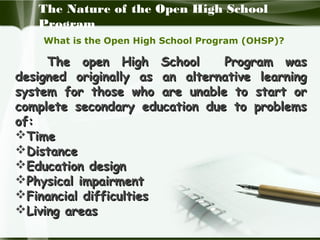
What is the Open High School Program (OHSP)?

The open High School
Program was
designed originally as an alternative learning
system for those who are unable to start or
complete secondary education due to problems
of:
Time
Distance
Education design
Physical impairment
Financial difficulties
Living areas
The Nature of the Open High School
Program
What are the goal and objectives of the OHSP?

The OHSP is aligned with the School
Improvement Plan’s (SIP) goal of producing
functionally literate learner/graduate or one who
has a mastery of the basic competencies, capable
of problem – solving, and is a productive member
of his family and community.
The Nature of the Open High School
Program
Objectives:

 Provides opportunity to all elementary
graduates, high school drop-outs, and successful
examinees of the Philippine Educational Placement
Test (PEPT) to complete secondary education;
 Prevents potential school leavers and
encourages those who are out of school to finish
secondary education;
 Reduces high school drop outs and increases
participation rate; and
 Increase achievement rate through quality
distance education.
The Nature of the Open High School
Program
Who can participate in the program?
 The program is open to all public or private secondary schools.
What are the requirements for participation?

1. Submit a Letter of Intent (LOI) addressed to the Schools
Division Superintendent (SDS), copy furnished the Regional
Office and the Director of the Bureau of Secondary Education
(BSE).
2. Undergo a capacity building program to be conducted by the
BSE in preparation for accreditation as a participating school.
3. Make available learning facilities and equipment in the school
e.g., library, computer room, laboratory room, workshop room,
gymnasium, etc.
4. Link with the community for the students’ access to facilities
like public library, baranggay learning center, internet cafe,
public sports facilities and those that will help the students in
their self-managed learning.
The Nature of the Open High School
Program
Who are qualified to enrol in the OHSP?

The program is open to Filipino learners who can
demonstrate capacity for independent learning and are willing
to undertake self-directed learning.
Below are pre-requisites for enrolment:
1. Submission of any of the following:
• High School Report Card (in case of drop-outs)
• Elementary Report Card (for high school entrants)
• PEPT qualifying certificate
2. Passing of the Independent Learning Readiness Test (ILRT)
and the Informal Reading Inventory (IRI) test (Appendices B
and C). The ILRT assesses the learner’s reading level as basis
for class grouping.
3. Interview of parent/guardian to get a complete profile of
the learner.
The MANAGEMENT STRUCTURE OF
THE OHSP
How is the OHSP managed?

The overall management of the OHSP
shall be done through the DropOut
Reduction
Program
(DORP)
management
structure
(DORP
Handbook, p.21). An OHSP Coordinator
shall be designated to oversee all the
activities of the intervention.
The MANAGEMENT STRUCTURE OF
THE OHSP

Roles and Responsibilities:
School H
ead
• Coordinates with the Local Government Unit (LGU) to ensure the
use of community facilities by the OHSP learners;
• Establishes a learning management program to bridge learning
gaps and enhance learning;
• Designates an OHSP Coordinator to synchronize OHSP
activities with the other strategic components of DORP;
• Oversees the implementation of policies formulated by the
DORP Council (for schools with DORP Council) pertinent to the
OHSP;
• Provides administrative and technical support to the
implementers;
• Evaluates the performance of the OHSP Coordinator and
teacher implementers ; and
• Submits report to the Division through the Division DORP
The MANAGEMENT STRUCTURE OF
THE OHSP

Roles and Responsibilities:
School DORP Council
• Formulates policies to promote and ensure
the successful implementation of the OHSP;
• Monitors the implementation of the policies
in particular and the intervention in general;
and
• Resolves OHSP issues that may arise and
problems that may be encountered.
The MANAGEMENT STRUCTURE OF
THE OHSP

Roles and Responsibilities:
OH Coordinator
SP
• Initiates the designing and implementation of advocacy
plans on OHSP to increase participation;
• Coordinates with the Guidance Counselor on the conduct
of the Independent Learning Readiness Test (ILRT) and the
Informal Reading Inventory (IRI) test;
• Leads in the conduct of orientation program for OHSP
students and parents;
• Provides technical assistance to the teacher implementers ;
• Oversees proper documentation of OHSP activities; and
• Keeps the school Head and the School DORP
Council properly informed on the progress of the OHSP.
The MANAGEMENT STRUCTURE OF
THE OHSP

Roles and Responsibilities:
Guidance Counsellor
• Administers, analyzes and interprets ILRT
and IRI test and helps teachers utilize test
results;
• Helps screen qualified enrolees to the
OHSP;
• Keeps an updated profile of the OHSP
students; and
• Tracks the progress of the students through
the teacher-implementers.
The MANAGEMENT STRUCTURE OF
THE OHSP

Roles and Responsibilities:
T
eacher-Adviser
• Orients learners on their tasks and responsibilities
as OHSP students;
• Helps learners gain access to learning
materials/resources;
• Guides the learner in his/her self-directed learning
tasks;
• Tracks the progress of the learner;
• Refers the learner to appropriate subject teacher
for assistance when necessary; and
• Maintains a complete record of the learner’s
performance.
The MANAGEMENT STRUCTURE OF
THE OHSP

Roles and Responsibilities:
Subject-T
eacher
• Assists learners in identifying their learning needs;
and in preparing their self-directed learning plan
(sample student learning plan attached in the
handbook)
• Provides time for consultation to address learning
gaps;
• Assesses learner’s progress and provide
feedback;
• Keeps a complete record of the learner’s
performance; and
• Provides the teacher-adviser with the results of the
The MANAGEMENT STRUCTURE OF
THE OHSP

Roles and Responsibilities:
L
earner/
Student
• Accomplishes the learner’s profile form;
• Identifies his learning needs and prepares his
self directed learning plan;
• Implements his self-learning plan;
• Consults with the teacher-adviser, subject
teacher or any capable person in the community
when necessary;
• Assesses his own progress and performance;
and
• Reports periodically to the teacher-adviser and
subject teachers.
The MANAGEMENT STRUCTURE OF
THE OHSP

Roles and Responsibilities:
Division Office
• Advocates the OHSP within the Division
and encourages the participation of private
secondary schools;
• Provides technical guidance through its
Division DORP Council;
• Monitors the implementation of the OHSP;
and
• Conducts researches to improve the
program.
The MANAGEMENT STRUCTURE OF
THE OHSP

Roles and Responsibilities:
Regional Office

• Conducts advocacy activities to
increase participation rate within the
region;
• Provides technical assistance to the
Division DORP implementers who assist
and monitors the OHSP; and
• Conducts results monitoring and
researches;
The MANAGEMENT STRUCTURE OF
THE OHSP

Roles and Responsibilities:
Central Office through the B
SE

• Advocates the program through print and
broadcast media to ensure nationwide
participation in the program;
• Formulates national policies on OHSP;
• Conducts capability building activities for
OHSP participating schools; and
• Monitors the implementation of the program
through the Regional Office.
The MANAGEMENT STRUCTURE OF
THE OHSP

Roles and Responsibilities:
L
ocal Government Unit (L
GU)
• Promotes the OHSP program through the conduct of
community assemblies, barangay council and sangguniang
bayan
meetings,
linkages
with
nongovernment
organizations, and print and broadcast media;
• Provides a list of out-of-school youth who may participate in
the program;
• Makes available to the learners community facilities like
library, reading centres, museum, gymnasium, etc.;
• Identifies potential resource persons in the community who
can assist the learners; and
• Provides incentives to learners to increase participation in
different community activities.
EVALUATING the OHSP
What are to be evaluated in the OHSP?
Who shall be involved?

1. Performance
learner/student.

of

the

The learner shall be evaluated by the
subject teachers using the same scheme
used for the regular high school.
EVALUATING the OHSP
What are to be evaluated in the OHSP?
Who shall be involved?

2. Performance
implementers.

of

the

teacher-

The Performance of
the teacher implementers shall be looked
into to determine areas for improving the
implementation of the program. The
assessment shall be a collaborative
undertaking of the OHSP Coordinator and
the school DORP Council.
EVALUATING the OHSP
What are to be evaluated in the OHSP?
Who shall be involved?

3. Overall Implementation of the OHSP
(Summative Evaluation).

The Division Office through its Division
DORP Council, the School DORP Council and
the school head shall evaluate the overall
implementation at the end of the school year in
terms of the following:
• approaches/methodologies used
• learner/performance
• community/LGU support
EVALUATING the OHSP
How shall the learner be evaluated?

1. Evaluation of learning in each
subject can include written and oral
tests and the assessment of
required outputs.
EVALUATING the OHSP
How shall the learner be evaluated?

2. Promotion is based on the fulfilment
of requirements and mastery of at
least 75% of the competencies in
each subject area.
EVALUATING the OHSP
How shall the learner be evaluated?

3. Acceleration by learning area and b
year level shall be determined in
highly meritorious cases upon
fulfilment of the requirements and
mastery of at least 90% of the
competencies in the subject area.
EVALUATING the OHSP
How shall the learner be evaluated?

4. Retention of the learner in the
program is for a maximum period of
six years with the option to be
mainstreamed in the regular program
anytime within the period of study.
APPENDICES
Appendix A: Learner’s Profile
Appendix B: Independent Learning
Readiness Test (ILRT)
Appendix C: Informal Reading Inventory
(IRI)
Appendix D: Sample Reading Passage
Appendix E: Learner’s Agreement
Appendix F: Kasunduan
Appendix G: Sample Learning Plan
Appendix H: Summary of Modules
Accomplished by Quarter
Thank You!

Mr. Cristopher C. Midea

MAED EM

Open High School Program

  • 1.
    Republic of thePhilippines Department of Education BUREAU OF SECONDARY EDUCATION OPEN HIGH SCHOOL PROGRAM (ohsp) Cristopher C. Midea July 2008
  • 2.
    FOREWORD It is aninalienable right of every individual to receive education which will enable him/her to become a productive citizen. The Constitution, recognizing this right, explicitly mandates that every individual regardless of age, sex, race, political or socio-economic status must enjoy access to quality and relevant basic education. To this end, the Bureau of Secondary Education has designed the open High School Program (OHSP), as an alternative mode of secondary education. The program offers an opportunity to those who desire to complete the high school curriculum outside of the formal school structure. This OHSP Handbook aims to guide the schools interested in implementing the program. The implementers are encouraged to modify or adapt the content of the handbook to suit their local conditions within the framework of an open learning system. DR. LOLITA M. ANDRADA Director IV, Bureau of Secondary Education Department of Education
  • 3.
    OPEN HIGH SCHOOLPROGRAM  The Nature of the Open High School Program (OHSP)  The MANAGEMENT STRUCTURE OF THE OPEN HIGH SCHOOL PROGRAM (OHSP) EVALUATING the Open High School Program (OHSP) APPENDICES
  • 4.
    The Nature ofthe Open High School Program What is the Open High School Program (OHSP)? The OHSP is an alternative mode of secondary education that uses distance learning. It caters to learners who are unable to attend the regular class program due to physical impairment, work, financial difficulties, distance of home to school, and other justifiable and legitimate reasons.
  • 5.
    The Nature ofthe Open High School Program What is the Open High School Program (OHSP)? The open High School Program was designed originally as an alternative learning system for those who are unable to start or complete secondary education due to problems of: Time Distance Education design Physical impairment Financial difficulties Living areas
  • 6.
    The Nature ofthe Open High School Program What are the goal and objectives of the OHSP? The OHSP is aligned with the School Improvement Plan’s (SIP) goal of producing functionally literate learner/graduate or one who has a mastery of the basic competencies, capable of problem – solving, and is a productive member of his family and community.
  • 7.
    The Nature ofthe Open High School Program Objectives:  Provides opportunity to all elementary graduates, high school drop-outs, and successful examinees of the Philippine Educational Placement Test (PEPT) to complete secondary education;  Prevents potential school leavers and encourages those who are out of school to finish secondary education;  Reduces high school drop outs and increases participation rate; and  Increase achievement rate through quality distance education.
  • 8.
    The Nature ofthe Open High School Program Who can participate in the program?  The program is open to all public or private secondary schools. What are the requirements for participation? 1. Submit a Letter of Intent (LOI) addressed to the Schools Division Superintendent (SDS), copy furnished the Regional Office and the Director of the Bureau of Secondary Education (BSE). 2. Undergo a capacity building program to be conducted by the BSE in preparation for accreditation as a participating school. 3. Make available learning facilities and equipment in the school e.g., library, computer room, laboratory room, workshop room, gymnasium, etc. 4. Link with the community for the students’ access to facilities like public library, baranggay learning center, internet cafe, public sports facilities and those that will help the students in their self-managed learning.
  • 9.
    The Nature ofthe Open High School Program Who are qualified to enrol in the OHSP? The program is open to Filipino learners who can demonstrate capacity for independent learning and are willing to undertake self-directed learning. Below are pre-requisites for enrolment: 1. Submission of any of the following: • High School Report Card (in case of drop-outs) • Elementary Report Card (for high school entrants) • PEPT qualifying certificate 2. Passing of the Independent Learning Readiness Test (ILRT) and the Informal Reading Inventory (IRI) test (Appendices B and C). The ILRT assesses the learner’s reading level as basis for class grouping. 3. Interview of parent/guardian to get a complete profile of the learner.
  • 10.
    The MANAGEMENT STRUCTUREOF THE OHSP How is the OHSP managed? The overall management of the OHSP shall be done through the DropOut Reduction Program (DORP) management structure (DORP Handbook, p.21). An OHSP Coordinator shall be designated to oversee all the activities of the intervention.
  • 11.
    The MANAGEMENT STRUCTUREOF THE OHSP Roles and Responsibilities: School H ead • Coordinates with the Local Government Unit (LGU) to ensure the use of community facilities by the OHSP learners; • Establishes a learning management program to bridge learning gaps and enhance learning; • Designates an OHSP Coordinator to synchronize OHSP activities with the other strategic components of DORP; • Oversees the implementation of policies formulated by the DORP Council (for schools with DORP Council) pertinent to the OHSP; • Provides administrative and technical support to the implementers; • Evaluates the performance of the OHSP Coordinator and teacher implementers ; and • Submits report to the Division through the Division DORP
  • 12.
    The MANAGEMENT STRUCTUREOF THE OHSP Roles and Responsibilities: School DORP Council • Formulates policies to promote and ensure the successful implementation of the OHSP; • Monitors the implementation of the policies in particular and the intervention in general; and • Resolves OHSP issues that may arise and problems that may be encountered.
  • 13.
    The MANAGEMENT STRUCTUREOF THE OHSP Roles and Responsibilities: OH Coordinator SP • Initiates the designing and implementation of advocacy plans on OHSP to increase participation; • Coordinates with the Guidance Counselor on the conduct of the Independent Learning Readiness Test (ILRT) and the Informal Reading Inventory (IRI) test; • Leads in the conduct of orientation program for OHSP students and parents; • Provides technical assistance to the teacher implementers ; • Oversees proper documentation of OHSP activities; and • Keeps the school Head and the School DORP Council properly informed on the progress of the OHSP.
  • 14.
    The MANAGEMENT STRUCTUREOF THE OHSP Roles and Responsibilities: Guidance Counsellor • Administers, analyzes and interprets ILRT and IRI test and helps teachers utilize test results; • Helps screen qualified enrolees to the OHSP; • Keeps an updated profile of the OHSP students; and • Tracks the progress of the students through the teacher-implementers.
  • 15.
    The MANAGEMENT STRUCTUREOF THE OHSP Roles and Responsibilities: T eacher-Adviser • Orients learners on their tasks and responsibilities as OHSP students; • Helps learners gain access to learning materials/resources; • Guides the learner in his/her self-directed learning tasks; • Tracks the progress of the learner; • Refers the learner to appropriate subject teacher for assistance when necessary; and • Maintains a complete record of the learner’s performance.
  • 16.
    The MANAGEMENT STRUCTUREOF THE OHSP Roles and Responsibilities: Subject-T eacher • Assists learners in identifying their learning needs; and in preparing their self-directed learning plan (sample student learning plan attached in the handbook) • Provides time for consultation to address learning gaps; • Assesses learner’s progress and provide feedback; • Keeps a complete record of the learner’s performance; and • Provides the teacher-adviser with the results of the
  • 17.
    The MANAGEMENT STRUCTUREOF THE OHSP Roles and Responsibilities: L earner/ Student • Accomplishes the learner’s profile form; • Identifies his learning needs and prepares his self directed learning plan; • Implements his self-learning plan; • Consults with the teacher-adviser, subject teacher or any capable person in the community when necessary; • Assesses his own progress and performance; and • Reports periodically to the teacher-adviser and subject teachers.
  • 18.
    The MANAGEMENT STRUCTUREOF THE OHSP Roles and Responsibilities: Division Office • Advocates the OHSP within the Division and encourages the participation of private secondary schools; • Provides technical guidance through its Division DORP Council; • Monitors the implementation of the OHSP; and • Conducts researches to improve the program.
  • 19.
    The MANAGEMENT STRUCTUREOF THE OHSP Roles and Responsibilities: Regional Office • Conducts advocacy activities to increase participation rate within the region; • Provides technical assistance to the Division DORP implementers who assist and monitors the OHSP; and • Conducts results monitoring and researches;
  • 20.
    The MANAGEMENT STRUCTUREOF THE OHSP Roles and Responsibilities: Central Office through the B SE • Advocates the program through print and broadcast media to ensure nationwide participation in the program; • Formulates national policies on OHSP; • Conducts capability building activities for OHSP participating schools; and • Monitors the implementation of the program through the Regional Office.
  • 21.
    The MANAGEMENT STRUCTUREOF THE OHSP Roles and Responsibilities: L ocal Government Unit (L GU) • Promotes the OHSP program through the conduct of community assemblies, barangay council and sangguniang bayan meetings, linkages with nongovernment organizations, and print and broadcast media; • Provides a list of out-of-school youth who may participate in the program; • Makes available to the learners community facilities like library, reading centres, museum, gymnasium, etc.; • Identifies potential resource persons in the community who can assist the learners; and • Provides incentives to learners to increase participation in different community activities.
  • 22.
    EVALUATING the OHSP Whatare to be evaluated in the OHSP? Who shall be involved? 1. Performance learner/student. of the The learner shall be evaluated by the subject teachers using the same scheme used for the regular high school.
  • 23.
    EVALUATING the OHSP Whatare to be evaluated in the OHSP? Who shall be involved? 2. Performance implementers. of the teacher- The Performance of the teacher implementers shall be looked into to determine areas for improving the implementation of the program. The assessment shall be a collaborative undertaking of the OHSP Coordinator and the school DORP Council.
  • 24.
    EVALUATING the OHSP Whatare to be evaluated in the OHSP? Who shall be involved? 3. Overall Implementation of the OHSP (Summative Evaluation). The Division Office through its Division DORP Council, the School DORP Council and the school head shall evaluate the overall implementation at the end of the school year in terms of the following: • approaches/methodologies used • learner/performance • community/LGU support
  • 25.
    EVALUATING the OHSP Howshall the learner be evaluated? 1. Evaluation of learning in each subject can include written and oral tests and the assessment of required outputs.
  • 26.
    EVALUATING the OHSP Howshall the learner be evaluated? 2. Promotion is based on the fulfilment of requirements and mastery of at least 75% of the competencies in each subject area.
  • 27.
    EVALUATING the OHSP Howshall the learner be evaluated? 3. Acceleration by learning area and b year level shall be determined in highly meritorious cases upon fulfilment of the requirements and mastery of at least 90% of the competencies in the subject area.
  • 28.
    EVALUATING the OHSP Howshall the learner be evaluated? 4. Retention of the learner in the program is for a maximum period of six years with the option to be mainstreamed in the regular program anytime within the period of study.
  • 29.
    APPENDICES Appendix A: Learner’sProfile Appendix B: Independent Learning Readiness Test (ILRT) Appendix C: Informal Reading Inventory (IRI) Appendix D: Sample Reading Passage Appendix E: Learner’s Agreement Appendix F: Kasunduan Appendix G: Sample Learning Plan Appendix H: Summary of Modules Accomplished by Quarter
  • 30.
    Thank You! Mr. CristopherC. Midea MAED EM