Dean Witter Senior Consultants Program
      Aresty Institute of Executive Education
 The Wharton School - University of Pennsylvania
                November 12, 1994


 Investment Planning
& Policy Development
         By Steve Saenz
Introduction
 Most important phase of the consulting
    process
   Often overlooked by investors and
    consultants
   Can be a significant advantage
     increases the probability of investment success
     provides an opportunity to add significant value
      to client relationships
 Other phases of the consulting process are
    becoming “commodities”

         Investment Planning & Policy Development | SteveSaenz.com   2
Presentation Objectives
   To provide a better understanding of
    the importance of investment
    planning & policy development
   To review the essential elements of
    an investment policy
   To provide some actionable ideas and
    practical information


       Investment Planning & Policy Development | SteveSaenz.com   3
Agenda
 Investment Planning and the Consulting
    Process
   Investment Planning: Critical Objectives
   Client Education
   Goals and Objectives
   Asset Allocation
   The Investment Policy Statement
   Practical Applications


        Investment Planning & Policy Development | SteveSaenz.com   4
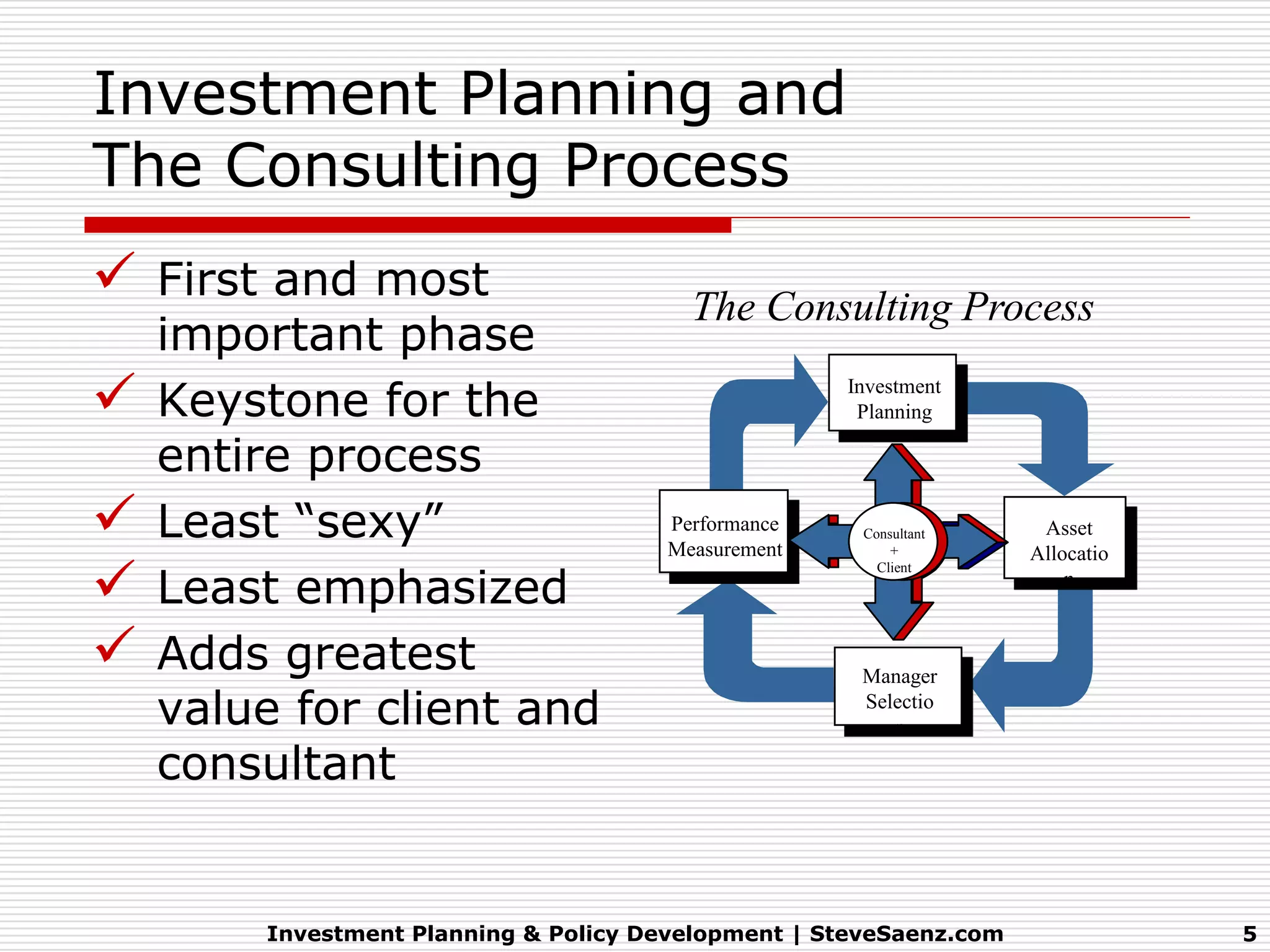
Investment Planning and
The Consulting Process
 First and most                        The Consulting Process
    important phase
   Keystone for the
                                                    Investment
                                                     Planning

    entire process
   Least “sexy”                      Performance
                                      Measurement
                                                      Consultant
                                                          +
                                                                     Asset
                                                                    Allocatio

   Least emphasized
                                                        Client
                                                                        n


   Adds greatest                                     Manager
    value for client and                              Selectio
                                                         n

    consultant


        Investment Planning & Policy Development | SteveSaenz.com               5
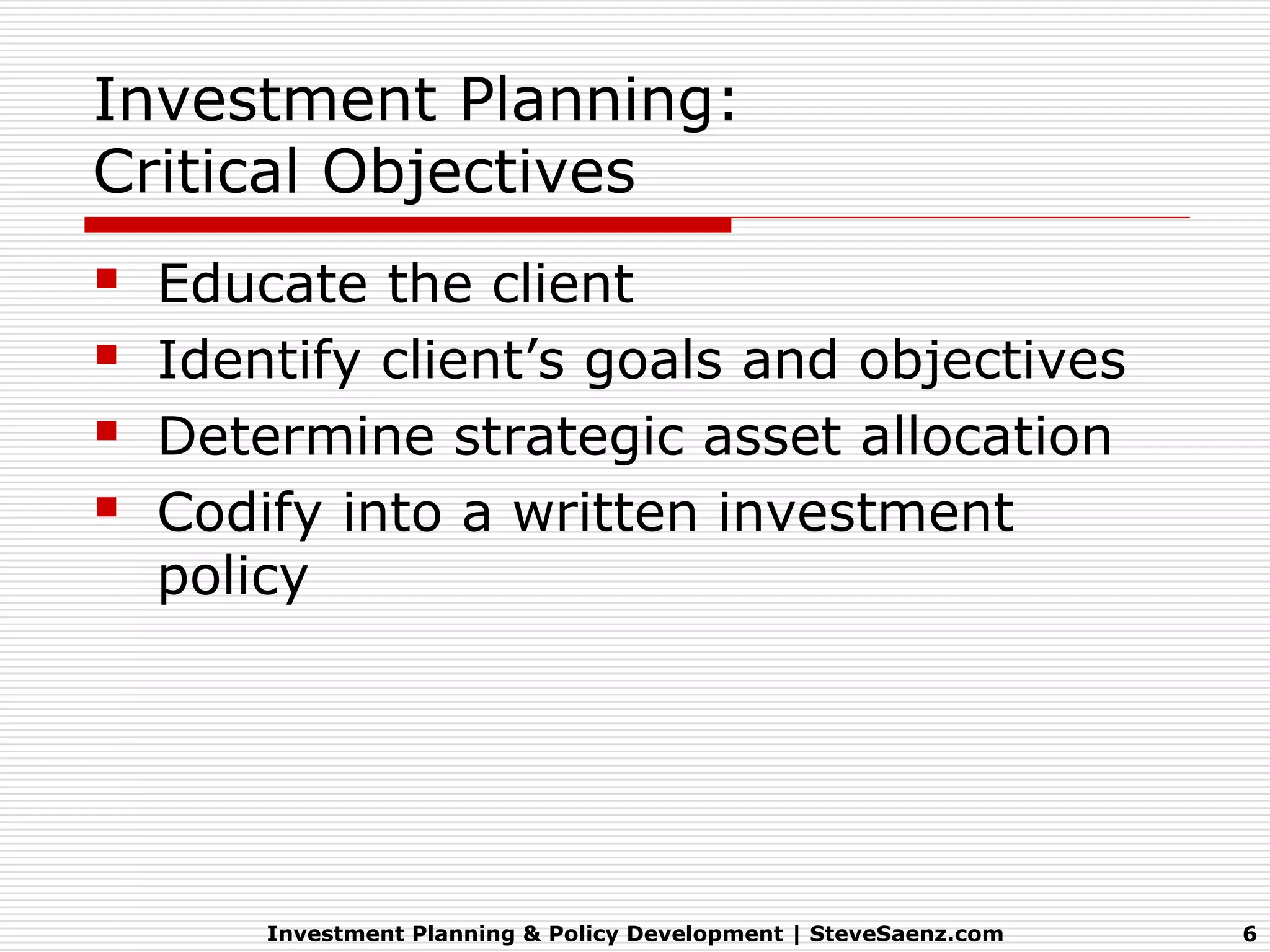
Investment Planning:
Critical Objectives
   Educate the client
   Identify client’s goals and objectives
   Determine strategic asset allocation
   Codify into a written investment
    policy


        Investment Planning & Policy Development | SteveSaenz.com   6
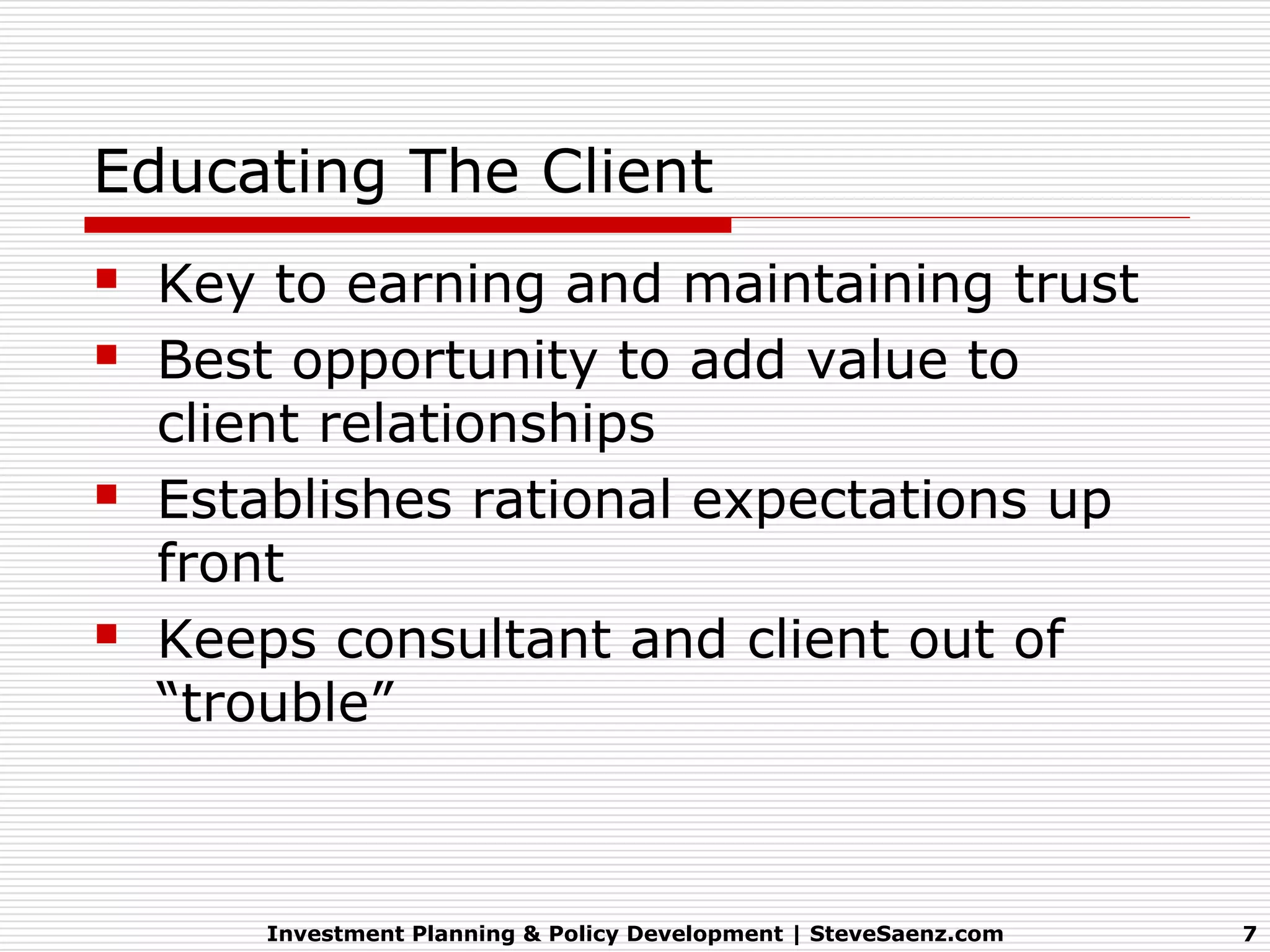
Educating The Client
   Key to earning and maintaining trust
   Best opportunity to add value to
    client relationships
   Establishes rational expectations up
    front
   Keeps consultant and client out of
    “trouble”


        Investment Planning & Policy Development | SteveSaenz.com   7
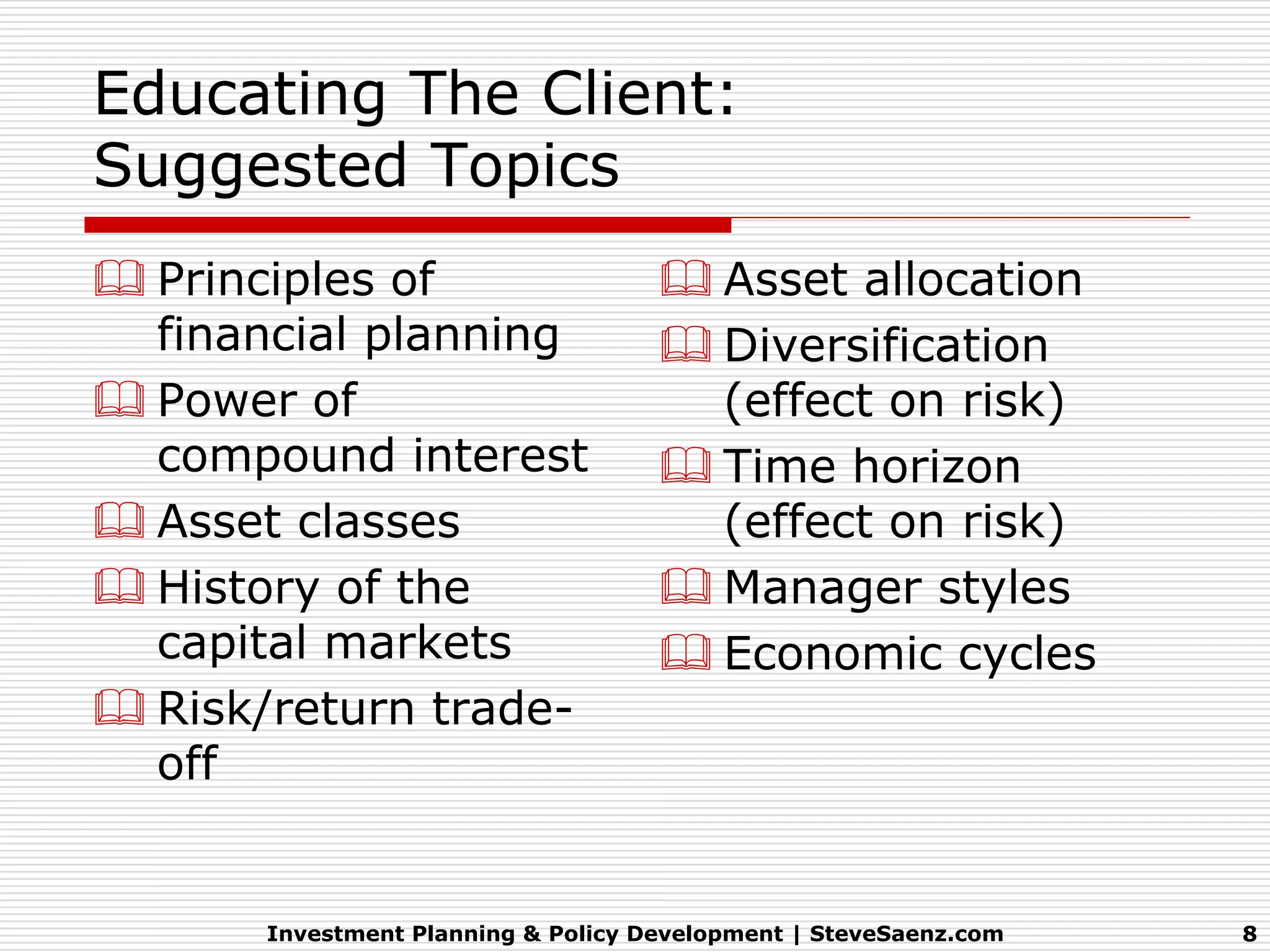
Educating The Client:
Suggested Topics
 Principles of                       Asset allocation
  financial planning                  Diversification
 Power of                             (effect on risk)
  compound interest                   Time horizon
 Asset classes                        (effect on risk)
 History of the                      Manager styles
  capital markets                     Economic cycles
 Risk/return trade-
  off


       Investment Planning & Policy Development | SteveSaenz.com   8
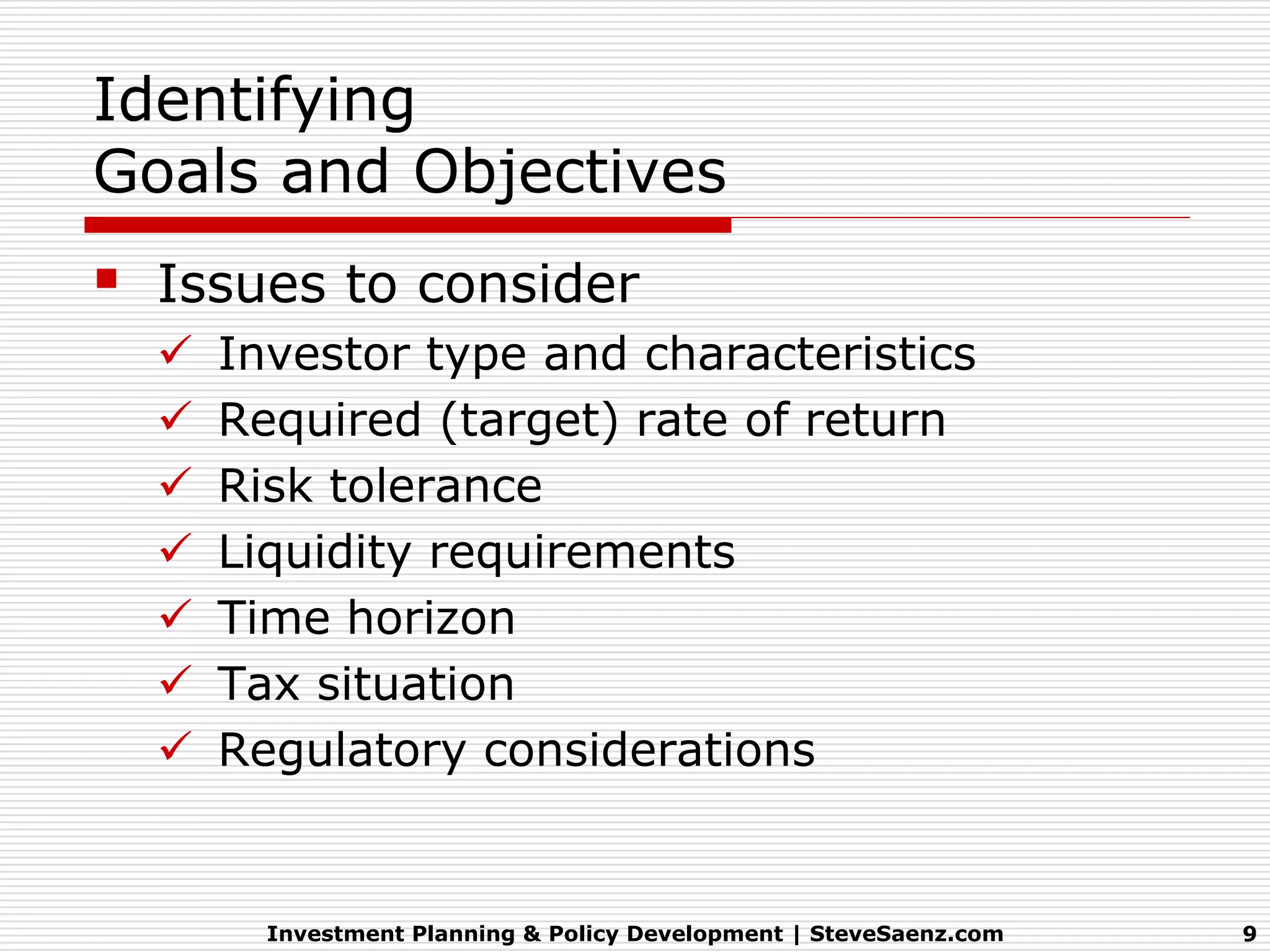
Identifying
Goals and Objectives
   Issues to consider
       Investor type and characteristics
       Required (target) rate of return
       Risk tolerance
       Liquidity requirements
       Time horizon
       Tax situation
       Regulatory considerations


          Investment Planning & Policy Development | SteveSaenz.com   9
Identifying
 Goals and Objectives
             Investor Types and Characteristics
Institutional investors                    Individual investors
      Corporate                                 Taxable
      Public                                    Tax-deferred [IRA,
      Unions (Taft-Hartley)                      401(k)]
      Endowments                                Trusts
      Foundations


           Investment Planning & Policy Development | SteveSaenz.com   10
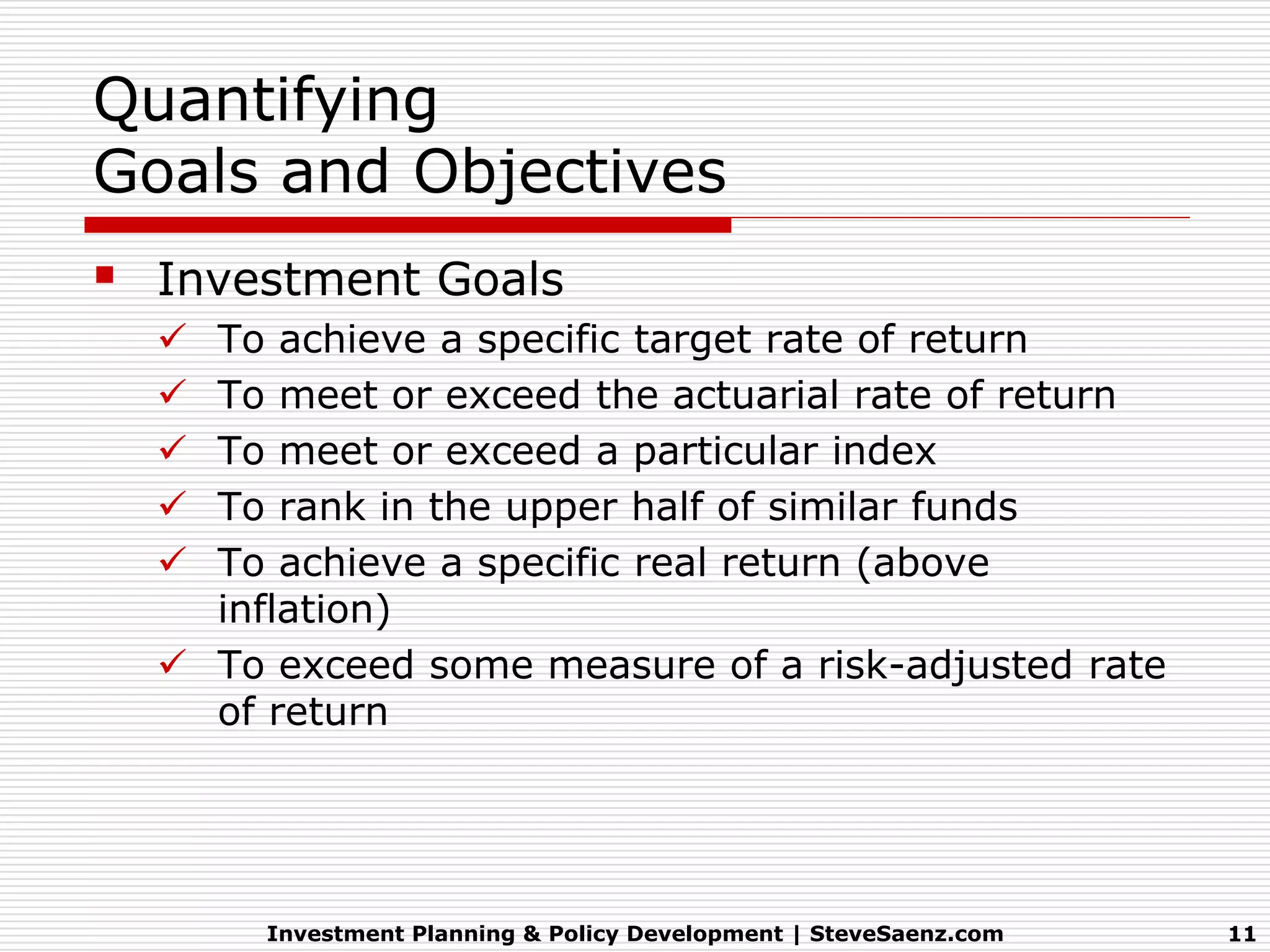
Quantifying
Goals and Objectives
 Investment Goals
   To achieve a specific target rate of return
   To meet or exceed the actuarial rate of return
   To meet or exceed a particular index
   To rank in the upper half of similar funds
   To achieve a specific real return (above
    inflation)
   To exceed some measure of a risk-adjusted rate
    of return


       Investment Planning & Policy Development | SteveSaenz.com   11
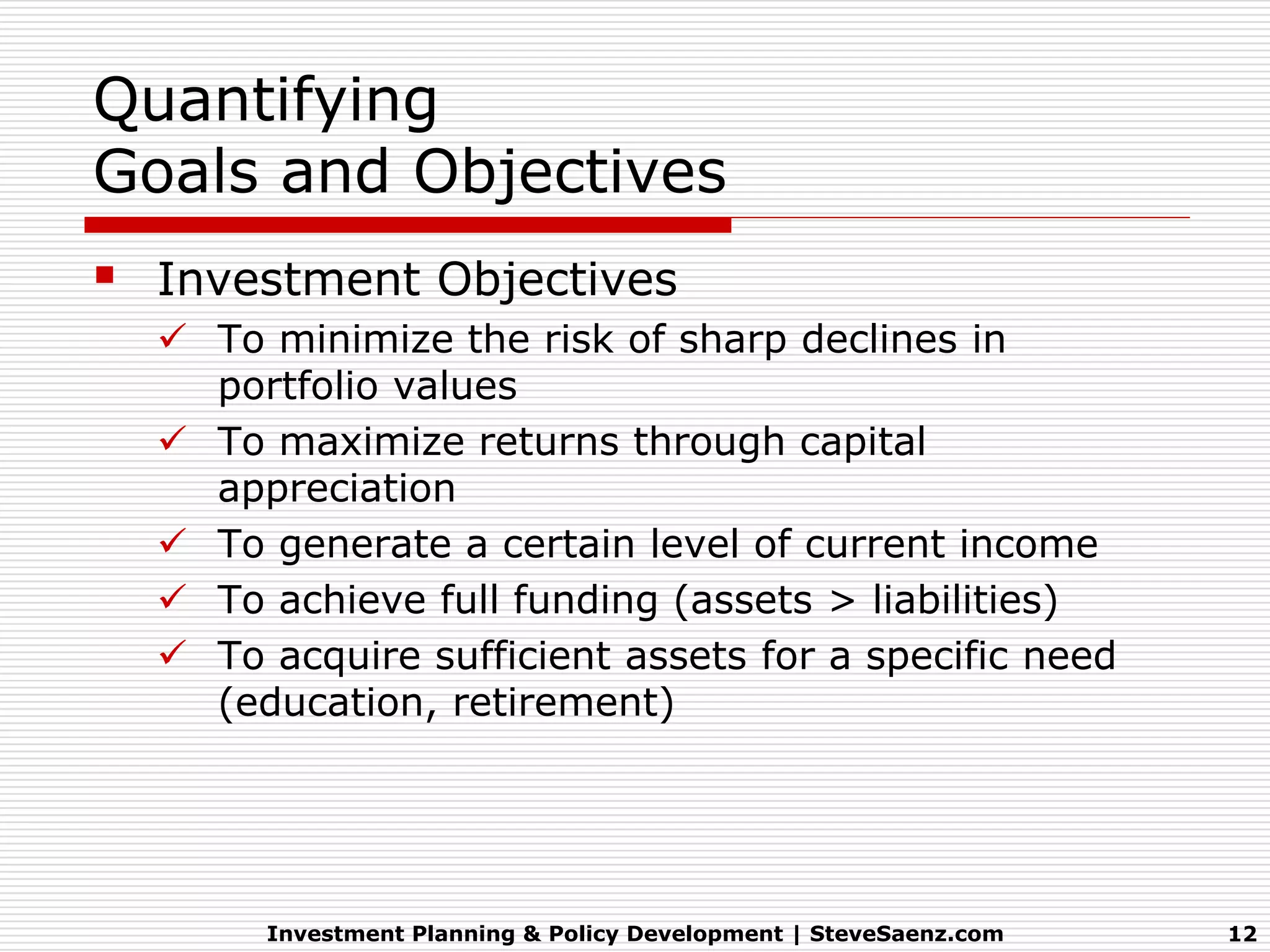
Quantifying
Goals and Objectives
 Investment Objectives
   To minimize the risk of sharp declines in
    portfolio values
   To maximize returns through capital
    appreciation
   To generate a certain level of current income
   To achieve full funding (assets > liabilities)
   To acquire sufficient assets for a specific need
    (education, retirement)


       Investment Planning & Policy Development | SteveSaenz.com   12
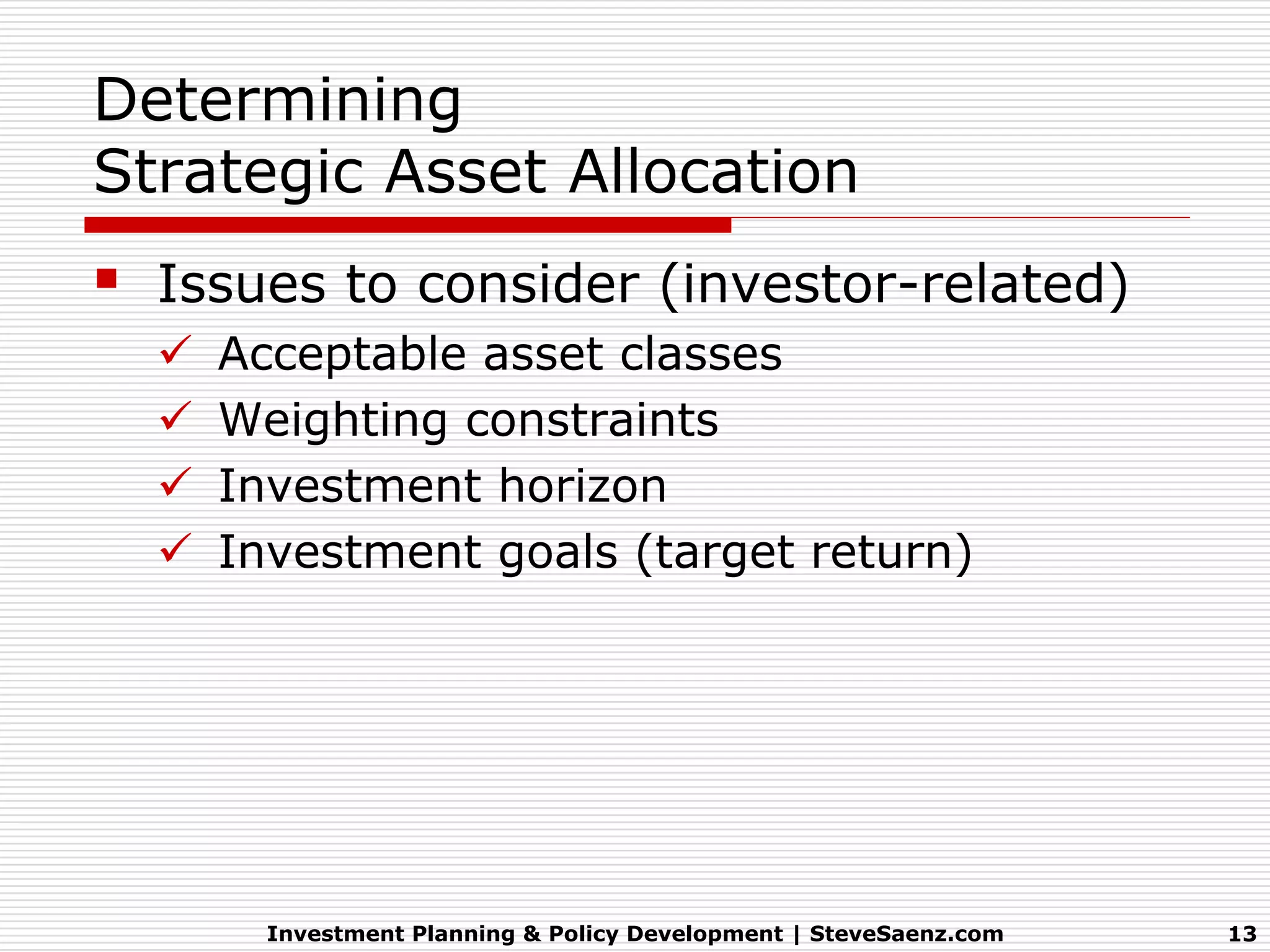
Determining
Strategic Asset Allocation
   Issues to consider (investor-related)
       Acceptable asset classes
       Weighting constraints
       Investment horizon
       Investment goals (target return)


          Investment Planning & Policy Development | SteveSaenz.com   13
Determining
Strategic Asset Allocation
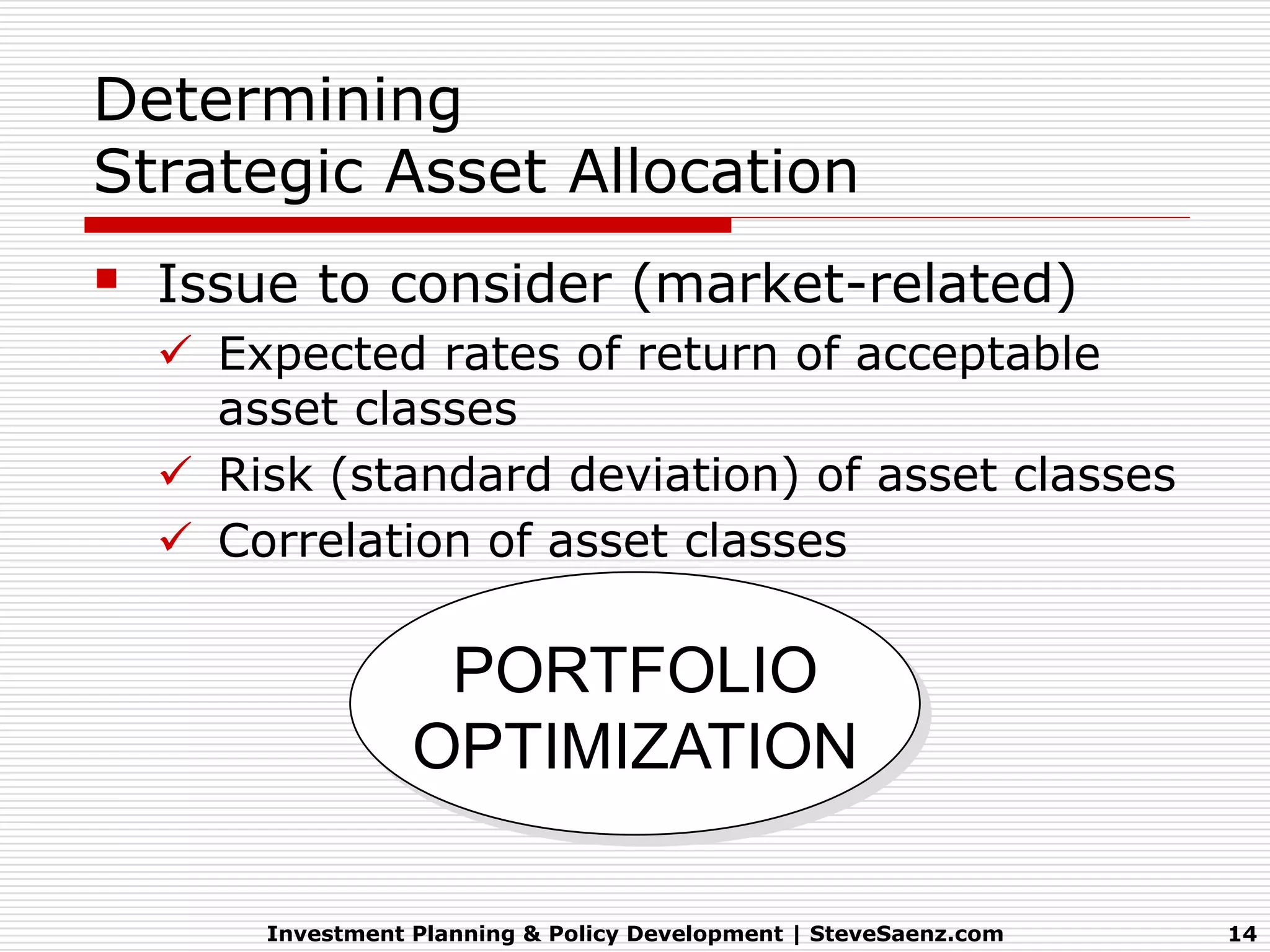
   Issue to consider (market-related)
     Expected rates of return of acceptable
      asset classes
     Risk (standard deviation) of asset classes
     Correlation of asset classes

                    PORTFOLIO
                   OPTIMIZATION

        Investment Planning & Policy Development | SteveSaenz.com   14
The Investment Policy Statement
 Definition
   Formal, written document that outlines the
    investment goals, objectives and guidelines of
    the investor


 Responsibilities
   Consultant assists by providing investor with
    necessary information
   Investor is ultimately responsible for drafting the
    investment policy
   Consultant reviews annually with investor

       Investment Planning & Policy Development | SteveSaenz.com   15
The Investment Policy Statement
 Purpose
   Codify the information gathered during
    investment planning phase
   Establish a clear line of communication between
    the investor, consultant and manager(s)
   Define the role and responsibilities of the
    investment manager
   Establish asset allocation policy
   Establish investment guidelines
   Establish a basis for evaluating investment
    results


       Investment Planning & Policy Development | SteveSaenz.com   16
The Investment Policy Statement
 Importance
   Regulatory requirements (e.g., ERISA)
   Fiduciary responsibility


 Practical benefits
     Logical and systematic approach
     Incorporates key principles of investments
     Promotes investment success
     Keeps investor “on track”


        Investment Planning & Policy Development | SteveSaenz.com   17
The Investment Policy Statement
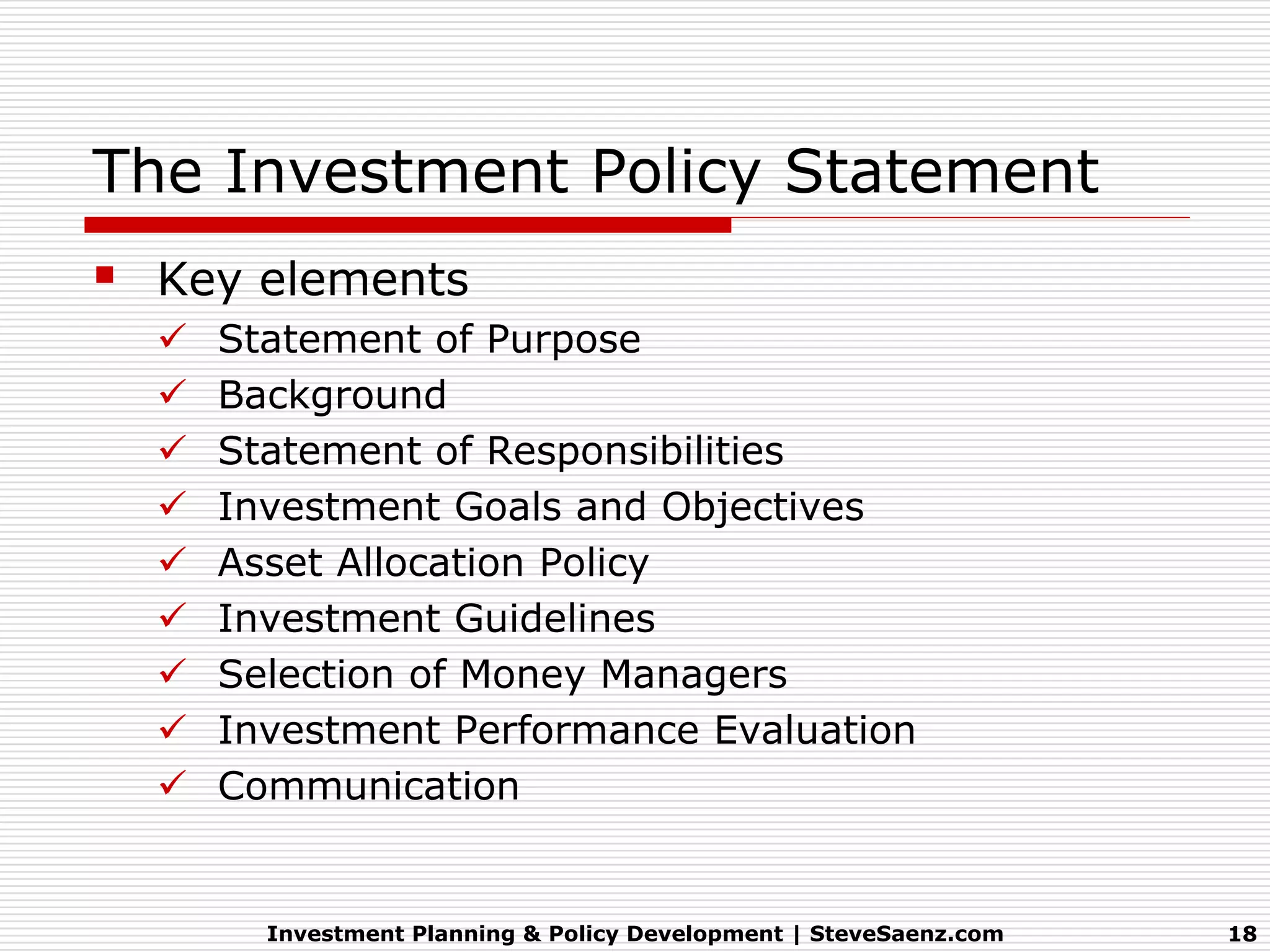
 Key elements
     Statement of Purpose
     Background
     Statement of Responsibilities
     Investment Goals and Objectives
     Asset Allocation Policy
     Investment Guidelines
     Selection of Money Managers
     Investment Performance Evaluation
     Communication


        Investment Planning & Policy Development | SteveSaenz.com   18
Practical Applications
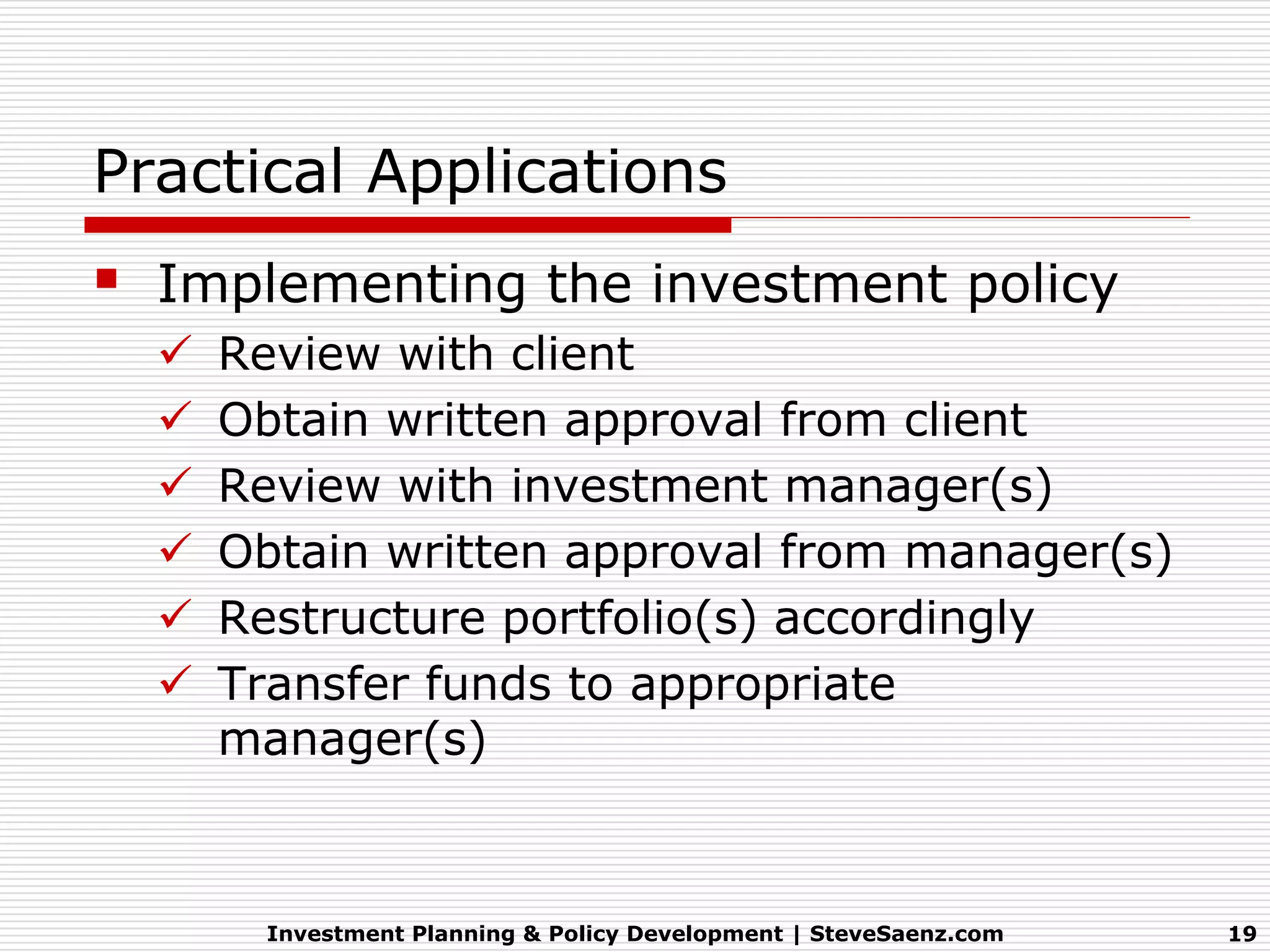
   Implementing the investment policy
       Review with client
       Obtain written approval from client
       Review with investment manager(s)
       Obtain written approval from manager(s)
       Restructure portfolio(s) accordingly
       Transfer funds to appropriate
        manager(s)


          Investment Planning & Policy Development | SteveSaenz.com   19
Practical Applications
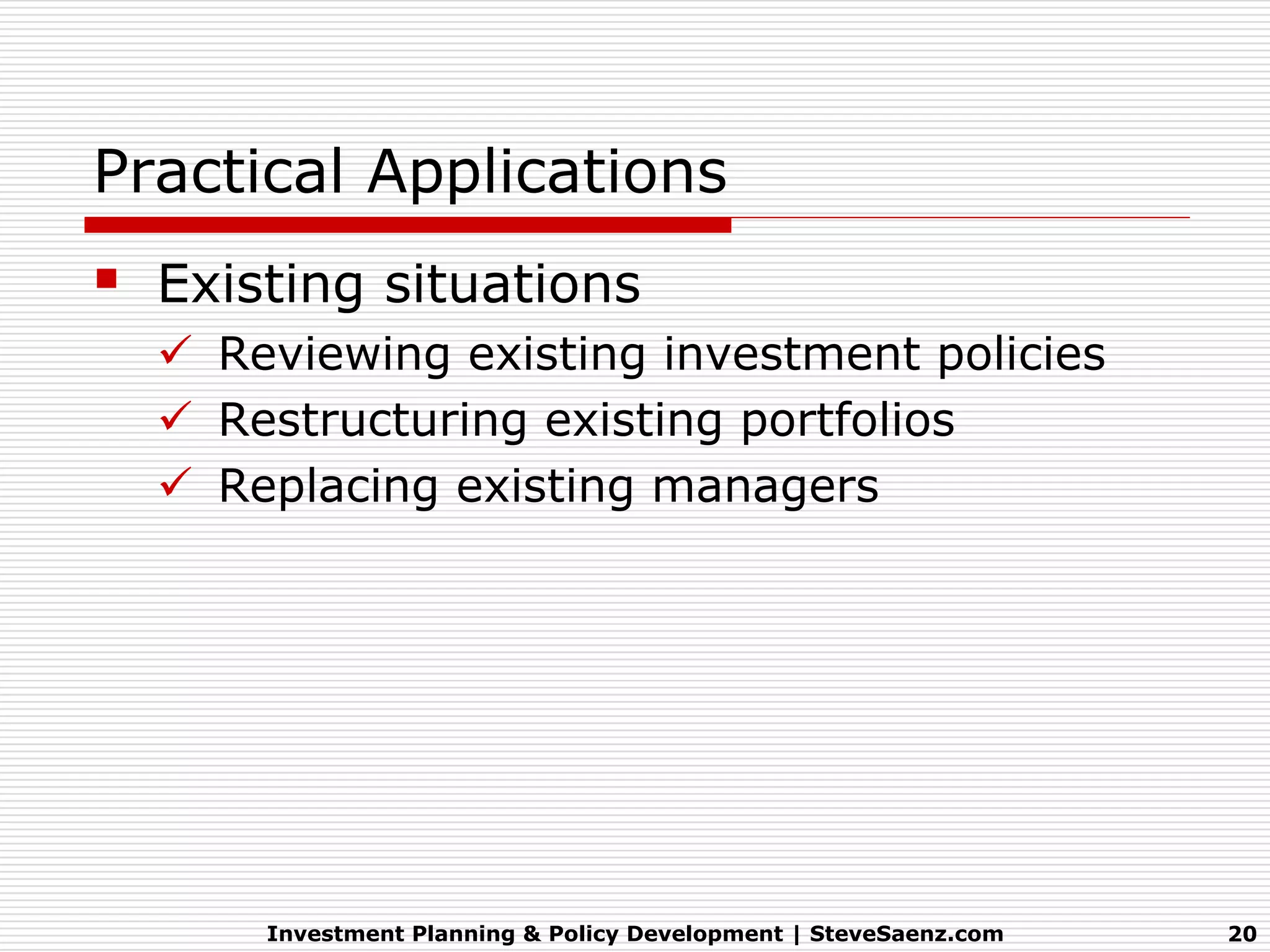
   Existing situations
     Reviewing existing investment policies
     Restructuring existing portfolios
     Replacing existing managers


        Investment Planning & Policy Development | SteveSaenz.com   20
Practical Applications
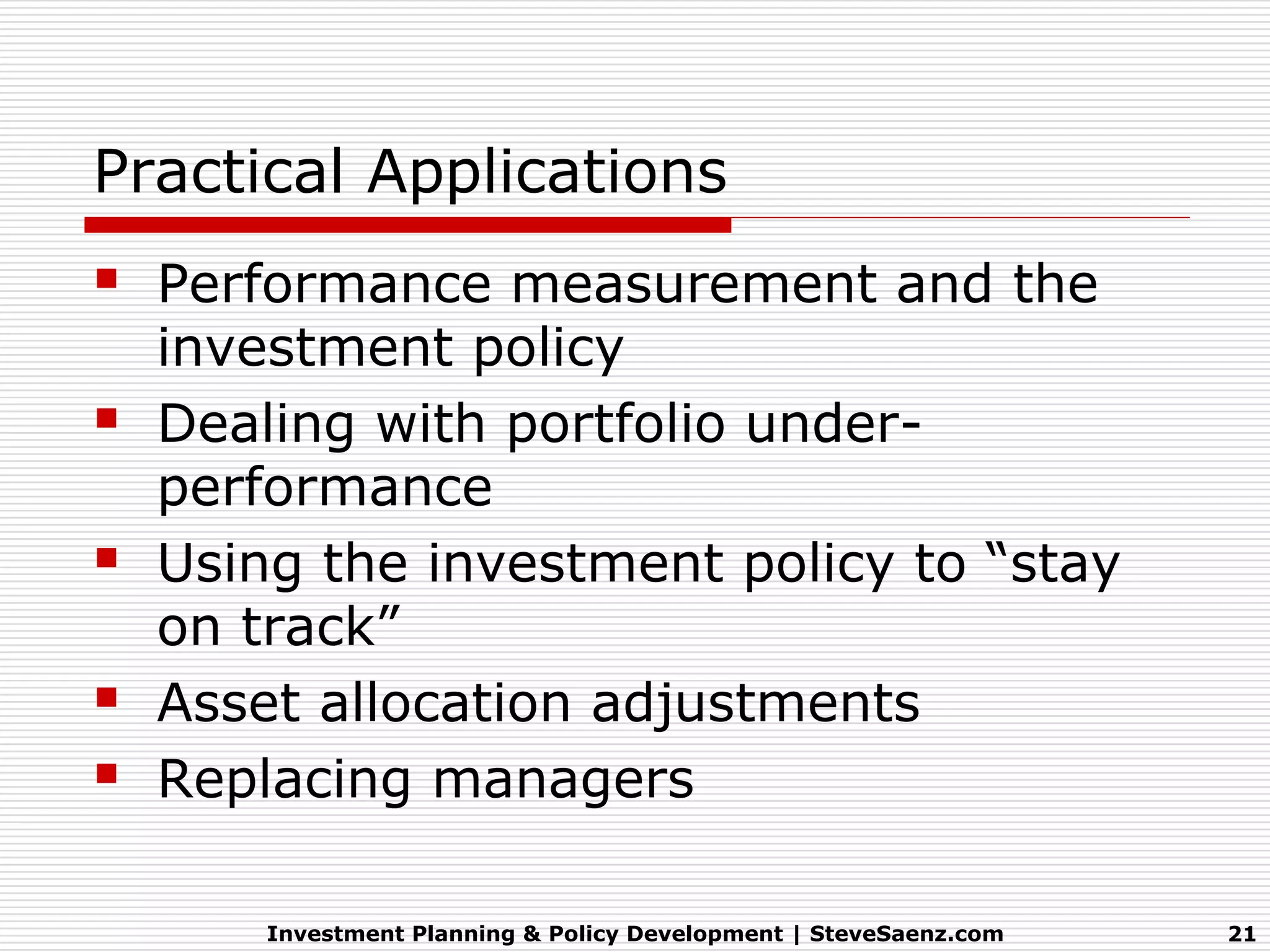
   Performance measurement and the
    investment policy
   Dealing with portfolio under-
    performance
   Using the investment policy to “stay
    on track”
   Asset allocation adjustments
   Replacing managers

        Investment Planning & Policy Development | SteveSaenz.com   21
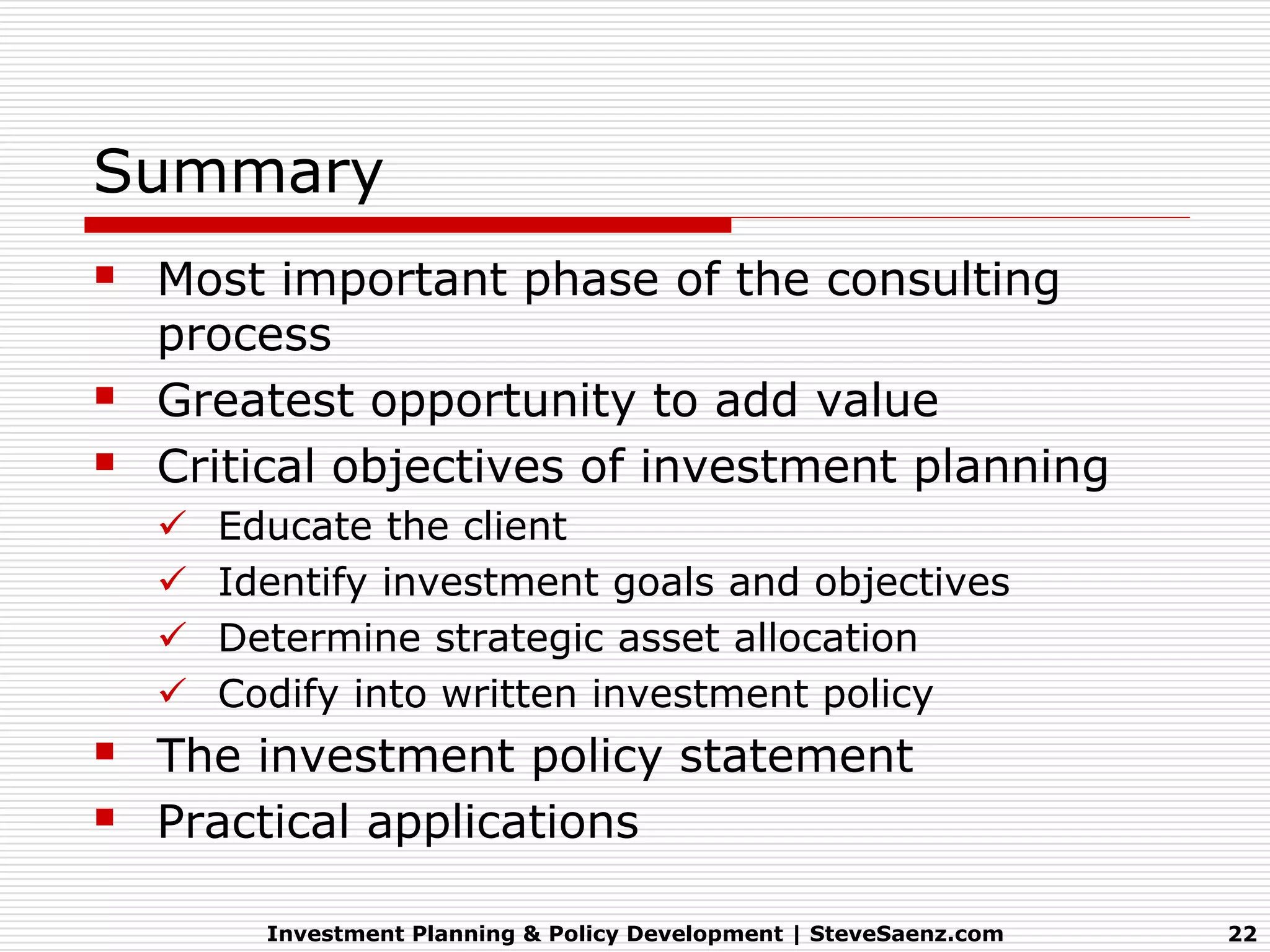
Summary
 Most important phase of the consulting
    process
   Greatest opportunity to add value
   Critical objectives of investment planning
       Educate the client
       Identify investment goals and objectives
       Determine strategic asset allocation
       Codify into written investment policy
 The investment policy statement
 Practical applications
          Investment Planning & Policy Development | SteveSaenz.com   22
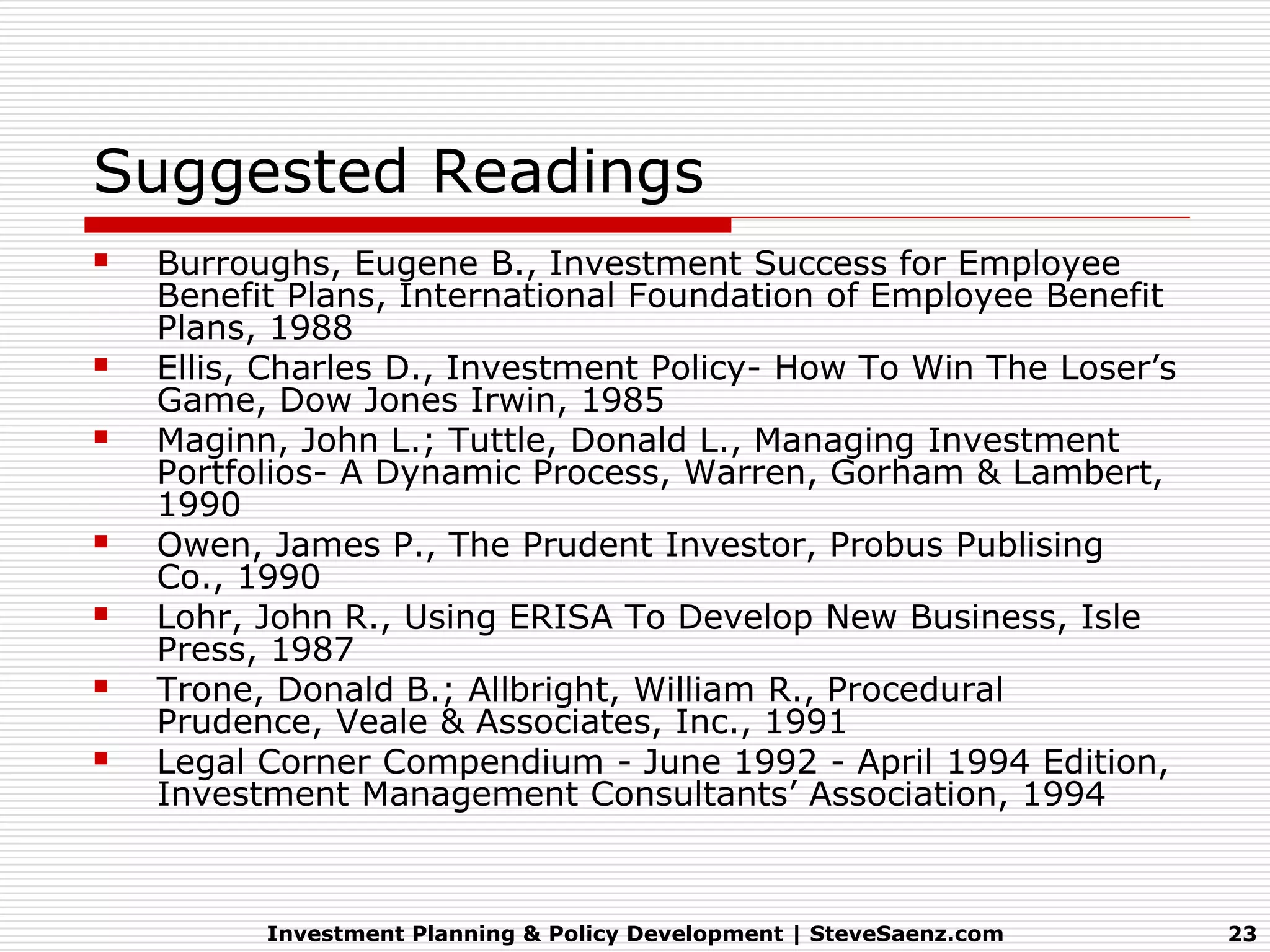
Suggested Readings
   Burroughs, Eugene B., Investment Success for Employee
    Benefit Plans, International Foundation of Employee Benefit
    Plans, 1988
   Ellis, Charles D., Investment Policy- How To Win The Loser’s
    Game, Dow Jones Irwin, 1985
   Maginn, John L.; Tuttle, Donald L., Managing Investment
    Portfolios- A Dynamic Process, Warren, Gorham & Lambert,
    1990
   Owen, James P., The Prudent Investor, Probus Publising
    Co., 1990
   Lohr, John R., Using ERISA To Develop New Business, Isle
    Press, 1987
   Trone, Donald B.; Allbright, William R., Procedural
    Prudence, Veale & Associates, Inc., 1991
   Legal Corner Compendium - June 1992 - April 1994 Edition,
    Investment Management Consultants’ Association, 1994


          Investment Planning & Policy Development | SteveSaenz.com   23
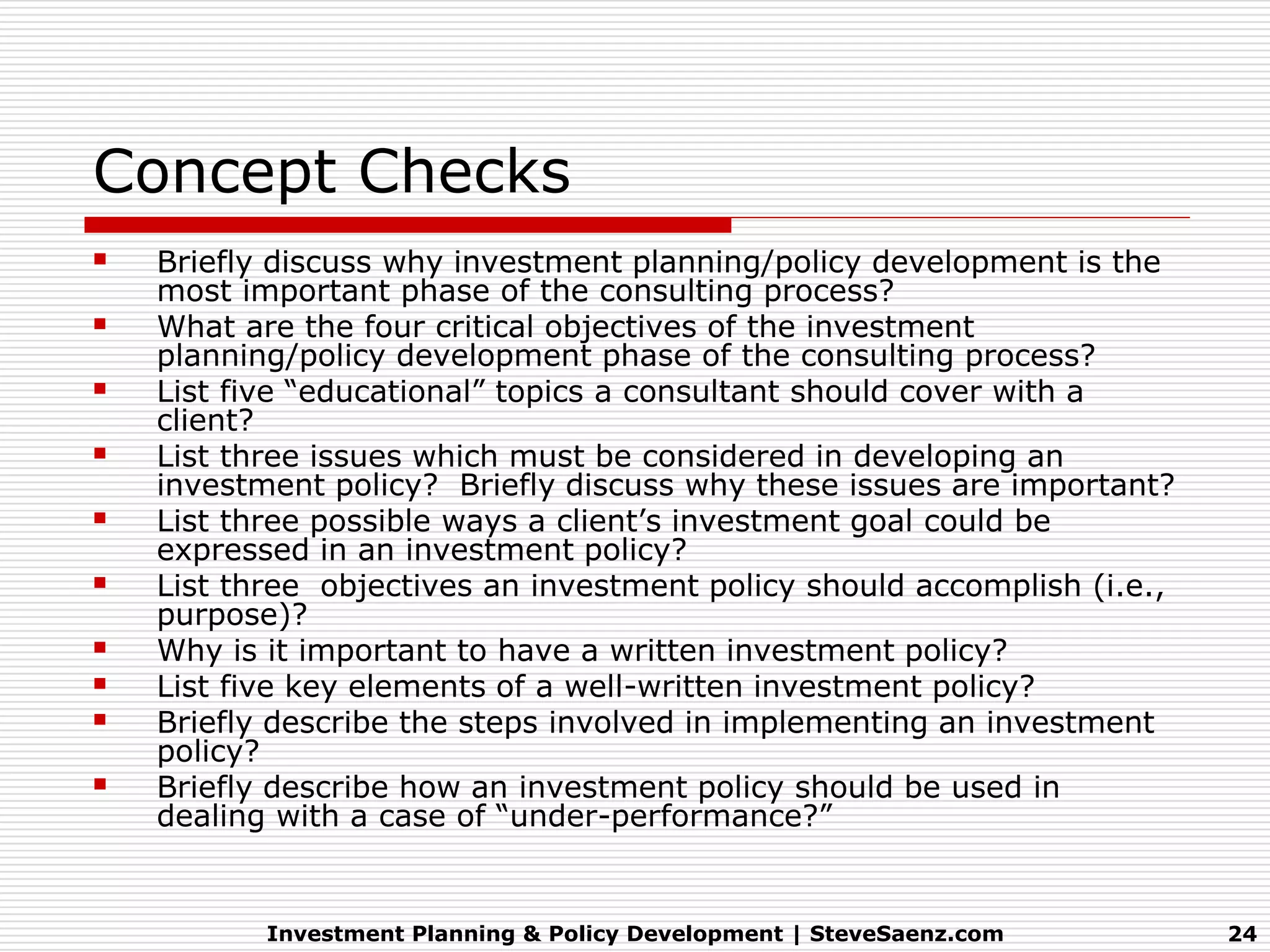
Concept Checks
   Briefly discuss why investment planning/policy development is the
    most important phase of the consulting process?
   What are the four critical objectives of the investment
    planning/policy development phase of the consulting process?
   List five “educational” topics a consultant should cover with a
    client?
   List three issues which must be considered in developing an
    investment policy? Briefly discuss why these issues are important?
   List three possible ways a client’s investment goal could be
    expressed in an investment policy?
   List three objectives an investment policy should accomplish (i.e.,
    purpose)?
   Why is it important to have a written investment policy?
   List five key elements of a well-written investment policy?
   Briefly describe the steps involved in implementing an investment
    policy?
   Briefly describe how an investment policy should be used in
    dealing with a case of “under-performance?”


           Investment Planning & Policy Development | SteveSaenz.com      24

Investment Planning & Policy Development

  • 1.
    Dean Witter SeniorConsultants Program Aresty Institute of Executive Education The Wharton School - University of Pennsylvania November 12, 1994 Investment Planning & Policy Development By Steve Saenz
  • 2.
    Introduction  Most importantphase of the consulting process  Often overlooked by investors and consultants  Can be a significant advantage  increases the probability of investment success  provides an opportunity to add significant value to client relationships  Other phases of the consulting process are becoming “commodities” Investment Planning & Policy Development | SteveSaenz.com 2
  • 3.
    Presentation Objectives  To provide a better understanding of the importance of investment planning & policy development  To review the essential elements of an investment policy  To provide some actionable ideas and practical information Investment Planning & Policy Development | SteveSaenz.com 3
  • 4.
    Agenda  Investment Planningand the Consulting Process  Investment Planning: Critical Objectives  Client Education  Goals and Objectives  Asset Allocation  The Investment Policy Statement  Practical Applications Investment Planning & Policy Development | SteveSaenz.com 4
  • 5.
    Investment Planning and TheConsulting Process  First and most The Consulting Process important phase  Keystone for the Investment Planning entire process  Least “sexy” Performance Measurement Consultant + Asset Allocatio  Least emphasized Client n  Adds greatest Manager value for client and Selectio n consultant Investment Planning & Policy Development | SteveSaenz.com 5
  • 6.
    Investment Planning: Critical Objectives  Educate the client  Identify client’s goals and objectives  Determine strategic asset allocation  Codify into a written investment policy Investment Planning & Policy Development | SteveSaenz.com 6
  • 7.
    Educating The Client  Key to earning and maintaining trust  Best opportunity to add value to client relationships  Establishes rational expectations up front  Keeps consultant and client out of “trouble” Investment Planning & Policy Development | SteveSaenz.com 7
  • 8.
    Educating The Client: SuggestedTopics  Principles of  Asset allocation financial planning  Diversification  Power of (effect on risk) compound interest  Time horizon  Asset classes (effect on risk)  History of the  Manager styles capital markets  Economic cycles  Risk/return trade- off Investment Planning & Policy Development | SteveSaenz.com 8
  • 9.
    Identifying Goals and Objectives  Issues to consider  Investor type and characteristics  Required (target) rate of return  Risk tolerance  Liquidity requirements  Time horizon  Tax situation  Regulatory considerations Investment Planning & Policy Development | SteveSaenz.com 9
  • 10.
    Identifying Goals andObjectives Investor Types and Characteristics Institutional investors Individual investors  Corporate  Taxable  Public  Tax-deferred [IRA,  Unions (Taft-Hartley) 401(k)]  Endowments  Trusts  Foundations Investment Planning & Policy Development | SteveSaenz.com 10
  • 11.
    Quantifying Goals and Objectives Investment Goals  To achieve a specific target rate of return  To meet or exceed the actuarial rate of return  To meet or exceed a particular index  To rank in the upper half of similar funds  To achieve a specific real return (above inflation)  To exceed some measure of a risk-adjusted rate of return Investment Planning & Policy Development | SteveSaenz.com 11
  • 12.
    Quantifying Goals and Objectives Investment Objectives  To minimize the risk of sharp declines in portfolio values  To maximize returns through capital appreciation  To generate a certain level of current income  To achieve full funding (assets > liabilities)  To acquire sufficient assets for a specific need (education, retirement) Investment Planning & Policy Development | SteveSaenz.com 12
  • 13.
    Determining Strategic Asset Allocation  Issues to consider (investor-related)  Acceptable asset classes  Weighting constraints  Investment horizon  Investment goals (target return) Investment Planning & Policy Development | SteveSaenz.com 13
  • 14.
    Determining Strategic Asset Allocation  Issue to consider (market-related)  Expected rates of return of acceptable asset classes  Risk (standard deviation) of asset classes  Correlation of asset classes PORTFOLIO OPTIMIZATION Investment Planning & Policy Development | SteveSaenz.com 14
  • 15.
    The Investment PolicyStatement  Definition  Formal, written document that outlines the investment goals, objectives and guidelines of the investor  Responsibilities  Consultant assists by providing investor with necessary information  Investor is ultimately responsible for drafting the investment policy  Consultant reviews annually with investor Investment Planning & Policy Development | SteveSaenz.com 15
  • 16.
    The Investment PolicyStatement  Purpose  Codify the information gathered during investment planning phase  Establish a clear line of communication between the investor, consultant and manager(s)  Define the role and responsibilities of the investment manager  Establish asset allocation policy  Establish investment guidelines  Establish a basis for evaluating investment results Investment Planning & Policy Development | SteveSaenz.com 16
  • 17.
    The Investment PolicyStatement  Importance  Regulatory requirements (e.g., ERISA)  Fiduciary responsibility  Practical benefits  Logical and systematic approach  Incorporates key principles of investments  Promotes investment success  Keeps investor “on track” Investment Planning & Policy Development | SteveSaenz.com 17
  • 18.
    The Investment PolicyStatement  Key elements  Statement of Purpose  Background  Statement of Responsibilities  Investment Goals and Objectives  Asset Allocation Policy  Investment Guidelines  Selection of Money Managers  Investment Performance Evaluation  Communication Investment Planning & Policy Development | SteveSaenz.com 18
  • 19.
    Practical Applications  Implementing the investment policy  Review with client  Obtain written approval from client  Review with investment manager(s)  Obtain written approval from manager(s)  Restructure portfolio(s) accordingly  Transfer funds to appropriate manager(s) Investment Planning & Policy Development | SteveSaenz.com 19
  • 20.
    Practical Applications  Existing situations  Reviewing existing investment policies  Restructuring existing portfolios  Replacing existing managers Investment Planning & Policy Development | SteveSaenz.com 20
  • 21.
    Practical Applications  Performance measurement and the investment policy  Dealing with portfolio under- performance  Using the investment policy to “stay on track”  Asset allocation adjustments  Replacing managers Investment Planning & Policy Development | SteveSaenz.com 21
  • 22.
    Summary  Most importantphase of the consulting process  Greatest opportunity to add value  Critical objectives of investment planning  Educate the client  Identify investment goals and objectives  Determine strategic asset allocation  Codify into written investment policy  The investment policy statement  Practical applications Investment Planning & Policy Development | SteveSaenz.com 22
  • 23.
    Suggested Readings  Burroughs, Eugene B., Investment Success for Employee Benefit Plans, International Foundation of Employee Benefit Plans, 1988  Ellis, Charles D., Investment Policy- How To Win The Loser’s Game, Dow Jones Irwin, 1985  Maginn, John L.; Tuttle, Donald L., Managing Investment Portfolios- A Dynamic Process, Warren, Gorham & Lambert, 1990  Owen, James P., The Prudent Investor, Probus Publising Co., 1990  Lohr, John R., Using ERISA To Develop New Business, Isle Press, 1987  Trone, Donald B.; Allbright, William R., Procedural Prudence, Veale & Associates, Inc., 1991  Legal Corner Compendium - June 1992 - April 1994 Edition, Investment Management Consultants’ Association, 1994 Investment Planning & Policy Development | SteveSaenz.com 23
  • 24.
    Concept Checks  Briefly discuss why investment planning/policy development is the most important phase of the consulting process?  What are the four critical objectives of the investment planning/policy development phase of the consulting process?  List five “educational” topics a consultant should cover with a client?  List three issues which must be considered in developing an investment policy? Briefly discuss why these issues are important?  List three possible ways a client’s investment goal could be expressed in an investment policy?  List three objectives an investment policy should accomplish (i.e., purpose)?  Why is it important to have a written investment policy?  List five key elements of a well-written investment policy?  Briefly describe the steps involved in implementing an investment policy?  Briefly describe how an investment policy should be used in dealing with a case of “under-performance?” Investment Planning & Policy Development | SteveSaenz.com 24