6-1
ObjectivesObjectives
Define Social Stratification
Identify characteristics of the
system of stratification
Promote protection of humanity,
dignity, rights, and the common
good.
6-2
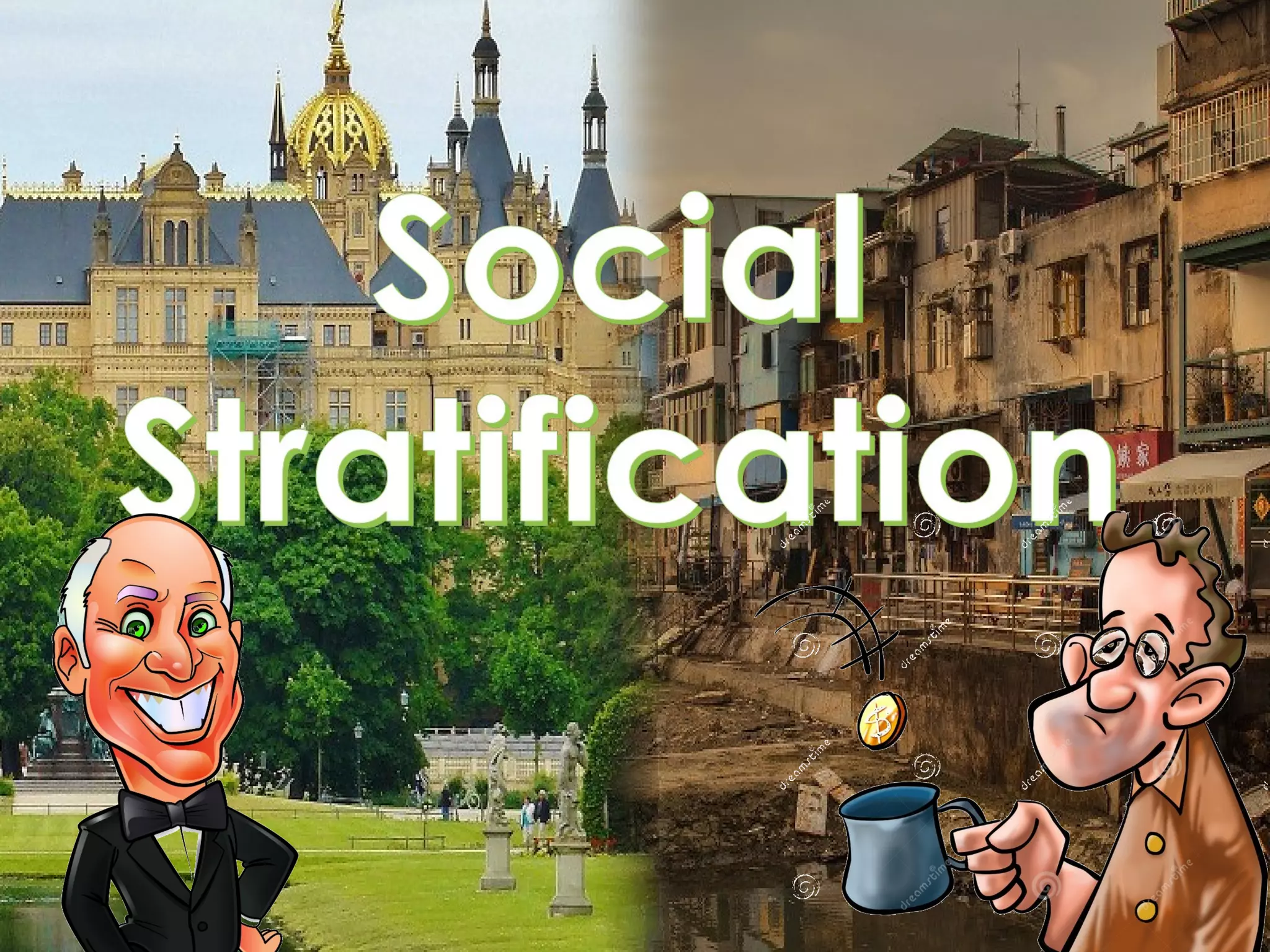
SocialSocial
StratificatioStratificatio
nn
Division or classification of
members of society into different
status
Development of hierarchy among
social groups
Exists in all societies*
6-3
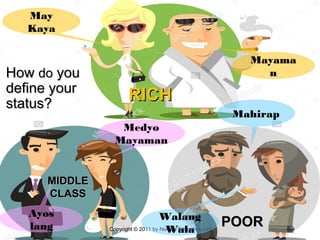
HowHow dodo youyou
define yourdefine your
status?status?
Copyright © 2011 by Nelson Education Ltd 6-4
Walang
Wala
Mahirap
Ayos
lang
Medyo
Mayaman
Mayama
n
May
Kaya
POORPOOR
MIDDLEMIDDLE
CLASSCLASS
RICHRICH
SocialSocial
DesirablesDesirables
6-5
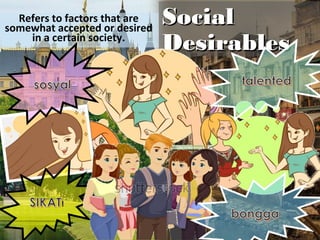
Refers to factors that are
somewhat accepted or desired
in a certain society.
SocialSocial
DesirablesDesirables
6-6
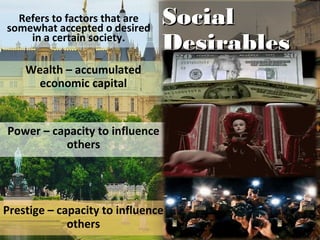
Refers to factors that are
somewhat accepted o desired
in a certain society.
Power – capacity to influence
others
Wealth – accumulated
economic capital
Prestige – capacity to influence
others
SocialSocial
MobilityMobility
6-7
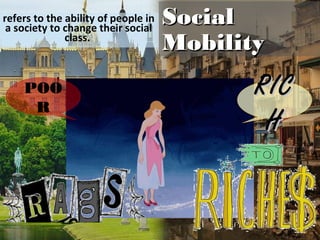
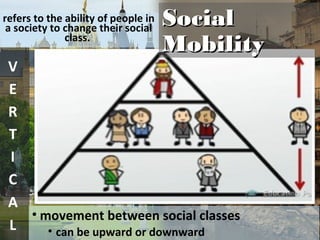
refers to the ability of people in
a society to change their social
class.
POO
R
RICRIC
HH
6-8
SocialSocial
MobilityMobility
refers to the ability of people in
a society to change their social
class.
• movement between social classes
• can be upward or downward
6-9
SocialSocial
MobilityMobility
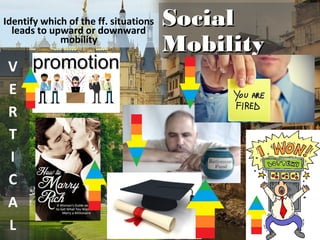
Identify which of the ff. situations
leads to upward or downward
mobility
promotionpromotion
6-10
SocialSocial
MobilityMobility
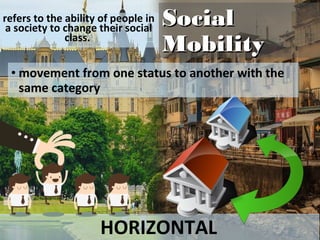
refers to the ability of people in
a society to change their social
class.
HORIZONTAL
• movement from one status to another with the
same category
6-11
SocialSocial
MobilityMobility
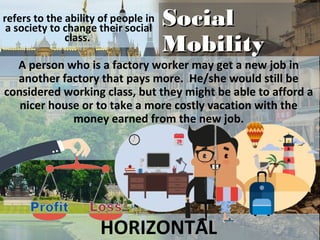
refers to the ability of people in
a society to change their social
class.
HORIZONTAL
A person who is a factory worker may get a new job in
another factory that pays more. He/she would still be
considered working class, but they might be able to afford a
nicer house or to take a more costly vacation with the
money earned from the new job.
6-12
SocialSocial
MobilityMobility
• May cause family problems.
• Moving, travelling.
• May result in financial burdens.
• May also create false expectations.
• May lead to disappointments.
• Stress and psychological conditions.
• Higher incidences of suicide, depression,
psychosis.
6-13
SocialSocial
MobilityMobility
• INTERGENERATIONAL
6-14
SocialSocial
MobilityMobility
• INTRAGENERATIONAL
6-15
SocialSocial
StratificatioStratificatio
nn
SystemSystem
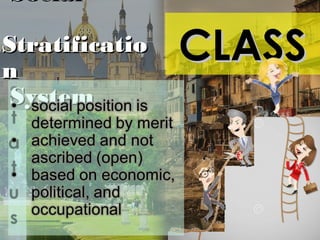
•CLASS
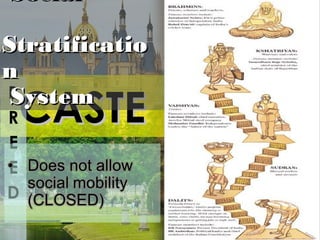
•CASTE
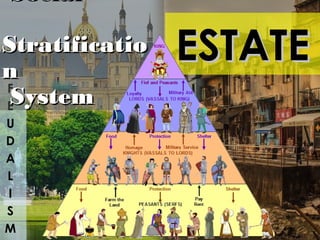
•ESTATE
•SLAVERY
6-16
CLASSCLASS
SocialSocial
StratificatioStratificatio
nn
SystemSystem
6-17
CASTECASTE
SocialSocial
StratificatioStratificatio
nn
SystemSystem
6-18
ESTATEESTATE
SocialSocial
StratificatioStratificatio
nn
SystemSystem
6-19
SLAVERYSLAVERY
SocialSocial
StratificatioStratificatio
nn
SystemSystem
6-20
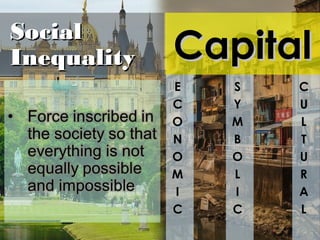
CapitalCapitalSocialSocial
InequalityInequality
6-21
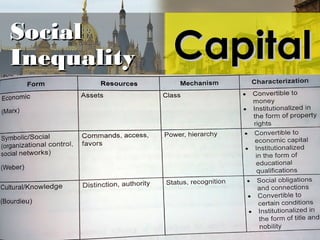
CapitalCapitalSocialSocial
InequalityInequality
6-22
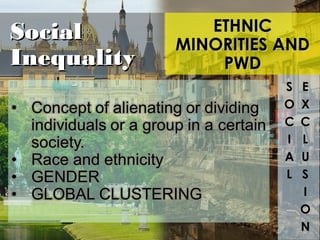
ETHNICETHNIC
MINORITIES ANDMINORITIES AND
PWDPWD
SocialSocial
InequalityInequality
CONSEQUENCES OF
MATERIAL INEQUALITY
• Position in class structure has effect on belief systems,
behaviours, voting patterns, lifestyles, and, most
importantly, life chances (e.g., health, longevity,
educational attainment, criminality)
• Increasing inequality may mean more social unrest
among the poor
But more opposition today from better-organized,
better-funded middle class*
Copyright © 2011 by Nelson Education Ltd 6-23
RESPONDING TO
INEQUALITY
• Two views:
1. Inequality is inevitable and need not be addressed
(tends to be espoused by the well-off)
2. Inequality is unjust and needs to be addressed (tends
to be espoused by the poor):
i. Socialist response: Overthrow capitalism
ii. Reformist response: Government redistribution of
wealth to the poor (e.g., through pensions, minimum-
wage legislation, unemployment insurance, etc.)*
Copyright © 2011 by Nelson Education Ltd 6-24

Social stratification

Editor's Notes

  • #24 Children from poorer families typically do not do as well in school as more affluent children, are more likely to drop out before completing high school, and are less likely to go on to higher education Such effects of poverty are largely responsible for the perpetuation of class inequalities from one generation to the next For a variety of reasons, including better nutrition, access to better health care, and less hazardous working conditions, those who are situated higher in the economic hierarchy are typically healthier than the poor On average, the poor do not live as long as those who are better off Similarly, when dealing with the criminal justice system, those with greater access to and control over economic resources tend to fare better; the poor are consequently overrepresented in jails Life-chances are a function of position in the class structure: Those higher up in the economic hierarchy enjoy a better quality of life For society, increasing inequality may mean more unrest among the poor; but there is more opposition today from better-organized middle class than from the poor
  • #25 Reactions to, and recommendations about, inequality reflect personal values and political orientation A large part of the problem lies in the fact that any serious effort to redistribute the wealth and income from the well-off to the poor would probably be opposed by the former