NORTH KOREA
Subject: Politics
Lecturer: Gary Giss
Group’s members
• Đặng Kim Hiếu - 1258020
• Trần Quang Khôi - 1258027
• Đào Ngọc Lan Đài - 1258007
• Nguyễn Trọng Tấn- 1258068
• Nguyễn Thị Trà My- 1258034
Outline
• Introduction
• Politics
• Economy
• Society
• Conclusion
INTRODUCTION
NORTH KOREA
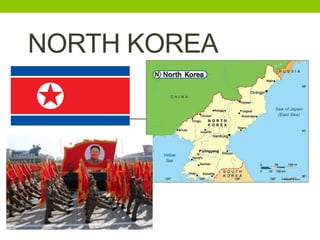
• Relative Location: Eastern Asia on the coast of
the Sea of Japan, it is located on a peninsula.
• Absolute Location: 39.2 N 125.45 E
Location
North Korea Physical Features/map
Background
• Japan invaded North Korea in 1905
• Korea split into North & South Korea in 1945
• On June 25th 1950, North Korea sent 75,000
soldiers across the 38th Parallel attacking the
South.
Timeline
1944 1948 1960's19531950
Japanese
occupation
of Korea
ends
Soviet
troops
withdraw
South
declares
independence
, sparking
North Korean
invasion
Armistice
ends
Korean
War,
Rapid
industrial
growth.
1980 1991 200320011994
Kim Jong-il,
moved up
party and
political
ladder.
North and
South Korea
join the
United
Nations
Death of Kim
Il-sung. Kim
Jong-il
succeeds him
as leader
North Korea
agrees to
freeze
nuclear
program
Worst
drought in
history
North Korea
withdraws
from the
Nuclear Non-
Proliferation
Treaty (NPT)
North Korean Leaders
• North Korea is a
communist state led by a
Dictator. That Dictator is
now Kim Jong-un
Human Environment Interaction
• North Korea's agricultural
economy is 35% while its
industry and services are 65%
of its economy
Floods and Food shortages
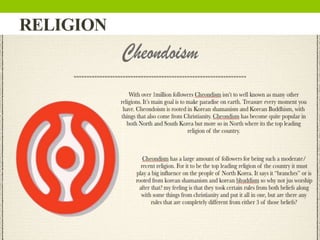
Religion
• Buddhist, Hindu or a Confucius
Movement
• The government has total control and
they decide where people are, and
how everything works and flows.
The government provide the illusion of religion.
• Closed economy
Continuity Through Change Of North
Korea
• In 1994 : The ‘Arduous March’
• Kim Jong il died in December 2011
• Economy was in meltdown
• Kim Jong Un has become the head of a new collective leadership that
appears firmly in control
Biography Kim Jong-il
• Kim Jong-il was the powerful leader of
North Korea from 1994 to 2011
• By that time North Korea had become
one of the most isolated countries in
the world, with frequent famines and
an economy in a shambles
• Kim's attempts to acquire nuclear
weapons for North Korea
• He reportedly suffered a stroke in
2008, and died three years later
POLITICS
NORTH KOREA POLITICAL
Political parties
• Democratic Republic
• Single party : Workers' Party of
Korea.
Political ideology
• Juche (state ideology).
• Songun ("military-first" policy).
Juche (Chosŏn'gŭl: 주체; hancha: 主體;)
• Described by the regime as Kim Il-Sung's "original,
brilliant and revolutionary contribution to national and
international thought“ .
Songun (or, alternatively, Seon'gun)
• Songun became major ideology after Kim Il-
sung's death.
• Their army was called Korean People’s Army.
Military
• The KPA has 1,106,000 active and 8,389,000 reserve and
paramilitary troops, making it the largest military institution
in the world.
• Approximately one in every 25 citizens is an enlisted
soldier.
Weapon
• North Korea had been
suspected of maintaining a
clandestine nuclear
weapons development
program since the early
1980s when it constructed
a plutonium-producing
Magnox nuclear reactor at
Yongbyon.
• North Korea's ability to
deliver weapons of mass
destruction to a
hypothetical target is
somewhat limited by its
missile technology.
• KN-1
• KN-2
• Hwasong-5
• Hwasong-6
• Nodong-1
• Taepodong
ECONOMY
North Korea’s Economic Phases
• Industrialization
• The Soviet model (self-reliance)1960s
• Foreign loans and indulged in large-scale imports of
machinery and plant facilities
• The oil shock   the petroleum prices
1970s
• Malfunctioning in its centralized planned system in the form
of supply shortages, systemic inefficiency, and infrastructural
decay
• Refusing to open up the economy
1980s
• Collapsed (The disintegration of the Soviet Union, food
crisis, natural disasters: hails in 1994, flooding in 1995-1996,
and droughts in 1997) pushed North Korea into a crisis
• Dependent on international aid
1990s
Foreign Loans & Grants (US$ Million)
Former
Soviet Union
China
Other Socialist
States
OECD
Members
Subtotal
Before 1948 53.0 - - - 53.0
1953-60 609.0 459.6 364.9 - 1,883.5
(Grants) (325.0) (287.1) (364.9) - (977.0)
1961-70 558.3 157.4 159.0 9 883.7
1971-80 682.1 300.0 - 1,292.2 2,274.1
1981-90 508.4 500.0 - - 1,008.4
Total 2,409.8 1,417.0 523.9 1,301.0 6,102.7
Source: North Korea’s External Debts: Trend and Characteristics, Korea Focus (KDI Review of the North Korea Economy,
March 2012, published by the Korea Development Institute)
North Korea’s Economic Phases
• Industrialization
• The Soviet model (self-reliance)1960s
• Foreign loans and indulged in large-scale imports of
machinery and plant facilities
• The oil shock   the petroleum prices
1970s
• Malfunctioning in its centralized planned system in the form
of supply shortages, systemic inefficiency, and infrastructural
decay
• Refusing to open up the economy
1980s
• collapsed (The disintegration of the Soviet Union, food
crisis, natural disasters: hails in 1994, flooding in 1995-1996,
and droughts in 1997) pushed North Korea into a crisis
• Dependent on international aid
1990s
Amount of Shortage (Unit: 10,000 ton)
1995 121
1996 184
1997 161
1998 146
1999 115
2000 96
2001 165
2002 141
2003
129
2004 114
2005 106
2006 106
2007 95
2008 139
2009 117
2010 135
2011 109
• Rolled out 14 new Special Economic Zones2013
• The economic growth picked for few years before dipping
again.2000s
• Malfunctioning in its centralized planned system in the form
of supply shortages, systemic inefficiency, and infrastructural
decay
• Refusing to open up the economy
1980s
• collapsed (The disintegration of the Soviet Union, food
crisis, natural disasters: hails in 1994, flooding in 1995-1996,
and droughts in 1997) pushed North Korea into a crisis
• Dependent on international aid
1990s
The “military” ambition
• 1966: the defense sector comprised around 10%
total expenditures
• 1967 to 1971: over 30 %
• 1970s: 30% - 50%
• GDP: $33.3 billion (2013) (rise of 1.1%)
• agriculture: 23.4%
• industry: 47.2%
• services: 29.4%
• The main industries:
• military products
• machine building
• electric power, chemicals
• mining (coal, iron ore, limestone, graphite, copper, zinc,
lead, and precious metals), metallurgy
• textiles, food processing
• tourism
• China and South Korea are North’s main trading
partners.
• CIA’s 2012 estimates from the Factbook reveal:
• 63% of the exports from North are directed to China
• 27% to South Korea
• 73% percent of the total imports comes from China
(concessional assistance and support)
• 19% from South Korea
SOCIETY
Demography
• Ethnically homogeneous
• Population growth rate
Healthcare
• Public health
• Free universal insurance system
• Preventive medicine emphasization
Pyongyang Maternity Hospital
Infrastructure
• Rail transport is by far the most widespread
• Road transport is very limited
• Obsolete and in disrepair
• Develop own civilian nuclear program
A Soviet-built M62 diesel unit at Pyongyang Station
EDUCATION
EDUCATION
RELIGION
RELIGION
HUMAN RIGHTS
HUMAN RIGHTS
CONCLUSION
THANK YOU FOR
LISTENING

North korea ppt

  • 1.
  • 2.
    Group’s members • ĐặngKim Hiếu - 1258020 • Trần Quang Khôi - 1258027 • Đào Ngọc Lan Đài - 1258007 • Nguyễn Trọng Tấn- 1258068 • Nguyễn Thị Trà My- 1258034
  • 3.
    Outline • Introduction • Politics •Economy • Society • Conclusion
  • 4.
  • 5.
  • 6.
    • Relative Location:Eastern Asia on the coast of the Sea of Japan, it is located on a peninsula. • Absolute Location: 39.2 N 125.45 E Location
  • 7.
  • 8.
    Background • Japan invadedNorth Korea in 1905 • Korea split into North & South Korea in 1945 • On June 25th 1950, North Korea sent 75,000 soldiers across the 38th Parallel attacking the South.
  • 9.
    Timeline 1944 1948 1960's19531950 Japanese occupation ofKorea ends Soviet troops withdraw South declares independence , sparking North Korean invasion Armistice ends Korean War, Rapid industrial growth.
  • 10.
    1980 1991 200320011994 KimJong-il, moved up party and political ladder. North and South Korea join the United Nations Death of Kim Il-sung. Kim Jong-il succeeds him as leader North Korea agrees to freeze nuclear program Worst drought in history North Korea withdraws from the Nuclear Non- Proliferation Treaty (NPT)
  • 11.
    North Korean Leaders •North Korea is a communist state led by a Dictator. That Dictator is now Kim Jong-un
  • 12.
    Human Environment Interaction •North Korea's agricultural economy is 35% while its industry and services are 65% of its economy
  • 13.
    Floods and Foodshortages
  • 14.
  • 15.
    Movement • The governmenthas total control and they decide where people are, and how everything works and flows.
  • 16.
    The government providethe illusion of religion.
  • 17.
  • 18.
    Continuity Through ChangeOf North Korea • In 1994 : The ‘Arduous March’ • Kim Jong il died in December 2011 • Economy was in meltdown • Kim Jong Un has become the head of a new collective leadership that appears firmly in control
  • 19.
    Biography Kim Jong-il •Kim Jong-il was the powerful leader of North Korea from 1994 to 2011 • By that time North Korea had become one of the most isolated countries in the world, with frequent famines and an economy in a shambles • Kim's attempts to acquire nuclear weapons for North Korea • He reportedly suffered a stroke in 2008, and died three years later
  • 20.
  • 21.
  • 22.
    Political parties • DemocraticRepublic • Single party : Workers' Party of Korea.
  • 24.
    Political ideology • Juche(state ideology). • Songun ("military-first" policy).
  • 25.
  • 26.
    • Described bythe regime as Kim Il-Sung's "original, brilliant and revolutionary contribution to national and international thought“ .
  • 27.
  • 28.
    • Songun becamemajor ideology after Kim Il- sung's death. • Their army was called Korean People’s Army.
  • 29.
  • 30.
    • The KPAhas 1,106,000 active and 8,389,000 reserve and paramilitary troops, making it the largest military institution in the world. • Approximately one in every 25 citizens is an enlisted soldier.
  • 31.
    Weapon • North Koreahad been suspected of maintaining a clandestine nuclear weapons development program since the early 1980s when it constructed a plutonium-producing Magnox nuclear reactor at Yongbyon.
  • 32.
    • North Korea'sability to deliver weapons of mass destruction to a hypothetical target is somewhat limited by its missile technology. • KN-1 • KN-2 • Hwasong-5 • Hwasong-6 • Nodong-1 • Taepodong
  • 33.
  • 34.
    North Korea’s EconomicPhases • Industrialization • The Soviet model (self-reliance)1960s • Foreign loans and indulged in large-scale imports of machinery and plant facilities • The oil shock   the petroleum prices 1970s • Malfunctioning in its centralized planned system in the form of supply shortages, systemic inefficiency, and infrastructural decay • Refusing to open up the economy 1980s • Collapsed (The disintegration of the Soviet Union, food crisis, natural disasters: hails in 1994, flooding in 1995-1996, and droughts in 1997) pushed North Korea into a crisis • Dependent on international aid 1990s
  • 35.
    Foreign Loans &Grants (US$ Million) Former Soviet Union China Other Socialist States OECD Members Subtotal Before 1948 53.0 - - - 53.0 1953-60 609.0 459.6 364.9 - 1,883.5 (Grants) (325.0) (287.1) (364.9) - (977.0) 1961-70 558.3 157.4 159.0 9 883.7 1971-80 682.1 300.0 - 1,292.2 2,274.1 1981-90 508.4 500.0 - - 1,008.4 Total 2,409.8 1,417.0 523.9 1,301.0 6,102.7 Source: North Korea’s External Debts: Trend and Characteristics, Korea Focus (KDI Review of the North Korea Economy, March 2012, published by the Korea Development Institute)
  • 36.
    North Korea’s EconomicPhases • Industrialization • The Soviet model (self-reliance)1960s • Foreign loans and indulged in large-scale imports of machinery and plant facilities • The oil shock   the petroleum prices 1970s • Malfunctioning in its centralized planned system in the form of supply shortages, systemic inefficiency, and infrastructural decay • Refusing to open up the economy 1980s • collapsed (The disintegration of the Soviet Union, food crisis, natural disasters: hails in 1994, flooding in 1995-1996, and droughts in 1997) pushed North Korea into a crisis • Dependent on international aid 1990s
  • 37.
    Amount of Shortage(Unit: 10,000 ton) 1995 121 1996 184 1997 161 1998 146 1999 115 2000 96 2001 165 2002 141 2003 129 2004 114 2005 106 2006 106 2007 95 2008 139 2009 117 2010 135 2011 109
  • 38.
    • Rolled out14 new Special Economic Zones2013 • The economic growth picked for few years before dipping again.2000s • Malfunctioning in its centralized planned system in the form of supply shortages, systemic inefficiency, and infrastructural decay • Refusing to open up the economy 1980s • collapsed (The disintegration of the Soviet Union, food crisis, natural disasters: hails in 1994, flooding in 1995-1996, and droughts in 1997) pushed North Korea into a crisis • Dependent on international aid 1990s
  • 39.
    The “military” ambition •1966: the defense sector comprised around 10% total expenditures • 1967 to 1971: over 30 % • 1970s: 30% - 50%
  • 41.
    • GDP: $33.3billion (2013) (rise of 1.1%) • agriculture: 23.4% • industry: 47.2% • services: 29.4% • The main industries: • military products • machine building • electric power, chemicals • mining (coal, iron ore, limestone, graphite, copper, zinc, lead, and precious metals), metallurgy • textiles, food processing • tourism
  • 42.
    • China andSouth Korea are North’s main trading partners. • CIA’s 2012 estimates from the Factbook reveal: • 63% of the exports from North are directed to China • 27% to South Korea • 73% percent of the total imports comes from China (concessional assistance and support) • 19% from South Korea
  • 43.
  • 44.
  • 45.
    Healthcare • Public health •Free universal insurance system • Preventive medicine emphasization Pyongyang Maternity Hospital
  • 46.
    Infrastructure • Rail transportis by far the most widespread • Road transport is very limited • Obsolete and in disrepair • Develop own civilian nuclear program A Soviet-built M62 diesel unit at Pyongyang Station
  • 47.
  • 48.
  • 49.
  • 50.
  • 51.
  • 52.
  • 53.
  • 56.