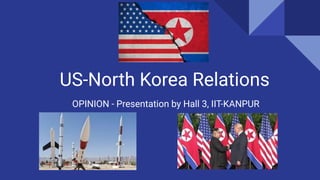
US-North Korea Relations
OPINION - Presentation by Hall 3, IIT-KANPUR
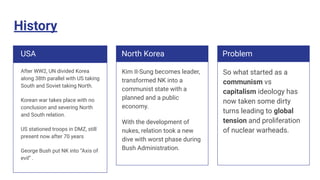
History
USA
After WW2, UN divided Korea
along 38th parallel with US taking
South and Soviet taking North.
Korean war takes place with no
conclusion and severing North
and South relation.
US stationed troops in DMZ, still
present now after 70 years
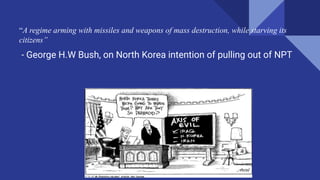
George Bush put NK into “Axis of
evil” .
North Korea
Kim II-Sung becomes leader,
transformed NK into a
communist state with a
planned and a public
economy.
With the development of
nukes, relation took a new
dive with worst phase during
Bush Administration.
Problem
So what started as a
communism vs
capitalism ideology has
now taken some dirty
turns leading to global
tension and proliferation
of nuclear warheads.
Korean War
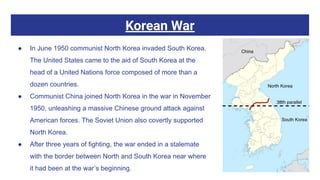
● In June 1950 communist North Korea invaded South Korea.
The United States came to the aid of South Korea at the
head of a United Nations force composed of more than a
dozen countries.
● Communist China joined North Korea in the war in November
1950, unleashing a massive Chinese ground attack against
American forces. The Soviet Union also covertly supported
North Korea.
● After three years of fighting, the war ended in a stalemate
with the border between North and South Korea near where
it had been at the war’s beginning.
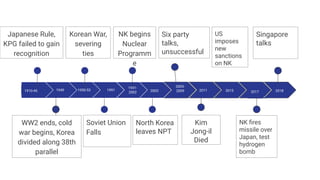
Japanese Rule,
KPG failed to gain
recognition
1949
WW2 ends, cold
war begins, Korea
divided along 38th
parallel
1950-53
Korean War,
severing
ties
1991
Soviet Union
Falls
1991-
2002
NK begins
Nuclear
Programm
e
1910-45
North Korea
leaves NPT
2003
2003-
2009 2011 2015 2017 2018
Six party
talks,
unsuccessful
Kim
Jong-il
Died
US
imposes
new
sanctions
on NK
NK fires
missile over
Japan, test
hydrogen
bomb
Singapore
talks
“A regime arming with missiles and weapons of mass destruction, while starving its
citizens”
- George H.W Bush, on North Korea intention of pulling out of NPT
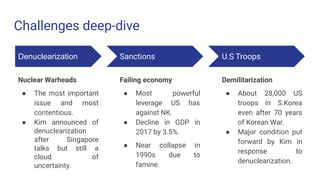
Challenges deep-dive
Denuclearization
Nuclear Warheads
● The most important
issue and most
contentious.
● Kim announced of
denuclearization
after Singapore
talks but still a
cloud of
uncertainty.
Sanctions
Failing economy
● Most powerful
leverage US has
against NK.
● Decline in GDP in
2017 by 3.5%.
● Near collapse in
1990s due to
famine.
U.S Troops
Demilitarization
● About 28,000 US
troops in S.Korea
even after 70 years
of Korean War.
● Major condition put
forward by Kim in
response to
denuclearization.
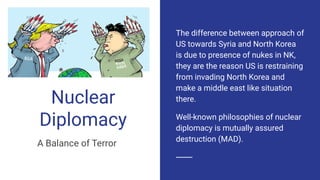
Nuclear
Diplomacy
A Balance of Terror
The difference between approach of
US towards Syria and North Korea
is due to presence of nukes in NK,
they are the reason US is restraining
from invading North Korea and
make a middle east like situation
there.
Well-known philosophies of nuclear
diplomacy is mutually assured
destruction (MAD).
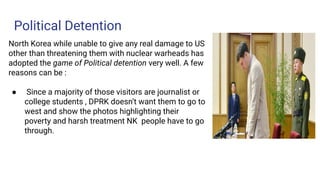
Political Detention
North Korea while unable to give any real damage to US
other than threatening them with nuclear warheads has
adopted the game of Political detention very well. A few
reasons can be :
● Since a majority of those visitors are journalist or
college students , DPRK doesn’t want them to go to
west and show the photos highlighting their
poverty and harsh treatment NK people have to go
through.
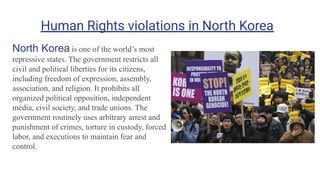
Human Rights violations in North Korea
North Korea is one of the world’s most
repressive states. The government restricts all
civil and political liberties for its citizens,
including freedom of expression, assembly,
association, and religion. It prohibits all
organized political opposition, independent
media, civil society, and trade unions. The
government routinely uses arbitrary arrest and
punishment of crimes, torture in custody, forced
labor, and executions to maintain fear and
control.
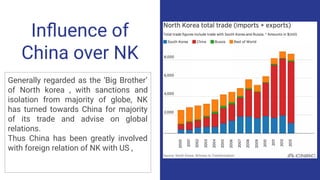
Influence of
China over NK
Generally regarded as the ‘Big Brother’
of North korea , with sanctions and
isolation from majority of globe, NK
has turned towards China for majority
of its trade and advise on global
relations.
Thus China has been greatly involved
with foreign relation of NK with US ,
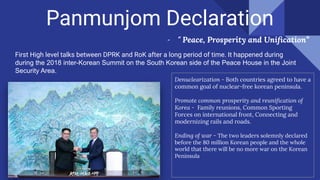
Panmunjom Declaration
- “ Peace, Prosperity and Unification”
First High level talks between DPRK and RoK after a long period of time. It happened during
during the 2018 inter-Korean Summit on the South Korean side of the Peace House in the Joint
Security Area.
Denuclearization - Both countries agreed to have a
common goal of nuclear-free korean peninsula.
Promote common prosperity and reunification of
Korea - Family reunions, Common Sporting
Forces on international front, Connecting and
modernizing rails and roads.
Ending of war - The two leaders solemnly declared
before the 80 million Korean people and the whole
world that there will be no more war on the Korean
Peninsula
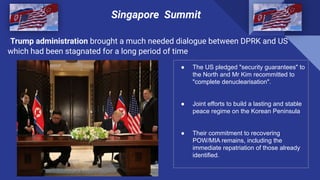
Trump administration brought a much needed dialogue between DPRK and US
which had been stagnated for a long period of time
Singapore Summit
● The US pledged "security guarantees" to
the North and Mr Kim recommitted to
"complete denuclearisation".
● Joint efforts to build a lasting and stable
peace regime on the Korean Peninsula
● Their commitment to recovering
POW/MIA remains, including the
immediate repatriation of those already
identified.
.
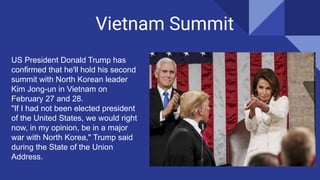
Vietnam Summit
US President Donald Trump has
confirmed that he'll hold his second
summit with North Korean leader
Kim Jong-un in Vietnam on
February 27 and 28.
"If I had not been elected president
of the United States, we would right
now, in my opinion, be in a major
war with North Korea," Trump said
during the State of the Union
Address.
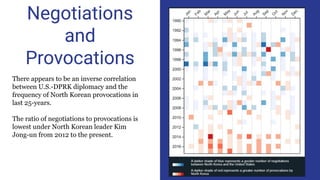
Negotiations
and
Provocations
There appears to be an inverse correlation
between U.S.-DPRK diplomacy and the
frequency of North Korean provocations in
last 25-years.
The ratio of negotiations to provocations is
lowest under North Korean leader Kim
Jong-un from 2012 to the present.
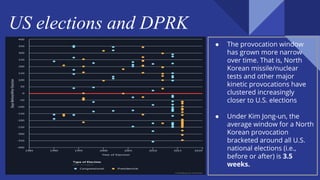
US elections and DPRK
● The provocation window
has grown more narrow
over time. That is, North
Korean missile/nuclear
tests and other major
kinetic provocations have
clustered increasingly
closer to U.S. elections
● Under Kim Jong-un, the
average window for a North
Korean provocation
bracketed around all U.S.
national elections (i.e.,
before or after) is 3.5
weeks.
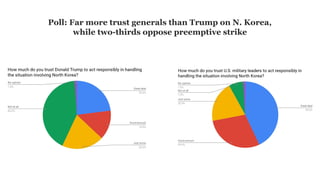
Poll: Far more trust generals than Trump on N. Korea,
while two-thirds oppose preemptive strike
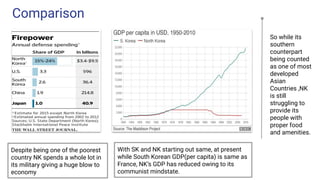
Comparison
Despite being one of the poorest
country NK spends a whole lot in
its military giving a huge blow to
economy
With SK and NK starting out same, at present
while South Korean GDP(per capita) is same as
France, NK’s GDP has reduced owing to its
communist mindstate.
So while its
southern
counterpart
being counted
as one of most
developed
Asian
Countries ,NK
is still
struggling to
provide its
people with
proper food
and amenities.
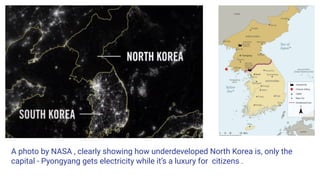
A photo by NASA , clearly showing how underdeveloped North Korea is, only the
capital - Pyongyang gets electricity while it’s a luxury for citizens .
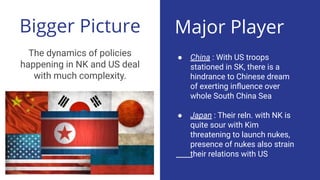
Bigger Picture
The dynamics of policies
happening in NK and US deal
with much complexity.
Major Player
● China : With US troops
stationed in SK, there is a
hindrance to Chinese dream
of exerting influence over
whole South China Sea
● Japan : Their reln. with NK is
quite sour with Kim
threatening to launch nukes,
presence of nukes also strain
their relations with US
Bottlenecks for Peace
The Korean War which began in 1950, ended in 1953 with an armistice rather than
a peace treaty. North Korea wants South Korea and the United States to declare
the war to be formally over, as a sign that hostilities have ended and to build trust.
North Korea expressed their willingness to speed up their denuclearization
process if actions are taken to form a new U.S.-North Korea relationship,” South
Korean President Moon Jae-in said.
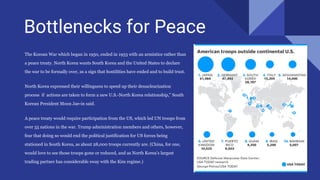
A peace treaty would require participation from the US, which led UN troops from
over 55 nations in the war. Trump administration members and others, however,
fear that doing so would end the political justification for US forces being
stationed in South Korea, as about 28,000 troops currently are. (China, for one,
would love to see those troops gone or reduced, and as North Korea’s largest
trading partner has considerable sway with the Kim regime.)
Bibliography
1. https://fas.org/sgp/crs/nuke/R41259.pdf
2. https://beyondparallel.csis.org/25-years-of-negotiations-provocations/
3. Survey of US citizen on TRump handling of North Korea taken by Washington Post.
4. Photo showing nightime of Korean Peninsula taken by NASA.
5. https://www.dhakatribune.com/world/asia/2018/04/27/panmunjom-declaration-key-points
6. www.mofa.go.kr/eng/brd/m_5478/view.do?seq=319130&srchFr=&amp%3BsrchTo=&amp%3Bsr
chWord=&amp%3BsrchTp=&amp%3Bmulti_itm_seq=0&amp%3Bitm_seq_1=0&amp%3Bitm_seq_
2=0&amp%3Bcompany_cd=&amp%3Bcompany_nm=&page=1&titleNm=

North korea - USA relations

  • 1.
    US-North Korea Relations OPINION- Presentation by Hall 3, IIT-KANPUR
  • 2.
    History USA After WW2, UNdivided Korea along 38th parallel with US taking South and Soviet taking North. Korean war takes place with no conclusion and severing North and South relation. US stationed troops in DMZ, still present now after 70 years George Bush put NK into “Axis of evil” . North Korea Kim II-Sung becomes leader, transformed NK into a communist state with a planned and a public economy. With the development of nukes, relation took a new dive with worst phase during Bush Administration. Problem So what started as a communism vs capitalism ideology has now taken some dirty turns leading to global tension and proliferation of nuclear warheads.
  • 3.
    Korean War ● InJune 1950 communist North Korea invaded South Korea. The United States came to the aid of South Korea at the head of a United Nations force composed of more than a dozen countries. ● Communist China joined North Korea in the war in November 1950, unleashing a massive Chinese ground attack against American forces. The Soviet Union also covertly supported North Korea. ● After three years of fighting, the war ended in a stalemate with the border between North and South Korea near where it had been at the war’s beginning.
  • 4.
    Japanese Rule, KPG failedto gain recognition 1949 WW2 ends, cold war begins, Korea divided along 38th parallel 1950-53 Korean War, severing ties 1991 Soviet Union Falls 1991- 2002 NK begins Nuclear Programm e 1910-45 North Korea leaves NPT 2003 2003- 2009 2011 2015 2017 2018 Six party talks, unsuccessful Kim Jong-il Died US imposes new sanctions on NK NK fires missile over Japan, test hydrogen bomb Singapore talks
  • 5.
    “A regime armingwith missiles and weapons of mass destruction, while starving its citizens” - George H.W Bush, on North Korea intention of pulling out of NPT
  • 6.
    Challenges deep-dive Denuclearization Nuclear Warheads ●The most important issue and most contentious. ● Kim announced of denuclearization after Singapore talks but still a cloud of uncertainty. Sanctions Failing economy ● Most powerful leverage US has against NK. ● Decline in GDP in 2017 by 3.5%. ● Near collapse in 1990s due to famine. U.S Troops Demilitarization ● About 28,000 US troops in S.Korea even after 70 years of Korean War. ● Major condition put forward by Kim in response to denuclearization.
  • 7.
    Nuclear Diplomacy A Balance ofTerror The difference between approach of US towards Syria and North Korea is due to presence of nukes in NK, they are the reason US is restraining from invading North Korea and make a middle east like situation there. Well-known philosophies of nuclear diplomacy is mutually assured destruction (MAD).
  • 8.
    Political Detention North Koreawhile unable to give any real damage to US other than threatening them with nuclear warheads has adopted the game of Political detention very well. A few reasons can be : ● Since a majority of those visitors are journalist or college students , DPRK doesn’t want them to go to west and show the photos highlighting their poverty and harsh treatment NK people have to go through.
  • 9.
    Human Rights violationsin North Korea North Korea is one of the world’s most repressive states. The government restricts all civil and political liberties for its citizens, including freedom of expression, assembly, association, and religion. It prohibits all organized political opposition, independent media, civil society, and trade unions. The government routinely uses arbitrary arrest and punishment of crimes, torture in custody, forced labor, and executions to maintain fear and control.
  • 10.
    Influence of China overNK Generally regarded as the ‘Big Brother’ of North korea , with sanctions and isolation from majority of globe, NK has turned towards China for majority of its trade and advise on global relations. Thus China has been greatly involved with foreign relation of NK with US ,
  • 11.
    Panmunjom Declaration - “Peace, Prosperity and Unification” First High level talks between DPRK and RoK after a long period of time. It happened during during the 2018 inter-Korean Summit on the South Korean side of the Peace House in the Joint Security Area. Denuclearization - Both countries agreed to have a common goal of nuclear-free korean peninsula. Promote common prosperity and reunification of Korea - Family reunions, Common Sporting Forces on international front, Connecting and modernizing rails and roads. Ending of war - The two leaders solemnly declared before the 80 million Korean people and the whole world that there will be no more war on the Korean Peninsula
  • 12.
    Trump administration broughta much needed dialogue between DPRK and US which had been stagnated for a long period of time Singapore Summit ● The US pledged "security guarantees" to the North and Mr Kim recommitted to "complete denuclearisation". ● Joint efforts to build a lasting and stable peace regime on the Korean Peninsula ● Their commitment to recovering POW/MIA remains, including the immediate repatriation of those already identified. .
  • 13.
    Vietnam Summit US PresidentDonald Trump has confirmed that he'll hold his second summit with North Korean leader Kim Jong-un in Vietnam on February 27 and 28. "If I had not been elected president of the United States, we would right now, in my opinion, be in a major war with North Korea," Trump said during the State of the Union Address.
  • 14.
    Negotiations and Provocations There appears tobe an inverse correlation between U.S.-DPRK diplomacy and the frequency of North Korean provocations in last 25-years. The ratio of negotiations to provocations is lowest under North Korean leader Kim Jong-un from 2012 to the present.
  • 15.
    US elections andDPRK ● The provocation window has grown more narrow over time. That is, North Korean missile/nuclear tests and other major kinetic provocations have clustered increasingly closer to U.S. elections ● Under Kim Jong-un, the average window for a North Korean provocation bracketed around all U.S. national elections (i.e., before or after) is 3.5 weeks.
  • 16.
    Poll: Far moretrust generals than Trump on N. Korea, while two-thirds oppose preemptive strike
  • 17.
    Comparison Despite being oneof the poorest country NK spends a whole lot in its military giving a huge blow to economy With SK and NK starting out same, at present while South Korean GDP(per capita) is same as France, NK’s GDP has reduced owing to its communist mindstate. So while its southern counterpart being counted as one of most developed Asian Countries ,NK is still struggling to provide its people with proper food and amenities.
  • 18.
    A photo byNASA , clearly showing how underdeveloped North Korea is, only the capital - Pyongyang gets electricity while it’s a luxury for citizens .
  • 19.
    Bigger Picture The dynamicsof policies happening in NK and US deal with much complexity. Major Player ● China : With US troops stationed in SK, there is a hindrance to Chinese dream of exerting influence over whole South China Sea ● Japan : Their reln. with NK is quite sour with Kim threatening to launch nukes, presence of nukes also strain their relations with US
  • 20.
    Bottlenecks for Peace TheKorean War which began in 1950, ended in 1953 with an armistice rather than a peace treaty. North Korea wants South Korea and the United States to declare the war to be formally over, as a sign that hostilities have ended and to build trust. North Korea expressed their willingness to speed up their denuclearization process if actions are taken to form a new U.S.-North Korea relationship,” South Korean President Moon Jae-in said. A peace treaty would require participation from the US, which led UN troops from over 55 nations in the war. Trump administration members and others, however, fear that doing so would end the political justification for US forces being stationed in South Korea, as about 28,000 troops currently are. (China, for one, would love to see those troops gone or reduced, and as North Korea’s largest trading partner has considerable sway with the Kim regime.)
  • 21.
    Bibliography 1. https://fas.org/sgp/crs/nuke/R41259.pdf 2. https://beyondparallel.csis.org/25-years-of-negotiations-provocations/ 3.Survey of US citizen on TRump handling of North Korea taken by Washington Post. 4. Photo showing nightime of Korean Peninsula taken by NASA. 5. https://www.dhakatribune.com/world/asia/2018/04/27/panmunjom-declaration-key-points 6. www.mofa.go.kr/eng/brd/m_5478/view.do?seq=319130&srchFr=&amp%3BsrchTo=&amp%3Bsr chWord=&amp%3BsrchTp=&amp%3Bmulti_itm_seq=0&amp%3Bitm_seq_1=0&amp%3Bitm_seq_ 2=0&amp%3Bcompany_cd=&amp%3Bcompany_nm=&page=1&titleNm=