STARTIAP 2016
BUILD A STARTUP IN FOUR WEEKS
Elaine Chen
Business models 101
January, 2016
What are you leaving with today
• A list of possible business models relevant to
your venture
• Everything you need to know to hallucinate a
5-year forecast for your venture (hopefully)
2
Before we begin:
3
“FREE” IS NOT A BUSINESS MODEL
WhatsApp, FB, Twitter are anomalities. Why won’t you do the hard work now and play to win?
>40 out of 940
companies funded
by America’s most
elite accelerator
are woth more
than $100M (4%)
Read this in your spare time
4
But really, it’s very simple
• 3 classes of approaches
– Transaction based
– Subscription based
– Advertising based
• One factor that drives the LTV/COCA ratio
– One and done versus recurring revenue stream
5
Some examples
6
Transactional Subscription Ad-based
Common wisdom
• Simple is beautiful
– You are building a hypothesis of what works, so you
can test in the field. Complexity will befuddle you.
• Ad based is hard
– Ad-based needs scale, scale needs awareness,
awareness needs time and money startups don’t have
– Most investors will be skeptical
• One and done is hard
– Recurring revenue stream creates much needed
sanity in the chaos of a startup
7
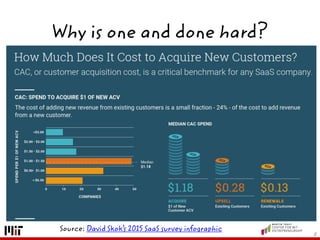
Why is one and done hard?
8
Source: David Skok’s 2015 SaaS survey infographic
Anything can be made recurring
9
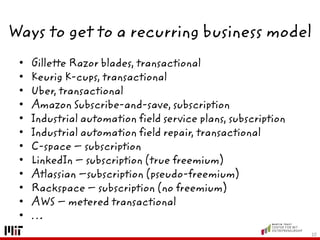
Ways to get to a recurring business model
• Gillette Razor blades, transactional
• Keurig K-cups, transactional
• Uber, transactional
• Amazon Subscribe-and-save, subscription
• Industrial automation field service plans, subscription
• Industrial automation field repair, transactional
• C-space – subscription
• LinkedIn – subscription (true freemium)
• Atlassian –subscription (pseudo-freemium)
• Rackspace – subscription (no freemium)
• AWS – metered transactional
• …
10
Workshop activity: Business Models
Enumerate all the business models you can think
of that is relevant to your venture and classify
them by the 3 approaches (transactional,
subscription, ad-based). Think about ways to
maximize life time value. See if you can come up
with a recurring revenue model.
Pick the one you think works best and explain why.
11
Sharing!
12
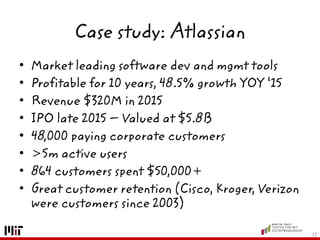
Case study: Atlassian
13
• Market leading software dev and mgmt tools
• Profitable for 10 years, 48.5% growth YOY ‘15
• Revenue $320M in 2015
• IPO late 2015 – Valued at $5.8B
• 48,000 paying corporate customers
• >5m active users
• 864 customers spent $50,000+
• Great customer retention (Cisco, Kroger, Verizon
were customers since 2003)
“Pseudo-freemium”
14
Pricing tiers
15
It’s not all self service, but close
16
Simple template: B2C SaaS
17
Y1 Y2 Y3 Y4 Y5
Average
annual
subscription
fee per user
($$)
# New users
this year
%Churn
# Install base
this year (=
#new + #old
last year –
churn)
Revenue this
year ($$)
Example forecast: Product +
subscription (e.g. traditional MCAD)
18
Example forecast: Consumer
electronics – connected device
19
Example forecast: B2B SaaS
20
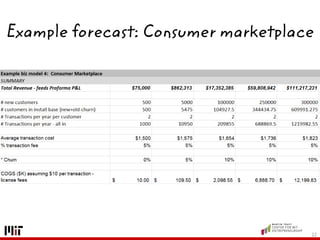
Example forecast: Consumer marketplace
21
End
Questions?
22

Business Models 101

  • 1.
    STARTIAP 2016 BUILD ASTARTUP IN FOUR WEEKS Elaine Chen Business models 101 January, 2016
  • 2.
    What are youleaving with today • A list of possible business models relevant to your venture • Everything you need to know to hallucinate a 5-year forecast for your venture (hopefully) 2
  • 3.
    Before we begin: 3 “FREE”IS NOT A BUSINESS MODEL WhatsApp, FB, Twitter are anomalities. Why won’t you do the hard work now and play to win? >40 out of 940 companies funded by America’s most elite accelerator are woth more than $100M (4%)
  • 4.
    Read this inyour spare time 4
  • 5.
    But really, it’svery simple • 3 classes of approaches – Transaction based – Subscription based – Advertising based • One factor that drives the LTV/COCA ratio – One and done versus recurring revenue stream 5
  • 6.
  • 7.
    Common wisdom • Simpleis beautiful – You are building a hypothesis of what works, so you can test in the field. Complexity will befuddle you. • Ad based is hard – Ad-based needs scale, scale needs awareness, awareness needs time and money startups don’t have – Most investors will be skeptical • One and done is hard – Recurring revenue stream creates much needed sanity in the chaos of a startup 7
  • 8.
    Why is oneand done hard? 8 Source: David Skok’s 2015 SaaS survey infographic
  • 9.
    Anything can bemade recurring 9
  • 10.
    Ways to getto a recurring business model • Gillette Razor blades, transactional • Keurig K-cups, transactional • Uber, transactional • Amazon Subscribe-and-save, subscription • Industrial automation field service plans, subscription • Industrial automation field repair, transactional • C-space – subscription • LinkedIn – subscription (true freemium) • Atlassian –subscription (pseudo-freemium) • Rackspace – subscription (no freemium) • AWS – metered transactional • … 10
  • 11.
    Workshop activity: BusinessModels Enumerate all the business models you can think of that is relevant to your venture and classify them by the 3 approaches (transactional, subscription, ad-based). Think about ways to maximize life time value. See if you can come up with a recurring revenue model. Pick the one you think works best and explain why. 11
  • 12.
  • 13.
    Case study: Atlassian 13 •Market leading software dev and mgmt tools • Profitable for 10 years, 48.5% growth YOY ‘15 • Revenue $320M in 2015 • IPO late 2015 – Valued at $5.8B • 48,000 paying corporate customers • >5m active users • 864 customers spent $50,000+ • Great customer retention (Cisco, Kroger, Verizon were customers since 2003)
  • 14.
  • 15.
  • 16.
    It’s not allself service, but close 16
  • 17.
    Simple template: B2CSaaS 17 Y1 Y2 Y3 Y4 Y5 Average annual subscription fee per user ($$) # New users this year %Churn # Install base this year (= #new + #old last year – churn) Revenue this year ($$)
  • 18.
    Example forecast: Product+ subscription (e.g. traditional MCAD) 18
  • 19.
  • 20.
  • 21.
  • 22.