From Idea
To Business
A guide to business modeling
for millennial entrepreneurs
By Norbert Schöpke © 2017
Topics
1. What is a business model?
2. Why should I care?
3. Entrepreneurial skills today
4. Translating your idea into a business
5. How do I validate and maintain it?
6. Methods, tools and how to learn more
This is you
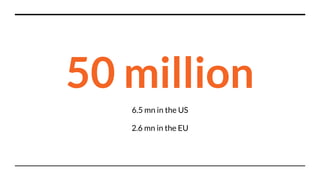
How many Startups
are launched every year
worldwide?
50 million
6.5 mn in the US
2.6 mn in the EU
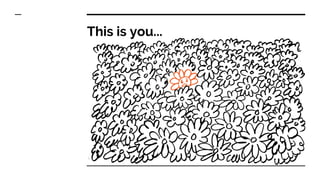
This is you...
What is a Business Model?
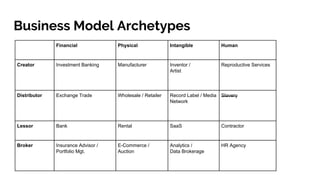
Financial Physical Intangible Human
Creator Investment Banking Manufacturer Inventor /
Artist
Reproductive Services
Distributor Exchange Trade Wholesale / Retailer Record Label / Media
Network
Slavery
Lessor Bank Rental SaaS Contractor
Broker Insurance Advisor /
Portfolio Mgt.
E-Commerce /
Auction
Analytics /
Data Brokerage
HR Agency
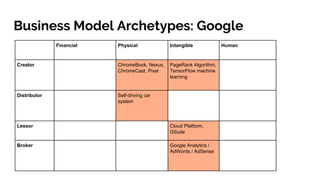
Business Model Archetypes
Financial Physical Intangible Human
Creator ChromeBook, Nexus,
ChromeCast, Pixel
PageRank Algorithm,
TensorFlow machine
learning
Distributor Self-driving car
system
Lessor Cloud Platform,
GSuite
Broker Google Analytics /
AdWords / AdSense
Business Model Archetypes: Google
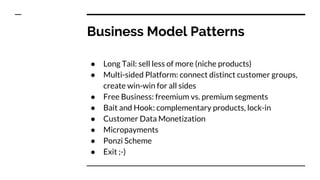
Business Model Patterns
● Long Tail: sell less of more (niche products)
● Multi-sided Platform: connect distinct customer groups,
create win-win for all sides
● Free Business: freemium vs. premium segments
● Bait and Hook: complementary products, lock-in
● Customer Data Monetization
● Micropayments
● Ponzi Scheme
● Exit ;-)
Why should I care?
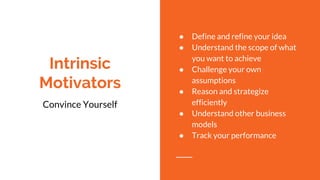
Intrinsic
Motivators
Convince Yourself
● Define and refine your idea
● Understand the scope of what
you want to achieve
● Challenge your own
assumptions
● Reason and strategize
efficiently
● Understand other business
models
● Track your performance
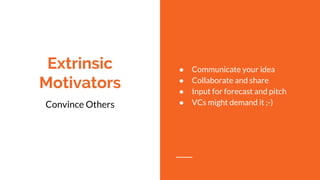
Extrinsic
Motivators
Convince Others
● Communicate your idea
● Collaborate and share
● Input for forecast and pitch
● VCs might demand it ;-)
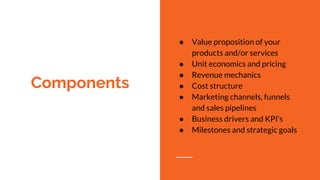
Components
● Value proposition of your
products and/or services
● Unit economics and pricing
● Revenue mechanics
● Cost structure
● Marketing channels, funnels
and sales pipelines
● Business drivers and KPI’s
● Milestones and strategic goals
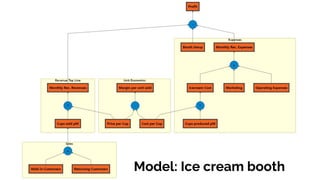
Model: Ice cream booth
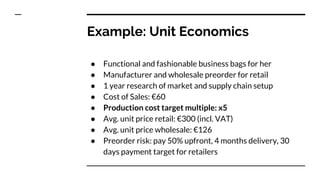
Example: Unit Economics
● Functional and fashionable business bags for her
● Manufacturer and wholesale preorder for retail
● 1 year research of market and supply chain setup
● Cost of Sales: €60
● Production cost target multiple: x5
● Avg. unit price retail: €300 (incl. VAT)
● Avg. unit price wholesale: €126
● Preorder risk: pay 50% upfront, 4 months delivery, 30
days payment target for retailers
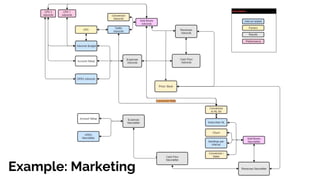
Example: Marketing
Concepts
● Product-Market fit
● Profitability
● Scalability
● Robustness
● Disruption
● Networked BM
● Funding
● Pivot
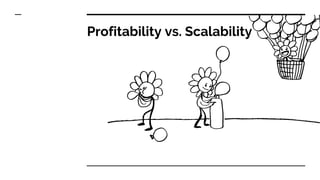
Profitability vs. Scalability
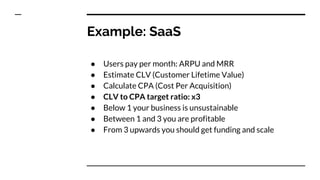
Example: SaaS
● Users pay per month: ARPU and MRR
● Estimate CLV (Customer Lifetime Value)
● Calculate CPA (Cost Per Acquisition)
● CLV to CPA target ratio: x3
● Below 1 your business is unsustainable
● Between 1 and 3 you are profitable
● From 3 upwards you should get funding and scale
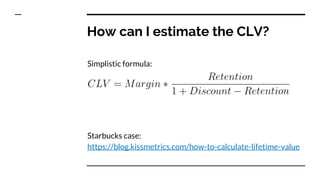
How can I estimate the CLV?
Simplistic formula:
Starbucks case:
https://blog.kissmetrics.com/how-to-calculate-lifetime-value
How can I calculate the CPA?
● Depends on marketing channels
○ Adwords: CPC (Cost Per Click)
■ CPA = Traffic * CPC / Conversion Rate
■ CPA = 1000 * CPC / 10% = 10000 * CPC
○ TV News: CPM (Cost Per Mille)
○ Online Sign-Up: CPL (Cost Per Lead)
● With CLV: Upper limit for marketing spend
● Options for hacking your business model
○ Lower CPA
○ Higher price to increase CLV
○ Improve retention rate
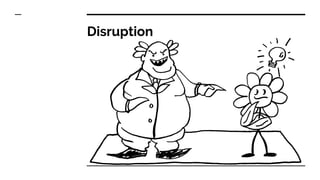
Disruption
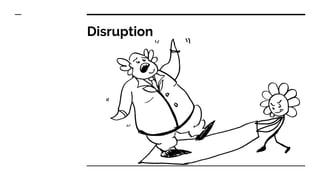
Disruption
Disruption
● Undermining BM operations of big industry players
● Exchanging consumer touchpoint
● Re-combination of old products or services
and new forms of operating or revenue model
● Examples: Amazon, Dell, AirBnB, Uber
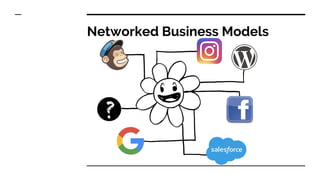
Networked Business Models
Networked BM: Tinder
● Strategy: mobile-first, viral growth, gamification
● Networked with Facebook, Instagram and advertisers
● Pay-per-tier vs. Pay-per-feature
● Revenue streams:
○ Premium subscription
○ In-app purchases
○ Advertising
● Pricing age- and location based
● Primary driver: PMC (paid member count) 1.7 mn Q4’16
● MRR $20 mn, ARPU $0.40
What does it take to be an
Entrepreneur today?
Soft Skills
● Think outside the box
● DIY attitude vs. delegation
● Avoid bias blind spot
● Stress resistance
● Embrace uncertainty
● Embrace possible failure
● Time management
● Focus, focus, focus
Cognitive Biases
● Projection
● Confirmation bias
● Hindsight
● Survivorship bias
● Loss aversion / sunk costs fallacy
● Planning fallacy
● Framing
● Anchoring
You don’t have to
have a lot of
money!
Instead, you should know
● what makes your business
profitable
● how much funding to ask for
when starting up or scaling
● how to effectively spend
the money you’ve got
● when to exchange money
for time
● when to go all-in and
when to fold your cards
Translating your Idea into a
Business
From Idea...
1. Start with Why?
2. Look for pain points
3. Formulate the solution
4. Create a narrative for change
5. Fill a Business Model Canvas
6. Do a SWOT or 5 Forces analysis
7. Do the same for your main
competitors
...to Business
Model...
1. Model basic unit economics
2. Model revenue streams and
cost buckets
3. Identify customer funnel steps
4. Predict retention / churn rates
and returning customers
5. Try to put it all into numbers
6. Forecasts and balance sheet
from abstract business model
...to Business
Model Analytics
1. Add growth functions and
seasonality
2. Add factor dependencies
3. Make it data-driven
4. Best-case vs. worst-case
5. What-If Scenarios
6. Identify KPI’s
7. Discover hidden insights
Business Model Validation
and Maintenance
“If I had asked people
what they wanted,
they would have said:
faster horses”
Henri Ford
Start with the
Basics
● Which value do you create
● At what cost
● For whom
● Don’t rely on naive and broad
customer canvassing
● Pick low-hanging fruits
Let it grow
● Rapid prototyping
● Fail fast
● Ideally 3+ USPs
● Create MVP
● Incorporate User Feedback
● Reach Product-Market fit
● Build brand
Maintenance
● Compare forecast with actual
performance
● Increase robustness by hooking
up 3rd-party data sources
● Document strategic changes
● Try growth hacking
● If you fail with an experiment,
try to understand WHY?
● If it doesn’t work at all,
pivot or fold
The Millennial
Entrepreneur
A Manifesto
● Inspired
● Inspiring
● Networked
● Prudent
● Convincing
● Agile
Inspired - the possibilities of
the digital global economy
spark your creativity and
entrepreneurial spirit
Inspiring - you are a great
communicator of ideas and
a storyteller in business
Networked - in a sharing
economy, your business
model is as networked
as you are
Prudent - your seek insights
about your market,
your product and
how they fit together;
you can handle money
Agile - you execute what
works efficiently, but
change or throw away what
doesn’t
Thank you!
norbert.schoepke@gmail.com
Methods, Tools
and how to learn more
Methods
● Business Model Canvas
(https://canvanizer.com/new/business-model-canvas)
● Lean Canvas (https://canvanizer.com/new/lean-canvas)
● SWOT (https://canvanizer.com/new/swot-canvas)
● Five Forces
● Lean Startup
● Empathy Map
(http://bmtoolbox.net/tools/empathy-map/)
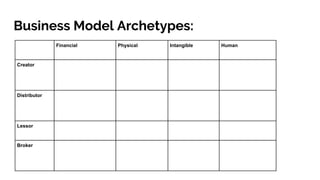
Financial Physical Intangible Human
Creator
Distributor
Lessor
Broker
Business Model Archetypes:
Tools
● Spreadsheet tools (Google Sheets, LO Calc, MS Excel)
● Business plan templates
● CLV calculator (http://www.clv-calculator.com/)
● Financial planning tools
● Accounting tools with API (e.g. FIGO)
How to learn more
● https://strategyzer.com/books/business-model-generation
● Startup Playbook (http://playbook.samaltman.stfi.re/)
● YCombinator’s StartupClass (https://startupclass.co/)
● Free Udacity course: The Lean LaunchPad
(https://www.udacity.com/course/how-to-build-a-startup--ep245)
● Business Model Toolbox (http://bmtoolbox.net/)
● Contact me ;-)

From Idea To Business

  • 1.
    From Idea To Business Aguide to business modeling for millennial entrepreneurs By Norbert Schöpke © 2017
  • 2.
    Topics 1. What isa business model? 2. Why should I care? 3. Entrepreneurial skills today 4. Translating your idea into a business 5. How do I validate and maintain it? 6. Methods, tools and how to learn more
  • 3.
  • 4.
    How many Startups arelaunched every year worldwide?
  • 5.
    50 million 6.5 mnin the US 2.6 mn in the EU
  • 6.
  • 7.
    What is aBusiness Model?
  • 8.
    Financial Physical IntangibleHuman Creator Investment Banking Manufacturer Inventor / Artist Reproductive Services Distributor Exchange Trade Wholesale / Retailer Record Label / Media Network Slavery Lessor Bank Rental SaaS Contractor Broker Insurance Advisor / Portfolio Mgt. E-Commerce / Auction Analytics / Data Brokerage HR Agency Business Model Archetypes
  • 9.
    Financial Physical IntangibleHuman Creator ChromeBook, Nexus, ChromeCast, Pixel PageRank Algorithm, TensorFlow machine learning Distributor Self-driving car system Lessor Cloud Platform, GSuite Broker Google Analytics / AdWords / AdSense Business Model Archetypes: Google
  • 10.
    Business Model Patterns ●Long Tail: sell less of more (niche products) ● Multi-sided Platform: connect distinct customer groups, create win-win for all sides ● Free Business: freemium vs. premium segments ● Bait and Hook: complementary products, lock-in ● Customer Data Monetization ● Micropayments ● Ponzi Scheme ● Exit ;-)
  • 11.
  • 12.
    Intrinsic Motivators Convince Yourself ● Defineand refine your idea ● Understand the scope of what you want to achieve ● Challenge your own assumptions ● Reason and strategize efficiently ● Understand other business models ● Track your performance
  • 13.
    Extrinsic Motivators Convince Others ● Communicateyour idea ● Collaborate and share ● Input for forecast and pitch ● VCs might demand it ;-)
  • 14.
    Components ● Value propositionof your products and/or services ● Unit economics and pricing ● Revenue mechanics ● Cost structure ● Marketing channels, funnels and sales pipelines ● Business drivers and KPI’s ● Milestones and strategic goals
  • 15.
  • 16.
    Example: Unit Economics ●Functional and fashionable business bags for her ● Manufacturer and wholesale preorder for retail ● 1 year research of market and supply chain setup ● Cost of Sales: €60 ● Production cost target multiple: x5 ● Avg. unit price retail: €300 (incl. VAT) ● Avg. unit price wholesale: €126 ● Preorder risk: pay 50% upfront, 4 months delivery, 30 days payment target for retailers
  • 17.
  • 18.
    Concepts ● Product-Market fit ●Profitability ● Scalability ● Robustness ● Disruption ● Networked BM ● Funding ● Pivot
  • 19.
  • 20.
    Example: SaaS ● Userspay per month: ARPU and MRR ● Estimate CLV (Customer Lifetime Value) ● Calculate CPA (Cost Per Acquisition) ● CLV to CPA target ratio: x3 ● Below 1 your business is unsustainable ● Between 1 and 3 you are profitable ● From 3 upwards you should get funding and scale
  • 21.
    How can Iestimate the CLV? Simplistic formula: Starbucks case: https://blog.kissmetrics.com/how-to-calculate-lifetime-value
  • 22.
    How can Icalculate the CPA? ● Depends on marketing channels ○ Adwords: CPC (Cost Per Click) ■ CPA = Traffic * CPC / Conversion Rate ■ CPA = 1000 * CPC / 10% = 10000 * CPC ○ TV News: CPM (Cost Per Mille) ○ Online Sign-Up: CPL (Cost Per Lead) ● With CLV: Upper limit for marketing spend ● Options for hacking your business model ○ Lower CPA ○ Higher price to increase CLV ○ Improve retention rate
  • 23.
  • 24.
  • 25.
    Disruption ● Undermining BMoperations of big industry players ● Exchanging consumer touchpoint ● Re-combination of old products or services and new forms of operating or revenue model ● Examples: Amazon, Dell, AirBnB, Uber
  • 26.
  • 27.
    Networked BM: Tinder ●Strategy: mobile-first, viral growth, gamification ● Networked with Facebook, Instagram and advertisers ● Pay-per-tier vs. Pay-per-feature ● Revenue streams: ○ Premium subscription ○ In-app purchases ○ Advertising ● Pricing age- and location based ● Primary driver: PMC (paid member count) 1.7 mn Q4’16 ● MRR $20 mn, ARPU $0.40
  • 28.
    What does ittake to be an Entrepreneur today?
  • 29.
    Soft Skills ● Thinkoutside the box ● DIY attitude vs. delegation ● Avoid bias blind spot ● Stress resistance ● Embrace uncertainty ● Embrace possible failure ● Time management ● Focus, focus, focus
  • 30.
    Cognitive Biases ● Projection ●Confirmation bias ● Hindsight ● Survivorship bias ● Loss aversion / sunk costs fallacy ● Planning fallacy ● Framing ● Anchoring
  • 31.
    You don’t haveto have a lot of money! Instead, you should know ● what makes your business profitable ● how much funding to ask for when starting up or scaling ● how to effectively spend the money you’ve got ● when to exchange money for time ● when to go all-in and when to fold your cards
  • 32.
    Translating your Ideainto a Business
  • 33.
    From Idea... 1. Startwith Why? 2. Look for pain points 3. Formulate the solution 4. Create a narrative for change 5. Fill a Business Model Canvas 6. Do a SWOT or 5 Forces analysis 7. Do the same for your main competitors
  • 34.
    ...to Business Model... 1. Modelbasic unit economics 2. Model revenue streams and cost buckets 3. Identify customer funnel steps 4. Predict retention / churn rates and returning customers 5. Try to put it all into numbers 6. Forecasts and balance sheet from abstract business model
  • 35.
    ...to Business Model Analytics 1.Add growth functions and seasonality 2. Add factor dependencies 3. Make it data-driven 4. Best-case vs. worst-case 5. What-If Scenarios 6. Identify KPI’s 7. Discover hidden insights
  • 36.
  • 37.
    “If I hadasked people what they wanted, they would have said: faster horses” Henri Ford
  • 38.
    Start with the Basics ●Which value do you create ● At what cost ● For whom ● Don’t rely on naive and broad customer canvassing ● Pick low-hanging fruits
  • 39.
    Let it grow ●Rapid prototyping ● Fail fast ● Ideally 3+ USPs ● Create MVP ● Incorporate User Feedback ● Reach Product-Market fit ● Build brand
  • 40.
    Maintenance ● Compare forecastwith actual performance ● Increase robustness by hooking up 3rd-party data sources ● Document strategic changes ● Try growth hacking ● If you fail with an experiment, try to understand WHY? ● If it doesn’t work at all, pivot or fold
  • 41.
    The Millennial Entrepreneur A Manifesto ●Inspired ● Inspiring ● Networked ● Prudent ● Convincing ● Agile
  • 42.
    Inspired - thepossibilities of the digital global economy spark your creativity and entrepreneurial spirit
  • 43.
    Inspiring - youare a great communicator of ideas and a storyteller in business
  • 44.
    Networked - ina sharing economy, your business model is as networked as you are
  • 45.
    Prudent - yourseek insights about your market, your product and how they fit together; you can handle money
  • 46.
    Agile - youexecute what works efficiently, but change or throw away what doesn’t
  • 47.
  • 48.
  • 49.
    Methods ● Business ModelCanvas (https://canvanizer.com/new/business-model-canvas) ● Lean Canvas (https://canvanizer.com/new/lean-canvas) ● SWOT (https://canvanizer.com/new/swot-canvas) ● Five Forces ● Lean Startup ● Empathy Map (http://bmtoolbox.net/tools/empathy-map/)
  • 50.
    Financial Physical IntangibleHuman Creator Distributor Lessor Broker Business Model Archetypes:
  • 51.
    Tools ● Spreadsheet tools(Google Sheets, LO Calc, MS Excel) ● Business plan templates ● CLV calculator (http://www.clv-calculator.com/) ● Financial planning tools ● Accounting tools with API (e.g. FIGO)
  • 52.
    How to learnmore ● https://strategyzer.com/books/business-model-generation ● Startup Playbook (http://playbook.samaltman.stfi.re/) ● YCombinator’s StartupClass (https://startupclass.co/) ● Free Udacity course: The Lean LaunchPad (https://www.udacity.com/course/how-to-build-a-startup--ep245) ● Business Model Toolbox (http://bmtoolbox.net/) ● Contact me ;-)