ART 
CRITICISM 
SM2273 
CHARLOTTE FROST
LAST WEEK 
We thought about the idea of judging art and how the concept and 
philosophy of aesthetics has helped people think about the art 
experience. 
We considered modern methods of reviewing and rating 
experiences like listening to music, reading a book or watching a 
movie and how these demonstrate our relationships to taste and 
judgment in our everyday lives.
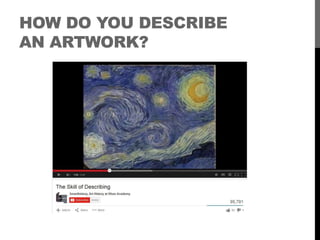
HOW DO YOU DESCRIBE 
AN ARTWORK?
In 1970 a professor of art at Georgia University, Edmund 
Feldman, came up with a 4 step technique for looking at art which 
is used again and again to teach art criticism. 
It looks like this: 
1. DESCRIPTION: What can be seen in the artwork? 
2. ANALYSIS: What relationships exist with what is seen? 
3. INTERPRETATION: What is the content or meaning, based on 
steps 1 and 2? 
4. JUDGEMENT: What is your evaluation of the work, based on 
steps1, 2, 3?
DESCRIPTION 
This is the cornerstone of art criticism… 
• Many critics think description is the most important task 
• It helps you recognise every aspect of an artwork 
• It leads to all the other aspects of criticising an artwork 
(such as analysis, interpretation and judgment.) 
• It takes practice!
INTERNAL EVIDENCE 
= Everything you see before you, without having to do any 
analysis or research: 
• What is the subject? 
• What does it look like? 
• What shapes can you see? 
• What colours are used? 
• What textures are present? 
• What is it made of?
EXTERNAL EVIDENCE 
= Other pieces of information you can gather specifically 
relating to the physical presence of the artwork: 
• What is it called? 
• Who is it by? 
• Where is it/how is it installed in the space? 
• How was it made?
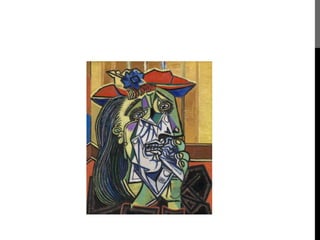
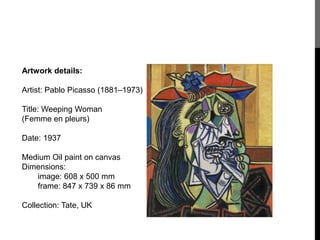
Artwork details: 
Artist: Pablo Picasso (1881–1973) 
Title: Weeping Woman 
(Femme en pleurs) 
Date: 1937 
Medium Oil paint on canvas 
Dimensions: 
image: 608 x 500 mm 
frame: 847 x 739 x 86 mm 
Collection: Tate, UK
YOUR REACTION 
What is your immediate reaction to it? 
Is there anything it makes you think or feel right from the 
start? 
Did you come across it in a way that is worth explaining? For 
example is it a public artwork that you stumbled across. Did 
you spend hours looking for it in a gallery? It might even be 
relevant what kind of mood you were in before you had this 
art encounter if your mood was significantly altered by the 
artwork/art show.
WAYS OF DESCRIBING
PAINTING WITH 
WORDS 
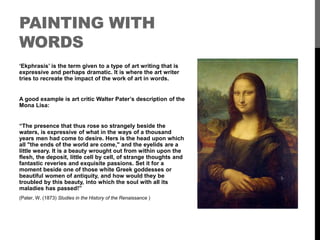
‘Ekphrasis’ is the term given to a type of art writing that is 
expressive and perhaps dramatic. It is where the art writer 
tries to recreate the impact of the work of art in words. 
A good example is art critic Walter Pater’s description of the 
Mona Lisa: 
“The presence that thus rose so strangely beside the 
waters, is expressive of what in the ways of a thousand 
years men had come to desire. Hers is the head upon which 
all "the ends of the world are come," and the eyelids are a 
little weary. It is a beauty wrought out from within upon the 
flesh, the deposit, little cell by cell, of strange thoughts and 
fantastic reveries and exquisite passions. Set it for a 
moment beside one of those white Greek goddesses or 
beautiful women of antiquity, and how would they be 
troubled by this beauty, into which the soul with all its 
maladies has passed!” 
(Pater, W. (1873) Studies in the History of the Renaissance )
FIGURES OF SPEECH 
Metaphor: where one thing is used to mean another. Artworks are 
metaphors but we can use metaphors when writing about art too: 
‘it is a carnival of colours’ 
Simile: a type of metaphor where one thing is compared to another 
using words such as ‘like’, ‘than’, ‘as’, ‘so’ or ‘resembles’: 
‘The colours are like a carnival’ 
‘The composition is more hectic than a carnival’ 
Analogy: where a comparison in made over more than just one phrase. 
It is an extended argument that makes a comparison of some sort: 
‘The artist combines colours in an almost carnivalesque fashion. They 
seem to perform for us as if on parade. There is so much movement 
with just the occasional break in the action as if a performer has 
stepped out of time or the crowd have interupted’
TENSES 
What tense will you use. 
Past tense? 
This can make it clear that you witnessed the artwork in the past and 
now you are writing it up. It can make the art sound historic, or grand 
and emphasises the fact your time with it has passed. 
‘I found this artwork was perplexing on many levels’ 
Present tense? 
This can make it clear that the artwork exists even when you’re not with 
it. It can make it sound eternal or on-going and can emphasise the way 
you engaged with it at the time. 
‘It is a perplexing painting, on many levels ’
BEYOND WORDS 
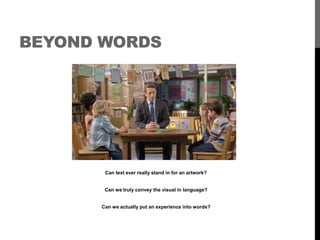
Can text ever really stand in for an artwork? 
Can we truly convey the visual in language? 
Can we actually put an experience into words?
BEYOND WORDS 
Solution 1: Acknowledge what is 
beyond description. 
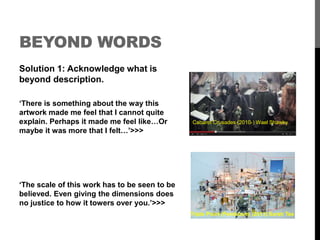
‘There is something about the way this 
artwork made me feel that I cannot quite 
explain. Perhaps it made me feel like…Or 
maybe it was more that I felt…’>>> 
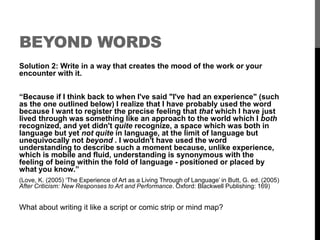
‘The scale of this work has to be seen to be 
believed. Even giving the dimensions does 
no justice to how it towers over you.’>>> 
Cabaret Crusades (2010-) Wael Shawky 
Triple Point (Pendulum) (2013) Sarah Tse
BEYOND WORDS 
Solution 2: Write in a way that creates the mood of the work or your 
encounter with it. 
“Because if I think back to when I've said "I've had an experience" (such 
as the one outlined below) I realize that I have probably used the word 
because I want to register the precise feeling that that which I have just 
lived through was something like an approach to the world which I both 
recognized, and yet didn't quite recognize, a space which was both in 
language but yet not quite in language, at the limit of language but 
unequivocally not beyond . I wouldn't have used the word 
understanding to describe such a moment because, unlike experience, 
which is mobile and fluid, understanding is synonymous with the 
feeling of being within the fold of language - positioned or placed by 
what you know.” 
(Love, K. (2005) ‘The Experience of Art as a Living Through of Language’ in Butt, G. ed. (2005) 
After Criticism: New Responses to Art and Performance. Oxford: Blackwell Publishing: 169) 
What about writing it like a script or comic strip or mind map?
BEYOND WORDS 
Solution 3: Don’t use words. Could 
you convey something about the art 
in another format? 
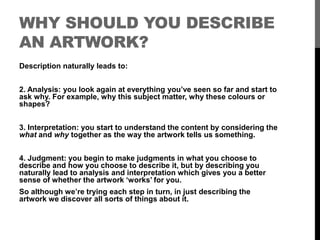
For example, in a form of ‘embodied 
art criticism’ art historian Julia 
Bryan-Wilson learns and performs 
Yvonne Rainer's "Trio A" in order to 
better understand it and write about. 
So could you dance about an 
artwork? 
Could you record your experience of 
it in another way???>>>
WHY SHOULD YOU DESCRIBE 
AN ARTWORK? 
Description naturally leads to: 
2. Analysis: you look again at everything you’ve seen so far and start to 
ask why. For example, why this subject matter, why these colours or 
shapes? 
3. Interpretation: you start to understand the content by considering the 
what and why together as the way the artwork tells us something. 
4. Judgment: you begin to make judgments in what you choose to 
describe and how you choose to describe it, but by describing you 
naturally lead to analysis and interpretation which gives you a better 
sense of whether the artwork ‘works’ for you. 
So although we’re trying each step in turn, in just describing the 
artwork we discover all sorts of things about it.
TASK 
Split into pairs to perform blindfolded artwork descriptions. One student 
will blindfold him/herself. The other will find an artwork on one of the 
suggested websites below and they will be allowed up to 10 minutes to 
carefully describe it. 
The blindfolded student will then remove their blindfold and give the 
describer a mark out of 10 for how accurate their description was. 
Then reverse the task by now blindfolding the original describer and 
having the other person choose and describe an artwork for up to 10 
minutes, before being marked out of 10 for their description. 
Perform about 4 descriptions each. Do not pick simple images, the 
harder the image is to describe the better you will become at thinking 
and writing about art! 
http://www.tate.org.uk/ 
http://www.moma.org/ 
https://www.google.com/culturalinstitute/project/art-project
NEXT WEEK 
Animated Art Critics: 
Make a short movie analyzing an artwork of you choice using everyday objects as the 
‘characters’ in your movie. 
Preparation: 
1. Read the first part of the essay on ‘Las Meninas’ by Michel Foucault. 
2. Read the introductory slides for class (posted on course website by Monday 22nd 
Sept). 
3. Set up a YouTube or Vimeo account (if you don’t already have one) 
4. Together with your partner, choose an artwork (either from one of the suggested 
websites or from another source) and print it out in colour on an A4 sheet of. 
paper. 
5. Each choose an everyday object to be a ‘character’ in your movie. This could be a 
stuffed toy, an action figure, it could even be a pencil, pen or stapler. You just need 
to each choose an object that can star in a movie about describing art. 
6. Borrow a video camera from SCM (have your smartphone ready). 
7. Create a film set by sticking up you're A4 artwork as a backdrop and placing your 
two objects in front of it.
Task: 
8. Together with your partner, make a short movie where your chosen 
objects appear as two characters discussing the work of art. You are 
welcome to hold and move your characters, or leave them sitting still in 
front of the artwork, but you must both provide their voices and take 
turns in describing and asking questions about the artwork. 
9. The key to this task is to ask ‘why’ a LOT! Try to describe and then 
ANALYSE the artwork by asking why this colour, shape or idea. And as 
this is a dialogue, try to answer each other’s questions and see what 
type of conversation you have. 
10. The video should be no shorter than 6 minutes and as long as you like. 
If it doesn’t work out the first time, start again until you get the 
conversation about the artwork flowing. 
11. When the video is complete, upload it to YouTube or Vimeo (if you 
prefer, keeping it hidden from anyone who doesn’t have the link) and 
email me the link (clfrost@cityu.edu.hk). It’s due by 9am Monday 29th 
September.
Things to remember: 
• If you don’t have access to videoing equipment, take a set 
of still images and jointly write the discussion 
above/below/next to each image as though it is a comic 
strip. 
• Be as creative as you can. What location might be fun to 
video in? What personality or voice does your character 
have? 
• Make your characters ask as many silly or serious 
questions about the artwork as you can.

How do you describe an artwork

  • 1.
    ART CRITICISM SM2273 CHARLOTTE FROST
  • 2.
    LAST WEEK Wethought about the idea of judging art and how the concept and philosophy of aesthetics has helped people think about the art experience. We considered modern methods of reviewing and rating experiences like listening to music, reading a book or watching a movie and how these demonstrate our relationships to taste and judgment in our everyday lives.
  • 3.
    HOW DO YOUDESCRIBE AN ARTWORK?
  • 4.
    In 1970 aprofessor of art at Georgia University, Edmund Feldman, came up with a 4 step technique for looking at art which is used again and again to teach art criticism. It looks like this: 1. DESCRIPTION: What can be seen in the artwork? 2. ANALYSIS: What relationships exist with what is seen? 3. INTERPRETATION: What is the content or meaning, based on steps 1 and 2? 4. JUDGEMENT: What is your evaluation of the work, based on steps1, 2, 3?
  • 5.
    DESCRIPTION This isthe cornerstone of art criticism… • Many critics think description is the most important task • It helps you recognise every aspect of an artwork • It leads to all the other aspects of criticising an artwork (such as analysis, interpretation and judgment.) • It takes practice!
  • 6.
    INTERNAL EVIDENCE =Everything you see before you, without having to do any analysis or research: • What is the subject? • What does it look like? • What shapes can you see? • What colours are used? • What textures are present? • What is it made of?
  • 8.
    EXTERNAL EVIDENCE =Other pieces of information you can gather specifically relating to the physical presence of the artwork: • What is it called? • Who is it by? • Where is it/how is it installed in the space? • How was it made?
  • 9.
    Artwork details: Artist:Pablo Picasso (1881–1973) Title: Weeping Woman (Femme en pleurs) Date: 1937 Medium Oil paint on canvas Dimensions: image: 608 x 500 mm frame: 847 x 739 x 86 mm Collection: Tate, UK
  • 10.
    YOUR REACTION Whatis your immediate reaction to it? Is there anything it makes you think or feel right from the start? Did you come across it in a way that is worth explaining? For example is it a public artwork that you stumbled across. Did you spend hours looking for it in a gallery? It might even be relevant what kind of mood you were in before you had this art encounter if your mood was significantly altered by the artwork/art show.
  • 11.
  • 12.
    PAINTING WITH WORDS ‘Ekphrasis’ is the term given to a type of art writing that is expressive and perhaps dramatic. It is where the art writer tries to recreate the impact of the work of art in words. A good example is art critic Walter Pater’s description of the Mona Lisa: “The presence that thus rose so strangely beside the waters, is expressive of what in the ways of a thousand years men had come to desire. Hers is the head upon which all "the ends of the world are come," and the eyelids are a little weary. It is a beauty wrought out from within upon the flesh, the deposit, little cell by cell, of strange thoughts and fantastic reveries and exquisite passions. Set it for a moment beside one of those white Greek goddesses or beautiful women of antiquity, and how would they be troubled by this beauty, into which the soul with all its maladies has passed!” (Pater, W. (1873) Studies in the History of the Renaissance )
  • 13.
    FIGURES OF SPEECH Metaphor: where one thing is used to mean another. Artworks are metaphors but we can use metaphors when writing about art too: ‘it is a carnival of colours’ Simile: a type of metaphor where one thing is compared to another using words such as ‘like’, ‘than’, ‘as’, ‘so’ or ‘resembles’: ‘The colours are like a carnival’ ‘The composition is more hectic than a carnival’ Analogy: where a comparison in made over more than just one phrase. It is an extended argument that makes a comparison of some sort: ‘The artist combines colours in an almost carnivalesque fashion. They seem to perform for us as if on parade. There is so much movement with just the occasional break in the action as if a performer has stepped out of time or the crowd have interupted’
  • 14.
    TENSES What tensewill you use. Past tense? This can make it clear that you witnessed the artwork in the past and now you are writing it up. It can make the art sound historic, or grand and emphasises the fact your time with it has passed. ‘I found this artwork was perplexing on many levels’ Present tense? This can make it clear that the artwork exists even when you’re not with it. It can make it sound eternal or on-going and can emphasise the way you engaged with it at the time. ‘It is a perplexing painting, on many levels ’
  • 15.
    BEYOND WORDS Cantext ever really stand in for an artwork? Can we truly convey the visual in language? Can we actually put an experience into words?
  • 16.
    BEYOND WORDS Solution1: Acknowledge what is beyond description. ‘There is something about the way this artwork made me feel that I cannot quite explain. Perhaps it made me feel like…Or maybe it was more that I felt…’>>> ‘The scale of this work has to be seen to be believed. Even giving the dimensions does no justice to how it towers over you.’>>> Cabaret Crusades (2010-) Wael Shawky Triple Point (Pendulum) (2013) Sarah Tse
  • 17.
    BEYOND WORDS Solution2: Write in a way that creates the mood of the work or your encounter with it. “Because if I think back to when I've said "I've had an experience" (such as the one outlined below) I realize that I have probably used the word because I want to register the precise feeling that that which I have just lived through was something like an approach to the world which I both recognized, and yet didn't quite recognize, a space which was both in language but yet not quite in language, at the limit of language but unequivocally not beyond . I wouldn't have used the word understanding to describe such a moment because, unlike experience, which is mobile and fluid, understanding is synonymous with the feeling of being within the fold of language - positioned or placed by what you know.” (Love, K. (2005) ‘The Experience of Art as a Living Through of Language’ in Butt, G. ed. (2005) After Criticism: New Responses to Art and Performance. Oxford: Blackwell Publishing: 169) What about writing it like a script or comic strip or mind map?
  • 18.
    BEYOND WORDS Solution3: Don’t use words. Could you convey something about the art in another format? For example, in a form of ‘embodied art criticism’ art historian Julia Bryan-Wilson learns and performs Yvonne Rainer's "Trio A" in order to better understand it and write about. So could you dance about an artwork? Could you record your experience of it in another way???>>>
  • 19.
    WHY SHOULD YOUDESCRIBE AN ARTWORK? Description naturally leads to: 2. Analysis: you look again at everything you’ve seen so far and start to ask why. For example, why this subject matter, why these colours or shapes? 3. Interpretation: you start to understand the content by considering the what and why together as the way the artwork tells us something. 4. Judgment: you begin to make judgments in what you choose to describe and how you choose to describe it, but by describing you naturally lead to analysis and interpretation which gives you a better sense of whether the artwork ‘works’ for you. So although we’re trying each step in turn, in just describing the artwork we discover all sorts of things about it.
  • 20.
    TASK Split intopairs to perform blindfolded artwork descriptions. One student will blindfold him/herself. The other will find an artwork on one of the suggested websites below and they will be allowed up to 10 minutes to carefully describe it. The blindfolded student will then remove their blindfold and give the describer a mark out of 10 for how accurate their description was. Then reverse the task by now blindfolding the original describer and having the other person choose and describe an artwork for up to 10 minutes, before being marked out of 10 for their description. Perform about 4 descriptions each. Do not pick simple images, the harder the image is to describe the better you will become at thinking and writing about art! http://www.tate.org.uk/ http://www.moma.org/ https://www.google.com/culturalinstitute/project/art-project
  • 21.
    NEXT WEEK AnimatedArt Critics: Make a short movie analyzing an artwork of you choice using everyday objects as the ‘characters’ in your movie. Preparation: 1. Read the first part of the essay on ‘Las Meninas’ by Michel Foucault. 2. Read the introductory slides for class (posted on course website by Monday 22nd Sept). 3. Set up a YouTube or Vimeo account (if you don’t already have one) 4. Together with your partner, choose an artwork (either from one of the suggested websites or from another source) and print it out in colour on an A4 sheet of. paper. 5. Each choose an everyday object to be a ‘character’ in your movie. This could be a stuffed toy, an action figure, it could even be a pencil, pen or stapler. You just need to each choose an object that can star in a movie about describing art. 6. Borrow a video camera from SCM (have your smartphone ready). 7. Create a film set by sticking up you're A4 artwork as a backdrop and placing your two objects in front of it.
  • 22.
    Task: 8. Togetherwith your partner, make a short movie where your chosen objects appear as two characters discussing the work of art. You are welcome to hold and move your characters, or leave them sitting still in front of the artwork, but you must both provide their voices and take turns in describing and asking questions about the artwork. 9. The key to this task is to ask ‘why’ a LOT! Try to describe and then ANALYSE the artwork by asking why this colour, shape or idea. And as this is a dialogue, try to answer each other’s questions and see what type of conversation you have. 10. The video should be no shorter than 6 minutes and as long as you like. If it doesn’t work out the first time, start again until you get the conversation about the artwork flowing. 11. When the video is complete, upload it to YouTube or Vimeo (if you prefer, keeping it hidden from anyone who doesn’t have the link) and email me the link (clfrost@cityu.edu.hk). It’s due by 9am Monday 29th September.
  • 23.
    Things to remember: • If you don’t have access to videoing equipment, take a set of still images and jointly write the discussion above/below/next to each image as though it is a comic strip. • Be as creative as you can. What location might be fun to video in? What personality or voice does your character have? • Make your characters ask as many silly or serious questions about the artwork as you can.

Editor's Notes

  • #5 Description is the cornerstone of art criticism, it leads directly into all the other steps (in fact it should become fairly difficult to separate them out)
  • #20 Break