Elements of Computing Systems, Nisan & Schocken, MIT Press, www.nand2tetris.org , Chapter 2: Boolean Arithmetic slide 1
www.nand2tetris.org
Building a Modern Computer From First Principles
Boolean Arithmetic
Elements of Computing Systems, Nisan & Schocken, MIT Press, www.nand2tetris.org , Chapter 2: Boolean Arithmetic slide 2
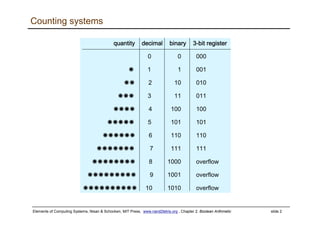
Counting systems
quantity decimal binary 3quantity decimal binary 3quantity decimal binary 3quantity decimal binary 3----bit registerbit registerbit registerbit register
0 0 000
1 1 001
2 10 010
3 11 011
4 100 100
5 101 101
6 110 110
7 111 111
8 1000 overflow
9 1001 overflow
10 1010 overflow
Elements of Computing Systems, Nisan & Schocken, MIT Press, www.nand2tetris.org , Chapter 2: Boolean Arithmetic slide 3
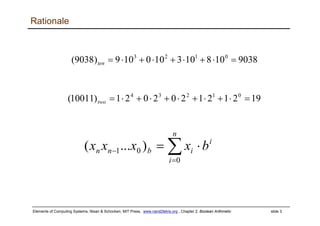
Rationale
192121202021)10011( 01234
=⋅+⋅+⋅+⋅+⋅=two
i
n
i
ibnn bxxxx ⋅= ∑=
−
0
01 )...(
9038018013010019)9038( 0123
=⋅+⋅+⋅+⋅=ten
Elements of Computing Systems, Nisan & Schocken, MIT Press, www.nand2tetris.org , Chapter 2: Boolean Arithmetic slide 4
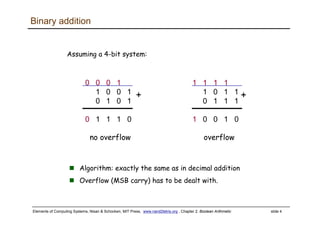
no overflow overflow
Algorithm: exactly the same as in decimal addition
Overflow (MSB carry) has to be dealt with.
Binary addition
Assuming a 4-bit system:
0 0 0 1
1 0 0 1
0 1 0 1
0 1 1 1 0
++++
1 1 1 1
1 0 1 1
0 1 1 1
1 0 0 1 0
++++
Elements of Computing Systems, Nisan & Schocken, MIT Press, www.nand2tetris.org , Chapter 2: Boolean Arithmetic slide 5
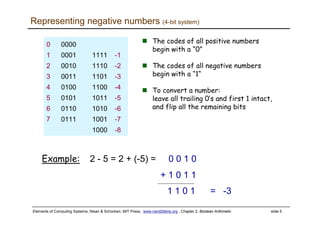
Representing negative numbers (4-bit system)
The codes of all positive numbers
begin with a “0”
The codes of all negative numbers
begin with a “1“
To convert a number:
leave all trailing 0’s and first 1 intact,
and flip all the remaining bits
0 0000
1 0001 1111 -1
2 0010 1110 -2
3 0011 1101 -3
4 0100 1100 -4
5 0101 1011 -5
6 0110 1010 -6
7 0111 1001 -7
1000 -8
Example: 2 - 5 = 2 + (-5) = 0 0 1 0
+ 1 0 1 1
1 1 0 1 = -3
Elements of Computing Systems, Nisan & Schocken, MIT Press, www.nand2tetris.org , Chapter 2: Boolean Arithmetic slide 6
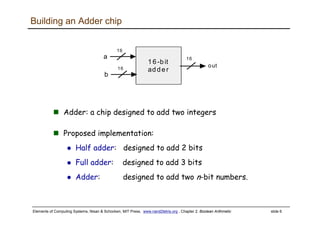
Building an Adder chip
Adder: a chip designed to add two integers
Proposed implementation:
Half adder: designed to add 2 bits
Full adder: designed to add 3 bits
Adder: designed to add two n-bit numbers.
out
a
16
16-bit
adder
b
16
16
Elements of Computing Systems, Nisan & Schocken, MIT Press, www.nand2tetris.org , Chapter 2: Boolean Arithmetic slide 7
Half adder (designed to add 2 bits)
Implementation: based on two gates that you’ve seen before.
half
adder
a sum
b carry
a b sum carry
0 0 0 0
0 1 1 0
1 0 1 0
1 1 0 1
Elements of Computing Systems, Nisan & Schocken, MIT Press, www.nand2tetris.org , Chapter 2: Boolean Arithmetic slide 8
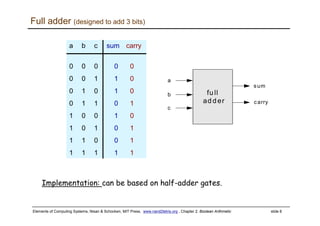
Full adder (designed to add 3 bits)
Implementation: can be based on half-adder gates.
a b c sum carry
0 0 0 0 0
0 0 1 1 0
0 1 0 1 0
0 1 1 0 1
1 0 0 1 0
1 0 1 0 1
1 1 0 0 1
1 1 1 1 1
fu ll
ad d er
a
sum
b
carry
c
Elements of Computing Systems, Nisan & Schocken, MIT Press, www.nand2tetris.org , Chapter 2: Boolean Arithmetic slide 9
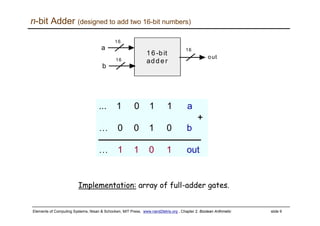
n-bit Adder (designed to add two 16-bit numbers)
Implementation: array of full-adder gates.
out
a
16
16-bit
adder
b
16
16
... 1 0 1 1 a
… 0 0 1 0 b
… 1 1 0 1 out
++++
Elements of Computing Systems, Nisan & Schocken, MIT Press, www.nand2tetris.org , Chapter 2: Boolean Arithmetic slide 10
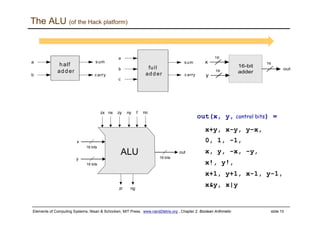
The ALU (of the Hack platform)
half
adder
a sum
b carry
full
ad der
a
sum
b
carry
c
out
x
16
16-bit
adder
y
16
16
zx no
zr
nx zy ny f
ALU
ng
16 bits
16 bits
x
y 16 bits
out
out(x, y, control bits) =
x+y, x-y, y–x,
0, 1, -1,
x, y, -x, -y,
x!, y!,
x+1, y+1, x-1, y-1,
x&y, x|y
Elements of Computing Systems, Nisan & Schocken, MIT Press, www.nand2tetris.org , Chapter 2: Boolean Arithmetic slide 11
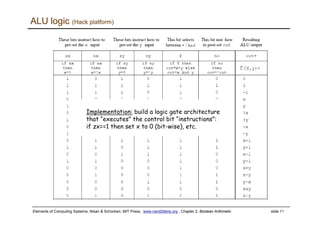
ALU logic (Hack platform)
Implementation: build a logic gate architecture
that “executes” the control bit “instructions”:
if zx==1 then set x to 0 (bit-wise), etc.
Elements of Computing Systems, Nisan & Schocken, MIT Press, www.nand2tetris.org , Chapter 2: Boolean Arithmetic slide 12
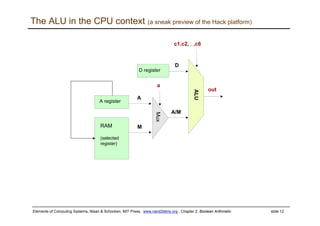
The ALU in the CPU context (a sneak preview of the Hack platform)
ALU
Mux
D
out
A/M
a
D register
A register
A
M
c1,c2, … ,c6
RAM
(selected
register)
Elements of Computing Systems, Nisan & Schocken, MIT Press, www.nand2tetris.org , Chapter 2: Boolean Arithmetic slide 13
Perspective
Combinational logic
Our adder design is very basic: no parallelism
It pays to optimize adders
Our ALU is also very basic: no multiplication, no division
Where is the seat of more advanced math operations?
a typical hardware/software tradeoff.
Elements of Computing Systems, Nisan & Schocken, MIT Press, www.nand2tetris.org , Chapter 2: Boolean Arithmetic slide 14
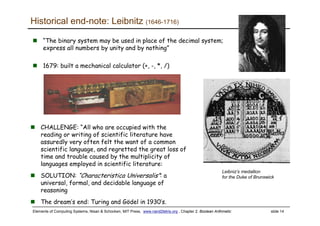
Historical end-note: Leibnitz (1646-1716)
“The binary system may be used in place of the decimal system;
express all numbers by unity and by nothing”
1679: built a mechanical calculator (+, -, *, /)
CHALLENGE: “All who are occupied with the
reading or writing of scientific literature have
assuredly very often felt the want of a common
scientific language, and regretted the great loss of
time and trouble caused by the multiplicity of
languages employed in scientific literature:
SOLUTION: “Characteristica Universalis”: a
universal, formal, and decidable language of
reasoning
The dream’s end: Turing and Gödel in 1930’s.
Leibniz’s medallion
for the Duke of Brunswick

nand2tetris 舊版投影片 -- 第二章 布林算術

  • 1.
    Elements of ComputingSystems, Nisan & Schocken, MIT Press, www.nand2tetris.org , Chapter 2: Boolean Arithmetic slide 1 www.nand2tetris.org Building a Modern Computer From First Principles Boolean Arithmetic
  • 2.
    Elements of ComputingSystems, Nisan & Schocken, MIT Press, www.nand2tetris.org , Chapter 2: Boolean Arithmetic slide 2 Counting systems quantity decimal binary 3quantity decimal binary 3quantity decimal binary 3quantity decimal binary 3----bit registerbit registerbit registerbit register 0 0 000 1 1 001 2 10 010 3 11 011 4 100 100 5 101 101 6 110 110 7 111 111 8 1000 overflow 9 1001 overflow 10 1010 overflow
  • 3.
    Elements of ComputingSystems, Nisan & Schocken, MIT Press, www.nand2tetris.org , Chapter 2: Boolean Arithmetic slide 3 Rationale 192121202021)10011( 01234 =⋅+⋅+⋅+⋅+⋅=two i n i ibnn bxxxx ⋅= ∑= − 0 01 )...( 9038018013010019)9038( 0123 =⋅+⋅+⋅+⋅=ten
  • 4.
    Elements of ComputingSystems, Nisan & Schocken, MIT Press, www.nand2tetris.org , Chapter 2: Boolean Arithmetic slide 4 no overflow overflow Algorithm: exactly the same as in decimal addition Overflow (MSB carry) has to be dealt with. Binary addition Assuming a 4-bit system: 0 0 0 1 1 0 0 1 0 1 0 1 0 1 1 1 0 ++++ 1 1 1 1 1 0 1 1 0 1 1 1 1 0 0 1 0 ++++
  • 5.
    Elements of ComputingSystems, Nisan & Schocken, MIT Press, www.nand2tetris.org , Chapter 2: Boolean Arithmetic slide 5 Representing negative numbers (4-bit system) The codes of all positive numbers begin with a “0” The codes of all negative numbers begin with a “1“ To convert a number: leave all trailing 0’s and first 1 intact, and flip all the remaining bits 0 0000 1 0001 1111 -1 2 0010 1110 -2 3 0011 1101 -3 4 0100 1100 -4 5 0101 1011 -5 6 0110 1010 -6 7 0111 1001 -7 1000 -8 Example: 2 - 5 = 2 + (-5) = 0 0 1 0 + 1 0 1 1 1 1 0 1 = -3
  • 6.
    Elements of ComputingSystems, Nisan & Schocken, MIT Press, www.nand2tetris.org , Chapter 2: Boolean Arithmetic slide 6 Building an Adder chip Adder: a chip designed to add two integers Proposed implementation: Half adder: designed to add 2 bits Full adder: designed to add 3 bits Adder: designed to add two n-bit numbers. out a 16 16-bit adder b 16 16
  • 7.
    Elements of ComputingSystems, Nisan & Schocken, MIT Press, www.nand2tetris.org , Chapter 2: Boolean Arithmetic slide 7 Half adder (designed to add 2 bits) Implementation: based on two gates that you’ve seen before. half adder a sum b carry a b sum carry 0 0 0 0 0 1 1 0 1 0 1 0 1 1 0 1
  • 8.
    Elements of ComputingSystems, Nisan & Schocken, MIT Press, www.nand2tetris.org , Chapter 2: Boolean Arithmetic slide 8 Full adder (designed to add 3 bits) Implementation: can be based on half-adder gates. a b c sum carry 0 0 0 0 0 0 0 1 1 0 0 1 0 1 0 0 1 1 0 1 1 0 0 1 0 1 0 1 0 1 1 1 0 0 1 1 1 1 1 1 fu ll ad d er a sum b carry c
  • 9.
    Elements of ComputingSystems, Nisan & Schocken, MIT Press, www.nand2tetris.org , Chapter 2: Boolean Arithmetic slide 9 n-bit Adder (designed to add two 16-bit numbers) Implementation: array of full-adder gates. out a 16 16-bit adder b 16 16 ... 1 0 1 1 a … 0 0 1 0 b … 1 1 0 1 out ++++
  • 10.
    Elements of ComputingSystems, Nisan & Schocken, MIT Press, www.nand2tetris.org , Chapter 2: Boolean Arithmetic slide 10 The ALU (of the Hack platform) half adder a sum b carry full ad der a sum b carry c out x 16 16-bit adder y 16 16 zx no zr nx zy ny f ALU ng 16 bits 16 bits x y 16 bits out out(x, y, control bits) = x+y, x-y, y–x, 0, 1, -1, x, y, -x, -y, x!, y!, x+1, y+1, x-1, y-1, x&y, x|y
  • 11.
    Elements of ComputingSystems, Nisan & Schocken, MIT Press, www.nand2tetris.org , Chapter 2: Boolean Arithmetic slide 11 ALU logic (Hack platform) Implementation: build a logic gate architecture that “executes” the control bit “instructions”: if zx==1 then set x to 0 (bit-wise), etc.
  • 12.
    Elements of ComputingSystems, Nisan & Schocken, MIT Press, www.nand2tetris.org , Chapter 2: Boolean Arithmetic slide 12 The ALU in the CPU context (a sneak preview of the Hack platform) ALU Mux D out A/M a D register A register A M c1,c2, … ,c6 RAM (selected register)
  • 13.
    Elements of ComputingSystems, Nisan & Schocken, MIT Press, www.nand2tetris.org , Chapter 2: Boolean Arithmetic slide 13 Perspective Combinational logic Our adder design is very basic: no parallelism It pays to optimize adders Our ALU is also very basic: no multiplication, no division Where is the seat of more advanced math operations? a typical hardware/software tradeoff.
  • 14.
    Elements of ComputingSystems, Nisan & Schocken, MIT Press, www.nand2tetris.org , Chapter 2: Boolean Arithmetic slide 14 Historical end-note: Leibnitz (1646-1716) “The binary system may be used in place of the decimal system; express all numbers by unity and by nothing” 1679: built a mechanical calculator (+, -, *, /) CHALLENGE: “All who are occupied with the reading or writing of scientific literature have assuredly very often felt the want of a common scientific language, and regretted the great loss of time and trouble caused by the multiplicity of languages employed in scientific literature: SOLUTION: “Characteristica Universalis”: a universal, formal, and decidable language of reasoning The dream’s end: Turing and Gödel in 1930’s. Leibniz’s medallion for the Duke of Brunswick