1
Logic Gates
2
Review of Boolean algebra
• Just like Boolean logic
• Variables can only be 1 or 0
– Instead of true / false
3
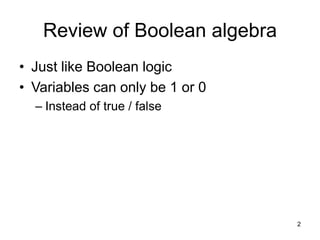
Review of Boolean algebra
• Not is a horizontal bar above the number
– 0 = 1
– 1 = 0
• Or is a plus
– 0+0 = 0
– 0+1 = 1
– 1+0 = 1
– 1+1 = 1
• And is multiplication
– 0*0 = 0
– 0*1 = 0
– 1*0 = 0
– 1*1 = 1
_
_
4
Review of Boolean algebra
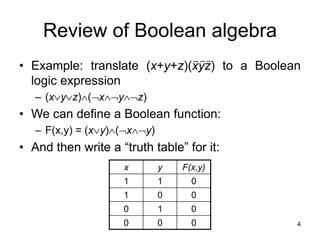
• Example: translate (x+y+z)(xyz) to a Boolean
logic expression
– (xyz)(xyz)
• We can define a Boolean function:
– F(x,y) = (xy)(xy)
• And then write a “truth table” for it:
_ _ _
x y F(x,y)
1 1 0
1 0 0
0 1 0
0 0 0
5
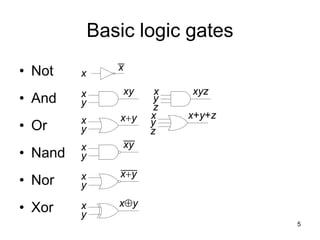
Basic logic gates
• Not
• And
• Or
• Nand
• Nor
• Xor
x
x
x
y
xy x
y
xyz
z
x+y
x
y
x
y
x+y+z
z
x
y
xy
x+y
x
y
xÅy
x
y
6
Converting between circuits and
equations
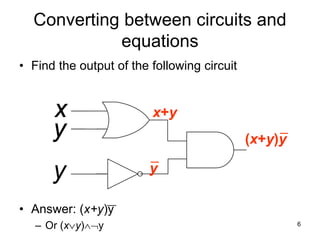
• Find the output of the following circuit
• Answer: (x+y)y
– Or (xy)y
x
y
x+y
y
(x+y)y
__
x
y
y
7
x
y
Converting between circuits and
equations
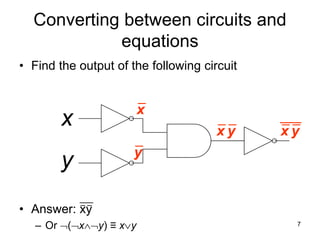
• Find the output of the following circuit
• Answer: xy
– Or (xy) ≡ xy
x
y
x y x y
_ _
___
8
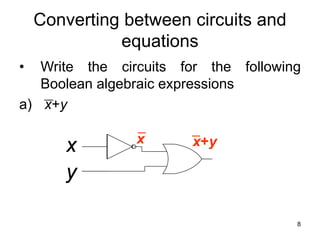
Converting between circuits and
equations
• Write the circuits for the following
Boolean algebraic expressions
a) x+y
x
y
x
y
x
y
__
x x+y
9
x
y
x
y
x
y
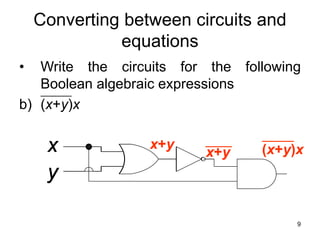
Converting between circuits and
equations
• Write the circuits for the following
Boolean algebraic expressions
b) (x+y)x
_______
x
y
x+y
x+y (x+y)x
10
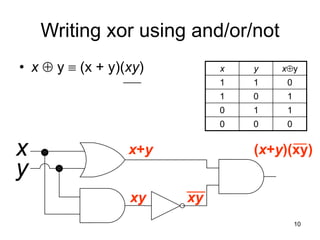
Writing xor using and/or/not
• x Å y  (x + y)(xy) x y xÅy
1 1 0
1 0 1
0 1 1
0 0 0
x
y
x+y
xy xy
(x+y)(xy)
____
11
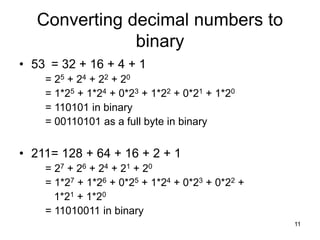
Converting decimal numbers to
binary
• 53 = 32 + 16 + 4 + 1
= 25 + 24 + 22 + 20
= 1*25 + 1*24 + 0*23 + 1*22 + 0*21 + 1*20
= 110101 in binary
= 00110101 as a full byte in binary
• 211= 128 + 64 + 16 + 2 + 1
= 27 + 26 + 24 + 21 + 20
= 1*27 + 1*26 + 0*25 + 1*24 + 0*23 + 0*22 +
1*21 + 1*20
= 11010011 in binary
12
Converting binary numbers to
decimal
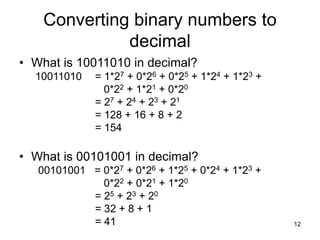
• What is 10011010 in decimal?
10011010 = 1*27 + 0*26 + 0*25 + 1*24 + 1*23 +
0*22 + 1*21 + 0*20
= 27 + 24 + 23 + 21
= 128 + 16 + 8 + 2
= 154
• What is 00101001 in decimal?
00101001 = 0*27 + 0*26 + 1*25 + 0*24 + 1*23 +
0*22 + 0*21 + 1*20
= 25 + 23 + 20
= 32 + 8 + 1
= 41
13
A note on binary numbers
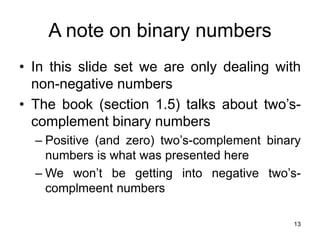
• In this slide set we are only dealing with
non-negative numbers
• The book (section 1.5) talks about two’s-
complement binary numbers
– Positive (and zero) two’s-complement binary
numbers is what was presented here
– We won’t be getting into negative two’s-
complmeent numbers
15
How to add binary numbers
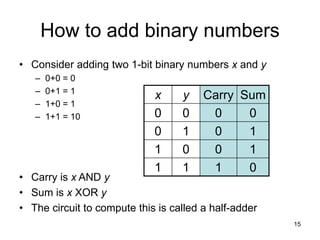
• Consider adding two 1-bit binary numbers x and y
– 0+0 = 0
– 0+1 = 1
– 1+0 = 1
– 1+1 = 10
• Carry is x AND y
• Sum is x XOR y
• The circuit to compute this is called a half-adder
x y Carry Sum
0 0 0 0
0 1 0 1
1 0 0 1
1 1 1 0
16
The half-adder
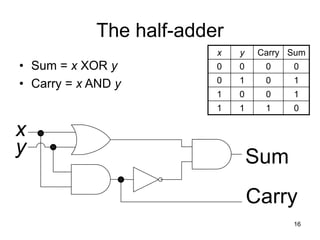
• Sum = x XOR y
• Carry = x AND y
x
y Sum
Carry
x
y Sum
Carry
x y Carry Sum
0 0 0 0
0 1 0 1
1 0 0 1
1 1 1 0
17
Using half adders
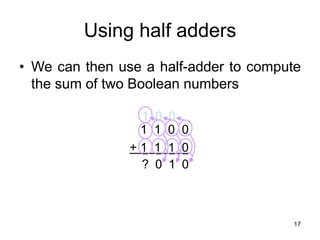
• We can then use a half-adder to compute
the sum of two Boolean numbers
1 1 0 0
+ 1 1 1 0
0
1
0
?
0
0
1
18
How to fix this
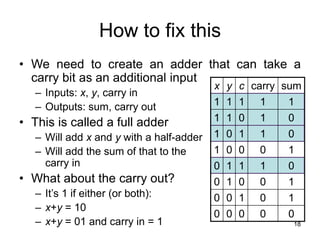
• We need to create an adder that can take a
carry bit as an additional input
– Inputs: x, y, carry in
– Outputs: sum, carry out
• This is called a full adder
– Will add x and y with a half-adder
– Will add the sum of that to the
carry in
• What about the carry out?
– It’s 1 if either (or both):
– x+y = 10
– x+y = 01 and carry in = 1
x y c carry sum
1 1 1 1 1
1 1 0 1 0
1 0 1 1 0
1 0 0 0 1
0 1 1 1 0
0 1 0 0 1
0 0 1 0 1
0 0 0 0 0
19
HA
X
Y
S
C
HA
X
Y
S
C
x
y
c
c
s
HA
X
Y
S
C
HA
X
Y
S
C
x
y
c
The full adder
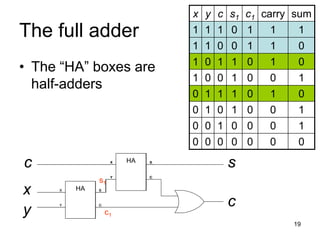
• The “HA” boxes are
half-adders
x y c s1 c1 carry sum
1 1 1 0 1 1 1
1 1 0 0 1 1 0
1 0 1 1 0 1 0
1 0 0 1 0 0 1
0 1 1 1 0 1 0
0 1 0 1 0 0 1
0 0 1 0 0 0 1
0 0 0 0 0 0 0
s1
c1
20
The full adder
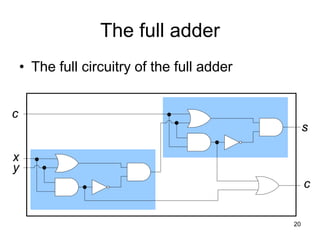
• The full circuitry of the full adder
x
y
s
c
c
21
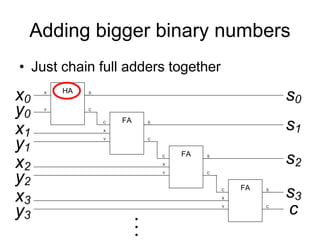
Adding bigger binary numbers
• Just chain full adders together
HA
X
Y
S
C
FA
C
Y
X
S
C
FA
C
Y
X
S
C
FA
C
Y
X
S
C
x1
y1
x2
y2
x3
y3
x0
y0
s0
s1
s2
s3
c
.
.
.
22
Adding bigger binary numbers
• A half adder has 4 logic gates
• A full adder has two half adders plus a OR gate
– Total of 9 logic gates
• To add n bit binary numbers, you need 1 HA and
n-1 FAs
• To add 32 bit binary numbers, you need 1 HA
and 31 FAs
– Total of 4+9*31 = 283 logic gates
• To add 64 bit binary numbers, you need 1 HA
and 63 FAs
– Total of 4+9*63 = 571 logic gates
23
More about logic gates
• To implement a logic gate in hardware,
you use a transistor
• Transistors are all enclosed in an “IC”, or
integrated circuit
• The current Intel Pentium IV processors
have 55 million transistors!
24
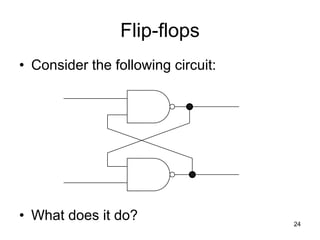
Flip-flops
• Consider the following circuit:
• What does it do?
25
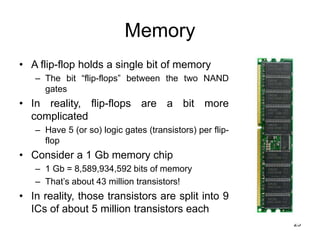
Memory
• A flip-flop holds a single bit of memory
– The bit “flip-flops” between the two NAND
gates
• In reality, flip-flops are a bit more
complicated
– Have 5 (or so) logic gates (transistors) per flip-
flop
• Consider a 1 Gb memory chip
– 1 Gb = 8,589,934,592 bits of memory
– That’s about 43 million transistors!
• In reality, those transistors are split into 9
ICs of about 5 million transistors each
26
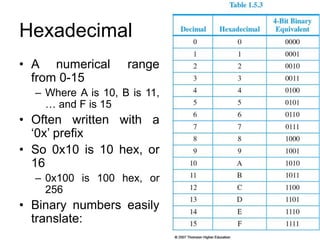
Hexadecimal
• A numerical range
from 0-15
– Where A is 10, B is 11,
… and F is 15
• Often written with a
‘0x’ prefix
• So 0x10 is 10 hex, or
16
– 0x100 is 100 hex, or
256
• Binary numbers easily
translate:
27
From
ThinkGeek
(http://www.thinkgeek.com)
28
Also from
ThinkGeek
(http://www.thinkgeek.com)
29
DEADBEEF
• Many IBM machines would fill allocated
(but uninitialized) memory with the hexa-
decimal pattern 0xDEADBEEF
– Decimal -21524111
– See http://www.jargon.net/jargonfile/d/DEADBEEF.html
• Makes it easier to spot in a debugger
30
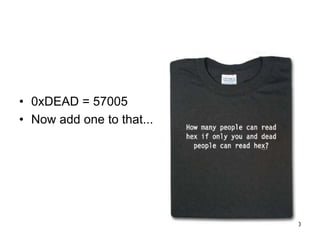
• 0xDEAD = 57005
• Now add one to that...

basic_gates.ppt

  • 1.
  • 2.
    2 Review of Booleanalgebra • Just like Boolean logic • Variables can only be 1 or 0 – Instead of true / false
  • 3.
    3 Review of Booleanalgebra • Not is a horizontal bar above the number – 0 = 1 – 1 = 0 • Or is a plus – 0+0 = 0 – 0+1 = 1 – 1+0 = 1 – 1+1 = 1 • And is multiplication – 0*0 = 0 – 0*1 = 0 – 1*0 = 0 – 1*1 = 1 _ _
  • 4.
    4 Review of Booleanalgebra • Example: translate (x+y+z)(xyz) to a Boolean logic expression – (xyz)(xyz) • We can define a Boolean function: – F(x,y) = (xy)(xy) • And then write a “truth table” for it: _ _ _ x y F(x,y) 1 1 0 1 0 0 0 1 0 0 0 0
  • 5.
    5 Basic logic gates •Not • And • Or • Nand • Nor • Xor x x x y xy x y xyz z x+y x y x y x+y+z z x y xy x+y x y xÅy x y
  • 6.
    6 Converting between circuitsand equations • Find the output of the following circuit • Answer: (x+y)y – Or (xy)y x y x+y y (x+y)y __ x y y
  • 7.
    7 x y Converting between circuitsand equations • Find the output of the following circuit • Answer: xy – Or (xy) ≡ xy x y x y x y _ _ ___
  • 8.
    8 Converting between circuitsand equations • Write the circuits for the following Boolean algebraic expressions a) x+y x y x y x y __ x x+y
  • 9.
    9 x y x y x y Converting between circuitsand equations • Write the circuits for the following Boolean algebraic expressions b) (x+y)x _______ x y x+y x+y (x+y)x
  • 10.
    10 Writing xor usingand/or/not • x Å y  (x + y)(xy) x y xÅy 1 1 0 1 0 1 0 1 1 0 0 0 x y x+y xy xy (x+y)(xy) ____
  • 11.
    11 Converting decimal numbersto binary • 53 = 32 + 16 + 4 + 1 = 25 + 24 + 22 + 20 = 1*25 + 1*24 + 0*23 + 1*22 + 0*21 + 1*20 = 110101 in binary = 00110101 as a full byte in binary • 211= 128 + 64 + 16 + 2 + 1 = 27 + 26 + 24 + 21 + 20 = 1*27 + 1*26 + 0*25 + 1*24 + 0*23 + 0*22 + 1*21 + 1*20 = 11010011 in binary
  • 12.
    12 Converting binary numbersto decimal • What is 10011010 in decimal? 10011010 = 1*27 + 0*26 + 0*25 + 1*24 + 1*23 + 0*22 + 1*21 + 0*20 = 27 + 24 + 23 + 21 = 128 + 16 + 8 + 2 = 154 • What is 00101001 in decimal? 00101001 = 0*27 + 0*26 + 1*25 + 0*24 + 1*23 + 0*22 + 0*21 + 1*20 = 25 + 23 + 20 = 32 + 8 + 1 = 41
  • 13.
    13 A note onbinary numbers • In this slide set we are only dealing with non-negative numbers • The book (section 1.5) talks about two’s- complement binary numbers – Positive (and zero) two’s-complement binary numbers is what was presented here – We won’t be getting into negative two’s- complmeent numbers
  • 14.
    15 How to addbinary numbers • Consider adding two 1-bit binary numbers x and y – 0+0 = 0 – 0+1 = 1 – 1+0 = 1 – 1+1 = 10 • Carry is x AND y • Sum is x XOR y • The circuit to compute this is called a half-adder x y Carry Sum 0 0 0 0 0 1 0 1 1 0 0 1 1 1 1 0
  • 15.
    16 The half-adder • Sum= x XOR y • Carry = x AND y x y Sum Carry x y Sum Carry x y Carry Sum 0 0 0 0 0 1 0 1 1 0 0 1 1 1 1 0
  • 16.
    17 Using half adders •We can then use a half-adder to compute the sum of two Boolean numbers 1 1 0 0 + 1 1 1 0 0 1 0 ? 0 0 1
  • 17.
    18 How to fixthis • We need to create an adder that can take a carry bit as an additional input – Inputs: x, y, carry in – Outputs: sum, carry out • This is called a full adder – Will add x and y with a half-adder – Will add the sum of that to the carry in • What about the carry out? – It’s 1 if either (or both): – x+y = 10 – x+y = 01 and carry in = 1 x y c carry sum 1 1 1 1 1 1 1 0 1 0 1 0 1 1 0 1 0 0 0 1 0 1 1 1 0 0 1 0 0 1 0 0 1 0 1 0 0 0 0 0
  • 18.
    19 HA X Y S C HA X Y S C x y c c s HA X Y S C HA X Y S C x y c The full adder •The “HA” boxes are half-adders x y c s1 c1 carry sum 1 1 1 0 1 1 1 1 1 0 0 1 1 0 1 0 1 1 0 1 0 1 0 0 1 0 0 1 0 1 1 1 0 1 0 0 1 0 1 0 0 1 0 0 1 0 0 0 1 0 0 0 0 0 0 0 s1 c1
  • 19.
    20 The full adder •The full circuitry of the full adder x y s c c
  • 20.
    21 Adding bigger binarynumbers • Just chain full adders together HA X Y S C FA C Y X S C FA C Y X S C FA C Y X S C x1 y1 x2 y2 x3 y3 x0 y0 s0 s1 s2 s3 c . . .
  • 21.
    22 Adding bigger binarynumbers • A half adder has 4 logic gates • A full adder has two half adders plus a OR gate – Total of 9 logic gates • To add n bit binary numbers, you need 1 HA and n-1 FAs • To add 32 bit binary numbers, you need 1 HA and 31 FAs – Total of 4+9*31 = 283 logic gates • To add 64 bit binary numbers, you need 1 HA and 63 FAs – Total of 4+9*63 = 571 logic gates
  • 22.
    23 More about logicgates • To implement a logic gate in hardware, you use a transistor • Transistors are all enclosed in an “IC”, or integrated circuit • The current Intel Pentium IV processors have 55 million transistors!
  • 23.
    24 Flip-flops • Consider thefollowing circuit: • What does it do?
  • 24.
    25 Memory • A flip-flopholds a single bit of memory – The bit “flip-flops” between the two NAND gates • In reality, flip-flops are a bit more complicated – Have 5 (or so) logic gates (transistors) per flip- flop • Consider a 1 Gb memory chip – 1 Gb = 8,589,934,592 bits of memory – That’s about 43 million transistors! • In reality, those transistors are split into 9 ICs of about 5 million transistors each
  • 25.
    26 Hexadecimal • A numericalrange from 0-15 – Where A is 10, B is 11, … and F is 15 • Often written with a ‘0x’ prefix • So 0x10 is 10 hex, or 16 – 0x100 is 100 hex, or 256 • Binary numbers easily translate:
  • 26.
  • 27.
  • 28.
    29 DEADBEEF • Many IBMmachines would fill allocated (but uninitialized) memory with the hexa- decimal pattern 0xDEADBEEF – Decimal -21524111 – See http://www.jargon.net/jargonfile/d/DEADBEEF.html • Makes it easier to spot in a debugger
  • 29.
    30 • 0xDEAD =57005 • Now add one to that...