Developing
metacognition
Christian Bokhove
@cbokhove
Associate Professor, University of Southampton
Introduction
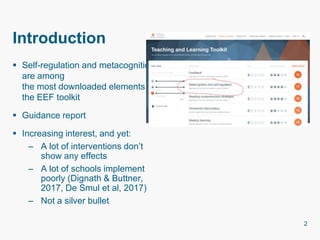
 Self-regulation and metacognition
are among
the most downloaded elements of
the EEF toolkit
 Guidance report
 Increasing interest, and yet:
– A lot of interventions don’t
show any effects
– A lot of schools implement
poorly (Dignath & Buttner,
2017, De Smul et al, 2017)
– Not a silver bullet
2
What is metacognition?
 Part of self-regulated learning -
 The extent to which learners are aware of:
– their strengths and weaknesses,
– the strategies they use to learn,
– how they can motivate themselves to engage in
learning, and
– how they can develop strategies and tactics to enhance
learning.
3
What is metacognition?
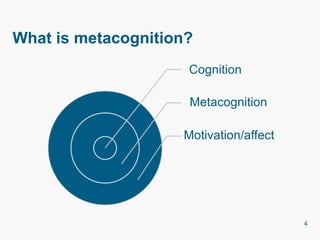
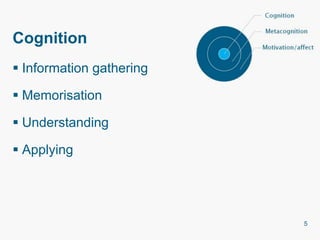
Cognition
Metacognition
Motivation/affect
4
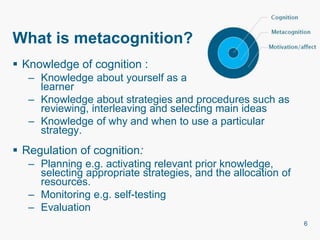
Cognition
 Information gathering
 Memorisation
 Understanding
 Applying
5
What is metacognition?
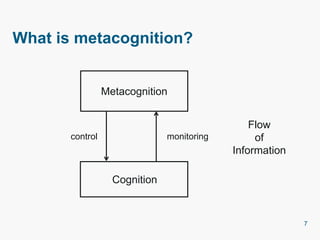
 Knowledge of cognition :
– Knowledge about yourself as a
learner
– Knowledge about strategies and procedures such as
reviewing, interleaving and selecting main ideas
– Knowledge of why and when to use a particular
strategy.
 Regulation of cognition:
– Planning e.g. activating relevant prior knowledge,
selecting appropriate strategies, and the allocation of
resources.
– Monitoring e.g. self-testing
– Evaluation
6
What is metacognition?
7
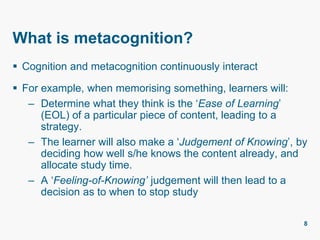
Metacognition
Cognition
control monitoring
Flow
of
Information
What is metacognition?
 Cognition and metacognition continuously interact
 For example, when memorising something, learners will:
– Determine what they think is the ‘Ease of Learning’
(EOL) of a particular piece of content, leading to a
strategy.
– The learner will also make a ‘Judgement of Knowing’, by
deciding how well s/he knows the content already, and
allocate study time.
– A ‘Feeling-of-Knowing’ judgement will then lead to a
decision as to when to stop study
8
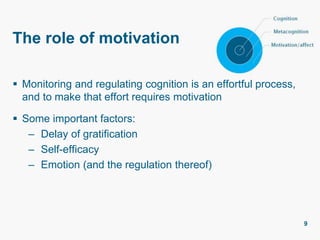
The role of motivation
 Monitoring and regulating cognition is an effortful process,
and to make that effort requires motivation
 Some important factors:
– Delay of gratification
– Self-efficacy
– Emotion (and the regulation thereof)
9
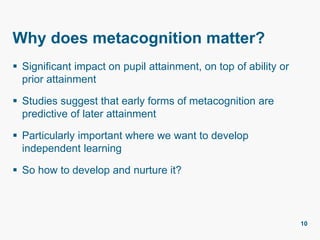
Why does metacognition matter?
 Significant impact on pupil attainment, on top of ability or
prior attainment
 Studies suggest that early forms of metacognition are
predictive of later attainment
 Particularly important where we want to develop
independent learning
 So how to develop and nurture it?
10
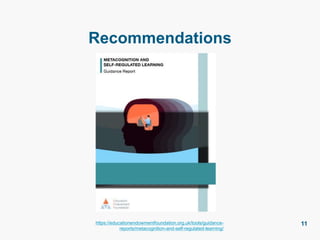
Recommendations
https://educationendowmentfoundation.org.uk/tools/guidance-
reports/metacognition-and-self-regulated-learning/
11
Teacher knowledge and skills
Strong understanding of the metacognitive
demands of the topics you are teaching.
One thing you could do is look up specific
domain-oriented studies that involve
metacognition.
12
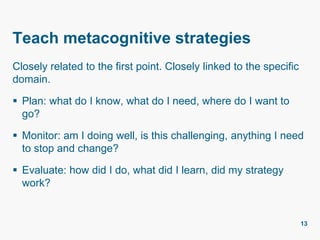
Teach metacognitive strategies
Closely related to the first point. Closely linked to the specific
domain.
 Plan: what do I know, what do I need, where do I want to
go?
 Monitor: am I doing well, is this challenging, anything I need
to stop and change?
 Evaluate: how did I do, what did I learn, did my strategy
work?
13
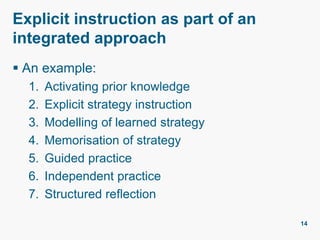
Explicit instruction as part of an
integrated approach
 An example:
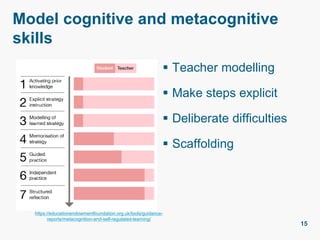
1. Activating prior knowledge
2. Explicit strategy instruction
3. Modelling of learned strategy
4. Memorisation of strategy
5. Guided practice
6. Independent practice
7. Structured reflection
14
Model cognitive and metacognitive
skills
 Teacher modelling
 Make steps explicit
 Deliberate difficulties
 Scaffolding
https://educationendowmentfoundation.org.uk/tools/guidance-
reports/metacognition-and-self-regulated-learning/
15
Appropriate challenge
Role of motivation and self-confidence.
‘Goldilocks degree of challenge’: not too hard not
too easy.
Teacher modelling, worked examples
16
Explicitly teach independent learning
skills
 Plan (goals), Monitor, Evaluate
 Learning techniques
– Elaborative interrogation (generate explanation
for why an explicitly stated fact or concept is
true)
– Practice testing
– Spaced practice
– Self-explanation
 Monitor motivation 17
Explicitly teach independent learning
skills
 Exploratory metacognitive talk
 Support teacher development
18
Developing
metacognition
Thank you
Questions or interested in this or other
mathematics education project, get in touch!
Dr Christian Bokhove
C.Bokhove@soton.ac.uk
@cbokhove
Associate Professor, University of Southampton

Developing metacognition

  • 1.
  • 2.
    Introduction  Self-regulation andmetacognition are among the most downloaded elements of the EEF toolkit  Guidance report  Increasing interest, and yet: – A lot of interventions don’t show any effects – A lot of schools implement poorly (Dignath & Buttner, 2017, De Smul et al, 2017) – Not a silver bullet 2
  • 3.
    What is metacognition? Part of self-regulated learning -  The extent to which learners are aware of: – their strengths and weaknesses, – the strategies they use to learn, – how they can motivate themselves to engage in learning, and – how they can develop strategies and tactics to enhance learning. 3
  • 4.
  • 5.
    Cognition  Information gathering Memorisation  Understanding  Applying 5
  • 6.
    What is metacognition? Knowledge of cognition : – Knowledge about yourself as a learner – Knowledge about strategies and procedures such as reviewing, interleaving and selecting main ideas – Knowledge of why and when to use a particular strategy.  Regulation of cognition: – Planning e.g. activating relevant prior knowledge, selecting appropriate strategies, and the allocation of resources. – Monitoring e.g. self-testing – Evaluation 6
  • 7.
  • 8.
    What is metacognition? Cognition and metacognition continuously interact  For example, when memorising something, learners will: – Determine what they think is the ‘Ease of Learning’ (EOL) of a particular piece of content, leading to a strategy. – The learner will also make a ‘Judgement of Knowing’, by deciding how well s/he knows the content already, and allocate study time. – A ‘Feeling-of-Knowing’ judgement will then lead to a decision as to when to stop study 8
  • 9.
    The role ofmotivation  Monitoring and regulating cognition is an effortful process, and to make that effort requires motivation  Some important factors: – Delay of gratification – Self-efficacy – Emotion (and the regulation thereof) 9
  • 10.
    Why does metacognitionmatter?  Significant impact on pupil attainment, on top of ability or prior attainment  Studies suggest that early forms of metacognition are predictive of later attainment  Particularly important where we want to develop independent learning  So how to develop and nurture it? 10
  • 11.
  • 12.
    Teacher knowledge andskills Strong understanding of the metacognitive demands of the topics you are teaching. One thing you could do is look up specific domain-oriented studies that involve metacognition. 12
  • 13.
    Teach metacognitive strategies Closelyrelated to the first point. Closely linked to the specific domain.  Plan: what do I know, what do I need, where do I want to go?  Monitor: am I doing well, is this challenging, anything I need to stop and change?  Evaluate: how did I do, what did I learn, did my strategy work? 13
  • 14.
    Explicit instruction aspart of an integrated approach  An example: 1. Activating prior knowledge 2. Explicit strategy instruction 3. Modelling of learned strategy 4. Memorisation of strategy 5. Guided practice 6. Independent practice 7. Structured reflection 14
  • 15.
    Model cognitive andmetacognitive skills  Teacher modelling  Make steps explicit  Deliberate difficulties  Scaffolding https://educationendowmentfoundation.org.uk/tools/guidance- reports/metacognition-and-self-regulated-learning/ 15
  • 16.
    Appropriate challenge Role ofmotivation and self-confidence. ‘Goldilocks degree of challenge’: not too hard not too easy. Teacher modelling, worked examples 16
  • 17.
    Explicitly teach independentlearning skills  Plan (goals), Monitor, Evaluate  Learning techniques – Elaborative interrogation (generate explanation for why an explicitly stated fact or concept is true) – Practice testing – Spaced practice – Self-explanation  Monitor motivation 17
  • 18.
    Explicitly teach independentlearning skills  Exploratory metacognitive talk  Support teacher development 18
  • 19.
    Developing metacognition Thank you Questions orinterested in this or other mathematics education project, get in touch! Dr Christian Bokhove C.Bokhove@soton.ac.uk @cbokhove Associate Professor, University of Southampton