Collagen Biochemistry
This lecture will cover Collagen as a vital connective tissue protein Distribution of collagen in nature The key collagen types Collagen biosynthesis Collagen cross-linking and stabilisation
Most of us are probably aware that collagen is a widely used cosmetic agent.
 
Collagen is the most abundant protein in the animal kingdom
Major collagen types
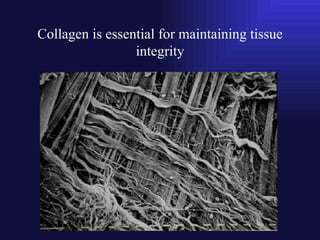
Collagen is essential for maintaining tissue integrity
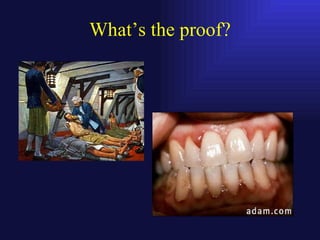
What’s the proof?
 
Collagen biosynthesis Intracellular events
Collagen hierarchy
Intracellular processing
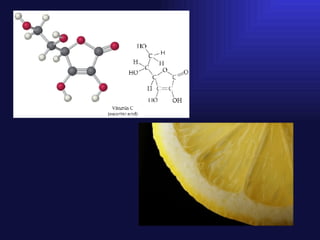
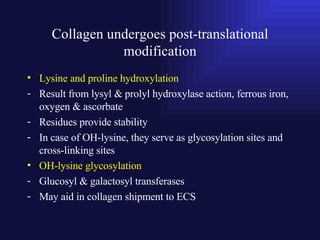
Collagen undergoes post-translational modification Lysine and proline hydroxylation  Result from lysyl & prolyl hydroxylase action, ferrous iron, oxygen & ascorbate Residues provide stability In case of OH-lysine, they serve as glycosylation sites and cross-linking sites OH-lysine glycosylation Glucosyl & galactosyl transferases May aid in collagen shipment to ECS
Extracellular processing
Extracellular modifications N & C-propeptide extensions are removed N & C-procollagen proteinases Reduces solubility, enables fibril formation Optimises subsequent cross-linking
Ehlers Danlos Highly elastic skin In rare cases it can be fragile Chronic joint pain, joint laxity Scoliosis Increased risk of bone fracture Fragile blood vessels Mitral valve prolapse
Extracellular processing II Collagen cross-linking
 
Lysyl oxidase initiates cross-link formation Copper containing amine oxidase Converts the   -amino group of lysine and hydroxylysine to corresponding aldehydes
Lathyritic agents underpin the critical importance of collagen cross-links  -aminoproprionitrile
The cross-links of bone & dentine collagen The lysyl and hydroxylysyl aldehydes react with adjacent   -amino groups of other lysine/hydroxylysine residues – KETOAMINES Bivalent cross-links, 1 st  phase cross-links Ketoamines converted to trivalent or 2 nd  phase cross-links by reaction with another lysyl/hydroxylysyl aldehyde Pyrrole & pyridinium cross-links
Pyrrole & Pyridinium Cross-links

Collagen Biochemistry