MAT225 TEST1A Name:
Show all work algebraically if possible.
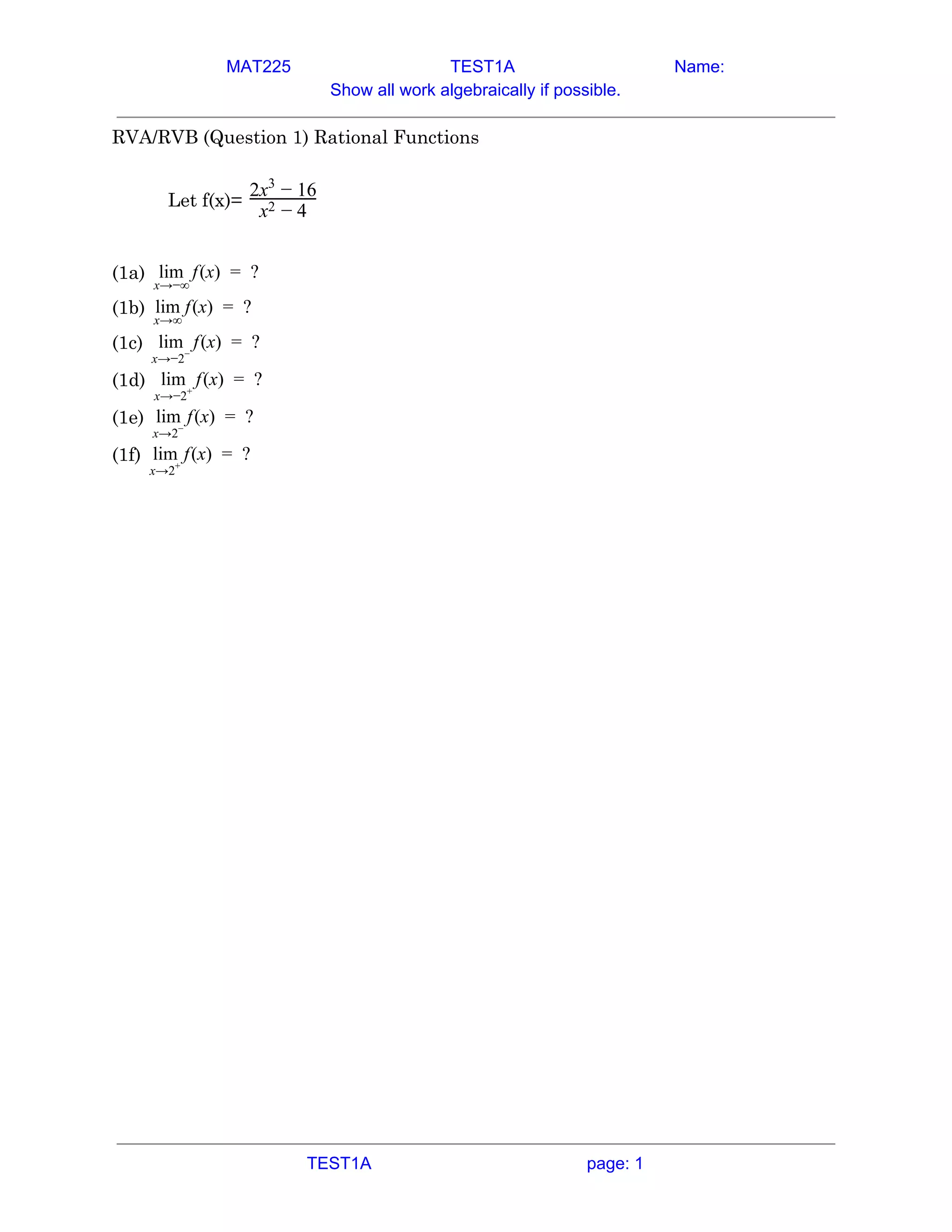
RVA/RVB (Question 1) Rational Functions 
 
Let f(x)=
x − 42
2x − 163
 
 
(1a) (x) ?lim
x→−∞
f =  
(1b) (x) ?lim
x→∞
f =  
(1c) (x) ?lim
x→−2−
f =  
(1d) (x) ?lim
x→−2+
f =  
(1e) (x) ?lim
x→2−
f =  
(1f) (x) ?lim
x→2+
f =    
TEST1A page: 1
MAT225 TEST1A Name:
Show all work algebraically if possible.
 
   
TEST1A page: 2
MAT225 TEST1A Name:
Show all work algebraically if possible.
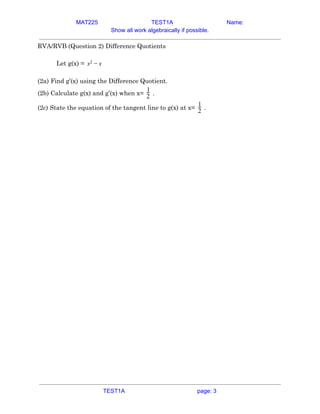
RVA/RVB (Question 2) Difference Quotients 
 
Let g(x) = x2 − x  
 
(2a) Find g’(x) using the Difference Quotient. 
(2b) Calculate g(x) and g’(x) when x= .2
1
 
(2c) State the equation of the tangent line to g(x) at x= .2
1
   
TEST1A page: 3
MAT225 TEST1A Name:
Show all work algebraically if possible.
   
TEST1A page: 4
MAT225 TEST1A Name:
Show all work algebraically if possible.
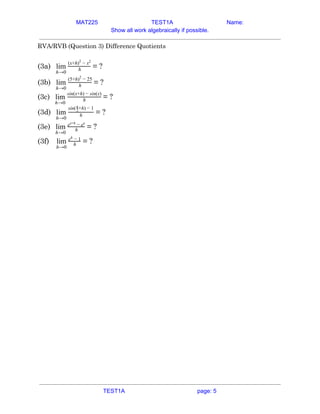
RVA/RVB (Question 3) Difference Quotients 
 
(3a) = ?lim
h→0
h
(x+h) − x2 2
 
(3b) = ?lim
h→0
h
(5+h) − 252
 
(3c) = ?lim
h→0
h
sin(x+h) − sin(x)
 
(3d) = ?lim
h→0
h
sin( +h) − 12
π
 
(3e) = ?lim
h→0
h
e − ex+h x
 
(3f) = ?lim
h→0
h
e − 1h
 
TEST1A page: 5
MAT225 TEST1A Name:
Show all work algebraically if possible.
   
TEST1A page: 6
MAT225 TEST1A Name:
Show all work algebraically if possible.
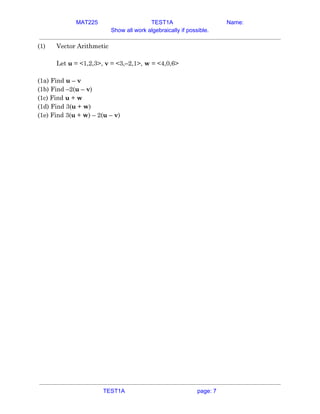
(1)  Vector Arithmetic 
 
Let ​u​ = <1,2,3>, ​v​ = <3,–2,1>, ​w​ = <4,0,6> 
 
(1a) Find ​u​ – ​v 
(1b) Find –2(​u​ – ​v​) 
(1c) Find ​u​ + ​w 
(1d) Find 3(​u​ + ​w​) 
(1e) Find 3(​u​ + ​w​) – 2(​u​ – ​v​)   
TEST1A page: 7
MAT225 TEST1A Name:
Show all work algebraically if possible.
TEST1A page: 8
MAT225 TEST1A Name:
Show all work algebraically if possible.
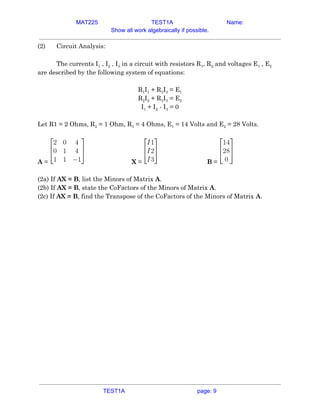
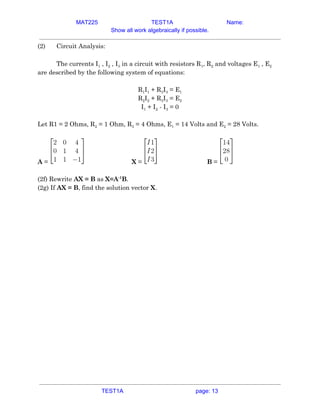
(2) Circuit Analysis: 
 
The currents I​1​ , I​2​ , I​3​ in a circuit with resistors R​1​, R​2​ and voltages E​1​ , E​2 
are described by the following system of equations: 
 
R​1​I​1​ + R​3​I​3​ = E​1 
R​2​I​2​ + R​3​I​3​ = E​2 
I​1​ + I​2​ - I​3​ = 0 
 
Let R1 = 2 Ohms, R​2​ = 1 Ohm, R​3​ = 4 Ohms, E​1​ = 14 Volts and E​2​ = 28 Volts. 
 
A​ = X​ = B​ =  
 
(2a) If ​AX = B​, list the Minors of Matrix ​A​. 
(2b) If ​AX = B​, state the CoFactors of the Minors of Matrix ​A​. 
(2c) If ​AX = B​, find the Transpose of the CoFactors of the Minors of Matrix ​A​.   
TEST1A page: 9
MAT225 TEST1A Name:
Show all work algebraically if possible.
   
TEST1A page: 10
MAT225 TEST1A Name:
Show all work algebraically if possible.
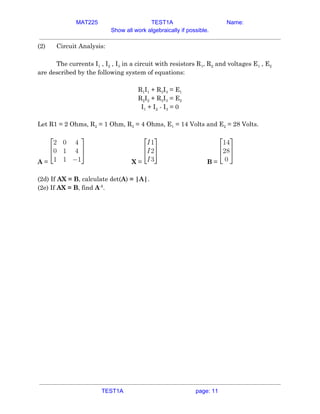
(2) Circuit Analysis: 
 
The currents I​1​ , I​2​ , I​3​ in a circuit with resistors R​1​, R​2​ and voltages E​1​ , E​2 
are described by the following system of equations: 
 
R​1​I​1​ + R​3​I​3​ = E​1 
R​2​I​2​ + R​3​I​3​ = E​2 
I​1​ + I​2​ - I​3​ = 0 
 
Let R1 = 2 Ohms, R​2​ = 1 Ohm, R​3​ = 4 Ohms, E​1​ = 14 Volts and E​2​ = 28 Volts. 
 
A​ = X​ = B​ =  
 
(2d) If ​AX = B​, calculate det(​A​)​ = |A|​. 
(2e) If ​AX = B​, find ​A​-1​
.   
TEST1A page: 11
MAT225 TEST1A Name:
Show all work algebraically if possible.
   
TEST1A page: 12
MAT225 TEST1A Name:
Show all work algebraically if possible.
(2) Circuit Analysis: 
 
The currents I​1​ , I​2​ , I​3​ in a circuit with resistors R​1​, R​2​ and voltages E​1​ , E​2 
are described by the following system of equations: 
 
R​1​I​1​ + R​3​I​3​ = E​1 
R​2​I​2​ + R​3​I​3​ = E​2 
I​1​ + I​2​ - I​3​ = 0 
 
Let R1 = 2 Ohms, R​2​ = 1 Ohm, R​3​ = 4 Ohms, E​1​ = 14 Volts and E​2​ = 28 Volts. 
 
A​ = X​ = B​ =  
 
(2f) Rewrite ​AX = B​ as ​X=A​-1​
B​. 
(2g) If ​AX = B​, find the solution vector ​X​.   
TEST1A page: 13
MAT225 TEST1A Name:
Show all work algebraically if possible.
   
TEST1A page: 14
MAT225 TEST1A Name:
Show all work algebraically if possible.
(3) TetraHedrons 
 
A molecule of Methane CH​4​ forms a Tetrahedron with Carbon at 
the centroid E(k/2, k/2, k/2) and Hydrogen atoms at the 4 corners: 
 
A(0, 0, 0), B(k, k, 0), C(k,0,k) and D(0, k, k) 
 
(3a) Find the length of side ​CD​. 
(3b) What is the angle between sides ​AC​ and ​AD​. 
(3c) Calculate the bonding angle between the vectors ​ED​ and ​EA​.   
TEST1A page: 15
MAT225 TEST1A Name:
Show all work algebraically if possible.
   
TEST1A page: 16
MAT225 TEST1A Name:
Show all work algebraically if possible.
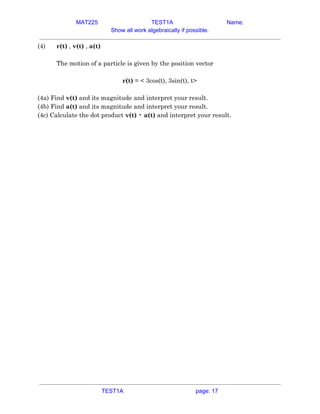
(4) r(t)​ , ​v(t)​ , ​a(t) 
 
The motion of a particle is given by the position vector 
 
r(t)​ = < 3cos(t), 3sin(t), t> 
 
(4a) Find ​v(t)​ and its magnitude and interpret your result. 
(4b) Find ​a(t)​ and its magnitude and interpret your result. 
(4c) Calculate the dot product ​v(t)​ • ​a(t)​ and interpret your result.   
TEST1A page: 17
MAT225 TEST1A Name:
Show all work algebraically if possible.
   
TEST1A page: 18
MAT225 TEST1A Name:
Show all work algebraically if possible.
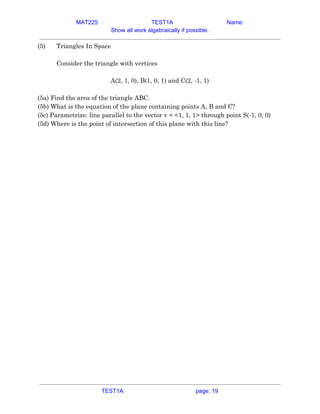
(5)  Triangles In Space 
 
Consider the triangle with vertices 
 
A(2, 1, 0), B(1, 0, 1) and C(2, -1, 1) 
 
(5a) Find the area of the triangle ABC. 
(5b) What is the equation of the plane containing points A, B and C? 
(5c) Parametrize: line parallel to the vector v = <1, 1, 1> through point S(-1, 0, 0) 
(5d) Where is the point of intersection of this plane with this line?    
TEST1A page: 19
MAT225 TEST1A Name:
Show all work algebraically if possible.
   
TEST1A page: 20
MAT225 TEST1A Name:
Show all work algebraically if possible.
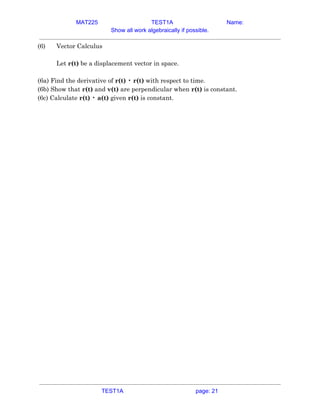
(6) Vector Calculus 
 
Let ​r(t)​ be a displacement vector in space. 
 
(6a) Find the derivative of ​r(t)​ • ​r(t)​ with respect to time. 
(6b) Show that ​r(t)​ and ​v(t)​ are perpendicular when ​r(t)​ is constant. 
(6c) Calculate ​r(t)​ • ​a(t)​ given ​r(t)​ is constant.   
TEST1A page: 21
MAT225 TEST1A Name:
Show all work algebraically if possible.
   
TEST1A page: 22
MAT225 TEST1A Name:
Show all work algebraically if possible.
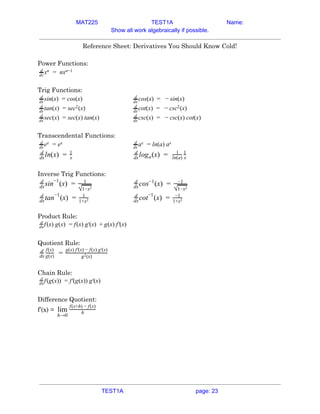
Reference Sheet: Derivatives You Should Know Cold! 
 
Power Functions: 
x nxd
dx
n = n−1  
 
Trig Functions: 
sin(x) os(x)d
dx
= c cos(x) in(x)d
dx
= − s  
tan(x) (x)d
dx
= sec2 cot(x) (x)d
dx
= − csc2  
sec(x) ec(x) tan(x)d
dx
= s csc(x) sc(x) cot(x)d
dx
= − c  
 
Transcendental Functions: 
ed
dx
x = ex a n(a) ad
dx
x = l x  
ln(x)d
dx = x
1
log (x)d
dx a = 1
ln(a) x
1
 
 
Inverse Trig Functions: 
sin (x)d
dx
−1
= 1
√1−x2
cos (x)d
dx
−1
= −1
√1−x2
 
tan (x)d
dx
−1
= 1
1+x2 cot (x)d
dx
−1
= −1
1+x2  
 
Product Rule: 
f(x) g(x) (x) g (x) (x) f (x)d
dx = f ′ + g ′  
 
Quotient Rule: 
d
dx
f(x)
g(x) = g (x)2
g(x) f (x) − f(x) g (x)′ ′
 
 
Chain Rule: 
f(g(x)) (g(x)) g (x)d
dx = f′ ′  
 
Difference Quotient: 
f’(x) =​ lim
h→0
h
f(x+h) − f(x)
   
TEST1A page: 23
MAT225 TEST1A Name:
Show all work algebraically if possible.


TEST1A page: 24

2020 preTEST1A

  • 1.
    MAT225 TEST1A Name: Showall work algebraically if possible. RVA/RVB (Question 1) Rational Functions    Let f(x)= x − 42 2x − 163     (1a) (x) ?lim x→−∞ f =   (1b) (x) ?lim x→∞ f =   (1c) (x) ?lim x→−2− f =   (1d) (x) ?lim x→−2+ f =   (1e) (x) ?lim x→2− f =   (1f) (x) ?lim x→2+ f =     TEST1A page: 1
  • 2.
    MAT225 TEST1A Name: Showall work algebraically if possible.       TEST1A page: 2
  • 3.
    MAT225 TEST1A Name: Showall work algebraically if possible. RVA/RVB (Question 2) Difference Quotients    Let g(x) = x2 − x     (2a) Find g’(x) using the Difference Quotient.  (2b) Calculate g(x) and g’(x) when x= .2 1   (2c) State the equation of the tangent line to g(x) at x= .2 1     TEST1A page: 3
  • 4.
    MAT225 TEST1A Name: Showall work algebraically if possible.     TEST1A page: 4
  • 5.
    MAT225 TEST1A Name: Showall work algebraically if possible. RVA/RVB (Question 3) Difference Quotients    (3a) = ?lim h→0 h (x+h) − x2 2   (3b) = ?lim h→0 h (5+h) − 252   (3c) = ?lim h→0 h sin(x+h) − sin(x)   (3d) = ?lim h→0 h sin( +h) − 12 π   (3e) = ?lim h→0 h e − ex+h x   (3f) = ?lim h→0 h e − 1h   TEST1A page: 5
  • 6.
    MAT225 TEST1A Name: Showall work algebraically if possible.     TEST1A page: 6
  • 7.
    MAT225 TEST1A Name: Showall work algebraically if possible. (1)  Vector Arithmetic    Let ​u​ = <1,2,3>, ​v​ = <3,–2,1>, ​w​ = <4,0,6>    (1a) Find ​u​ – ​v  (1b) Find –2(​u​ – ​v​)  (1c) Find ​u​ + ​w  (1d) Find 3(​u​ + ​w​)  (1e) Find 3(​u​ + ​w​) – 2(​u​ – ​v​)    TEST1A page: 7
  • 8.
    MAT225 TEST1A Name: Showall work algebraically if possible. TEST1A page: 8
  • 9.
    MAT225 TEST1A Name: Showall work algebraically if possible. (2) Circuit Analysis:    The currents I​1​ , I​2​ , I​3​ in a circuit with resistors R​1​, R​2​ and voltages E​1​ , E​2  are described by the following system of equations:    R​1​I​1​ + R​3​I​3​ = E​1  R​2​I​2​ + R​3​I​3​ = E​2  I​1​ + I​2​ - I​3​ = 0    Let R1 = 2 Ohms, R​2​ = 1 Ohm, R​3​ = 4 Ohms, E​1​ = 14 Volts and E​2​ = 28 Volts.    A​ = X​ = B​ =     (2a) If ​AX = B​, list the Minors of Matrix ​A​.  (2b) If ​AX = B​, state the CoFactors of the Minors of Matrix ​A​.  (2c) If ​AX = B​, find the Transpose of the CoFactors of the Minors of Matrix ​A​.    TEST1A page: 9
  • 10.
    MAT225 TEST1A Name: Showall work algebraically if possible.     TEST1A page: 10
  • 11.
    MAT225 TEST1A Name: Showall work algebraically if possible. (2) Circuit Analysis:    The currents I​1​ , I​2​ , I​3​ in a circuit with resistors R​1​, R​2​ and voltages E​1​ , E​2  are described by the following system of equations:    R​1​I​1​ + R​3​I​3​ = E​1  R​2​I​2​ + R​3​I​3​ = E​2  I​1​ + I​2​ - I​3​ = 0    Let R1 = 2 Ohms, R​2​ = 1 Ohm, R​3​ = 4 Ohms, E​1​ = 14 Volts and E​2​ = 28 Volts.    A​ = X​ = B​ =     (2d) If ​AX = B​, calculate det(​A​)​ = |A|​.  (2e) If ​AX = B​, find ​A​-1​ .    TEST1A page: 11
  • 12.
    MAT225 TEST1A Name: Showall work algebraically if possible.     TEST1A page: 12
  • 13.
    MAT225 TEST1A Name: Showall work algebraically if possible. (2) Circuit Analysis:    The currents I​1​ , I​2​ , I​3​ in a circuit with resistors R​1​, R​2​ and voltages E​1​ , E​2  are described by the following system of equations:    R​1​I​1​ + R​3​I​3​ = E​1  R​2​I​2​ + R​3​I​3​ = E​2  I​1​ + I​2​ - I​3​ = 0    Let R1 = 2 Ohms, R​2​ = 1 Ohm, R​3​ = 4 Ohms, E​1​ = 14 Volts and E​2​ = 28 Volts.    A​ = X​ = B​ =     (2f) Rewrite ​AX = B​ as ​X=A​-1​ B​.  (2g) If ​AX = B​, find the solution vector ​X​.    TEST1A page: 13
  • 14.
    MAT225 TEST1A Name: Showall work algebraically if possible.     TEST1A page: 14
  • 15.
    MAT225 TEST1A Name: Showall work algebraically if possible. (3) TetraHedrons    A molecule of Methane CH​4​ forms a Tetrahedron with Carbon at  the centroid E(k/2, k/2, k/2) and Hydrogen atoms at the 4 corners:    A(0, 0, 0), B(k, k, 0), C(k,0,k) and D(0, k, k)    (3a) Find the length of side ​CD​.  (3b) What is the angle between sides ​AC​ and ​AD​.  (3c) Calculate the bonding angle between the vectors ​ED​ and ​EA​.    TEST1A page: 15
  • 16.
    MAT225 TEST1A Name: Showall work algebraically if possible.     TEST1A page: 16
  • 17.
    MAT225 TEST1A Name: Showall work algebraically if possible. (4) r(t)​ , ​v(t)​ , ​a(t)    The motion of a particle is given by the position vector    r(t)​ = < 3cos(t), 3sin(t), t>    (4a) Find ​v(t)​ and its magnitude and interpret your result.  (4b) Find ​a(t)​ and its magnitude and interpret your result.  (4c) Calculate the dot product ​v(t)​ • ​a(t)​ and interpret your result.    TEST1A page: 17
  • 18.
    MAT225 TEST1A Name: Showall work algebraically if possible.     TEST1A page: 18
  • 19.
    MAT225 TEST1A Name: Showall work algebraically if possible. (5)  Triangles In Space    Consider the triangle with vertices    A(2, 1, 0), B(1, 0, 1) and C(2, -1, 1)    (5a) Find the area of the triangle ABC.  (5b) What is the equation of the plane containing points A, B and C?  (5c) Parametrize: line parallel to the vector v = <1, 1, 1> through point S(-1, 0, 0)  (5d) Where is the point of intersection of this plane with this line?     TEST1A page: 19
  • 20.
    MAT225 TEST1A Name: Showall work algebraically if possible.     TEST1A page: 20
  • 21.
    MAT225 TEST1A Name: Showall work algebraically if possible. (6) Vector Calculus    Let ​r(t)​ be a displacement vector in space.    (6a) Find the derivative of ​r(t)​ • ​r(t)​ with respect to time.  (6b) Show that ​r(t)​ and ​v(t)​ are perpendicular when ​r(t)​ is constant.  (6c) Calculate ​r(t)​ • ​a(t)​ given ​r(t)​ is constant.    TEST1A page: 21
  • 22.
    MAT225 TEST1A Name: Showall work algebraically if possible.     TEST1A page: 22
  • 23.
    MAT225 TEST1A Name: Showall work algebraically if possible. Reference Sheet: Derivatives You Should Know Cold!    Power Functions:  x nxd dx n = n−1     Trig Functions:  sin(x) os(x)d dx = c cos(x) in(x)d dx = − s   tan(x) (x)d dx = sec2 cot(x) (x)d dx = − csc2   sec(x) ec(x) tan(x)d dx = s csc(x) sc(x) cot(x)d dx = − c     Transcendental Functions:  ed dx x = ex a n(a) ad dx x = l x   ln(x)d dx = x 1 log (x)d dx a = 1 ln(a) x 1     Inverse Trig Functions:  sin (x)d dx −1 = 1 √1−x2 cos (x)d dx −1 = −1 √1−x2   tan (x)d dx −1 = 1 1+x2 cot (x)d dx −1 = −1 1+x2     Product Rule:  f(x) g(x) (x) g (x) (x) f (x)d dx = f ′ + g ′     Quotient Rule:  d dx f(x) g(x) = g (x)2 g(x) f (x) − f(x) g (x)′ ′     Chain Rule:  f(g(x)) (g(x)) g (x)d dx = f′ ′     Difference Quotient:  f’(x) =​ lim h→0 h f(x+h) − f(x)     TEST1A page: 23
  • 24.
    MAT225 TEST1A Name: Showall work algebraically if possible.             TEST1A page: 24