Ankle/Foot Mobilization
        Techniques
             Case Study
 Using ankle/foot joint mobilization
techniques in rehabilitation of a talar
               fracture
Fracture of the Talar Body
• Patient is 28 year old male
• Mechanism of Injury
   – Motor Vehicle -High Impact Injury
• Patient is six weeks post op.
• Cast remove one day ago.
Orthopedic Procedure
• Internal Fixation with lag screws across
  the talar body facture to produce
  anatomic reduction
• Fracture of the talar body must be stably
  fixed to restore subtalar joint congruity
Rehabilitation Objectives
• Range of Motion        • Muscle Strength
  – Restore ROM to the   • Tibialis posterior
    ankle                • Pernoneus longus &
                           brevis
  Restore ROM to the     • Tibialis anterior
  subtalar joint         • Extensor hallucis longus
• Restore ROM to the     • Gastrocnemius
  metatarsophalangel     • Soleus
  joints                 • Flexor digitorum
Important Consideration

Intraarticular fracture of the talar
 body involving the subtalar joint
  may have residual loss of range
             motion.
Mobilization Techniques

Talocrural             Subtalar Joint
  Anterior glide of    • Inversion of Calcaneus
  Talus                • Eversion of Calcaneus
  Posterior glide of   • Calcaneus Distraction
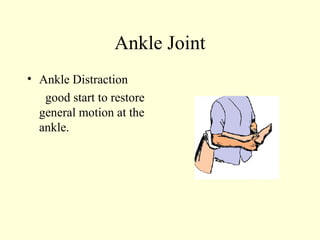
Ankle Joint
• Ankle Distraction
   good start to restore
  general motion at the
  ankle.
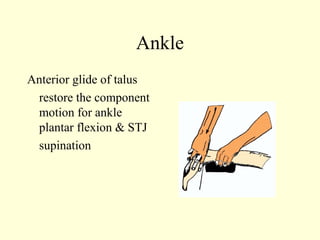
Ankle
Anterior glide of talus
 restore the component
 motion for ankle
 plantar flexion & STJ
 supination
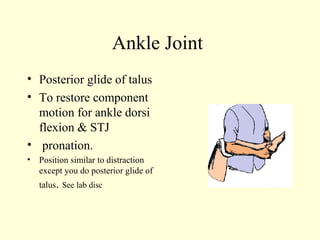
Ankle Joint
• Posterior glide of talus
• To restore component
  motion for ankle dorsi
  flexion & STJ
• pronation.
• Position similar to distraction
  except you do posterior glide of
   talus. See lab disc
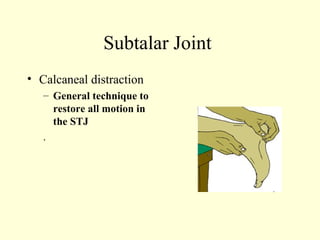
Subtalar Joint
• Calcaneal distraction
   – General technique to
     restore all motion in
     the STJ
   .
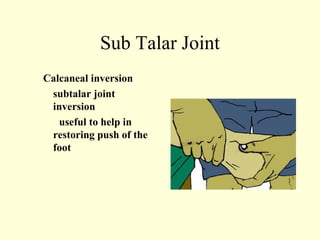
Sub Talar Joint
Calcaneal inversion
 subtalar joint
 inversion
   useful to help in
 restoring push of the
 foot
Subtalar Joint

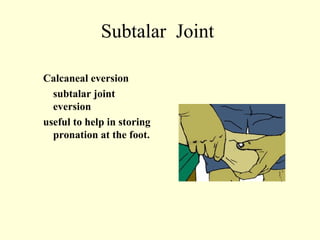
Calcaneal eversion
  subtalar joint
  eversion
useful to help in storing
  pronation at the foot.
Mobilization Techniques
• Mid- tarsal joints
   – Plantar& Dorsal glides of   • Metatarsophalangel
     the cuboid & cuneiforms       – Distraction
  Dorsal & plantar glide of        – Plantar glide-flexion
  the navicular on talus           – Dorsal glide-extension
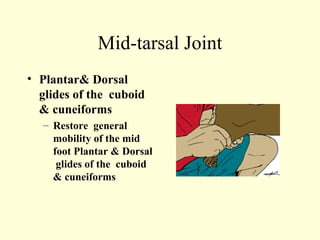
Mid-tarsal Joint
• Plantar& Dorsal
  glides of the cuboid
  & cuneiforms
  – Restore general
    mobility of the mid
    foot Plantar & Dorsal
     glides of the cuboid
    & cuneiforms
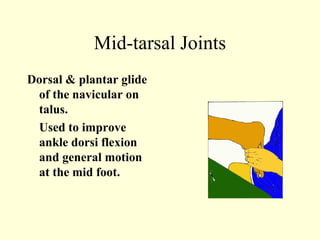
Mid-tarsal Joints
Dorsal & plantar glide
 of the navicular on
 talus.
 Used to improve
 ankle dorsi flexion
 and general motion
 at the mid foot.
Metatarsophalangel Joints
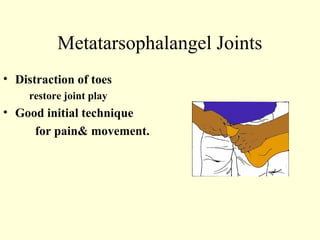
• Distraction of toes
     restore joint play
• Good initial technique
     for pain& movement.
Metatarsophalangel Joints
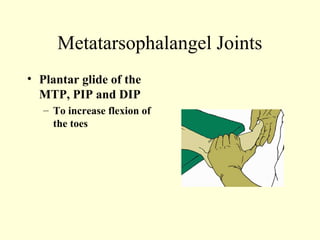
• Plantar glide of the
  MTP, PIP and DIP
   – To increase flexion of
     the toes
Metatarsophalangel Joints
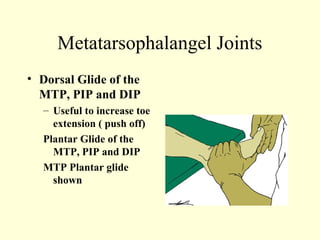
• Dorsal Glide of the
  MTP, PIP and DIP
  – Useful to increase toe
    extension ( push off)
  Plantar Glide of the
    MTP, PIP and DIP
  MTP Plantar glide
    shown

Ankle Mobility Presentation

  • 1.
    Ankle/Foot Mobilization Techniques Case Study Using ankle/foot joint mobilization techniques in rehabilitation of a talar fracture
  • 2.
    Fracture of theTalar Body • Patient is 28 year old male • Mechanism of Injury – Motor Vehicle -High Impact Injury • Patient is six weeks post op. • Cast remove one day ago.
  • 3.
    Orthopedic Procedure • InternalFixation with lag screws across the talar body facture to produce anatomic reduction • Fracture of the talar body must be stably fixed to restore subtalar joint congruity
  • 4.
    Rehabilitation Objectives • Rangeof Motion • Muscle Strength – Restore ROM to the • Tibialis posterior ankle • Pernoneus longus & brevis Restore ROM to the • Tibialis anterior subtalar joint • Extensor hallucis longus • Restore ROM to the • Gastrocnemius metatarsophalangel • Soleus joints • Flexor digitorum
  • 5.
    Important Consideration Intraarticular fractureof the talar body involving the subtalar joint may have residual loss of range motion.
  • 6.
    Mobilization Techniques Talocrural Subtalar Joint Anterior glide of • Inversion of Calcaneus Talus • Eversion of Calcaneus Posterior glide of • Calcaneus Distraction
  • 7.
    Ankle Joint • AnkleDistraction good start to restore general motion at the ankle.
  • 8.
    Ankle Anterior glide oftalus restore the component motion for ankle plantar flexion & STJ supination
  • 9.
    Ankle Joint • Posteriorglide of talus • To restore component motion for ankle dorsi flexion & STJ • pronation. • Position similar to distraction except you do posterior glide of talus. See lab disc
  • 10.
    Subtalar Joint • Calcanealdistraction – General technique to restore all motion in the STJ .
  • 11.
    Sub Talar Joint Calcanealinversion subtalar joint inversion useful to help in restoring push of the foot
  • 12.
    Subtalar Joint Calcaneal eversion subtalar joint eversion useful to help in storing pronation at the foot.
  • 13.
    Mobilization Techniques • Mid-tarsal joints – Plantar& Dorsal glides of • Metatarsophalangel the cuboid & cuneiforms – Distraction Dorsal & plantar glide of – Plantar glide-flexion the navicular on talus – Dorsal glide-extension
  • 14.
    Mid-tarsal Joint • Plantar&Dorsal glides of the cuboid & cuneiforms – Restore general mobility of the mid foot Plantar & Dorsal glides of the cuboid & cuneiforms
  • 15.
    Mid-tarsal Joints Dorsal &plantar glide of the navicular on talus. Used to improve ankle dorsi flexion and general motion at the mid foot.
  • 16.
    Metatarsophalangel Joints • Distractionof toes restore joint play • Good initial technique for pain& movement.
  • 17.
    Metatarsophalangel Joints • Plantarglide of the MTP, PIP and DIP – To increase flexion of the toes
  • 18.
    Metatarsophalangel Joints • DorsalGlide of the MTP, PIP and DIP – Useful to increase toe extension ( push off) Plantar Glide of the MTP, PIP and DIP MTP Plantar glide shown