Slack, Chambers and Johnston, Operations Management, 6th Edition,
© Nigel Slack, Stuart Chambers, and Robert Johnston 201010.1
10.1
Chapter 10
The nature of planning and
control
Pearson Education Ltd. Jules Selmes
Slack, Chambers and Johnston, Operations Management, 6th Edition,
© Nigel Slack, Stuart Chambers, and Robert Johnston 201010.2
10.2
• Planning is a formalization of what is intended to
happen at some time in the future.
• A plan does not guarantee that an event will actually
happen, it is a statement of intention.
• Although plans are based on expectations, during their
implementation things do not always happen as
expected.
• Control is the process of coping with any changes that
affect the plan. It may also mean that an ‘intervention’ will
need to be made in the operation to bring it back ‘on track’.
Planning and control
Slack, Chambers and Johnston, Operations Management, 6th Edition,
© Nigel Slack, Stuart Chambers, and Robert Johnston 201010.3
10.3
Planning is deciding
Control is
what activities should take place in the
operation
when they should take place
what resources should be allocated to them
understanding what is actually happening in
the operation
deciding whether there is a significant deviation
from what should be happening
(if there is deviation) changing resources in order
to affect the operation’s activities.
Planning and control (Continued)
Slack, Chambers and Johnston, Operations Management, 6th Edition,
© Nigel Slack, Stuart Chambers, and Robert Johnston 201010.4
10.4
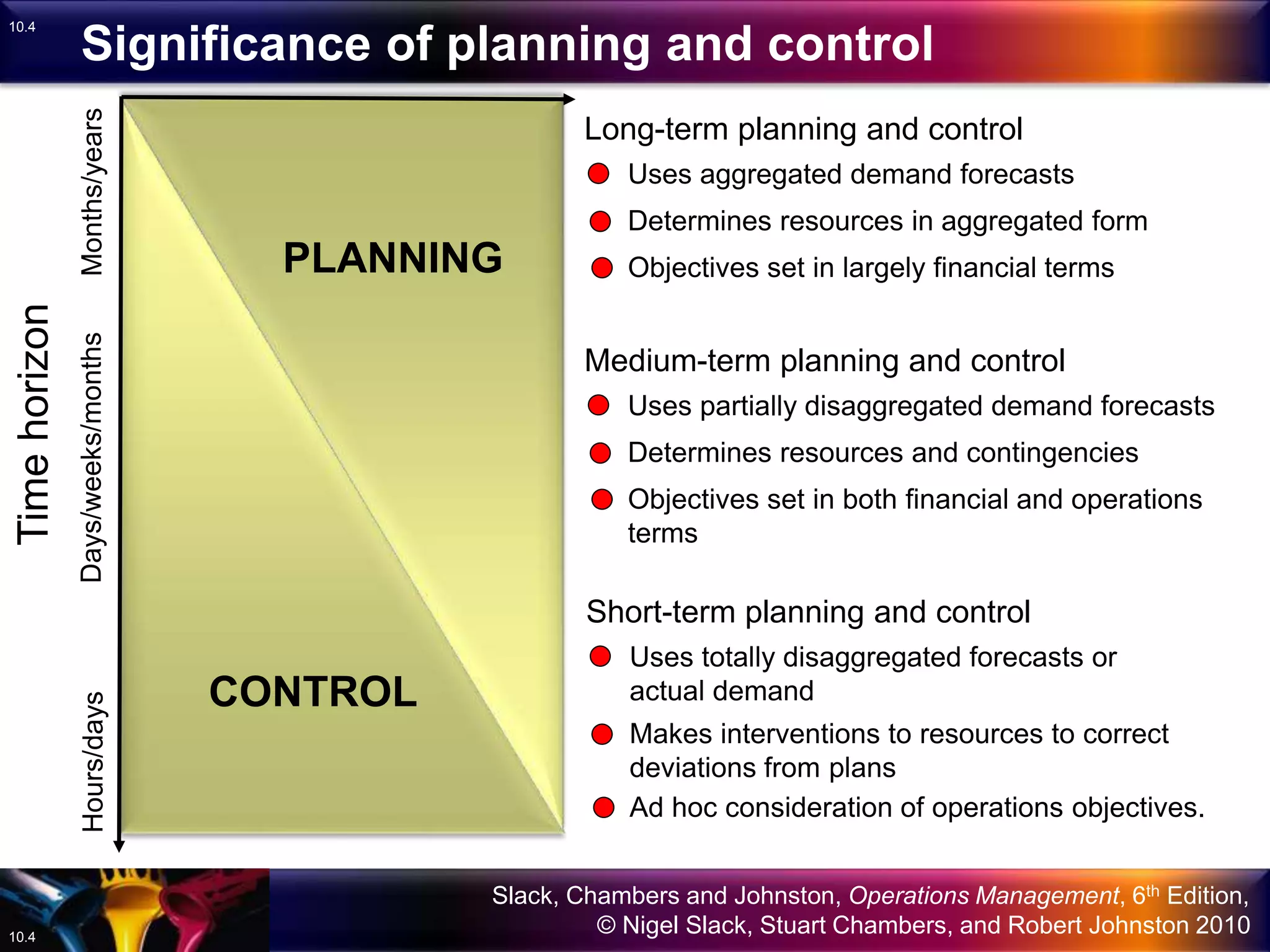
PLANNING
CONTROL
Significance of planning and controlTimehorizon
Hours/daysDays/weeks/monthsMonths/years
Long-term planning and control
Uses aggregated demand forecasts
Determines resources in aggregated form
Objectives set in largely financial terms
Medium-term planning and control
Uses partially disaggregated demand forecasts
Determines resources and contingencies
Objectives set in both financial and operations
terms
Short-term planning and control
Uses totally disaggregated forecasts or
actual demand
Makes interventions to resources to correct
deviations from plans
Ad hoc consideration of operations objectives.
Slack, Chambers and Johnston, Operations Management, 6th Edition,
© Nigel Slack, Stuart Chambers, and Robert Johnston 201010.5
10.5
Volume-Variety Effect on Planning and Control
• An architect’s practice-- high variety and low volume.
[Planning occurs on a relatively short-term basis. Control
decisions will be relatively in detailed level.]
• The electricity utility--- low variety and high volume.
[Major decisions regarding the capacity of power stations
are made many years in advance. Control decisions will
concern aggregated measures of output like the total
kilowatts of electricity generated.]
Slack, Chambers and Johnston, Operations Management, 6th Edition,
© Nigel Slack, Stuart Chambers, and Robert Johnston 201010.6
10.6
Dependent & Independent demand
• Dependent demand is relatively predictable
because it is dependent upon some factors.
• Some operations will supply demand
without having any firm forward visibility
of customer orders. Decision must be made
based on demand forecasts and in the light
of the risks they are prepared to run of being
out of stock. It’s the nature of Independent
Demand.
Slack, Chambers and Johnston, Operations Management, 6th Edition,
© Nigel Slack, Stuart Chambers, and Robert Johnston 201010.7
10.7
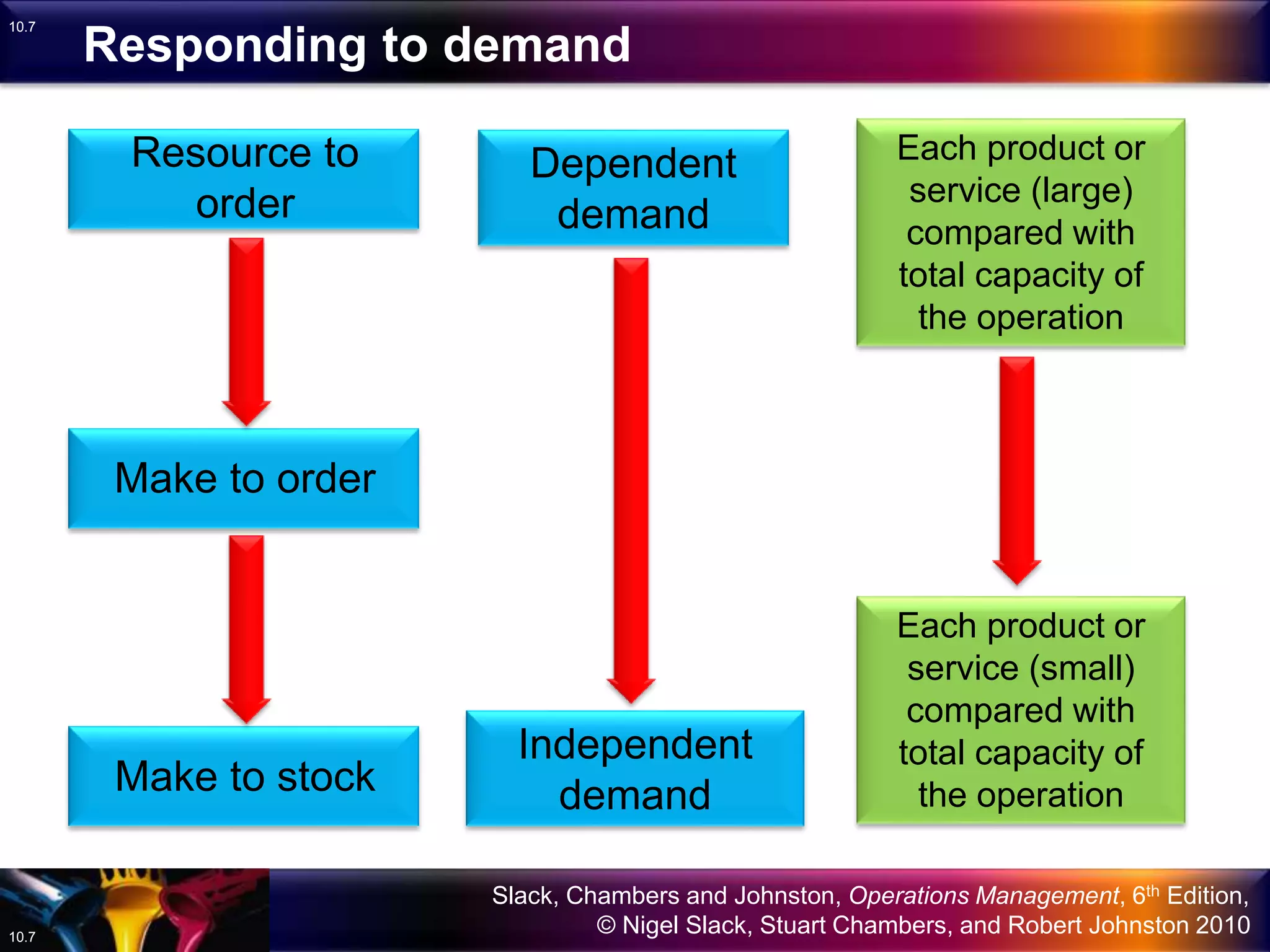
Responding to demand
Resource to
order
Make to stock
Make to order
Dependent
demand
Independent
demand
Each product or
service (large)
compared with
total capacity of
the operation
Each product or
service (small)
compared with
total capacity of
the operation
Slack, Chambers and Johnston, Operations Management, 6th Edition,
© Nigel Slack, Stuart Chambers, and Robert Johnston 201010.8
10.8
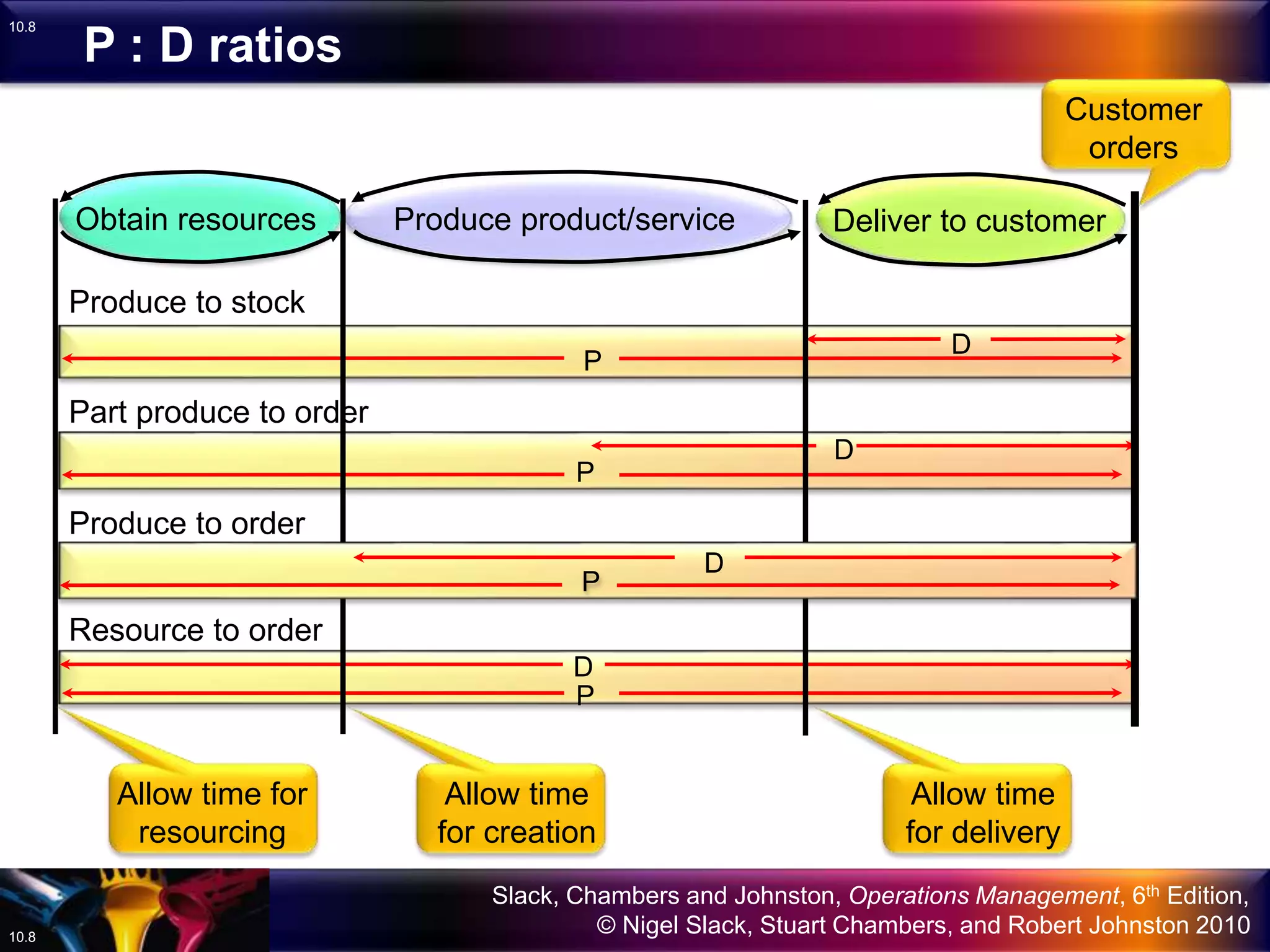
P : D ratios
D
P
Produce to stock
D
P
Part produce to order
D
P
Resource to order
Customer
orders
Deliver to customer
Allow time
for delivery
Produce product/service
Allow time
for creation
Obtain resources
Allow time for
resourcing
D
P
Produce to order
Slack, Chambers and Johnston, Operations Management, 6th Edition,
© Nigel Slack, Stuart Chambers, and Robert Johnston 201010.9
10.9
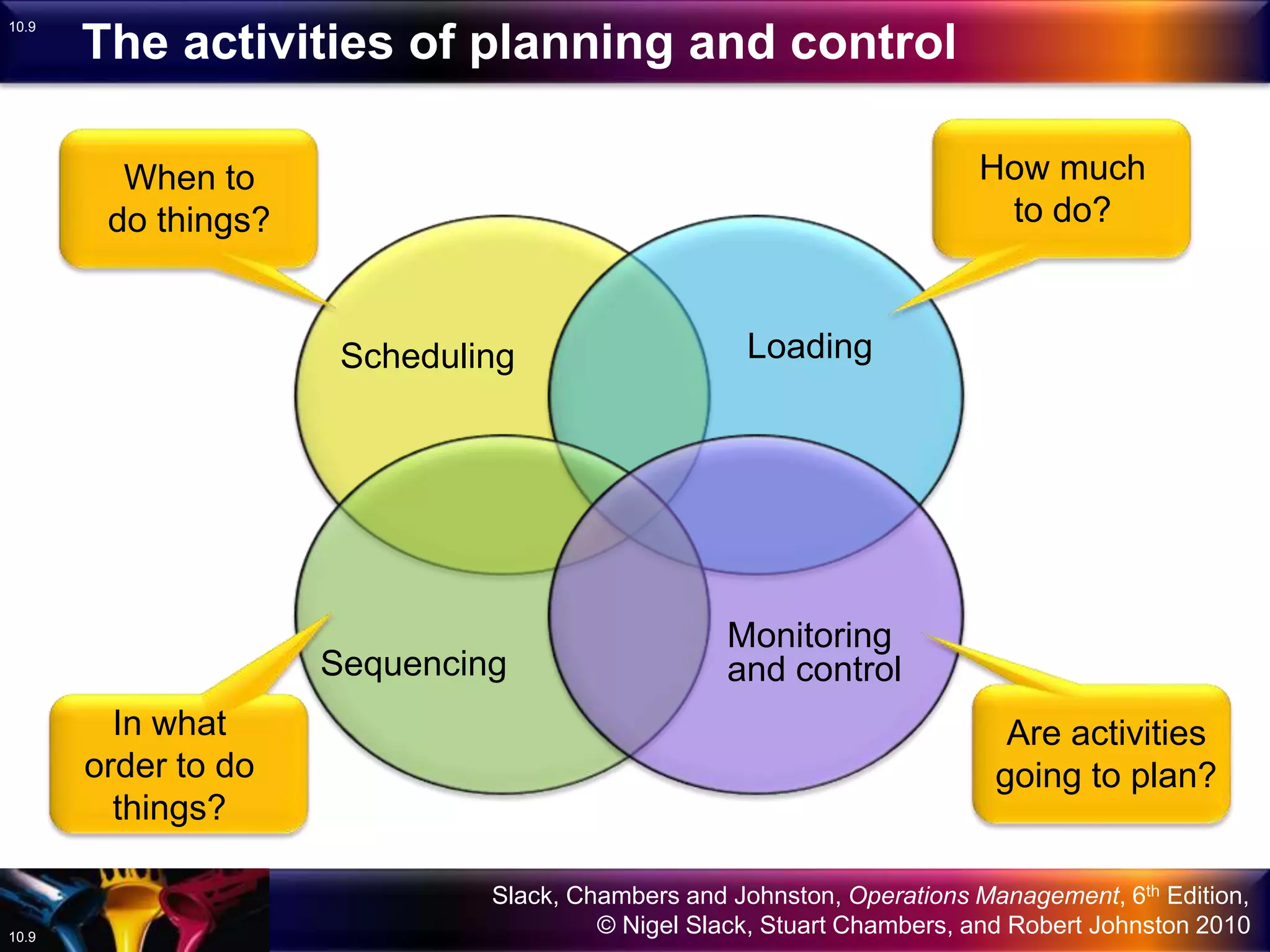
Scheduling Loading
Sequencing
Monitoring
and control
When to
do things?
In what
order to do
things?
How much
to do?
Are activities
going to plan?
The activities of planning and control
Slack, Chambers and Johnston, Operations Management, 6th Edition,
© Nigel Slack, Stuart Chambers, and Robert Johnston 201010.10
10.10
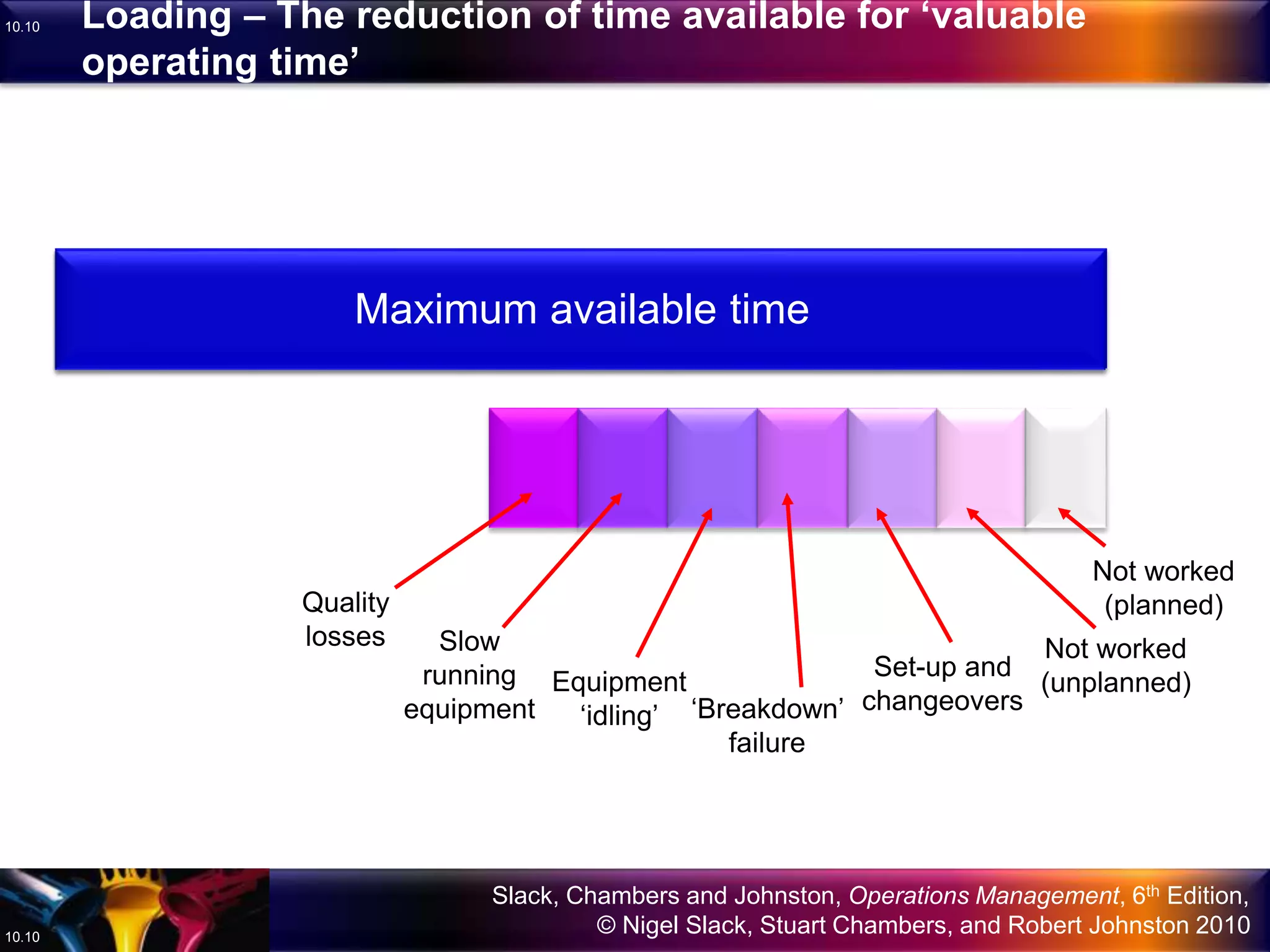
Quality
losses Slow
running
equipment
Equipment
‘idling’ ‘Breakdown’
failure
Set-up and
changeovers
Not worked
(unplanned)
Valuable operating
time
Maximum available time
Loading – The reduction of time available for ‘valuable
operating time’
Not worked
(planned)
Slack, Chambers and Johnston, Operations Management, 6th Edition,
© Nigel Slack, Stuart Chambers, and Robert Johnston 201010.11
10.11
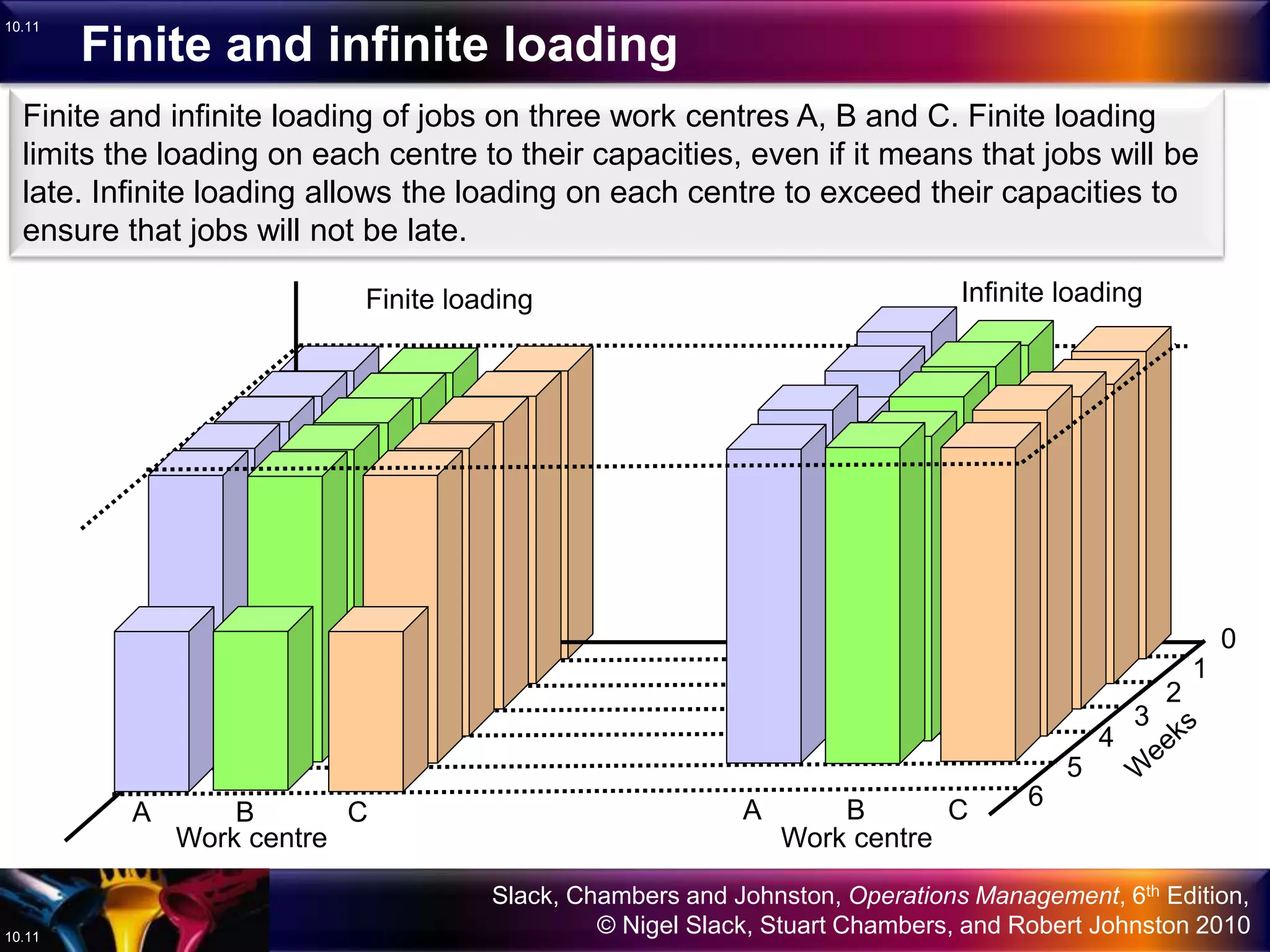
Finite and infinite loading of jobs on three work centres A, B and C. Finite loading
limits the loading on each centre to their capacities, even if it means that jobs will be
late. Infinite loading allows the loading on each centre to exceed their capacities to
ensure that jobs will not be late.
1
2
3
4
5
6
0
Work centre Work centre
A B C A B C
Finite loading Infinite loading
Finite and infinite loading
Slack, Chambers and Johnston, Operations Management, 6th Edition,
© Nigel Slack, Stuart Chambers, and Robert Johnston 201010.12
10.12
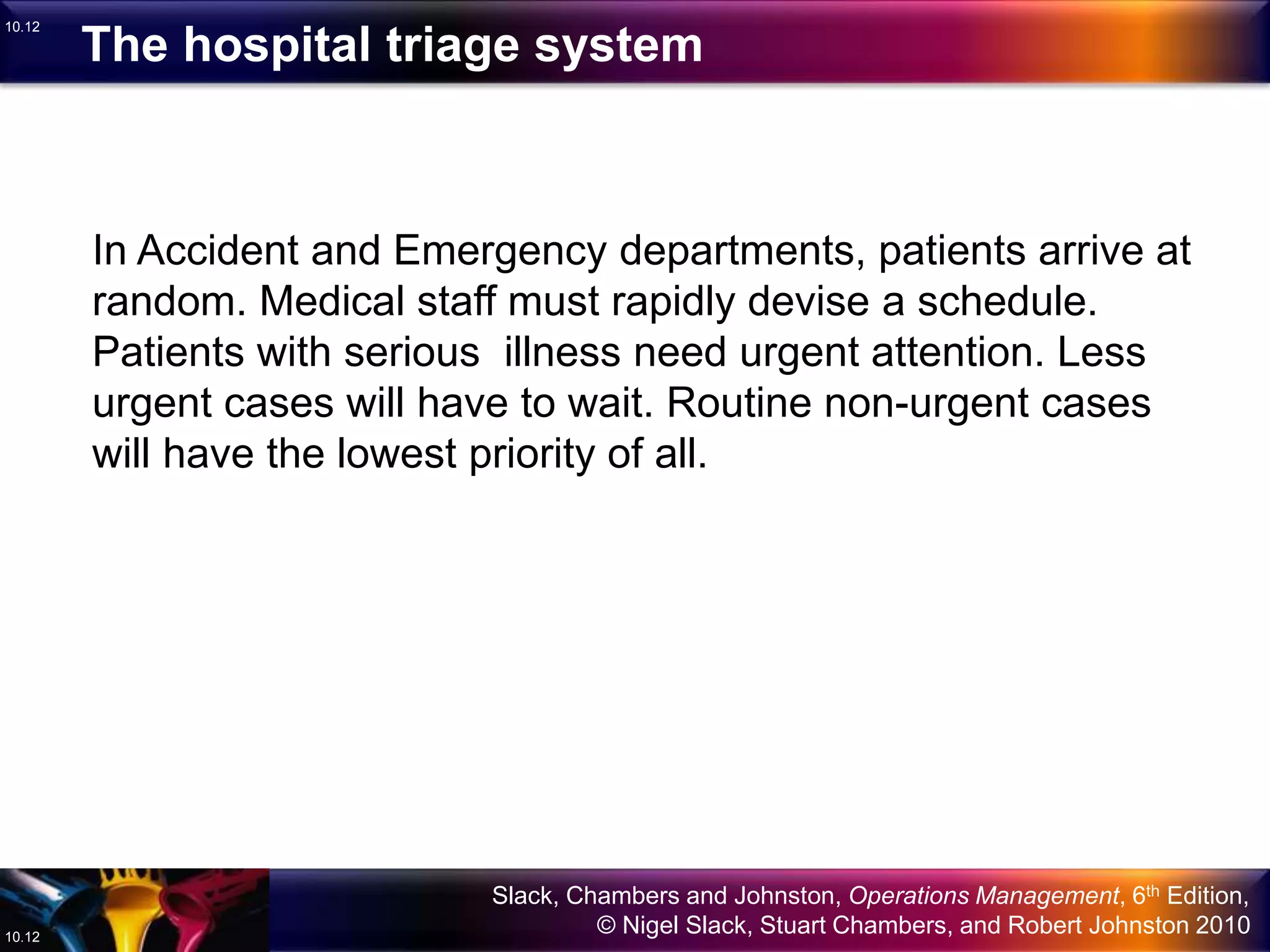
In Accident and Emergency departments, patients arrive at
random. Medical staff must rapidly devise a schedule.
Patients with serious illness need urgent attention. Less
urgent cases will have to wait. Routine non-urgent cases
will have the lowest priority of all.
The hospital triage system
Slack, Chambers and Johnston, Operations Management, 6th Edition,
© Nigel Slack, Stuart Chambers, and Robert Johnston 201010.13
10.13
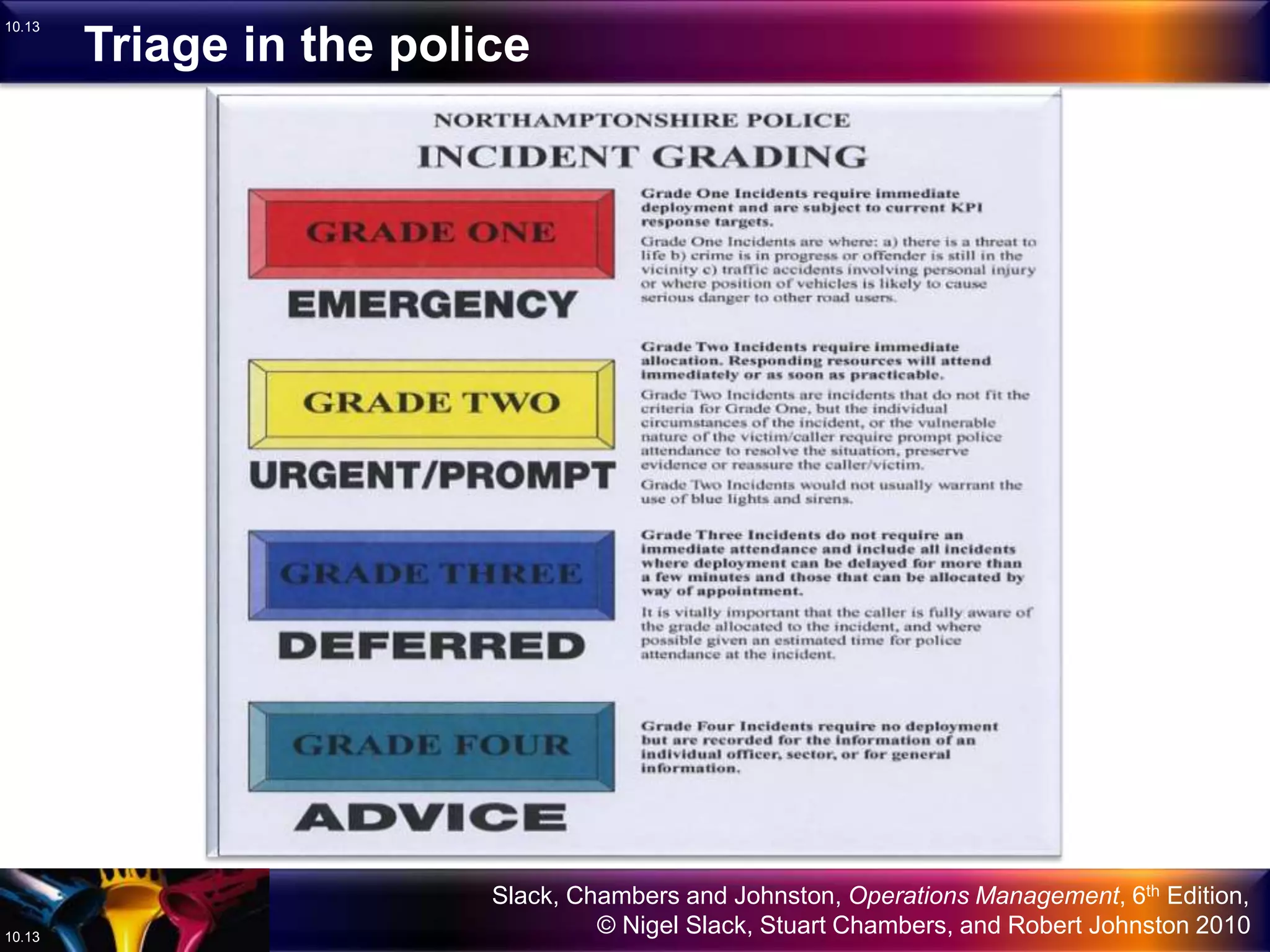
Triage in the police
Slack, Chambers and Johnston, Operations Management, 6th Edition,
© Nigel Slack, Stuart Chambers, and Robert Johnston 201010.14
10.14
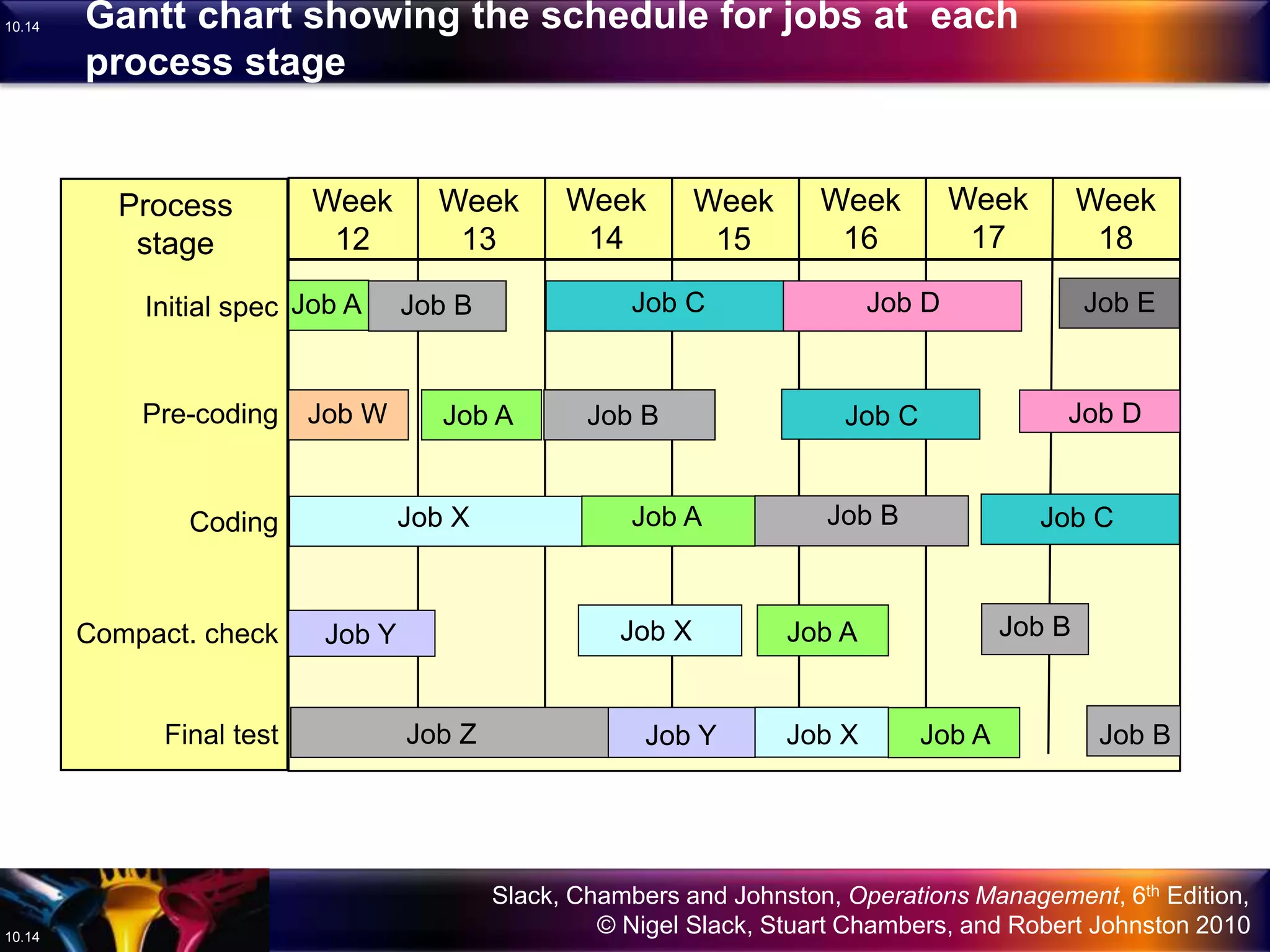
Process
stage
Week
12
Week
13
Week
14
Week
15
Week
16
Week
17
Week
18
Job A Job B Job C Job D Job E
Job A Job BJob Y Job X
Job A Job BJob Z Job XJob Y
Job A Job BJob X Job C
Gantt chart showing the schedule for jobs at each
process stage
Initial spec
Pre-coding
Coding
Compact. check
Final test
Job A Job BJob W Job C Job D
Slack, Chambers and Johnston, Operations Management, 6th Edition,
© Nigel Slack, Stuart Chambers, and Robert Johnston 201010.15
10.15
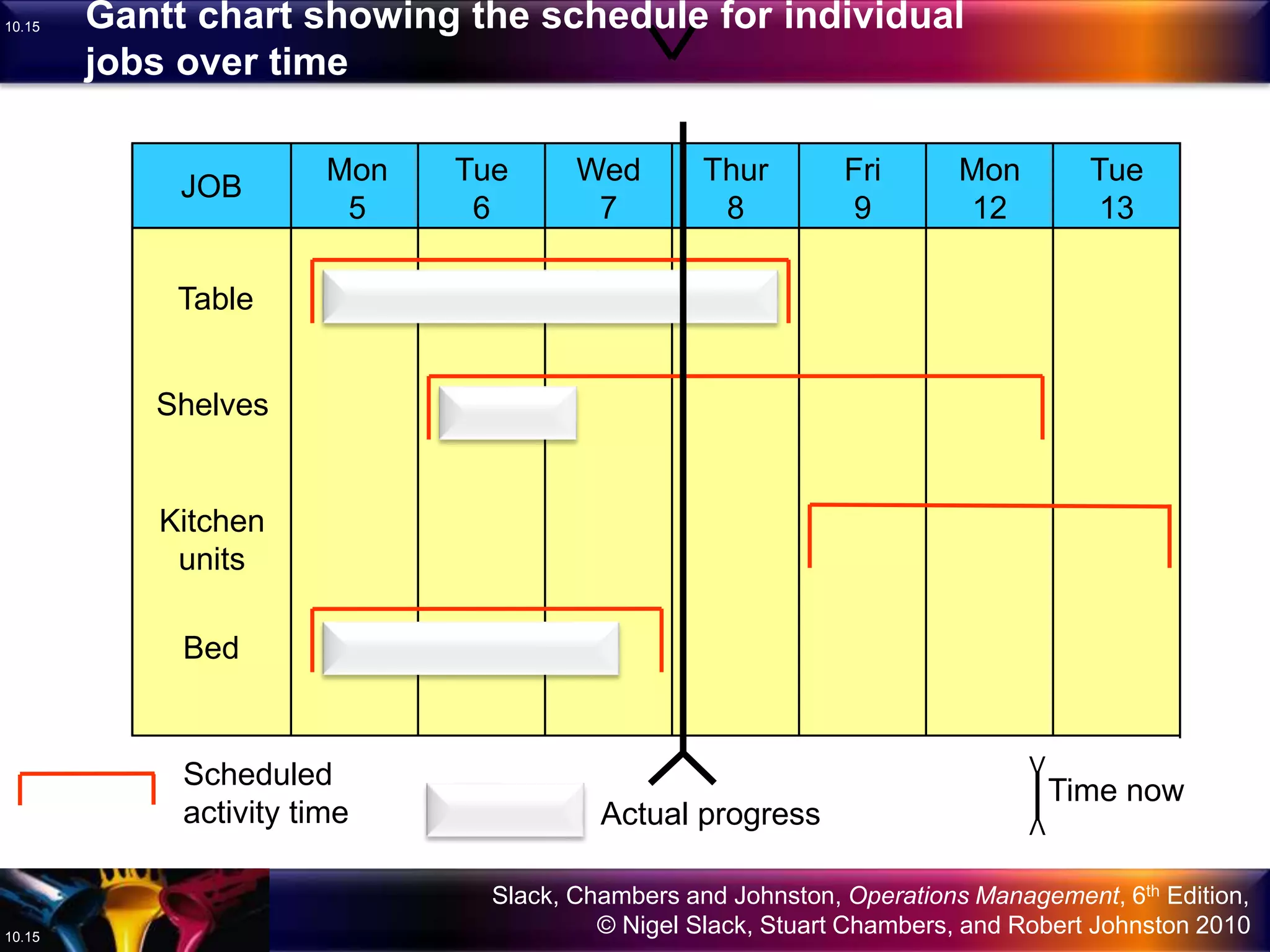
JOB
Mon
5
Tue
6
Wed
7
Thur
8
Fri
9
Mon
12
Tue
13
Table
Shelves
Kitchen
units
Bed
Actual progress
Time now
V
V
Gantt chart showing the schedule for individual
jobs over time
Scheduled
activity time
Slack, Chambers and Johnston, Operations Management, 6th Edition,
© Nigel Slack, Stuart Chambers, and Robert Johnston 201010.16
10.16
JOB
Mon
5
Tue
6
Wed
7
Thur
8
Fri
9
Mon
12
Tue
13
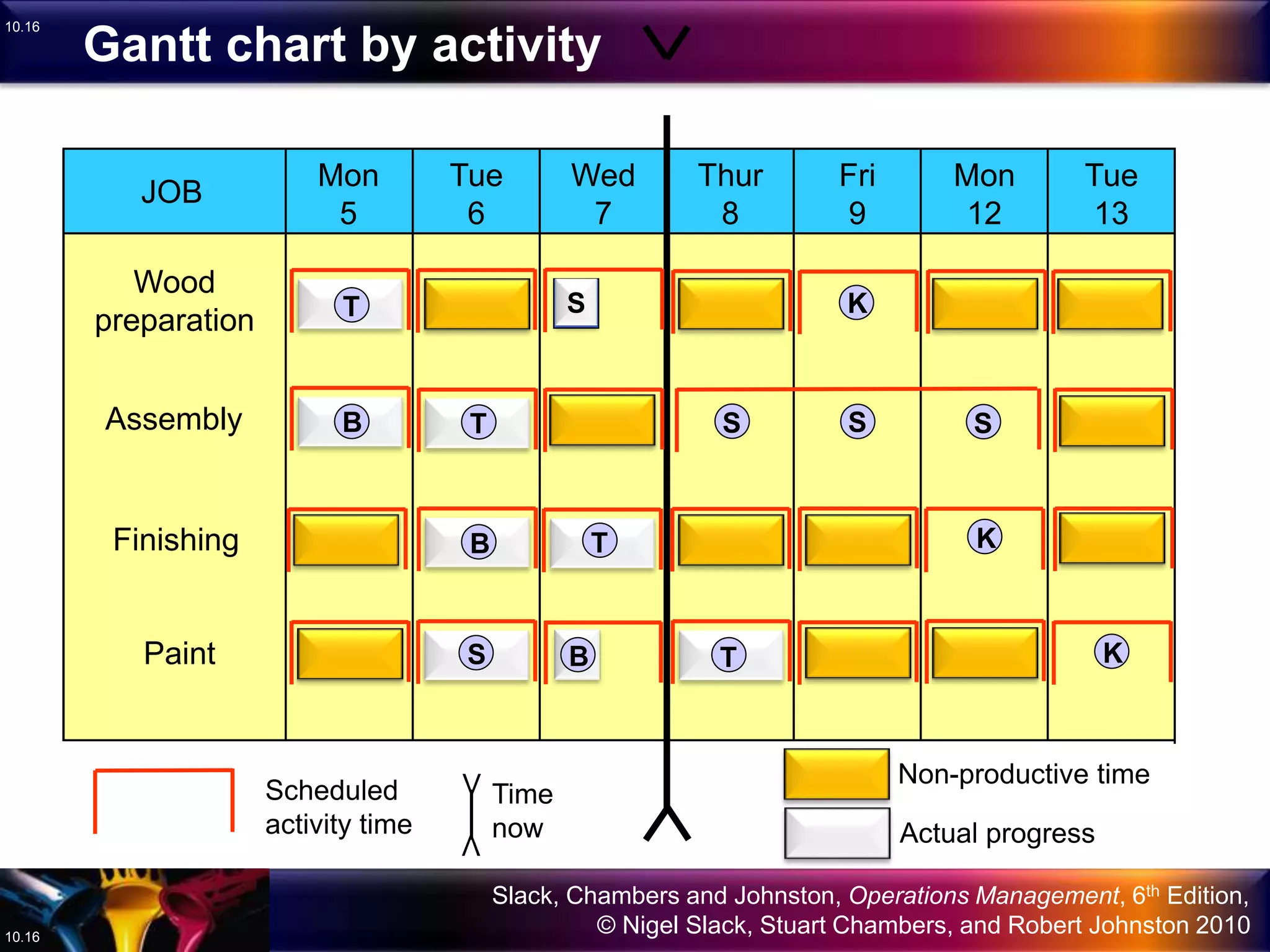
Wood
preparation
Assembly
Finishing
Paint
Scheduled
activity time Actual progress
T
B
B T
S K
S S S
K
KTS
B T
Non-productive timeV
V
Time
now
Gantt chart by activity
Slack, Chambers and Johnston, Operations Management, 6th Edition,
© Nigel Slack, Stuart Chambers, and Robert Johnston 201010.17
10.17
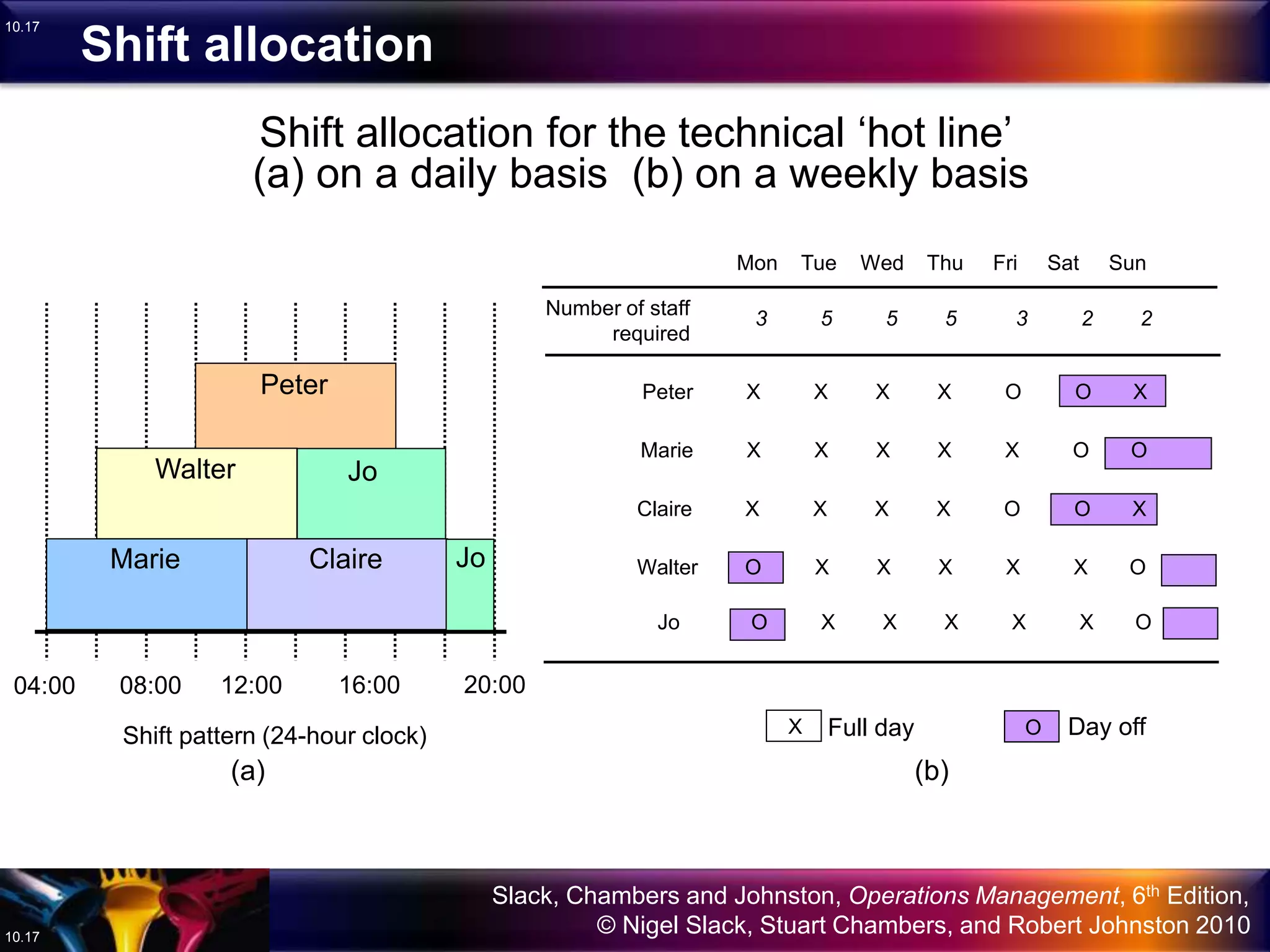
Shift allocation for the technical ‘hot line’
(a) on a daily basis (b) on a weekly basis
(a)
Shift pattern (24-hour clock)
Peter
Jo
Walter Jo
Marie Claire Jo
04:00 08:00 12:00 16:00 20:00
Peter X X X X O O X
Marie X X X X X O O
Claire X X X X O O X
Walter O X X X X X O
Jo O X X X X X O
Mon Tue Wed Thu Fri Sat Sun
Number of staff
required
3 5 5 5 3 2 2
(b)
X OFull day Day off
Shift allocation
Slack, Chambers and Johnston, Operations Management, 6th Edition,
© Nigel Slack, Stuart Chambers, and Robert Johnston 201010.18
10.18
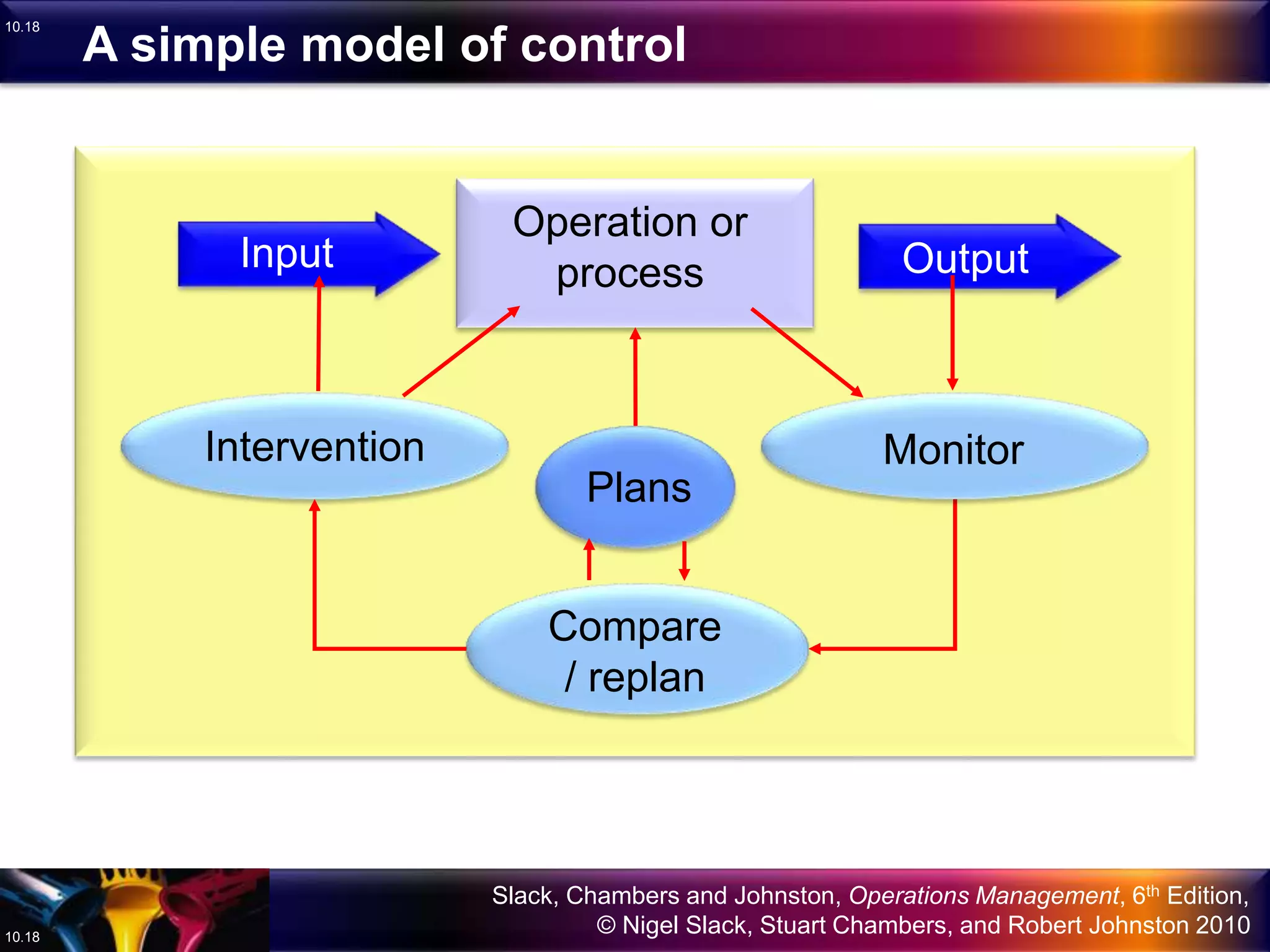
Operation or
processInput Output
Compare
/ replan
Intervention
Plans
A simple model of control
Monitor
Slack, Chambers and Johnston, Operations Management, 6th Edition,
© Nigel Slack, Stuart Chambers, and Robert Johnston 201010.19
10.19
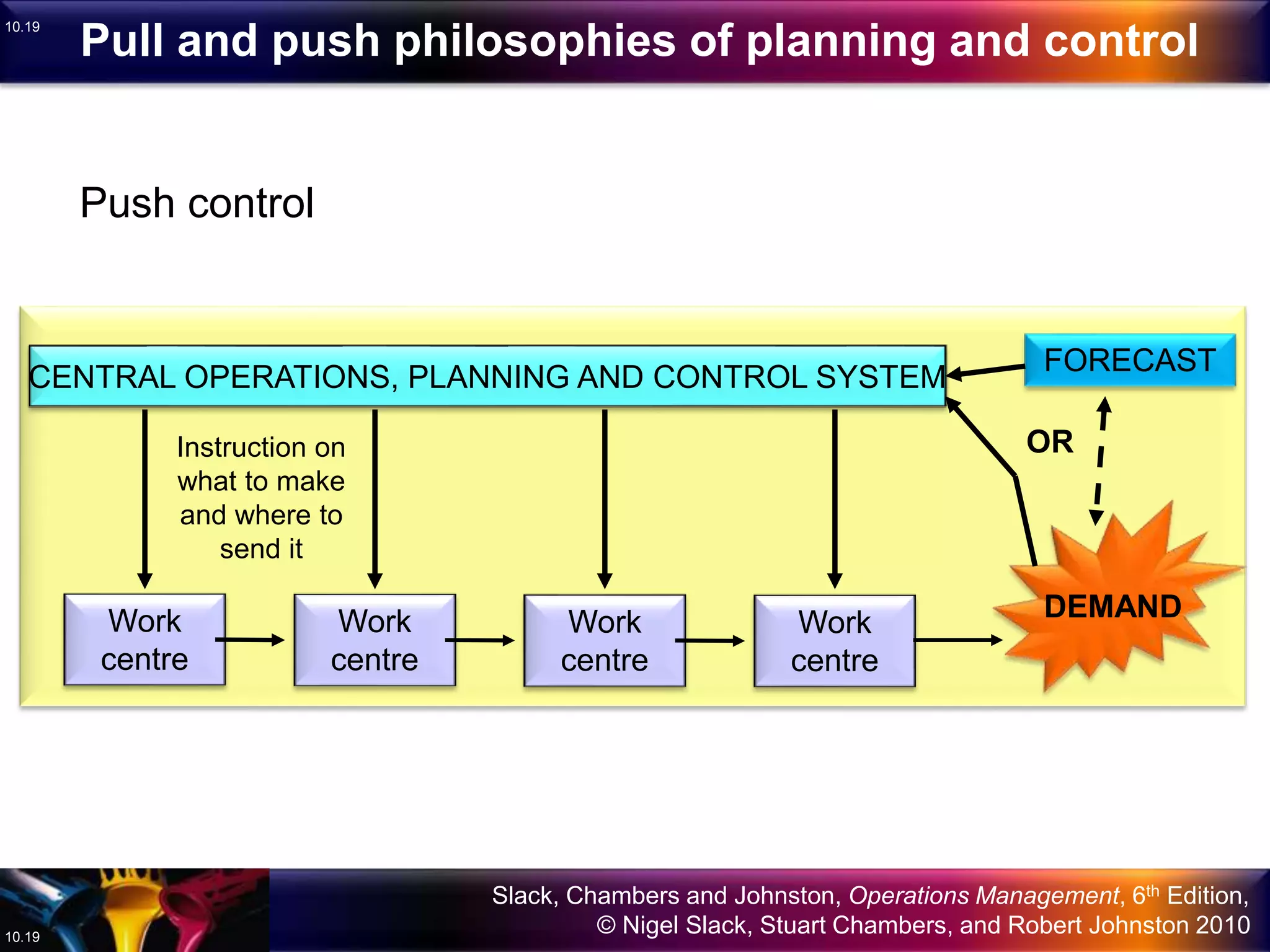
Pull and push philosophies of planning and control
Push control
Work
centre
Work
centre
Work
centre
Work
centre
Instruction on
what to make
and where to
send it
DEMAND
FORECAST
OR
CENTRAL OPERATIONS, PLANNING AND CONTROL SYSTEM
Slack, Chambers and Johnston, Operations Management, 6th Edition,
© Nigel Slack, Stuart Chambers, and Robert Johnston 201010.20
10.20
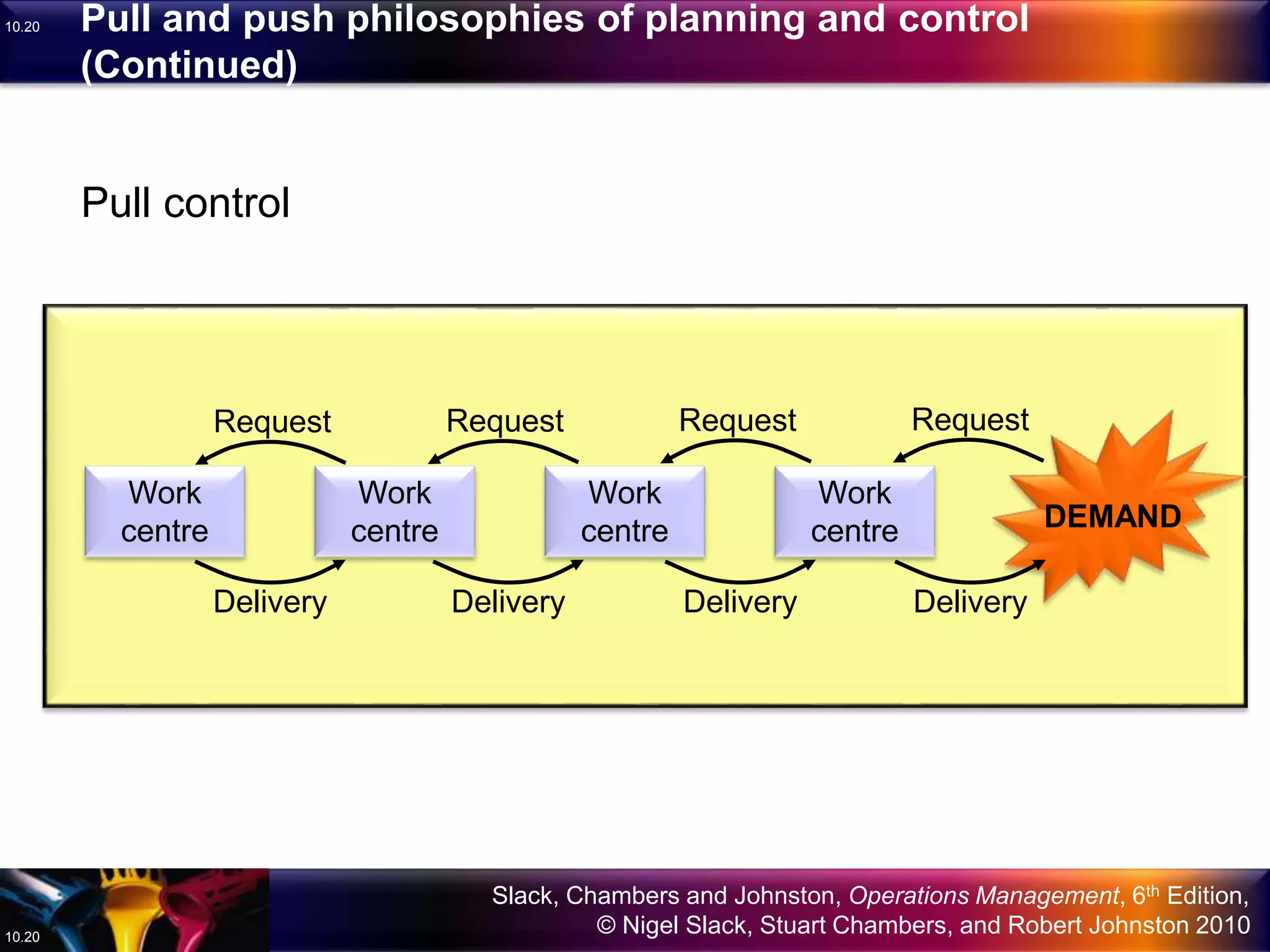
Pull control
Work
centre DEMAND
Pull and push philosophies of planning and control
(Continued)
Work
centre
Work
centre
Work
centre
Request Request Request Request
Delivery Delivery Delivery Delivery

10 the nature of planning and control_Operations Management

  • 1.
    Slack, Chambers andJohnston, Operations Management, 6th Edition, © Nigel Slack, Stuart Chambers, and Robert Johnston 201010.1 10.1 Chapter 10 The nature of planning and control Pearson Education Ltd. Jules Selmes
  • 2.
    Slack, Chambers andJohnston, Operations Management, 6th Edition, © Nigel Slack, Stuart Chambers, and Robert Johnston 201010.2 10.2 • Planning is a formalization of what is intended to happen at some time in the future. • A plan does not guarantee that an event will actually happen, it is a statement of intention. • Although plans are based on expectations, during their implementation things do not always happen as expected. • Control is the process of coping with any changes that affect the plan. It may also mean that an ‘intervention’ will need to be made in the operation to bring it back ‘on track’. Planning and control
  • 3.
    Slack, Chambers andJohnston, Operations Management, 6th Edition, © Nigel Slack, Stuart Chambers, and Robert Johnston 201010.3 10.3 Planning is deciding Control is what activities should take place in the operation when they should take place what resources should be allocated to them understanding what is actually happening in the operation deciding whether there is a significant deviation from what should be happening (if there is deviation) changing resources in order to affect the operation’s activities. Planning and control (Continued)
  • 4.
    Slack, Chambers andJohnston, Operations Management, 6th Edition, © Nigel Slack, Stuart Chambers, and Robert Johnston 201010.4 10.4 PLANNING CONTROL Significance of planning and controlTimehorizon Hours/daysDays/weeks/monthsMonths/years Long-term planning and control Uses aggregated demand forecasts Determines resources in aggregated form Objectives set in largely financial terms Medium-term planning and control Uses partially disaggregated demand forecasts Determines resources and contingencies Objectives set in both financial and operations terms Short-term planning and control Uses totally disaggregated forecasts or actual demand Makes interventions to resources to correct deviations from plans Ad hoc consideration of operations objectives.
  • 5.
    Slack, Chambers andJohnston, Operations Management, 6th Edition, © Nigel Slack, Stuart Chambers, and Robert Johnston 201010.5 10.5 Volume-Variety Effect on Planning and Control • An architect’s practice-- high variety and low volume. [Planning occurs on a relatively short-term basis. Control decisions will be relatively in detailed level.] • The electricity utility--- low variety and high volume. [Major decisions regarding the capacity of power stations are made many years in advance. Control decisions will concern aggregated measures of output like the total kilowatts of electricity generated.]
  • 6.
    Slack, Chambers andJohnston, Operations Management, 6th Edition, © Nigel Slack, Stuart Chambers, and Robert Johnston 201010.6 10.6 Dependent & Independent demand • Dependent demand is relatively predictable because it is dependent upon some factors. • Some operations will supply demand without having any firm forward visibility of customer orders. Decision must be made based on demand forecasts and in the light of the risks they are prepared to run of being out of stock. It’s the nature of Independent Demand.
  • 7.
    Slack, Chambers andJohnston, Operations Management, 6th Edition, © Nigel Slack, Stuart Chambers, and Robert Johnston 201010.7 10.7 Responding to demand Resource to order Make to stock Make to order Dependent demand Independent demand Each product or service (large) compared with total capacity of the operation Each product or service (small) compared with total capacity of the operation
  • 8.
    Slack, Chambers andJohnston, Operations Management, 6th Edition, © Nigel Slack, Stuart Chambers, and Robert Johnston 201010.8 10.8 P : D ratios D P Produce to stock D P Part produce to order D P Resource to order Customer orders Deliver to customer Allow time for delivery Produce product/service Allow time for creation Obtain resources Allow time for resourcing D P Produce to order
  • 9.
    Slack, Chambers andJohnston, Operations Management, 6th Edition, © Nigel Slack, Stuart Chambers, and Robert Johnston 201010.9 10.9 Scheduling Loading Sequencing Monitoring and control When to do things? In what order to do things? How much to do? Are activities going to plan? The activities of planning and control
  • 10.
    Slack, Chambers andJohnston, Operations Management, 6th Edition, © Nigel Slack, Stuart Chambers, and Robert Johnston 201010.10 10.10 Quality losses Slow running equipment Equipment ‘idling’ ‘Breakdown’ failure Set-up and changeovers Not worked (unplanned) Valuable operating time Maximum available time Loading – The reduction of time available for ‘valuable operating time’ Not worked (planned)
  • 11.
    Slack, Chambers andJohnston, Operations Management, 6th Edition, © Nigel Slack, Stuart Chambers, and Robert Johnston 201010.11 10.11 Finite and infinite loading of jobs on three work centres A, B and C. Finite loading limits the loading on each centre to their capacities, even if it means that jobs will be late. Infinite loading allows the loading on each centre to exceed their capacities to ensure that jobs will not be late. 1 2 3 4 5 6 0 Work centre Work centre A B C A B C Finite loading Infinite loading Finite and infinite loading
  • 12.
    Slack, Chambers andJohnston, Operations Management, 6th Edition, © Nigel Slack, Stuart Chambers, and Robert Johnston 201010.12 10.12 In Accident and Emergency departments, patients arrive at random. Medical staff must rapidly devise a schedule. Patients with serious illness need urgent attention. Less urgent cases will have to wait. Routine non-urgent cases will have the lowest priority of all. The hospital triage system
  • 13.
    Slack, Chambers andJohnston, Operations Management, 6th Edition, © Nigel Slack, Stuart Chambers, and Robert Johnston 201010.13 10.13 Triage in the police
  • 14.
    Slack, Chambers andJohnston, Operations Management, 6th Edition, © Nigel Slack, Stuart Chambers, and Robert Johnston 201010.14 10.14 Process stage Week 12 Week 13 Week 14 Week 15 Week 16 Week 17 Week 18 Job A Job B Job C Job D Job E Job A Job BJob Y Job X Job A Job BJob Z Job XJob Y Job A Job BJob X Job C Gantt chart showing the schedule for jobs at each process stage Initial spec Pre-coding Coding Compact. check Final test Job A Job BJob W Job C Job D
  • 15.
    Slack, Chambers andJohnston, Operations Management, 6th Edition, © Nigel Slack, Stuart Chambers, and Robert Johnston 201010.15 10.15 JOB Mon 5 Tue 6 Wed 7 Thur 8 Fri 9 Mon 12 Tue 13 Table Shelves Kitchen units Bed Actual progress Time now V V Gantt chart showing the schedule for individual jobs over time Scheduled activity time
  • 16.
    Slack, Chambers andJohnston, Operations Management, 6th Edition, © Nigel Slack, Stuart Chambers, and Robert Johnston 201010.16 10.16 JOB Mon 5 Tue 6 Wed 7 Thur 8 Fri 9 Mon 12 Tue 13 Wood preparation Assembly Finishing Paint Scheduled activity time Actual progress T B B T S K S S S K KTS B T Non-productive timeV V Time now Gantt chart by activity
  • 17.
    Slack, Chambers andJohnston, Operations Management, 6th Edition, © Nigel Slack, Stuart Chambers, and Robert Johnston 201010.17 10.17 Shift allocation for the technical ‘hot line’ (a) on a daily basis (b) on a weekly basis (a) Shift pattern (24-hour clock) Peter Jo Walter Jo Marie Claire Jo 04:00 08:00 12:00 16:00 20:00 Peter X X X X O O X Marie X X X X X O O Claire X X X X O O X Walter O X X X X X O Jo O X X X X X O Mon Tue Wed Thu Fri Sat Sun Number of staff required 3 5 5 5 3 2 2 (b) X OFull day Day off Shift allocation
  • 18.
    Slack, Chambers andJohnston, Operations Management, 6th Edition, © Nigel Slack, Stuart Chambers, and Robert Johnston 201010.18 10.18 Operation or processInput Output Compare / replan Intervention Plans A simple model of control Monitor
  • 19.
    Slack, Chambers andJohnston, Operations Management, 6th Edition, © Nigel Slack, Stuart Chambers, and Robert Johnston 201010.19 10.19 Pull and push philosophies of planning and control Push control Work centre Work centre Work centre Work centre Instruction on what to make and where to send it DEMAND FORECAST OR CENTRAL OPERATIONS, PLANNING AND CONTROL SYSTEM
  • 20.
    Slack, Chambers andJohnston, Operations Management, 6th Edition, © Nigel Slack, Stuart Chambers, and Robert Johnston 201010.20 10.20 Pull control Work centre DEMAND Pull and push philosophies of planning and control (Continued) Work centre Work centre Work centre Request Request Request Request Delivery Delivery Delivery Delivery