Energy Conservation – Spring
Simple Harmonic Motion
(SHM)
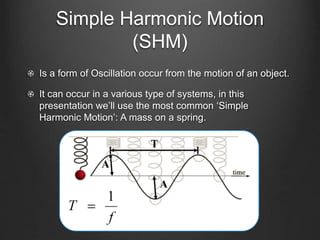
Is a form of Oscillation occur from the motion of an object.
It can occur in a various type of systems, in this
presentation we’ll use the most common ‘Simple
Harmonic Motion’: A mass on a spring.
Energy Conservation
Ideal Condition : Absent of friction
Total Energy (E) = Kinetic Energy (K) + Potential Energy
(U)
Kinetic Energy = (1/2)mv^2
Potential Energy of the spring = (1/2)kx^2
Therefore, E = (1/2)mv^2 + (1/2)kX^2
1st Case
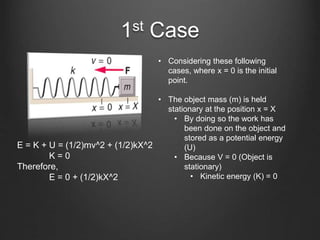
• Considering these following
cases, where x = 0 is the initial
point.
• The object mass (m) is held
stationary at the position x = X
• By doing so the work has
been done on the object and
stored as a potential energy
(U)
• Because V = 0 (Object is
stationary)
• Kinetic energy (K) = 0
E = K + U = (1/2)mv^2 + (1/2)kX^2
K = 0
Therefore,
E = 0 + (1/2)kX^2
2nd Case
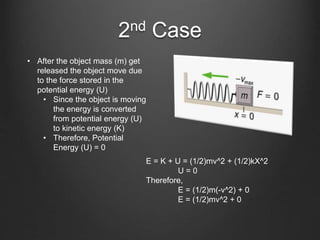
• After the object mass (m) get
released the object move due
to the force stored in the
potential energy (U)
• Since the object is moving
the energy is converted
from potential energy (U)
to kinetic energy (K)
• Therefore, Potential
Energy (U) = 0
E = K + U = (1/2)mv^2 + (1/2)kX^2
U = 0
Therefore,
E = (1/2)m(-v^2) + 0
E = (1/2)mv^2 + 0
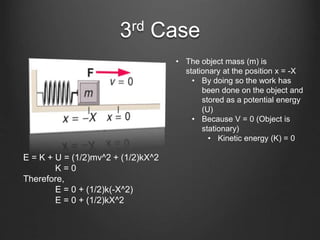
3rd Case
• The object mass (m) is
stationary at the position x = -X
• By doing so the work has
been done on the object and
stored as a potential energy
(U)
• Because V = 0 (Object is
stationary)
• Kinetic energy (K) = 0
E = K + U = (1/2)mv^2 + (1/2)kX^2
K = 0
Therefore,
E = 0 + (1/2)k(-X^2)
E = 0 + (1/2)kX^2
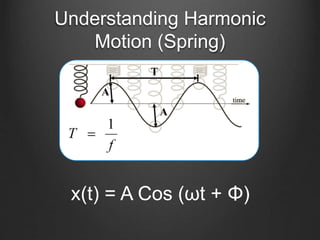
Understanding Harmonic
Motion (Spring)
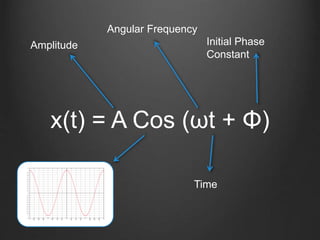
x(t) = A Cos (ωt + Φ)
Amplitude
Angular Frequency
Initial Phase
Constant
Time
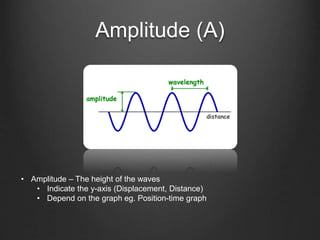
Amplitude (A)
• Amplitude – The height of the waves
• Indicate the y-axis (Displacement, Distance)
• Depend on the graph eg. Position-time graph
Angular Frequency (ω)
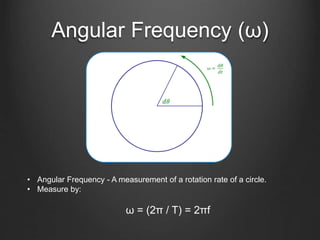
• Angular Frequency - A measurement of a rotation rate of a circle.
• Measure by:
ω = (2π / T) = 2πf
Initial Phase Constant (Φ)
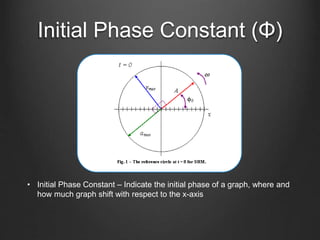
• Initial Phase Constant – Indicate the initial phase of a graph, where and
how much graph shift with respect to the x-axis
Q1 : A mass of 10 kg oscillating on a spring passes
through its equilibrium point with a velocity of 15 m/s.
What is the energy of the system at this point?
Questions
Q2 : A box mass of m kg is moving to the left at a
velocity of v m/s due to the force from the spring. The
spring is not fully stretched. Express this in a formula.
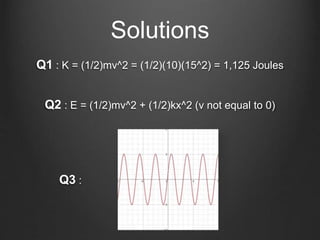
Q3 : Sketch a graph of f where Amplitude = 5, Angular
Frequency = 2 and Initial Phase constant = 5
Q1 : K = (1/2)mv^2 = (1/2)(10)(15^2) = 1,125 Joules
Solutions
Q2 : E = (1/2)mv^2 + (1/2)kx^2 (v not equal to 0)
Q3 :

Physics lo1

  • 1.
  • 2.
    Simple Harmonic Motion (SHM) Isa form of Oscillation occur from the motion of an object. It can occur in a various type of systems, in this presentation we’ll use the most common ‘Simple Harmonic Motion’: A mass on a spring.
  • 3.
    Energy Conservation Ideal Condition: Absent of friction Total Energy (E) = Kinetic Energy (K) + Potential Energy (U) Kinetic Energy = (1/2)mv^2 Potential Energy of the spring = (1/2)kx^2 Therefore, E = (1/2)mv^2 + (1/2)kX^2
  • 4.
    1st Case • Consideringthese following cases, where x = 0 is the initial point. • The object mass (m) is held stationary at the position x = X • By doing so the work has been done on the object and stored as a potential energy (U) • Because V = 0 (Object is stationary) • Kinetic energy (K) = 0 E = K + U = (1/2)mv^2 + (1/2)kX^2 K = 0 Therefore, E = 0 + (1/2)kX^2
  • 5.
    2nd Case • Afterthe object mass (m) get released the object move due to the force stored in the potential energy (U) • Since the object is moving the energy is converted from potential energy (U) to kinetic energy (K) • Therefore, Potential Energy (U) = 0 E = K + U = (1/2)mv^2 + (1/2)kX^2 U = 0 Therefore, E = (1/2)m(-v^2) + 0 E = (1/2)mv^2 + 0
  • 6.
    3rd Case • Theobject mass (m) is stationary at the position x = -X • By doing so the work has been done on the object and stored as a potential energy (U) • Because V = 0 (Object is stationary) • Kinetic energy (K) = 0 E = K + U = (1/2)mv^2 + (1/2)kX^2 K = 0 Therefore, E = 0 + (1/2)k(-X^2) E = 0 + (1/2)kX^2
  • 7.
  • 8.
    x(t) = ACos (ωt + Φ) Amplitude Angular Frequency Initial Phase Constant Time
  • 9.
    Amplitude (A) • Amplitude– The height of the waves • Indicate the y-axis (Displacement, Distance) • Depend on the graph eg. Position-time graph
  • 10.
    Angular Frequency (ω) •Angular Frequency - A measurement of a rotation rate of a circle. • Measure by: ω = (2π / T) = 2πf
  • 11.
    Initial Phase Constant(Φ) • Initial Phase Constant – Indicate the initial phase of a graph, where and how much graph shift with respect to the x-axis
  • 12.
    Q1 : Amass of 10 kg oscillating on a spring passes through its equilibrium point with a velocity of 15 m/s. What is the energy of the system at this point? Questions Q2 : A box mass of m kg is moving to the left at a velocity of v m/s due to the force from the spring. The spring is not fully stretched. Express this in a formula. Q3 : Sketch a graph of f where Amplitude = 5, Angular Frequency = 2 and Initial Phase constant = 5
  • 13.
    Q1 : K= (1/2)mv^2 = (1/2)(10)(15^2) = 1,125 Joules Solutions Q2 : E = (1/2)mv^2 + (1/2)kx^2 (v not equal to 0) Q3 :