Assigned by Dr. Khubab Shaker
Prepared by Engr. Habibullah
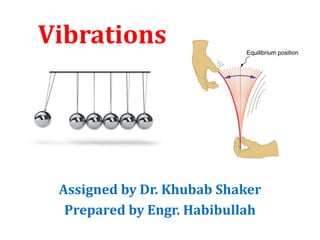
Vibrations
Motion
Change in position w.r.t Time
We have two types of periodic
Motions in all time
Types of Motion
Periodic Motion: Repetition of motion itself after particular interval
of time.
Motion of pendulum Motion of spring
Circular motion Motion of Satellite
around earth
Types of Motion
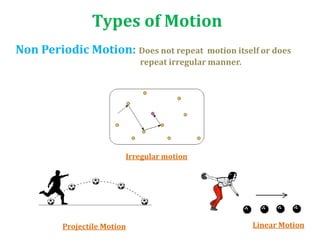
Non Periodic Motion: Does not repeat motion itself or does
repeat irregular manner.
Projectile Motion Linear Motion
Irregular motion
Types of Periodic Motion
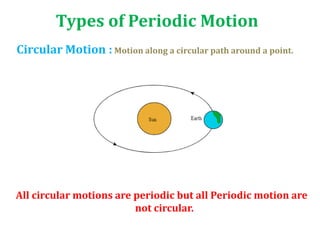
Circular Motion : Motion along a circular path around a point.
All circular motions are periodic but all Periodic motion are
not circular.
Types of Periodic Motion
Oscillatory/ Vibratory: To and fro motion about a point
Motion
Pendulum Spring mass system
Oscillatory v/s Vibratory
Motion
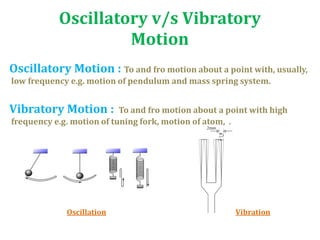
Oscillatory Motion : To and fro motion about a point with, usually,
low frequency e.g. motion of pendulum and mass spring system.
Vibratory Motion : To and fro motion about a point with high
frequency e.g. motion of tuning fork, motion of atom, .
Oscillation Vibration
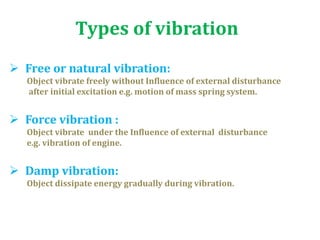
Types of vibration
 Free or natural vibration:
Object vibrate freely without Influence of external disturbance
after initial excitation e.g. motion of mass spring system.
 Force vibration :
Object vibrate under the Influence of external disturbance
e.g. vibration of engine.
 Damp vibration:
Object dissipate energy gradually during vibration.
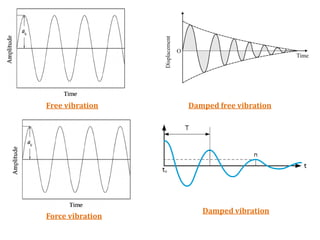
Force vibration
Damped free vibration
Damped vibration
Free vibration
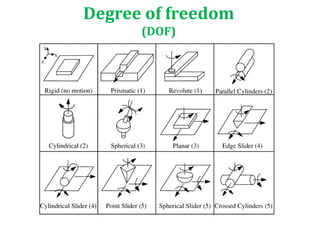
Degree of freedom
(DOF)
1. The minimum number of quadrants required to describe the position of
a particle in space.
2. The minimum number of inputs required to actuate a mechanism.
3. The number of degrees of freedom for a system is the number of
kinematic ally independent variables necessary to completely describe
the motion of every particle in the system.
Degree of freedom
(DOF)
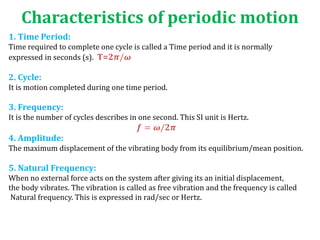
Characteristics of periodic motion
1. Time Period:
Time required to complete one cycle is called a Time period and it is normally
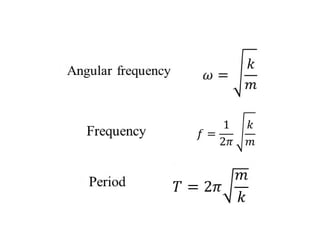
expressed in seconds (s). T=2𝝅/𝝎
2. Cycle:
It is motion completed during one time period.
3. Frequency:
It is the number of cycles describes in one second. This SI unit is Hertz.
𝒇 = 𝝎/𝟐𝝅
4. Amplitude:
The maximum displacement of the vibrating body from its equilibrium/mean position.
5. Natural Frequency:
When no external force acts on the system after giving its an initial displacement,
the body vibrates. The vibration is called as free vibration and the frequency is called
Natural frequency. This is expressed in rad/sec or Hertz.
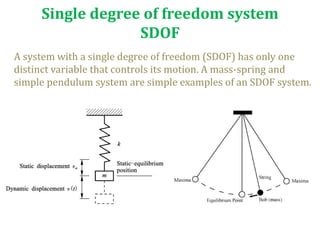
Single degree of freedom system
SDOF
A system with a single degree of freedom (SDOF) has only one
distinct variable that controls its motion. A mass-spring and
simple pendulum system are simple examples of an SDOF system.
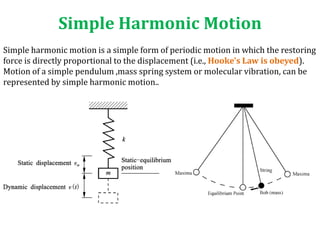
Simple Harmonic Motion
Simple harmonic motion is a simple form of periodic motion in which the restoring
force is directly proportional to the displacement (i.e., Hooke's Law is obeyed).
Motion of a simple pendulum ,mass spring system or molecular vibration, can be
represented by simple harmonic motion..
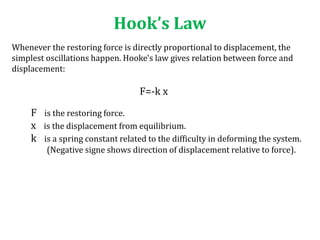
Hook’s Law
Whenever the restoring force is directly proportional to displacement, the
simplest oscillations happen. Hooke's law gives relation between force and
displacement:
F=-k x
F is the restoring force.
x is the displacement from equilibrium.
k is a spring constant related to the difficulty in deforming the system.
(Negative signe shows direction of displacement relative to force).
Hook’s Law
The extension of the spring is linearly proportional to the force.
Conditions for SHM
1. Restoring force directly proportional to displacement
2. Acceleration directly proportional to displacement
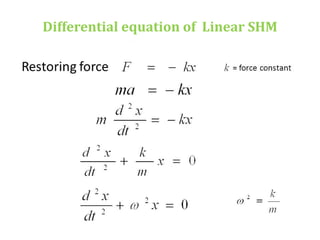
Differential equation of Linear SHM
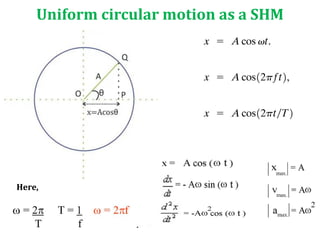
Uniform circular motion as a SHM
Here,
The velocity and acceleration can be
calculated as functions of time.
+A
o
-A
Energy in SHM
potential energy of a mass-spring system is given by:
PE = ½ kx2
The total mechanical energy of system:
E = Kinetic Energy + Potential Energy = Constt.
= Constt.
The total mechanical energy will be conserved, as we are
assuming the system is frictionless.
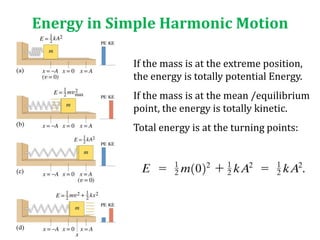
Energy in Simple Harmonic Motion
If the mass is at the extreme position,
the energy is totally potential Energy.
If the mass is at the mean /equilibrium
point, the energy is totally kinetic.
Total energy is at the turning points:
The total energy of system is, therefore ½ kA2
And energy at any instant of time:
Here ,
A is max. displacement from mean position.
x is displacement from mean position at any
interval of time.
Potential
Energy
Kinetic
Energy
Total Energy
Energy in SHM
-A A
Mean Position
Energy
Force vibration
Forced vibrations occur when there is a periodic
external force. This force may or may not have the
same period as the natural frequency of the system.
If the frequency is the same as the natural frequency,
the amplitude becomes quite large. This is called
resonance.
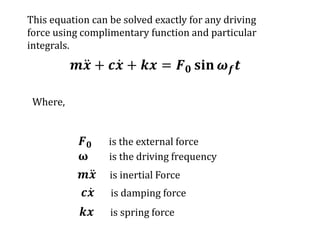
𝒎𝒙 + 𝒄𝒙 + 𝒌𝒙 = 𝑭𝟎 𝐬𝐢𝐧 𝝎𝒇𝒕
𝑭𝟎 is the external force
ω is the driving frequency
𝒎𝒙 is inertial Force
𝒄𝒙 is damping force
𝒌𝒙 is spring force
Where,
This equation can be solved exactly for any driving
force using complimentary function and particular
integrals.
The sharpness of the resonant peak depends on the damping. If
the damping force is small (A), it can be quite sharp, if the
damping force is larger (B), it is less sharp.
Thanks

Vibrations

  • 1.
    Assigned by Dr.Khubab Shaker Prepared by Engr. Habibullah Vibrations
  • 2.
  • 3.
    We have twotypes of periodic Motions in all time
  • 4.
    Types of Motion PeriodicMotion: Repetition of motion itself after particular interval of time. Motion of pendulum Motion of spring Circular motion Motion of Satellite around earth
  • 5.
    Types of Motion NonPeriodic Motion: Does not repeat motion itself or does repeat irregular manner. Projectile Motion Linear Motion Irregular motion
  • 6.
    Types of PeriodicMotion Circular Motion : Motion along a circular path around a point. All circular motions are periodic but all Periodic motion are not circular.
  • 7.
    Types of PeriodicMotion Oscillatory/ Vibratory: To and fro motion about a point Motion Pendulum Spring mass system
  • 8.
    Oscillatory v/s Vibratory Motion OscillatoryMotion : To and fro motion about a point with, usually, low frequency e.g. motion of pendulum and mass spring system. Vibratory Motion : To and fro motion about a point with high frequency e.g. motion of tuning fork, motion of atom, . Oscillation Vibration
  • 9.
    Types of vibration Free or natural vibration: Object vibrate freely without Influence of external disturbance after initial excitation e.g. motion of mass spring system.  Force vibration : Object vibrate under the Influence of external disturbance e.g. vibration of engine.  Damp vibration: Object dissipate energy gradually during vibration.
  • 10.
    Force vibration Damped freevibration Damped vibration Free vibration
  • 11.
    Degree of freedom (DOF) 1.The minimum number of quadrants required to describe the position of a particle in space. 2. The minimum number of inputs required to actuate a mechanism. 3. The number of degrees of freedom for a system is the number of kinematic ally independent variables necessary to completely describe the motion of every particle in the system.
  • 12.
  • 13.
    Characteristics of periodicmotion 1. Time Period: Time required to complete one cycle is called a Time period and it is normally expressed in seconds (s). T=2𝝅/𝝎 2. Cycle: It is motion completed during one time period. 3. Frequency: It is the number of cycles describes in one second. This SI unit is Hertz. 𝒇 = 𝝎/𝟐𝝅 4. Amplitude: The maximum displacement of the vibrating body from its equilibrium/mean position. 5. Natural Frequency: When no external force acts on the system after giving its an initial displacement, the body vibrates. The vibration is called as free vibration and the frequency is called Natural frequency. This is expressed in rad/sec or Hertz.
  • 14.
    Single degree offreedom system SDOF A system with a single degree of freedom (SDOF) has only one distinct variable that controls its motion. A mass-spring and simple pendulum system are simple examples of an SDOF system.
  • 15.
    Simple Harmonic Motion Simpleharmonic motion is a simple form of periodic motion in which the restoring force is directly proportional to the displacement (i.e., Hooke's Law is obeyed). Motion of a simple pendulum ,mass spring system or molecular vibration, can be represented by simple harmonic motion..
  • 16.
    Hook’s Law Whenever therestoring force is directly proportional to displacement, the simplest oscillations happen. Hooke's law gives relation between force and displacement: F=-k x F is the restoring force. x is the displacement from equilibrium. k is a spring constant related to the difficulty in deforming the system. (Negative signe shows direction of displacement relative to force).
  • 17.
    Hook’s Law The extensionof the spring is linearly proportional to the force.
  • 18.
    Conditions for SHM 1.Restoring force directly proportional to displacement 2. Acceleration directly proportional to displacement
  • 19.
  • 20.
  • 22.
    The velocity andacceleration can be calculated as functions of time. +A o -A
  • 23.
    Energy in SHM potentialenergy of a mass-spring system is given by: PE = ½ kx2 The total mechanical energy of system: E = Kinetic Energy + Potential Energy = Constt. = Constt. The total mechanical energy will be conserved, as we are assuming the system is frictionless.
  • 24.
    Energy in SimpleHarmonic Motion If the mass is at the extreme position, the energy is totally potential Energy. If the mass is at the mean /equilibrium point, the energy is totally kinetic. Total energy is at the turning points:
  • 25.
    The total energyof system is, therefore ½ kA2 And energy at any instant of time: Here , A is max. displacement from mean position. x is displacement from mean position at any interval of time.
  • 26.
  • 27.
    Force vibration Forced vibrationsoccur when there is a periodic external force. This force may or may not have the same period as the natural frequency of the system. If the frequency is the same as the natural frequency, the amplitude becomes quite large. This is called resonance.
  • 28.
    𝒎𝒙 + 𝒄𝒙+ 𝒌𝒙 = 𝑭𝟎 𝐬𝐢𝐧 𝝎𝒇𝒕 𝑭𝟎 is the external force ω is the driving frequency 𝒎𝒙 is inertial Force 𝒄𝒙 is damping force 𝒌𝒙 is spring force Where, This equation can be solved exactly for any driving force using complimentary function and particular integrals.
  • 30.
    The sharpness ofthe resonant peak depends on the damping. If the damping force is small (A), it can be quite sharp, if the damping force is larger (B), it is less sharp.
  • 32.