CompoZr™ ZFN Technology for CHO Cell Engineering
       Rapid and Precise Engineering of Mammalian Cells for cGMP
                Manufacturing of Protein Pharmaceutical Products
Overview

    Features and Applications of CompoZr™ ZFN Technology


    Value Proposition for Large-scale Biopharm Producers


    Validation in the Scientific Literature and Across Multiple
     Applications in Healthcare, Agriculture and Life Science Research


    Working with Sigma-Aldrich
Features of CompoZr™ ZFN Technology

  One-step gene knockout, knock-in or correction at ANY genomic address

  No selection required: 1-20% frequency of targeted modification in transfected pool

  Bi-allelic knockouts are routine—ZFN modifications are not limited by copy number

  Targeted integration of therapeutic genes in parental cell lines

  Modifications are precise, permanent and heritable

  6-26 weeks to genotype and preliminary phenotype of bi-allelic knockouts

  CompoZr ZFN is fully validated with multiple publications and collaborator data across multiple
   applications in healthcare, agriculture and industry
Value Proposition


• CompoZr™ ZFN Shortens Time-to-IND
  • GS-/-, DHFR-/-, FUT8-/-, BAX-/- & BAK-/- clones can be generated in a single step
  • 2X (BAX/BAK) and 3X (GS/DHFR/FUT8) combinations of these and other traits
  • Targeted integration to maximize yield and reduce clonal variation


• High-value Product Attributes (e.g., glycosylation)
  • Improve efficacy, toxicity and PK profiles by altering glycosylation


• Remove Endogenous Proteins That Co-purify with Protein Product
  • Eliminate endogenous CHO cell proteins that co-purify with therapeutic product


• Remove Viral Elements from Host Cell Genome
  • Reduce QC costs from viral elements that generate false positives


• Reduce/Eliminate Byproducts of Host Cell Metabolism (e.g., lactate)
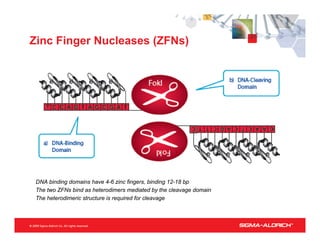
Zinc Finger Nucleases (ZFNs)


• DNA binding domains have 4-6 zinc fingers, binding 12-18 bp
• The two ZFNs bind as heterodimers mediated by the cleavage domain
• The heterodimeric structure is required for cleavage
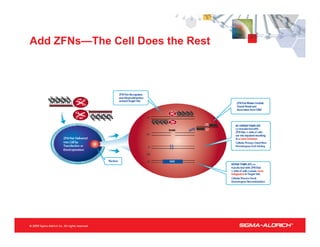
Add ZFNs—The Cell Does the Rest
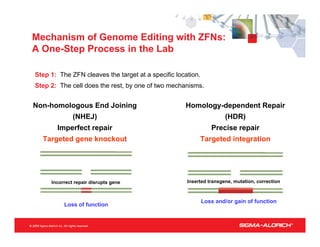
Mechanism of Genome Editing with ZFNs:
A One-Step Process in the Lab

Step 1: The ZFN cleaves the target at a specific location.
Step 2: The cell does the rest, by one of two mechanisms.


Non-homologous End Joining                          Homology-dependent Repair
              (NHEJ)                                                 (HDR)
       Imperfect repair                                         Precise repair
  Targeted gene knockout                                  Targeted integration


     Incorrect repair disrupts gene                  Inserted transgene, mutation, correction


                                                             Loss and/or gain of function
          Loss of function
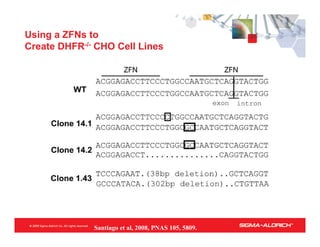
Using a ZFNs to
Create DHFR-/- CHO Cell Lines


              Santiago et al, 2008, PNAS 105, 5809.
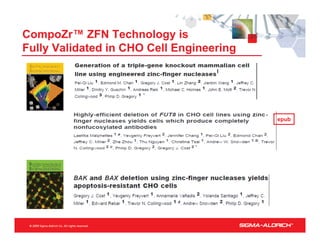
CompoZr™ ZFN Technology is
Fully Validated in CHO Cell Engineering


                                          epub
ZFN Genome Editing, ZFP
Transcriptional Activation in CHO Cells

1. Malphettes L et al. “Highly-efficient deletion of FUT8 in CHO cell lines using zinc-finger
   nucleases yields cells which produce completely non-fucosylated antibodies.” Biotechnol.
   Bioeng. (online in advance of publication 4/8/10).
2. Liu P-Q et al. “Generation of a triple-gene knockout mammalian cell line using engineered
   zinc-finger nucleases.” Biotechnol. Bioeng. 106:97 (2010).
3. Cost GJ et al. “BAK and BAX deletion using zinc-finger nucleases yields apoptosis-
   resistant CHO cells.” Biotechnol. Bioeng. 105:330 (2009).
4. Santiago Y et al. “Targeted gene knockout in mammalian cells using engineered zinc finger
   nucleases.” Proc. Natl. Acad. Sci. USA 105:5809 (2008).
5. Reik A et al. “Enhanced protein production by engineered zinc fingers proteins.”
   Biotechnol. Bioeng. 97:1180 (2007).
ZFN Genome Editing in
Human Cells and Other Model Systems
1.   Hockmeyer, D. et al. Efficient targeting of expressed and silent genes in human ESCs and iPSCs using zinc-finger
     nuclease. Nat. Biotech. 27:851 (2009).
2.   Perez, EE et al. Establishment of HIV-1 resistance in CD4+ T cells by genome editing using zinc-finger nucleases. Nat.
     Biotech. 26:808 (2008).
3.   Lombardo, A et al. Gene editing in human stem cells using zinc finger nucleases and integrase-defective lentiviral vector
     delivery. Nat. Biotech. 25:1298 (2007).
4.   Moehle, EA et al. Targeted gene addition into a specified location in the human genome using designed zinc finger
     nucleases. Proc. Natl. Acad. Sci. USA (2007).
5.   Urnov, FD et al. Highly efficient endogenous human gene correction using designed zinc-finger nucleases. Nature
     435:646 (2005).
6.   Geurts AM et al. “Knockout rats via embryo microinjection of zinc-finger nucleases.” Science 325(5939):433 (2009).
7.   Shukla VK et al. “Precise genome modification in the crop species Zea mays using zinc-finger nucleases.” Nature
     459(7245):437 (2009).
8.   Doyon Y et al. “Heritable targeted gene disruption in zebrafish using designed zinc-finger nucleases.” Nat. Biotech.
     26(6):702 (2008).
9.   Beumera, KJ et al. “Efficient gene targeting in Drosophila by direct embryo injection with zinc-finger nucleases.” Proc.
     Natl. Acad. Sci. USA 105(50):19821 (2008).
10. Lloyd, A et al. Targeted mutagenesis using zinc-finger nucleases in Arabidopsis. Proc. Natl. Acad. Sci. USA 102(6):2232
    (2005)
Commercial Applications

   Genome Editing of Mammalian Cell Lines (Sigma-Aldrich)
        Bi-allelic disruption of deleterious genes
        Targeted insertion, trait stacking
        Alteration of glycosylation
        Cost/time efficiencies vs. homologous recombination
   Therapeutic Genome Editing (Sangamo BioSciences)
        Gene disruption (i.e., HIV/AIDS)Phase I
        Gene correction (i.e., X-linked SCID, glioblastoma)IND
   Enhancement of Commercial Crops (Dow Agrosciences)
        EXZACT Precision Traits for yield, insect resistance, drought resistance
        Features of targeted integration, trait stacking were key to DAS investment
   ZFN-Knockout Animal Models (Sigma-Aldrich)
        Unlimited species, </=3 months to founder colony
        10-15% frequency of knockout phenotype in founder generation

Zfn Compozr Mammalian Cle

  • 1.
    CompoZr™ ZFN Technologyfor CHO Cell Engineering Rapid and Precise Engineering of Mammalian Cells for cGMP Manufacturing of Protein Pharmaceutical Products
  • 2.
    Overview  Features and Applications of CompoZr™ ZFN Technology  Value Proposition for Large-scale Biopharm Producers  Validation in the Scientific Literature and Across Multiple Applications in Healthcare, Agriculture and Life Science Research  Working with Sigma-Aldrich
  • 3.
    Features of CompoZr™ZFN Technology  One-step gene knockout, knock-in or correction at ANY genomic address  No selection required: 1-20% frequency of targeted modification in transfected pool  Bi-allelic knockouts are routine—ZFN modifications are not limited by copy number  Targeted integration of therapeutic genes in parental cell lines  Modifications are precise, permanent and heritable  6-26 weeks to genotype and preliminary phenotype of bi-allelic knockouts  CompoZr ZFN is fully validated with multiple publications and collaborator data across multiple applications in healthcare, agriculture and industry
  • 4.
    Value Proposition • CompoZr™ZFN Shortens Time-to-IND • GS-/-, DHFR-/-, FUT8-/-, BAX-/- & BAK-/- clones can be generated in a single step • 2X (BAX/BAK) and 3X (GS/DHFR/FUT8) combinations of these and other traits • Targeted integration to maximize yield and reduce clonal variation • High-value Product Attributes (e.g., glycosylation) • Improve efficacy, toxicity and PK profiles by altering glycosylation • Remove Endogenous Proteins That Co-purify with Protein Product • Eliminate endogenous CHO cell proteins that co-purify with therapeutic product • Remove Viral Elements from Host Cell Genome • Reduce QC costs from viral elements that generate false positives • Reduce/Eliminate Byproducts of Host Cell Metabolism (e.g., lactate)
  • 5.
    Zinc Finger Nucleases(ZFNs) • DNA binding domains have 4-6 zinc fingers, binding 12-18 bp • The two ZFNs bind as heterodimers mediated by the cleavage domain • The heterodimeric structure is required for cleavage
  • 6.
    Add ZFNs—The CellDoes the Rest
  • 7.
    Mechanism of GenomeEditing with ZFNs: A One-Step Process in the Lab Step 1: The ZFN cleaves the target at a specific location. Step 2: The cell does the rest, by one of two mechanisms. Non-homologous End Joining Homology-dependent Repair (NHEJ) (HDR) Imperfect repair Precise repair Targeted gene knockout Targeted integration Incorrect repair disrupts gene Inserted transgene, mutation, correction Loss and/or gain of function Loss of function
  • 8.
    Using a ZFNsto Create DHFR-/- CHO Cell Lines Santiago et al, 2008, PNAS 105, 5809.
  • 9.
    CompoZr™ ZFN Technologyis Fully Validated in CHO Cell Engineering epub
  • 10.
    ZFN Genome Editing,ZFP Transcriptional Activation in CHO Cells 1. Malphettes L et al. “Highly-efficient deletion of FUT8 in CHO cell lines using zinc-finger nucleases yields cells which produce completely non-fucosylated antibodies.” Biotechnol. Bioeng. (online in advance of publication 4/8/10). 2. Liu P-Q et al. “Generation of a triple-gene knockout mammalian cell line using engineered zinc-finger nucleases.” Biotechnol. Bioeng. 106:97 (2010). 3. Cost GJ et al. “BAK and BAX deletion using zinc-finger nucleases yields apoptosis- resistant CHO cells.” Biotechnol. Bioeng. 105:330 (2009). 4. Santiago Y et al. “Targeted gene knockout in mammalian cells using engineered zinc finger nucleases.” Proc. Natl. Acad. Sci. USA 105:5809 (2008). 5. Reik A et al. “Enhanced protein production by engineered zinc fingers proteins.” Biotechnol. Bioeng. 97:1180 (2007).
  • 11.
    ZFN Genome Editingin Human Cells and Other Model Systems 1. Hockmeyer, D. et al. Efficient targeting of expressed and silent genes in human ESCs and iPSCs using zinc-finger nuclease. Nat. Biotech. 27:851 (2009). 2. Perez, EE et al. Establishment of HIV-1 resistance in CD4+ T cells by genome editing using zinc-finger nucleases. Nat. Biotech. 26:808 (2008). 3. Lombardo, A et al. Gene editing in human stem cells using zinc finger nucleases and integrase-defective lentiviral vector delivery. Nat. Biotech. 25:1298 (2007). 4. Moehle, EA et al. Targeted gene addition into a specified location in the human genome using designed zinc finger nucleases. Proc. Natl. Acad. Sci. USA (2007). 5. Urnov, FD et al. Highly efficient endogenous human gene correction using designed zinc-finger nucleases. Nature 435:646 (2005). 6. Geurts AM et al. “Knockout rats via embryo microinjection of zinc-finger nucleases.” Science 325(5939):433 (2009). 7. Shukla VK et al. “Precise genome modification in the crop species Zea mays using zinc-finger nucleases.” Nature 459(7245):437 (2009). 8. Doyon Y et al. “Heritable targeted gene disruption in zebrafish using designed zinc-finger nucleases.” Nat. Biotech. 26(6):702 (2008). 9. Beumera, KJ et al. “Efficient gene targeting in Drosophila by direct embryo injection with zinc-finger nucleases.” Proc. Natl. Acad. Sci. USA 105(50):19821 (2008). 10. Lloyd, A et al. Targeted mutagenesis using zinc-finger nucleases in Arabidopsis. Proc. Natl. Acad. Sci. USA 102(6):2232 (2005)
  • 12.
    Commercial Applications  Genome Editing of Mammalian Cell Lines (Sigma-Aldrich)  Bi-allelic disruption of deleterious genes  Targeted insertion, trait stacking  Alteration of glycosylation  Cost/time efficiencies vs. homologous recombination  Therapeutic Genome Editing (Sangamo BioSciences)  Gene disruption (i.e., HIV/AIDS)Phase I  Gene correction (i.e., X-linked SCID, glioblastoma)IND  Enhancement of Commercial Crops (Dow Agrosciences)  EXZACT Precision Traits for yield, insect resistance, drought resistance  Features of targeted integration, trait stacking were key to DAS investment  ZFN-Knockout Animal Models (Sigma-Aldrich)  Unlimited species, </=3 months to founder colony  10-15% frequency of knockout phenotype in founder generation