M:\Science Department PLCs\greenough\biology\Dr Smith_The Sneeze.avi
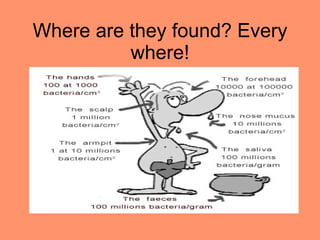
Where are they found? Every where!
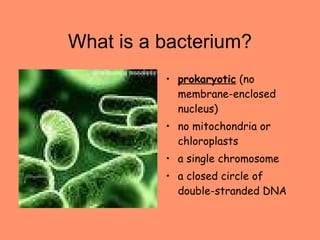
What is a bacterium? prokaryotic  (no membrane-enclosed nucleus) no mitochondria or chloroplasts a single chromosome a closed circle of double-stranded DNA
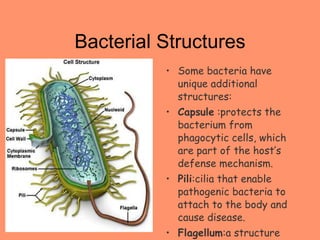
Bacterial Structures Some bacteria have unique additional structures: Capsule  :protects the bacterium from phagocytic cells, which are part of the host’s defense mechanism. Pili :cilia that enable pathogenic bacteria to attach to the body and cause disease. Flagellum :a structure used for locomotion.
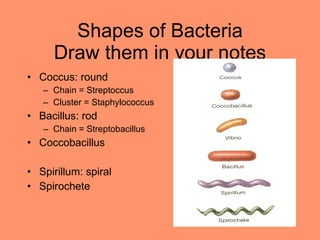
Shapes of Bacteria Draw them in your notes Coccus: round Chain = Streptoccus Cluster = Staphylococcus Bacillus: rod Chain = Streptobacillus Coccobacillus Spirillum: spiral Spirochete
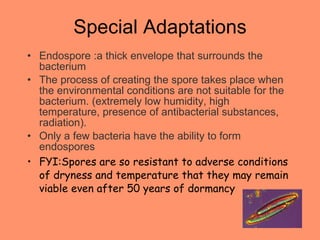
Special Adaptations Endospore :a thick envelope that surrounds the bacterium The process of creating the spore takes place when the environmental conditions are not suitable for the bacterium. (extremely low humidity, high temperature, presence of antibacterial substances, radiation).  Only a few bacteria have the ability to form endospores  FYI:Spores are so resistant to adverse conditions of dryness and temperature that they may remain viable even after 50 years of dormancy
Friendly Bacteria In the human digestive system, there are different species of friendly bacteria.  These bacteria are important in the metabolism of food, the production of enzymes and vitamins (e.g., bacteria that manufacture vitamin B or vitamin K) Make food , especially dairy products such as cheese, cultured milk and yogurt, Bacteria located at the entrances to the body do not allow disease-causing microorganisms to settle there or to invade our bodies through these entrance points. I.e mouth
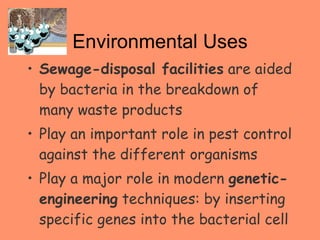
Environmental Uses Sewage-disposal facilities  are aided by bacteria in the breakdown of many waste products  Play an important role in pest control against the different organisms Play a major role in modern  genetic-engineering  techniques: by inserting specific genes into the bacterial cell
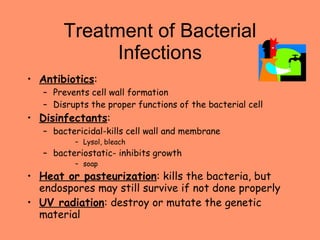
Treatment of Bacterial Infections Antibiotics : Prevents cell wall formation Disrupts the proper functions of the bacterial cell Disinfectants : bactericidal-kills cell wall and membrane Lysol, bleach bacteriostatic- inhibits growth soap Heat or pasteurization : kills the bacteria, but endospores may still survive if not done properly UV radiation : destroy or mutate the genetic material
Viruses There are no cells in nature that escape infection by one or more kinds of viruses. (Viruses that infect bacteria are called  bacteriophages .) ・ Outside the cell, they consist of particles called  pirons.
Are viruses alive? Without a host cell, viruses cannot carry out their life-sustaining functions or reproduce.  Viruses cannot generate or store energy Viruses are incapable of survival without living organisms
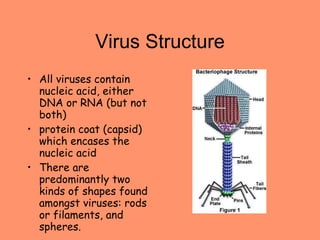
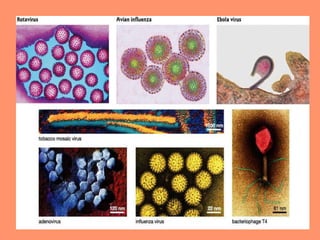
Virus Structure All viruses contain nucleic acid, either DNA or RNA (but not both) protein coat (capsid) which encases the nucleic acid There are predominantly two kinds of shapes found amongst viruses: rods or filaments, and spheres.
 
Viral Invasion YouTube - Flu Attack! How A Virus Invades Your Body
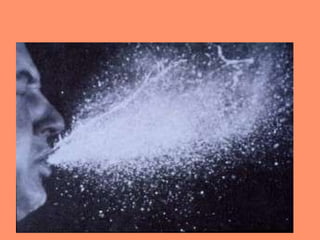
Transmission of Diseases Airborne : carried in a water droplet via a sneeze of cough Waterborne : spread when contaminated water is drank or food has been prepared with “bad” water Arthropods : person or animal is bitten and bacteria enters the wound ie. Ticks, fleas, chiggers  Food-borne   :infections are probably contracted by person-to-person contact, most probably via fecal soiled hand to mouth. Sexually transmitted : through sexual contact
FYI An  infected person  will frequently touch their nose or conjunctiva (pink eye), placing virus on the hand. Any contact (e.g. shaking hands) will transfer the virus to another person, who will then infect themselves by touching their nose or eyes.  Keep your hands away from your face! Use the back of your hand. Others have shown that infectious influenza virus may be persist on paper currency (money) for several weeks.  Stop rubbing money on your face .
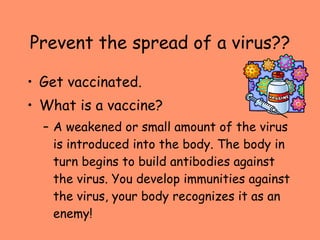
Prevent the spread of a virus?? Get vaccinated. What is a vaccine? A weakened or small amount of the virus is introduced into the body. The body in turn begins to build antibodies against the virus. You develop immunities against the virus, your body recognizes it as an enemy!
FYI: Difference between Bacteria and viruses Antibiotic drugs usually kill bacteria, but they aren't effective against viruses.  In some cases, it may be difficult to determine whether bacteria or a virus is causing your symptoms. Many ailments — such as pneumonia, meningitis and diarrhea — can be caused by either type of microbe.
What happens if we miss use antibiotics? Inappropriate use of antibiotics has helped create strains of bacterial disease that are   resistant  to treatment with different types of antibiotic medications. AKA Superbugs
Outbreak  During:  http://www.youtube.com/watch?v=A409yO-G1Mk&feature=related After:  http://www.youtube.com/watch?v=TVLo2CtB3GA http://www.youtube.com/watch?v=C061bmvk7Hw&feature=related
http://www.cellsalive.com/howbig.htm
Remember to organize your notes and study for your test!

Bacteria and virus Notes

  • 1.
  • 2.
  • 3.
    Where are theyfound? Every where!
  • 4.
    What is abacterium? prokaryotic (no membrane-enclosed nucleus) no mitochondria or chloroplasts a single chromosome a closed circle of double-stranded DNA
  • 5.
    Bacterial Structures Somebacteria have unique additional structures: Capsule :protects the bacterium from phagocytic cells, which are part of the host’s defense mechanism. Pili :cilia that enable pathogenic bacteria to attach to the body and cause disease. Flagellum :a structure used for locomotion.
  • 6.
    Shapes of BacteriaDraw them in your notes Coccus: round Chain = Streptoccus Cluster = Staphylococcus Bacillus: rod Chain = Streptobacillus Coccobacillus Spirillum: spiral Spirochete
  • 7.
    Special Adaptations Endospore:a thick envelope that surrounds the bacterium The process of creating the spore takes place when the environmental conditions are not suitable for the bacterium. (extremely low humidity, high temperature, presence of antibacterial substances, radiation). Only a few bacteria have the ability to form endospores FYI:Spores are so resistant to adverse conditions of dryness and temperature that they may remain viable even after 50 years of dormancy
  • 8.
    Friendly Bacteria Inthe human digestive system, there are different species of friendly bacteria. These bacteria are important in the metabolism of food, the production of enzymes and vitamins (e.g., bacteria that manufacture vitamin B or vitamin K) Make food , especially dairy products such as cheese, cultured milk and yogurt, Bacteria located at the entrances to the body do not allow disease-causing microorganisms to settle there or to invade our bodies through these entrance points. I.e mouth
  • 9.
    Environmental Uses Sewage-disposalfacilities are aided by bacteria in the breakdown of many waste products Play an important role in pest control against the different organisms Play a major role in modern genetic-engineering techniques: by inserting specific genes into the bacterial cell
  • 10.
    Treatment of BacterialInfections Antibiotics : Prevents cell wall formation Disrupts the proper functions of the bacterial cell Disinfectants : bactericidal-kills cell wall and membrane Lysol, bleach bacteriostatic- inhibits growth soap Heat or pasteurization : kills the bacteria, but endospores may still survive if not done properly UV radiation : destroy or mutate the genetic material
  • 11.
    Viruses There areno cells in nature that escape infection by one or more kinds of viruses. (Viruses that infect bacteria are called bacteriophages .) ・ Outside the cell, they consist of particles called pirons.
  • 12.
    Are viruses alive?Without a host cell, viruses cannot carry out their life-sustaining functions or reproduce. Viruses cannot generate or store energy Viruses are incapable of survival without living organisms
  • 13.
    Virus Structure Allviruses contain nucleic acid, either DNA or RNA (but not both) protein coat (capsid) which encases the nucleic acid There are predominantly two kinds of shapes found amongst viruses: rods or filaments, and spheres.
  • 14.
  • 15.
    Viral Invasion YouTube- Flu Attack! How A Virus Invades Your Body
  • 16.
    Transmission of DiseasesAirborne : carried in a water droplet via a sneeze of cough Waterborne : spread when contaminated water is drank or food has been prepared with “bad” water Arthropods : person or animal is bitten and bacteria enters the wound ie. Ticks, fleas, chiggers Food-borne :infections are probably contracted by person-to-person contact, most probably via fecal soiled hand to mouth. Sexually transmitted : through sexual contact
  • 17.
    FYI An infected person will frequently touch their nose or conjunctiva (pink eye), placing virus on the hand. Any contact (e.g. shaking hands) will transfer the virus to another person, who will then infect themselves by touching their nose or eyes. Keep your hands away from your face! Use the back of your hand. Others have shown that infectious influenza virus may be persist on paper currency (money) for several weeks. Stop rubbing money on your face .
  • 18.
    Prevent the spreadof a virus?? Get vaccinated. What is a vaccine? A weakened or small amount of the virus is introduced into the body. The body in turn begins to build antibodies against the virus. You develop immunities against the virus, your body recognizes it as an enemy!
  • 19.
    FYI: Difference betweenBacteria and viruses Antibiotic drugs usually kill bacteria, but they aren't effective against viruses. In some cases, it may be difficult to determine whether bacteria or a virus is causing your symptoms. Many ailments — such as pneumonia, meningitis and diarrhea — can be caused by either type of microbe.
  • 20.
    What happens ifwe miss use antibiotics? Inappropriate use of antibiotics has helped create strains of bacterial disease that are resistant to treatment with different types of antibiotic medications. AKA Superbugs
  • 21.
    Outbreak During: http://www.youtube.com/watch?v=A409yO-G1Mk&feature=related After: http://www.youtube.com/watch?v=TVLo2CtB3GA http://www.youtube.com/watch?v=C061bmvk7Hw&feature=related
  • 22.
  • 23.
    Remember to organizeyour notes and study for your test!