INTRODUCTION
• Ethics is the rational reflection on what is right, what is wrong,
what is just, what is unjust, what is good & what is bad in terms of
human behaviour.
• Some ethical principles are:
o Truthfulness
o Honesty
o Loyalty
o Respect
o Fairness
o Integrity
ORIGIN OF ETHICS
• The word Ethics is derived from Latin word ‘Ethicus’ & the
Greek word ‘Ethikos’
• Ethics are an arrangement of decent principles & a branch of
attitude which defines what is good for individuals & society
• There are many well known figures in the history of ethics,
Greek philosophers Plato & Aristotle, modern influences
include such people as Immanuel Kant, Jeremy Bentham, John
Stuart Mill, D.W.Ross, C.L.Stevenson, Alasdair MacIntyre &
John Rawls
MEANING OF ETHICS
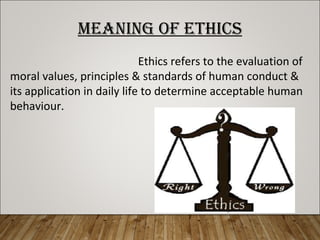
Ethics refers to the evaluation of
moral values, principles & standards of human conduct &
its application in daily life to determine acceptable human
behaviour.
EVOLUTION OF ETHICS
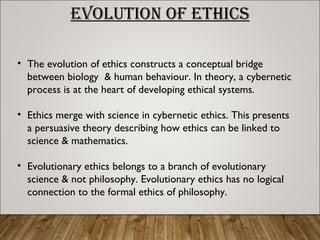
• The evolution of ethics constructs a conceptual bridge
between biology & human behaviour. In theory, a cybernetic
process is at the heart of developing ethical systems.
• Ethics merge with science in cybernetic ethics. This presents
a persuasive theory describing how ethics can be linked to
science & mathematics.
• Evolutionary ethics belongs to a branch of evolutionary
science & not philosophy. Evolutionary ethics has no logical
connection to the formal ethics of philosophy.
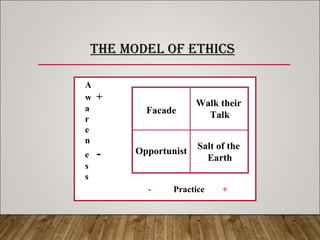
THE MODEL OF ETHICS
A
w +
a
r
e
n
e -
s
s
- Practice +
Facade
Walk their
Talk
Opportunist
Salt of the
Earth
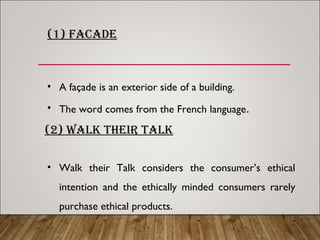
(1) FACADE
• A façade is an exterior side of a building.
• The word comes from the French language.
(2) WALk THEIR TALk
• Walk their Talk considers the consumer’s ethical
intention and the ethically minded consumers rarely
purchase ethical products.
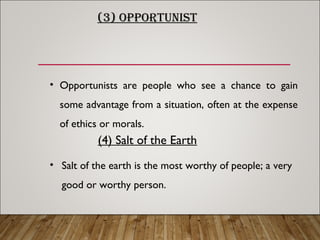
(3) OPPORTUNIST
• Opportunists are people who see a chance to gain
some advantage from a situation, often at the expense
of ethics or morals.
(4) Salt of the Earth
• Salt of the earth is the most worthy of people; a very
good or worthy person.
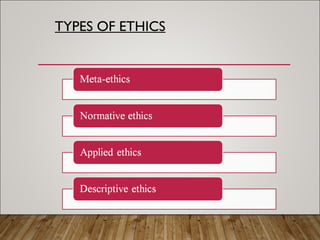
TYPES OF ETHICS
(1) META-ETHICS
• Meta-ethics is the branch of ethics that seeks
to understand the nature of ethical properties,
statements, attitudes and judgments.
• A meta-ethical question is abstract and relates
to a wide range of more specific practical
questions.
(2) NORMATIVE ETHICS
• Normative ethics is the study of ethical action.
• Normative ethics is distinct from meta-ethics and descriptive
ethics. (3) Applied Ethics
• Applied ethics is the most practical of the three divisions of the
philosophy of ethics.
• Applied ethics is the actual application of ethical theory for the
purpose of choosing an ethical action in a given issue.
(4) Descriptive ethics
• Descriptive ethics is the study of people’s beliefs
about morality.
CODE OF ETHICS
CODE OF ETHICS REFERS TO A WRITTEN SET OF
GUIDELINES ISSUED BY AN ORGANIZATION TO ITS
WORKER AND MANAGEMENT TO HELP THEM
CONDUCT THEIR ACTIONS IN ACCORDANCE WITH
ITS PRIMARYVALUES AND ETHICAL STANDARDS.
CONDITION FOR MAKING CODES
EFFECTIVE
There are six conditions for effective code of ethics
• There should be a valid motivation for introduction of ethics
• Broad acceptance within the company
• Continuous feedback is important.
• Verification and control. New guidelines should be drawn up if
the rules prove inadequate in any way
• Integration in a broad company philosophy
• Sanctions and control.
DIFFICULTIES IN IMPLEMENTING CODE OF
ETHICS
• The main difficulty with code of ethics is that they do
not establish priority between norms and beliefs.
There are three main areas that can create an obstacle
to put codes into practice i.e.
o Culture
o Design
o Enforcement
CODE OF CONDUCT ETHICS FOR
PROFESSIONAL GROUPS
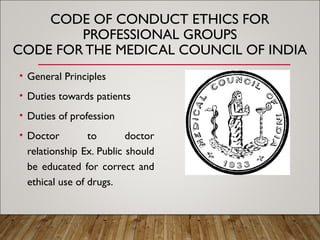
CODE FOR THE MEDICAL COUNCIL OF INDIA
• General Principles
• Duties towards patients
• Duties of profession
• Doctor to doctor
relationship Ex. Public should
be educated for correct and
ethical use of drugs.
ETHICS FOR CHARTERED ACCOUNTANTS
IN CHARTERED ACCOUNTANTS ACT
Some of the misconduct is ……
• If he allows any person to practice as
C.A. if he is not one.
• If he advertise or solicits work.
• If he accepts a position held by another
C.A without communicating with him.
• If he discloses confidential information
about his client
• He certifies a statement without
adequate scrutiny.
THE ENGINEERS' CODE
National society of
professional Engineers
described their code…
• Do not work with the
organization which are having
questionable character.
• Avoid engineering unsafe
ventures
• Maintain confidentiality
CODE OF THE ADVERTISEMENT COUNCIL
OF INDIA
• Moral and religious sentiment
should not be offended
• Advertisement should not
directly and adversely compare
products with those of the
competitors.
• Rhetoric like offering to refund
money if the product is not
good should be avoided.
ETHICAL ISSUES
• Business managers face ethical issues that vary based on market and
geographic region.
• Businesses have the responsibility to develop codes of conduct and
ethics that every member of the organization must abided by and
put into action.
Fundamental issues
Diversity issues
Decision-making issues
Compliances and governs issues
MANAGING ISSUES
• Ethics should be handled and managed properly.
• Many companies are management techniques to encourage ethical
behaviour at an organizational level.
• Various techniques of managing ethics like practising ethics at top
level management, special training on ethics, forming committee to
oversee ethical issues and defining and implementing code of ethics.
• The following are the some code of
ethics.
Top management
Code of ethics
Ethics committee
Ethics hotline
Ethics training programme
Ethics and law
NATIONAL DIFFERENCE IN
ETHICS
• National difference in ethics means difference between two states or two
places of one country.
• In that,
Culture
Attitudes
Religious belief
Education
Nature of government
Competitive environment
Work environment
INTERNATIONAL DIFFERENCE IN
ETHICS
• International difference in ethics means difference between two
different countries value, beliefs and culture.
• Work environment of any country is also affect business while they
are in multi national companies.
• Such as Reliance,Walmart,Amazon,Apple,Tata etc.
• Many companies formed well-designed codes of conduct to help
their employees.
• Two of the most prominent issues that managers in MNCs
operating in foreign countries face are Bribery and corruption
and Worker compensation.
ETHICAL RELATIVISM
• According to the school of ethical relativism…
• Different societies/cultures/countries
• Put more/less emphasis on some values than others
• Have different standards of right and wrong
• Have different social mores and behavioral norms
• What is ethical or unethical
• Must be judged in light of local customs and social mores and
• Can vary from one country to another
ETHICAL RELATIVISM
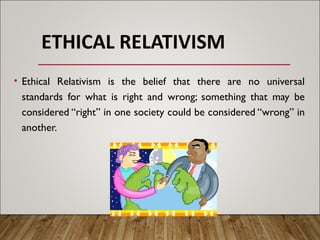
• Ethical Relativism is the belief that there are no universal
standards for what is right and wrong; something that may be
considered “right” in one society could be considered “wrong” in
another.
ETHICAL UNIVERSALISM
• According to the school of ethical universalism . . .
• Same standards of what is ethical and what is unethical resonate with peoples of
most societies regardless of
• Local traditions and
• Cultural norms
• Thus, common ethical standards can be used to judge conduct of personnel at
companies operating in a variety of
• Country markets and
• Cultural circumstances
EXAMPLES OF UNIVERSAL ETHICAL
PRINCIPLES/NORMS
• Honesty
• Trustworthiness
• Treating people with dignity and respect
• Respecting rights of others
• Avoiding unnecessary harm to
- Workers
- Users of a company’s product or services
ETHICAL CONVERGENCE
• Ethical convergence is defined as the practice of a uniform
system of ethical codes in different countries that are culturally
and socially different.
REASONS FOR ETHICAL
CONVERGENCE
1) The growth of international trade and trading blocks
2) Increased pressures to imitate business practices
3) Varied cultural background employees require common
standards
4) An increasing number of business watchdogs
ETHICAL BEHAVIOUR
(1) VALUE SYSTEMS
(2) LOCUS OF CONTROL
(3) MACHIAVELLIANISM
(4) COGNITIVE MORAL DEVELOPMENT
ETHICAL PHILOSOPHES
(1) Categorical Imperative
(2) Utilitarianism
(3) Hedonism
(4) The Golden Mean
(5) The Golden Rule
(6) Veil of Ignorance
ADVANTAGE OF ETHICS
1. SIGNIFICANT IMPROVEMENT TO SOCIETY
2. CULTIVATE STRONG TEAM WORK AND PRODUCTIVITY
3. SUPPORT EMPLOYEE GROWTH
4. INSURANCE POLICY
5. AVOID PENAL ACTION
6. HELPS IN QUALITY MANAGEMENT, STRATEGIC
PLANNING DIVERSITY MANAGEMENT
ETHICS IN PARTICULAR FIELD OF
APPLICATION
1. BIOETHICS
2.GEOETHICS
3.BUSINESSETHICS
4.RELATIONAL ETHICS
5.MACHINE ETHICS
6.MILITARY ETHICS
7.POLITICAL ETHICS
8.PUBLIC SECTOR ETHICS
BIOETHICS
• Bioethics is the study of controversial ethics bought about by
advances in biology and medicine. Bioethicists are concerned with
the ethical questions that arise in the relationships among life
sciences, biotechnology, medicine, politics, low, and philosophy.
GEOETHICS
• Genetics is an interdisciplinary field between
Geosciences and Ethics which involves Earth and
planetary Sciences as well as applied ethics. It deals
with the way of human thinking and acting in relation
to the significance of the Earth as a system and as a
model.
BUSINESS ETHICS
• Business ethics is a form of applied ethics or
professional ethics that examines ethical principles and
moral or ethical problems that arise in a business
environment. It applied to all aspects of business
conduct and is relevant to the conduct of individuals
and entire organization.
RELATIONAL ETHICS
• Relational Erica are related to an ethics of care
researchers who employ relational ethics value and
respect the connection between themselves and the
people they study and "between researchers and the
communities in which they live and work" .
MACHINE ETHICS
• Machine ethics will likely drive advancement in
understanding of human ethics by forcing us to address gaps
in modern normative theory and by providing a platform for
experimental investigation.
MILITARY ETHICS
• Military ethics are intended to guide members of the
armed forces to act in a manner consistent with the
requirements of combat and military organization.
POLITICAL ETHICS
• Political ethics is the practice of making moral
judgments about political action and political agents.
PUBLIC SECTOR ETHICS
• Public sector ethics is a set of principles that guide public officials
in their service to their constitutes, including their decision -
making on behalf of their constituents.
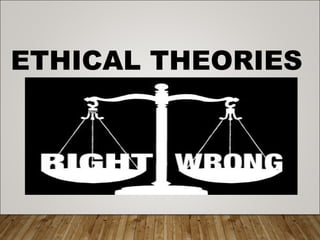
ETHICAL THEORIES
INTRODUCTION
• Based on the individual ethical ideology , ethical theories
allow a person to find an answer to an issue to make a
morally right decision or to justify decision.
• Ethical theories challenges what we think is right and
wrong
• People usually base their individual choice of ethical theory
upon their life experience
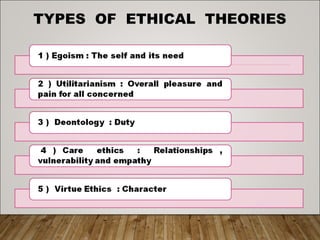
TYPES OF ETHICAL THEORIES
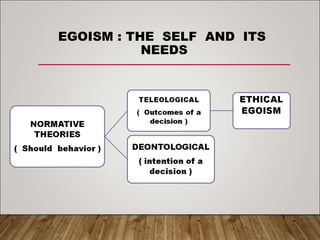
EGOISM : THE SELF AND ITS
NEEDS
 EGOISM : THE SELF AND
ITS NEEDS
• Based on personal interest .
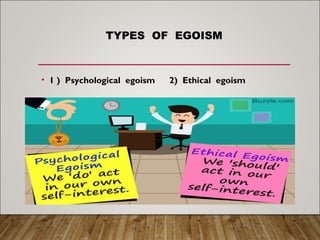
• Psychological egoism describes How people actually behave .
• Normative egoism describes how people should behave .
• According to ethical egoism , It is ok or acceptable to make a
decision or choose an action that benefit oneself .
• It argues about we have no duty except to do what is the best for
ourselves.
• There is only one ultimate principle of conduct – the principle of
self interest .
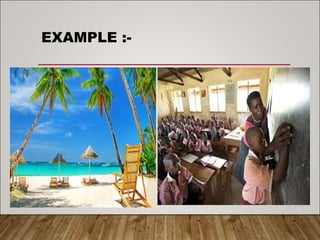
EXAMPLE :-
TYPES OF EGOISM
• 1 ) Psychological egoism 2) Ethical egoism
3 ) Minimalist egoism :-
• This is not a normative claim and usually not a descriptive
claim .
 UTILITARIANISM : OVERALL
PLEASURE AND PAIN
FOR ALL CONCERNED
• The morality of an depends solely on some relation
specified by the theory that it has to the maximization of
total or average utility .
• NET HEDONIC VALUE OF LIFE = DF THE SUM OF ALL
PLEASURE
• Hedonic Utilitarianism
• Pluralistic Utilitarianism
• Preference Utilitarianism
 DEONTOLOGY : DUTY
• Deontology term comes from the Greek word deon ,
meaning duty .
• We are morally obligated to act in accordance with a
certain set of principles and rules regardless of outcomes .
• We have an obligation to take the course of action that
achieves the most positive outcome or consequence .
TERMINOLOGY ::-
• Moral Agent
• Mxim
• Will
 CARE ETHICS :
RELATIONSHIPS , VULNERABILITY
AND EMPATHY
• Normative ethical theory .
• What makes actions right or wrong
BASIC BELIEFS OF THIS THEORY ::
1) All individuals are independent for achieving their
interest .
2) Those particularly vulnerable to our choices and their
outcomes deserve extra consideration to be measured
according o the level of their vulnerability to one’s
choices the level of their affectedness by one’s choices
and no one else’s .
3) It is necessary to attend to the contextual details of the
situation in order to safeguard and promote the actual
specific interest of those involved .
ETHICAL ELEMENTS OF CARE
• Attentiveness
• Responsibility
• Competence
• Responsiveness
 VIRTUE ETHICS : CHARACTER
• An approach to ethics that emphasizes the character of the
moral agent rather than rules or consequences as the key
element of ethical thinking .

INTRODUCTION TO ETHICS

  • 1.
    INTRODUCTION • Ethics isthe rational reflection on what is right, what is wrong, what is just, what is unjust, what is good & what is bad in terms of human behaviour. • Some ethical principles are: o Truthfulness o Honesty o Loyalty o Respect o Fairness o Integrity
  • 2.
    ORIGIN OF ETHICS •The word Ethics is derived from Latin word ‘Ethicus’ & the Greek word ‘Ethikos’ • Ethics are an arrangement of decent principles & a branch of attitude which defines what is good for individuals & society • There are many well known figures in the history of ethics, Greek philosophers Plato & Aristotle, modern influences include such people as Immanuel Kant, Jeremy Bentham, John Stuart Mill, D.W.Ross, C.L.Stevenson, Alasdair MacIntyre & John Rawls
  • 3.
    MEANING OF ETHICS Ethicsrefers to the evaluation of moral values, principles & standards of human conduct & its application in daily life to determine acceptable human behaviour.
  • 4.
    EVOLUTION OF ETHICS •The evolution of ethics constructs a conceptual bridge between biology & human behaviour. In theory, a cybernetic process is at the heart of developing ethical systems. • Ethics merge with science in cybernetic ethics. This presents a persuasive theory describing how ethics can be linked to science & mathematics. • Evolutionary ethics belongs to a branch of evolutionary science & not philosophy. Evolutionary ethics has no logical connection to the formal ethics of philosophy.
  • 5.
    THE MODEL OFETHICS A w + a r e n e - s s - Practice + Facade Walk their Talk Opportunist Salt of the Earth
  • 6.
    (1) FACADE • Afaçade is an exterior side of a building. • The word comes from the French language. (2) WALk THEIR TALk • Walk their Talk considers the consumer’s ethical intention and the ethically minded consumers rarely purchase ethical products.
  • 7.
    (3) OPPORTUNIST • Opportunistsare people who see a chance to gain some advantage from a situation, often at the expense of ethics or morals. (4) Salt of the Earth • Salt of the earth is the most worthy of people; a very good or worthy person.
  • 8.
  • 9.
    (1) META-ETHICS • Meta-ethicsis the branch of ethics that seeks to understand the nature of ethical properties, statements, attitudes and judgments. • A meta-ethical question is abstract and relates to a wide range of more specific practical questions.
  • 10.
    (2) NORMATIVE ETHICS •Normative ethics is the study of ethical action. • Normative ethics is distinct from meta-ethics and descriptive ethics. (3) Applied Ethics • Applied ethics is the most practical of the three divisions of the philosophy of ethics. • Applied ethics is the actual application of ethical theory for the purpose of choosing an ethical action in a given issue.
  • 11.
    (4) Descriptive ethics •Descriptive ethics is the study of people’s beliefs about morality.
  • 12.
    CODE OF ETHICS CODEOF ETHICS REFERS TO A WRITTEN SET OF GUIDELINES ISSUED BY AN ORGANIZATION TO ITS WORKER AND MANAGEMENT TO HELP THEM CONDUCT THEIR ACTIONS IN ACCORDANCE WITH ITS PRIMARYVALUES AND ETHICAL STANDARDS.
  • 13.
    CONDITION FOR MAKINGCODES EFFECTIVE There are six conditions for effective code of ethics • There should be a valid motivation for introduction of ethics • Broad acceptance within the company • Continuous feedback is important. • Verification and control. New guidelines should be drawn up if the rules prove inadequate in any way • Integration in a broad company philosophy • Sanctions and control.
  • 14.
    DIFFICULTIES IN IMPLEMENTINGCODE OF ETHICS • The main difficulty with code of ethics is that they do not establish priority between norms and beliefs. There are three main areas that can create an obstacle to put codes into practice i.e. o Culture o Design o Enforcement
  • 15.
    CODE OF CONDUCTETHICS FOR PROFESSIONAL GROUPS CODE FOR THE MEDICAL COUNCIL OF INDIA • General Principles • Duties towards patients • Duties of profession • Doctor to doctor relationship Ex. Public should be educated for correct and ethical use of drugs.
  • 16.
    ETHICS FOR CHARTEREDACCOUNTANTS IN CHARTERED ACCOUNTANTS ACT Some of the misconduct is …… • If he allows any person to practice as C.A. if he is not one. • If he advertise or solicits work. • If he accepts a position held by another C.A without communicating with him. • If he discloses confidential information about his client • He certifies a statement without adequate scrutiny.
  • 17.
    THE ENGINEERS' CODE Nationalsociety of professional Engineers described their code… • Do not work with the organization which are having questionable character. • Avoid engineering unsafe ventures • Maintain confidentiality
  • 18.
    CODE OF THEADVERTISEMENT COUNCIL OF INDIA • Moral and religious sentiment should not be offended • Advertisement should not directly and adversely compare products with those of the competitors. • Rhetoric like offering to refund money if the product is not good should be avoided.
  • 19.
    ETHICAL ISSUES • Businessmanagers face ethical issues that vary based on market and geographic region. • Businesses have the responsibility to develop codes of conduct and ethics that every member of the organization must abided by and put into action. Fundamental issues Diversity issues Decision-making issues Compliances and governs issues
  • 20.
    MANAGING ISSUES • Ethicsshould be handled and managed properly. • Many companies are management techniques to encourage ethical behaviour at an organizational level. • Various techniques of managing ethics like practising ethics at top level management, special training on ethics, forming committee to oversee ethical issues and defining and implementing code of ethics.
  • 21.
    • The followingare the some code of ethics. Top management Code of ethics Ethics committee Ethics hotline Ethics training programme Ethics and law
  • 22.
    NATIONAL DIFFERENCE IN ETHICS •National difference in ethics means difference between two states or two places of one country. • In that, Culture Attitudes Religious belief Education Nature of government Competitive environment Work environment
  • 23.
    INTERNATIONAL DIFFERENCE IN ETHICS •International difference in ethics means difference between two different countries value, beliefs and culture. • Work environment of any country is also affect business while they are in multi national companies. • Such as Reliance,Walmart,Amazon,Apple,Tata etc. • Many companies formed well-designed codes of conduct to help their employees. • Two of the most prominent issues that managers in MNCs operating in foreign countries face are Bribery and corruption and Worker compensation.
  • 24.
    ETHICAL RELATIVISM • Accordingto the school of ethical relativism… • Different societies/cultures/countries • Put more/less emphasis on some values than others • Have different standards of right and wrong • Have different social mores and behavioral norms • What is ethical or unethical • Must be judged in light of local customs and social mores and • Can vary from one country to another
  • 25.
    ETHICAL RELATIVISM • EthicalRelativism is the belief that there are no universal standards for what is right and wrong; something that may be considered “right” in one society could be considered “wrong” in another.
  • 26.
    ETHICAL UNIVERSALISM • Accordingto the school of ethical universalism . . . • Same standards of what is ethical and what is unethical resonate with peoples of most societies regardless of • Local traditions and • Cultural norms • Thus, common ethical standards can be used to judge conduct of personnel at companies operating in a variety of • Country markets and • Cultural circumstances
  • 27.
    EXAMPLES OF UNIVERSALETHICAL PRINCIPLES/NORMS • Honesty • Trustworthiness • Treating people with dignity and respect • Respecting rights of others • Avoiding unnecessary harm to - Workers - Users of a company’s product or services
  • 28.
    ETHICAL CONVERGENCE • Ethicalconvergence is defined as the practice of a uniform system of ethical codes in different countries that are culturally and socially different.
  • 29.
    REASONS FOR ETHICAL CONVERGENCE 1)The growth of international trade and trading blocks 2) Increased pressures to imitate business practices 3) Varied cultural background employees require common standards 4) An increasing number of business watchdogs
  • 30.
    ETHICAL BEHAVIOUR (1) VALUESYSTEMS (2) LOCUS OF CONTROL (3) MACHIAVELLIANISM (4) COGNITIVE MORAL DEVELOPMENT
  • 31.
    ETHICAL PHILOSOPHES (1) CategoricalImperative (2) Utilitarianism (3) Hedonism (4) The Golden Mean (5) The Golden Rule (6) Veil of Ignorance
  • 32.
    ADVANTAGE OF ETHICS 1.SIGNIFICANT IMPROVEMENT TO SOCIETY 2. CULTIVATE STRONG TEAM WORK AND PRODUCTIVITY 3. SUPPORT EMPLOYEE GROWTH 4. INSURANCE POLICY 5. AVOID PENAL ACTION 6. HELPS IN QUALITY MANAGEMENT, STRATEGIC PLANNING DIVERSITY MANAGEMENT
  • 33.
    ETHICS IN PARTICULARFIELD OF APPLICATION 1. BIOETHICS 2.GEOETHICS 3.BUSINESSETHICS 4.RELATIONAL ETHICS 5.MACHINE ETHICS 6.MILITARY ETHICS 7.POLITICAL ETHICS 8.PUBLIC SECTOR ETHICS
  • 34.
    BIOETHICS • Bioethics isthe study of controversial ethics bought about by advances in biology and medicine. Bioethicists are concerned with the ethical questions that arise in the relationships among life sciences, biotechnology, medicine, politics, low, and philosophy.
  • 35.
    GEOETHICS • Genetics isan interdisciplinary field between Geosciences and Ethics which involves Earth and planetary Sciences as well as applied ethics. It deals with the way of human thinking and acting in relation to the significance of the Earth as a system and as a model.
  • 36.
    BUSINESS ETHICS • Businessethics is a form of applied ethics or professional ethics that examines ethical principles and moral or ethical problems that arise in a business environment. It applied to all aspects of business conduct and is relevant to the conduct of individuals and entire organization.
  • 37.
    RELATIONAL ETHICS • RelationalErica are related to an ethics of care researchers who employ relational ethics value and respect the connection between themselves and the people they study and "between researchers and the communities in which they live and work" .
  • 38.
    MACHINE ETHICS • Machineethics will likely drive advancement in understanding of human ethics by forcing us to address gaps in modern normative theory and by providing a platform for experimental investigation.
  • 39.
    MILITARY ETHICS • Militaryethics are intended to guide members of the armed forces to act in a manner consistent with the requirements of combat and military organization.
  • 40.
    POLITICAL ETHICS • Politicalethics is the practice of making moral judgments about political action and political agents.
  • 41.
    PUBLIC SECTOR ETHICS •Public sector ethics is a set of principles that guide public officials in their service to their constitutes, including their decision - making on behalf of their constituents.
  • 42.
  • 43.
    INTRODUCTION • Based onthe individual ethical ideology , ethical theories allow a person to find an answer to an issue to make a morally right decision or to justify decision. • Ethical theories challenges what we think is right and wrong • People usually base their individual choice of ethical theory upon their life experience
  • 44.
  • 45.
    EGOISM : THESELF AND ITS NEEDS
  • 46.
     EGOISM :THE SELF AND ITS NEEDS • Based on personal interest . • Psychological egoism describes How people actually behave . • Normative egoism describes how people should behave . • According to ethical egoism , It is ok or acceptable to make a decision or choose an action that benefit oneself . • It argues about we have no duty except to do what is the best for ourselves. • There is only one ultimate principle of conduct – the principle of self interest .
  • 47.
  • 50.
    TYPES OF EGOISM •1 ) Psychological egoism 2) Ethical egoism
  • 51.
    3 ) Minimalistegoism :- • This is not a normative claim and usually not a descriptive claim .
  • 52.
     UTILITARIANISM :OVERALL PLEASURE AND PAIN FOR ALL CONCERNED • The morality of an depends solely on some relation specified by the theory that it has to the maximization of total or average utility . • NET HEDONIC VALUE OF LIFE = DF THE SUM OF ALL PLEASURE • Hedonic Utilitarianism • Pluralistic Utilitarianism • Preference Utilitarianism
  • 53.
     DEONTOLOGY :DUTY • Deontology term comes from the Greek word deon , meaning duty . • We are morally obligated to act in accordance with a certain set of principles and rules regardless of outcomes . • We have an obligation to take the course of action that achieves the most positive outcome or consequence .
  • 54.
    TERMINOLOGY ::- • MoralAgent • Mxim • Will
  • 55.
     CARE ETHICS: RELATIONSHIPS , VULNERABILITY AND EMPATHY • Normative ethical theory . • What makes actions right or wrong
  • 56.
    BASIC BELIEFS OFTHIS THEORY :: 1) All individuals are independent for achieving their interest . 2) Those particularly vulnerable to our choices and their outcomes deserve extra consideration to be measured according o the level of their vulnerability to one’s choices the level of their affectedness by one’s choices and no one else’s . 3) It is necessary to attend to the contextual details of the situation in order to safeguard and promote the actual specific interest of those involved .
  • 57.
    ETHICAL ELEMENTS OFCARE • Attentiveness • Responsibility • Competence • Responsiveness
  • 58.
     VIRTUE ETHICS: CHARACTER • An approach to ethics that emphasizes the character of the moral agent rather than rules or consequences as the key element of ethical thinking .