INDIAN INSTITUTE OF TECHNOLOGY ROORKEE
COMPARITIVE STUDY OF PILE FOUNDATIONS AND FOUNDATIONS
ON STONE COLUMN TREATED GROUND
Department of Civil Engineering
Indian Institute Of Technology ,Roorkee
Avneesh Kumar Meena (14113030)
Bhupendra Kumar Verma (14113036)
Abhishek Kumar Meena (14113003)
Dhyanchand Meena (14113042)
2
CONTENTS
 INTRODUCTION
 PILE FOOUNDATION VS STONE COLUMN
 STONE COLUMN PRINCIPLE AND CHARACTERISTICS
 STONE COLUMN INSTALLATION TECHNIQUES
 STONE COLUMN BEHAVIOUR AND DESIGN
 LIMITATIONS OF STONE COLUMN
 CONCLUSION AND FUTURE PROSPECTS
3
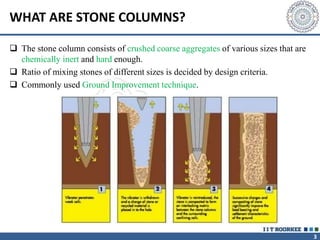
WHAT ARE STONE COLUMNS?
 The stone column consists of crushed coarse aggregates of various sizes that are
chemically inert and hard enough.
 Ratio of mixing stones of different sizes is decided by design criteria.
 Commonly used Ground Improvement technique.
Avneesh
4
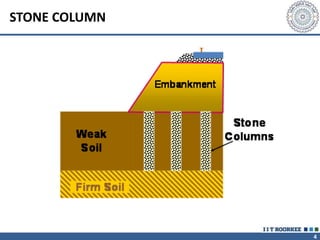
STONE COLUMN
5
PILE FOUNDATION vs STONE COLUMN
 Soft soils on which foundations have low bearing capacity and high probable
consolidation settlement - Pile foundations often adopted as the only solution.
- Piles in general are costly propositions
- Shall be chosen only as a last choice
 Ground improvement techniques- particularly stone columns provide a superior
and more economical alternative to pile foundations
 Common low rise and medium loaded industrial structures
- Stone columns is the simpler and attractive alternative
6
STONE COLUMN vs PILE FOUNDATION
PILE FOUNDATION
 Employed to carry load
through soft soil to firm
stratum through bearing or
side friction.
 Costly proposition - advance
planning and heavy
equipments are required for
driving them.
STONE COLUMN
 Modify the original soil to a
composite ground of low
compressibility and higher
shear strength.
 Simple and cost saving
alternative. Best suited for
low-rise and medium loaded
industrial structures
7
ADVANTAGES OF STONE COLUMNS
 Improves shear strength of subsoil to increase the bearing capacity.
 More economical than piling.
 Rapid consolidation of subsoil is facilitated
 Mitigates liquefaction potential.
 Immediate increase of shear strength and friction angle of treated soil
 No waiting period after installation unlike PVD
 Embankment construction can begin soon after installation.
 Installation in a uniform grid pattern ‘homogenizes’ variable soil properties
=> reducing the potential for differential settlement
 No dewatering or excavation is required
 Short construction period
8
PRINCIPLE AND WORKING OF STONE COLUMN
 Principle
- rapid consolidation due to the accelerated dissipation of excess pore
water pressure into the drainage path (aggregate column).
- degree of improvement of soft soils due to densification of the
surrounding soft soil during the installation of stone column itself and the
subsequent consolidation process occurring in soft soil before the final
loading of improved soil
9
FAILURE MECHANISM
10
FAILURE MECHANISM
The parameters believed to govern the mode of failure:
 Modulus of elasticity of the stone column material and the
clay
 Column diameter and spacing
 Angle of shearing resistance of the column material.
11
BEARING CAPACITY OF IMPROVED GROUND
• Assumptions:
- Vertical deformation of the top of stone column and soil is
same
=> total foundation pressure shared b/w column and soil in proportion to
their relative stiffness.
where A= total area of unit cell for each stone column
(assuming triangular pattern)
S= spacing of stone solumns
qsafe= [(A-As)qs + Psafe]/A
where qs = safe allowable bearing capacity of untreated ground
Psafe = safe allowable bearing capacity of stone column
As = cross sectional area of stone column
A = 0.868 S2
12
LIMITATIONS
• Sensitive clays do not adequately regain shear strength.
-ground improvement by stone column cannot be achieved in clays with
sensitivity greater than 4.
• Stone columns when installed at a distance of less than 3.66m can
cause high lateral pressures and displacement of adjacent structures.
Severe cracks could be seen in structures close by the stone column site
due to the vibrations of 30-50Hz.
• Stone column installation in extremely cohesive clays and silts is suitable
only if preloading facility is available,
13
STONE COLUMN INSTALLATION TECHNIQUES
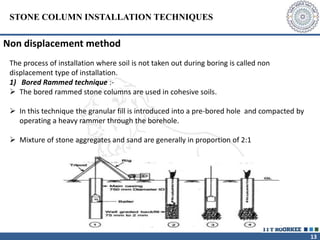
Non displacement method
The process of installation where soil is not taken out during boring is called non
displacement type of installation.
1) Bored Rammed technique :-
 The bored rammed stone columns are used in cohesive soils.
 In this technique the granular fill is introduced into a pre-bored hole and compacted by
operating a heavy rammer through the borehole.
 Mixture of stone aggregates and sand are generally in proportion of 2:1
14
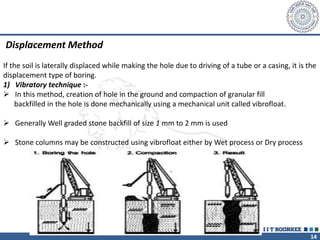
Displacement Method
If the soil is laterally displaced while making the hole due to driving of a tube or a casing, it is the
displacement type of boring.
1) Vibratory technique :-
 In this method, creation of hole in the ground and compaction of granular fill
backfilled in the hole is done mechanically using a mechanical unit called vibrofloat.
 Generally Well graded stone backfill of size 1 mm to 2 mm is used
 Stone columns may be constructed using vibrofloat either by Wet process or Dry process
15
Top Feed System
INSTALLATION PROCEDURE
 In the method of top feed vibroflotation, the OMS vibroflotation probe is put where a
stone column is required and is vibrated into the ground to the desired depth with the
help of water jetting.
 This top feed technique require 12-75mm size of stones.
 .The compression of the ground is tracked by the monitor on the hydraulic power unit.
16
Bottom Feed System
 In the method of bottom feed vibroflotation, there is a gravel reservoir and gravel tube
on the OMS vibroflotation probe.
 After the probe is vibrated into the ground to the desired depth, with the help of
compressed air.
 This Bottom Feed process requires a smaller grade of stone (2-45mm).
 In this process the compression of the ground is also tracked by the monitor on the
hydraulic power unit.
17
DESIGN
 Design Parameters
 Stone Column Diameter
 Pattern of Arrangement
 Spacing
 Replacement ratio
 Stress concentration factor
 Stress
 Settlement
 Aggregate
18
• Stone column diameter : softer is the soil bigger is the diameter. usually varies
from 800 to 1500mm
• Pattern of arrangement : equilateral triangle pattern and square pattern.
Spacing : site specific. No guidelines on the maximum and the minimum
column spacing. However, the column spacing may broadly ranges from 2 to 3
depending upon the site conditions, loading pattern, column factors, the
installation technique, settlement tolerances, etc.
DESIGN
19
• Replacement ratio: quantifies the amount of soil replaced by the stone
as = 0.907 (D/S)2
constant 0.907 is for equilateral triangular pattern.
• Stress Concentration factor: ratio of average stress in stone column σs
,to the stress σg, in the soil within the unit cell, due to externally applied
load σ,
n=σs/ σg
The value of n generally lies between 2.5 and 5 at the ground surface.
20
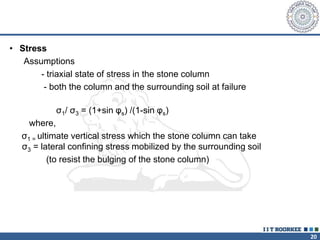
• Stress
Assumptions
- triaxial state of stress in the stone column
- both the column and the surrounding soil at failure
σ1/ σ3 = (1+sin φs) /(1-sin φs)
where,
σ1 = ultimate vertical stress which the stone column can take
σ3 = lateral confining stress mobilized by the surrounding soil
(to resist the bulging of the stone column)
21
• Settlement
Consolidation settlement of the composite (treated) soil S,
S= mvσgH
• Aggregate for constructing the aggregate column
-Crushed stone or gravel
-chemically inert,
-devoid of organic matter,
-hard are used.
(Well graded stones of 75mm to 2mm may be used)
22
CONCLUSION
 Stone columns certainly better choice in suitable situations
 Stone columns are always better ?
 Covered one aspect of the topic
 Pile foundation yet to be covered
 Waiting for some live data from consultancy to work upon
23

Comparitive study-of-pile-foundations-with-foundations-on-stone-column-treated-ground

  • 1.
    INDIAN INSTITUTE OFTECHNOLOGY ROORKEE COMPARITIVE STUDY OF PILE FOUNDATIONS AND FOUNDATIONS ON STONE COLUMN TREATED GROUND Department of Civil Engineering Indian Institute Of Technology ,Roorkee Avneesh Kumar Meena (14113030) Bhupendra Kumar Verma (14113036) Abhishek Kumar Meena (14113003) Dhyanchand Meena (14113042)
  • 2.
    2 CONTENTS  INTRODUCTION  PILEFOOUNDATION VS STONE COLUMN  STONE COLUMN PRINCIPLE AND CHARACTERISTICS  STONE COLUMN INSTALLATION TECHNIQUES  STONE COLUMN BEHAVIOUR AND DESIGN  LIMITATIONS OF STONE COLUMN  CONCLUSION AND FUTURE PROSPECTS
  • 3.
    3 WHAT ARE STONECOLUMNS?  The stone column consists of crushed coarse aggregates of various sizes that are chemically inert and hard enough.  Ratio of mixing stones of different sizes is decided by design criteria.  Commonly used Ground Improvement technique. Avneesh
  • 4.
  • 5.
    5 PILE FOUNDATION vsSTONE COLUMN  Soft soils on which foundations have low bearing capacity and high probable consolidation settlement - Pile foundations often adopted as the only solution. - Piles in general are costly propositions - Shall be chosen only as a last choice  Ground improvement techniques- particularly stone columns provide a superior and more economical alternative to pile foundations  Common low rise and medium loaded industrial structures - Stone columns is the simpler and attractive alternative
  • 6.
    6 STONE COLUMN vsPILE FOUNDATION PILE FOUNDATION  Employed to carry load through soft soil to firm stratum through bearing or side friction.  Costly proposition - advance planning and heavy equipments are required for driving them. STONE COLUMN  Modify the original soil to a composite ground of low compressibility and higher shear strength.  Simple and cost saving alternative. Best suited for low-rise and medium loaded industrial structures
  • 7.
    7 ADVANTAGES OF STONECOLUMNS  Improves shear strength of subsoil to increase the bearing capacity.  More economical than piling.  Rapid consolidation of subsoil is facilitated  Mitigates liquefaction potential.  Immediate increase of shear strength and friction angle of treated soil  No waiting period after installation unlike PVD  Embankment construction can begin soon after installation.  Installation in a uniform grid pattern ‘homogenizes’ variable soil properties => reducing the potential for differential settlement  No dewatering or excavation is required  Short construction period
  • 8.
    8 PRINCIPLE AND WORKINGOF STONE COLUMN  Principle - rapid consolidation due to the accelerated dissipation of excess pore water pressure into the drainage path (aggregate column). - degree of improvement of soft soils due to densification of the surrounding soft soil during the installation of stone column itself and the subsequent consolidation process occurring in soft soil before the final loading of improved soil
  • 9.
  • 10.
    10 FAILURE MECHANISM The parametersbelieved to govern the mode of failure:  Modulus of elasticity of the stone column material and the clay  Column diameter and spacing  Angle of shearing resistance of the column material.
  • 11.
    11 BEARING CAPACITY OFIMPROVED GROUND • Assumptions: - Vertical deformation of the top of stone column and soil is same => total foundation pressure shared b/w column and soil in proportion to their relative stiffness. where A= total area of unit cell for each stone column (assuming triangular pattern) S= spacing of stone solumns qsafe= [(A-As)qs + Psafe]/A where qs = safe allowable bearing capacity of untreated ground Psafe = safe allowable bearing capacity of stone column As = cross sectional area of stone column A = 0.868 S2
  • 12.
    12 LIMITATIONS • Sensitive claysdo not adequately regain shear strength. -ground improvement by stone column cannot be achieved in clays with sensitivity greater than 4. • Stone columns when installed at a distance of less than 3.66m can cause high lateral pressures and displacement of adjacent structures. Severe cracks could be seen in structures close by the stone column site due to the vibrations of 30-50Hz. • Stone column installation in extremely cohesive clays and silts is suitable only if preloading facility is available,
  • 13.
    13 STONE COLUMN INSTALLATIONTECHNIQUES Non displacement method The process of installation where soil is not taken out during boring is called non displacement type of installation. 1) Bored Rammed technique :-  The bored rammed stone columns are used in cohesive soils.  In this technique the granular fill is introduced into a pre-bored hole and compacted by operating a heavy rammer through the borehole.  Mixture of stone aggregates and sand are generally in proportion of 2:1
  • 14.
    14 Displacement Method If thesoil is laterally displaced while making the hole due to driving of a tube or a casing, it is the displacement type of boring. 1) Vibratory technique :-  In this method, creation of hole in the ground and compaction of granular fill backfilled in the hole is done mechanically using a mechanical unit called vibrofloat.  Generally Well graded stone backfill of size 1 mm to 2 mm is used  Stone columns may be constructed using vibrofloat either by Wet process or Dry process
  • 15.
    15 Top Feed System INSTALLATIONPROCEDURE  In the method of top feed vibroflotation, the OMS vibroflotation probe is put where a stone column is required and is vibrated into the ground to the desired depth with the help of water jetting.  This top feed technique require 12-75mm size of stones.  .The compression of the ground is tracked by the monitor on the hydraulic power unit.
  • 16.
    16 Bottom Feed System In the method of bottom feed vibroflotation, there is a gravel reservoir and gravel tube on the OMS vibroflotation probe.  After the probe is vibrated into the ground to the desired depth, with the help of compressed air.  This Bottom Feed process requires a smaller grade of stone (2-45mm).  In this process the compression of the ground is also tracked by the monitor on the hydraulic power unit.
  • 17.
    17 DESIGN  Design Parameters Stone Column Diameter  Pattern of Arrangement  Spacing  Replacement ratio  Stress concentration factor  Stress  Settlement  Aggregate
  • 18.
    18 • Stone columndiameter : softer is the soil bigger is the diameter. usually varies from 800 to 1500mm • Pattern of arrangement : equilateral triangle pattern and square pattern. Spacing : site specific. No guidelines on the maximum and the minimum column spacing. However, the column spacing may broadly ranges from 2 to 3 depending upon the site conditions, loading pattern, column factors, the installation technique, settlement tolerances, etc. DESIGN
  • 19.
    19 • Replacement ratio:quantifies the amount of soil replaced by the stone as = 0.907 (D/S)2 constant 0.907 is for equilateral triangular pattern. • Stress Concentration factor: ratio of average stress in stone column σs ,to the stress σg, in the soil within the unit cell, due to externally applied load σ, n=σs/ σg The value of n generally lies between 2.5 and 5 at the ground surface.
  • 20.
    20 • Stress Assumptions - triaxialstate of stress in the stone column - both the column and the surrounding soil at failure σ1/ σ3 = (1+sin φs) /(1-sin φs) where, σ1 = ultimate vertical stress which the stone column can take σ3 = lateral confining stress mobilized by the surrounding soil (to resist the bulging of the stone column)
  • 21.
    21 • Settlement Consolidation settlementof the composite (treated) soil S, S= mvσgH • Aggregate for constructing the aggregate column -Crushed stone or gravel -chemically inert, -devoid of organic matter, -hard are used. (Well graded stones of 75mm to 2mm may be used)
  • 22.
    22 CONCLUSION  Stone columnscertainly better choice in suitable situations  Stone columns are always better ?  Covered one aspect of the topic  Pile foundation yet to be covered  Waiting for some live data from consultancy to work upon
  • 23.