The Philippines is home to
around on
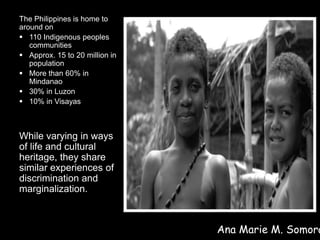
 110 Indigenous peoples
communities
 Approx. 15 to 20 million in
population
 More than 60% in
Mindanao
 30% in Luzon
 10% in Visayas
While varying in ways
of life and cultural
heritage, they share
similar experiences of
discrimination and
marginalization.
Ana Marie M. Somora
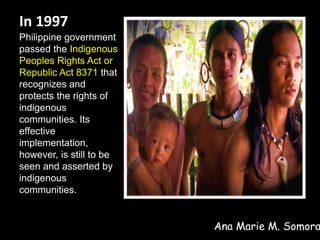
In 1997
Philippine government
passed the Indigenous
Peoples Rights Act or
Republic Act 8371 that
recognizes and
protects the rights of
indigenous
communities. Its
effective
implementation,
however, is still to be
seen and asserted by
indigenous
communities.
Ana Marie M. Somora
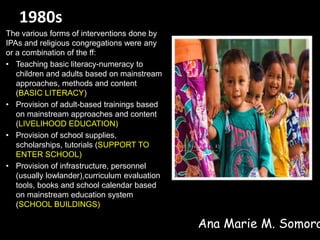
1980s
The various forms of interventions done by
IPAs and religious congregations were any
or a combination of the ff:
• Teaching basic literacy-numeracy to
children and adults based on mainstream
approaches, methods and content
(BASIC LITERACY)
• Provision of adult-based trainings based
on mainstream approaches and content
(LIVELIHOOD EDUCATION)
• Provision of school supplies,
scholarships, tutorials (SUPPORT TO
ENTER SCHOOL)
• Provision of infrastructure, personnel
(usually lowlander),curriculum evaluation
tools, books and school calendar based
on mainstream education system
(SCHOOL BUILDINGS)
Ana Marie M. Somora
Reasons for education
intervention are the ff:
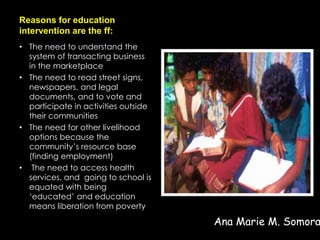
• The need to understand the
system of transacting business
in the marketplace
• The need to read street signs,
newspapers, and legal
documents, and to vote and
participate in activities outside
their communities
• The need for other livelihood
options because the
community’s resource base
(finding employment)
• The need to access health
services, and going to school is
equated with being
‘educated’ and education
means liberation from poverty
Ana Marie M. Somora
IP EXPERIENCES IN EDUCATION
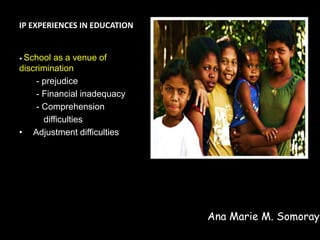
• School as a venue of
discrimination
- prejudice
- Financial inadequacy
- Comprehension
difficulties
• Adjustment difficulties
Ana Marie M. Somoray
Impact on Mainstream
School System
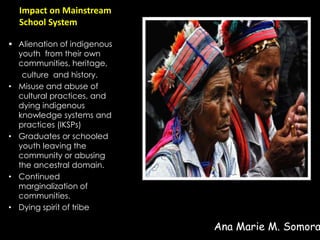
 Alienation of indigenous
youth from their own
communities, heritage,
culture and history.
• Misuse and abuse of
cultural practices, and
dying indigenous
knowledge systems and
practices (IKSPs)
• Graduates or schooled
youth leaving the
community or abusing
the ancestral domain.
• Continued
marginalization of
communities.
• Dying spirit of tribe
Ana Marie M. Somora
Culturally-sensitive
educational interventions
1. Indigenized formal education
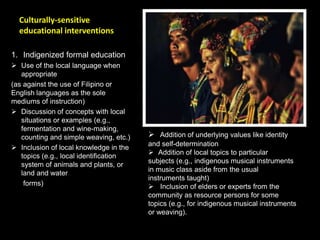
 Use of the local language when
appropriate
(as against the use of Filipino or
English languages as the sole
mediums of instruction)
 Discussion of concepts with local
situations or examples (e.g.,
fermentation and wine-making,
counting and simple weaving, etc.)
 Inclusion of local knowledge in the
topics (e.g., local identification
system of animals and plants, or
land and water
forms)
 Addition of underlying values like identity
and self-determination
 Addition of local topics to particular
subjects (e.g., indigenous musical instruments
in music class aside from the usual
instruments taught)
 Inclusion of elders or experts from the
community as resource persons for some
topics (e.g., for indigenous musical instruments
or weaving).
Indigenized Alternative
Learning Systems
Curriculum
The ALS curriculum is
applied to the indigenous
education programs with
innovations consisting of
the use of indigenous
learning and
teaching techniques (i.e.,
more group work, use of
the outdoors as venues for
lessons) and increased use
of indigenous materials for
teaching
aids.
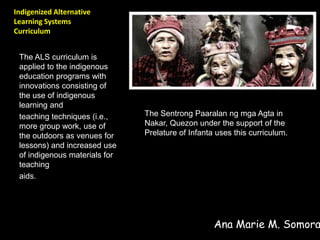
The Sentrong Paaralan ng mga Agta in
Nakar, Quezon under the support of the
Prelature of Infanta uses this curriculum.
Ana Marie M. Somora
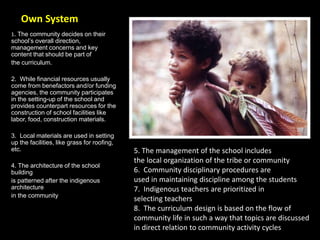
Own System
1. The community decides on their
school’s overall direction,
management concerns and key
content that should be part of
the curriculum.
2. While financial resources usually
come from benefactors and/or funding
agencies, the community participates
in the setting-up of the school and
provides counterpart resources for the
construction of school facilities like
labor, food, construction materials.
3. Local materials are used in setting
up the facilities, like grass for roofing,
etc.
4. The architecture of the school
building
is patterned after the indigenous
architecture
in the community
5. The management of the school includes
the local organization of the tribe or community
6. Community disciplinary procedures are
used in maintaining discipline among the students
7. Indigenous teachers are prioritized in
selecting teachers
8. The curriculum design is based on the flow of
community life in such a way that topics are discussed
in direct relation to community activity cycles
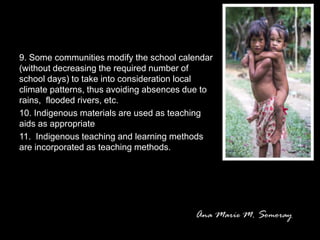
9. Some communities modify the school calendar
(without decreasing the required number of
school days) to take into consideration local
climate patterns, thus avoiding absences due to
rains, flooded rivers, etc.
10. Indigenous materials are used as teaching
aids as appropriate
11. Indigenous teaching and learning methods
are incorporated as teaching methods.
An education system
appropriate to
indigenous communities
Philosophy
To instill mainstream
competencies and learning
processes, and getting them
assimilated in mainstream
society, the end goals now
are to nurture their sense of
identity/indigenous
personhood and instill
competencies and learning
processes both from their
system and the mainstream
to enable them to assert
their rights and self
determination.
To reach these goals, indigenous peoples
education should be founded on the following:
• CULTURE (as process and product)
• HISTORY (life-stories woven into the
tribe’s story, woven into the bigger story
of nation and the world)
• HERITAGE (a sense of being a descendant
and ancestor)
• SPIRITUALITY (expression of faith life,
values and beliefs).
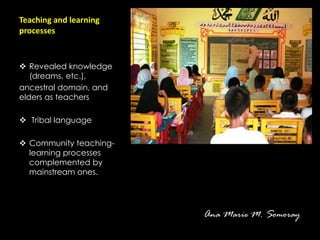
Teaching and learning
processes
 Revealed knowledge
(dreams, etc.),
ancestral domain, and
elders as teachers
 Tribal language
 Community teaching-
learning processes
complemented by
mainstream ones.
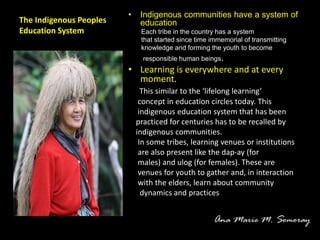
The Indigenous Peoples
Education System
• Indigenous communities have a system of
education
Each tribe in the country has a system
that started since time immemorial of transmitting
knowledge and forming the youth to become
responsible human beings.
• Learning is everywhere and at every
moment.
This similar to the ‘lifelong learning’
concept in education circles today. This
indigenous education system that has been
practiced for centuries has to be recalled by
indigenous communities.
In some tribes, learning venues or institutions
are also present like the dap-ay (for
males) and ulog (for females). These are
venues for youth to gather and, in interaction
with the elders, learn about community
dynamics and practices
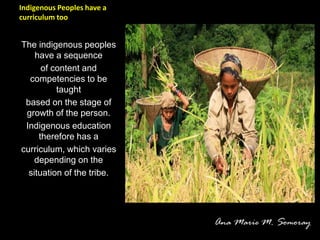
Indigenous Peoples have a
curriculum too
The indigenous peoples
have a sequence
of content and
competencies to be
taught
based on the stage of
growth of the person.
Indigenous education
therefore has a
curriculum, which varies
depending on the
situation of the tribe.
Indigenous books and
knowledge storage
system
• The elders are the repository of knowledge. Their
memory is the library of indigenous communities
• knowledge is also stored in songs, chants,
dances, rituals, and day-to-day activities of the
tribe
• day-to-day living and the cycle of life of the
community was the ultimate repository of
knowledge, for it was in living the knowledge
that its remembrance and storage were
ensured.
• Another repository of knowledge is called
cellular memory (One example is the
competency, which
evolved through the centuries of making rice
• terraces, of indigenous communities of the
Cordillera mountains)
”This is a natural competency among the members of the
indigenous community that cannot be taught in any Master’s
or PhD course anywhere in the world. It can only be learned
by being part of the ancestry (blood) and living in and
working in the ancestral domain so that this competency
(which includes psycho-emotional components) is nurtured
and practiced.”
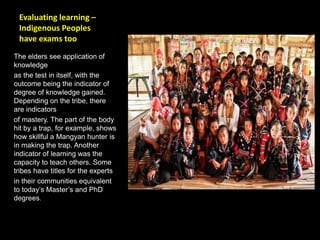
Evaluating learning –
Indigenous Peoples
have exams too
The elders see application of
knowledge
as the test in itself, with the
outcome being the indicator of
degree of knowledge gained.
Depending on the tribe, there
are indicators
of mastery. The part of the body
hit by a trap, for example, shows
how skillful a Mangyan hunter is
in making the trap. Another
indicator of learning was the
capacity to teach others. Some
tribes have titles for the experts
in their communities equivalent
to today’s Master’s and PhD
degrees.
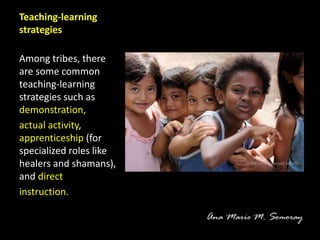
Teaching-learning
strategies
Among tribes, there
are some common
teaching-learning
strategies such as
demonstration,
actual activity,
apprenticeship (for
specialized roles like
healers and shamans),
and direct
instruction.
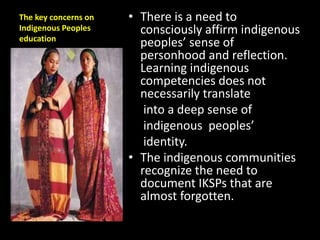
The key concerns on
Indigenous Peoples
education
• There is a need to
consciously affirm indigenous
peoples’ sense of
personhood and reflection.
Learning indigenous
competencies does not
necessarily translate
into a deep sense of
indigenous peoples’
identity.
• The indigenous communities
recognize the need to
document IKSPs that are
almost forgotten.
CONCLUSION
Culture is at the core of
being human, an
expression of how we
have encountered God
through life questions. It
contains the blessings or
graces of God to a people
which, if nurtured well,
make us able to share
these blessings and
graces with
each other. In the case of
our indigenous brothers
and sisters, they have
shared their blessings
with us but were abused,
neglected and ridiculed in
return.
We hope to continue journeying with
our indigenous brothers and sisters as
they articulate and define an education
system that will once again nurture
their tribe, communities and culture,
before it is too late.
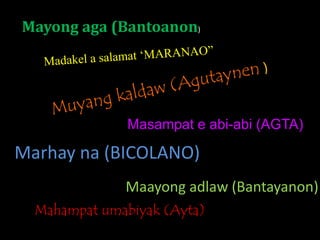
Masampat e abi-abi (AGTA)
Mahampat umabiyak (Ayta)
Maayong adlaw (Bantayanon)
Mayong aga (Bantoanon)
Marhay na (BICOLANO)

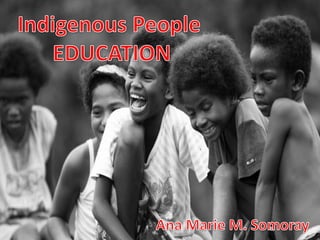
Indigenous people education

  • 2.
    The Philippines ishome to around on  110 Indigenous peoples communities  Approx. 15 to 20 million in population  More than 60% in Mindanao  30% in Luzon  10% in Visayas While varying in ways of life and cultural heritage, they share similar experiences of discrimination and marginalization. Ana Marie M. Somora
  • 3.
    In 1997 Philippine government passedthe Indigenous Peoples Rights Act or Republic Act 8371 that recognizes and protects the rights of indigenous communities. Its effective implementation, however, is still to be seen and asserted by indigenous communities. Ana Marie M. Somora
  • 4.
    1980s The various formsof interventions done by IPAs and religious congregations were any or a combination of the ff: • Teaching basic literacy-numeracy to children and adults based on mainstream approaches, methods and content (BASIC LITERACY) • Provision of adult-based trainings based on mainstream approaches and content (LIVELIHOOD EDUCATION) • Provision of school supplies, scholarships, tutorials (SUPPORT TO ENTER SCHOOL) • Provision of infrastructure, personnel (usually lowlander),curriculum evaluation tools, books and school calendar based on mainstream education system (SCHOOL BUILDINGS) Ana Marie M. Somora
  • 5.
    Reasons for education interventionare the ff: • The need to understand the system of transacting business in the marketplace • The need to read street signs, newspapers, and legal documents, and to vote and participate in activities outside their communities • The need for other livelihood options because the community’s resource base (finding employment) • The need to access health services, and going to school is equated with being ‘educated’ and education means liberation from poverty Ana Marie M. Somora
  • 6.
    IP EXPERIENCES INEDUCATION • School as a venue of discrimination - prejudice - Financial inadequacy - Comprehension difficulties • Adjustment difficulties Ana Marie M. Somoray
  • 7.
    Impact on Mainstream SchoolSystem  Alienation of indigenous youth from their own communities, heritage, culture and history. • Misuse and abuse of cultural practices, and dying indigenous knowledge systems and practices (IKSPs) • Graduates or schooled youth leaving the community or abusing the ancestral domain. • Continued marginalization of communities. • Dying spirit of tribe Ana Marie M. Somora
  • 8.
    Culturally-sensitive educational interventions 1. Indigenizedformal education  Use of the local language when appropriate (as against the use of Filipino or English languages as the sole mediums of instruction)  Discussion of concepts with local situations or examples (e.g., fermentation and wine-making, counting and simple weaving, etc.)  Inclusion of local knowledge in the topics (e.g., local identification system of animals and plants, or land and water forms)  Addition of underlying values like identity and self-determination  Addition of local topics to particular subjects (e.g., indigenous musical instruments in music class aside from the usual instruments taught)  Inclusion of elders or experts from the community as resource persons for some topics (e.g., for indigenous musical instruments or weaving).
  • 9.
    Indigenized Alternative Learning Systems Curriculum TheALS curriculum is applied to the indigenous education programs with innovations consisting of the use of indigenous learning and teaching techniques (i.e., more group work, use of the outdoors as venues for lessons) and increased use of indigenous materials for teaching aids. The Sentrong Paaralan ng mga Agta in Nakar, Quezon under the support of the Prelature of Infanta uses this curriculum. Ana Marie M. Somora
  • 10.
    Own System 1. Thecommunity decides on their school’s overall direction, management concerns and key content that should be part of the curriculum. 2. While financial resources usually come from benefactors and/or funding agencies, the community participates in the setting-up of the school and provides counterpart resources for the construction of school facilities like labor, food, construction materials. 3. Local materials are used in setting up the facilities, like grass for roofing, etc. 4. The architecture of the school building is patterned after the indigenous architecture in the community 5. The management of the school includes the local organization of the tribe or community 6. Community disciplinary procedures are used in maintaining discipline among the students 7. Indigenous teachers are prioritized in selecting teachers 8. The curriculum design is based on the flow of community life in such a way that topics are discussed in direct relation to community activity cycles
  • 11.
    9. Some communitiesmodify the school calendar (without decreasing the required number of school days) to take into consideration local climate patterns, thus avoiding absences due to rains, flooded rivers, etc. 10. Indigenous materials are used as teaching aids as appropriate 11. Indigenous teaching and learning methods are incorporated as teaching methods.
  • 12.
    An education system appropriateto indigenous communities Philosophy To instill mainstream competencies and learning processes, and getting them assimilated in mainstream society, the end goals now are to nurture their sense of identity/indigenous personhood and instill competencies and learning processes both from their system and the mainstream to enable them to assert their rights and self determination. To reach these goals, indigenous peoples education should be founded on the following: • CULTURE (as process and product) • HISTORY (life-stories woven into the tribe’s story, woven into the bigger story of nation and the world) • HERITAGE (a sense of being a descendant and ancestor) • SPIRITUALITY (expression of faith life, values and beliefs).
  • 13.
    Teaching and learning processes Revealed knowledge (dreams, etc.), ancestral domain, and elders as teachers  Tribal language  Community teaching- learning processes complemented by mainstream ones.
  • 14.
    The Indigenous Peoples EducationSystem • Indigenous communities have a system of education Each tribe in the country has a system that started since time immemorial of transmitting knowledge and forming the youth to become responsible human beings. • Learning is everywhere and at every moment. This similar to the ‘lifelong learning’ concept in education circles today. This indigenous education system that has been practiced for centuries has to be recalled by indigenous communities. In some tribes, learning venues or institutions are also present like the dap-ay (for males) and ulog (for females). These are venues for youth to gather and, in interaction with the elders, learn about community dynamics and practices
  • 15.
    Indigenous Peoples havea curriculum too The indigenous peoples have a sequence of content and competencies to be taught based on the stage of growth of the person. Indigenous education therefore has a curriculum, which varies depending on the situation of the tribe.
  • 16.
    Indigenous books and knowledgestorage system • The elders are the repository of knowledge. Their memory is the library of indigenous communities • knowledge is also stored in songs, chants, dances, rituals, and day-to-day activities of the tribe • day-to-day living and the cycle of life of the community was the ultimate repository of knowledge, for it was in living the knowledge that its remembrance and storage were ensured. • Another repository of knowledge is called cellular memory (One example is the competency, which evolved through the centuries of making rice • terraces, of indigenous communities of the Cordillera mountains) ”This is a natural competency among the members of the indigenous community that cannot be taught in any Master’s or PhD course anywhere in the world. It can only be learned by being part of the ancestry (blood) and living in and working in the ancestral domain so that this competency (which includes psycho-emotional components) is nurtured and practiced.”
  • 17.
    Evaluating learning – IndigenousPeoples have exams too The elders see application of knowledge as the test in itself, with the outcome being the indicator of degree of knowledge gained. Depending on the tribe, there are indicators of mastery. The part of the body hit by a trap, for example, shows how skillful a Mangyan hunter is in making the trap. Another indicator of learning was the capacity to teach others. Some tribes have titles for the experts in their communities equivalent to today’s Master’s and PhD degrees.
  • 18.
    Teaching-learning strategies Among tribes, there aresome common teaching-learning strategies such as demonstration, actual activity, apprenticeship (for specialized roles like healers and shamans), and direct instruction.
  • 19.
    The key concernson Indigenous Peoples education • There is a need to consciously affirm indigenous peoples’ sense of personhood and reflection. Learning indigenous competencies does not necessarily translate into a deep sense of indigenous peoples’ identity. • The indigenous communities recognize the need to document IKSPs that are almost forgotten.
  • 20.
    CONCLUSION Culture is atthe core of being human, an expression of how we have encountered God through life questions. It contains the blessings or graces of God to a people which, if nurtured well, make us able to share these blessings and graces with each other. In the case of our indigenous brothers and sisters, they have shared their blessings with us but were abused, neglected and ridiculed in return. We hope to continue journeying with our indigenous brothers and sisters as they articulate and define an education system that will once again nurture their tribe, communities and culture, before it is too late.
  • 21.
    Masampat e abi-abi(AGTA) Mahampat umabiyak (Ayta) Maayong adlaw (Bantayanon) Mayong aga (Bantoanon) Marhay na (BICOLANO)

Editor's Notes

  • #6 Very common interventions were basic literacy-numeracy and scholarships. In the later years, the communities themselves started to request for education interventions because of the following commonly cited reasons: The need to understand the system of transacting business in the marketplace (which were different from indigenous communities’ system of economic calculations and barter) because of the rampant cheating they experienced • The need to read street signs, newspapers, and legal documents, and to vote and participate in activities outside their communities • The need for other livelihood options because the community’s resource base (such as farmland) has been exploited by others (for logging, mining, plantations, etc); exploring other livelihood options means interacting with the enlarging national economy, thus the need for trainings to familiarize them with this arena; others found schooling necessary to be able to find employment • The need to access health services, and going to school is equated with being ‘educated’ and education means liberation from poverty.
  • #7 Graduates of indigenous communities were viewed as success stories both by the communities and the congregations or IPAs, and these graduates learned, as individuals, how to navigate their way in the wider social demands of mainstream society. The backdrop, however, of these few success stories was the reality of as much bigger number of drop-outs because of the following: • Comprehension difficulties • Adjustment difficulties • Discrimination. In the case of shoes, this is something that some indigenous children are not used to. Not wearing shoes became a mark of being an indigenous person and a source of discrimination
  • #8 These indelible experiences of indigenous students in the mainstream school system have the following impacts at the individual level: Broken intergenerational ties. Learning from school that indigenous peoples’ ways are backward, indigenous youth consequently view elders as backward or inferior since they are the living memories of these life-ways. This is manifested in the youth’s disrespect and sometimes blatant disregard of the elders, resulting in broken intergenerational ties. Since schooled youth have been observed to be close-minded or distant, elders have also become silent, to the point that in some communities elders feel and accept that they have no place or have lost their roles in the community.
  • #9 Realizing the need to address the adverse impact of mainstream education system on the indigenous communities, some IPAs and religious congregations started in the 1980s to introduce culturally-sensitive educational interventions. At present, more culturally-sensitive educational interventions have been introduced that are classified into
  • #11 This approach is employed in areas where the formal school setting is not applicable and appropriate (e.g., areas where the school is being introduced for the first time or is quite far from the town proper), or the communities have decided to design their own school set-up in response to the painful impacts discussed earlier. In these initiatives, some of the innovations are the following:
  • #13 To further specify what the key components of an education system appropriate to indigenous communities are, IPAs and their partner communities consolidated common and fundamental viewpoints and principles shared by their efforts and expressed them in relation to five components of an education system. This was done during the 2nd National Convention on Indigenous Peoples Education attended by twenty-seven dioceses and sixteen tribes. The five components discussed were: education philosophy, curriculum and evaluation processes, teaching-learning processes, instructional setup, and school management.
  • #15 During the 2nd National IP Education Convention in May 2007, the reports on key findings of case studies done in four areas inthe country significantly articulated what the indigenous education system was. The following are the key points shared so far: Each tribe in the country has a system that started since time immemorial of transmitting knowledge and forming the youth to become responsible human beings.
  • #20 Indigenous Knowledge Sytem
  • #21 Sometimes we ask, what is so importantabout culture? Why should we, like our indigenous sisters and brothers, be so assertive about it? It is not just because of its aesthetic value, or its uniqueness or the economics of it. Culture is at the core of being human, an expression of how we have encountered God through life questions. It contains the blessings or graces of God to a people which, if nurtured well, make us able to share these blessings and graces with each other. In the case of our indigenous brothers and sisters, they have shared their blessings with us but were abused, neglected and ridiculed in return. We hope to continue journeying with our indigenous brothers and sisters as they articulate and define an education system that will once again nurture their tribe, communities and culture, before it is too late