Enhancing PROFESSIONAL PRACTICE A Framework For Teaching CHARLOTTE DANIELSON
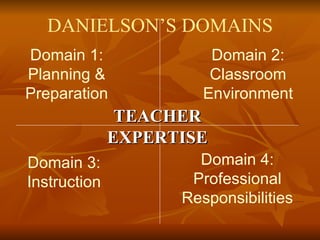
TEACHER EXPERTISE DANIELSON’S DOMAINS Domain 1: Planning & Preparation Domain 2: Classroom Environment Domain 3: Instruction Domain 4: Professional Responsibilities
DOMAIN 1: Planning & Preparation Knowledge of Content & Pedagogy Knowledge of Students Setting Instructional Outcomes Knowledge of Resources Designing Coherent Instruction Designing Student Assessments
Creating an Environment of Respect & Rapport Establishing a Culture For Learning Managing Classroom Procedures Managing Student Behavior Organizing Physical Space DOMAIN 2:  Classroom Environment
Domain 4: Professional Responsibilities … the “ behind the scenes ” work  associated with teaching … showing  commitment  to  high ethical  and p rofessional standards   while seeking to  improve  practice
Component 4A:  Reflecting on Teaching The ability to reflect (the thinking that follows any instructional event) on teaching is the mark of a true professional Were goals met?  Did the lesson “work?” Reflection = natural… doing it well is a learned skill
Reflection as a Learned Skill Characterized by accuracy, specifically, and ability to use the analysis in future teaching Cite specific examples from a lesson to support the assessment of it (successful or not) Become more discerning and evaluate both successes and failures Demonstrate  through professional conversation with colleagues
Component 4B:  Maintaining Accurate Records Keep accurate records of: Routine classroom events Student progress Other non-instructional matters (such as permission slips, supply orders, absence notes, etc) Records inform interactions and enable teachers to respond to individual needs.
Communication with Students A well-designed system for assignments enables both teacher and students to know at all times which assignments have been completed and which are still outstanding. It is essential for teachers to keep track of students’ learning so that they know which parts of the curriculum students have learned and which they have not. A system for monitoring student progress must align with a teacher’s approach to assessment (not necessarily only formal assessments – teacher anecdotal notes are a great source of information).
Demonstration Teachers demonstrate their skill in maintaining accurate records through: Grade books Skills inventories Results of student assessments Records of classroom non-instructional activities
Component 4C:  Communicating and Families Enlisting the participation of students’ families in the educational process enhances student learning. Communication with families involves keeping them informed about how a class is run.  Parents need information about the teacher’s approach to the class.
Strategies for Communication Written information via:  Students Email Websites Back-to-School Night Meeting the parents Parent conferences Phone calls home Report cards/Interims
Component 4D:  Participating in a Professional Community School is a social environment for teachers, too! Relationships with colleagues mean participation in a professional community. Professional learning should continue throughout a teacher’s career. Demonstrate  through actions – making contributions to the life of a school by assuming duties that help the school function smoothly.
Component 4E:  Growing and Developing Professionally Continuing development is the mark of a true professional Areas for continuing professional development: Content knowledge (join a professional organization) Pedagogy  Integrating new technology Your colleagues! Demonstrate  commitment to ongoing professional learning through the activities you undertake
Component 4F:  Showing Professionalism “Professionalism” = elusive concept Expert teachers display the highest standards of:  Integrity  Ethical conduct Intellectually honest  Conduct themselves in ways consistent with a comprehensive moral code
Professional educators… … never forget that schools are not institutions run for the convenience of the adults who work in them. … understand that the purpose of schools is to educate the students.  … are keenly alert to the needs of their students. … demonstrate a commitment to professional standards in problem solving and decision making. … comply with school and district regulations and procedures (punctuality, dress code, completion of reports, etc).  Demonstrate  by displaying professional ethics in daily interactions with students and colleagues.

Danielson Domain 4

  • 1.
    Enhancing PROFESSIONAL PRACTICEA Framework For Teaching CHARLOTTE DANIELSON
  • 2.
    TEACHER EXPERTISE DANIELSON’SDOMAINS Domain 1: Planning & Preparation Domain 2: Classroom Environment Domain 3: Instruction Domain 4: Professional Responsibilities
  • 3.
    DOMAIN 1: Planning& Preparation Knowledge of Content & Pedagogy Knowledge of Students Setting Instructional Outcomes Knowledge of Resources Designing Coherent Instruction Designing Student Assessments
  • 4.
    Creating an Environmentof Respect & Rapport Establishing a Culture For Learning Managing Classroom Procedures Managing Student Behavior Organizing Physical Space DOMAIN 2: Classroom Environment
  • 5.
    Domain 4: ProfessionalResponsibilities … the “ behind the scenes ” work associated with teaching … showing commitment to high ethical and p rofessional standards while seeking to improve practice
  • 6.
    Component 4A: Reflecting on Teaching The ability to reflect (the thinking that follows any instructional event) on teaching is the mark of a true professional Were goals met? Did the lesson “work?” Reflection = natural… doing it well is a learned skill
  • 7.
    Reflection as aLearned Skill Characterized by accuracy, specifically, and ability to use the analysis in future teaching Cite specific examples from a lesson to support the assessment of it (successful or not) Become more discerning and evaluate both successes and failures Demonstrate through professional conversation with colleagues
  • 8.
    Component 4B: Maintaining Accurate Records Keep accurate records of: Routine classroom events Student progress Other non-instructional matters (such as permission slips, supply orders, absence notes, etc) Records inform interactions and enable teachers to respond to individual needs.
  • 9.
    Communication with StudentsA well-designed system for assignments enables both teacher and students to know at all times which assignments have been completed and which are still outstanding. It is essential for teachers to keep track of students’ learning so that they know which parts of the curriculum students have learned and which they have not. A system for monitoring student progress must align with a teacher’s approach to assessment (not necessarily only formal assessments – teacher anecdotal notes are a great source of information).
  • 10.
    Demonstration Teachers demonstratetheir skill in maintaining accurate records through: Grade books Skills inventories Results of student assessments Records of classroom non-instructional activities
  • 11.
    Component 4C: Communicating and Families Enlisting the participation of students’ families in the educational process enhances student learning. Communication with families involves keeping them informed about how a class is run. Parents need information about the teacher’s approach to the class.
  • 12.
    Strategies for CommunicationWritten information via: Students Email Websites Back-to-School Night Meeting the parents Parent conferences Phone calls home Report cards/Interims
  • 13.
    Component 4D: Participating in a Professional Community School is a social environment for teachers, too! Relationships with colleagues mean participation in a professional community. Professional learning should continue throughout a teacher’s career. Demonstrate through actions – making contributions to the life of a school by assuming duties that help the school function smoothly.
  • 14.
    Component 4E: Growing and Developing Professionally Continuing development is the mark of a true professional Areas for continuing professional development: Content knowledge (join a professional organization) Pedagogy Integrating new technology Your colleagues! Demonstrate commitment to ongoing professional learning through the activities you undertake
  • 15.
    Component 4F: Showing Professionalism “Professionalism” = elusive concept Expert teachers display the highest standards of: Integrity Ethical conduct Intellectually honest Conduct themselves in ways consistent with a comprehensive moral code
  • 16.
    Professional educators… …never forget that schools are not institutions run for the convenience of the adults who work in them. … understand that the purpose of schools is to educate the students. … are keenly alert to the needs of their students. … demonstrate a commitment to professional standards in problem solving and decision making. … comply with school and district regulations and procedures (punctuality, dress code, completion of reports, etc). Demonstrate by displaying professional ethics in daily interactions with students and colleagues.