EDUCATIONAL
TECHNOLOGY
AZHARUDDEEN.M
M.ED.2014-
15. Sem 2
Self Learning
Materials(SLMs)
Self-Learning Materials (SLMs)
Self-learning materials (SLMs) are basically
learner-centered materials. Open, distance and
flexible learners usually depend a lot on SLMs
because they have to learn on their own, at a time,
pace and place of their own choice.
The success and the effectiveness of distance
education/open learning systems largely depends
on the quality of learning material in print and non-
print media. Distance education or distance
teaching-learning materials are popularly called self-
learning materials (SLMs).
The main objective of SLMs is to stimulate and
facilitate independent learning by the student. Thus ,
SLMs preference the functions of an effective
,efficient and inspiring classroom teacher in the
distance learning situation.
SIMs promote the concept of self-learning and help the
students to learn independently at his own pace.
Concept:-
SIMs are specially designed to provide instruction to the
identified target groups with the purpose of enabling
them acquire knowledge , attitudes and skills ,promote
self-learning. The learning materials in D.E are designed
in such a way that the functions of an effective teacher
are built into it
.
In other words, the distance teacher in the learning
material performs the functions of a classroom
teacher such as directing the students ,motivating
them, explaining the concepts , asking question ,etc,
these functions facilitate independent learning as
self-learning among the distance learners without
much external support.
The based principles of programmed instruction
such as division of content into small (but
manageable ) steps , logical and sequential ordering
,feed back on performance ,layout (developmental
testing), etc., act as the guiding factors in designing
and development of SIMs.
Need:-
In Distance Education ,students are away from the DE
institution . Neither the teacher or the peer group is
around the learner to help him in his learning from the
materials. In order to provide for the problems associated
with distance of the institution ,teacher and the peer
group from the learner, the learning materials should be
such that they are self-contained or self-sufficient ,self-
instructional /learning ,self-explanatory ,self-directed and
also self-assessing /evaluating.
Only them these materials facilities their learning
,and lesson their dependency on external support .
these materials should also provide for learners
control over their learning . the learner should be
able to learn according to his own pace of learning.
The load and style of presentation of content
should fit into the learning habits ,prior knowledge ,
language competency ,etc., of the learners.
Therefore ,SIMs are to be designed and developed
along sound principles of pedagogy and
andragogy .
 Books
 Workbooks
 Worksheets
 Audio tapes
 Video tapes
 Computer based packages
 Web based packages
 CD-ROMs Etc
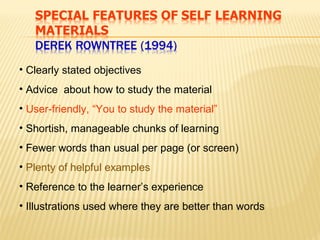
• Clearly stated objectives
• Advice about how to study the material
• User-friendly, “You to study the material”
• Shortish, manageable chunks of learning
• Fewer words than usual per page (or screen)
• Plenty of helpful examples
• Reference to the learner’s experience
• Illustrations used where they are better than words
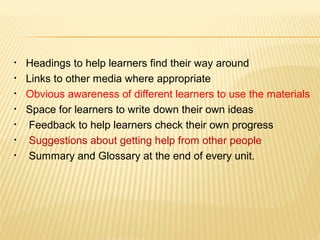
• Headings to help learners find their way around
• Links to other media where appropriate
• Obvious awareness of different learners to use the materials
• Space for learners to write down their own ideas
• Feedback to help learners check their own progress
• Suggestions about getting help from other people
• Summary and Glossary at the end of every unit.
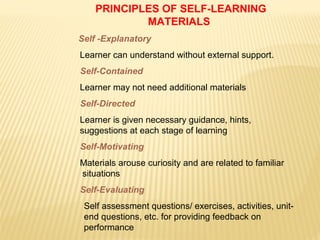
PRINCIPLES OF SELF-LEARNING
MATERIALS
Self -Explanatory
Learner can understand without external support.
Self-Contained
Learner may not need additional materials
Self-Directed
Learner is given necessary guidance, hints,
suggestions at each stage of learning
Self-Motivating
Materials arouse curiosity and are related to familiar
situations
Self-Evaluating
Self assessment questions/ exercises, activities, unit-
end questions, etc. for providing feedback on
performance
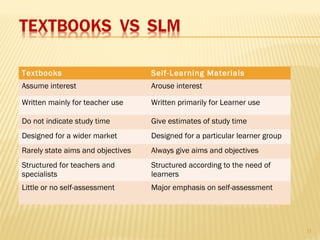
Textbooks Self-Learning Materials
Assume interest Arouse interest
Written mainly for teacher use Written primarily for Learner use
Do not indicate study time Give estimates of study time
Designed for a wider market Designed for a particular learner group
Rarely state aims and objectives Always give aims and objectives
Structured for teachers and
specialists
Structured according to the need of
learners
Little or no self-assessment Major emphasis on self-assessment
15
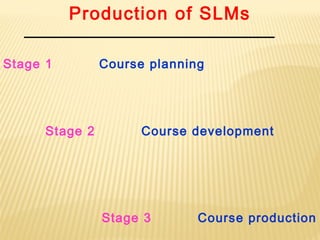
Production of SLMs
Stage 1 Course planning
Stage 2 Course development
Stage 3 Course production
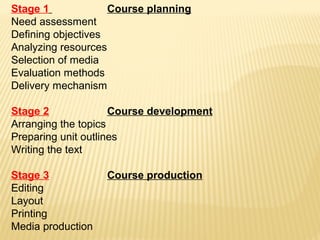
Stage 1 Course planning
Need assessment
Defining objectives
Analyzing resources
Selection of media
Evaluation methods
Delivery mechanism
Stage 2 Course development
Arranging the topics
Preparing unit outlines
Writing the text
Stage 3 Course production
Editing
Layout
Printing
Media production
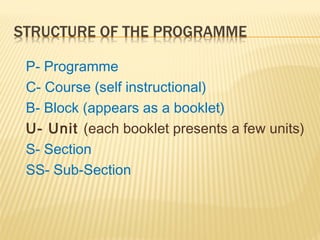
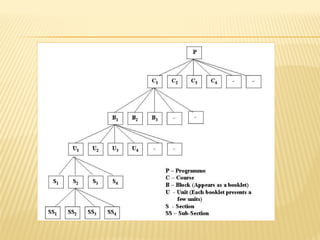
P- Programme
C- Course (self instructional)
B- Block (appears as a booklet)
U- Unit (each booklet presents a few units)
S- Section
SS- Sub-Section
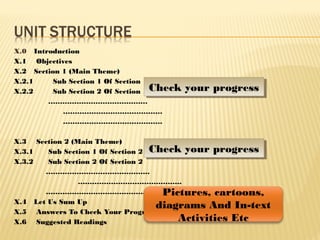
X.0 Introduction
X.1 Objectives
X.2 Section 1 (Main Theme)
X.2.1 Sub Section 1 Of Section 1
X.2.2 Sub Section 2 Of Section 1
……………………………………
……………………………………
……………………………………
X.3 Section 2 (Main Theme)
X.3.1 Sub Section 1 Of Section 2
X.3.2 Sub Section 2 Of Section 2
……………………………………..
……………………………………..
……………………………………..
X.4 Let Us Sum Up
X.5 Answers To Check Your Progress
X.6 Suggested Readings
Check your progressCheck your progress
Pictures, cartoons,
diagrams And In-text
Activities Etc
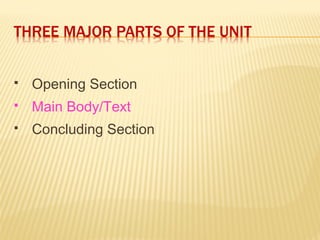
 Opening Section
 Main Body/Text
 Concluding Section
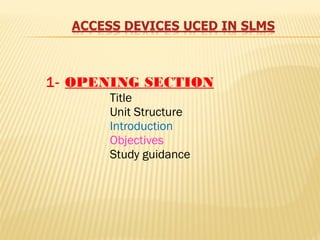
1- OPENING SECTION
Title
Unit Structure
Introduction
Objectives
Study guidance
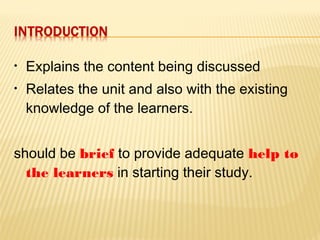
• Explains the content being discussed
• Relates the unit and also with the existing
knowledge of the learners.
should be brief to provide adequate help to
the learners in starting their study.
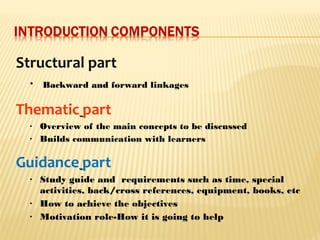
Structural part
• Backward andand forward linkages
Thematic part
• Overview of the main concepts to be discussed
• Builds communication with learners
Guidance part
• Study guide and requirements such as time, special
activities, back/cross references, equipment, books, etc
• How to achieve the objectives
• Motivation role-How it is going to help
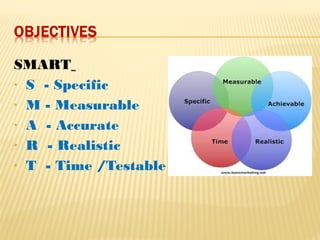
SMART
• S - Specific
• M - Measurable
• A - Accurate
• R - Realistic
• T - Time /Testable
• Conditions (Situation)-Condition under which the
behavior will occur
• Performance (Action)-Behavior is described in
observable and measurable terms (by using a verb)
• Standards (Level)-Expected level or standard for
successful performance

2- MAIN BODY
Thematic Content
Illustrations/ Photos
Diagrams/Tables
Graphics/Charts
Activities
References
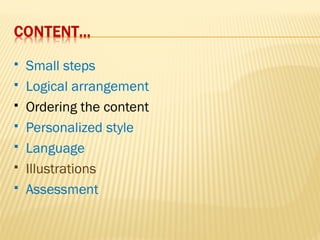
 Small steps
 Logical arrangement
 Ordering the content
 Personalized style
 Language
 Illustrations
 Assessment
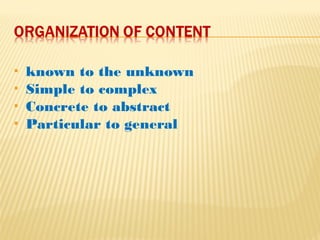
 known to the unknown
 Simple to complex
 Concrete to abstract
 Particular to general
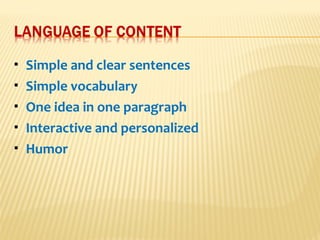
 Simple and clear sentences
 Simple vocabulary
 One idea in one paragraph
 Interactive and personalized
 Humor
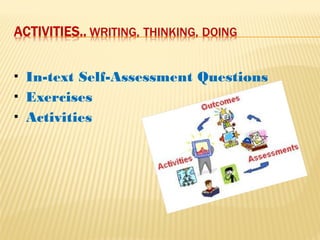
 In-text Self-Assessment Questions
 Exercises
 Activities
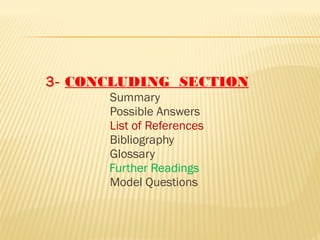
3- CONCLUDING SECTION
Summary
Possible Answers
List of References
Bibliography
Glossary
Further Readings
Model Questions
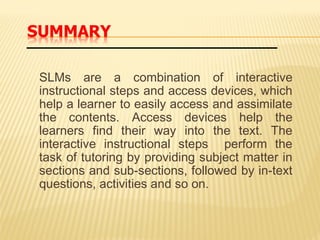
SLMs are a combination of interactive
instructional steps and access devices, which
help a learner to easily access and assimilate
the contents. Access devices help the
learners find their way into the text. The
interactive instructional steps perform the
task of tutoring by providing subject matter in
sections and sub-sections, followed by in-text
questions, activities and so on.
Reference :-
• http://www.authorstream.com/Presentation/bhanumu
•  
http://hindi.ignou.ac.in/upload/ignoudocs/DEC/Handboo
• http://www.slideshare.net/AshishKumar70/developm
• https://webserver.ignou.ac.in/institute/handbook5
/
THANK YOU…

Educational Technology

  • 1.
  • 2.
  • 3.
    Self-Learning Materials (SLMs) Self-learningmaterials (SLMs) are basically learner-centered materials. Open, distance and flexible learners usually depend a lot on SLMs because they have to learn on their own, at a time, pace and place of their own choice.
  • 4.
    The success andthe effectiveness of distance education/open learning systems largely depends on the quality of learning material in print and non- print media. Distance education or distance teaching-learning materials are popularly called self- learning materials (SLMs).
  • 5.
    The main objectiveof SLMs is to stimulate and facilitate independent learning by the student. Thus , SLMs preference the functions of an effective ,efficient and inspiring classroom teacher in the distance learning situation.
  • 6.
    SIMs promote theconcept of self-learning and help the students to learn independently at his own pace. Concept:- SIMs are specially designed to provide instruction to the identified target groups with the purpose of enabling them acquire knowledge , attitudes and skills ,promote self-learning. The learning materials in D.E are designed in such a way that the functions of an effective teacher are built into it
  • 7.
    . In other words,the distance teacher in the learning material performs the functions of a classroom teacher such as directing the students ,motivating them, explaining the concepts , asking question ,etc, these functions facilitate independent learning as self-learning among the distance learners without much external support.
  • 8.
    The based principlesof programmed instruction such as division of content into small (but manageable ) steps , logical and sequential ordering ,feed back on performance ,layout (developmental testing), etc., act as the guiding factors in designing and development of SIMs.
  • 9.
    Need:- In Distance Education,students are away from the DE institution . Neither the teacher or the peer group is around the learner to help him in his learning from the materials. In order to provide for the problems associated with distance of the institution ,teacher and the peer group from the learner, the learning materials should be such that they are self-contained or self-sufficient ,self- instructional /learning ,self-explanatory ,self-directed and also self-assessing /evaluating.
  • 10.
    Only them thesematerials facilities their learning ,and lesson their dependency on external support . these materials should also provide for learners control over their learning . the learner should be able to learn according to his own pace of learning. The load and style of presentation of content should fit into the learning habits ,prior knowledge , language competency ,etc., of the learners. Therefore ,SIMs are to be designed and developed along sound principles of pedagogy and andragogy .
  • 11.
     Books  Workbooks Worksheets  Audio tapes  Video tapes  Computer based packages  Web based packages  CD-ROMs Etc
  • 12.
    • Clearly statedobjectives • Advice about how to study the material • User-friendly, “You to study the material” • Shortish, manageable chunks of learning • Fewer words than usual per page (or screen) • Plenty of helpful examples • Reference to the learner’s experience • Illustrations used where they are better than words
  • 13.
    • Headings tohelp learners find their way around • Links to other media where appropriate • Obvious awareness of different learners to use the materials • Space for learners to write down their own ideas • Feedback to help learners check their own progress • Suggestions about getting help from other people • Summary and Glossary at the end of every unit.
  • 14.
    PRINCIPLES OF SELF-LEARNING MATERIALS Self-Explanatory Learner can understand without external support. Self-Contained Learner may not need additional materials Self-Directed Learner is given necessary guidance, hints, suggestions at each stage of learning Self-Motivating Materials arouse curiosity and are related to familiar situations Self-Evaluating Self assessment questions/ exercises, activities, unit- end questions, etc. for providing feedback on performance
  • 15.
    Textbooks Self-Learning Materials Assumeinterest Arouse interest Written mainly for teacher use Written primarily for Learner use Do not indicate study time Give estimates of study time Designed for a wider market Designed for a particular learner group Rarely state aims and objectives Always give aims and objectives Structured for teachers and specialists Structured according to the need of learners Little or no self-assessment Major emphasis on self-assessment 15
  • 16.
    Production of SLMs Stage1 Course planning Stage 2 Course development Stage 3 Course production
  • 17.
    Stage 1 Courseplanning Need assessment Defining objectives Analyzing resources Selection of media Evaluation methods Delivery mechanism Stage 2 Course development Arranging the topics Preparing unit outlines Writing the text Stage 3 Course production Editing Layout Printing Media production
  • 18.
    P- Programme C- Course(self instructional) B- Block (appears as a booklet) U- Unit (each booklet presents a few units) S- Section SS- Sub-Section
  • 20.
    X.0 Introduction X.1 Objectives X.2Section 1 (Main Theme) X.2.1 Sub Section 1 Of Section 1 X.2.2 Sub Section 2 Of Section 1 …………………………………… …………………………………… …………………………………… X.3 Section 2 (Main Theme) X.3.1 Sub Section 1 Of Section 2 X.3.2 Sub Section 2 Of Section 2 …………………………………….. …………………………………….. …………………………………….. X.4 Let Us Sum Up X.5 Answers To Check Your Progress X.6 Suggested Readings Check your progressCheck your progress Check your progressCheck your progress Pictures, cartoons, diagrams And In-text Activities Etc
  • 21.
     Opening Section Main Body/Text  Concluding Section
  • 22.
    1- OPENING SECTION Title UnitStructure Introduction Objectives Study guidance
  • 23.
    • Explains thecontent being discussed • Relates the unit and also with the existing knowledge of the learners. should be brief to provide adequate help to the learners in starting their study.
  • 24.
    Structural part • Backwardandand forward linkages Thematic part • Overview of the main concepts to be discussed • Builds communication with learners Guidance part • Study guide and requirements such as time, special activities, back/cross references, equipment, books, etc • How to achieve the objectives • Motivation role-How it is going to help
  • 25.
    SMART • S -Specific • M - Measurable • A - Accurate • R - Realistic • T - Time /Testable
  • 26.
    • Conditions (Situation)-Conditionunder which the behavior will occur • Performance (Action)-Behavior is described in observable and measurable terms (by using a verb) • Standards (Level)-Expected level or standard for successful performance
  • 27.
     2- MAIN BODY ThematicContent Illustrations/ Photos Diagrams/Tables Graphics/Charts Activities References
  • 28.
     Small steps Logical arrangement  Ordering the content  Personalized style  Language  Illustrations  Assessment
  • 29.
     known tothe unknown  Simple to complex  Concrete to abstract  Particular to general
  • 30.
     Simple andclear sentences  Simple vocabulary  One idea in one paragraph  Interactive and personalized  Humor
  • 31.
     In-text Self-AssessmentQuestions  Exercises  Activities
  • 32.
    3- CONCLUDING SECTION Summary PossibleAnswers List of References Bibliography Glossary Further Readings Model Questions
  • 33.
    SLMs are acombination of interactive instructional steps and access devices, which help a learner to easily access and assimilate the contents. Access devices help the learners find their way into the text. The interactive instructional steps perform the task of tutoring by providing subject matter in sections and sub-sections, followed by in-text questions, activities and so on.
  • 34.
    Reference :- • http://www.authorstream.com/Presentation/bhanumu •  http://hindi.ignou.ac.in/upload/ignoudocs/DEC/Handboo • http://www.slideshare.net/AshishKumar70/developm • https://webserver.ignou.ac.in/institute/handbook5 /
  • 35.