Food Safety  (Microbiology, Sanitation and HACCP) Frank T. Jones Extension Poultry Specialist Cooperative Extension Service University of Arkansas Fayetteville, AR
Presentation Outline Sanitation Definitions Microorganisms – Overview Public Health Background Sanitation on Farm Sanitation in Plants HACCP Overview
What is Sanitation? World Health Organization (WHO) – “All precautions and measures which are necessary in production, processing, storage and distribution, in order to assure an unobjectionable, sound and palatable product which is suited for human consumption.” Sanitation from Greek Sanitas – Health N. G. Marriott – “The creation and maintenance of hygenic and healthful conditions.”
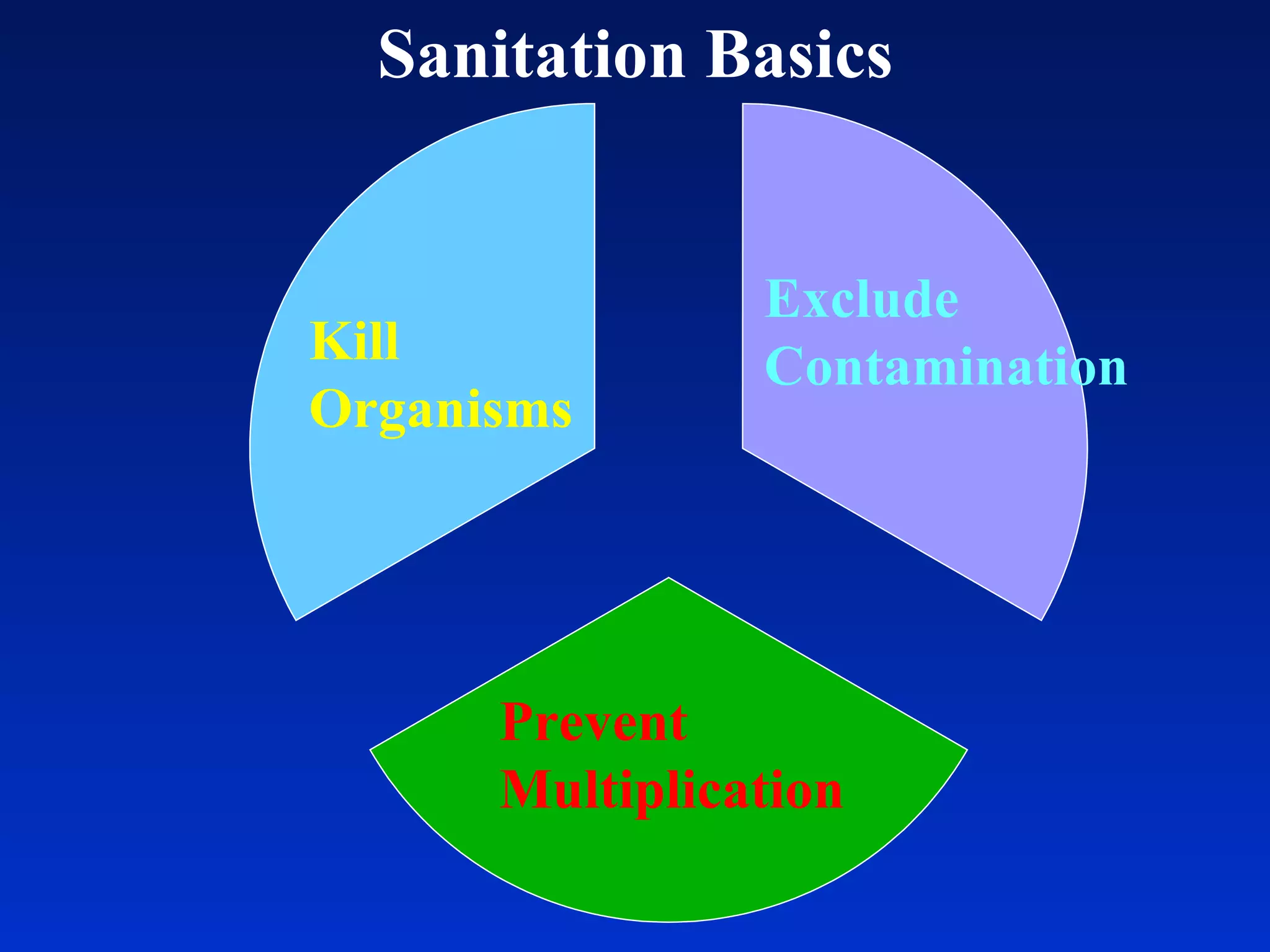
Kill Organisms Exclude Contamination Prevent Multiplication Sanitation Basics
Fungi Molds Yeasts Microorganisms Bacteria Viruses
Beneficial Microorganisms Fermentation Cheese, Beer, Wine, Bread, Yogurt Enzymes Aids to Human Metabolism Decay Waste treatment, composting, decomposition
“The Enemies” Pathogens – Food Safety Illness, Disease and Death Spoilage – Food Quality Poor Quality, Short Shelf Life, Off Flavors, Customer Dissatisfaction
Bacteria Microscopic single cells Lots of moisture required Cause most food illness Three basic shapes Rod Cocci (spheres) Spiral Some spore formers Grow, grow, grow Binary Fission
Bacterial Reproduction –  Binary Fission Generation Time 409,600 13 819,200 14 1,638,400 15 51,200 10 102,400 11 204,800 12 25,600 9 12,800 8 6,400 7 3,200 6 1,600 5 800 4 400 3 200 2 100 1 Cell Numbers Generation 21.3 14.2 7.1 2.4 Hours from 100 to 1 Million 90 60 30 10 Generation Time (Min)
What Bacteria Need for Growth? F  ood A  cid (pH) T  ime T   emperature O   xygen M  oisture FAT TOM
The Spore Cycle Spores VERY resistant Two species form spores Bacillus Clostridium Difficult to destroy – reduce strategy Problem in cooked foods
Fungi (Molds and Yeasts) Require less moisture Can grow in acid pH Very adaptable Grow slower than bacteria Molds – multicellular Form spores that are less resistant than bacterial spores Yeasts bud
Basic Virus Structure Genetic Material (DNA or RNA) Protein Coat Tail Fibers Hollow Protein Tail
Viruses Tiny Simple structure Must grow in cells In foods – fecal contam. Personal sanitation to prevent Living? Virus  Life Cycle
Our Losses… Every year (based on CDC data): Over 250 billion meals are prepared  An estimated 76 million foodborne illnesses occur >5,000 foodborne associated deaths Costs = $7.7 to 23 billion (Centers for Disease Control and Prevention, 2003)
Foodborne Illness   “ ... when a person becomes ill after ingesting a contaminated food...” Foodborne illness can be caused by: Biological hazards (bacteria, viruses, fungi) Chemical hazards (cleaning agents, toxins) Physical hazards (bone, glass, metal)
Foodborne Hazards Hazard   Est. Cases   Deaths Norwalk virus  23,000,000   na Campylobacter   2,453,926 0.1% Salmonella 1,412,498  0.8% C. perfringens   248,520 .05% S. aureus   185,060 .02% E. coli O157:H7     73,480 .83% L. monocytogenes   2,518 20% C. botulinum   58 8.6% (Centers for Disease Control and Prevention, 2001)
FOOD BORNE PATHOGENS: USDA – FSIS “Target Pathogens” Four major pathogens of food bone illness Salmonella E. coli 0157:H7 Campylobacter Listeria monocyctogens
SALMONELLA Most frequently reported Introduced anywhere within the food chain Grown on any food under the right conditions: Moisture and Temperature Ideal growth temperature 40-140  °  F Cook temperature essential to kill-160  º  F Safe handling of food by consumer essential
E COLI 0157:H7 & Campylobacter Natural inhabitant of the GI tract of all animals Sanitary practices throughout the Farm to Table essential for control Consumer education of safe handling practices for food, raw and cooked, essential for control
LISTERIA MONOCYTOGENS Commonly found in GI tract of all animals Can survive for long periods in SOIL, SEWAGE, DUST, VEGATATION AND WATER Resistant to cool temp - Cold storage Can form biofilms on surfaces to resist cleaning and sanitizing Biggest threat:Pregnant women-miscarriages and birth defects
Sanitation in Live Production Will never be sterile but don’t give up! 7 Basic Steps in Live Production Sanitation Obtain Clean Stock Proper Bird Care Vermin Control Moisture Control Feed Storage Biosecurity Water Sanitation
Obtaining Clean Stock Know the seller Don’t look for bargains Isolate birds for 2 wks Monitor birds daily and separate sick ones
Proper Birds Care Healthy birds are more resistant Pay attention to bird behavior Collect dead at least daily Provide ventilation
Vermin Damage facilities Eat feed Contaminate facilities Entry for other pests May kill animals
Moisture is often  THE   SINGLE   Most Important Factor in Determining Microbial Growth
Moisture Control Litter moisture related to pathogens Moisture control related to: Addressing obvious sources Ventilation Control of Drinkers
 
Feed Storage Protection from Rodents & Wild Birds Protection from Moisture Protection from Heat and Sunlight Moisture Migration UV Destruction Feed Freshness
Moisture Migration in Food
12% 12% 12% 12% 12% 12% 12% 12% 12% 16% 16% 13% 16% 13% 13% 10% 10% 10% 20% 20% 12% 20% 12% 12% 8% 8% 8% Moisture Migration in Feeds
From Headley 1969
From Headley, 1969
From Jones  et al. 1982
How Feeds Age on Farm Birds prefer to eat pellets rather than fines Concentration of Fines Feed older than average and high in fines
Biosecurity Procedures that work for bird pathogens also keep out human pathogens Basic Steps No Visitor Policy – Have Farm Clothes Protect Personnel – Clean Vehicles Clean Equipment – No Contact Other Birds Proper Dead Disposal – No Borrowed Equip No Visits to Problems – No Wild Game Locks & Security Avoid Mixing Animal Species
Footbaths – The Good, The Bad and The Ugly Can be effective BUT MUST pay attention Use correct disinfectant Contaminated baths spread disease and pathogens
Basics Steps in Sanitizer Use Avoid mixing sanitizers PARTICULARLY Chlorine @ pH<4 = Chlorine Gas In general, clean, scrub, rinse THEN sanitize Store sanitizers away from feed and birds Protect sanitizers from heat and light Avoid long storage times Use for Approved Purposes General Sanitation Food Contact Surfaces
Disinfectant Types and Qualities Can be corrosive Low Low Kills effects Wide no spores Hypochlorite May stain clothing, porous surfaces Low Mod Reduces effects Wide no spores Iodophors Limited residual,  Mod corrosive Low Mod Kills effects Mod. No spores Oxidizer Gets everything, but can be highly toxic Mod Mod Limits effects Wide Aldehyde Good residual activity Low Mod Little to none Wide no spores Phenolic Soaps, detergents and hard water limit effectiveness Low Low Reduces effects Limited no spores QAC  (Quaternary Ammonia Compounds) Non Corrosive, Fire Hazard, conc 70-95%,  Low Exp Reduces effects Wide no spores Alcohols Comments Human Toxicity Cost Organic Mattter Effect Activity Type
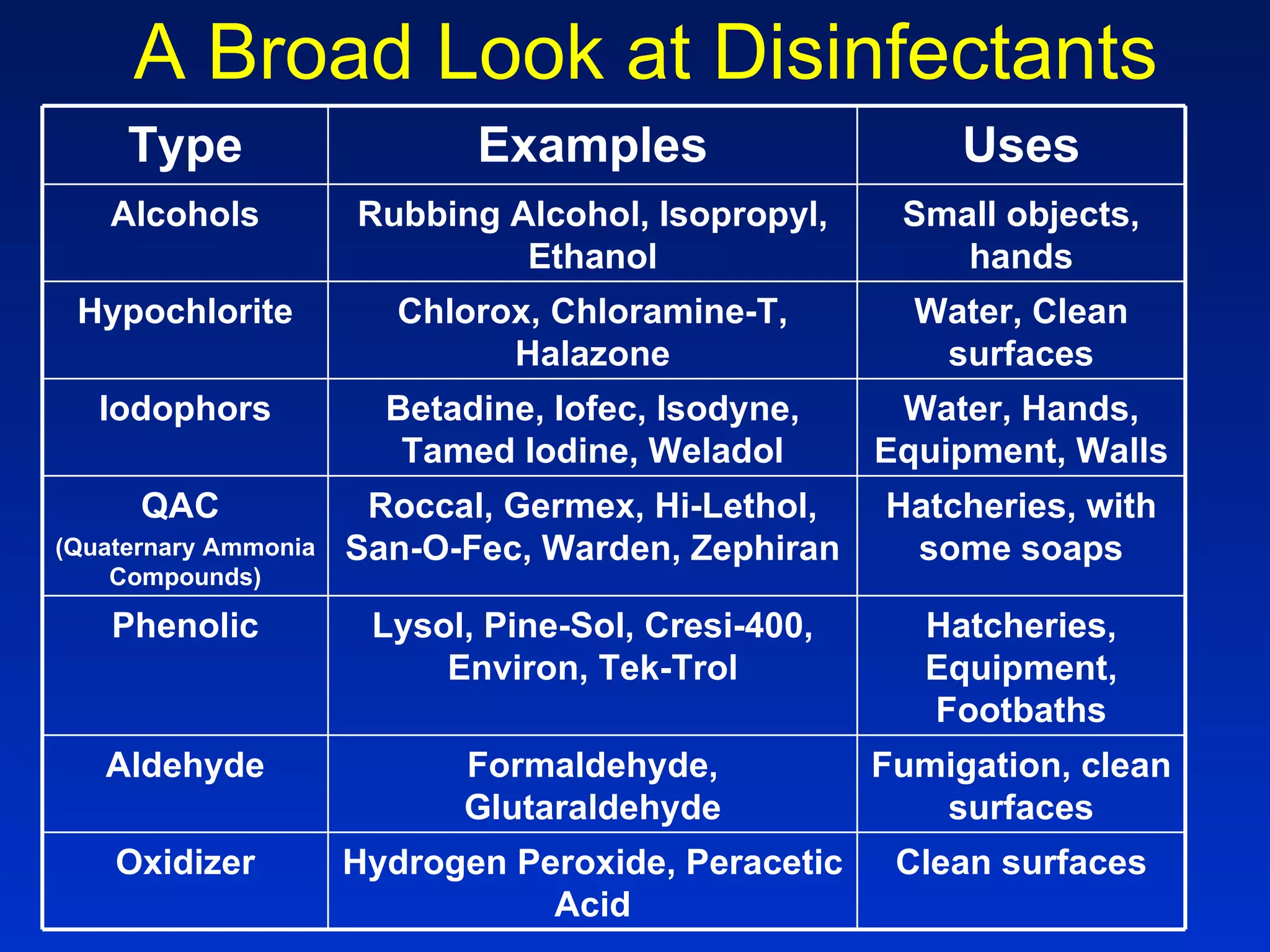
A Broad Look at Disinfectants Clean surfaces Hydrogen Peroxide, Peracetic Acid Oxidizer Fumigation, clean surfaces Formaldehyde, Glutaraldehyde Aldehyde Hatcheries, Equipment, Footbaths Lysol, Pine-Sol, Cresi-400, Environ, Tek-Trol Phenolic Hatcheries, with some soaps Roccal, Germex, Hi-Lethol, San-O-Fec, Warden, Zephiran QAC  (Quaternary Ammonia Compounds) Water, Hands, Equipment, Walls Betadine, Iofec, Isodyne, Tamed Iodine, Weladol Iodophors Water, Clean surfaces Chlorox, Chloramine-T, Halazone Hypochlorite Small objects, hands Rubbing Alcohol, Isopropyl, Ethanol Alcohols Uses Examples Type
Water Sanitation Water – A GREAT organism transmitter Consider closed line systems – Nipples or cups Clean open waterers often, but don’t dump water in the litter Proper height adjustment
Bacterial Counts from  Poultry Water Systems From: Watkins. 2003
Used with permission from: The Center for Biofilm Engineering at Montana State University – Bozeman http://www.erc.montana.edu/CBEssentials-SW/bf-basics-99/bbasics-01.htm
Used with permission from: The Center for Biofilm  Engineering at Montana State University – Bozeman http://www.erc.montana.edu/CBEssentials-SW/bf-basics-99/bbasics-01.htm
Biofilm in a Municipal Water Line
Water Line Cleaners for Use Once a Week When Birds are Present ¼ teaspoon per gallon of water 1 oz per gallon of water ½ teaspoon per gallon of water ½ teaspoon per gallon of water Iodine (18.05%) White Household Vinegar Household Bleach Clear Household Ammonia
Cleaning Closed Watering Systems with Birds in the House Meter stock solution at 1 oz / 128 oz (gal) water Prepare a stock solution 2 oz per gallon 128 oz per gallon 6 oz per gallon 6 oz per gallon Iodine (18.05%) Clear Vinegar Household Bleach Clear Household Ammonia
Basic Steps in Poultry Processing Pre-slaughter Immobilize Feather Removal Evisceration Chilling Further Processing or Packaging Kill Line Evisceration Line Separation Wall Air Flow
Sanitation in Small Processing Work indoors if possible Avoid the use of wood surfaces Use sanitizers labeled for  Food Contact Surfaces Clean and sanitize equipment before use Separate slaughter and picking from evisceration and cut up  -- Job Specialize Avoid long delays Keep things as clean as possible (insects) Don’t spare the water Cool processed carcasses quickly and keep them cool Clean and sanitize equipment before storage
Loblolly Pine Birch 100 μ Staphylococcus  - 1.0 μ Clostridium  - 0.4 x 3 μ   Treponema  0.2x 11 μ Wood Should be Avoided in Processing Areas
Sanitizers for Food Contact Surfaces Co, Cu, Ti, Mishandling Danger, Concentrate Odor Broad Act., Degrade,  Non Corrosive, Temp. Tolerant Peroxy Acid Low Temp., Corrosive Broad Act., Stable, W/ Organic Matter, High Temp Carboxylic Acid Cost, pH Stable, W/ Organic Matter, Non Corrosive, Odorless Acid-Anionic Low temps, Hard water, Little effect on gram negative bacteria Stable, Innocuous, Some Residual QAC Stains, Hard water, Temps (High & Low), Odor, Cl cheaper Broad Act., Low Tox., Stable, Color, Good Residual Iodophores Cl gas, Corrosive, Organic material, Degrades, THM’s, pH range Broad Act., Not temp. sensitive, Cheap, No Foam Chlorine, Dioxides Disadvantages Advantages Category
Natural Disinfecting Agents Sunlight (Ultraviolet rays) Heat (>85 °F) Cold (Freezing or below) Drying (Aided by wind, light and heat) EFFECTIVE, But are they reliable?
HACCP -What is it? HACCP -(HAS-SIP) H  azard A  nalysis and C  ritical C  ontrol P  oints HACCP often misused term. A systematic method of documenting that food safety hazards have been addressed.
HACCP - What is it?  HACCP involves only food safety issues. Out of control = unsafe food produced. Plans  unique for each unit and product.
HACCP – What is it? How do you know the system works? 7. Establish Verification Procedures If you don’t write it down it doesn’t exit. 6.  Establish a Record Keeping System What happens if we exceed a Critical limit? 5.  Establish Corrective Actions Who, what, when , where and how will CCP’s be monitored? 4. Establish Monitoring Procedures What value indicates the process is in control? 3.  Establish Critical Limits Where do things go wrong and how can we reliably control it? 2.  Establish Critical Control Points What are the controllable food safety hazards? 1.  Hazard Analysis Meaning Step
HOW DOES HACCP WORK? Processors must take the following steps: assemble a HACCP team to design their plan  describe the product and its method of production, distribution and intended consumer. Develop and verify process flow diagrams
How does HACCP Work?  Identify at each step of the production flow chart any hazard to food safety as to: Chemical  Physical Bacterial Support the hazard with a decision making document and scientific data
How does HACCP Work? If a CCP deviation is found the following must take place: Identify the cause of deviation Describe how the critical limit was restored Describe how the deviation can be prevented from happening again Describe how the adulterated product was reconditioned or what happened to the product
FARM TO TABLE FSIS GOALS FSIS has made a commitment to expanding into the pre harvest areas of the food chain, working in a non regulatory capacity, to promote food safety. Commitment to utilize the knowledge, skills and abilities of FSIS veterinary medical expertise to contribute to the goal of food safety.

Food Safety (Microbiology, Sanitation and HACCP)

  • 1.
    Food Safety (Microbiology, Sanitation and HACCP) Frank T. Jones Extension Poultry Specialist Cooperative Extension Service University of Arkansas Fayetteville, AR
  • 2.
    Presentation Outline SanitationDefinitions Microorganisms – Overview Public Health Background Sanitation on Farm Sanitation in Plants HACCP Overview
  • 3.
    What is Sanitation?World Health Organization (WHO) – “All precautions and measures which are necessary in production, processing, storage and distribution, in order to assure an unobjectionable, sound and palatable product which is suited for human consumption.” Sanitation from Greek Sanitas – Health N. G. Marriott – “The creation and maintenance of hygenic and healthful conditions.”
  • 4.
    Kill Organisms ExcludeContamination Prevent Multiplication Sanitation Basics
  • 5.
    Fungi Molds YeastsMicroorganisms Bacteria Viruses
  • 6.
    Beneficial Microorganisms FermentationCheese, Beer, Wine, Bread, Yogurt Enzymes Aids to Human Metabolism Decay Waste treatment, composting, decomposition
  • 7.
    “The Enemies” Pathogens– Food Safety Illness, Disease and Death Spoilage – Food Quality Poor Quality, Short Shelf Life, Off Flavors, Customer Dissatisfaction
  • 8.
    Bacteria Microscopic singlecells Lots of moisture required Cause most food illness Three basic shapes Rod Cocci (spheres) Spiral Some spore formers Grow, grow, grow Binary Fission
  • 9.
    Bacterial Reproduction – Binary Fission Generation Time 409,600 13 819,200 14 1,638,400 15 51,200 10 102,400 11 204,800 12 25,600 9 12,800 8 6,400 7 3,200 6 1,600 5 800 4 400 3 200 2 100 1 Cell Numbers Generation 21.3 14.2 7.1 2.4 Hours from 100 to 1 Million 90 60 30 10 Generation Time (Min)
  • 10.
    What Bacteria Needfor Growth? F ood A cid (pH) T ime T emperature O xygen M oisture FAT TOM
  • 11.
    The Spore CycleSpores VERY resistant Two species form spores Bacillus Clostridium Difficult to destroy – reduce strategy Problem in cooked foods
  • 12.
    Fungi (Molds andYeasts) Require less moisture Can grow in acid pH Very adaptable Grow slower than bacteria Molds – multicellular Form spores that are less resistant than bacterial spores Yeasts bud
  • 13.
    Basic Virus StructureGenetic Material (DNA or RNA) Protein Coat Tail Fibers Hollow Protein Tail
  • 14.
    Viruses Tiny Simplestructure Must grow in cells In foods – fecal contam. Personal sanitation to prevent Living? Virus Life Cycle
  • 15.
    Our Losses… Everyyear (based on CDC data): Over 250 billion meals are prepared An estimated 76 million foodborne illnesses occur >5,000 foodborne associated deaths Costs = $7.7 to 23 billion (Centers for Disease Control and Prevention, 2003)
  • 16.
    Foodborne Illness “ ... when a person becomes ill after ingesting a contaminated food...” Foodborne illness can be caused by: Biological hazards (bacteria, viruses, fungi) Chemical hazards (cleaning agents, toxins) Physical hazards (bone, glass, metal)
  • 17.
    Foodborne Hazards Hazard Est. Cases Deaths Norwalk virus 23,000,000 na Campylobacter 2,453,926 0.1% Salmonella 1,412,498 0.8% C. perfringens 248,520 .05% S. aureus 185,060 .02% E. coli O157:H7 73,480 .83% L. monocytogenes 2,518 20% C. botulinum 58 8.6% (Centers for Disease Control and Prevention, 2001)
  • 18.
    FOOD BORNE PATHOGENS:USDA – FSIS “Target Pathogens” Four major pathogens of food bone illness Salmonella E. coli 0157:H7 Campylobacter Listeria monocyctogens
  • 19.
    SALMONELLA Most frequentlyreported Introduced anywhere within the food chain Grown on any food under the right conditions: Moisture and Temperature Ideal growth temperature 40-140 ° F Cook temperature essential to kill-160 º F Safe handling of food by consumer essential
  • 20.
    E COLI 0157:H7& Campylobacter Natural inhabitant of the GI tract of all animals Sanitary practices throughout the Farm to Table essential for control Consumer education of safe handling practices for food, raw and cooked, essential for control
  • 21.
    LISTERIA MONOCYTOGENS Commonlyfound in GI tract of all animals Can survive for long periods in SOIL, SEWAGE, DUST, VEGATATION AND WATER Resistant to cool temp - Cold storage Can form biofilms on surfaces to resist cleaning and sanitizing Biggest threat:Pregnant women-miscarriages and birth defects
  • 22.
    Sanitation in LiveProduction Will never be sterile but don’t give up! 7 Basic Steps in Live Production Sanitation Obtain Clean Stock Proper Bird Care Vermin Control Moisture Control Feed Storage Biosecurity Water Sanitation
  • 23.
    Obtaining Clean StockKnow the seller Don’t look for bargains Isolate birds for 2 wks Monitor birds daily and separate sick ones
  • 24.
    Proper Birds CareHealthy birds are more resistant Pay attention to bird behavior Collect dead at least daily Provide ventilation
  • 25.
    Vermin Damage facilitiesEat feed Contaminate facilities Entry for other pests May kill animals
  • 26.
    Moisture is often THE SINGLE Most Important Factor in Determining Microbial Growth
  • 27.
    Moisture Control Littermoisture related to pathogens Moisture control related to: Addressing obvious sources Ventilation Control of Drinkers
  • 28.
  • 29.
    Feed Storage Protectionfrom Rodents & Wild Birds Protection from Moisture Protection from Heat and Sunlight Moisture Migration UV Destruction Feed Freshness
  • 30.
  • 31.
    12% 12% 12%12% 12% 12% 12% 12% 12% 16% 16% 13% 16% 13% 13% 10% 10% 10% 20% 20% 12% 20% 12% 12% 8% 8% 8% Moisture Migration in Feeds
  • 32.
  • 33.
  • 34.
    From Jones et al. 1982
  • 35.
    How Feeds Ageon Farm Birds prefer to eat pellets rather than fines Concentration of Fines Feed older than average and high in fines
  • 36.
    Biosecurity Procedures thatwork for bird pathogens also keep out human pathogens Basic Steps No Visitor Policy – Have Farm Clothes Protect Personnel – Clean Vehicles Clean Equipment – No Contact Other Birds Proper Dead Disposal – No Borrowed Equip No Visits to Problems – No Wild Game Locks & Security Avoid Mixing Animal Species
  • 37.
    Footbaths – TheGood, The Bad and The Ugly Can be effective BUT MUST pay attention Use correct disinfectant Contaminated baths spread disease and pathogens
  • 38.
    Basics Steps inSanitizer Use Avoid mixing sanitizers PARTICULARLY Chlorine @ pH<4 = Chlorine Gas In general, clean, scrub, rinse THEN sanitize Store sanitizers away from feed and birds Protect sanitizers from heat and light Avoid long storage times Use for Approved Purposes General Sanitation Food Contact Surfaces
  • 39.
    Disinfectant Types andQualities Can be corrosive Low Low Kills effects Wide no spores Hypochlorite May stain clothing, porous surfaces Low Mod Reduces effects Wide no spores Iodophors Limited residual, Mod corrosive Low Mod Kills effects Mod. No spores Oxidizer Gets everything, but can be highly toxic Mod Mod Limits effects Wide Aldehyde Good residual activity Low Mod Little to none Wide no spores Phenolic Soaps, detergents and hard water limit effectiveness Low Low Reduces effects Limited no spores QAC (Quaternary Ammonia Compounds) Non Corrosive, Fire Hazard, conc 70-95%, Low Exp Reduces effects Wide no spores Alcohols Comments Human Toxicity Cost Organic Mattter Effect Activity Type
  • 40.
    A Broad Lookat Disinfectants Clean surfaces Hydrogen Peroxide, Peracetic Acid Oxidizer Fumigation, clean surfaces Formaldehyde, Glutaraldehyde Aldehyde Hatcheries, Equipment, Footbaths Lysol, Pine-Sol, Cresi-400, Environ, Tek-Trol Phenolic Hatcheries, with some soaps Roccal, Germex, Hi-Lethol, San-O-Fec, Warden, Zephiran QAC (Quaternary Ammonia Compounds) Water, Hands, Equipment, Walls Betadine, Iofec, Isodyne, Tamed Iodine, Weladol Iodophors Water, Clean surfaces Chlorox, Chloramine-T, Halazone Hypochlorite Small objects, hands Rubbing Alcohol, Isopropyl, Ethanol Alcohols Uses Examples Type
  • 41.
    Water Sanitation Water– A GREAT organism transmitter Consider closed line systems – Nipples or cups Clean open waterers often, but don’t dump water in the litter Proper height adjustment
  • 42.
    Bacterial Counts from Poultry Water Systems From: Watkins. 2003
  • 43.
    Used with permissionfrom: The Center for Biofilm Engineering at Montana State University – Bozeman http://www.erc.montana.edu/CBEssentials-SW/bf-basics-99/bbasics-01.htm
  • 44.
    Used with permissionfrom: The Center for Biofilm Engineering at Montana State University – Bozeman http://www.erc.montana.edu/CBEssentials-SW/bf-basics-99/bbasics-01.htm
  • 45.
    Biofilm in aMunicipal Water Line
  • 46.
    Water Line Cleanersfor Use Once a Week When Birds are Present ¼ teaspoon per gallon of water 1 oz per gallon of water ½ teaspoon per gallon of water ½ teaspoon per gallon of water Iodine (18.05%) White Household Vinegar Household Bleach Clear Household Ammonia
  • 47.
    Cleaning Closed WateringSystems with Birds in the House Meter stock solution at 1 oz / 128 oz (gal) water Prepare a stock solution 2 oz per gallon 128 oz per gallon 6 oz per gallon 6 oz per gallon Iodine (18.05%) Clear Vinegar Household Bleach Clear Household Ammonia
  • 48.
    Basic Steps inPoultry Processing Pre-slaughter Immobilize Feather Removal Evisceration Chilling Further Processing or Packaging Kill Line Evisceration Line Separation Wall Air Flow
  • 49.
    Sanitation in SmallProcessing Work indoors if possible Avoid the use of wood surfaces Use sanitizers labeled for Food Contact Surfaces Clean and sanitize equipment before use Separate slaughter and picking from evisceration and cut up -- Job Specialize Avoid long delays Keep things as clean as possible (insects) Don’t spare the water Cool processed carcasses quickly and keep them cool Clean and sanitize equipment before storage
  • 50.
    Loblolly Pine Birch100 μ Staphylococcus - 1.0 μ Clostridium - 0.4 x 3 μ Treponema 0.2x 11 μ Wood Should be Avoided in Processing Areas
  • 51.
    Sanitizers for FoodContact Surfaces Co, Cu, Ti, Mishandling Danger, Concentrate Odor Broad Act., Degrade, Non Corrosive, Temp. Tolerant Peroxy Acid Low Temp., Corrosive Broad Act., Stable, W/ Organic Matter, High Temp Carboxylic Acid Cost, pH Stable, W/ Organic Matter, Non Corrosive, Odorless Acid-Anionic Low temps, Hard water, Little effect on gram negative bacteria Stable, Innocuous, Some Residual QAC Stains, Hard water, Temps (High & Low), Odor, Cl cheaper Broad Act., Low Tox., Stable, Color, Good Residual Iodophores Cl gas, Corrosive, Organic material, Degrades, THM’s, pH range Broad Act., Not temp. sensitive, Cheap, No Foam Chlorine, Dioxides Disadvantages Advantages Category
  • 52.
    Natural Disinfecting AgentsSunlight (Ultraviolet rays) Heat (>85 °F) Cold (Freezing or below) Drying (Aided by wind, light and heat) EFFECTIVE, But are they reliable?
  • 53.
    HACCP -What isit? HACCP -(HAS-SIP) H azard A nalysis and C ritical C ontrol P oints HACCP often misused term. A systematic method of documenting that food safety hazards have been addressed.
  • 54.
    HACCP - Whatis it? HACCP involves only food safety issues. Out of control = unsafe food produced. Plans unique for each unit and product.
  • 55.
    HACCP – Whatis it? How do you know the system works? 7. Establish Verification Procedures If you don’t write it down it doesn’t exit. 6. Establish a Record Keeping System What happens if we exceed a Critical limit? 5. Establish Corrective Actions Who, what, when , where and how will CCP’s be monitored? 4. Establish Monitoring Procedures What value indicates the process is in control? 3. Establish Critical Limits Where do things go wrong and how can we reliably control it? 2. Establish Critical Control Points What are the controllable food safety hazards? 1. Hazard Analysis Meaning Step
  • 56.
    HOW DOES HACCPWORK? Processors must take the following steps: assemble a HACCP team to design their plan describe the product and its method of production, distribution and intended consumer. Develop and verify process flow diagrams
  • 57.
    How does HACCPWork? Identify at each step of the production flow chart any hazard to food safety as to: Chemical Physical Bacterial Support the hazard with a decision making document and scientific data
  • 58.
    How does HACCPWork? If a CCP deviation is found the following must take place: Identify the cause of deviation Describe how the critical limit was restored Describe how the deviation can be prevented from happening again Describe how the adulterated product was reconditioned or what happened to the product
  • 59.
    FARM TO TABLEFSIS GOALS FSIS has made a commitment to expanding into the pre harvest areas of the food chain, working in a non regulatory capacity, to promote food safety. Commitment to utilize the knowledge, skills and abilities of FSIS veterinary medical expertise to contribute to the goal of food safety.