GMAW
(MIG Welding)
2
GMAW Unit Topics
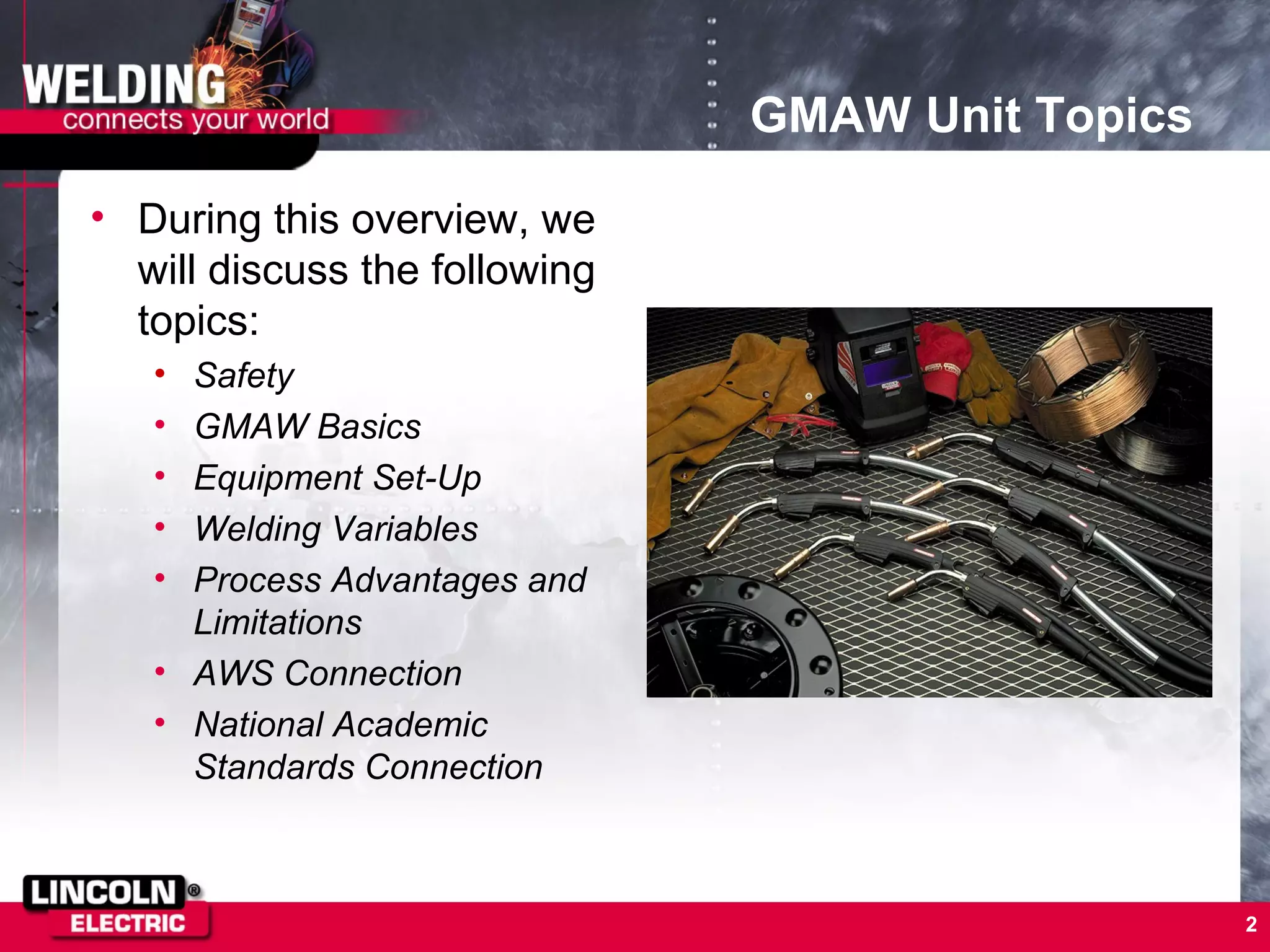
• During this overview, we
will discuss the following
topics:
• Safety
• GMAW Basics
• Equipment Set-Up
• Welding Variables
• Process Advantages and
Limitations
• AWS Connection
• National Academic
Standards Connection
3
Unit Objectives
• Upon successful
completion of the GMAW
Unit of Study, you will
have learned about:
– Properly protecting
yourself and others while
welding
– Setting up and operating
GMAW equipment
– Striking and maintaining
an arc
– Welding in four positions
using various electrodes
– Weld Inspection
– The AWS electrode
classification system
– Taking the next step to
becoming a certified
welder
4
GMAW Safety
5
GMAW Safety
• ‘GMAW Safety’ is supplemental
and does not replace the
information found in ‘Arc Welding
Basics’
• Understand and follow all safety
precautions listed in ‘Safety in
Welding, Cutting and Allied
Processes’ (ANSI Z49.1), and Arc
Welding Safety (E205)
• Understand and follow all warning
labels found:
– On welding equipment
– With all consumable packaging
– Within instruction manuals
• Read Material Safety Data Sheets
(MSDS)
If you ever have a question about your
safety or those around you,
PLEASE ASK YOUR INSTRUCTOR!
If you ever have a question about your
safety or those around you,
PLEASE ASK YOUR INSTRUCTOR!
6
GMAW Safety
• Fumes and Gases can be dangerous
– Keep your head out of the fumes
– Use enough ventilation, exhaust at the arc, or both, to keep fumes and gases
from your breathing zone and the general area
– Local exhaust and mechanical ventilation can be used without reducing weld
quality
• Electric Shock can kill – to receive a shock your body must touch the electrode
and work or ground at the same time
– Do not touch the electrode or metal parts of the electrode holder with skin or wet clothing
– Keep dry insulation between your body and the metal being welded or ground
– The coil of wire is ‘electrically hot’ when the trigger is pulled
• Arc Rays can injure eyes and skin -Choose correct filter shade (See chart below)
** Information taken from ANSI Z49.1:2005**
7
GMAW Safety
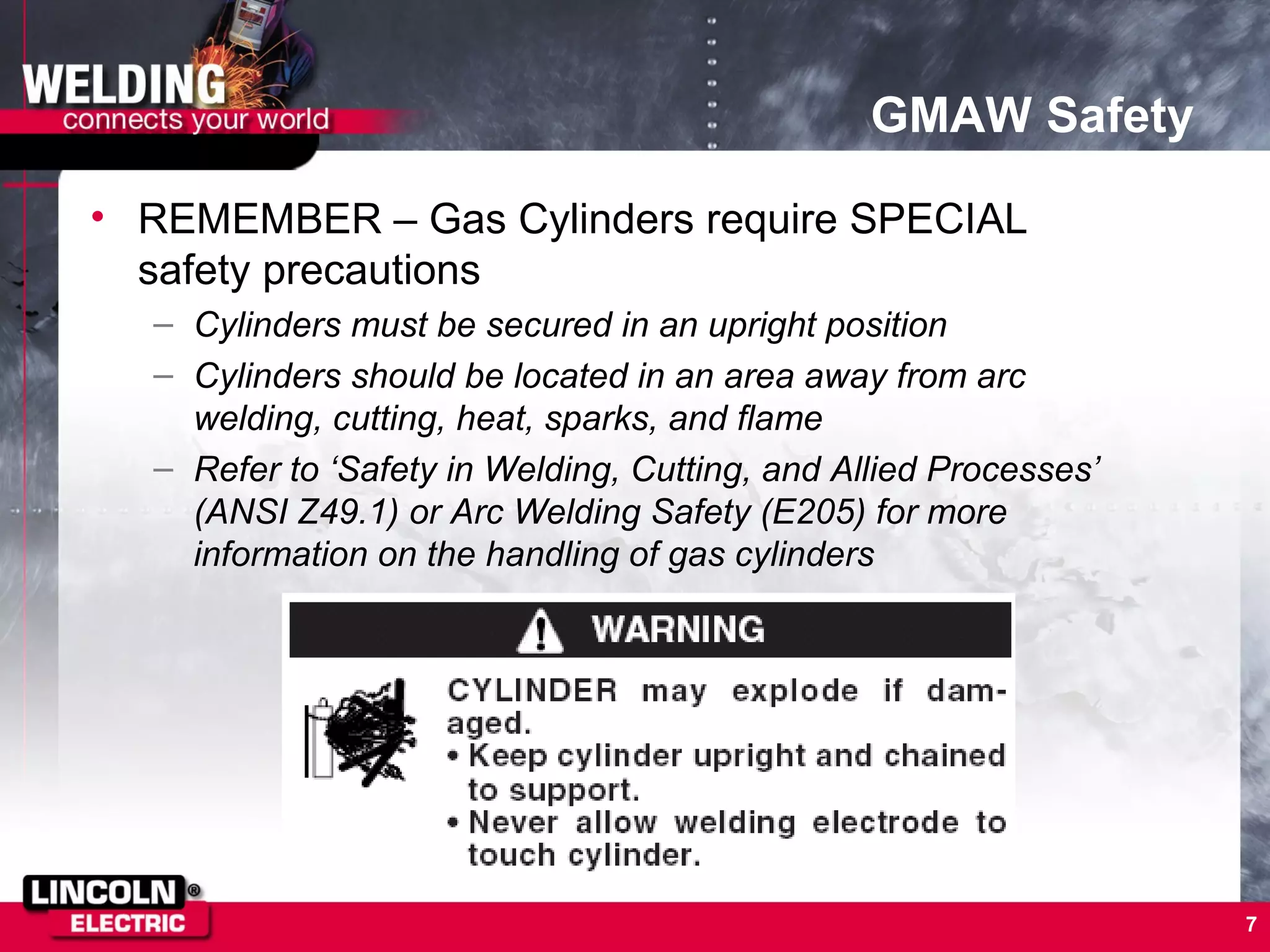
• REMEMBER – Gas Cylinders require SPECIAL
safety precautions
– Cylinders must be secured in an upright position
– Cylinders should be located in an area away from arc
welding, cutting, heat, sparks, and flame
– Refer to ‘Safety in Welding, Cutting, and Allied Processes’
(ANSI Z49.1) or Arc Welding Safety (E205) for more
information on the handling of gas cylinders
8
GMAW Principles
9
GMAW Definition
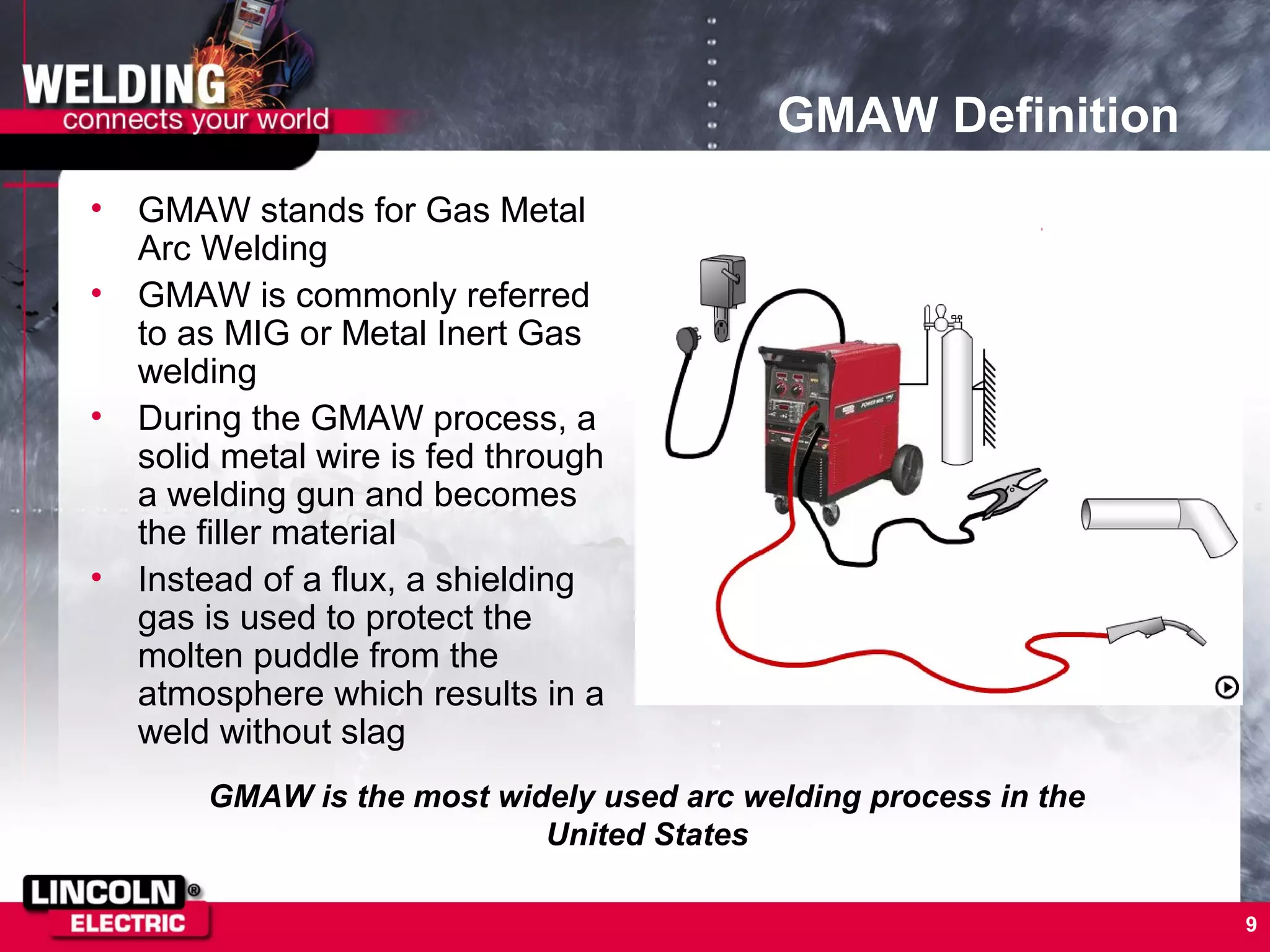
• GMAW stands for Gas Metal
Arc Welding
• GMAW is commonly referred
to as MIG or Metal Inert Gas
welding
• During the GMAW process, a
solid metal wire is fed through
a welding gun and becomes
the filler material
• Instead of a flux, a shielding
gas is used to protect the
molten puddle from the
atmosphere which results in a
weld without slag
GMAW is the most widely used arc welding process in the
United States
10
GMAW Circuit
• Three things happen
when the GMAW gun
trigger is pulled:
– The wire electrode
begins to feed
– The circuit becomes
electrically ‘hot’
• Current flows from the power source through the gun cable,
gun, contact tip to the wire and across the arc. On the other
side of the arc, current flows through the base metal to the
work cable and back to the power source
– Shielding gas flows through the gun and out the nozzle
11
GMAW Components
• Let’s look a little closer at the GMAW process
Travel direction
Electrode
1
Arc2
Weld Puddle
3
Shielding Gas4
5
Solidified Weld Metal
Generally, drag on thin sheet
metal and push on thicker
materials
12
1 - Electrode
• A GMAW electrode is:
– A metal wire
– Fed through the gun by
the wire feeder
– Measured by its
diameter
GMAW electrodes are commonly
packaged on spools, reels and
coils ranging from 1lb to 1000lbs
13
2 - Arc
• An electric arc
occurs in the gas
filled space between
the electrode wire
and the work piece
Electric arcs can generate
temperatures up to 10,000°F
14
3 - Weld Puddle
• As the wire electrode
and work piece heat
up and melt, they
form a pool of molten
material called a weld
puddle
• This is what the
welder watches and
manipulates while
welding .045” ER70S-6 at 400 ipm wire feed
speed and 28.5 Volts with a 90%
Argon/ 10% CO2 shielding gas
15
4 - Shielding Gas
• GMAW welding
requires a shielding
gas to protect the
weld puddle
• Shielding gas is
usually CO2, argon,
or a mixture of both
The gauges on the regulator show
gas flow rate and bottle pressure
16
5 - Solidified Weld Metal
• The welder “lays a
bead” of molten metal
that quickly solidifies
into a weld
• The resulting weld is
slag free
An aluminum weld done
with the GMAW process
17
Application Activity
18
GMAW Components
Application Activity
• 1 __________
• 2 __________
• 3 __________
• 4 __________
• 5 __________
• Let’s review the GMAW process
Travel direction
12
3
4
5
Generally, drag on thin sheet
metal and push on thicker
materials
19
Equipment Set Up
20
GMAW Equipment Set Up
1. Connect work clamp
2. Select electrode
a. Type
b. Diameter
3. Select shielding gas
4. Turn power supply on
5. Adjust machine output
a. Wire feed speed
b. Voltage
6. Adjust gas flow rate
Why would GMAW be a better
choice than SMAW for this job?
21
GMAW Process Variables
• Welding variables
– Wire Feed Speed (WFS)
– Voltage
• Operator controlled variables
– Travel speed
– Gun angles
– Contact tip to work distance
(CTWD)
– Gas flow rate
What is the relationship
between WFS and amperage?
22
Striking an Arc
and Making a Weld
23
Striking an Arc
• Position the gun
over joint
• Position the face
shield to protect
eyes and face
• Pull the gun trigger
and begin welding
What are some things to
consider before striking an arc?
24
Laying a Bead
The appearance of the puddle and
ridge where molten metal solidifies
indicates correct travel speed. The
ridge should be approximately 3/8”
(10 mm) behind the wire electrode.
Most beginners tend to weld too fast
resulting in a ropey bead which
means SLOW down!
The appearance of the puddle and
ridge where molten metal solidifies
indicates correct travel speed. The
ridge should be approximately 3/8”
(10 mm) behind the wire electrode.
Most beginners tend to weld too fast
resulting in a ropey bead which
means SLOW down!
• Maintain a Contact Tip to Work Distance (CTWD) of
3/8” to 1/2”
• Use a uniform travel speed
• Most Importantly – Watch the Puddle!
25
Fill the Crater
• Fill the crater by pausing
or using a slight back
step
• Release gun trigger and
pull gun away from the
work after the arc goes
out
• Large craters can cause
weld cracking
Crater cracks cannot be
tolerated on NASCAR radiators.
26
Restarting a Bead
• Restart the weld
bead by back
stepping into the
last weld’s crater
and then continue
moving forward
• This technique
should result in a
seamless
transition from one
weld to the next
2 Back step1
27
Modes of Metal
Transfer
28
Modes of Metal Transfer
• GMAW is a process that
features several distinctive,
individual methods and types
of metal transfer
• The mode of metal transfer is
determined by a number of
welding variables
– Voltage
– Amperage
– Shielding Gas
• By changing one or more
variables, you can go from
one metal transfer mode to
another
29
Modes of Metal Transfer
• Two common conventional
modes of metal transfer are:
– Short arc
– Axial spray arc
• The application, joint design,
base material thickness, and
properties determine the
appropriate mode to use
Typical short arc
application
Typical axial spray
arc application
30
Short Arc Transfer
• In short arc transfer…
– The arc is initiated
and a droplet is
formed on the end of
the wire
– The wire touches the
work piece and
produces a short
circuit
– The droplet is then
transferred to the weld
puddle
31
Axial Spray Arc Transfer
• In axial spray arc
transfer …
– Very high currents are
used
– A point forms at the
end of the electrode
and the fine droplets
– The puddle is very
fluid making out of
position welding
difficult
32
Troubleshooting
Welds
33
Troubleshooting Welds
• GOAL - Make Good Welds
• Eliminate Porosity
• Eliminate Ropey Convex bead
• Eliminate Excessive Spatter
34
Advantages and
Limitations
35
Advantages of GMAW
• High operating factor
• Easy to learn
• Limited cleanup
• Use on many different
metals: stainless steel,
mild (carbon) steel,
aluminum and more
• All position
• Great for home use with
115V and 230V units
36
Limitations of GMAW
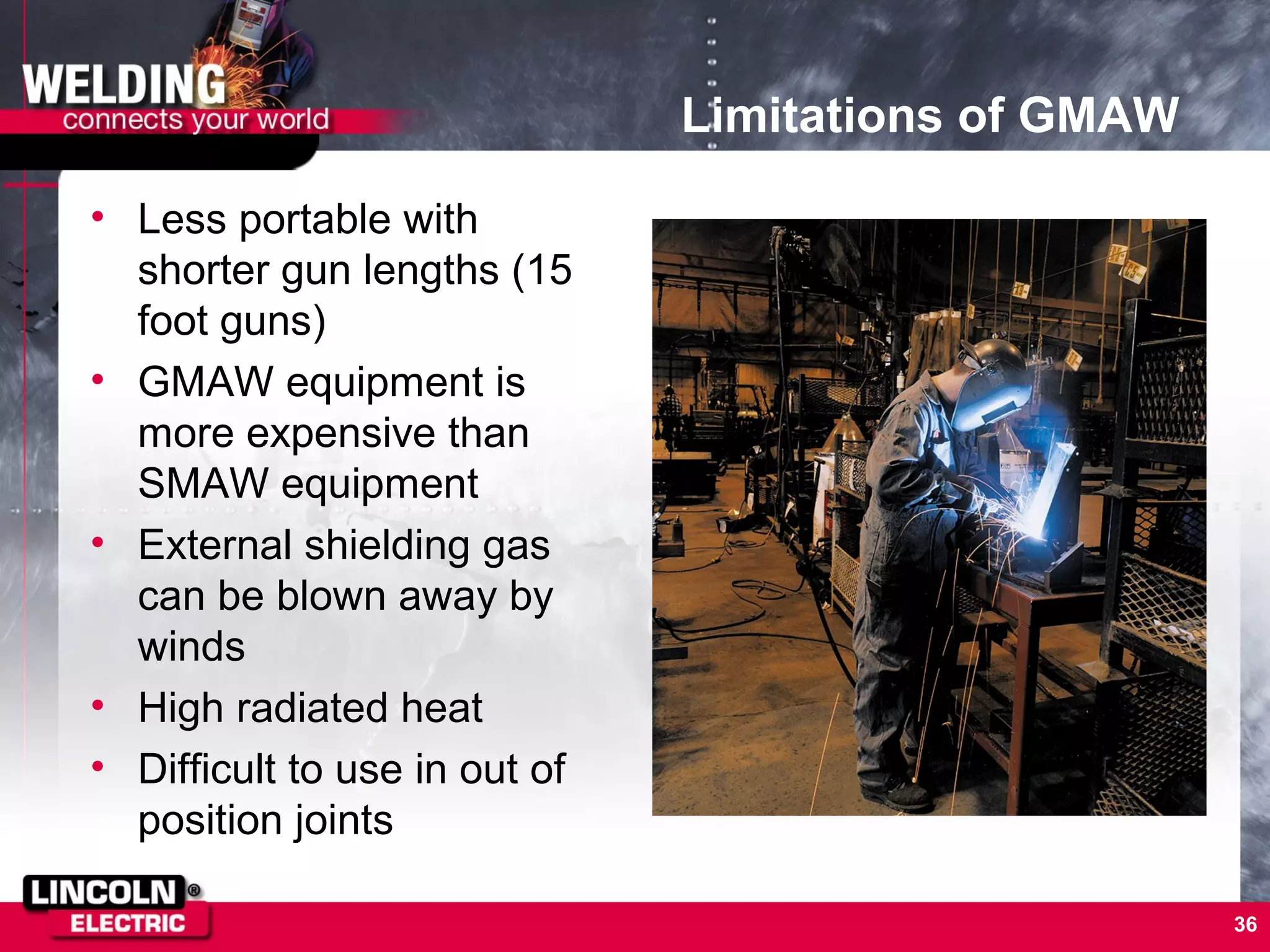
• Less portable with
shorter gun lengths (15
foot guns)
• GMAW equipment is
more expensive than
SMAW equipment
• External shielding gas
can be blown away by
winds
• High radiated heat
• Difficult to use in out of
position joints
37
AWS Classification of
GMAW Electrodes
38
ER70S-X
Electrode
Rod
70,000 psi Min. Tensile Strength
Solid
Chemistry, Amount of Deoxidizers (Silicon,
Manganese and/or Aluminum, Zirconium and
Titanium) X=2,3,4,6,7 or G
AWS Classification of
GMAW Electrodes
39
Lesson Plans
40
GMAW Lesson #1
• Objective: To run a stringer (straight) bead using short arc transfer and to fill the
crater
• Equipment:
– Single Process - Constant Voltage Power Source & Wire Feeder
 Power MIG 215 or Power MIG 255C
– Multi-Process
 Composite: Power MIG 350 MP
 Combination: V-350/ LF-72 package
• Material:
– Mild Steel Plate – 3/16” or thicker
 .035” SuperArc L-56 (ER70S-6)
 100% CO2 or 25% CO2/ 75% Argon blend shielding gas
41
GMAW Lesson #2
• Objective: To make a fillet weld on a lap joint in the horizontal position (AWS
position 2F)
• Equipment:
– Single Process - Constant Voltage Power Source & Wire Feeder
 Power MIG 215 or Power MIG 255C
– Multi-Process
 Composite: Power MIG 350 MP
 Combination: V-350/ LF-72 package
• Material
– Mild Steel Plate – 10 gauge
– .035” SuperArc L-56 (ER70S-6)
– 100% CO2 or 25% CO2/ 75% Argon blend shielding gas
2F
42
GMAW Lesson #3
• Objective: To make a fillet weld on a tee joint in the horizontal position
(AWS position 2F)
• Equipment:
– Single Process - Constant Voltage Power Source & Wire Feeder
 Power MIG 215 or Power MIG 255C
– Multi-Process –
 Composite: Power MIG 350 MP
 Combination: V-350/ LF-72 package
• Material:
– Mild Steel Plate – 10 gauge
– .035” SuperArc L-56 (ER70S-6)
– 100% CO2 or 25% CO2/ 75% Argon blend shielding gas
2F
43
GMAW Lesson #4
• Objective: To make a fillet weld on a lap joint in the vertical position welding
down (AWS position 3FD)
• Equipment:
– Single Process - Constant Voltage Power Source & Wire Feeder
 Power MIG 215 or Power MIG 255C
– Multi-Process –
 Composite: Power MIG 350 MP
 Combination: V-350/ LF-72 package
• Material:
– Mild Steel Plate – 10 gauge
– .035” SuperArc L-56 (ER70S-6)
– 100% CO2 or 25% CO2/ 75% Argon blend shielding gas
3FD
44
GMAW Lesson #5
• Objective: To make a fillet weld on a tee joint in the vertical position welding down (AWS
position 3FD)
• Equipment:
– Single Process - Constant Voltage Power Source & Wire Feeder
 Power MIG 215 or Power MIG 255C
– Multi-Process –
 Composite: Power MIG 350 MP
 Combination: V-350/ LF-72 package
• Material:
– Mild Steel Plate – 10 gauge
– .035” SuperArc L-56 (ER70S-6)
– 100% CO2 or 25% CO2/ 75% Argon blend shielding gas
3FD
45
GMAW Lesson #6
• Objective: To make a butt weld with a gap in the vertical position
welding down
• Equipment:
– Single Process - Constant Voltage Power Source & Wire Feeder
 Power MIG 215 or Power MIG 255C
– Multi-Process –
 Composite: Power MIG 350 MP
 Combination: V-350/ LF-72 package
• Material:
– Mild Steel Plate – 10 gauge
– .035” SuperArc L-56 (ER70S-6)
– 100% CO2 or 25% CO2/ 75% Argon blend shielding gas
3G
46
GMAW Lesson #7
• Objective: To make a fillet weld on a tee joint
in the overhead position (AWS position 4F)
• Equipment:
– Single Process - Constant Voltage Power
Source & Wire Feeder
 Power MIG 215 or Power MIG 255C
– Multi-Process –
 Composite: Power MIG 350 MP
 Combination: V-350/ LF-72 package
• Material:
– Mild Steel Plate – 10 gauge
– .035” SuperArc L-56 (ER70S-6)
– 100% CO2 or 25% CO2/ 75% Argon blend
shielding gas
4F
47
GMAW Lesson #8
• Objective: To make a three pass fillet weld on a tee
joint in the horizontal position (AWS position 2F)
• Equipment:
– Single Process - Constant Voltage Power Source
& Wire Feeder
 Power MIG 215 or Power MIG 255C
– Multi-Process –
 Composite: Power MIG 350 MP
 Combination: V-350/ LF-72 package
• Material:
– Mild Steel Plate – ¼”
– .035” SuperArc L-56 (ER70S-6)
– 100% CO2 or 25% CO2/ 75% Argon blend shielding gas
2F
48
GMAW Lesson #9
• Objective: To run a horizontal fillet weld on a tee joint using axial
spray transfer (AWS position 2F)
• Equipment:
– Single Process - Constant Voltage Power Source
& Wire Feeder
 Power MIG 225C
– Multi-Process –
 Composite: Power MIG 350 MP
 Combination: V-350/ LF-72 package Material:
– Mild Steel Plate – ¼”
– .045” SuperArc L-56 (ER70S-6)
– 90% Argon/ 10% CO2 blend shielding gas
2F
49
AWS Connection
50
American Welding Society
(AWS) Connection
• The GMAW unit of study
covered information related
to the following AWS
requirements for
certification:
– Setting up for GMAW
operations on carbon steel
– Operating GMAW equipment
on carbon steel
– Making GMAW fillet welds on
carbon steel
51
English, Math, and Science
Connection
52
National Academic Standards
Crosswalk
• This unit covered academic content listed in the
National Academic Standards as follows:
– NM-MEA.9-12.1: Understands measurable attributes of objects
and the units, systems, and processes of measurement
– NM-PROB.CONN.PK-12.3: Recognizes and applies
mathematics in contexts outside of mathematics.
– NS-PHYSICAL SCIENCE: (Understands) structure and
property of matter
– NS-PHYSICAL SCIENCE: (Understands) chemical reactions
– NLA-STANDARD 3: Uses grammatical and mechanical
conventions in written compositions
– NLA-STANDARD 10: Understands the characteristics and
components of the media

gmaw mig welding

  • 1.
  • 2.
    2 GMAW Unit Topics •During this overview, we will discuss the following topics: • Safety • GMAW Basics • Equipment Set-Up • Welding Variables • Process Advantages and Limitations • AWS Connection • National Academic Standards Connection
  • 3.
    3 Unit Objectives • Uponsuccessful completion of the GMAW Unit of Study, you will have learned about: – Properly protecting yourself and others while welding – Setting up and operating GMAW equipment – Striking and maintaining an arc – Welding in four positions using various electrodes – Weld Inspection – The AWS electrode classification system – Taking the next step to becoming a certified welder
  • 4.
  • 5.
    5 GMAW Safety • ‘GMAWSafety’ is supplemental and does not replace the information found in ‘Arc Welding Basics’ • Understand and follow all safety precautions listed in ‘Safety in Welding, Cutting and Allied Processes’ (ANSI Z49.1), and Arc Welding Safety (E205) • Understand and follow all warning labels found: – On welding equipment – With all consumable packaging – Within instruction manuals • Read Material Safety Data Sheets (MSDS) If you ever have a question about your safety or those around you, PLEASE ASK YOUR INSTRUCTOR! If you ever have a question about your safety or those around you, PLEASE ASK YOUR INSTRUCTOR!
  • 6.
    6 GMAW Safety • Fumesand Gases can be dangerous – Keep your head out of the fumes – Use enough ventilation, exhaust at the arc, or both, to keep fumes and gases from your breathing zone and the general area – Local exhaust and mechanical ventilation can be used without reducing weld quality • Electric Shock can kill – to receive a shock your body must touch the electrode and work or ground at the same time – Do not touch the electrode or metal parts of the electrode holder with skin or wet clothing – Keep dry insulation between your body and the metal being welded or ground – The coil of wire is ‘electrically hot’ when the trigger is pulled • Arc Rays can injure eyes and skin -Choose correct filter shade (See chart below) ** Information taken from ANSI Z49.1:2005**
  • 7.
    7 GMAW Safety • REMEMBER– Gas Cylinders require SPECIAL safety precautions – Cylinders must be secured in an upright position – Cylinders should be located in an area away from arc welding, cutting, heat, sparks, and flame – Refer to ‘Safety in Welding, Cutting, and Allied Processes’ (ANSI Z49.1) or Arc Welding Safety (E205) for more information on the handling of gas cylinders
  • 8.
  • 9.
    9 GMAW Definition • GMAWstands for Gas Metal Arc Welding • GMAW is commonly referred to as MIG or Metal Inert Gas welding • During the GMAW process, a solid metal wire is fed through a welding gun and becomes the filler material • Instead of a flux, a shielding gas is used to protect the molten puddle from the atmosphere which results in a weld without slag GMAW is the most widely used arc welding process in the United States
  • 10.
    10 GMAW Circuit • Threethings happen when the GMAW gun trigger is pulled: – The wire electrode begins to feed – The circuit becomes electrically ‘hot’ • Current flows from the power source through the gun cable, gun, contact tip to the wire and across the arc. On the other side of the arc, current flows through the base metal to the work cable and back to the power source – Shielding gas flows through the gun and out the nozzle
  • 11.
    11 GMAW Components • Let’slook a little closer at the GMAW process Travel direction Electrode 1 Arc2 Weld Puddle 3 Shielding Gas4 5 Solidified Weld Metal Generally, drag on thin sheet metal and push on thicker materials
  • 12.
    12 1 - Electrode •A GMAW electrode is: – A metal wire – Fed through the gun by the wire feeder – Measured by its diameter GMAW electrodes are commonly packaged on spools, reels and coils ranging from 1lb to 1000lbs
  • 13.
    13 2 - Arc •An electric arc occurs in the gas filled space between the electrode wire and the work piece Electric arcs can generate temperatures up to 10,000°F
  • 14.
    14 3 - WeldPuddle • As the wire electrode and work piece heat up and melt, they form a pool of molten material called a weld puddle • This is what the welder watches and manipulates while welding .045” ER70S-6 at 400 ipm wire feed speed and 28.5 Volts with a 90% Argon/ 10% CO2 shielding gas
  • 15.
    15 4 - ShieldingGas • GMAW welding requires a shielding gas to protect the weld puddle • Shielding gas is usually CO2, argon, or a mixture of both The gauges on the regulator show gas flow rate and bottle pressure
  • 16.
    16 5 - SolidifiedWeld Metal • The welder “lays a bead” of molten metal that quickly solidifies into a weld • The resulting weld is slag free An aluminum weld done with the GMAW process
  • 17.
  • 18.
    18 GMAW Components Application Activity •1 __________ • 2 __________ • 3 __________ • 4 __________ • 5 __________ • Let’s review the GMAW process Travel direction 12 3 4 5 Generally, drag on thin sheet metal and push on thicker materials
  • 19.
  • 20.
    20 GMAW Equipment SetUp 1. Connect work clamp 2. Select electrode a. Type b. Diameter 3. Select shielding gas 4. Turn power supply on 5. Adjust machine output a. Wire feed speed b. Voltage 6. Adjust gas flow rate Why would GMAW be a better choice than SMAW for this job?
  • 21.
    21 GMAW Process Variables •Welding variables – Wire Feed Speed (WFS) – Voltage • Operator controlled variables – Travel speed – Gun angles – Contact tip to work distance (CTWD) – Gas flow rate What is the relationship between WFS and amperage?
  • 22.
  • 23.
    23 Striking an Arc •Position the gun over joint • Position the face shield to protect eyes and face • Pull the gun trigger and begin welding What are some things to consider before striking an arc?
  • 24.
    24 Laying a Bead Theappearance of the puddle and ridge where molten metal solidifies indicates correct travel speed. The ridge should be approximately 3/8” (10 mm) behind the wire electrode. Most beginners tend to weld too fast resulting in a ropey bead which means SLOW down! The appearance of the puddle and ridge where molten metal solidifies indicates correct travel speed. The ridge should be approximately 3/8” (10 mm) behind the wire electrode. Most beginners tend to weld too fast resulting in a ropey bead which means SLOW down! • Maintain a Contact Tip to Work Distance (CTWD) of 3/8” to 1/2” • Use a uniform travel speed • Most Importantly – Watch the Puddle!
  • 25.
    25 Fill the Crater •Fill the crater by pausing or using a slight back step • Release gun trigger and pull gun away from the work after the arc goes out • Large craters can cause weld cracking Crater cracks cannot be tolerated on NASCAR radiators.
  • 26.
    26 Restarting a Bead •Restart the weld bead by back stepping into the last weld’s crater and then continue moving forward • This technique should result in a seamless transition from one weld to the next 2 Back step1
  • 27.
  • 28.
    28 Modes of MetalTransfer • GMAW is a process that features several distinctive, individual methods and types of metal transfer • The mode of metal transfer is determined by a number of welding variables – Voltage – Amperage – Shielding Gas • By changing one or more variables, you can go from one metal transfer mode to another
  • 29.
    29 Modes of MetalTransfer • Two common conventional modes of metal transfer are: – Short arc – Axial spray arc • The application, joint design, base material thickness, and properties determine the appropriate mode to use Typical short arc application Typical axial spray arc application
  • 30.
    30 Short Arc Transfer •In short arc transfer… – The arc is initiated and a droplet is formed on the end of the wire – The wire touches the work piece and produces a short circuit – The droplet is then transferred to the weld puddle
  • 31.
    31 Axial Spray ArcTransfer • In axial spray arc transfer … – Very high currents are used – A point forms at the end of the electrode and the fine droplets – The puddle is very fluid making out of position welding difficult
  • 32.
  • 33.
    33 Troubleshooting Welds • GOAL- Make Good Welds • Eliminate Porosity • Eliminate Ropey Convex bead • Eliminate Excessive Spatter
  • 34.
  • 35.
    35 Advantages of GMAW •High operating factor • Easy to learn • Limited cleanup • Use on many different metals: stainless steel, mild (carbon) steel, aluminum and more • All position • Great for home use with 115V and 230V units
  • 36.
    36 Limitations of GMAW •Less portable with shorter gun lengths (15 foot guns) • GMAW equipment is more expensive than SMAW equipment • External shielding gas can be blown away by winds • High radiated heat • Difficult to use in out of position joints
  • 37.
  • 38.
    38 ER70S-X Electrode Rod 70,000 psi Min.Tensile Strength Solid Chemistry, Amount of Deoxidizers (Silicon, Manganese and/or Aluminum, Zirconium and Titanium) X=2,3,4,6,7 or G AWS Classification of GMAW Electrodes
  • 39.
  • 40.
    40 GMAW Lesson #1 •Objective: To run a stringer (straight) bead using short arc transfer and to fill the crater • Equipment: – Single Process - Constant Voltage Power Source & Wire Feeder  Power MIG 215 or Power MIG 255C – Multi-Process  Composite: Power MIG 350 MP  Combination: V-350/ LF-72 package • Material: – Mild Steel Plate – 3/16” or thicker  .035” SuperArc L-56 (ER70S-6)  100% CO2 or 25% CO2/ 75% Argon blend shielding gas
  • 41.
    41 GMAW Lesson #2 •Objective: To make a fillet weld on a lap joint in the horizontal position (AWS position 2F) • Equipment: – Single Process - Constant Voltage Power Source & Wire Feeder  Power MIG 215 or Power MIG 255C – Multi-Process  Composite: Power MIG 350 MP  Combination: V-350/ LF-72 package • Material – Mild Steel Plate – 10 gauge – .035” SuperArc L-56 (ER70S-6) – 100% CO2 or 25% CO2/ 75% Argon blend shielding gas 2F
  • 42.
    42 GMAW Lesson #3 •Objective: To make a fillet weld on a tee joint in the horizontal position (AWS position 2F) • Equipment: – Single Process - Constant Voltage Power Source & Wire Feeder  Power MIG 215 or Power MIG 255C – Multi-Process –  Composite: Power MIG 350 MP  Combination: V-350/ LF-72 package • Material: – Mild Steel Plate – 10 gauge – .035” SuperArc L-56 (ER70S-6) – 100% CO2 or 25% CO2/ 75% Argon blend shielding gas 2F
  • 43.
    43 GMAW Lesson #4 •Objective: To make a fillet weld on a lap joint in the vertical position welding down (AWS position 3FD) • Equipment: – Single Process - Constant Voltage Power Source & Wire Feeder  Power MIG 215 or Power MIG 255C – Multi-Process –  Composite: Power MIG 350 MP  Combination: V-350/ LF-72 package • Material: – Mild Steel Plate – 10 gauge – .035” SuperArc L-56 (ER70S-6) – 100% CO2 or 25% CO2/ 75% Argon blend shielding gas 3FD
  • 44.
    44 GMAW Lesson #5 •Objective: To make a fillet weld on a tee joint in the vertical position welding down (AWS position 3FD) • Equipment: – Single Process - Constant Voltage Power Source & Wire Feeder  Power MIG 215 or Power MIG 255C – Multi-Process –  Composite: Power MIG 350 MP  Combination: V-350/ LF-72 package • Material: – Mild Steel Plate – 10 gauge – .035” SuperArc L-56 (ER70S-6) – 100% CO2 or 25% CO2/ 75% Argon blend shielding gas 3FD
  • 45.
    45 GMAW Lesson #6 •Objective: To make a butt weld with a gap in the vertical position welding down • Equipment: – Single Process - Constant Voltage Power Source & Wire Feeder  Power MIG 215 or Power MIG 255C – Multi-Process –  Composite: Power MIG 350 MP  Combination: V-350/ LF-72 package • Material: – Mild Steel Plate – 10 gauge – .035” SuperArc L-56 (ER70S-6) – 100% CO2 or 25% CO2/ 75% Argon blend shielding gas 3G
  • 46.
    46 GMAW Lesson #7 •Objective: To make a fillet weld on a tee joint in the overhead position (AWS position 4F) • Equipment: – Single Process - Constant Voltage Power Source & Wire Feeder  Power MIG 215 or Power MIG 255C – Multi-Process –  Composite: Power MIG 350 MP  Combination: V-350/ LF-72 package • Material: – Mild Steel Plate – 10 gauge – .035” SuperArc L-56 (ER70S-6) – 100% CO2 or 25% CO2/ 75% Argon blend shielding gas 4F
  • 47.
    47 GMAW Lesson #8 •Objective: To make a three pass fillet weld on a tee joint in the horizontal position (AWS position 2F) • Equipment: – Single Process - Constant Voltage Power Source & Wire Feeder  Power MIG 215 or Power MIG 255C – Multi-Process –  Composite: Power MIG 350 MP  Combination: V-350/ LF-72 package • Material: – Mild Steel Plate – ¼” – .035” SuperArc L-56 (ER70S-6) – 100% CO2 or 25% CO2/ 75% Argon blend shielding gas 2F
  • 48.
    48 GMAW Lesson #9 •Objective: To run a horizontal fillet weld on a tee joint using axial spray transfer (AWS position 2F) • Equipment: – Single Process - Constant Voltage Power Source & Wire Feeder  Power MIG 225C – Multi-Process –  Composite: Power MIG 350 MP  Combination: V-350/ LF-72 package Material: – Mild Steel Plate – ¼” – .045” SuperArc L-56 (ER70S-6) – 90% Argon/ 10% CO2 blend shielding gas 2F
  • 49.
  • 50.
    50 American Welding Society (AWS)Connection • The GMAW unit of study covered information related to the following AWS requirements for certification: – Setting up for GMAW operations on carbon steel – Operating GMAW equipment on carbon steel – Making GMAW fillet welds on carbon steel
  • 51.
    51 English, Math, andScience Connection
  • 52.
    52 National Academic Standards Crosswalk •This unit covered academic content listed in the National Academic Standards as follows: – NM-MEA.9-12.1: Understands measurable attributes of objects and the units, systems, and processes of measurement – NM-PROB.CONN.PK-12.3: Recognizes and applies mathematics in contexts outside of mathematics. – NS-PHYSICAL SCIENCE: (Understands) structure and property of matter – NS-PHYSICAL SCIENCE: (Understands) chemical reactions – NLA-STANDARD 3: Uses grammatical and mechanical conventions in written compositions – NLA-STANDARD 10: Understands the characteristics and components of the media

Editor's Notes

  • #2 SECTION OVERVIEW: Section Overviews are provided on the introductory slides at the front of each topical area to explain the intended use for the slides included in the section. Slide numbers are included on the Section Overview slides for easy reference when preparing for delivery of the slide content. TEACHER NOTES: Teacher Notes are included on the Section Overview slides as a reference tool when making class preparations. Suggested Activities are included as ideas for teachers to use to help students gain practical experience with the welding content. However, these are designed to be supplemented by each teacher based on local program needs. Slides have been developed to incorporate content information regarding performance standards from the American Welding Society (AWS) and the National Academic Standards for English, Science, and Math. INDIVIDUAL LESSON NOTES ARE AVAILABLE IN LESSON PLAN FACILITATOR’S GUIDE
  • #3 SECTION OVERVIEW: This slide is meant to start generating conversation and thoughts about content to be covered in this lesson. TEACHER NOTES: Bulleted information on topical areas is provided to lead class discussion on areas which are to be covered in the training.
  • #4 SECTION OVERVIEW: This slide is included to explain the objectives of this unit of study. TEACHER NOTES: Teachers could use this opportunity to give a high-level overview of the importance and application of GMAW welding in today’s society.
  • #5 SECTION OVERVIEW: The next few slides are meant to point out safety requirements when using the GMAW process. TEACHER NOTES: Slides 4-7: Bulleted information on topical areas is provided to lead class discussion on important areas of safety to be practiced in the GMAW welding environment. To download your own copy of ‘Safety in Welding, Cutting and Allied Processes’ (ANSI Z49.1) go to: www.aws.org/technical/facts/Z49.1-2005-all.pdf To download your own copy of Lincoln Electric’s Arc Welding Safety (E205) document go to: http://content.lincolnelectric.com/pdfs/products/literature/e205.pdf To order copies of Lincoln Electric’s Arc Welding Safety (E205) document and poster (E201) go to: www.lincolnelectric.com (Quick Link: Literature Request) MSDS can be obtained from Lincoln Consumable packaging, online at www.lincolnelectric.com (Quick Link: MSDS) or by calling 1-216-481-8100 For a free DVD on Welding Safely, submit order form in the back of the Lesson Plan Facilitator’s Guide (shipping and handling charges apply). See Facilitator’s Guide for more information on welding hazards such as Fumes and Gases and Electrical Shock.
  • #9 SECTION OVERVIEW: These slides are meant to lead into the discussion on the components involved with GMAW welding. TEACHER NOTES: Slides 8-16: When using these slides, discussion could include: With semi-automatic MIG welding, the electrode wire is fed through a welding gun controlled by the operator. The operator starts the arc and controls the puddle. In automatic MIG welding, a robot or automated machine makes the weld. An arc digs into the base metal much like water from a nozzle on a garden hose digs into the earth. (The flow of the water is like welding current and water pressure is similar to voltage) Molten metal forms a molten pool or crater and tends to flow away from the arc while cooling and solidifying. A continuous even flow of shielding gas is needed to protect the molten weld metal from atmospheric contaminants such as oxygen and nitrogen. The shielding gas comes from a gas cylinder and flows through the gun and cable assembly, through the gas nozzle, and into the welding zone.
  • #18 SECTION OVERVIEW: This slide reviews what has been learned about the GMAW process. TEACHER NOTES: (Explanation of Activity) Slide 17-18: After having discussed the parts included on this slide, students will take a quiz as an application activity. For the activity, have participants work individually and mark 1-5 on a piece of paper. Explain that this activity is meant to check student understanding of GMAW before beginning to apply the process in the lab. Project slide on the screen and have each student fill in the blanks on a piece of paper to be turned in. Collect papers and discuss. Answers to the Application Activity are: 1. Electrode 2. Arc 3. Weld Puddle 4. Shielding Gas 5. Solidified Weld Metal
  • #20 SECTION OVERVIEW: These slides explain how to set-up the equipment for GMAW and covers process variables. TEACHER NOTES: Slides 19-21: For welding procedure recommendations see: The Lesson Plan Facilitator’s Guide Lincoln Electric’s GMAW Welding Guide - http://content.lincolnelectric.com/pdfs/products/literature/c4200.pdf The inside of a Lincoln Electric combination wire feeder/ welder. Check the gas nozzle. Turn the gas supply on. If adjustable, set for 15-20 cubic feet per hour (7 to 10 l/min.) under normal conditions increasing to as high as 35 CFH (17 l/min) in drafty and/or slightly windy conditions. The liner and contact tip should match that of the electrode diameter being used. The work clamp must be grounded to the work piece. Be sure to make a good connection.
  • #23 SECTION OVERVIEW: These slides discuss striking an arc and making a weld using the GMAW process. TEACHER NOTES: Slides 22-26: Teacher might want to discuss … Once the arc has been established, maintaining the correct contact tip to work distance (CTWD) becomes extremely important. The CTWD should be approximately 3/8 to ½ inch (10-12 mm) long. The easiest way to tell if CTWD is right length is to listen to the sound. If the CTWD is too short the wire electrode can fuse to the contact tip. It also causes the arc voltage to raise resulting in a flat bead shape, increase in spatter and possible undercut. If the CTWD is too long the electrode can stub out. It also causes the arc voltage to drop resulting in a ropey and convex bead, increase in spatter and possible loss of gas shielding.
  • #28 SECTION OVERVIEW: These slides discuss two conventional modes of metal transfer: short arc and spray arc TEACHER NOTES: Slides 27-31: Short Arc Transfer The wire shorts to the base material, the molten metal is pinched off and transferred to the weld puddle. Common gas mixtures for short arc: 100% CO2 or 75% Argon/ 25% CO2 Typical applications include thin materials, out of position welding, joints with poor fit up, root pass on pipe and when using 110V welders. Axial Spray Arc Transfer Very high currents are used in axial spray arc transfer (or spray arc). The current level must be above the transition level and the shielding gas must contain at least 80% Argon. A point forms at the end of the electrode and fine droplets of molten metal ‘spray’ across the arc. The droplets are equal to or smaller than the electrode diameter and are directed axially in a straight line to the weld puddle. Typical applications include thick materials, flat and horizontal welding, structural fabrication, heavy machinery and aluminum welding. For more information on the conventional modes of metal transfer see the GMAW Lesson Plan Facilitator’s Guide and Lincoln Electric’s free GMAW Welding Guide (http://content.lincolnelectric.com/pdfs/products/literature/c4200.pdf)
  • #33 SECTION OVERVIEW: The next slide explains about troubleshooting welds. TEACHER NOTES: Slide 32-33: Corrective actions for common GMAW problems: Porosity Check for proper gas flow/ block any winds or drafts Clean joints from moisture, paint, etc. Check for proper WFS and Voltage settings Decrease CTWD, drag angle, and travel speed Ropey and Convex Check or reset WFS & Volts (increase voltage first) Decrease CTWD, travel speed, and drag angle (push angle) Excessive Spatter Check and reset WFS and Volts Increase drag angle Decrease CTWD and travel speed Eliminate Stubbing Check or rest WFS & Volts (increase voltage first) Decrease CTWD Increase drag angle
  • #35 SECTION OVERVIEW: This section is meant to lead into a discussion regarding the advantages and limitations of the GMAW welding process. TEACHER NOTES: Slides 34-36: Advantages High operating factor: The welder does not have to stop and clean slag or change electrodes. Easy to learn: GMAW is easier to learn than Stick welding Clean process with little or no slag and spatter - High efficiency (93-98%) Welds can be made on a wide variety of metals and alloys. Can be done in all welding positions Disadvantages: Less portable – Gun lengths are often only 15 feet long. More expensive due to higher equipment price than SMAW and the need for a gas bottle. Shielding gas can be blown away by winds so GMAW may require special precautions when welding outdoors or in drafty areas. In spray arc transfer - the process radiates a lot of heat Difficult to use in out of position joints For more information on GMAW consumables and gases, see the Lesson Plan Facilitator’s Guide or GMAW Welding Guide available through Lincoln Electric
  • #38 SECTION OVERVIEW: This section is meant to lead into a discussion about the AWS Classification of GMAW Electrodes TEACHER NOTES: Slides 37-38 For more information on the AWS classification of GMAW electrodes see Lincoln Electric’s free ‘GMAW Welding Guide’ - http://content.lincolnelectric.com/pdfs/products/literature/c4200.pdf
  • #40 SECTION OVERVIEW: These slides are used for practicing lesson content in the lab setting. TEACHER NOTES: Slides 39-48: When using these slides, reference information included in the Facilitator’s Guide. Recommended equipment – Only one of the single process or multi-process machines is required to complete the lesson.
  • #50 SECTION OVERVIEW: The next few slides discuss the connection of this unit with AWS and the certification process. TEACHER NOTES: Slide 49-50: Content included in this unit of study is designed to be used by interested students as a building block in the learning process if interested in pursuing a certification program
  • #52 SECTION OVERVIEW: The next slide discusses how the content covered in the welding unit is applicable to English, Math, and Science classes. TEACHER NOTES: Slides 51-52: This slide contains information regarding how this welding unit of study relates to the National Academic Standards.