Lean Culture Introduction
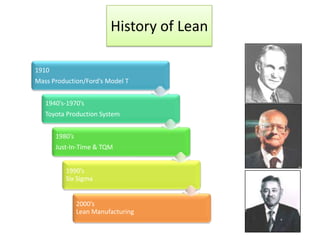
History of Lean

1910
Mass Production/Ford’s Model T


   1940’s-1970’s
   Toyota Production System


       1980’s
       Just-In-Time & TQM


          1990’s
          Six Sigma


                2000’s
                Lean Manufacturing
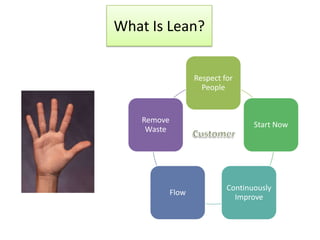
What Is Lean?


                    Respect for
                      People


    Remove
                                    Start Now
     Waste


                             Continuously
             Flow
                               Improve
Respect For
                       People
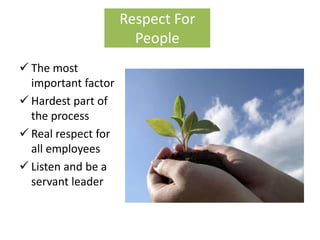
 The most
  important factor
 Hardest part of
  the process
 Real respect for
  all employees
 Listen and be a
  servant leader
Respect For           Be an Employer of Choice
    People
Employees want*:
Empowerment to
Make Decisions
Opportunities for
Growth &
Development
Variety
Mutual Support and
Respect
Sense of Purpose
Desirable Future
  *BusinessWeek, 2008
Respect For                                  Employees Are Essential
      People
    Only 21% of
employees are willing
   to go the extra
  distance to help
 company succeed*

     Firms with most
  engaged employees
   increase operating
     income 19% and
   earnings per share
    28% year to year*
*2007 Towers Perrin survey, 18 countries, 40 companies,
90,000 employees
Respect For                                Change your Culture –
                                               Change your Future
     People
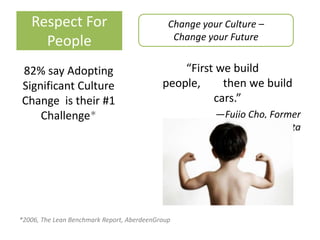
82% say Adopting                                “First we build
Significant Culture                         people,     then we build
Change is their #1                                    cars.”
    Challenge*                                          —Fujio Cho, Former
                                                         Chairman, Toyota


*2006, The Lean Benchmark Report, AberdeenGroup
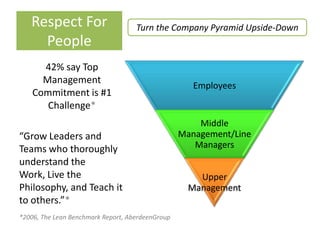
Respect For                      Turn the Company Pyramid Upside-Down
     People
      42% say Top
      Management
                                                     Employees
    Commitment is #1
       Challenge*
                                                      Middle
“Grow Leaders and                                 Management/Line
Teams who thoroughly                                 Managers
understand the
Work, Live the                                        Upper
Philosophy, and Teach it                            Management
to others.”*
*2006, The Lean Benchmark Report, AberdeenGroup
Respect For                            Your Culture is your Cornerstone
      People


      Only 10% of
 employees say senior
  management treats
     them as most
   important part of
     organization*


*2007 Towers Perrin survey, 18 countries, 40 companies,
90,000 employees
(615) 852-LEAN [5326]
                                                                                www.TheLeanWayConsulting.com


                                     The Seven Wastes


Transportation     Inventory          Motion        Wait time         Over Processing     Over Production      Defects

Movement between   Buffers            Poor work     Materials         Excessive testing   Material Shortages   Internal
buildings/sites                       design        Shortages
                   Excess WIP &                                       Install             Un-level Demand      Rework
Premium            RIP                Ergonomic     Un-level Demand
freight                               Design                          Reconfiguration     Build to stock       Supplier
                   Supplier                         Startup
Distribution       inventories for    Travel time                     Double handling     Economic Lot Sizes   Final Test
Network            long lead time                   Vendor
                                      Tool &        Predictability    Material            Batching             Inspection
Plant Layout       Stock              Material                        variability/over
                                      access        Scheduling        design
                                                    Conflicts


                                Operations, Overhead, Materials, Suppliers
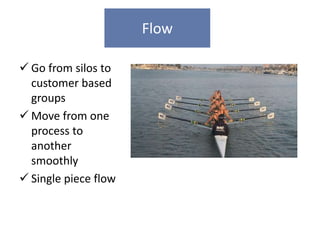
Flow

 Go from silos to
  customer based
  groups
 Move from one
  process to
  another
  smoothly
 Single piece flow
Start Now

 Boyd’s Law of
  iteration
 Experiment
 100-50 rule
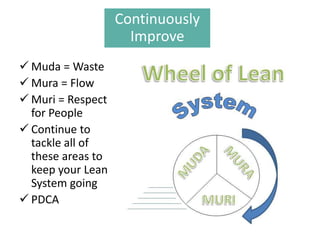
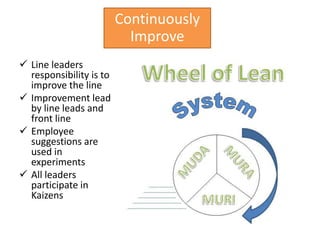
Continuously
                     Improve
 Muda = Waste
 Mura = Flow
 Muri = Respect
  for People
 Continue to
  tackle all of
  these areas to
  keep your Lean
  System going
 PDCA
(615) 852-LEAN [5326]
                                              www.TheLeanWayConsulting.com


                 Traditional             Lean enterprise
           Emphasis on production        Emphasis on customer service
          Make product to forecast       Makes to actual customer demand
          ‘Push’ production system       ‘Pull’ production system
                Machine utilization      Employee utilization
Reduce cost and increase efficiency      Reduce waste and add value
Leadership by executive command          Leadership by vision and broad participation
            Specialized employees        Multi-functional employees
                 Penalize mistakes       Educate
                     Blame people        Identify and solve process failure
                          Reactive       Proactive
                 Inspect in Quality      Built in Quality
                       Complexity        Simplicity
 Functional Management Structure         Manage by Value Stream
  How does your company rate as a Lean       Rating Scale:      1 2 3 4 5
  Enterprise?
Think Like a
                 Lean Culture
1) Leadership
2) Visual Controls
3) Feedback
4) Do What You Say
   – Say What You
   Do
5) Stick To The
   Process
6) Root Cause
   Problem Solving
7) Continuous
   Improvement
Leadership

 Strategic
  Alignment
 Daily Standard
  Work
 Gemba Walks
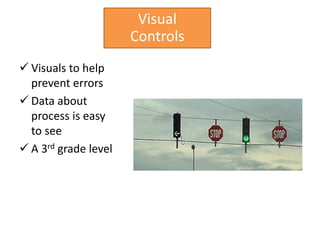
Visual
                      Controls
 Visuals to help
  prevent errors
 Data about
  process is easy
  to see
 A 3rd grade level
Feedback

 Instantaneous
  feedback
 Corrective action
  close to
  instantaneous
 Project
  management
  done in a visual
  way
Do What You
                  Say – Say What
                      You Do
 All processes are
  up-to-date in the
  paper work
 Ask anyone and
  they will give
  you the same
  response
 Supposed to =
  Actual
Stick To The
                       Process
 Review
  production
  process
  adherence
 Gemba walks
 Assign owners to
  process misses
 Top 3 issues
  Pareto chart
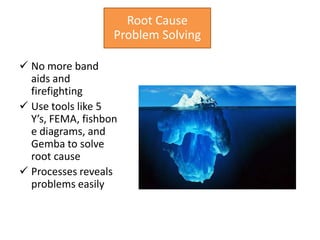
Root Cause
                   Problem Solving

 No more band
  aids and
  firefighting
 Use tools like 5
  Y’s, FEMA, fishbon
  e diagrams, and
  Gemba to solve
  root cause
 Processes reveals
  problems easily
Continuously
                           Improve
 Line leaders
  responsibility is to
  improve the line
 Improvement lead
  by line leads and
  front line
 Employee
  suggestions are
  used in
  experiments
 All leaders
  participate in
  Kaizens
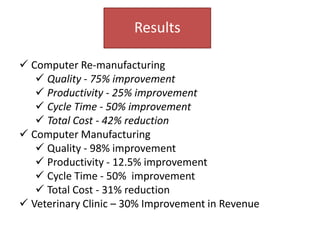
Results

 Computer Re-manufacturing
    Quality - 75% improvement
    Productivity - 25% improvement
    Cycle Time - 50% improvement
    Total Cost - 42% reduction
 Computer Manufacturing
    Quality - 98% improvement
    Productivity - 12.5% improvement
    Cycle Time - 50% improvement
    Total Cost - 31% reduction
 Veterinary Clinic – 30% Improvement in Revenue
Questions?


ankit@TheLeanWayConsulting.com
www.TheLeanWayConsulting.com
http://TheLeanWayConsulting.blogspot.com
(615) 779-3629

Lean Culture Introduction

  • 1.
  • 2.
    History of Lean 1910 MassProduction/Ford’s Model T 1940’s-1970’s Toyota Production System 1980’s Just-In-Time & TQM 1990’s Six Sigma 2000’s Lean Manufacturing
  • 3.
    What Is Lean? Respect for People Remove Start Now Waste Continuously Flow Improve
  • 4.
    Respect For People  The most important factor  Hardest part of the process  Real respect for all employees  Listen and be a servant leader
  • 5.
    Respect For Be an Employer of Choice People Employees want*: Empowerment to Make Decisions Opportunities for Growth & Development Variety Mutual Support and Respect Sense of Purpose Desirable Future *BusinessWeek, 2008
  • 6.
    Respect For Employees Are Essential People Only 21% of employees are willing to go the extra distance to help company succeed* Firms with most engaged employees increase operating income 19% and earnings per share 28% year to year* *2007 Towers Perrin survey, 18 countries, 40 companies, 90,000 employees
  • 7.
    Respect For Change your Culture – Change your Future People 82% say Adopting “First we build Significant Culture people, then we build Change is their #1 cars.” Challenge* —Fujio Cho, Former Chairman, Toyota *2006, The Lean Benchmark Report, AberdeenGroup
  • 8.
    Respect For Turn the Company Pyramid Upside-Down People 42% say Top Management Employees Commitment is #1 Challenge* Middle “Grow Leaders and Management/Line Teams who thoroughly Managers understand the Work, Live the Upper Philosophy, and Teach it Management to others.”* *2006, The Lean Benchmark Report, AberdeenGroup
  • 9.
    Respect For Your Culture is your Cornerstone People Only 10% of employees say senior management treats them as most important part of organization* *2007 Towers Perrin survey, 18 countries, 40 companies, 90,000 employees
  • 10.
    (615) 852-LEAN [5326] www.TheLeanWayConsulting.com The Seven Wastes Transportation Inventory Motion Wait time Over Processing Over Production Defects Movement between Buffers Poor work Materials Excessive testing Material Shortages Internal buildings/sites design Shortages Excess WIP & Install Un-level Demand Rework Premium RIP Ergonomic Un-level Demand freight Design Reconfiguration Build to stock Supplier Supplier Startup Distribution inventories for Travel time Double handling Economic Lot Sizes Final Test Network long lead time Vendor Tool & Predictability Material Batching Inspection Plant Layout Stock Material variability/over access Scheduling design Conflicts Operations, Overhead, Materials, Suppliers
  • 11.
    Flow  Go fromsilos to customer based groups  Move from one process to another smoothly  Single piece flow
  • 12.
    Start Now  Boyd’sLaw of iteration  Experiment  100-50 rule
  • 13.
    Continuously Improve  Muda = Waste  Mura = Flow  Muri = Respect for People  Continue to tackle all of these areas to keep your Lean System going  PDCA
  • 14.
    (615) 852-LEAN [5326] www.TheLeanWayConsulting.com Traditional Lean enterprise Emphasis on production Emphasis on customer service Make product to forecast Makes to actual customer demand ‘Push’ production system ‘Pull’ production system Machine utilization Employee utilization Reduce cost and increase efficiency Reduce waste and add value Leadership by executive command Leadership by vision and broad participation Specialized employees Multi-functional employees Penalize mistakes Educate Blame people Identify and solve process failure Reactive Proactive Inspect in Quality Built in Quality Complexity Simplicity Functional Management Structure Manage by Value Stream How does your company rate as a Lean Rating Scale: 1 2 3 4 5 Enterprise?
  • 15.
    Think Like a Lean Culture 1) Leadership 2) Visual Controls 3) Feedback 4) Do What You Say – Say What You Do 5) Stick To The Process 6) Root Cause Problem Solving 7) Continuous Improvement
  • 16.
    Leadership  Strategic Alignment  Daily Standard Work  Gemba Walks
  • 17.
    Visual Controls  Visuals to help prevent errors  Data about process is easy to see  A 3rd grade level
  • 18.
    Feedback  Instantaneous feedback  Corrective action close to instantaneous  Project management done in a visual way
  • 19.
    Do What You Say – Say What You Do  All processes are up-to-date in the paper work  Ask anyone and they will give you the same response  Supposed to = Actual
  • 20.
    Stick To The Process  Review production process adherence  Gemba walks  Assign owners to process misses  Top 3 issues Pareto chart
  • 21.
    Root Cause Problem Solving  No more band aids and firefighting  Use tools like 5 Y’s, FEMA, fishbon e diagrams, and Gemba to solve root cause  Processes reveals problems easily
  • 22.
    Continuously Improve  Line leaders responsibility is to improve the line  Improvement lead by line leads and front line  Employee suggestions are used in experiments  All leaders participate in Kaizens
  • 23.
    Results  Computer Re-manufacturing  Quality - 75% improvement  Productivity - 25% improvement  Cycle Time - 50% improvement  Total Cost - 42% reduction  Computer Manufacturing  Quality - 98% improvement  Productivity - 12.5% improvement  Cycle Time - 50% improvement  Total Cost - 31% reduction  Veterinary Clinic – 30% Improvement in Revenue
  • 24.