Dr.Anjalatchi Muthukumaran
Vice principal cum nursing supt
Era college of nursing , ELMCH
Era University-226003
Emergency department
Triage Protocol 2023
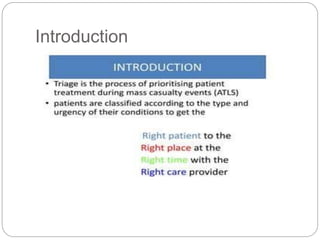
Introduction
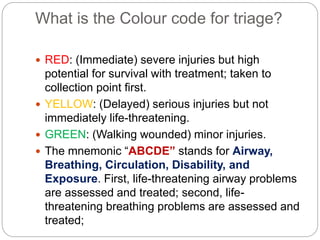
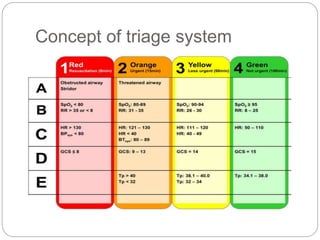
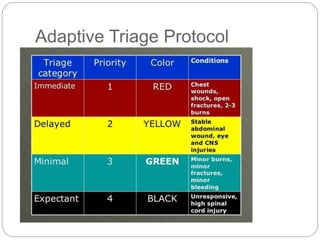
What is the Colour code for triage?
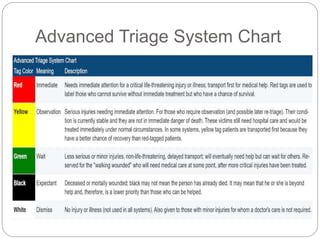
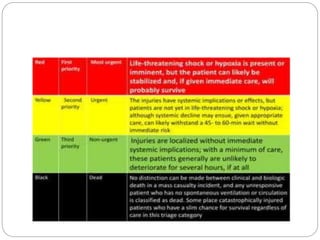
 RED: (Immediate) severe injuries but high
potential for survival with treatment; taken to
collection point first.
 YELLOW: (Delayed) serious injuries but not
immediately life-threatening.
 GREEN: (Walking wounded) minor injuries.
 The mnemonic “ABCDE” stands for Airway,
Breathing, Circulation, Disability, and
Exposure. First, life-threatening airway problems
are assessed and treated; second, life-
threatening breathing problems are assessed and
treated;
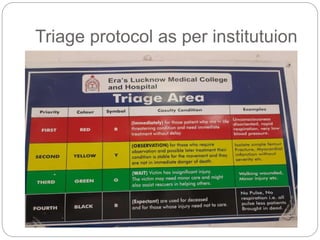
Triage protocol as per institutuion
Advanced Triage System Chart
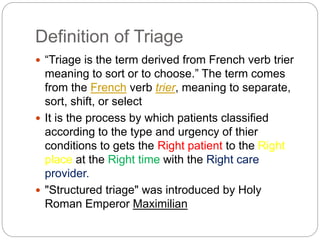
Definition of Triage
 “Triage is the term derived from French verb trier
meaning to sort or to choose.” The term comes
from the French verb trier, meaning to separate,
sort, shift, or select
 It is the process by which patients classified
according to the type and urgency of thier
conditions to gets the Right patient to the Right
place at the Right time with the Right care
provider.
 "Structured triage" was introduced by Holy
Roman Emperor Maximilian
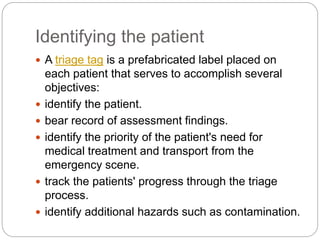
Identifying the patient
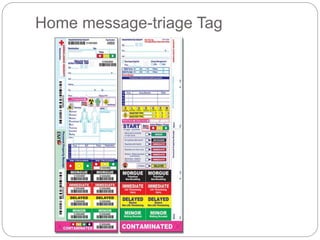
 A triage tag is a prefabricated label placed on
each patient that serves to accomplish several
objectives:
 identify the patient.
 bear record of assessment findings.
 identify the priority of the patient's need for
medical treatment and transport from the
emergency scene.
 track the patients' progress through the triage
process.
 identify additional hazards such as contamination.
Concept of triage system
Type of triage
 Simple triage
 Advanced triage
 Continuous integrated triage
 Reverse triage
 Under triage or over triage
 Telephone triage
1. Simple triage
 It is usually used in a scene of an accident or
“mass-casualty incident” (MCI), in order to sort
patients into those who need critical attention and
immediate transport to hospital and those with
less serious injuries.
2. Advance triage
 In advance triage, doctors and specially trained
nurses may decide that some seriously injured
people should not receive advanced care
because they are unlikely to survive, in order to
increase the chances for others with higher
likelihood.
3. Continuous integrated triage
 It is an approach to triage in mass casualty.
 It combines three form of triage with progressive
specificity to most rapidly identify those patients
in greatest need of care while balancing the
needs of the individual patients against the
available resources.
 Continuous integrated triage employs-
 a. Group triage
 b. Individual triage
 c. Hospital triage
4.Reverse Triage - Early
Discharge
 Usually, triage refers to prioritizing admission. A
similar process can be applied to discharging patients
early when the medical system is stressed. This
process has been called "reverse triage".
 Reverse triage- This process of triage can be applied
to discharging patients early when the medical system
is stressed.
 • During a “surge” in demand, such as immediate after
a natural disaster, many hospital beds will be
occupied by regular non-critical patients.
 • In order to accommodate a greater number of the
new critical patients, the existing patients may be
triaged, and those who will not need immediate care
can be discharged.
Under triage and over triage
5.Under triage is underestimating the severity of an illness
or injury.
 An example of this would be categorizing a
 Priority 1 (Immediate)
 patient as a Priority 2 (Delayed) or
 Priority 3 (Minimal). Historically, acceptable undertriage
rates have been deemed 5% or less.
6. Over triage is the overestimating of the severity of an
illness or injury. An example of this would be categorizing
a
 Priority 3 (Minimal)
 patient as a Priority 2 (Delayed) or
 Priority 1 (Immediate).
 Acceptable over triage rates have been typically up to
50% in an effort to avoid under triage.
 Some studies suggest that over triage is less likely to
occur when triaging is performed by hospital medical
7. Telephone triage
 In telephone triage, decision makers over the
phone must effectively assess the patient's
symptoms and provide directives based on the
urgency. This should be done in a timely fashion
while meeting standard guidelines in order to
prevent symptoms from worsening
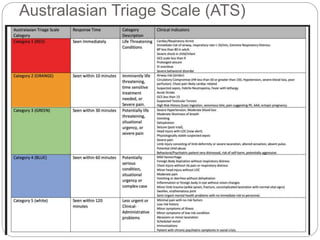
Australasian Triage Scale (ATS)
Adaptive Triage Protocol
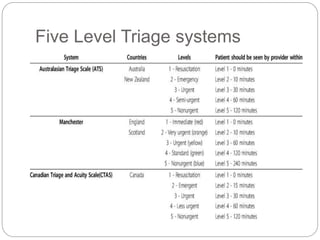
Five Level Triage systems
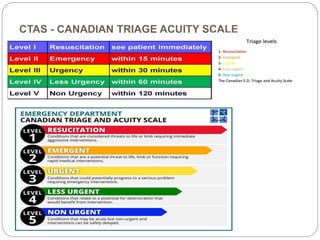
CTAS - CANADIAN TRIAGE ACUITY SCALE
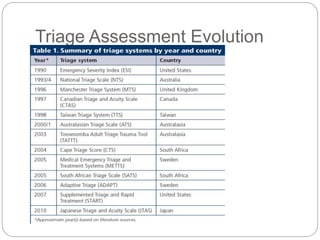
Triage Assessment Evolution
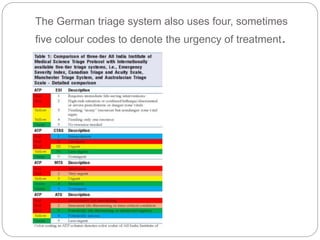
The German triage system also uses four, sometimes
five colour codes to denote the urgency of treatment.
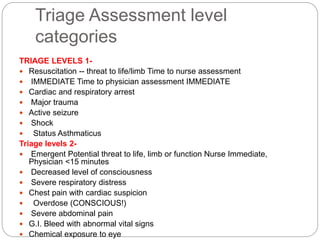
Triage Assessment level
categories
TRIAGE LEVELS 1-
 Resuscitation -- threat to life/limb Time to nurse assessment
 IMMEDIATE Time to physician assessment IMMEDIATE
 Cardiac and respiratory arrest
 Major trauma
 Active seizure
 Shock
 Status Asthmaticus
Triage levels 2-
 Emergent Potential threat to life, limb or function Nurse Immediate,
Physician <15 minutes
 Decreased level of consciousness
 Severe respiratory distress
 Chest pain with cardiac suspicion
 Overdose (CONSCIOUS!)
 Severe abdominal pain
 G.I. Bleed with abnormal vital signs
 Chemical exposure to eye
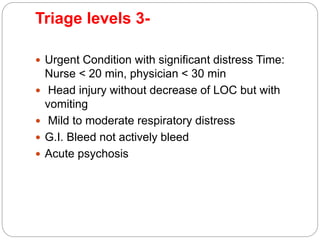
Triage levels 3-
 Urgent Condition with significant distress Time:
Nurse < 20 min, physician < 30 min
 Head injury without decrease of LOC but with
vomiting
 Mild to moderate respiratory distress
 G.I. Bleed not actively bleed
 Acute psychosis
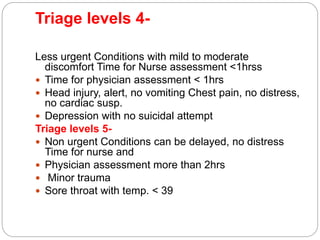
Triage levels 4-
Less urgent Conditions with mild to moderate
discomfort Time for Nurse assessment <1hrss
 Time for physician assessment < 1hrs
 Head injury, alert, no vomiting Chest pain, no distress,
no cardiac susp.
 Depression with no suicidal attempt
Triage levels 5-
 Non urgent Conditions can be delayed, no distress
Time for nurse and
 Physician assessment more than 2hrs
 Minor trauma
 Sore throat with temp. < 39
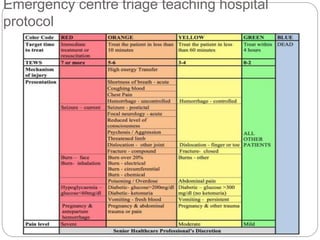
Emergency centre triage teaching hospital
protocol
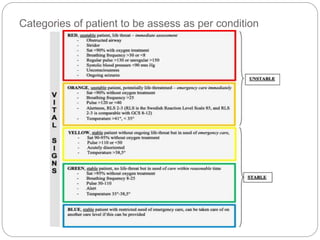
Categories of patient to be assess as per condition
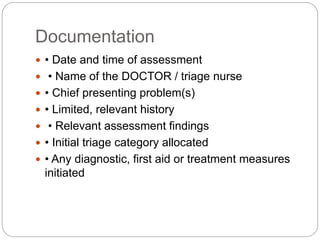
Documentation
 • Date and time of assessment
 • Name of the DOCTOR / triage nurse
 • Chief presenting problem(s)
 • Limited, relevant history
 • Relevant assessment findings
 • Initial triage category allocated
 • Any diagnostic, first aid or treatment measures
initiated
Home message-triage Tag

Triage Protocol guidelines 14.2.23.pptx

  • 1.
    Dr.Anjalatchi Muthukumaran Vice principalcum nursing supt Era college of nursing , ELMCH Era University-226003 Emergency department Triage Protocol 2023
  • 2.
  • 3.
    What is theColour code for triage?  RED: (Immediate) severe injuries but high potential for survival with treatment; taken to collection point first.  YELLOW: (Delayed) serious injuries but not immediately life-threatening.  GREEN: (Walking wounded) minor injuries.  The mnemonic “ABCDE” stands for Airway, Breathing, Circulation, Disability, and Exposure. First, life-threatening airway problems are assessed and treated; second, life- threatening breathing problems are assessed and treated;
  • 4.
    Triage protocol asper institutuion
  • 5.
  • 6.
    Definition of Triage “Triage is the term derived from French verb trier meaning to sort or to choose.” The term comes from the French verb trier, meaning to separate, sort, shift, or select  It is the process by which patients classified according to the type and urgency of thier conditions to gets the Right patient to the Right place at the Right time with the Right care provider.  "Structured triage" was introduced by Holy Roman Emperor Maximilian
  • 8.
    Identifying the patient A triage tag is a prefabricated label placed on each patient that serves to accomplish several objectives:  identify the patient.  bear record of assessment findings.  identify the priority of the patient's need for medical treatment and transport from the emergency scene.  track the patients' progress through the triage process.  identify additional hazards such as contamination.
  • 9.
  • 10.
    Type of triage Simple triage  Advanced triage  Continuous integrated triage  Reverse triage  Under triage or over triage  Telephone triage
  • 11.
    1. Simple triage It is usually used in a scene of an accident or “mass-casualty incident” (MCI), in order to sort patients into those who need critical attention and immediate transport to hospital and those with less serious injuries.
  • 12.
    2. Advance triage In advance triage, doctors and specially trained nurses may decide that some seriously injured people should not receive advanced care because they are unlikely to survive, in order to increase the chances for others with higher likelihood.
  • 13.
    3. Continuous integratedtriage  It is an approach to triage in mass casualty.  It combines three form of triage with progressive specificity to most rapidly identify those patients in greatest need of care while balancing the needs of the individual patients against the available resources.  Continuous integrated triage employs-  a. Group triage  b. Individual triage  c. Hospital triage
  • 14.
    4.Reverse Triage -Early Discharge  Usually, triage refers to prioritizing admission. A similar process can be applied to discharging patients early when the medical system is stressed. This process has been called "reverse triage".  Reverse triage- This process of triage can be applied to discharging patients early when the medical system is stressed.  • During a “surge” in demand, such as immediate after a natural disaster, many hospital beds will be occupied by regular non-critical patients.  • In order to accommodate a greater number of the new critical patients, the existing patients may be triaged, and those who will not need immediate care can be discharged.
  • 15.
    Under triage andover triage 5.Under triage is underestimating the severity of an illness or injury.  An example of this would be categorizing a  Priority 1 (Immediate)  patient as a Priority 2 (Delayed) or  Priority 3 (Minimal). Historically, acceptable undertriage rates have been deemed 5% or less. 6. Over triage is the overestimating of the severity of an illness or injury. An example of this would be categorizing a  Priority 3 (Minimal)  patient as a Priority 2 (Delayed) or  Priority 1 (Immediate).  Acceptable over triage rates have been typically up to 50% in an effort to avoid under triage.  Some studies suggest that over triage is less likely to occur when triaging is performed by hospital medical
  • 16.
    7. Telephone triage In telephone triage, decision makers over the phone must effectively assess the patient's symptoms and provide directives based on the urgency. This should be done in a timely fashion while meeting standard guidelines in order to prevent symptoms from worsening
  • 17.
  • 18.
  • 19.
  • 20.
    CTAS - CANADIANTRIAGE ACUITY SCALE
  • 21.
  • 22.
    The German triagesystem also uses four, sometimes five colour codes to denote the urgency of treatment.
  • 23.
    Triage Assessment level categories TRIAGELEVELS 1-  Resuscitation -- threat to life/limb Time to nurse assessment  IMMEDIATE Time to physician assessment IMMEDIATE  Cardiac and respiratory arrest  Major trauma  Active seizure  Shock  Status Asthmaticus Triage levels 2-  Emergent Potential threat to life, limb or function Nurse Immediate, Physician <15 minutes  Decreased level of consciousness  Severe respiratory distress  Chest pain with cardiac suspicion  Overdose (CONSCIOUS!)  Severe abdominal pain  G.I. Bleed with abnormal vital signs  Chemical exposure to eye
  • 24.
    Triage levels 3- Urgent Condition with significant distress Time: Nurse < 20 min, physician < 30 min  Head injury without decrease of LOC but with vomiting  Mild to moderate respiratory distress  G.I. Bleed not actively bleed  Acute psychosis
  • 25.
    Triage levels 4- Lessurgent Conditions with mild to moderate discomfort Time for Nurse assessment <1hrss  Time for physician assessment < 1hrs  Head injury, alert, no vomiting Chest pain, no distress, no cardiac susp.  Depression with no suicidal attempt Triage levels 5-  Non urgent Conditions can be delayed, no distress Time for nurse and  Physician assessment more than 2hrs  Minor trauma  Sore throat with temp. < 39
  • 26.
    Emergency centre triageteaching hospital protocol
  • 27.
    Categories of patientto be assess as per condition
  • 28.
    Documentation  • Dateand time of assessment  • Name of the DOCTOR / triage nurse  • Chief presenting problem(s)  • Limited, relevant history  • Relevant assessment findings  • Initial triage category allocated  • Any diagnostic, first aid or treatment measures initiated
  • 29.