© 2015 SysPlay Workshops <workshop@sysplay.in>
All Rights Reserved.
Fun with 'Embedded' C
2© 2015 SysPlay Workshops <workshop@sysplay.in>
All Rights Reserved.
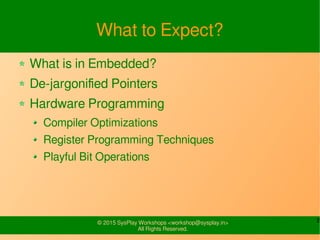
What to Expect?
What is in Embedded?
De-jargonified Pointers
Hardware Programming
Compiler Optimizations
Register Programming Techniques
Playful Bit Operations
3© 2015 SysPlay Workshops <workshop@sysplay.in>
All Rights Reserved.
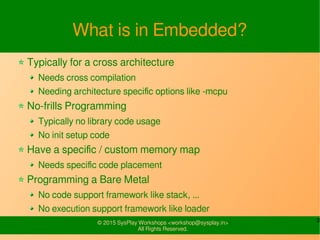
What is in Embedded?
Typically for a cross architecture
Needs cross compilation
Needing architecture specific options like -mcpu
No-frills Programming
Typically no library code usage
No init setup code
Have a specific / custom memory map
Needs specific code placement
Programming a Bare Metal
No code support framework like stack, ...
No execution support framework like loader
4© 2015 SysPlay Workshops <workshop@sysplay.in>
All Rights Reserved.
Pointers: De-jargonification
through 7 rules
5© 2015 SysPlay Workshops <workshop@sysplay.in>
All Rights Reserved.
Rule #0: Foundation
Memory Locations & its Address
CPU
RAM
DB
Integer i; Pointer p;
i = 6; p = 6;
i
p
AB
0
4
8
12
16
20
24
28
32
36
6
6
6© 2015 SysPlay Workshops <workshop@sysplay.in>
All Rights Reserved.
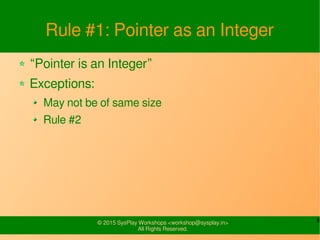
Rule #1: Pointer as an Integer
“Pointer is an Integer”
Exceptions:
May not be of same size
Rule #2
7© 2015 SysPlay Workshops <workshop@sysplay.in>
All Rights Reserved.
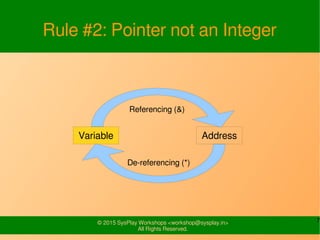
Rule #2: Pointer not an Integer
Variable Address
Referencing (&)
De-referencing (*)
8© 2015 SysPlay Workshops <workshop@sysplay.in>
All Rights Reserved.
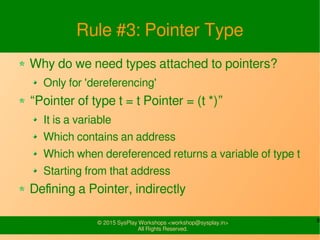
Rule #3: Pointer Type
Why do we need types attached to pointers?
Only for 'dereferencing'
“Pointer of type t = t Pointer = (t *)”
It is a variable
Which contains an address
Which when dereferenced returns a variable of type t
Starting from that address
Defining a Pointer, indirectly
9© 2015 SysPlay Workshops <workshop@sysplay.in>
All Rights Reserved.
Rule #4: Pointer Value
“Pointer pointing to a Variable = Pointer contains
the Address of the Variable”
“Pointing means Containing Address”
10© 2015 SysPlay Workshops <workshop@sysplay.in>
All Rights Reserved.
Rule #5: NULL Pointer
Need for Pointing to 'Nothing'
Evolution of NULL, typically 0
“Pointer value of NULL = Null Addr = Null Pointer
= Pointing to Nothing”
11© 2015 SysPlay Workshops <workshop@sysplay.in>
All Rights Reserved.
Array Interpretations
Original Big Variable
Consisting of Smaller Variables
Of Same Type
Placed consecutively
Constant Pointer to the 1st Small Variable
In the Big Variable
12© 2015 SysPlay Workshops <workshop@sysplay.in>
All Rights Reserved.
Rule #6: Array vs Pointer
arr + i = &arr[i]
Value(arr + i) = Value(arr) + i * sizeof(*arr)
“Value(p + i) = Value(p) + i * sizeof(*p)”
Corollaries:
p + i = &p[i]
*(p + i) = p[i]
sizeof(void) = 1
13© 2015 SysPlay Workshops <workshop@sysplay.in>
All Rights Reserved.
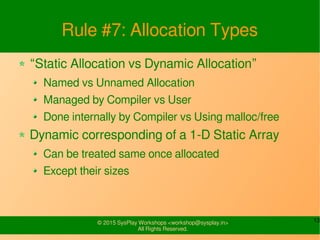
Rule #7: Allocation Types
“Static Allocation vs Dynamic Allocation”
Named vs Unnamed Allocation
Managed by Compiler vs User
Done internally by Compiler vs Using malloc/free
Dynamic corresponding of a 1-D Static Array
Can be treated same once allocated
Except their sizes
14© 2015 SysPlay Workshops <workshop@sysplay.in>
All Rights Reserved.
2-D Arrays
Each Dimension could be
Static, or
Dynamic
Various Forms for 2-D Arrays (2x2 = 4)
Both Static (Rectangular) - arr[r][c]
First Static, Second Dynamic - *arr[r]
First Dynamic, Second Static - (*arr)[c]
Both Dynamic - **arr
2-D Arrays using a Single Level Pointer
15© 2015 SysPlay Workshops <workshop@sysplay.in>
All Rights Reserved.
Hardware Programming
16© 2015 SysPlay Workshops <workshop@sysplay.in>
All Rights Reserved.
Compiler Optimizations
Using -O0, -O1, -O2, -O3, -Os, -Ofast, -Og
May eliminate seemingly redundant code
But important from embedded C perspective
Examples
Seemingly meaningless reads/writes
NOP loop for delay
Functions not called from C code
Ways to avoid
Use -O0 or no optimization
Use volatile for hardware mapped variables
Use __attribute__((optimize("O0"))) for specific functions
Use asmlinkage for functions called from assembly
17© 2015 SysPlay Workshops <workshop@sysplay.in>
All Rights Reserved.
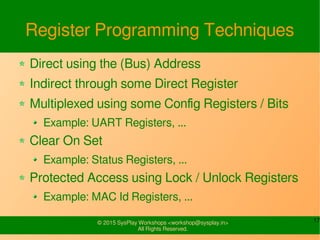
Register Programming Techniques
Direct using the (Bus) Address
Indirect through some Direct Register
Multiplexed using some Config Registers / Bits
Example: UART Registers, ...
Clear On Set
Example: Status Registers, ...
Protected Access using Lock / Unlock Registers
Example: MAC Id Registers, ...
18© 2015 SysPlay Workshops <workshop@sysplay.in>
All Rights Reserved.
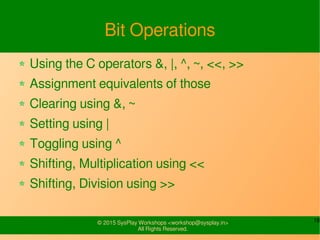
Bit Operations
Using the C operators &, |, ^, ~, <<, >>
Assignment equivalents of those
Clearing using &, ~
Setting using |
Toggling using ^
Shifting, Multiplication using <<
Shifting, Division using >>
19© 2015 SysPlay Workshops <workshop@sysplay.in>
All Rights Reserved.
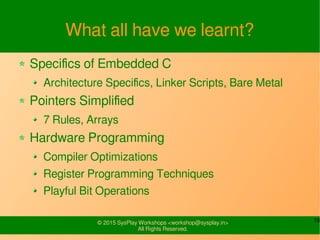
What all have we learnt?
Specifics of Embedded C
Architecture Specifics, Linker Scripts, Bare Metal
Pointers Simplified
7 Rules, Arrays
Hardware Programming
Compiler Optimizations
Register Programming Techniques
Playful Bit Operations
20© 2015 SysPlay Workshops <workshop@sysplay.in>
All Rights Reserved.
Any Queries?

Embedded C

  • 1.
    © 2015 SysPlayWorkshops <workshop@sysplay.in> All Rights Reserved. Fun with 'Embedded' C
  • 2.
    2© 2015 SysPlayWorkshops <workshop@sysplay.in> All Rights Reserved. What to Expect? What is in Embedded? De-jargonified Pointers Hardware Programming Compiler Optimizations Register Programming Techniques Playful Bit Operations
  • 3.
    3© 2015 SysPlayWorkshops <workshop@sysplay.in> All Rights Reserved. What is in Embedded? Typically for a cross architecture Needs cross compilation Needing architecture specific options like -mcpu No-frills Programming Typically no library code usage No init setup code Have a specific / custom memory map Needs specific code placement Programming a Bare Metal No code support framework like stack, ... No execution support framework like loader
  • 4.
    4© 2015 SysPlayWorkshops <workshop@sysplay.in> All Rights Reserved. Pointers: De-jargonification through 7 rules
  • 5.
    5© 2015 SysPlayWorkshops <workshop@sysplay.in> All Rights Reserved. Rule #0: Foundation Memory Locations & its Address CPU RAM DB Integer i; Pointer p; i = 6; p = 6; i p AB 0 4 8 12 16 20 24 28 32 36 6 6
  • 6.
    6© 2015 SysPlayWorkshops <workshop@sysplay.in> All Rights Reserved. Rule #1: Pointer as an Integer “Pointer is an Integer” Exceptions: May not be of same size Rule #2
  • 7.
    7© 2015 SysPlayWorkshops <workshop@sysplay.in> All Rights Reserved. Rule #2: Pointer not an Integer Variable Address Referencing (&) De-referencing (*)
  • 8.
    8© 2015 SysPlayWorkshops <workshop@sysplay.in> All Rights Reserved. Rule #3: Pointer Type Why do we need types attached to pointers? Only for 'dereferencing' “Pointer of type t = t Pointer = (t *)” It is a variable Which contains an address Which when dereferenced returns a variable of type t Starting from that address Defining a Pointer, indirectly
  • 9.
    9© 2015 SysPlayWorkshops <workshop@sysplay.in> All Rights Reserved. Rule #4: Pointer Value “Pointer pointing to a Variable = Pointer contains the Address of the Variable” “Pointing means Containing Address”
  • 10.
    10© 2015 SysPlayWorkshops <workshop@sysplay.in> All Rights Reserved. Rule #5: NULL Pointer Need for Pointing to 'Nothing' Evolution of NULL, typically 0 “Pointer value of NULL = Null Addr = Null Pointer = Pointing to Nothing”
  • 11.
    11© 2015 SysPlayWorkshops <workshop@sysplay.in> All Rights Reserved. Array Interpretations Original Big Variable Consisting of Smaller Variables Of Same Type Placed consecutively Constant Pointer to the 1st Small Variable In the Big Variable
  • 12.
    12© 2015 SysPlayWorkshops <workshop@sysplay.in> All Rights Reserved. Rule #6: Array vs Pointer arr + i = &arr[i] Value(arr + i) = Value(arr) + i * sizeof(*arr) “Value(p + i) = Value(p) + i * sizeof(*p)” Corollaries: p + i = &p[i] *(p + i) = p[i] sizeof(void) = 1
  • 13.
    13© 2015 SysPlayWorkshops <workshop@sysplay.in> All Rights Reserved. Rule #7: Allocation Types “Static Allocation vs Dynamic Allocation” Named vs Unnamed Allocation Managed by Compiler vs User Done internally by Compiler vs Using malloc/free Dynamic corresponding of a 1-D Static Array Can be treated same once allocated Except their sizes
  • 14.
    14© 2015 SysPlayWorkshops <workshop@sysplay.in> All Rights Reserved. 2-D Arrays Each Dimension could be Static, or Dynamic Various Forms for 2-D Arrays (2x2 = 4) Both Static (Rectangular) - arr[r][c] First Static, Second Dynamic - *arr[r] First Dynamic, Second Static - (*arr)[c] Both Dynamic - **arr 2-D Arrays using a Single Level Pointer
  • 15.
    15© 2015 SysPlayWorkshops <workshop@sysplay.in> All Rights Reserved. Hardware Programming
  • 16.
    16© 2015 SysPlayWorkshops <workshop@sysplay.in> All Rights Reserved. Compiler Optimizations Using -O0, -O1, -O2, -O3, -Os, -Ofast, -Og May eliminate seemingly redundant code But important from embedded C perspective Examples Seemingly meaningless reads/writes NOP loop for delay Functions not called from C code Ways to avoid Use -O0 or no optimization Use volatile for hardware mapped variables Use __attribute__((optimize("O0"))) for specific functions Use asmlinkage for functions called from assembly
  • 17.
    17© 2015 SysPlayWorkshops <workshop@sysplay.in> All Rights Reserved. Register Programming Techniques Direct using the (Bus) Address Indirect through some Direct Register Multiplexed using some Config Registers / Bits Example: UART Registers, ... Clear On Set Example: Status Registers, ... Protected Access using Lock / Unlock Registers Example: MAC Id Registers, ...
  • 18.
    18© 2015 SysPlayWorkshops <workshop@sysplay.in> All Rights Reserved. Bit Operations Using the C operators &, |, ^, ~, <<, >> Assignment equivalents of those Clearing using &, ~ Setting using | Toggling using ^ Shifting, Multiplication using << Shifting, Division using >>
  • 19.
    19© 2015 SysPlayWorkshops <workshop@sysplay.in> All Rights Reserved. What all have we learnt? Specifics of Embedded C Architecture Specifics, Linker Scripts, Bare Metal Pointers Simplified 7 Rules, Arrays Hardware Programming Compiler Optimizations Register Programming Techniques Playful Bit Operations
  • 20.
    20© 2015 SysPlayWorkshops <workshop@sysplay.in> All Rights Reserved. Any Queries?