Triangular Tracked Wheel Amir H. Soltanzadeh [email_address] ME Dep @ IAUCTB  A new hybrid locomotion mechanism for higher mobility
Acknowledgement Dr. Hossein Mahbadi Professor of Mechanical   Engineering Islamic Azad University of Central Tehran Branch Head of ME Dep. and Robotics Lab @ IAUCTB
Outlines Kinematics of TTW locomotion mechanism
Motivation Developing robots to be used in USAR application Search To look through in a place or in an area carefully in order to find something missing or lost Rescue To free or deliver victim from confinement.
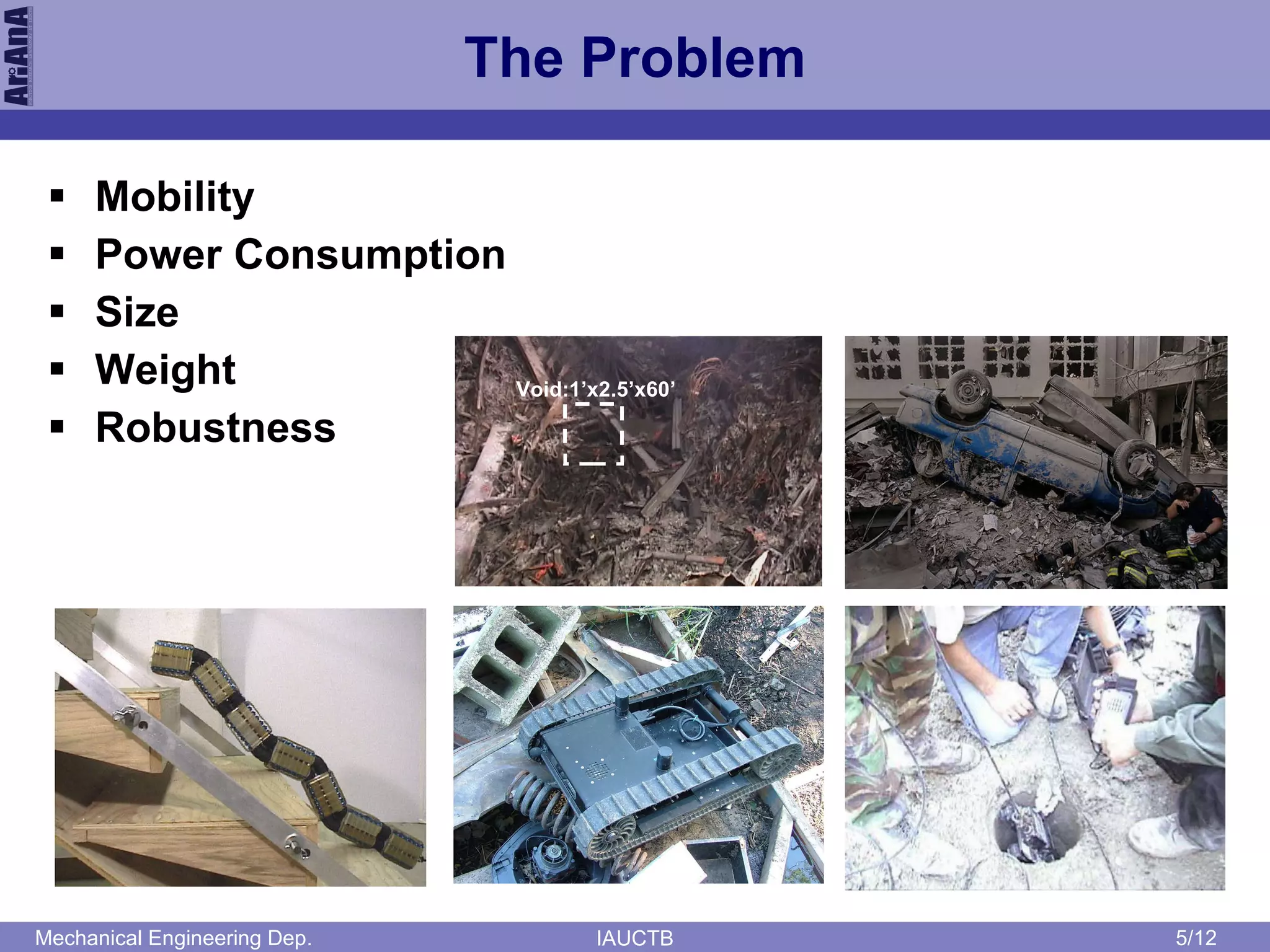
The Problem Mobility Power Consumption Size Weight Robustness Void:1’x2.5’x60’
Earlier Works Joint Control Space Cat Van Winnendael et al, EPFL (1998) Stair Climbing Vehicle J. Florystair, U.S. patents (1966)  Passive Active
TTW Triangular Tracked Wheel 1. Moving tracks 2. Rotating triangular frames 2 DOF
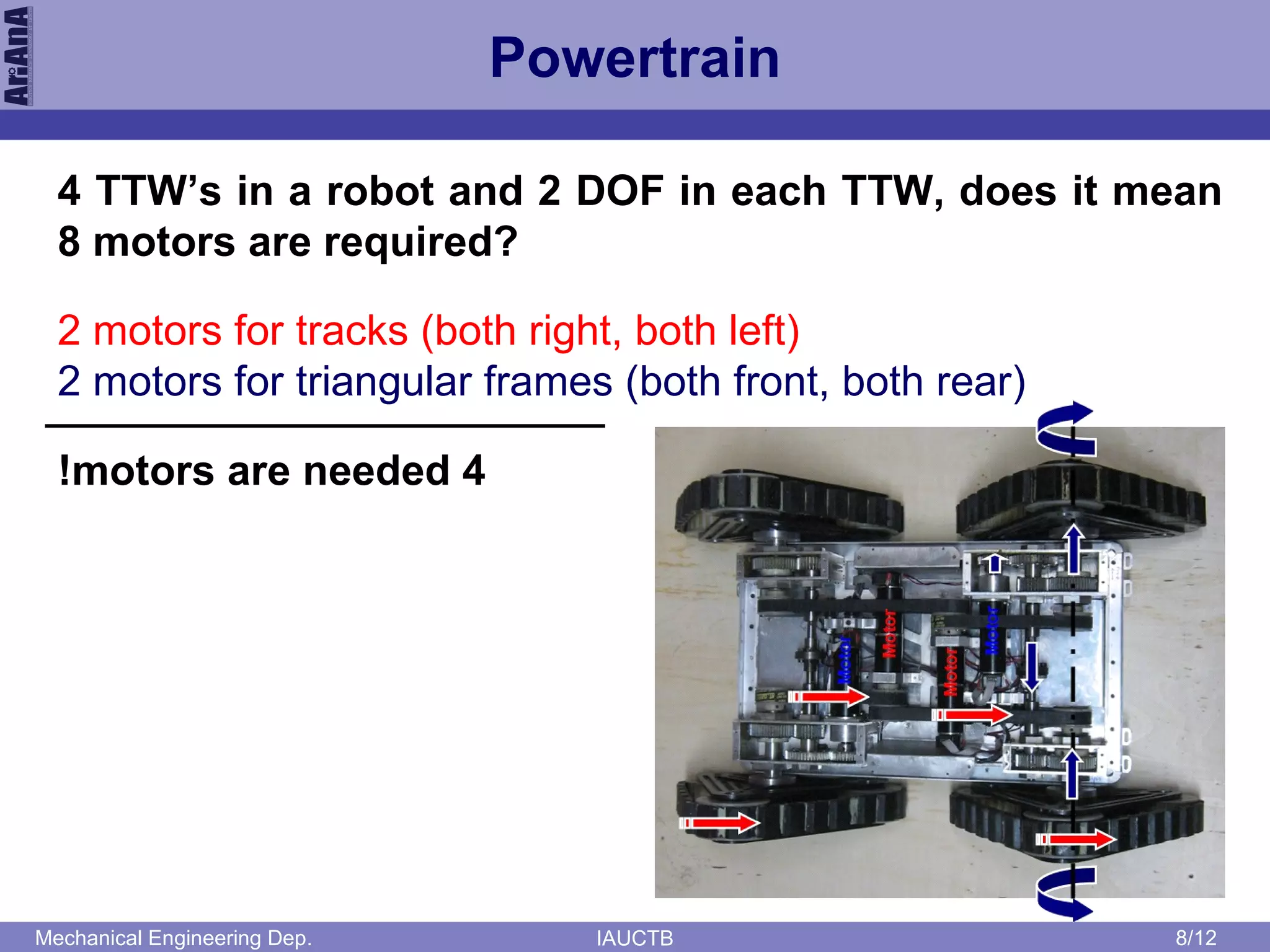
Powertrain 4 TTW’s in a robot and 2 DOF in each TTW, does it mean 8 motors are required? 2 motors for tracks (both right, both left) 2 motors for triangular frames (both front, both rear) 4 motors are needed!
Locomotion Styles Locomotion Continuous (85%)  Discrete (5%) Combined (10%) Discrete movement? Active (Position controlled)/Passive  Active (velocity controlled) Active (velocity controlled) Velocity of CG periodically becomes 0 three times in a cycle and causes a “Stop-Go” movement style.  Like a Four-legged robot!
Traction Management Joints’ Active Controlling (Position Mode) Positive (70%) Negative (5%) Trans (10%) Maximum traction  Tracked vehicle Climbing slopes Minimum traction  Directional  traction  Wheeled vehicle Turning Traversing in stones To reduce  power consumption  of Joint Controlling System, Positive configuration is achieved  in Passive mode.
Surface Adaptation Joints’ Passive Controlling Lateral Adaptation Axial Adaptation To enhance traction without any processing load on control system  Axial Adaptation can also be performed even in Active joint  controlling!
Thank You!

Triangular Tracked Wheel locomotion mechanism

  • 1.
    Triangular Tracked WheelAmir H. Soltanzadeh [email_address] ME Dep @ IAUCTB A new hybrid locomotion mechanism for higher mobility
  • 2.
    Acknowledgement Dr. HosseinMahbadi Professor of Mechanical Engineering Islamic Azad University of Central Tehran Branch Head of ME Dep. and Robotics Lab @ IAUCTB
  • 3.
    Outlines Kinematics ofTTW locomotion mechanism
  • 4.
    Motivation Developing robotsto be used in USAR application Search To look through in a place or in an area carefully in order to find something missing or lost Rescue To free or deliver victim from confinement.
  • 5.
    The Problem MobilityPower Consumption Size Weight Robustness Void:1’x2.5’x60’
  • 6.
    Earlier Works JointControl Space Cat Van Winnendael et al, EPFL (1998) Stair Climbing Vehicle J. Florystair, U.S. patents (1966) Passive Active
  • 7.
    TTW Triangular TrackedWheel 1. Moving tracks 2. Rotating triangular frames 2 DOF
  • 8.
    Powertrain 4 TTW’sin a robot and 2 DOF in each TTW, does it mean 8 motors are required? 2 motors for tracks (both right, both left) 2 motors for triangular frames (both front, both rear) 4 motors are needed!
  • 9.
    Locomotion Styles LocomotionContinuous (85%) Discrete (5%) Combined (10%) Discrete movement? Active (Position controlled)/Passive Active (velocity controlled) Active (velocity controlled) Velocity of CG periodically becomes 0 three times in a cycle and causes a “Stop-Go” movement style. Like a Four-legged robot!
  • 10.
    Traction Management Joints’Active Controlling (Position Mode) Positive (70%) Negative (5%) Trans (10%) Maximum traction Tracked vehicle Climbing slopes Minimum traction Directional traction Wheeled vehicle Turning Traversing in stones To reduce power consumption of Joint Controlling System, Positive configuration is achieved in Passive mode.
  • 11.
    Surface Adaptation Joints’Passive Controlling Lateral Adaptation Axial Adaptation To enhance traction without any processing load on control system Axial Adaptation can also be performed even in Active joint controlling!
  • 12.