Topics
⦿ Basics
⦿ Drive Types
⦿ Resources
⦿ Traction
⦿ Mobility
⦿ Speed
⦿ Timing
⦿ Importance
Basics
⦿ Know your resources
⦿ Decide after kickoff:
› Speed, power, shifting, mobility
⦿ Use most powerful motors on drivetrain
⦿ Don’t drive ½ of your robot…
WEIGH IT DOWN!
⦿ Break it early
⦿ Give software team TIME to work
⦿ Give drivers TIME to drive
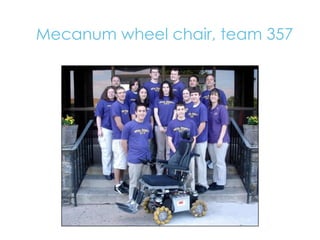
Mecanum wheel chair, team 357
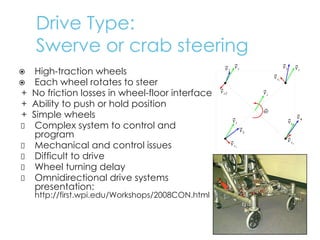
Drive Type:
Swerve or crab steering
⦿ High-traction wheels
⦿ Each wheel rotates to steer
+ No friction losses in wheel-floor interface
+ Ability to push or hold position
+ Simple wheels
Complex system to control and
program
Mechanical and control issues
Difficult to drive
Wheel turning delay
Omnidirectional drive systems
presentation:
http://first.wpi.edu/Workshops/2008CON.html
Resources
⦿ Design
› Difficult: swerve
⦿ Machining
› Difficult: swerve
› Moderate: non-kit frame
⦿ Money
› Kit wheels have been cheap
⦿ Time
› 6 weeks, long hours, multiple shifts?
Traction
⦿ Static vs Dynamic (🡨10% lower)
› Once you slip, you will get pushed
› Design encoders into your system
› Dynamic breaking & traction control
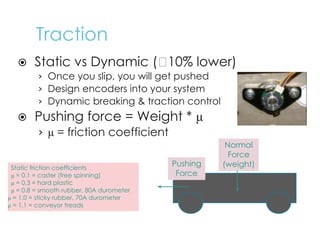
⦿ Pushing force = Weight * μ
› μ = friction coefficient
Normal
Force
(weight)
Static friction coefficients
μ = 0.1 = caster (free spinning)
μ = 0.3 = hard plastic
μ = 0.8 = smooth rubber, 80A durometer
μ = 1.0 = sticky rubber, 70A durometer
μ = 1.1 = conveyor treads
Pushing
Force
More on Traction
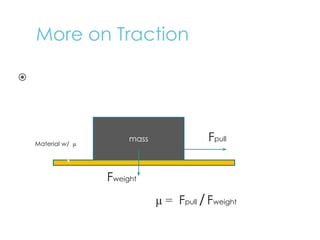
⦿ You can determine μ
mass Fpull
Fweight
Material w/ μ
μ = Fpull /Fweight
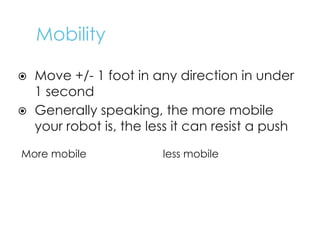
Mobility
⦿ Move +/- 1 foot in any direction in under
1 second
⦿ Generally speaking, the more mobile
your robot is, the less it can resist a push
More mobile less mobile
K
i
l
l
o
u
g
h
M
e
c
a
n
u
m
S
w
e
r
v
e
6
+
w
h
e
e
l
4
w
d
l
o
n
g
T
a
n
k
T
r
e
a
d
s
4
w
d
w
i
d
e
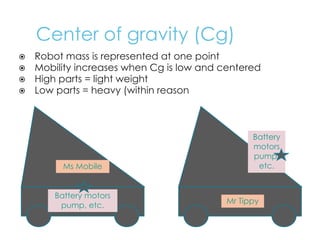
Center of gravity (Cg)
⦿ Robot mass is represented at one point
⦿ Mobility increases when Cg is low and centered
⦿ High parts = light weight
⦿ Low parts = heavy (within reason
Battery
motors
pump,
etc.
Battery motors
pump, etc.
Ms Mobile
Mr Tippy
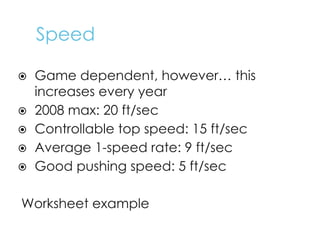
Speed
⦿ Game dependent, however… this
increases every year
⦿ 2008 max: 20 ft/sec
⦿ Controllable top speed: 15 ft/sec
⦿ Average 1-speed rate: 9 ft/sec
⦿ Good pushing speed: 5 ft/sec
Worksheet example
Timing
⦿ Get something driving early
› End of week 2
› Practice for operators
› Lessons learned for electrical
› Strategy lessons
⦿ Continuously improve
› Good enough is not good enough
⦿ Finish final drivetrain by week 4
Importance
⦿ Boat anchor = any heavy mass that does
not move
⦿ A non-reliable or non-repairable drive base
will turn your robot into a boat anchor
⦿ Good drive bases win consistently
⦿ Reliable drive bases win awards
⦿ Well-controlled, robust drive bases win
Championships
More info
⦿ Ken Patton and Paul Copioli
› Robot Drive System Fundamentals
› http://first.wpi.edu/Images/CMS/First/2007C
ON_Drive_Systems_Copioli.pdf
⦿ Ian Mackenzie and Andy Baker
› Omni Directional drive trains
› http://first.wpi.edu/Workshops/2008CON.htm

FIRST-Robotics-Drive-Systems.pdf

  • 1.
    Topics ⦿ Basics ⦿ DriveTypes ⦿ Resources ⦿ Traction ⦿ Mobility ⦿ Speed ⦿ Timing ⦿ Importance
  • 2.
    Basics ⦿ Know yourresources ⦿ Decide after kickoff: › Speed, power, shifting, mobility ⦿ Use most powerful motors on drivetrain ⦿ Don’t drive ½ of your robot… WEIGH IT DOWN! ⦿ Break it early ⦿ Give software team TIME to work ⦿ Give drivers TIME to drive
  • 3.
  • 4.
    Drive Type: Swerve orcrab steering ⦿ High-traction wheels ⦿ Each wheel rotates to steer + No friction losses in wheel-floor interface + Ability to push or hold position + Simple wheels Complex system to control and program Mechanical and control issues Difficult to drive Wheel turning delay Omnidirectional drive systems presentation: http://first.wpi.edu/Workshops/2008CON.html
  • 5.
    Resources ⦿ Design › Difficult:swerve ⦿ Machining › Difficult: swerve › Moderate: non-kit frame ⦿ Money › Kit wheels have been cheap ⦿ Time › 6 weeks, long hours, multiple shifts?
  • 6.
    Traction ⦿ Static vsDynamic (🡨10% lower) › Once you slip, you will get pushed › Design encoders into your system › Dynamic breaking & traction control ⦿ Pushing force = Weight * μ › μ = friction coefficient Normal Force (weight) Static friction coefficients μ = 0.1 = caster (free spinning) μ = 0.3 = hard plastic μ = 0.8 = smooth rubber, 80A durometer μ = 1.0 = sticky rubber, 70A durometer μ = 1.1 = conveyor treads Pushing Force
  • 7.
    More on Traction ⦿You can determine μ mass Fpull Fweight Material w/ μ μ = Fpull /Fweight
  • 8.
    Mobility ⦿ Move +/-1 foot in any direction in under 1 second ⦿ Generally speaking, the more mobile your robot is, the less it can resist a push More mobile less mobile K i l l o u g h M e c a n u m S w e r v e 6 + w h e e l 4 w d l o n g T a n k T r e a d s 4 w d w i d e
  • 9.
    Center of gravity(Cg) ⦿ Robot mass is represented at one point ⦿ Mobility increases when Cg is low and centered ⦿ High parts = light weight ⦿ Low parts = heavy (within reason Battery motors pump, etc. Battery motors pump, etc. Ms Mobile Mr Tippy
  • 10.
    Speed ⦿ Game dependent,however… this increases every year ⦿ 2008 max: 20 ft/sec ⦿ Controllable top speed: 15 ft/sec ⦿ Average 1-speed rate: 9 ft/sec ⦿ Good pushing speed: 5 ft/sec Worksheet example
  • 11.
    Timing ⦿ Get somethingdriving early › End of week 2 › Practice for operators › Lessons learned for electrical › Strategy lessons ⦿ Continuously improve › Good enough is not good enough ⦿ Finish final drivetrain by week 4
  • 12.
    Importance ⦿ Boat anchor= any heavy mass that does not move ⦿ A non-reliable or non-repairable drive base will turn your robot into a boat anchor ⦿ Good drive bases win consistently ⦿ Reliable drive bases win awards ⦿ Well-controlled, robust drive bases win Championships
  • 13.
    More info ⦿ KenPatton and Paul Copioli › Robot Drive System Fundamentals › http://first.wpi.edu/Images/CMS/First/2007C ON_Drive_Systems_Copioli.pdf ⦿ Ian Mackenzie and Andy Baker › Omni Directional drive trains › http://first.wpi.edu/Workshops/2008CON.htm