CONTENTS
Introduction
Basic Design
Simplified Model
Closed Loop Control
Application of Sensors for Measurements
PID Control Action
Stabilization of System
Uses of the Commercial Model
INTRODUCTION
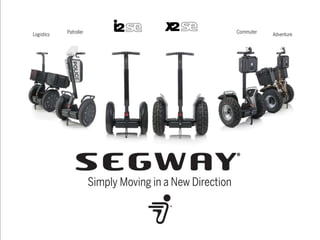
Segway is a two wheeled, battery powered
electric vehicle.
This self balancing Personal Transporter
can reach upto 20km/hr.
It was invented by Dean Kamen in the year
2001.
The name Segway is derived from segue,
meaning 'smooth transition'.
BASIC DESIGN
The vehicle consists of a platform on which
the user stands.
The platform has two wheels attached side
by side, parallel to each other on the same
axis.
A handlebar is provided for the user to hold
while riding.
But, why doesn't it fall?
BASIC DESIGN
That is because the vehicle is self
balancing.
It may look like that the user would fall off
such a vehicle.
But the use of 'Control Theory' stabilizes
this inherently unstable system.
So, are we curious to know about this
awesome application of our subject?
SIMPLIFIED MODEL
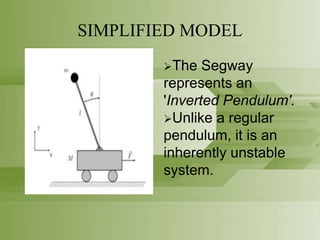
The Segway
represents an
'Inverted Pendulum'.
Unlike a regular
pendulum, it is an
inherently unstable
system.
SIMPLIFIED MODEL
Now we will use control theory to stabilize
the system.
The reference or desired value is 90° with
respect to horizontal.
At this point the pendulum is least likely to
fall off.
Now we need something to implement this
simple logic. What is that?
CLOSED LOOP CONTROL
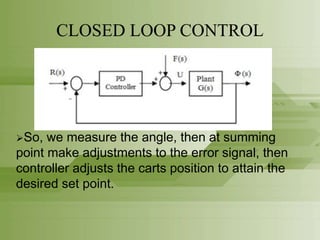
So, we measure the angle, then at summing
point make adjustments to the error signal, then
controller adjusts the carts position to attain the
desired set point.
APPLICATION OF SENSORS
To measure the angle, many sensors can
be used. Here only 3 of them will be
discussed.
The cheapest and common is the
potentiometer.
The potentiometer provides a voltage
proportional to the angular displacement of
the pendulum.
APPLICATION OF SENSORS
Optical Encoder, this measures the angle
of the pendulum using light, and a circular
disk.
IMU Sensor, Inertial Measurement Unit. It
consists of 3-axis accelerometer and 3-axis
gyroscope.
The cost of these sensors are inversely
proportional to sensitivity.
PID CONTROLACTION
Now the error signal is modified to control
signal.
This control signal acts as the input to the
system.
Now the cart moves according to the
control signal, which tends to minimize the
error and stabilizes the system.
PID CONTROLACTION
P controller sends a control signal
proportional to the error.
I controller sends a control signal
proportional to the accumulated error over a
certain time interval.
D controller sends a control signal
proportional to the rate of change of error.
PID CONTROLACTION
Now since only P controller, or I controller
or D controller cannot stabilize the system,
we use them in parallel combination.
This sums up the control signal providing
optimum modification of the error signal.
Tuning the controller must be done to
make the cart functional.
STABILIZATION OF SYSTEM
The system can only be stabilized by
controlling the position.
To control the position a motor must be
used.
According to the control signal a DC motor
is controlled using PWM to bring the cart to
a position, at which, the pendulum is 90°.
STABILIZATION OF SYSTEM
The control of an inverted pendulum cart is
far more simple than controlling a Segway.
Segway is designed to handle disturbances
to the system.
Leaning forward accelerates, leaning
backward decelerates and leaning sideways
makes turns.
IMPORTANCE
Segway is an example of Control Theory
applied to a mechanical system.
This is used in many sectors.
Police departments use it to patrol the
streets smoothly.
This eco-friendly vehicle is an excellent
transporter.
My presentation couldn't cover the entire topic, but
I tried to uncover the subject to reveal it's true
beauty. The beauty we all should seek to attain
next level of perfection, to gift the subject a
devotion and sincerity it deserves.
Created and presented by
Debargha Chakraborty

Segway

  • 2.
    CONTENTS Introduction Basic Design Simplified Model ClosedLoop Control Application of Sensors for Measurements PID Control Action Stabilization of System Uses of the Commercial Model
  • 3.
    INTRODUCTION Segway is atwo wheeled, battery powered electric vehicle. This self balancing Personal Transporter can reach upto 20km/hr. It was invented by Dean Kamen in the year 2001. The name Segway is derived from segue, meaning 'smooth transition'.
  • 4.
    BASIC DESIGN The vehicleconsists of a platform on which the user stands. The platform has two wheels attached side by side, parallel to each other on the same axis. A handlebar is provided for the user to hold while riding. But, why doesn't it fall?
  • 5.
    BASIC DESIGN That isbecause the vehicle is self balancing. It may look like that the user would fall off such a vehicle. But the use of 'Control Theory' stabilizes this inherently unstable system. So, are we curious to know about this awesome application of our subject?
  • 6.
    SIMPLIFIED MODEL The Segway representsan 'Inverted Pendulum'. Unlike a regular pendulum, it is an inherently unstable system.
  • 7.
    SIMPLIFIED MODEL Now wewill use control theory to stabilize the system. The reference or desired value is 90° with respect to horizontal. At this point the pendulum is least likely to fall off. Now we need something to implement this simple logic. What is that?
  • 8.
    CLOSED LOOP CONTROL So,we measure the angle, then at summing point make adjustments to the error signal, then controller adjusts the carts position to attain the desired set point.
  • 9.
    APPLICATION OF SENSORS Tomeasure the angle, many sensors can be used. Here only 3 of them will be discussed. The cheapest and common is the potentiometer. The potentiometer provides a voltage proportional to the angular displacement of the pendulum.
  • 10.
    APPLICATION OF SENSORS OpticalEncoder, this measures the angle of the pendulum using light, and a circular disk. IMU Sensor, Inertial Measurement Unit. It consists of 3-axis accelerometer and 3-axis gyroscope. The cost of these sensors are inversely proportional to sensitivity.
  • 11.
    PID CONTROLACTION Now theerror signal is modified to control signal. This control signal acts as the input to the system. Now the cart moves according to the control signal, which tends to minimize the error and stabilizes the system.
  • 12.
    PID CONTROLACTION P controllersends a control signal proportional to the error. I controller sends a control signal proportional to the accumulated error over a certain time interval. D controller sends a control signal proportional to the rate of change of error.
  • 13.
    PID CONTROLACTION Now sinceonly P controller, or I controller or D controller cannot stabilize the system, we use them in parallel combination. This sums up the control signal providing optimum modification of the error signal. Tuning the controller must be done to make the cart functional.
  • 14.
    STABILIZATION OF SYSTEM Thesystem can only be stabilized by controlling the position. To control the position a motor must be used. According to the control signal a DC motor is controlled using PWM to bring the cart to a position, at which, the pendulum is 90°.
  • 15.
    STABILIZATION OF SYSTEM Thecontrol of an inverted pendulum cart is far more simple than controlling a Segway. Segway is designed to handle disturbances to the system. Leaning forward accelerates, leaning backward decelerates and leaning sideways makes turns.
  • 16.
    IMPORTANCE Segway is anexample of Control Theory applied to a mechanical system. This is used in many sectors. Police departments use it to patrol the streets smoothly. This eco-friendly vehicle is an excellent transporter.
  • 17.
    My presentation couldn'tcover the entire topic, but I tried to uncover the subject to reveal it's true beauty. The beauty we all should seek to attain next level of perfection, to gift the subject a devotion and sincerity it deserves.
  • 18.
    Created and presentedby Debargha Chakraborty