Critical review writing
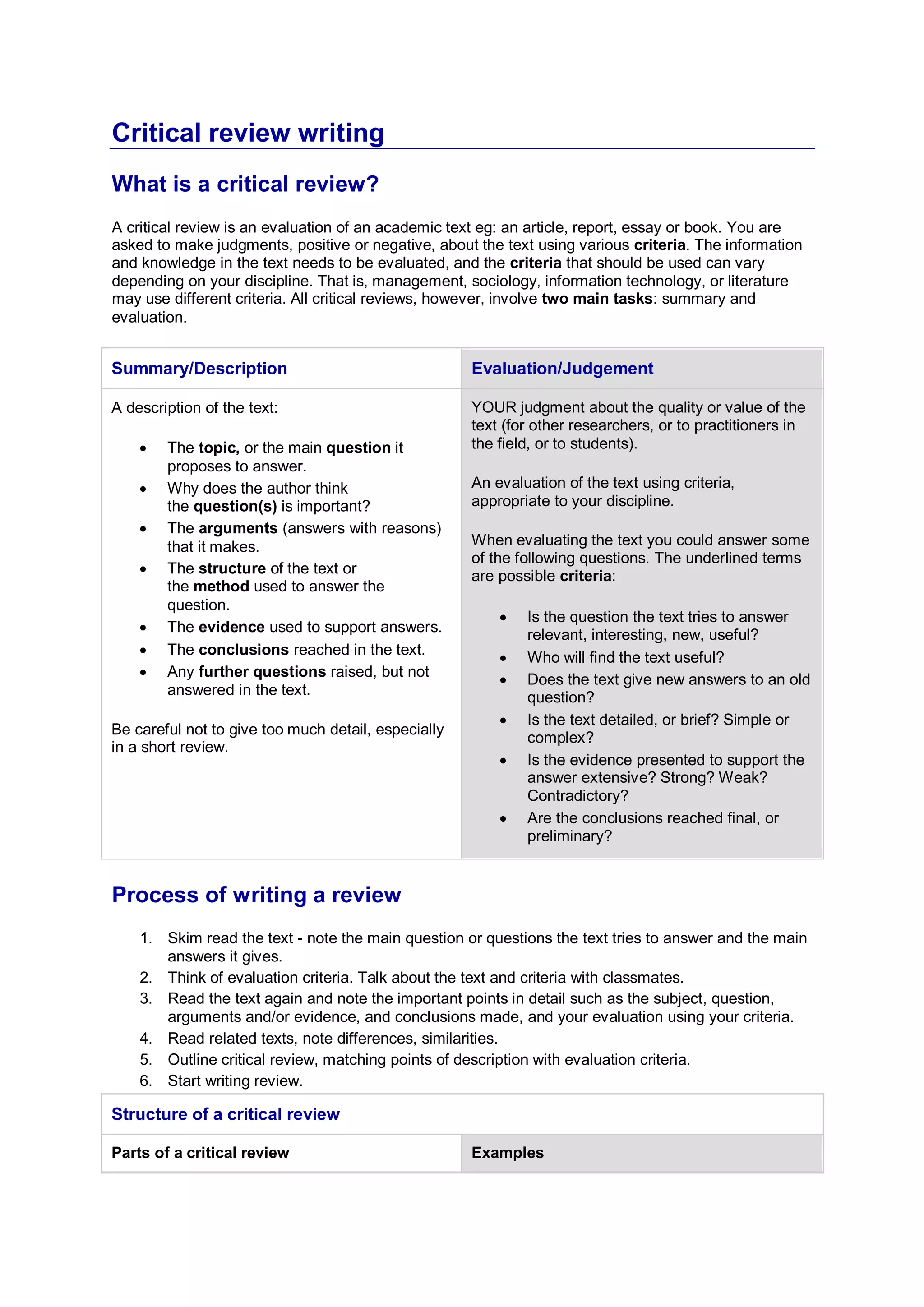
What is a critical review?
A critical review is an evaluation of an academic text eg: an article, report, essay or book. You are
asked to make judgments, positive or negative, about the text using various criteria. The information
and knowledge in the text needs to be evaluated, and the criteria that should be used can vary
depending on your discipline. That is, management, sociology, information technology, or literature
may use different criteria. All critical reviews, however, involve two main tasks: summary and
evaluation.

Summary/Description

Evaluation/Judgement

A description of the text:

YOUR judgment about the quality or value of the
text (for other researchers, or to practitioners in
the field, or to students).










The topic, or the main question it
proposes to answer.
Why does the author think
the question(s) is important?
The arguments (answers with reasons)
that it makes.
The structure of the text or
the method used to answer the
question.
The evidence used to support answers.
The conclusions reached in the text.
Any further questions raised, but not
answered in the text.

Be careful not to give too much detail, especially
in a short review.

An evaluation of the text using criteria,
appropriate to your discipline.
When evaluating the text you could answer some
of the following questions. The underlined terms
are possible criteria:







Is the question the text tries to answer
relevant, interesting, new, useful?
Who will find the text useful?
Does the text give new answers to an old
question?
Is the text detailed, or brief? Simple or
complex?
Is the evidence presented to support the
answer extensive? Strong? Weak?
Contradictory?
Are the conclusions reached final, or
preliminary?

Process of writing a review
1. Skim read the text - note the main question or questions the text tries to answer and the main
answers it gives.
2. Think of evaluation criteria. Talk about the text and criteria with classmates.
3. Read the text again and note the important points in detail such as the subject, question,
arguments and/or evidence, and conclusions made, and your evaluation using your criteria.
4. Read related texts, note differences, similarities.
5. Outline critical review, matching points of description with evaluation criteria.
6. Start writing review.

Structure of a critical review
Parts of a critical review

Examples
Title:
Usually looks like an entry in a bibliography.

Kotter, J 1990, 'What Leaders Really
Do', Harvard Business review, vol. 68, no. 3, p.
103.

Introduction should contain:




A general overview of the topic or
question(s) of the text.
Your evaluation of the importance of the
topic or question.
An explanation of how the critical review
will be organised.

Leadership is different from management and
this article provides a clear, cogent explanation of
the difference.
(From Coyle 2000)

Body of critical review should contain:
1. Summary/description of the text

Kotter examines the difference between
leadership and management across three major
sets of tasks: setting direction versus planning
and budgeting; aligning people versus
organisation and staffing; and motivating versus
controlling and problem solving.
(Adapted from Coyle 2000)

2. Evaluation of the text (note underlined
criteria used)

Kotter's insights, tools, and ideas for action are
relevant but the need for more insight is great.
[you should explain why in more detail]
(From Coyle 2000)

You may not always feel you are able to judge
whether the argument in a text is correct or not. It
may be useful to explain first how the arguments
given in the text are the same, or different from
arguments given in other texts on the same topic.
Then, if they are different, explain which
argument you find more convincing and why.

Like Mintzberg, Kotter concludes that the jobs of
a manager and a leader are not filled with neatly
segmented tasks such as planning or organising.
(From Gibson 1999)

It may be necessary to read widely about a topic
before making judgments.
Conclusion:
Critical reviews don't always need a conclusion
so you must decide whether to include one or
not. If you think a conclusion is necessary it
should reiterate your overall view of the text.

In sum, this is some of Kotter's best work. It is a
good resource for the practising manager who
wants a quick and reliable, even practical source
of information on what constitutes effective
leadership today.
(Adapted from Gibson 1999)

Sources:
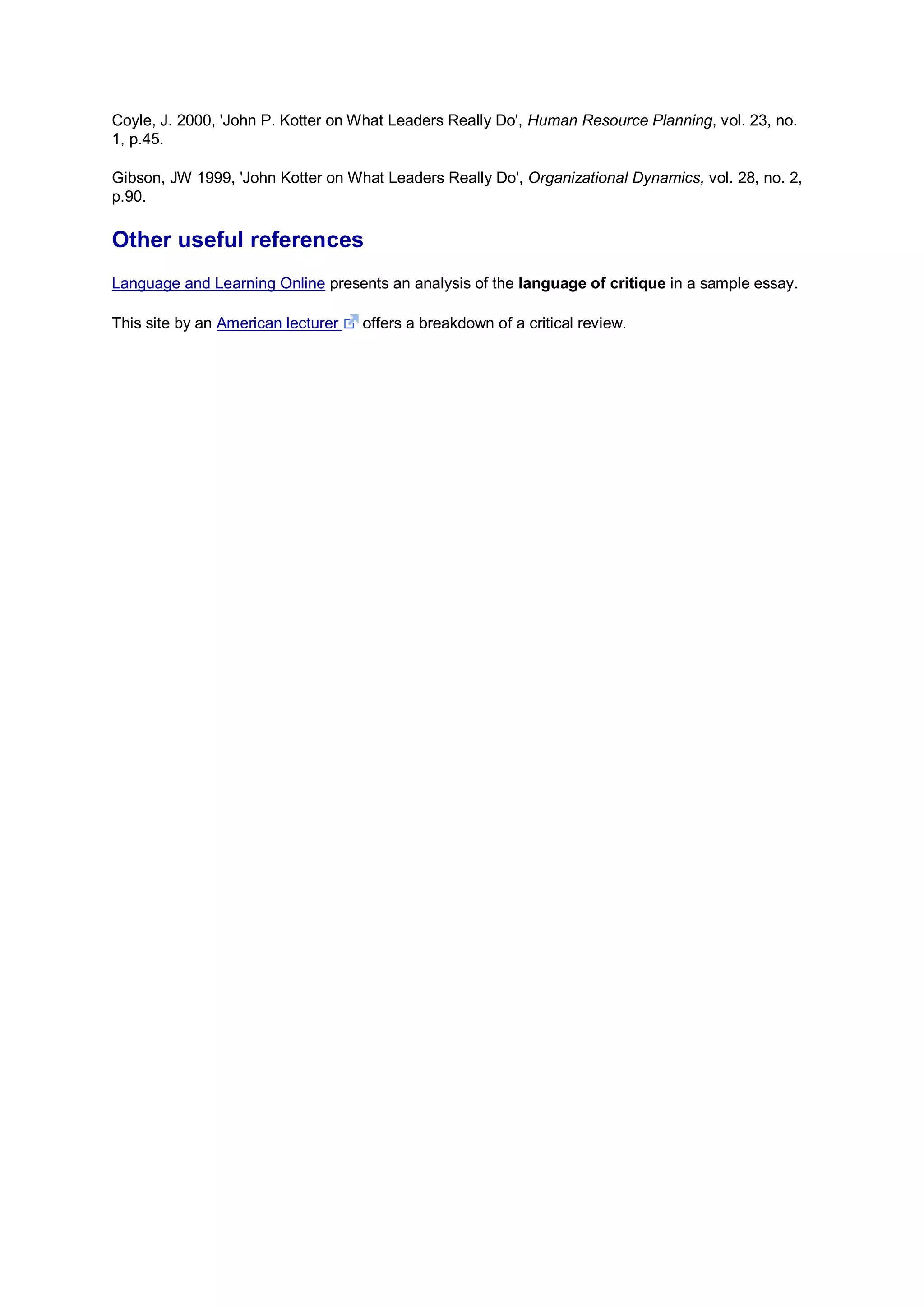
Coyle, J. 2000, 'John P. Kotter on What Leaders Really Do', Human Resource Planning, vol. 23, no.
1, p.45.
Gibson, JW 1999, 'John Kotter on What Leaders Really Do', Organizational Dynamics, vol. 28, no. 2,
p.90.

Other useful references
Language and Learning Online presents an analysis of the language of critique in a sample essay.
This site by an American lecturer

offers a breakdown of a critical review.

Critical review writing_help essay sample from assignmentsupport.com essay writing services

  • 1.
    Critical review writing Whatis a critical review? A critical review is an evaluation of an academic text eg: an article, report, essay or book. You are asked to make judgments, positive or negative, about the text using various criteria. The information and knowledge in the text needs to be evaluated, and the criteria that should be used can vary depending on your discipline. That is, management, sociology, information technology, or literature may use different criteria. All critical reviews, however, involve two main tasks: summary and evaluation. Summary/Description Evaluation/Judgement A description of the text: YOUR judgment about the quality or value of the text (for other researchers, or to practitioners in the field, or to students).        The topic, or the main question it proposes to answer. Why does the author think the question(s) is important? The arguments (answers with reasons) that it makes. The structure of the text or the method used to answer the question. The evidence used to support answers. The conclusions reached in the text. Any further questions raised, but not answered in the text. Be careful not to give too much detail, especially in a short review. An evaluation of the text using criteria, appropriate to your discipline. When evaluating the text you could answer some of the following questions. The underlined terms are possible criteria:       Is the question the text tries to answer relevant, interesting, new, useful? Who will find the text useful? Does the text give new answers to an old question? Is the text detailed, or brief? Simple or complex? Is the evidence presented to support the answer extensive? Strong? Weak? Contradictory? Are the conclusions reached final, or preliminary? Process of writing a review 1. Skim read the text - note the main question or questions the text tries to answer and the main answers it gives. 2. Think of evaluation criteria. Talk about the text and criteria with classmates. 3. Read the text again and note the important points in detail such as the subject, question, arguments and/or evidence, and conclusions made, and your evaluation using your criteria. 4. Read related texts, note differences, similarities. 5. Outline critical review, matching points of description with evaluation criteria. 6. Start writing review. Structure of a critical review Parts of a critical review Examples
  • 2.
    Title: Usually looks likean entry in a bibliography. Kotter, J 1990, 'What Leaders Really Do', Harvard Business review, vol. 68, no. 3, p. 103. Introduction should contain:    A general overview of the topic or question(s) of the text. Your evaluation of the importance of the topic or question. An explanation of how the critical review will be organised. Leadership is different from management and this article provides a clear, cogent explanation of the difference. (From Coyle 2000) Body of critical review should contain: 1. Summary/description of the text Kotter examines the difference between leadership and management across three major sets of tasks: setting direction versus planning and budgeting; aligning people versus organisation and staffing; and motivating versus controlling and problem solving. (Adapted from Coyle 2000) 2. Evaluation of the text (note underlined criteria used) Kotter's insights, tools, and ideas for action are relevant but the need for more insight is great. [you should explain why in more detail] (From Coyle 2000) You may not always feel you are able to judge whether the argument in a text is correct or not. It may be useful to explain first how the arguments given in the text are the same, or different from arguments given in other texts on the same topic. Then, if they are different, explain which argument you find more convincing and why. Like Mintzberg, Kotter concludes that the jobs of a manager and a leader are not filled with neatly segmented tasks such as planning or organising. (From Gibson 1999) It may be necessary to read widely about a topic before making judgments. Conclusion: Critical reviews don't always need a conclusion so you must decide whether to include one or not. If you think a conclusion is necessary it should reiterate your overall view of the text. In sum, this is some of Kotter's best work. It is a good resource for the practising manager who wants a quick and reliable, even practical source of information on what constitutes effective leadership today. (Adapted from Gibson 1999) Sources:
  • 3.
    Coyle, J. 2000,'John P. Kotter on What Leaders Really Do', Human Resource Planning, vol. 23, no. 1, p.45. Gibson, JW 1999, 'John Kotter on What Leaders Really Do', Organizational Dynamics, vol. 28, no. 2, p.90. Other useful references Language and Learning Online presents an analysis of the language of critique in a sample essay. This site by an American lecturer offers a breakdown of a critical review.