Critical thinking and analysis
What is critical thinking?
2
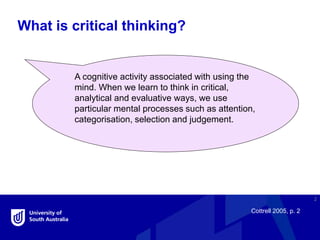
A cognitive activity associated with using the
mind. When we learn to think in critical,
analytical and evaluative ways, we use
particular mental processes such as attention,
categorisation, selection and judgement.
Cottrell 2005, p. 2
Critical thinking skills involves:
3
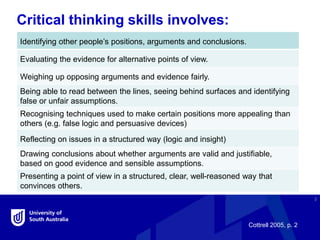
Identifying other people’s positions, arguments and conclusions.
Evaluating the evidence for alternative points of view.
Weighing up opposing arguments and evidence fairly.
Being able to read between the lines, seeing behind surfaces and identifying
false or unfair assumptions.
Recognising techniques used to make certain positions more appealing than
others (e.g. false logic and persuasive devices)
Reflecting on issues in a structured way (logic and insight)
Drawing conclusions about whether arguments are valid and justifiable,
based on good evidence and sensible assumptions.
Presenting a point of view in a structured, clear, well-reasoned way that
convinces others.
Cottrell 2005, p. 2
Critical thinking and reasoning
4
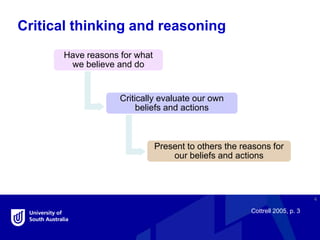
Have reasons for what
we believe and do
Critically evaluate our own
beliefs and actions
Present to others the reasons for
our beliefs and actions
Cottrell 2005, p. 3
Critical analysis of others’ reasoning
5
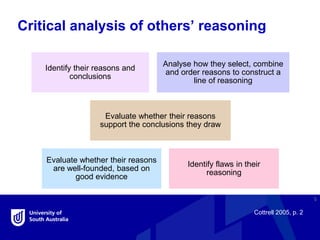
Identify their reasons and
conclusions
Analyse how they select, combine
and order reasons to construct a
line of reasoning
Evaluate whether their reasons
support the conclusions they draw
Evaluate whether their reasons
are well-founded, based on
good evidence
Identify flaws in their
reasoning
Cottrell 2005, p. 2
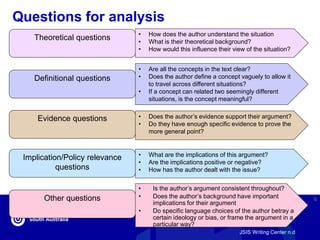
Questions for analysis
6
Theoretical questions
Definitional questions
Evidence questions
Implication/Policy relevance
questions
Other questions
• How does the author understand the situation
• What is their theoretical background?
• How would this influence their view of the situation?
• Are all the concepts in the text clear?
• Does the author define a concept vaguely to allow it
to travel across different situations?
• If a concept can related two seemingly different
situations, is the concept meaningful?
• Does the author’s evidence support their argument?
• Do they have enough specific evidence to prove the
more general point?
• What are the implications of this argument?
• Are the implications positive or negative?
• How has the author dealt with the issue?
• Is the author’s argument consistent throughout?
• Does the author’s background have important
implications for their argument
• Do specific language choices of the author betray a
certain ideology or bias, or frame the argument in a
particular way?
JSIS Writing Center n.d
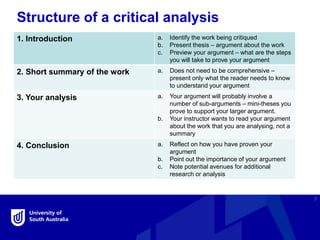
Structure of a critical analysis
7
1. Introduction a. Identify the work being critiqued
b. Present thesis – argument about the work
c. Preview your argument – what are the steps
you will take to prove your argument
2. Short summary of the work a. Does not need to be comprehensive –
present only what the reader needs to know
to understand your argument
3. Your analysis a. Your argument will probably involve a
number of sub-arguments – mini-theses you
prove to support your larger argument.
b. Your instructor wants to read your argument
about the work that you are analysing, not a
summary
4. Conclusion a. Reflect on how you have proven your
argument
b. Point out the importance of your argument
c. Note potential avenues for additional
research or analysis
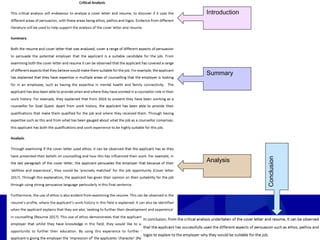
Introduction
Summary
Analysis
Conclusion
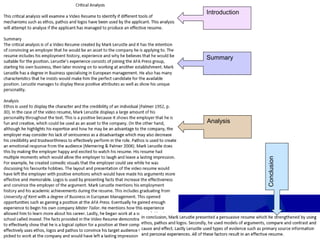
Introduction
Summary
Analysis
Conclusion
References
Cottrell, S 2005, Critical thinking skills, Palgrave Macmillan, New York.
JSIS Writing Center n.d. ‘Writing critical analysis papers’, viewed 19 June 2017,
https://depts.washington.edu/pswrite/Handouts/CriticalAnalysisPapers.pdf

Critical thinking and analysis.pptx

  • 1.
  • 2.
    What is criticalthinking? 2 A cognitive activity associated with using the mind. When we learn to think in critical, analytical and evaluative ways, we use particular mental processes such as attention, categorisation, selection and judgement. Cottrell 2005, p. 2
  • 3.
    Critical thinking skillsinvolves: 3 Identifying other people’s positions, arguments and conclusions. Evaluating the evidence for alternative points of view. Weighing up opposing arguments and evidence fairly. Being able to read between the lines, seeing behind surfaces and identifying false or unfair assumptions. Recognising techniques used to make certain positions more appealing than others (e.g. false logic and persuasive devices) Reflecting on issues in a structured way (logic and insight) Drawing conclusions about whether arguments are valid and justifiable, based on good evidence and sensible assumptions. Presenting a point of view in a structured, clear, well-reasoned way that convinces others. Cottrell 2005, p. 2
  • 4.
    Critical thinking andreasoning 4 Have reasons for what we believe and do Critically evaluate our own beliefs and actions Present to others the reasons for our beliefs and actions Cottrell 2005, p. 3
  • 5.
    Critical analysis ofothers’ reasoning 5 Identify their reasons and conclusions Analyse how they select, combine and order reasons to construct a line of reasoning Evaluate whether their reasons support the conclusions they draw Evaluate whether their reasons are well-founded, based on good evidence Identify flaws in their reasoning Cottrell 2005, p. 2
  • 6.
    Questions for analysis 6 Theoreticalquestions Definitional questions Evidence questions Implication/Policy relevance questions Other questions • How does the author understand the situation • What is their theoretical background? • How would this influence their view of the situation? • Are all the concepts in the text clear? • Does the author define a concept vaguely to allow it to travel across different situations? • If a concept can related two seemingly different situations, is the concept meaningful? • Does the author’s evidence support their argument? • Do they have enough specific evidence to prove the more general point? • What are the implications of this argument? • Are the implications positive or negative? • How has the author dealt with the issue? • Is the author’s argument consistent throughout? • Does the author’s background have important implications for their argument • Do specific language choices of the author betray a certain ideology or bias, or frame the argument in a particular way? JSIS Writing Center n.d
  • 7.
    Structure of acritical analysis 7 1. Introduction a. Identify the work being critiqued b. Present thesis – argument about the work c. Preview your argument – what are the steps you will take to prove your argument 2. Short summary of the work a. Does not need to be comprehensive – present only what the reader needs to know to understand your argument 3. Your analysis a. Your argument will probably involve a number of sub-arguments – mini-theses you prove to support your larger argument. b. Your instructor wants to read your argument about the work that you are analysing, not a summary 4. Conclusion a. Reflect on how you have proven your argument b. Point out the importance of your argument c. Note potential avenues for additional research or analysis
  • 8.
  • 9.
  • 10.
    References Cottrell, S 2005,Critical thinking skills, Palgrave Macmillan, New York. JSIS Writing Center n.d. ‘Writing critical analysis papers’, viewed 19 June 2017, https://depts.washington.edu/pswrite/Handouts/CriticalAnalysisPapers.pdf