Targeting CSA in Southern Tanzania under
multiple uncertainties
Which CSA water management technologies are most
suitable for Tanzania’s SAGCOT?
Chris&ne	
  Lamanna1,	
  Todd	
  S.	
  Rosenstock1,2,	
  Eike	
  Luedeling3	
  
1World	
  Agroforestry	
  Centre,	
  Nairobi,	
  Kenya;	
  2CGIAR	
  Research	
  Program	
  on	
  Climate	
  Change,	
  Agriculture	
  and	
  Food	
  Security;	
  3World	
  
Agroforestry	
  Centre,	
  Bonn,	
  Germany	
  
%HHs	
  w/	
  
Livestock	
  
Livestock	
  
Density	
  
Highland	
  
Focus	
  
Cereal	
  
Focus	
  
Lowland	
  
Focus	
  
Terrain	
  
Soil	
  
Fer&lity	
  
%HHs	
  
w/	
  
Coffee	
  
%HHs	
  
w/	
  
Maize	
  
%HHs	
  
w/	
  
Paddy	
  
Slope	
  
SOC	
  
Farming	
  
System	
  
Compa&bility	
  
Soil	
  
Resources	
  
Cropping	
  
System	
  
Distance	
  
to	
  
Market	
  
Precipita
&on	
  
Depth	
  to	
  
Groundwa
ter	
  
Surface	
  
Water	
  
Ground	
  
Water	
  
Water	
  
Resources	
  
Physical	
  
Capital	
  
Natural	
  
Capital	
  
Farm	
  &	
  
Physical	
  
Biophysical	
  
Factors	
  
%	
  HH	
  w/	
  
Tenure	
  
%	
  HH	
  w/	
  
Extension	
  
%	
  pop	
  
illiterate	
  
Land	
  
Tenure	
  
Farmer	
  
Support	
  
Literacy	
  
Rates	
  
Labour	
  
Avail.	
  
Complexity	
  
Start	
  up	
  
costs	
  
Poverty	
  
Access	
  
to	
  Credit	
  
Social	
  
Capital	
  
Human	
  
Capital	
  
Financial	
  
Capital	
  
Interven&on	
  	
  
Capital	
  
Social	
  Factors	
  
Interven&on	
  &	
  
Social	
  
Human	
  &	
  
Financial	
  	
  
N/A	
  
N/A	
  
Suitability	
  
%	
  pop	
  in	
  
lowest	
  
quar&le	
  
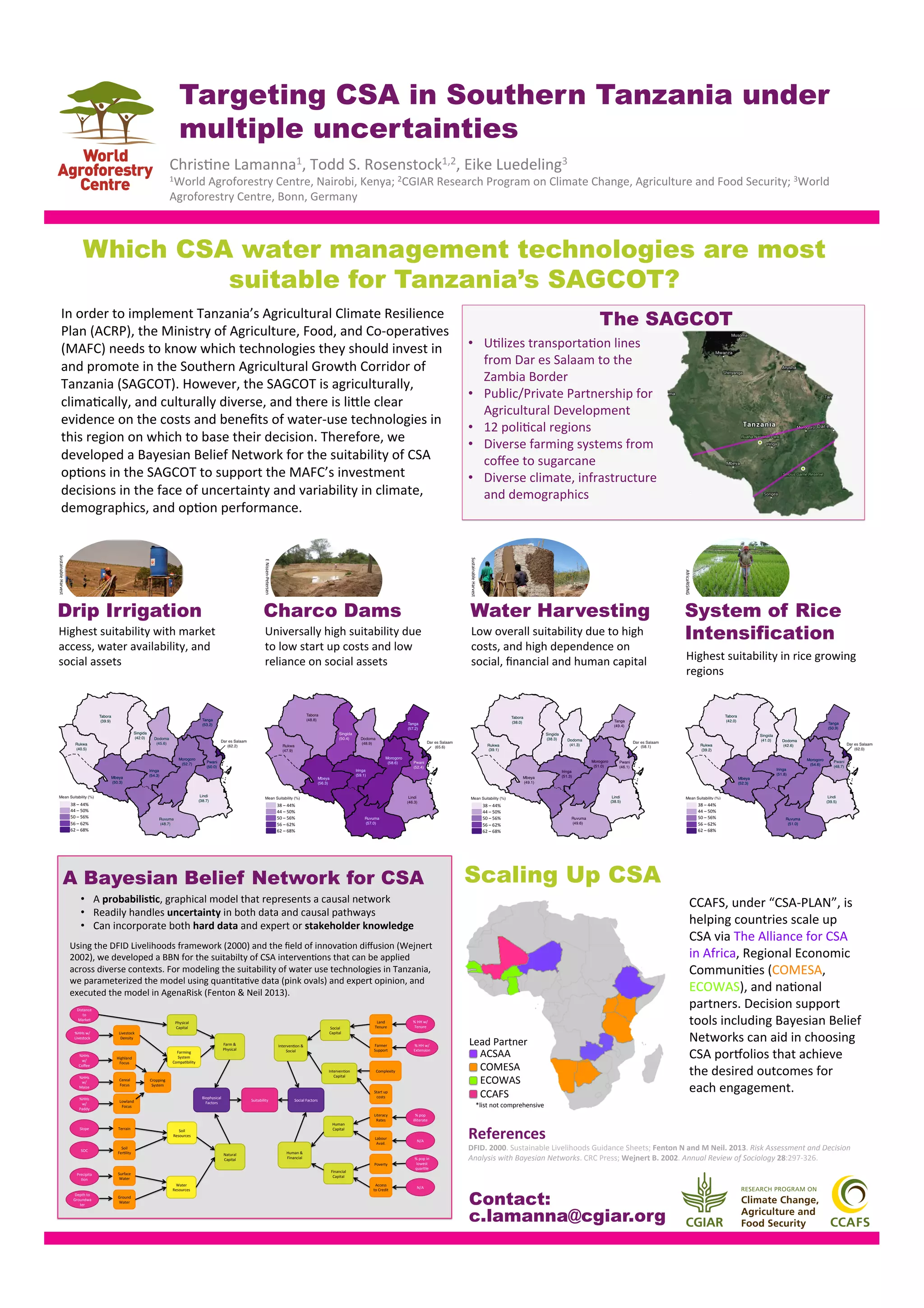
•  A	
  probabilis)c,	
  graphical	
  model	
  that	
  represents	
  a	
  causal	
  network	
  
•  Readily	
  handles	
  uncertainty	
  in	
  both	
  data	
  and	
  causal	
  pathways	
  
•  Can	
  incorporate	
  both	
  hard	
  data	
  and	
  expert	
  or	
  stakeholder	
  knowledge	
  
Using	
  the	
  DFID	
  Livelihoods	
  framework	
  (2000)	
  and	
  the	
  field	
  of	
  innova&on	
  diffusion	
  (Wejnert	
  
2002),	
  we	
  developed	
  a	
  BBN	
  for	
  the	
  suitabilty	
  of	
  CSA	
  interven&ons	
  that	
  can	
  be	
  applied	
  
across	
  diverse	
  contexts.	
  For	
  modeling	
  the	
  suitability	
  of	
  water	
  use	
  technologies	
  in	
  Tanzania,	
  
we	
  parameterized	
  the	
  model	
  using	
  quan&ta&ve	
  data	
  (pink	
  ovals)	
  and	
  expert	
  opinion,	
  and	
  
executed	
  the	
  model	
  in	
  AgenaRisk	
  (Fenton	
  &	
  Neil	
  2013).	
  	
  
A Bayesian Belief Network for CSA	
  
Contact:
c.lamanna@cgiar.org
In	
  order	
  to	
  implement	
  Tanzania’s	
  Agricultural	
  Climate	
  Resilience	
  
Plan	
  (ACRP),	
  the	
  Ministry	
  of	
  Agriculture,	
  Food,	
  and	
  Co-­‐opera&ves	
  
(MAFC)	
  needs	
  to	
  know	
  which	
  technologies	
  they	
  should	
  invest	
  in	
  
and	
  promote	
  in	
  the	
  Southern	
  Agricultural	
  Growth	
  Corridor	
  of	
  
Tanzania	
  (SAGCOT).	
  However,	
  the	
  SAGCOT	
  is	
  agriculturally,	
  
clima&cally,	
  and	
  culturally	
  diverse,	
  and	
  there	
  is	
  liale	
  clear	
  
evidence	
  on	
  the	
  costs	
  and	
  benefits	
  of	
  water-­‐use	
  technologies	
  in	
  
this	
  region	
  on	
  which	
  to	
  base	
  their	
  decision.	
  Therefore,	
  we	
  
developed	
  a	
  Bayesian	
  Belief	
  Network	
  for	
  the	
  suitability	
  of	
  CSA	
  
op&ons	
  in	
  the	
  SAGCOT	
  to	
  support	
  the	
  MAFC’s	
  investment	
  
decisions	
  in	
  the	
  face	
  of	
  uncertainty	
  and	
  variability	
  in	
  climate,	
  
demographics,	
  and	
  op&on	
  performance.	
  
References	
  
DFID.	
  2000.	
  Sustainable	
  Livelihoods	
  Guidance	
  Sheets;	
  Fenton	
  N	
  and	
  M	
  Neil.	
  2013.	
  Risk	
  Assessment	
  and	
  Decision	
  
Analysis	
  with	
  Bayesian	
  Networks.	
  CRC	
  Press;	
  Wejnert	
  B.	
  2002.	
  Annual	
  Review	
  of	
  Sociology	
  28:297-­‐326.	


•  U&lizes	
  transporta&on	
  lines	
  
from	
  Dar	
  es	
  Salaam	
  to	
  the	
  
Zambia	
  Border	
  
•  Public/Private	
  Partnership	
  for	
  
Agricultural	
  Development	
  
•  12	
  poli&cal	
  regions	
  
•  Diverse	
  farming	
  systems	
  from	
  
coffee	
  to	
  sugarcane	
  
•  Diverse	
  climate,	
  infrastructure	
  
and	
  demographics	
  
The SAGCOT	
  
Scaling Up CSA
38	
  –	
  44%	
  
44	
  –	
  50%	
  
50	
  –	
  56%	
  
56	
  –	
  62%	
  
62	
  –	
  68%	
  
Drip Irrigation	
  
Sustainable	
  Harvest	
  
Highest	
  suitability	
  with	
  market	
  
access,	
  water	
  availability,	
  and	
  
social	
  assets	
  
38	
  –	
  44%	
  
44	
  –	
  50%	
  
50	
  –	
  56%	
  
56	
  –	
  62%	
  
62	
  –	
  68%	
  
E	
  Nissen-­‐Petersen	
  
Charco Dams	
  
Universally	
  high	
  suitability	
  due	
  
to	
  low	
  start	
  up	
  costs	
  and	
  low	
  
reliance	
  on	
  social	
  assets	
  
38	
  –	
  44%	
  
44	
  –	
  50%	
  
50	
  –	
  56%	
  
56	
  –	
  62%	
  
62	
  –	
  68%	
  
Water Harvesting	
  
Sustainable	
  Harvest	
  
Low	
  overall	
  suitability	
  due	
  to	
  high	
  
costs,	
  and	
  high	
  dependence	
  on	
  
social,	
  financial	
  and	
  human	
  capital	
  
38	
  –	
  44%	
  
44	
  –	
  50%	
  
50	
  –	
  56%	
  
56	
  –	
  62%	
  
62	
  –	
  68%	
  
System of Rice
Intensification	
  
AfricaRISING	
  
Highest	
  suitability	
  in	
  rice	
  growing	
  
regions	
  
ACSAA	
  
COMESA	
  
ECOWAS	
  
CCAFS	
  
*list	
  not	
  comprehensive	
  
CCAFS,	
  under	
  “CSA-­‐PLAN”,	
  is	
  
helping	
  countries	
  scale	
  up	
  
CSA	
  via	
  The	
  Alliance	
  for	
  CSA	
  
in	
  Africa,	
  Regional	
  Economic	
  
Communi&es	
  (COMESA,	
  
ECOWAS),	
  and	
  na&onal	
  
partners.	
  Decision	
  support	
  
tools	
  including	
  Bayesian	
  Belief	
  
Networks	
  can	
  aid	
  in	
  choosing	
  
CSA	
  pornolios	
  that	
  achieve	
  
the	
  desired	
  outcomes	
  for	
  
each	
  engagement.	


Lead	
  Partner	
  

Targeting CSA in S. Tanzania

  • 1.
    Targeting CSA inSouthern Tanzania under multiple uncertainties Which CSA water management technologies are most suitable for Tanzania’s SAGCOT? Chris&ne  Lamanna1,  Todd  S.  Rosenstock1,2,  Eike  Luedeling3   1World  Agroforestry  Centre,  Nairobi,  Kenya;  2CGIAR  Research  Program  on  Climate  Change,  Agriculture  and  Food  Security;  3World   Agroforestry  Centre,  Bonn,  Germany   %HHs  w/   Livestock   Livestock   Density   Highland   Focus   Cereal   Focus   Lowland   Focus   Terrain   Soil   Fer&lity   %HHs   w/   Coffee   %HHs   w/   Maize   %HHs   w/   Paddy   Slope   SOC   Farming   System   Compa&bility   Soil   Resources   Cropping   System   Distance   to   Market   Precipita &on   Depth  to   Groundwa ter   Surface   Water   Ground   Water   Water   Resources   Physical   Capital   Natural   Capital   Farm  &   Physical   Biophysical   Factors   %  HH  w/   Tenure   %  HH  w/   Extension   %  pop   illiterate   Land   Tenure   Farmer   Support   Literacy   Rates   Labour   Avail.   Complexity   Start  up   costs   Poverty   Access   to  Credit   Social   Capital   Human   Capital   Financial   Capital   Interven&on     Capital   Social  Factors   Interven&on  &   Social   Human  &   Financial     N/A   N/A   Suitability   %  pop  in   lowest   quar&le   •  A  probabilis)c,  graphical  model  that  represents  a  causal  network   •  Readily  handles  uncertainty  in  both  data  and  causal  pathways   •  Can  incorporate  both  hard  data  and  expert  or  stakeholder  knowledge   Using  the  DFID  Livelihoods  framework  (2000)  and  the  field  of  innova&on  diffusion  (Wejnert   2002),  we  developed  a  BBN  for  the  suitabilty  of  CSA  interven&ons  that  can  be  applied   across  diverse  contexts.  For  modeling  the  suitability  of  water  use  technologies  in  Tanzania,   we  parameterized  the  model  using  quan&ta&ve  data  (pink  ovals)  and  expert  opinion,  and   executed  the  model  in  AgenaRisk  (Fenton  &  Neil  2013).     A Bayesian Belief Network for CSA   Contact: c.lamanna@cgiar.org In  order  to  implement  Tanzania’s  Agricultural  Climate  Resilience   Plan  (ACRP),  the  Ministry  of  Agriculture,  Food,  and  Co-­‐opera&ves   (MAFC)  needs  to  know  which  technologies  they  should  invest  in   and  promote  in  the  Southern  Agricultural  Growth  Corridor  of   Tanzania  (SAGCOT).  However,  the  SAGCOT  is  agriculturally,   clima&cally,  and  culturally  diverse,  and  there  is  liale  clear   evidence  on  the  costs  and  benefits  of  water-­‐use  technologies  in   this  region  on  which  to  base  their  decision.  Therefore,  we   developed  a  Bayesian  Belief  Network  for  the  suitability  of  CSA   op&ons  in  the  SAGCOT  to  support  the  MAFC’s  investment   decisions  in  the  face  of  uncertainty  and  variability  in  climate,   demographics,  and  op&on  performance.   References   DFID.  2000.  Sustainable  Livelihoods  Guidance  Sheets;  Fenton  N  and  M  Neil.  2013.  Risk  Assessment  and  Decision   Analysis  with  Bayesian  Networks.  CRC  Press;  Wejnert  B.  2002.  Annual  Review  of  Sociology  28:297-­‐326.       •  U&lizes  transporta&on  lines   from  Dar  es  Salaam  to  the   Zambia  Border   •  Public/Private  Partnership  for   Agricultural  Development   •  12  poli&cal  regions   •  Diverse  farming  systems  from   coffee  to  sugarcane   •  Diverse  climate,  infrastructure   and  demographics   The SAGCOT   Scaling Up CSA 38  –  44%   44  –  50%   50  –  56%   56  –  62%   62  –  68%   Drip Irrigation   Sustainable  Harvest   Highest  suitability  with  market   access,  water  availability,  and   social  assets   38  –  44%   44  –  50%   50  –  56%   56  –  62%   62  –  68%   E  Nissen-­‐Petersen   Charco Dams   Universally  high  suitability  due   to  low  start  up  costs  and  low   reliance  on  social  assets   38  –  44%   44  –  50%   50  –  56%   56  –  62%   62  –  68%   Water Harvesting   Sustainable  Harvest   Low  overall  suitability  due  to  high   costs,  and  high  dependence  on   social,  financial  and  human  capital   38  –  44%   44  –  50%   50  –  56%   56  –  62%   62  –  68%   System of Rice Intensification   AfricaRISING   Highest  suitability  in  rice  growing   regions   ACSAA   COMESA   ECOWAS   CCAFS   *list  not  comprehensive   CCAFS,  under  “CSA-­‐PLAN”,  is   helping  countries  scale  up   CSA  via  The  Alliance  for  CSA   in  Africa,  Regional  Economic   Communi&es  (COMESA,   ECOWAS),  and  na&onal   partners.  Decision  support   tools  including  Bayesian  Belief   Networks  can  aid  in  choosing   CSA  pornolios  that  achieve   the  desired  outcomes  for   each  engagement.             Lead  Partner