The Subjunctive Mood V.Rapa, M.Upmale  ENGLISH NORMATIVE GRAMMAR IV   Riga 2008
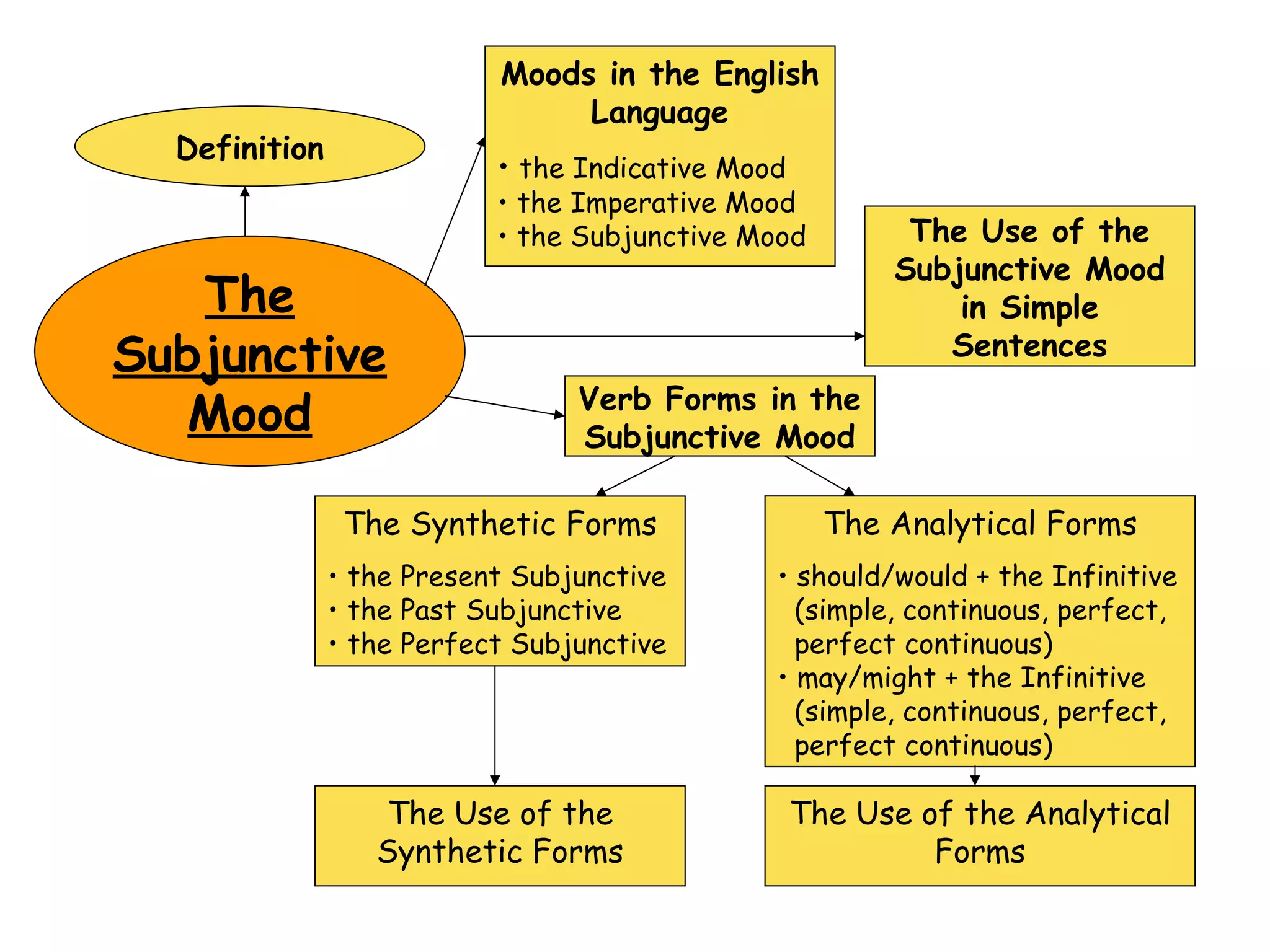
The Subjunctive Mood Moods in the English Language the Indicative Mood the Imperative Mood the Subjunctive Mood The Use of the Subjunctive Mood in Simple Sentences Verb Forms in the Subjunctive Mood The Synthetic Forms the Present Subjunctive the Past Subjunctive the Perfect Subjunctive The Use of the Synthetic Forms The Analytical Forms should/would + the Infinitive (simple, continuous, perfect,  perfect continuous) may/might + the Infinitive (simple, continuous, perfect, perfect continuous) The Use of the Analytical Forms Definition
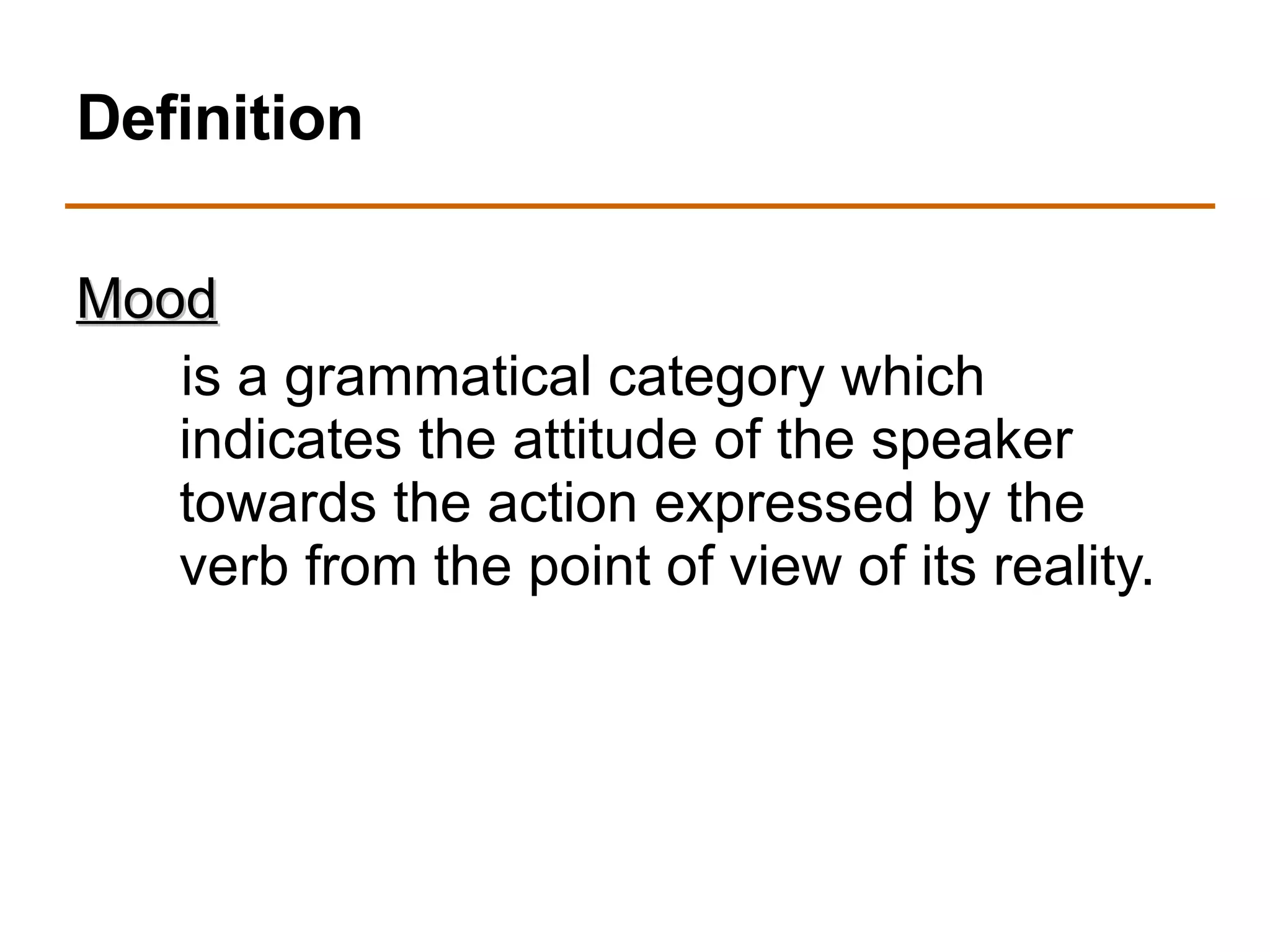
Definition Mood   is a grammatical category which indicates the attitude of the speaker towards the action expressed by the verb from the point of view of its reality.
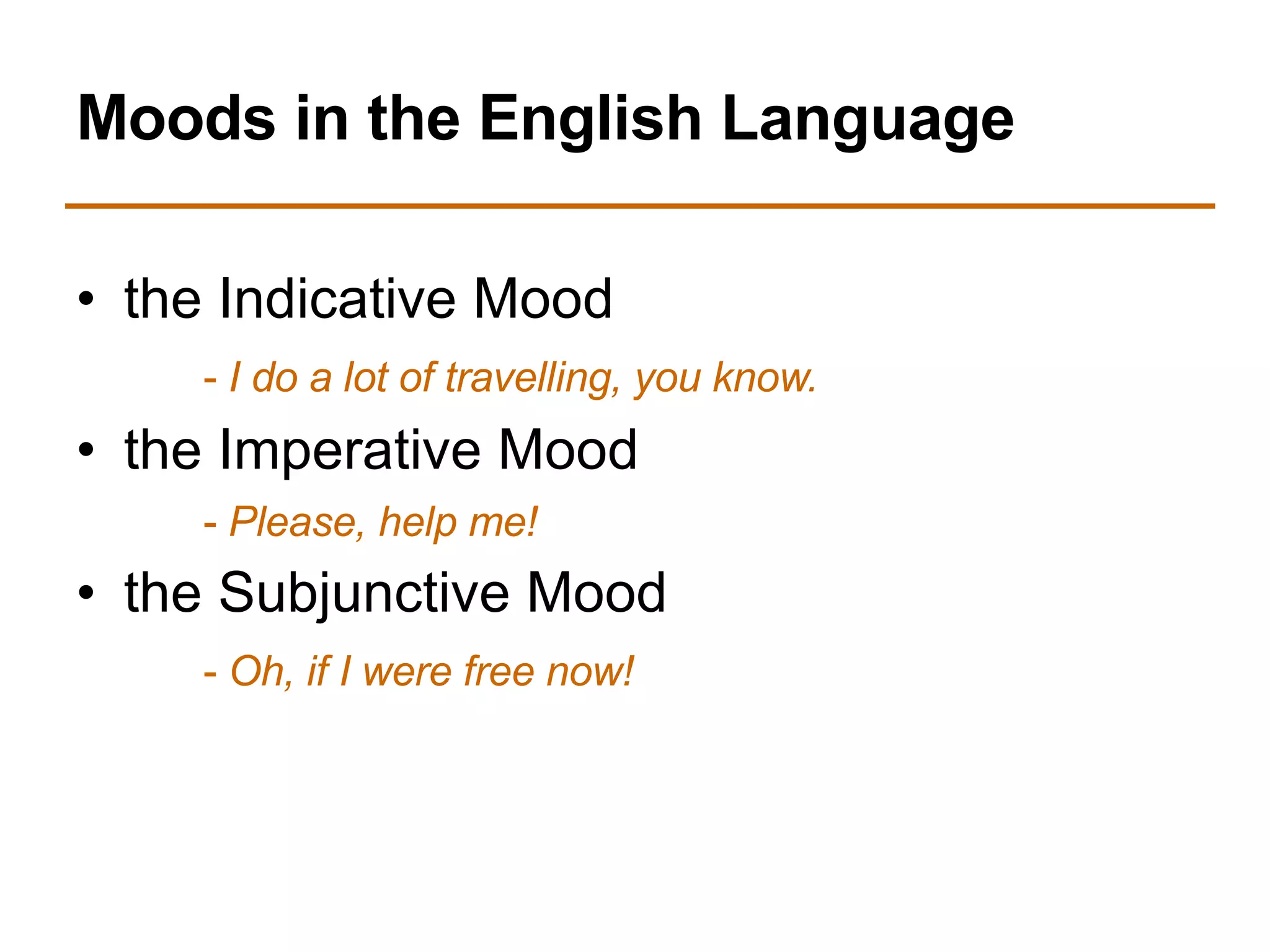
Moods in the English Language the Indicative Mood -  I do a lot of travelling, you know. the Imperative Mood -  Please, help me! the Subjunctive Mood -  Oh, if I were free now!
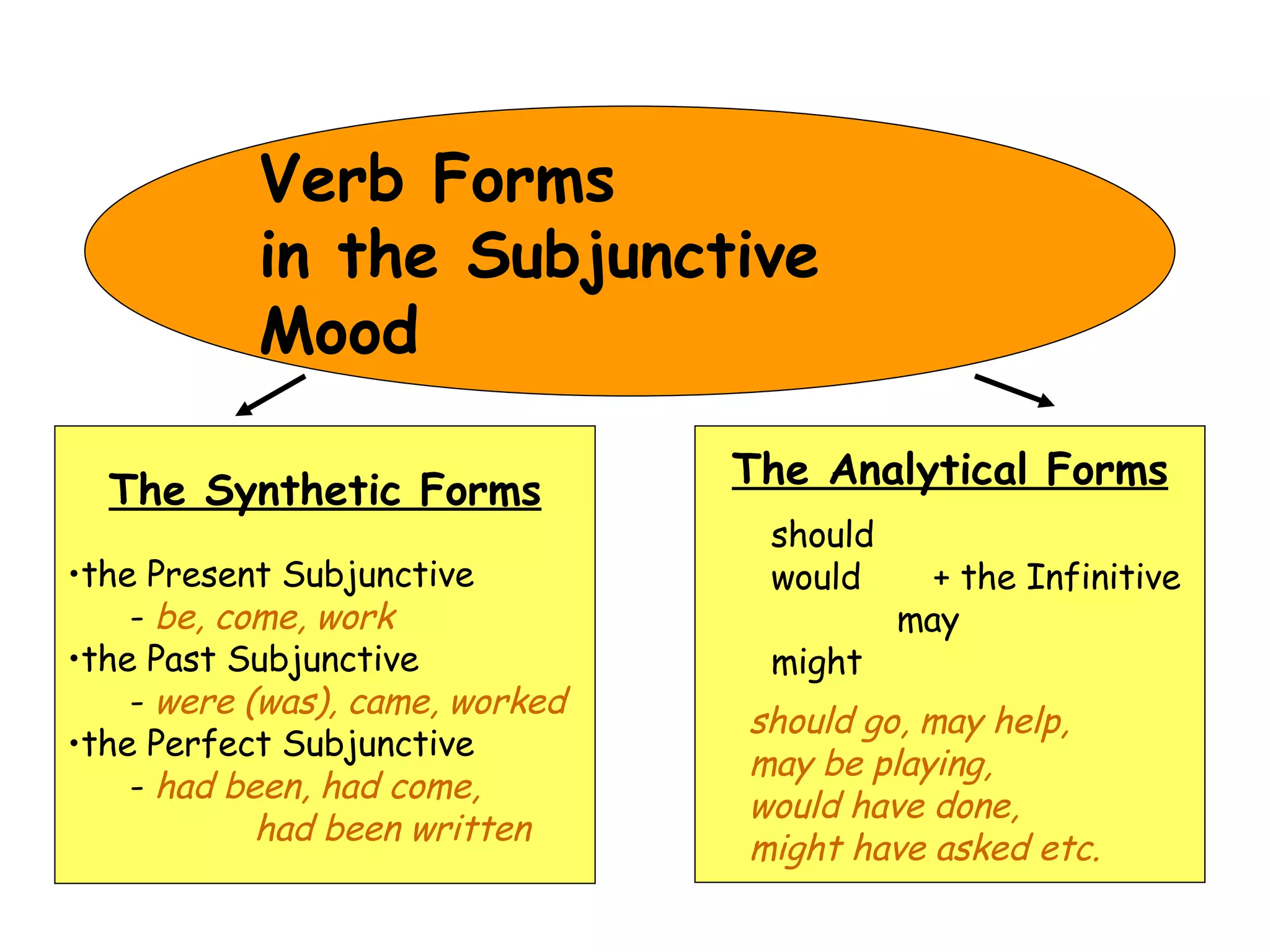
Verb Forms  in the Subjunctive Mood The Synthetic Forms the Present Subjunctive -  be, come, work the Past Subjunctive -  were (was), came, worked the Perfect Subjunctive -  had been, had come,  had been written The Analytical Forms should would  + the Infinitive may  might should go, may help,  may be playing,  would have done,  might have asked etc.
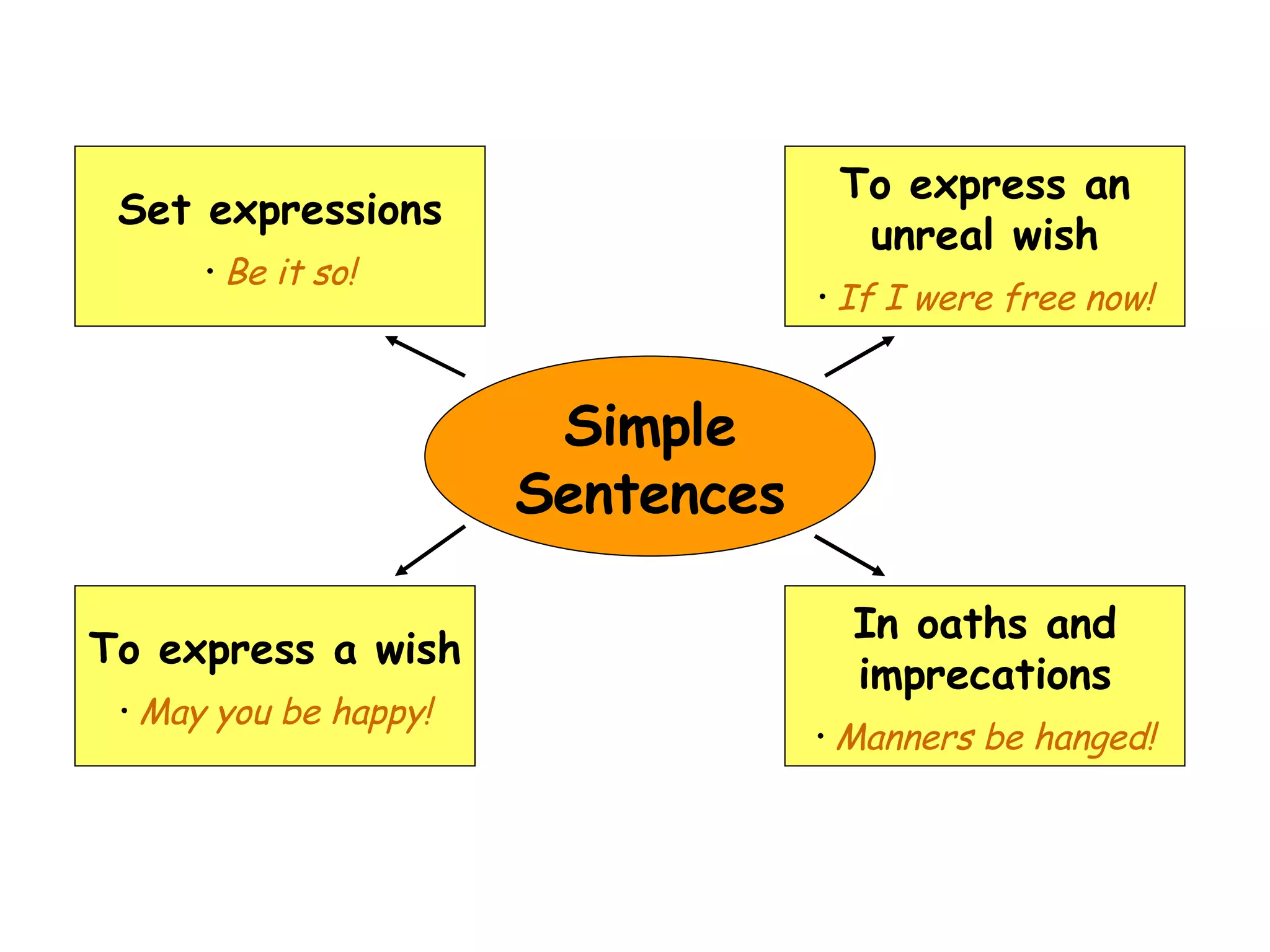
Simple   Sentences Set expressions Be it so! To express an unreal wish If I were free now! To express a wish May you be happy! In oaths and imprecations Manners be hanged!
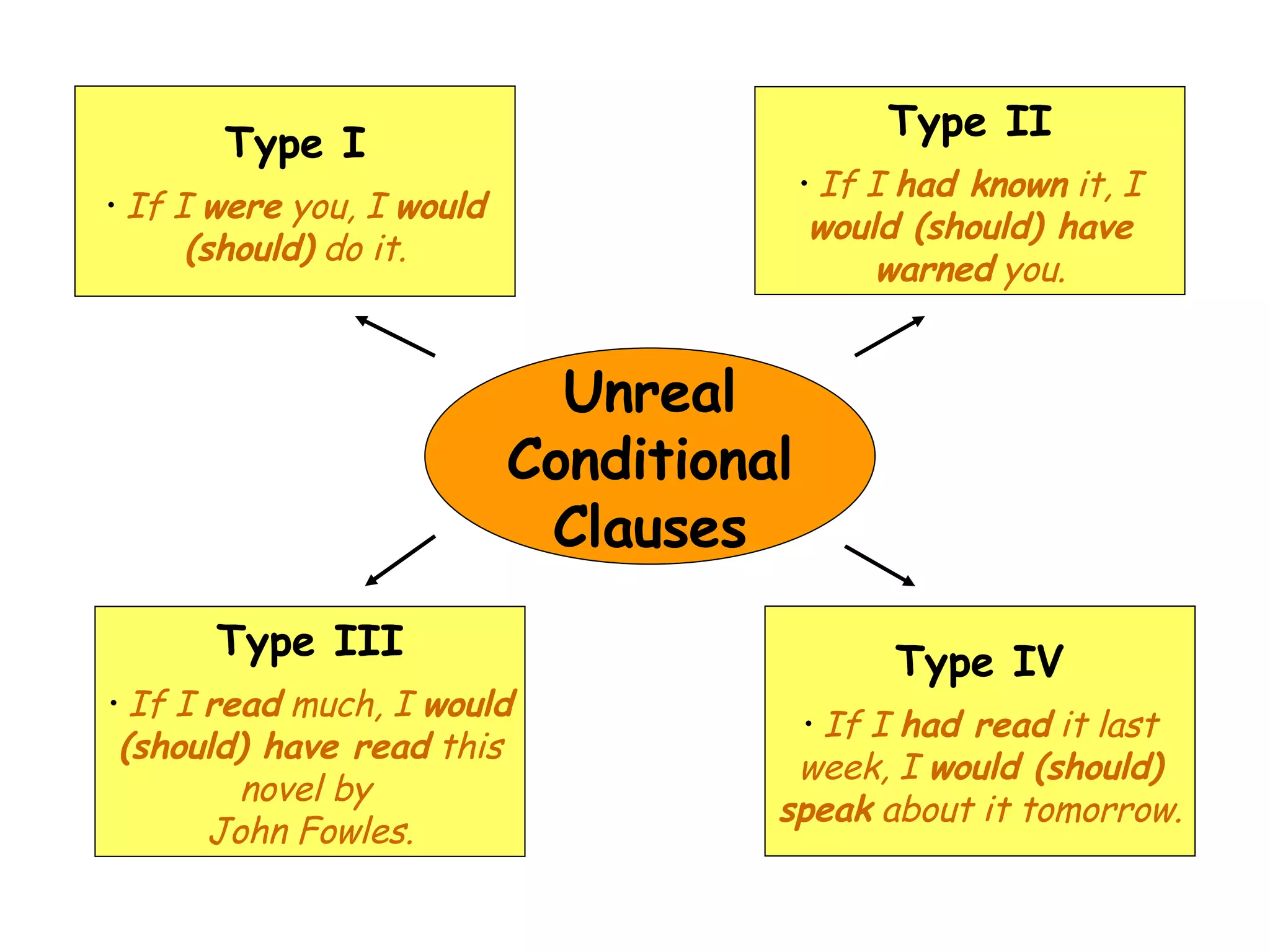
Unreal Conditional Clauses Type I If I  were  you, I  would (should)  do it. Type II If I  had known  it, I  would (should) have warned  you. Type III If I  read  much, I  would (should) have read  this novel by  John Fowles. Type IV If I  had read  it last week, I  would (should) speak  about it tomorrow.
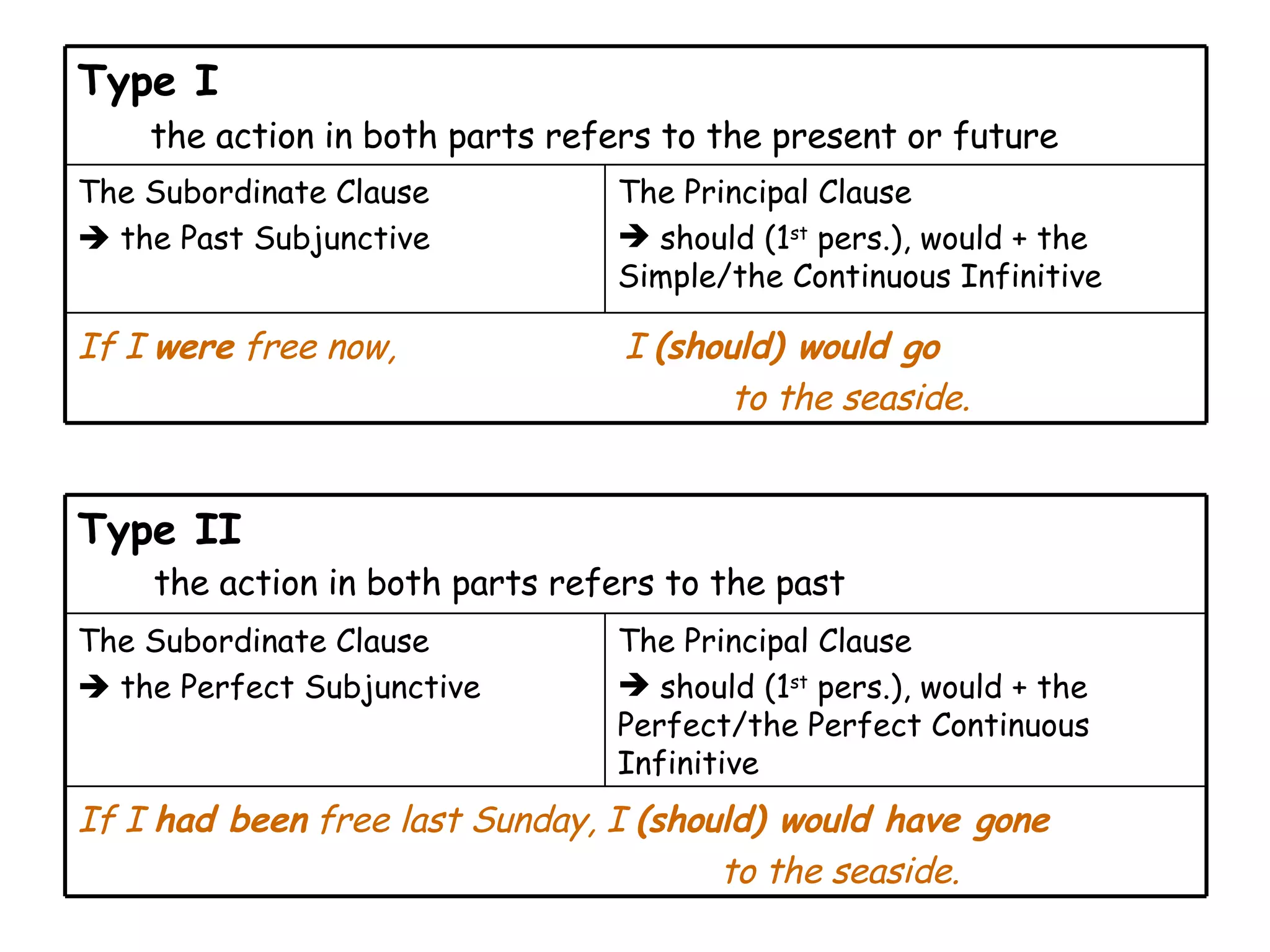
If I  had been  free last Sunday, I  (should) would have gone   to the seaside. The Principal Clause  should (1 st  pers.), would + the Perfect/the Perfect Continuous Infinitive The Subordinate Clause     the Perfect Subjunctive Type II    the action in both parts refers to the past If I  were  free now,    I  (should) would go   to the seaside. The Principal Clause  should (1 st  pers.), would + the Simple/the Continuous Infinitive The Subordinate Clause     the Past Subjunctive Type I  the action in both parts refers to the present or future
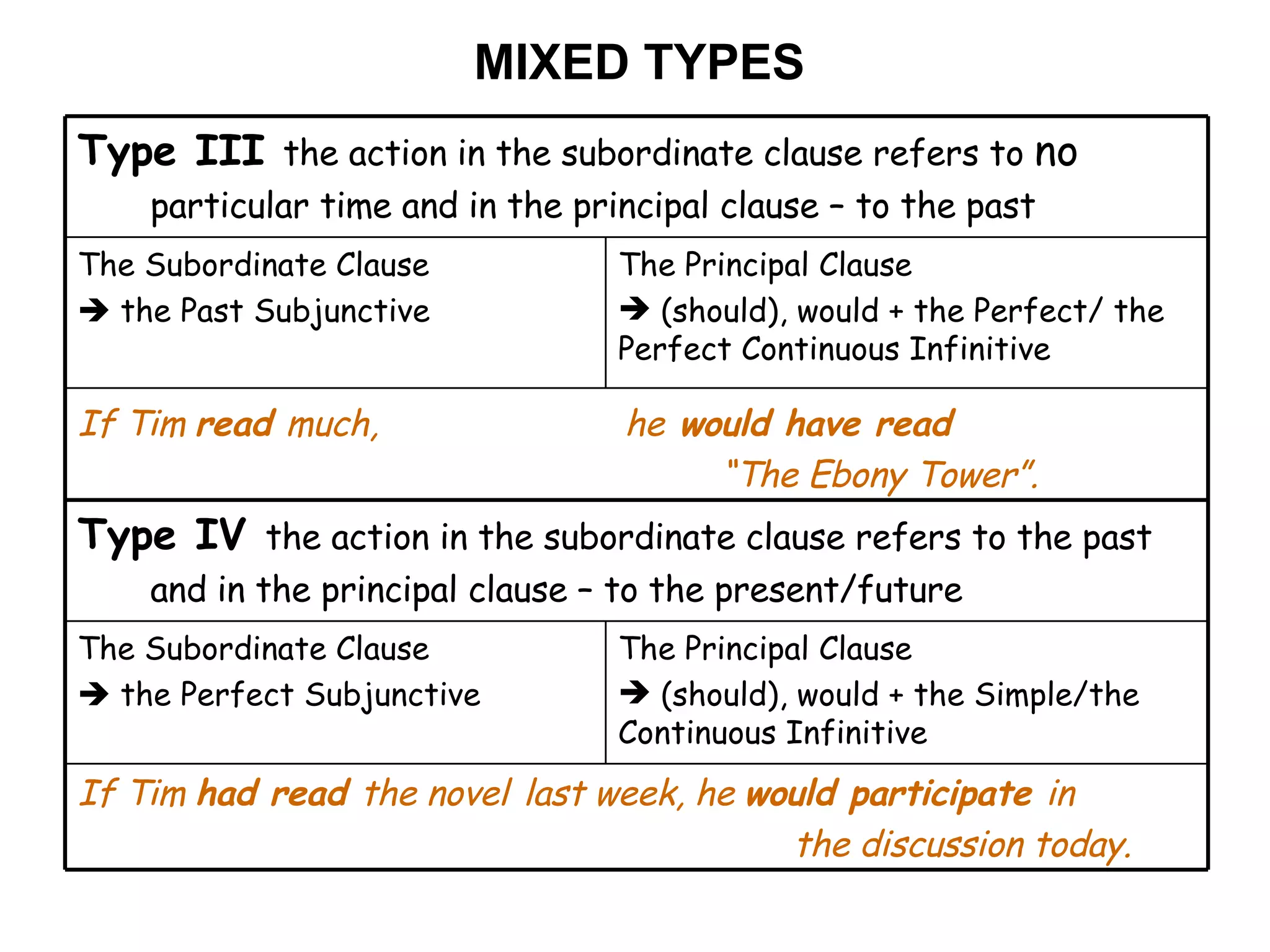
MIXED TYPES If Tim  had read  the novel   last week, he  would participate  in  the discussion today. The Principal Clause  (should), would + the Simple/the Continuous Infinitive The Subordinate Clause     the Perfect Subjunctive Type IV  the action in the subordinate clause refers to the past and in the principal clause – to the present/future If Tim  read  much,    he  would have read  “ The Ebony Tower”. The Principal Clause  (should), would + the Perfect/ the Perfect Continuous Infinitive The Subordinate Clause     the Past Subjunctive Type III  the action in the subordinate clause refers to  no   particular time and in the principal clause – to the past
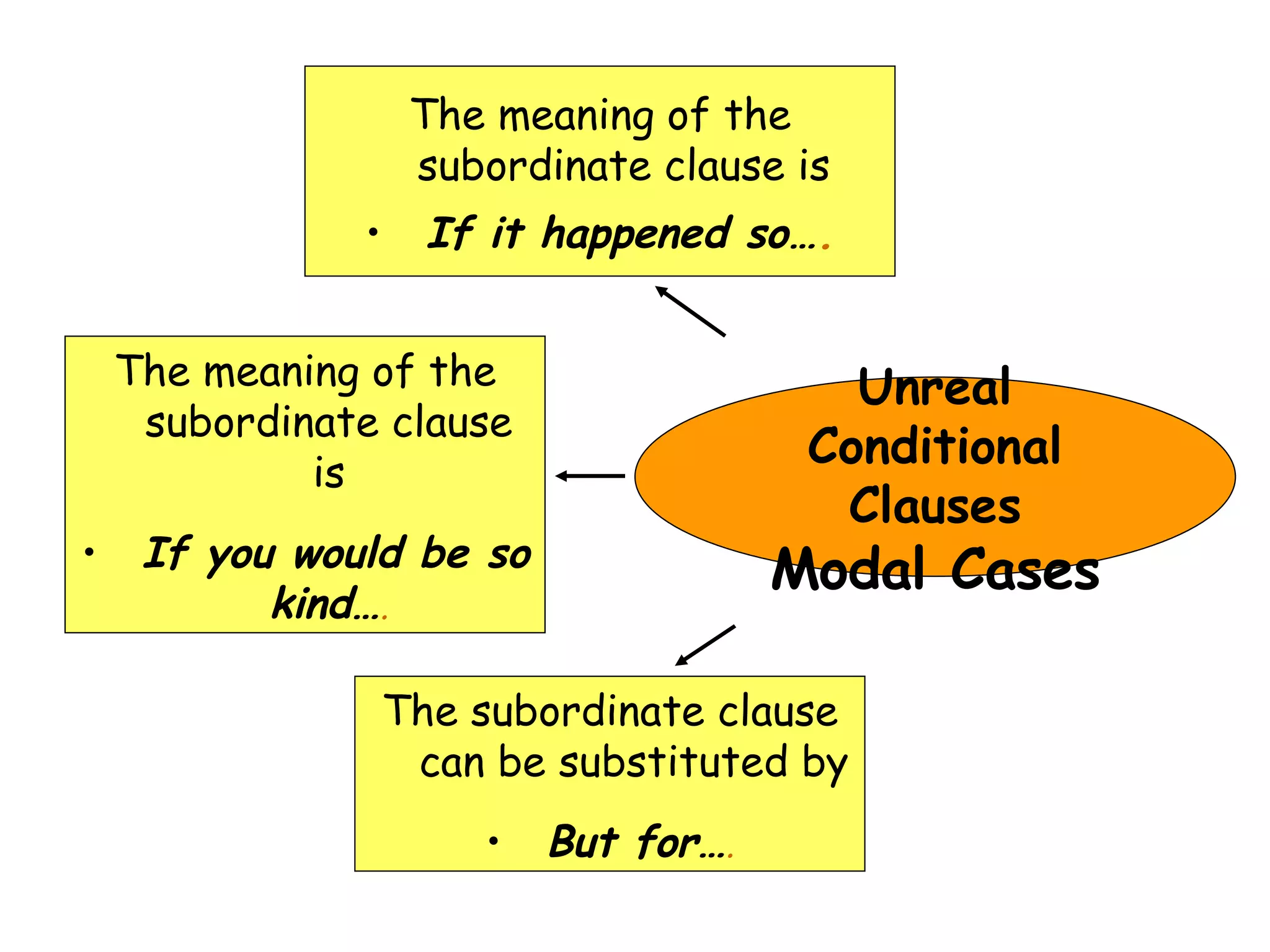
Unreal Conditional Clauses Modal Cases The meaning of the subordinate clause is If it happened so… . The meaning of the subordinate clause is If you would be so kind… . The subordinate clause can be substituted by But for… .
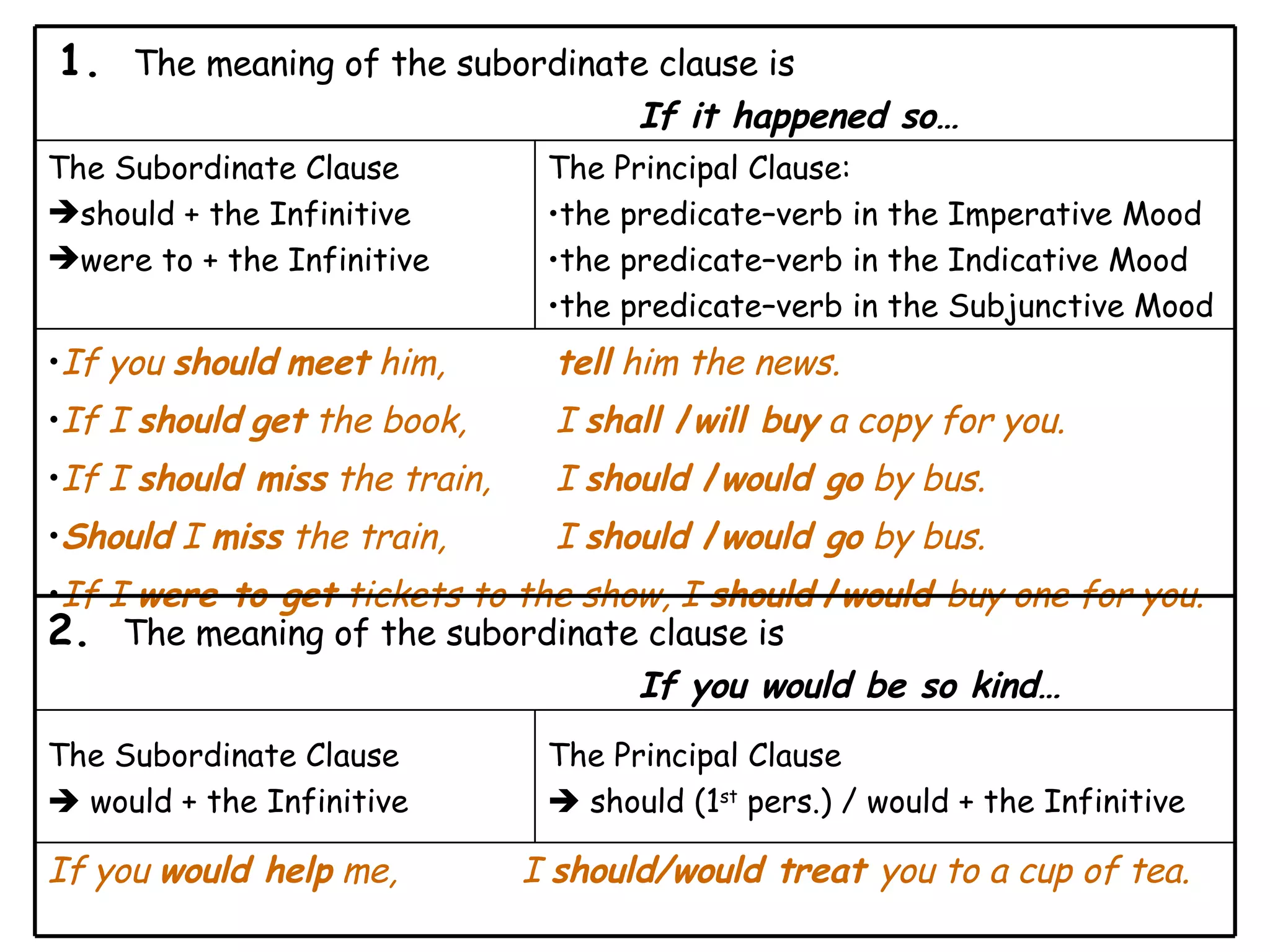
If you  would help  me,  I  should/would treat  you to a cup of tea.  The Principal Clause     should (1 st  pers.) / would + the Infinitive The Subordinate Clause     would + the Infinitive 2.   The meaning of the subordinate clause is If you would be so kind… If you  should   meet  him,  tell  him the news. If I  should   get  the book,  I  shall  / will buy  a copy for you. If I  should miss  the train,  I  should  / would go  by bus. Should  I  miss  the train,  I  should  / would go  by bus. If I  were to get  tickets to the show, I  should   / would  buy one for you. The Principal Clause: the predicate–verb in the Imperative Mood the predicate–verb in the Indicative Mood the predicate–verb in the Subjunctive Mood The Subordinate Clause  should + the Infinitive were to + the Infinitive 1.   The meaning of the subordinate clause is If it happened so…
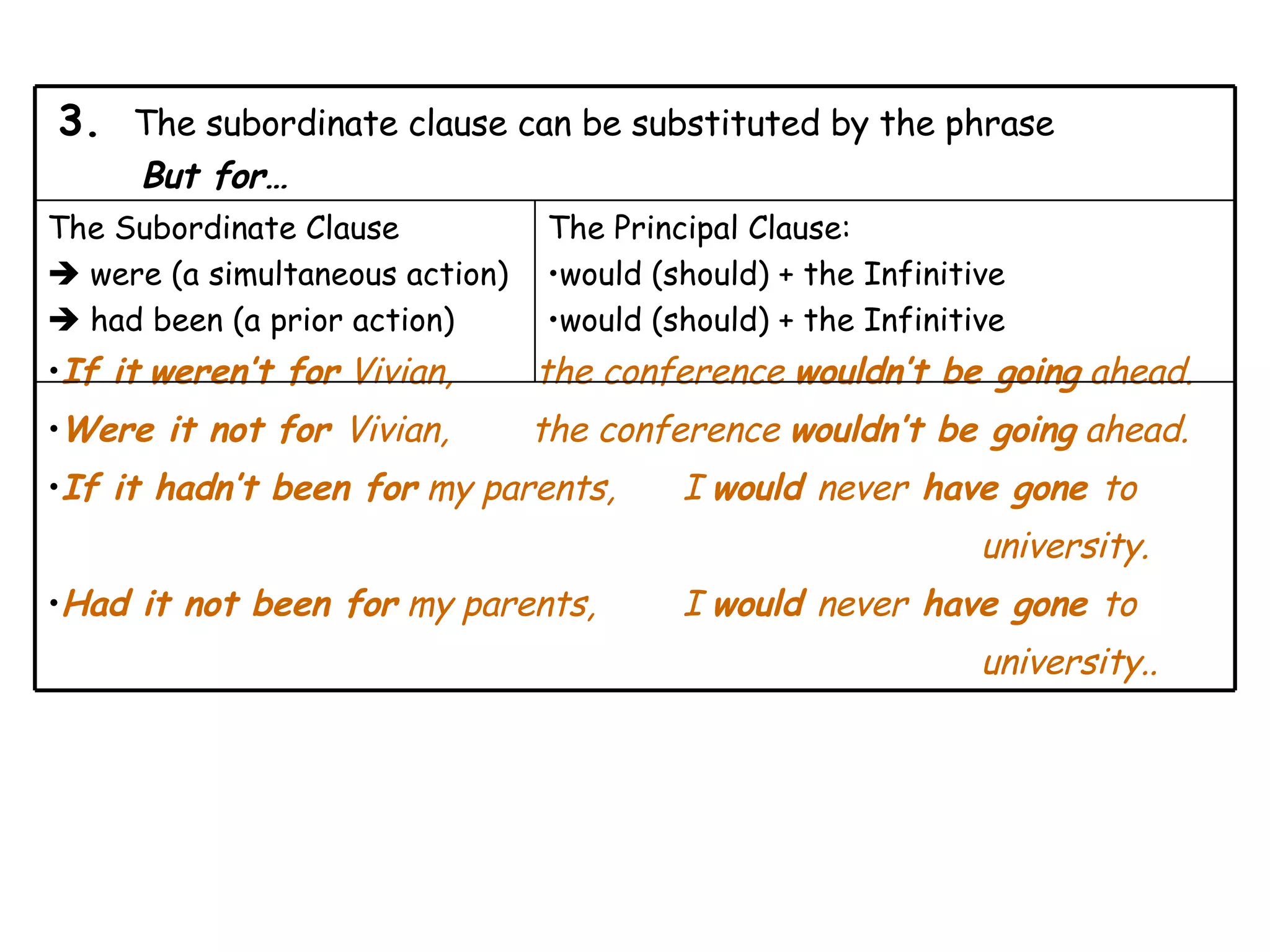
If it   weren’t for  Vivian,  the conference  wouldn’t be going  ahead. Were it not for  Vivian,  the conference  wouldn’t be going  ahead. If it hadn’t been for  my parents,  I  would  never  have gone  to  university. Had it not been for  my parents,  I  would  never  have gone  to  university.. The Principal Clause: would (should) + the Infinitive would (should) + the Infinitive The Subordinate Clause     were (a simultaneous action)    had been (a prior action) 3.   The subordinate clause can be substituted by the phrase But for…
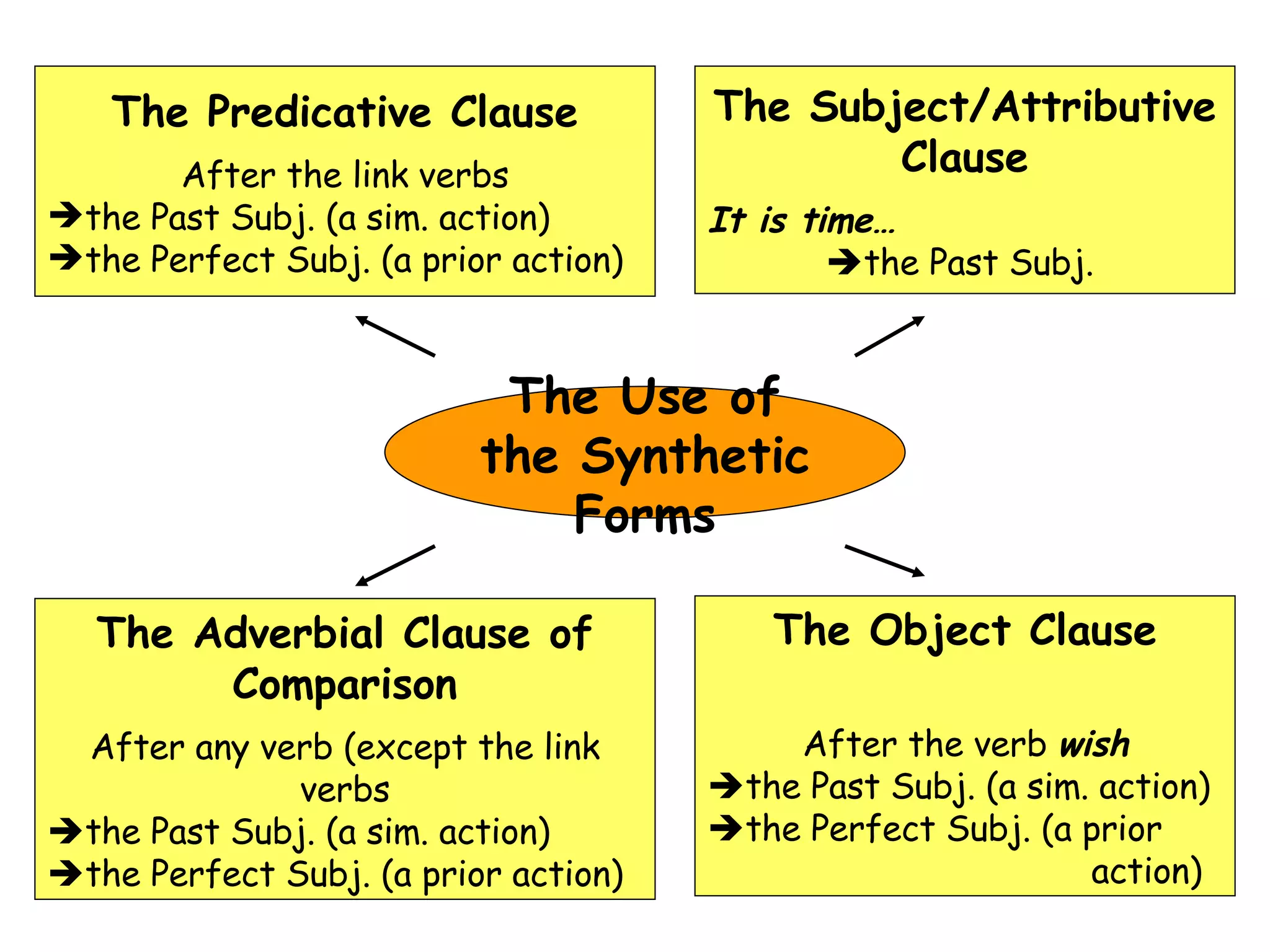
The Use of the Synthetic Forms The Predicative Clause After the link verbs the Past Subj. (a sim. action) the Perfect Subj. (a prior action) The Subject/Attributive Clause It is time…  the Past Subj.  The Adverbial Clause of Comparison After any verb (except the link verbs  the Past Subj. (a sim. action)  the Perfect Subj. (a prior action) The Object Clause After the verb  wish  the Past Subj. (a sim. action)  the Perfect Subj. (a prior  action)
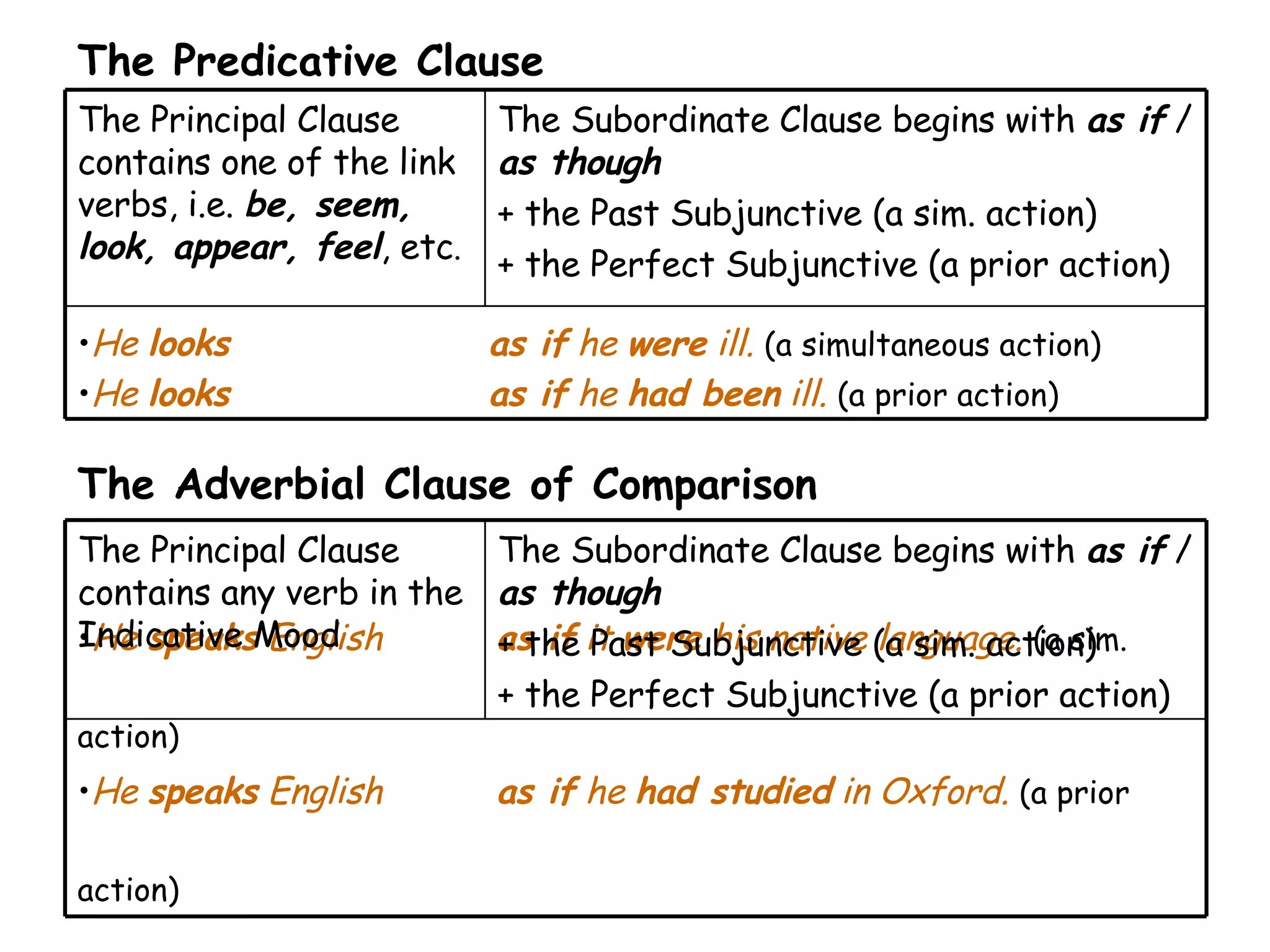
He  speaks  English  as if  it  were  his native language.  (a sim. action) He  speaks  English  as if  he  had studied  in Oxford.  (a prior action) The Subordinate Clause begins with  as if  /  as though   + the Past Subjunctive (a sim. action) + the Perfect Subjunctive (a prior action) The Principal Clause contains any verb in the Indicative Mood The Adverbial Clause of Comparison He  looks   as if  he  were  ill.  (a simultaneous action) He  looks   as if  he  had been  ill.  (a prior action) The Subordinate Clause begins with  as if  /  as though   + the Past Subjunctive (a sim. action) + the Perfect Subjunctive (a prior action) The Principal Clause contains one of the link verbs, i.e.  be, seem, look, appear, feel , etc . The Predicative Clause
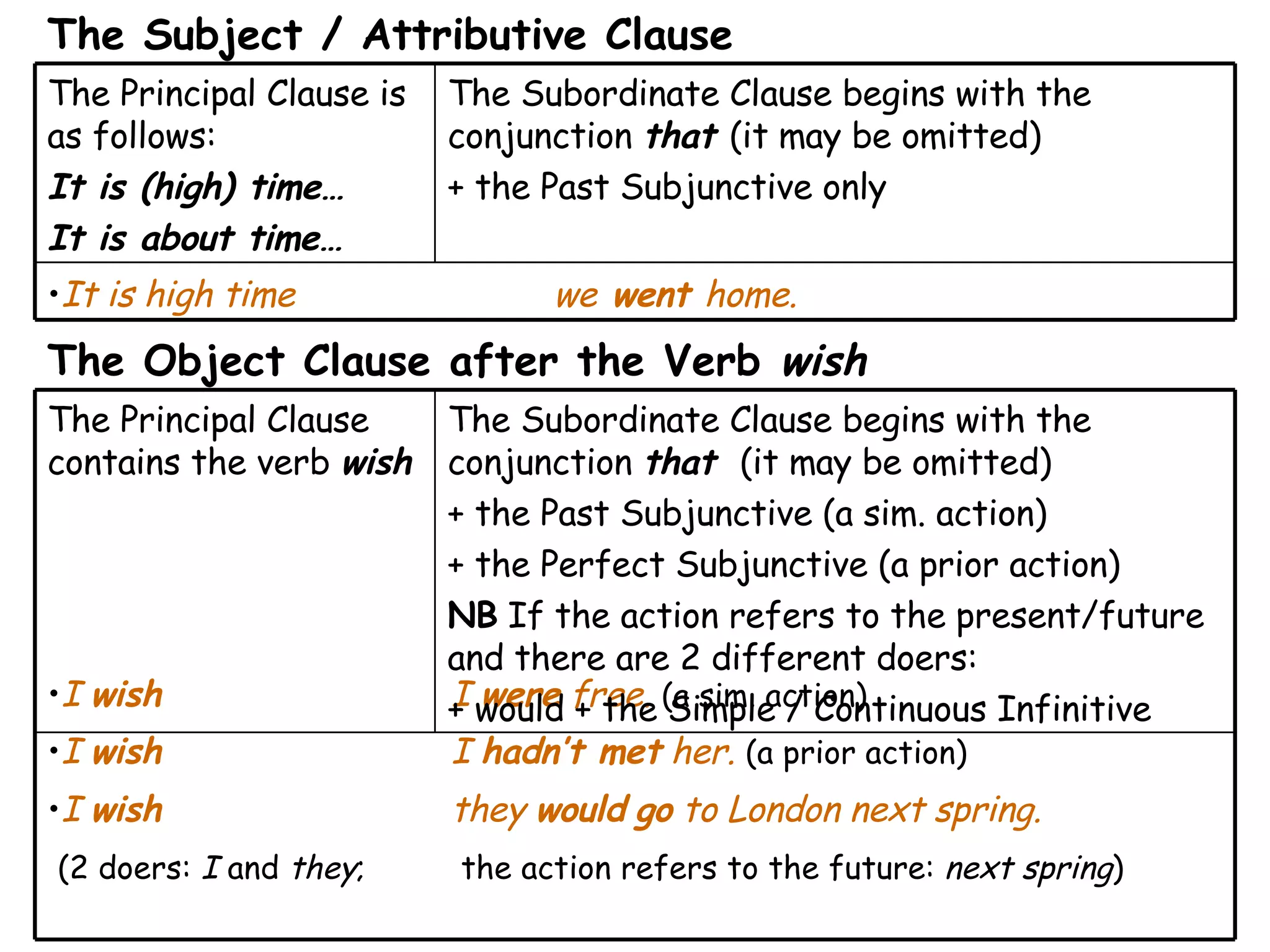
I  wish   I  were  free.  (a sim. action)  I  wish   I  hadn’t met  her.  (a prior action)  I  wish   they  would   go  to London next spring.  (2 doers:  I  and  they ;  the action refers to the future:  next spring )  The Subordinate Clause begins with the conjunction  that  (it may be omitted)  + the Past Subjunctive (a sim. action) + the Perfect Subjunctive (a prior action) NB  If the action refers to the present/future and there are 2 different doers: + would + the Simple / Continuous Infinitive The Principal Clause contains the verb  wish The Object Clause after the Verb  wish It is high time  we  went  home.  The Subordinate Clause begins with the conjunction  that  (it may be omitted)  + the Past Subjunctive only The Principal Clause is as follows:  It is (high) time… It is about time… The Subject / Attributive Clause
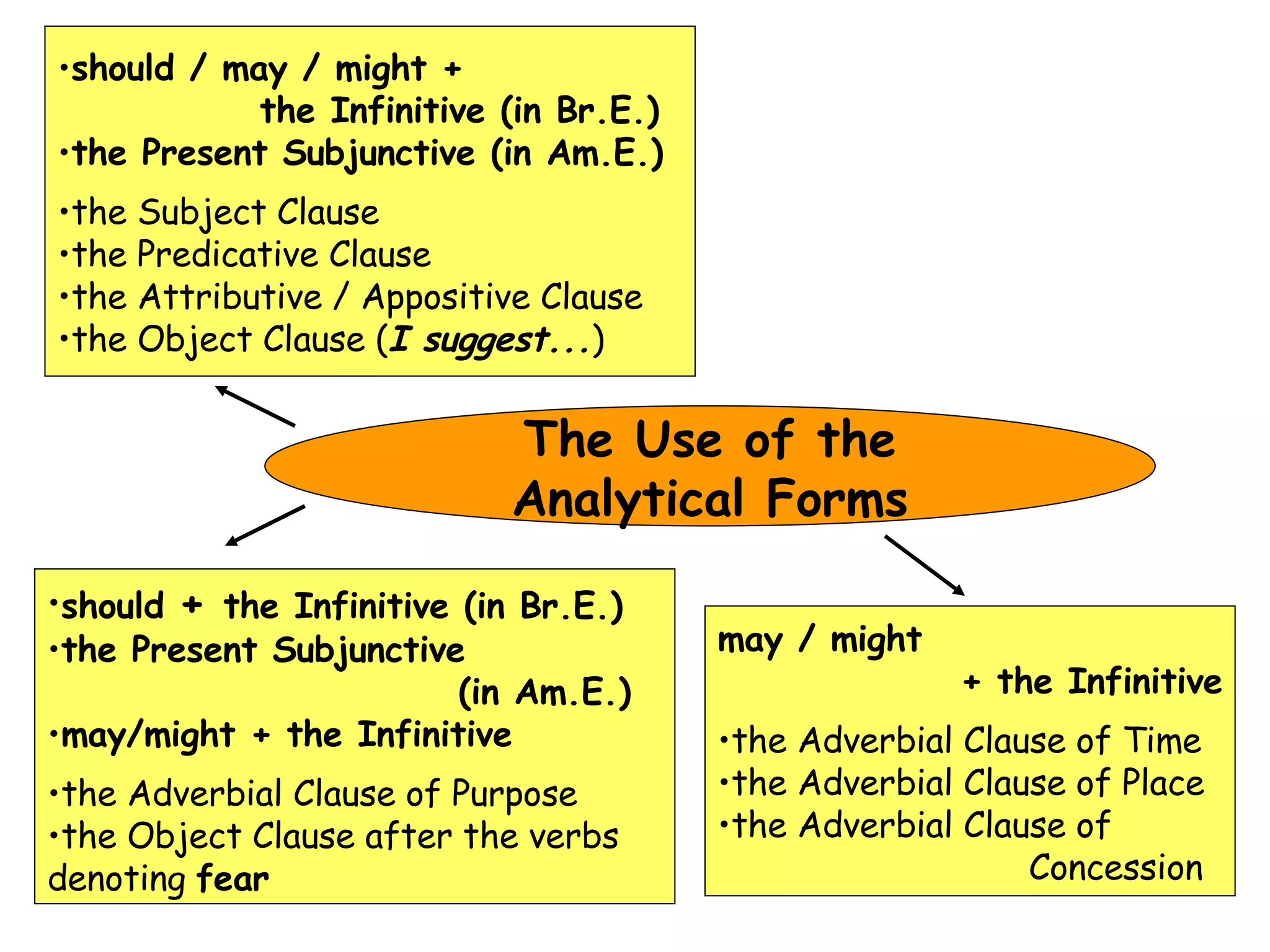
The Use of the Analytical Forms should / may / might +    the Infinitive (in Br.E.) the Present Subjunctive (in Am.E.) the Subject Clause the Predicative Clause  the Attributive / Appositive Clause the Object Clause ( I suggest... ) should  +  the Infinitive (in Br.E.) the Present Subjunctive    (in Am.E.) may/might + the Infinitive  the Adverbial Clause of Purpose the Object Clause after the verbs denoting  fear may / might  + the Infinitive the Adverbial Clause of Time the Adverbial Clause of Place the Adverbial Clause of  Concession
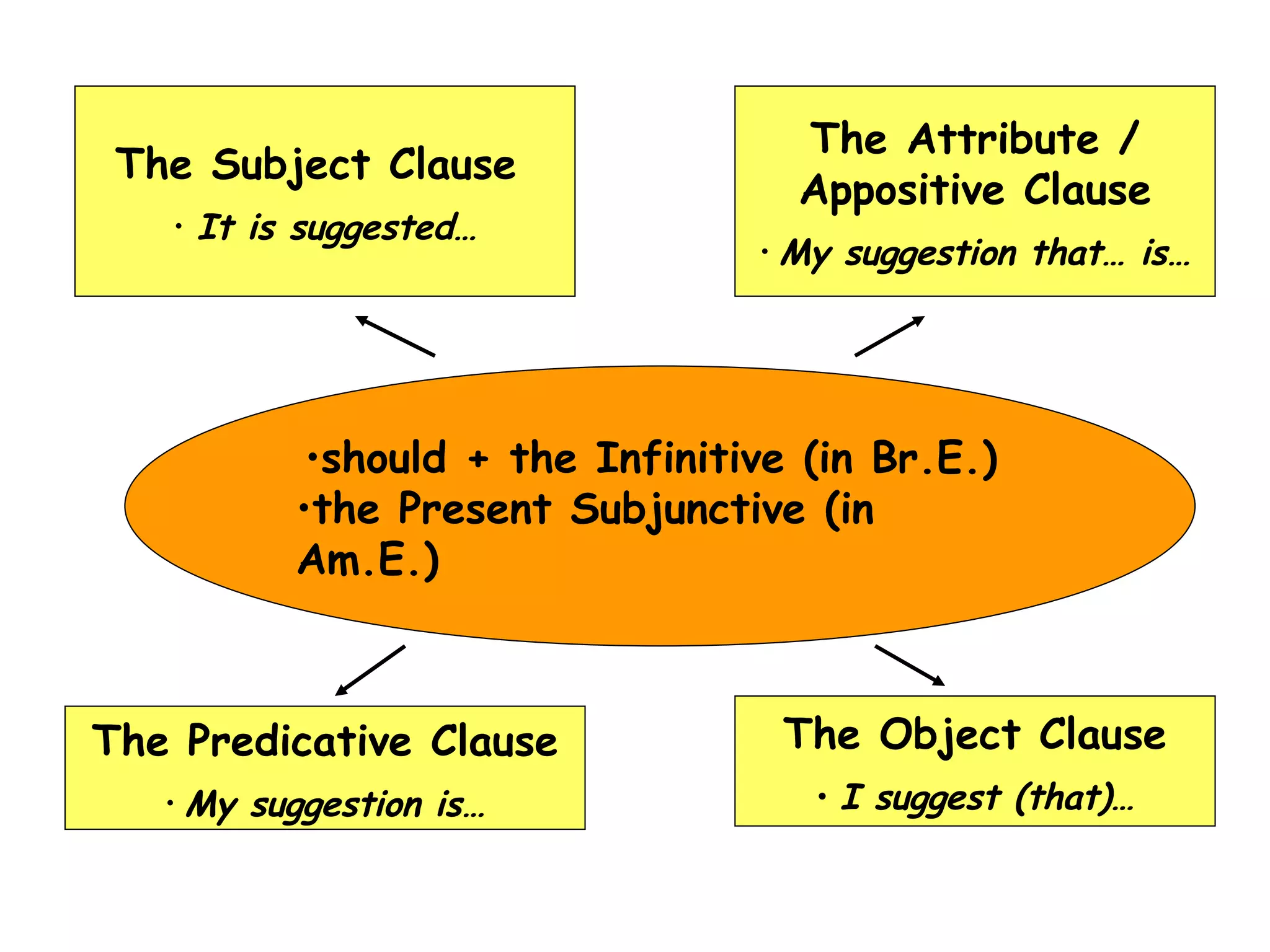
should + the Infinitive (in Br.E.)  the Present Subjunctive (in Am.E.) The Subject Clause  It is suggested… The Attribute / Appositive Clause My suggestion that… is… The Predicative Clause My suggestion is… The Object Clause I suggest (that)…
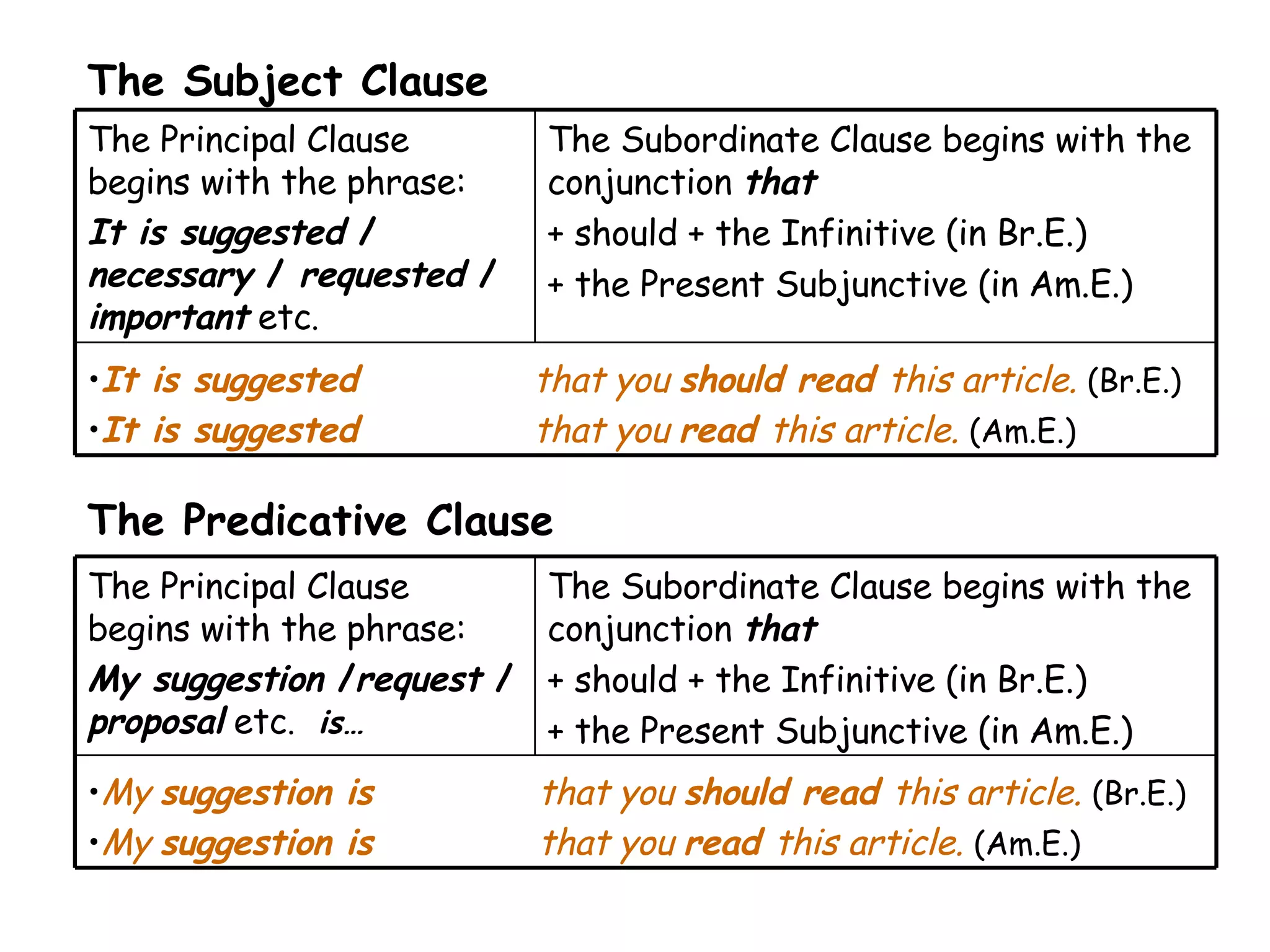
My  suggestion is   that you  should read  this article.  (Br.E.)  My  suggestion is   that you  read  this article.  (Am.E.)  The Subordinate Clause begins with the conjunction  that   + should + the Infinitive (in Br.E.) + the Present Subjunctive (in Am.E.) The Principal Clause begins with the phrase:  My suggestion  / request  /   proposal  etc .  is… The Predicative Clause It is suggested   that you  should read  this article.  (Br.E.)  It is suggested   that you  read  this article.  (Am.E.)  The Subordinate Clause begins with the conjunction  that   + should + the Infinitive (in Br.E.) + the Present Subjunctive (in Am.E.) The Principal Clause begins with the phrase:  It is suggested  /   necessary  /  requested  /   important  etc . The Subject Clause
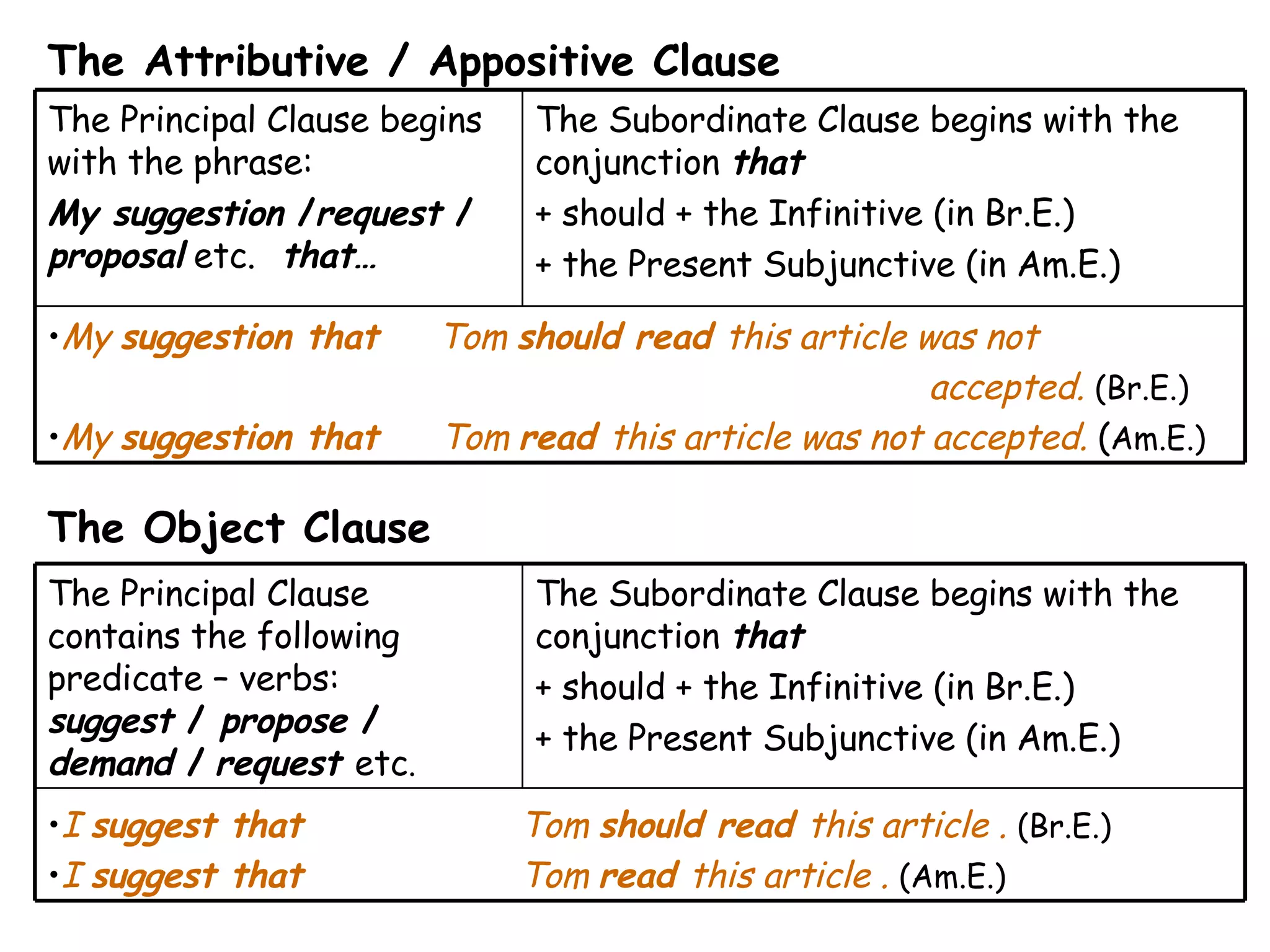
I  suggest that   Tom  should read  this article .  (Br.E.)  I  suggest that   Tom  read  this article .  (Am.E.)  The Subordinate Clause begins with the conjunction  that   + should + the Infinitive (in Br.E.) + the Present Subjunctive (in Am.E.) The Principal Clause contains the following predicate – verbs:  suggest  /  propose  /  demand  /   request  etc .  The Object Clause My  suggestion that  Tom  should read  this article was not accepted.  (Br.E.)  My  suggestion that   Tom  read  this article was not accepted.  ( Am.E.) The Subordinate Clause begins with the conjunction  that   + should + the Infinitive (in Br.E.) + the Present Subjunctive (in Am.E.) The Principal Clause begins with the phrase:  My suggestion  / request  /   proposal  etc.  that… The Attributive / Appositive Clause
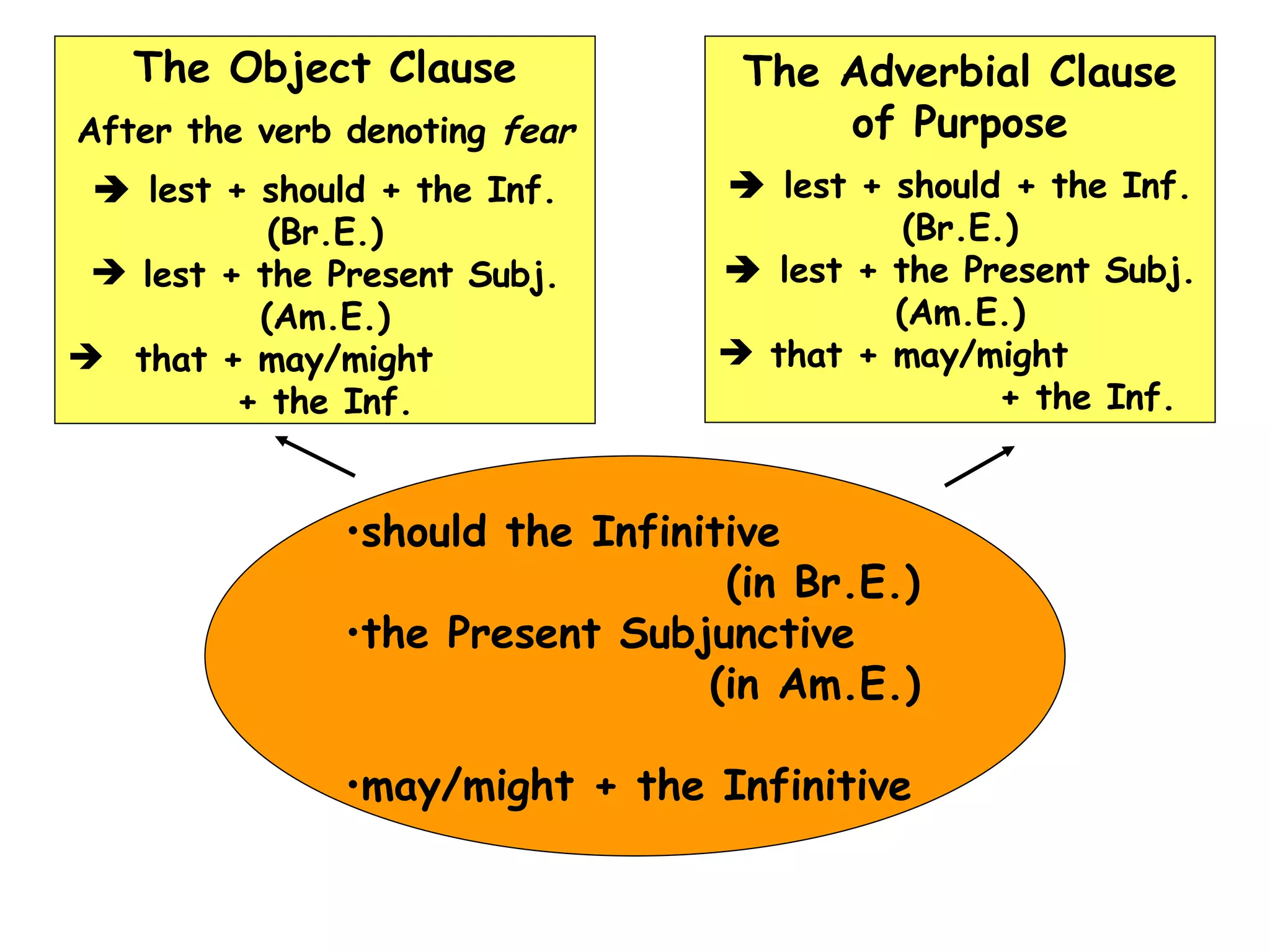
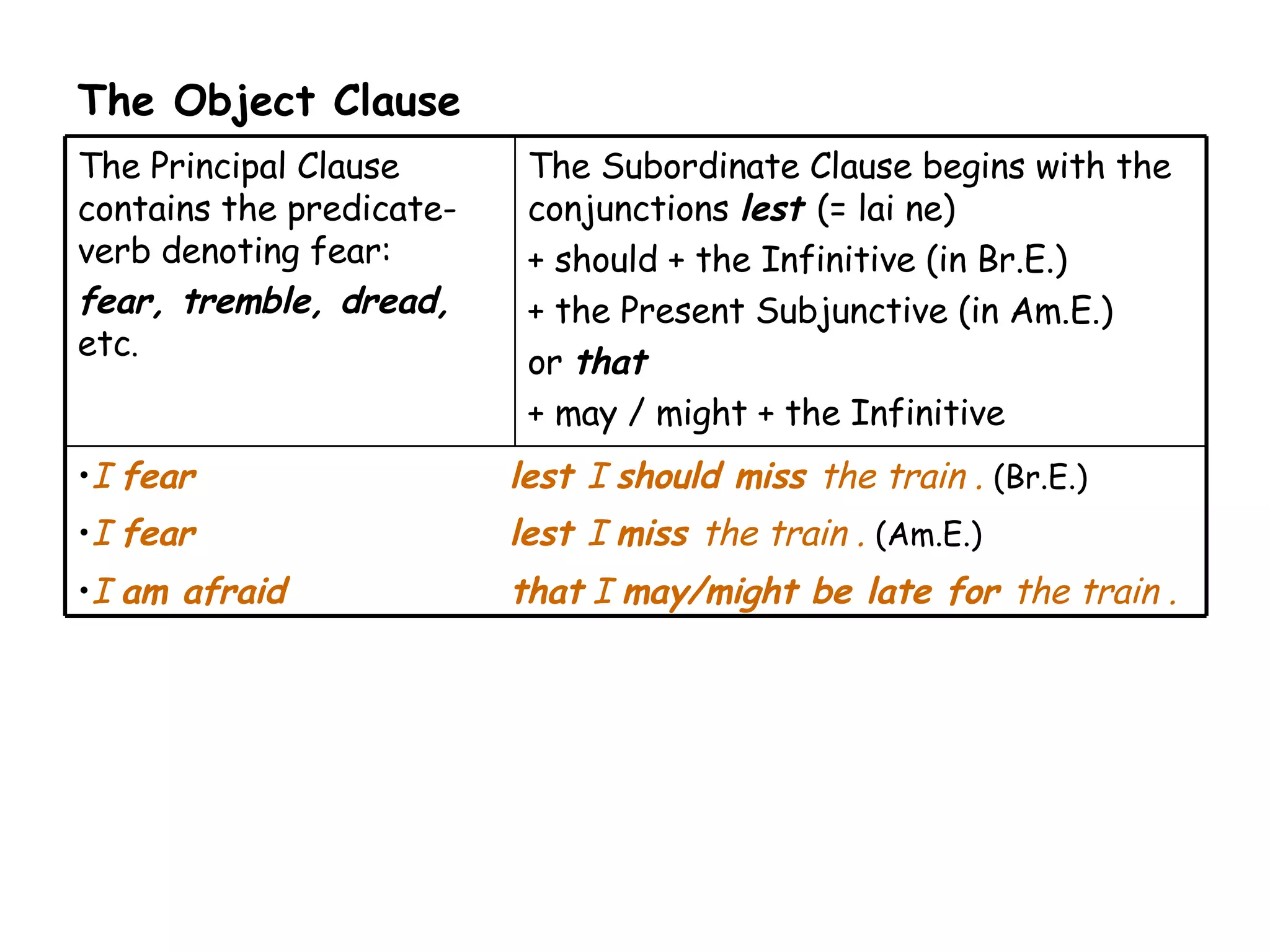
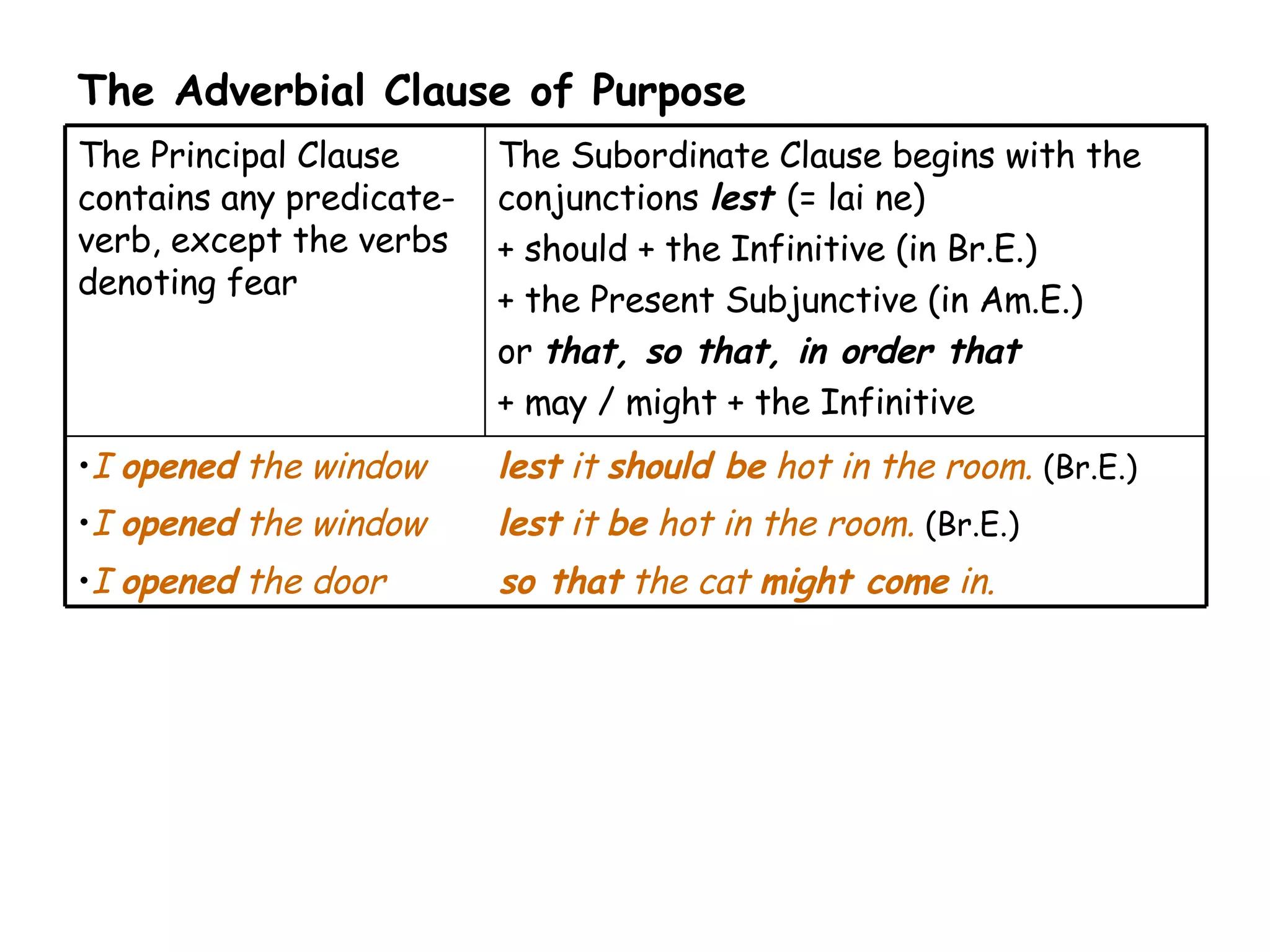
should the Infinitive  (in Br.E.)  the Present Subjunctive   (in Am.E.)  may/might + the Infinitive The Object Clause After the verb denoting  fear    lest + should + the Inf. (Br.E.) lest + the Present Subj. (Am.E.) that + may/might  + the Inf. The Adverbial Clause of Purpose    lest + should + the Inf. (Br.E.)    lest + the Present Subj. (Am.E.) that + may/might  + the Inf.
I  fear  lest  I  should miss  the train .  (Br.E.)  I  fear  lest  I  miss  the train .  (Am.E.) I  am afraid  that  I  may/might be late for  the train .  The Subordinate Clause begins with the conjunctions  lest  (= lai ne)  + should + the Infinitive (in Br.E.) + the Present Subjunctive (in Am.E.) or  that   + may / might + the Infinitive The Principal Clause contains the predicate-verb denoting fear:  fear, tremble, dread,  etc .  The Object Clause
I  opened  the window  lest  it  should be  hot in the room.  (Br.E.) I  opened  the window  lest  it  be  hot in the room.  (Br.E.) I  opened  the door  so that  the cat  might come  in.  The Subordinate Clause begins with the conjunctions  lest  (= lai ne)  + should + the Infinitive (in Br.E.) + the Present Subjunctive (in Am.E.) or  that, so that, in order that   + may / might + the Infinitive The Principal Clause contains any predicate-verb, except the verbs denoting fear  The Adverbial Clause of Purpose
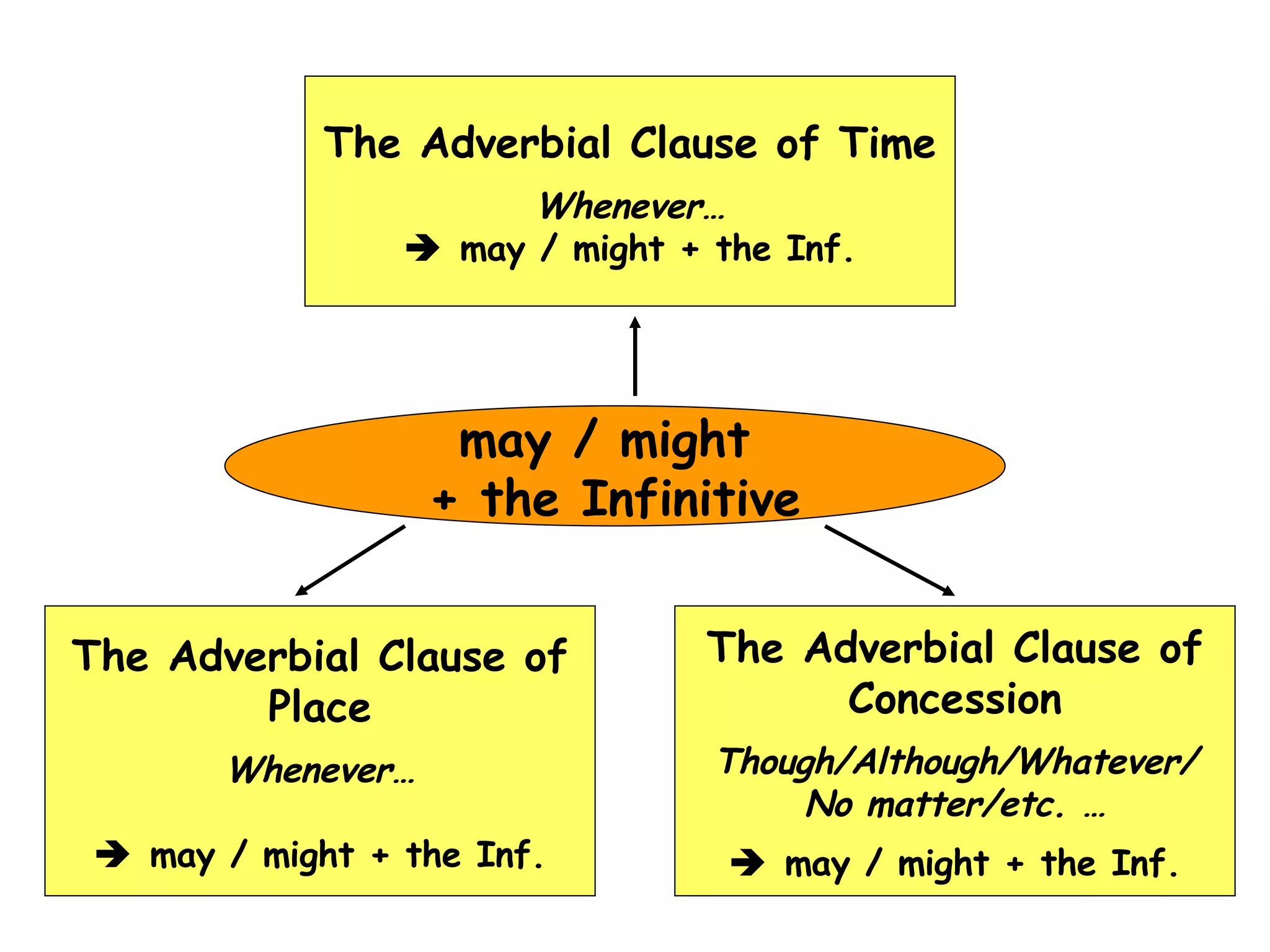
may / might  + the Infinitive The Adverbial Clause of Time Whenever…    may / might + the Inf. The Adverbial Clause of Place Whenever…    may / might + the Inf. The Adverbial Clause of Concession Though/Although/Whatever/ No matter/etc. …    may / might + the Inf.
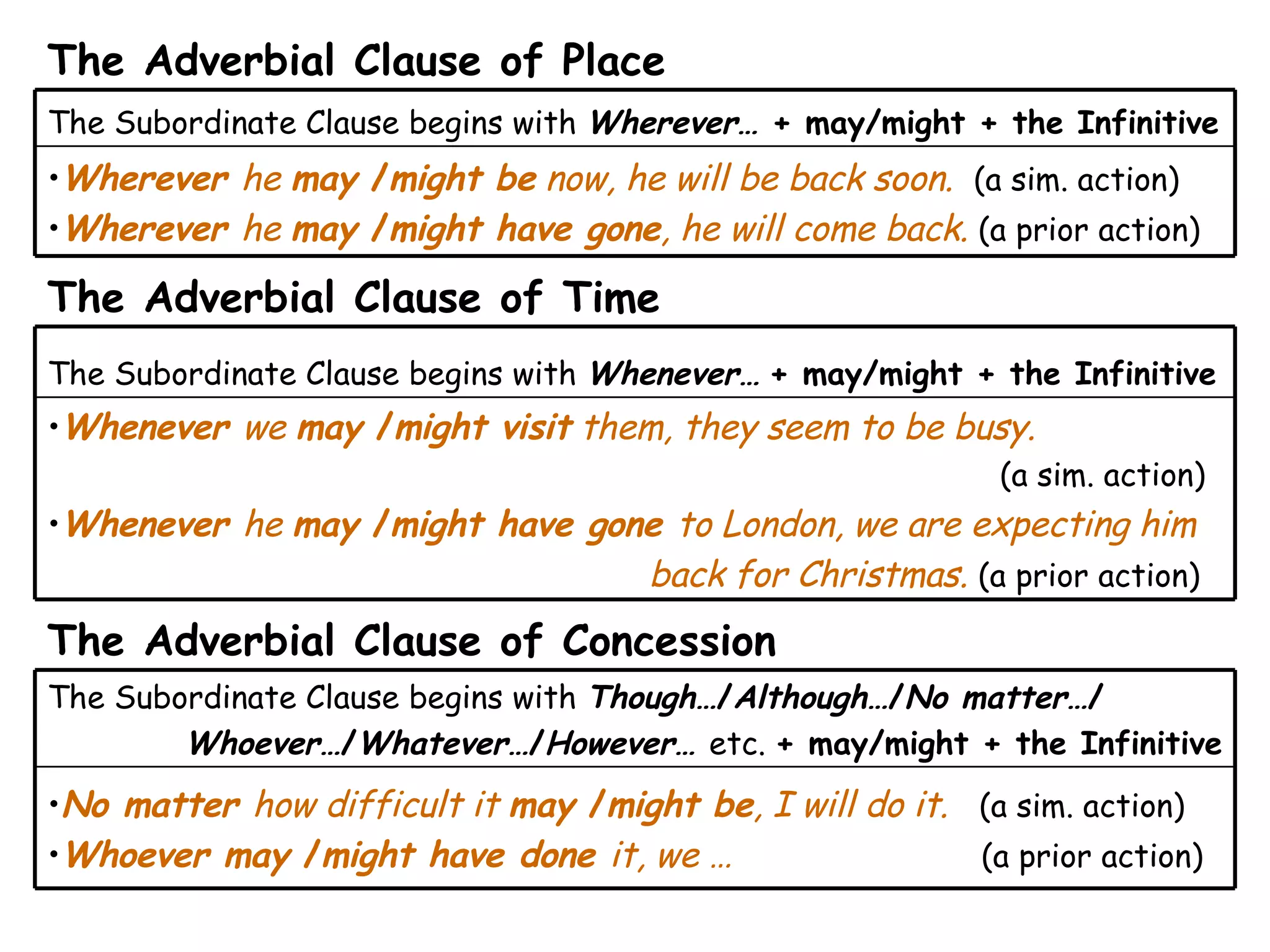
The Adverbial Clause of Time The Subordinate Clause begins with  Whenever…   + may/might + the Infinitive Whenever  we  may  / might visit  them, they seem to be busy.  (a sim. action) Whenever  he  may  / might have gone  to London, we are expecting him  back for Christmas.  (a prior action) No matter  how difficult it  may  / might be , I will do it.  (a sim. action) Whoever may  / might have done  it, we …  (a prior action) The Subordinate Clause begins with  Though… / Although… / No matter… / Whoever… / Whatever… / However…   etc.  + may/might + the Infinitive The Adverbial Clause of Concession Wherever  he  may  / might be  now, he will be back soon.  (a sim. action) Wherever  he  may  / might have gone , he will come back.  (a prior action) The Subordinate Clause begins with  Wherever…  + may/might + the Infinitive   The Adverbial Clause of Place
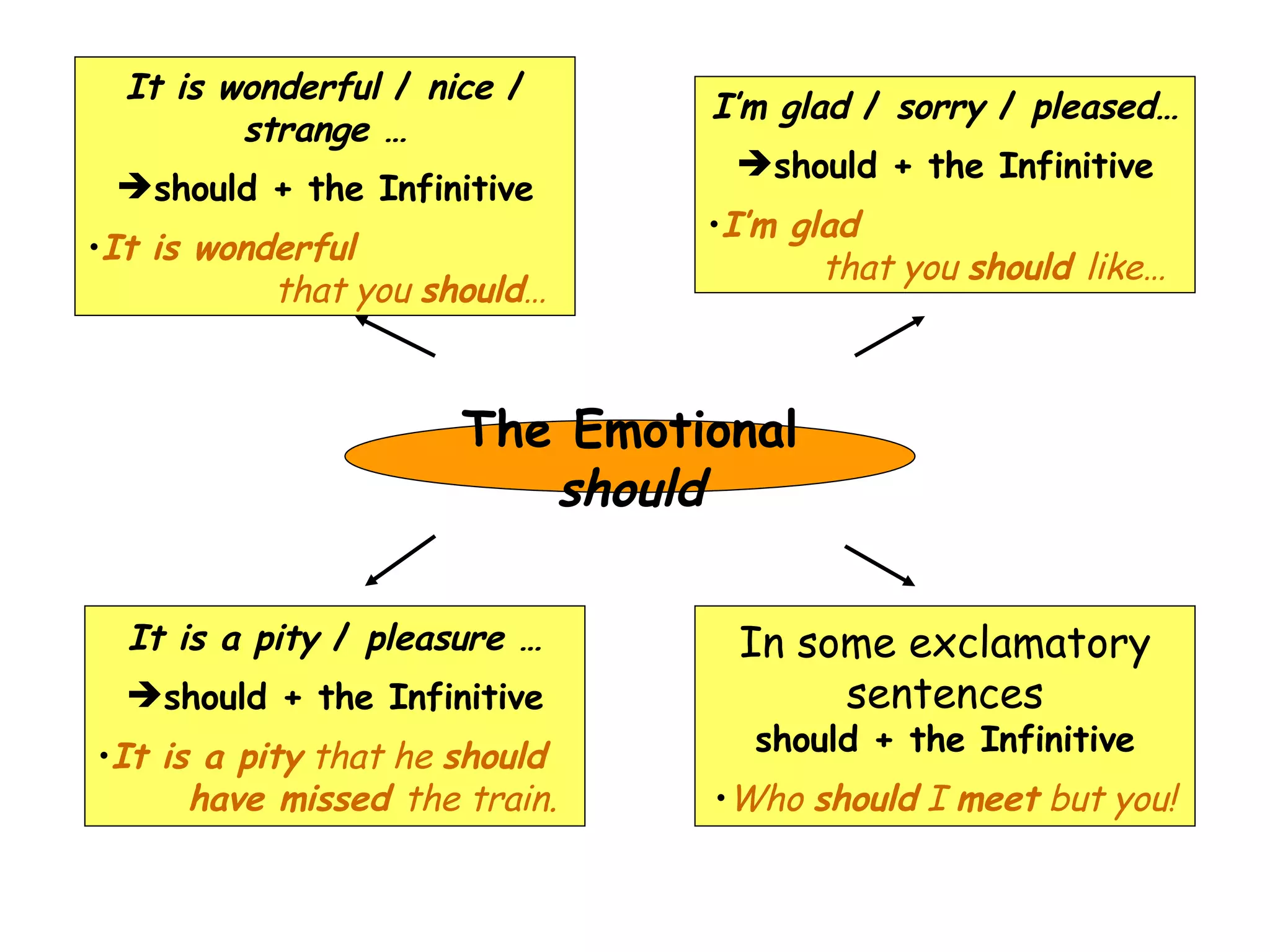
The Emotional  should It is wonderful  /  nice  /  strange … should + the Infinitive It is wonderful   that you  should … I’m glad  /  sorry  /  pleased… should + the Infinitive I’m glad  that you  should  like… It is a pity  /  pleasure … should + the Infinitive It is a pity  that he  should have missed  the train. In some exclamatory sentences should + the Infinitive Who  should  I  meet  but you!
Thank you and   good luck!

The Subjunctive Mood

  • 1.
    The Subjunctive MoodV.Rapa, M.Upmale ENGLISH NORMATIVE GRAMMAR IV Riga 2008
  • 2.
    The Subjunctive MoodMoods in the English Language the Indicative Mood the Imperative Mood the Subjunctive Mood The Use of the Subjunctive Mood in Simple Sentences Verb Forms in the Subjunctive Mood The Synthetic Forms the Present Subjunctive the Past Subjunctive the Perfect Subjunctive The Use of the Synthetic Forms The Analytical Forms should/would + the Infinitive (simple, continuous, perfect, perfect continuous) may/might + the Infinitive (simple, continuous, perfect, perfect continuous) The Use of the Analytical Forms Definition
  • 3.
    Definition Mood is a grammatical category which indicates the attitude of the speaker towards the action expressed by the verb from the point of view of its reality.
  • 4.
    Moods in theEnglish Language the Indicative Mood - I do a lot of travelling, you know. the Imperative Mood - Please, help me! the Subjunctive Mood - Oh, if I were free now!
  • 5.
    Verb Forms in the Subjunctive Mood The Synthetic Forms the Present Subjunctive - be, come, work the Past Subjunctive - were (was), came, worked the Perfect Subjunctive - had been, had come, had been written The Analytical Forms should would + the Infinitive may might should go, may help, may be playing, would have done, might have asked etc.
  • 6.
    Simple Sentences Set expressions Be it so! To express an unreal wish If I were free now! To express a wish May you be happy! In oaths and imprecations Manners be hanged!
  • 7.
    Unreal Conditional ClausesType I If I were you, I would (should) do it. Type II If I had known it, I would (should) have warned you. Type III If I read much, I would (should) have read this novel by John Fowles. Type IV If I had read it last week, I would (should) speak about it tomorrow.
  • 8.
    If I had been free last Sunday, I (should) would have gone to the seaside. The Principal Clause should (1 st pers.), would + the Perfect/the Perfect Continuous Infinitive The Subordinate Clause  the Perfect Subjunctive Type II the action in both parts refers to the past If I were free now, I (should) would go to the seaside. The Principal Clause should (1 st pers.), would + the Simple/the Continuous Infinitive The Subordinate Clause  the Past Subjunctive Type I the action in both parts refers to the present or future
  • 9.
    MIXED TYPES IfTim had read the novel last week, he would participate in the discussion today. The Principal Clause (should), would + the Simple/the Continuous Infinitive The Subordinate Clause  the Perfect Subjunctive Type IV the action in the subordinate clause refers to the past and in the principal clause – to the present/future If Tim read much, he would have read “ The Ebony Tower”. The Principal Clause (should), would + the Perfect/ the Perfect Continuous Infinitive The Subordinate Clause  the Past Subjunctive Type III the action in the subordinate clause refers to no particular time and in the principal clause – to the past
  • 10.
    Unreal Conditional ClausesModal Cases The meaning of the subordinate clause is If it happened so… . The meaning of the subordinate clause is If you would be so kind… . The subordinate clause can be substituted by But for… .
  • 11.
    If you would help me, I should/would treat you to a cup of tea. The Principal Clause  should (1 st pers.) / would + the Infinitive The Subordinate Clause  would + the Infinitive 2. The meaning of the subordinate clause is If you would be so kind… If you should meet him, tell him the news. If I should get the book, I shall / will buy a copy for you. If I should miss the train, I should / would go by bus. Should I miss the train, I should / would go by bus. If I were to get tickets to the show, I should / would buy one for you. The Principal Clause: the predicate–verb in the Imperative Mood the predicate–verb in the Indicative Mood the predicate–verb in the Subjunctive Mood The Subordinate Clause should + the Infinitive were to + the Infinitive 1. The meaning of the subordinate clause is If it happened so…
  • 12.
    If it weren’t for Vivian, the conference wouldn’t be going ahead. Were it not for Vivian, the conference wouldn’t be going ahead. If it hadn’t been for my parents, I would never have gone to university. Had it not been for my parents, I would never have gone to university.. The Principal Clause: would (should) + the Infinitive would (should) + the Infinitive The Subordinate Clause  were (a simultaneous action)  had been (a prior action) 3. The subordinate clause can be substituted by the phrase But for…
  • 13.
    The Use ofthe Synthetic Forms The Predicative Clause After the link verbs the Past Subj. (a sim. action) the Perfect Subj. (a prior action) The Subject/Attributive Clause It is time…  the Past Subj. The Adverbial Clause of Comparison After any verb (except the link verbs  the Past Subj. (a sim. action)  the Perfect Subj. (a prior action) The Object Clause After the verb wish  the Past Subj. (a sim. action)  the Perfect Subj. (a prior action)
  • 14.
    He speaks English as if it were his native language. (a sim. action) He speaks English as if he had studied in Oxford. (a prior action) The Subordinate Clause begins with as if / as though + the Past Subjunctive (a sim. action) + the Perfect Subjunctive (a prior action) The Principal Clause contains any verb in the Indicative Mood The Adverbial Clause of Comparison He looks as if he were ill. (a simultaneous action) He looks as if he had been ill. (a prior action) The Subordinate Clause begins with as if / as though + the Past Subjunctive (a sim. action) + the Perfect Subjunctive (a prior action) The Principal Clause contains one of the link verbs, i.e. be, seem, look, appear, feel , etc . The Predicative Clause
  • 15.
    I wish I were free. (a sim. action) I wish I hadn’t met her. (a prior action) I wish they would go to London next spring. (2 doers: I and they ; the action refers to the future: next spring ) The Subordinate Clause begins with the conjunction that (it may be omitted) + the Past Subjunctive (a sim. action) + the Perfect Subjunctive (a prior action) NB If the action refers to the present/future and there are 2 different doers: + would + the Simple / Continuous Infinitive The Principal Clause contains the verb wish The Object Clause after the Verb wish It is high time we went home. The Subordinate Clause begins with the conjunction that (it may be omitted) + the Past Subjunctive only The Principal Clause is as follows: It is (high) time… It is about time… The Subject / Attributive Clause
  • 16.
    The Use ofthe Analytical Forms should / may / might + the Infinitive (in Br.E.) the Present Subjunctive (in Am.E.) the Subject Clause the Predicative Clause the Attributive / Appositive Clause the Object Clause ( I suggest... ) should + the Infinitive (in Br.E.) the Present Subjunctive (in Am.E.) may/might + the Infinitive the Adverbial Clause of Purpose the Object Clause after the verbs denoting fear may / might + the Infinitive the Adverbial Clause of Time the Adverbial Clause of Place the Adverbial Clause of Concession
  • 17.
    should + theInfinitive (in Br.E.) the Present Subjunctive (in Am.E.) The Subject Clause It is suggested… The Attribute / Appositive Clause My suggestion that… is… The Predicative Clause My suggestion is… The Object Clause I suggest (that)…
  • 18.
    My suggestionis that you should read this article. (Br.E.) My suggestion is that you read this article. (Am.E.) The Subordinate Clause begins with the conjunction that + should + the Infinitive (in Br.E.) + the Present Subjunctive (in Am.E.) The Principal Clause begins with the phrase: My suggestion / request / proposal etc . is… The Predicative Clause It is suggested that you should read this article. (Br.E.) It is suggested that you read this article. (Am.E.) The Subordinate Clause begins with the conjunction that + should + the Infinitive (in Br.E.) + the Present Subjunctive (in Am.E.) The Principal Clause begins with the phrase: It is suggested / necessary / requested / important etc . The Subject Clause
  • 19.
    I suggestthat Tom should read this article . (Br.E.) I suggest that Tom read this article . (Am.E.) The Subordinate Clause begins with the conjunction that + should + the Infinitive (in Br.E.) + the Present Subjunctive (in Am.E.) The Principal Clause contains the following predicate – verbs: suggest / propose / demand / request etc . The Object Clause My suggestion that Tom should read this article was not accepted. (Br.E.) My suggestion that Tom read this article was not accepted. ( Am.E.) The Subordinate Clause begins with the conjunction that + should + the Infinitive (in Br.E.) + the Present Subjunctive (in Am.E.) The Principal Clause begins with the phrase: My suggestion / request / proposal etc. that… The Attributive / Appositive Clause
  • 20.
    should the Infinitive (in Br.E.) the Present Subjunctive (in Am.E.) may/might + the Infinitive The Object Clause After the verb denoting fear  lest + should + the Inf. (Br.E.) lest + the Present Subj. (Am.E.) that + may/might + the Inf. The Adverbial Clause of Purpose  lest + should + the Inf. (Br.E.)  lest + the Present Subj. (Am.E.) that + may/might + the Inf.
  • 21.
    I fear lest I should miss the train . (Br.E.) I fear lest I miss the train . (Am.E.) I am afraid that I may/might be late for the train . The Subordinate Clause begins with the conjunctions lest (= lai ne) + should + the Infinitive (in Br.E.) + the Present Subjunctive (in Am.E.) or that + may / might + the Infinitive The Principal Clause contains the predicate-verb denoting fear: fear, tremble, dread, etc . The Object Clause
  • 22.
    I opened the window lest it should be hot in the room. (Br.E.) I opened the window lest it be hot in the room. (Br.E.) I opened the door so that the cat might come in. The Subordinate Clause begins with the conjunctions lest (= lai ne) + should + the Infinitive (in Br.E.) + the Present Subjunctive (in Am.E.) or that, so that, in order that + may / might + the Infinitive The Principal Clause contains any predicate-verb, except the verbs denoting fear The Adverbial Clause of Purpose
  • 23.
    may / might + the Infinitive The Adverbial Clause of Time Whenever…  may / might + the Inf. The Adverbial Clause of Place Whenever…  may / might + the Inf. The Adverbial Clause of Concession Though/Although/Whatever/ No matter/etc. …  may / might + the Inf.
  • 24.
    The Adverbial Clauseof Time The Subordinate Clause begins with Whenever… + may/might + the Infinitive Whenever we may / might visit them, they seem to be busy. (a sim. action) Whenever he may / might have gone to London, we are expecting him back for Christmas. (a prior action) No matter how difficult it may / might be , I will do it. (a sim. action) Whoever may / might have done it, we … (a prior action) The Subordinate Clause begins with Though… / Although… / No matter… / Whoever… / Whatever… / However… etc. + may/might + the Infinitive The Adverbial Clause of Concession Wherever he may / might be now, he will be back soon. (a sim. action) Wherever he may / might have gone , he will come back. (a prior action) The Subordinate Clause begins with Wherever… + may/might + the Infinitive The Adverbial Clause of Place
  • 25.
    The Emotional should It is wonderful / nice / strange … should + the Infinitive It is wonderful that you should … I’m glad / sorry / pleased… should + the Infinitive I’m glad that you should like… It is a pity / pleasure … should + the Infinitive It is a pity that he should have missed the train. In some exclamatory sentences should + the Infinitive Who should I meet but you!
  • 26.
    Thank you and good luck!