





Julie Barrett, Sara Brandow, Vivian Harmon Cellular Respiration & Fermentation
Outline Fermentation and Cellular Respiration - what is it? How are fermentation and cellular respiration different? Why do we care? A story... 2 Experiments


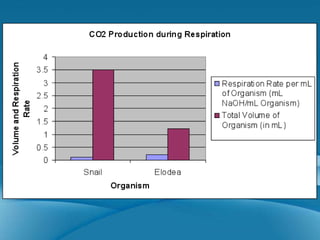
Experiment 1: Cellular Respiration Snail and elodea plant measured for volume and placed in water Elodea plant kept in the dark Respired for 15 minutes Amount of CO2 in solution was measured Respiration rate per mL of organism was calculated Elodea plant had a higher respiration rate than the snail Shell accounted for volume, but not respiration
0  0 0.8 0 Control Beaker 0.2 mL NaOH/mL elodea 0.2 mL 1.0 mL 1.0 mL Beaker 2: Elodea 0.114 mL NaOH/mL snail 0.4 mL 1.2 mL 3.5 mL Beaker 1: Snail Respiration Rate Per mL of Organism (mL NaOH/ mL Organism) Relative Respiration Rate  Of Organism (in mL NaOH) mL of NaOH to reach end point (in mL) Total Volume of Organisms (in mL) Organisms Data for Measuring CO2 Production During Respiration
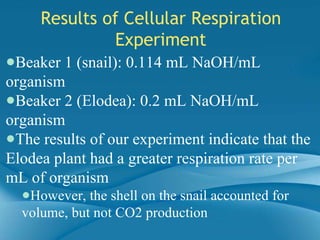
Results of Cellular Respiration Experiment Beaker 1 (snail): 0.114 mL NaOH/mL organism Beaker 2 (Elodea): 0.2 mL NaOH/mL organism The results of our experiment indicate that the Elodea plant had a greater respiration rate per mL of organism However, the shell on the snail accounted for volume, but not CO2 production


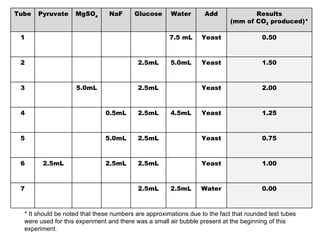
Experiment 2: Fermentation Seven test tubes filled with six combinations of different variables Na Pyruvate, MgSO4, and Glucose were activators. NaF was an inhibitor. Yeast suspension present in six of seven test tubes (seventh was control with water) Incubation Measurement of CO2 bubble (in mm)
* It should be noted that these numbers are approximations due to the fact that rounded test tubes were used for this experiment and there was a small air bubble present at the beginning of this experiment. 0.00 Water 2.5mL 2.5mL 7 1.00 Yeast 2.5mL 2.5mL 2.5mL 6 0.75 Yeast 2.5mL 5.0mL 5 1.25 Yeast 4.5mL 2.5mL 0.5mL 4 2.00 Yeast 2.5mL 5.0mL 3 1.50 Yeast 5.0mL 2.5mL 2 0.50 Yeast 7.5 mL 1 Results (mm of CO 2  produced)* Add Water Glucose NaF MgSO 4 Pyruvate Tube
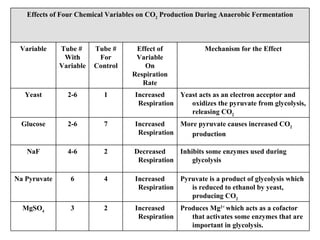
Produces Mg 2+  which acts as a cofactor that activates some enzymes that are important in glycolysis. Increased Respiration 2 3 MgSO 4 Pyruvate is a product of glycolysis which is reduced to ethanol by yeast, producing CO 2 Increased Respiration 4 6 Na Pyruvate Inhibits some enzymes used during glycolysis Decreased Respiration 2 4-6 NaF More pyruvate causes increased CO 2  production   Increased Respiration 7 2-6 Glucose Yeast acts as an electron acceptor and oxidizes the pyruvate from glycolysis, releasing CO 2 Increased Respiration 1 2-6 Yeast Mechanism for the Effect Effect of Variable On Respiration Rate Tube # For Control Tube #  With Variable Variable Effects of Four Chemical Variables on CO 2  Production During Anaerobic Fermentation
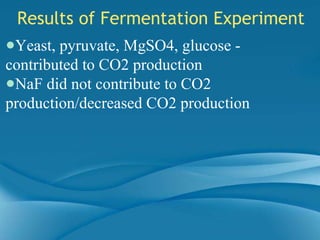
Results of Fermentation Experiment Yeast, pyruvate, MgSO4, glucose - contributed to CO2 production NaF did not contribute to CO2 production/decreased CO2 production
Amount of CO 2  Produced (in mm) Amount of CO2 produced  (in mm) Amount of CO2 produced (in mm)
Conclusion Cellular respiration, fermentation, and how they differ Why each are important Gary and Glenn Glucose
References Campbell-Reece.  Biology. Custom Edition. Vol. I. San Francisco: Benjamin Cummings, 2008. II vols. CornellInstitute for Biology Teachers [Internet]. Ithaca (NY): Photosynthesis and Respirationin Elodea [modified 2008 Jun 24; cited 2010 Nov 23]. Available from: http://cibt.bio.cornell.edu/labs/dl/PELO.PDF. Vodopich-Moore.  BiologyLaboratory Manual.  Ninth Edition. Boston :McGraw Hill Companies, Inc., 2011.

Fermentation and cellular respiration

  • 1.
    Julie Barrett, SaraBrandow, Vivian Harmon Cellular Respiration & Fermentation
  • 2.
    Outline Fermentation andCellular Respiration - what is it? How are fermentation and cellular respiration different? Why do we care? A story... 2 Experiments
  • 3.
  • 4.
  • 5.
  • 6.
  • 7.
  • 8.
  • 9.
    Experiment 1: CellularRespiration Snail and elodea plant measured for volume and placed in water Elodea plant kept in the dark Respired for 15 minutes Amount of CO2 in solution was measured Respiration rate per mL of organism was calculated Elodea plant had a higher respiration rate than the snail Shell accounted for volume, but not respiration
  • 10.
    0 00.8 0 Control Beaker 0.2 mL NaOH/mL elodea 0.2 mL 1.0 mL 1.0 mL Beaker 2: Elodea 0.114 mL NaOH/mL snail 0.4 mL 1.2 mL 3.5 mL Beaker 1: Snail Respiration Rate Per mL of Organism (mL NaOH/ mL Organism) Relative Respiration Rate Of Organism (in mL NaOH) mL of NaOH to reach end point (in mL) Total Volume of Organisms (in mL) Organisms Data for Measuring CO2 Production During Respiration
  • 11.
    Results of CellularRespiration Experiment Beaker 1 (snail): 0.114 mL NaOH/mL organism Beaker 2 (Elodea): 0.2 mL NaOH/mL organism The results of our experiment indicate that the Elodea plant had a greater respiration rate per mL of organism However, the shell on the snail accounted for volume, but not CO2 production
  • 12.
  • 13.
  • 14.
  • 15.
    Experiment 2: FermentationSeven test tubes filled with six combinations of different variables Na Pyruvate, MgSO4, and Glucose were activators. NaF was an inhibitor. Yeast suspension present in six of seven test tubes (seventh was control with water) Incubation Measurement of CO2 bubble (in mm)
  • 16.
    * It shouldbe noted that these numbers are approximations due to the fact that rounded test tubes were used for this experiment and there was a small air bubble present at the beginning of this experiment. 0.00 Water 2.5mL 2.5mL 7 1.00 Yeast 2.5mL 2.5mL 2.5mL 6 0.75 Yeast 2.5mL 5.0mL 5 1.25 Yeast 4.5mL 2.5mL 0.5mL 4 2.00 Yeast 2.5mL 5.0mL 3 1.50 Yeast 5.0mL 2.5mL 2 0.50 Yeast 7.5 mL 1 Results (mm of CO 2 produced)* Add Water Glucose NaF MgSO 4 Pyruvate Tube
  • 17.
    Produces Mg 2+ which acts as a cofactor that activates some enzymes that are important in glycolysis. Increased Respiration 2 3 MgSO 4 Pyruvate is a product of glycolysis which is reduced to ethanol by yeast, producing CO 2 Increased Respiration 4 6 Na Pyruvate Inhibits some enzymes used during glycolysis Decreased Respiration 2 4-6 NaF More pyruvate causes increased CO 2 production Increased Respiration 7 2-6 Glucose Yeast acts as an electron acceptor and oxidizes the pyruvate from glycolysis, releasing CO 2 Increased Respiration 1 2-6 Yeast Mechanism for the Effect Effect of Variable On Respiration Rate Tube # For Control Tube # With Variable Variable Effects of Four Chemical Variables on CO 2 Production During Anaerobic Fermentation
  • 18.
    Results of FermentationExperiment Yeast, pyruvate, MgSO4, glucose - contributed to CO2 production NaF did not contribute to CO2 production/decreased CO2 production
  • 19.
    Amount of CO2 Produced (in mm) Amount of CO2 produced (in mm) Amount of CO2 produced (in mm)
  • 20.
    Conclusion Cellular respiration,fermentation, and how they differ Why each are important Gary and Glenn Glucose
  • 21.
    References Campbell-Reece. Biology. Custom Edition. Vol. I. San Francisco: Benjamin Cummings, 2008. II vols. CornellInstitute for Biology Teachers [Internet]. Ithaca (NY): Photosynthesis and Respirationin Elodea [modified 2008 Jun 24; cited 2010 Nov 23]. Available from: http://cibt.bio.cornell.edu/labs/dl/PELO.PDF. Vodopich-Moore. BiologyLaboratory Manual. Ninth Edition. Boston :McGraw Hill Companies, Inc., 2011.

Editor's Notes

  • #3 This slide could be something like, "We are going to talk about fermentation and cellular respiration,
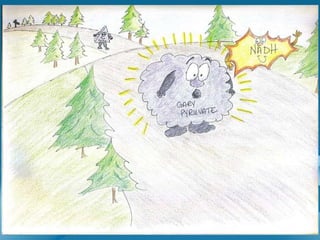
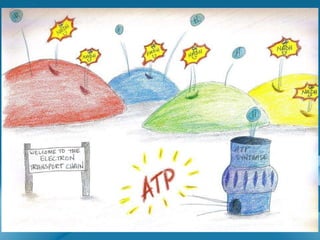
  • #4 I thought we'd include the illustrations for our story on the "big screen." Once I have drawn everything I will scan the pictures and put them on the slides here.
  • #10 This lab involved the quantitative measurement of carbon dioxide (CO2) production associated with the respiration of both a snail and an Elodea plant in water. The Elodea plant was kept in the dark for this procedure to ensure CO2 production rather than oxygen (O2) production. Phenolphthalein (a pH indicator) was used in conjunction with NaOH as indicators to determine how much CO2 was present after the plant and snail had respired for fifteen minutes underwater. The amount of NaOH used to restore the pH of the solution back to a slightly basic state was measured. The amount of NaOH used to restore the pH was determined to be the amount of CO2 present in the solution after the organisms had respired for fifteen minutes. Respiration rate per milliliter of organism (mL NaOH/mL organism) was then calculated based on these results. The results of this experiment concluded the snail had a respiration rate of 0.114 mL NaOH/mL organism and the Elodea plant had a respiration rate of 0.2 mL NaOH/mL organism. The data collected in this experiment indicate that the Elodea plant may have a higher respiration rate per mL of organism; however, the snail’s shell contributed significant mass but did not respire. Further experimentation would be necessary to determine a more accurate respiration rate of the snail.
  • #11 This lab involved the quantitative measurement of carbon dioxide (CO2) production associated with the respiration of both a snail and an Elodea plant in water. The Elodea plant was kept in the dark for this procedure to ensure CO2 production rather than oxygen (O2) production. Phenolphthalein (a pH indicator) was used in conjunction with NaOH as indicators to determine how much CO2 was present after the plant and snail had respired for fifteen minutes underwater. The amount of NaOH used to restore the pH of the solution back to a slightly basic state was measured. The amount of NaOH used to restore the pH was determined to be the amount of CO2 present in the solution after the organisms had respired for fifteen minutes. Respiration rate per milliliter of organism (mL NaOH/mL organism) was then calculated based on these results. The results of this experiment concluded the snail had a respiration rate of 0.114 mL NaOH/mL organism and the Elodea plant had a respiration rate of 0.2 mL NaOH/mL organism. The data collected in this experiment indicate that the Elodea plant may have a higher respiration rate per mL of organism; however, the snail’s shell contributed significant mass but did not respire. Further experimentation would be necessary to determine a more accurate respiration rate of the snail.
  • #13 GRAPH... and then BACK TO OUR STORY
  • #16 This lab involved the quantitative measurement of carbon dioxide (CO2) production from the process of fermentation. Seven test tubes were filled with combinations of seven different variables: water, yeast, MgSO4, NaF, Glucose, and Na Pyruvate. Some variables were activators and one was an inhibitor. A control test tube was assigned for each variable. The test tubes were carefully inverted inside a bigger tube so as to not create any air bubbles within the smaller tube. The test tubes were then placed inside an incubator set at 37 Celsius for 40 minutes. The incubation process caused some CO2 release, which in turn caused a small air bubble to form at the top of the inverted test tube. The size of the bubble was measured and recorded. We then determined the effects of the activators and inhibitors as they interacted with one another during this experiment. Of the solutions containing yeast, it was discovered that yeast in combination with MgSO4 and glucose produced the most CO2 while yeast and water alone produced the least CO2. These results are not surprising, as MgSO4 and glucose are both activators while the yeast/water solution contained no activators at all.
  • #17 This lab involved the quantitative measurement of carbon dioxide (CO2) production from the process of fermentation. Seven test tubes were filled with combinations of seven different variables: water, yeast, MgSO4, NaF, Glucose, and Na Pyruvate. Some variables were activators and one was an inhibitor. A control test tube was assigned for each variable. The test tubes were carefully inverted inside a bigger tube so as to not create any air bubbles within the smaller tube. The test tubes were then placed inside an incubator set at 37 Celsius for 40 minutes. The incubation process caused some CO2 release, which in turn caused a small air bubble to form at the top of the inverted test tube. The size of the bubble was measured and recorded. We then determined the effects of the activators and inhibitors as they interacted with one another during this experiment. Of the solutions containing yeast, it was discovered that yeast in combination with MgSO4 and glucose produced the most CO2 while yeast and water alone produced the least CO2. These results are not surprising, as MgSO4 and glucose are both activators while the yeast/water solution contained no activators at all.
  • #18 This lab involved the quantitative measurement of carbon dioxide (CO2) production from the process of fermentation. Seven test tubes were filled with combinations of seven different variables: water, yeast, MgSO4, NaF, Glucose, and Na Pyruvate. Some variables were activators and one was an inhibitor. A control test tube was assigned for each variable. The test tubes were carefully inverted inside a bigger tube so as to not create any air bubbles within the smaller tube. The test tubes were then placed inside an incubator set at 37 Celsius for 40 minutes. The incubation process caused some CO2 release, which in turn caused a small air bubble to form at the top of the inverted test tube. The size of the bubble was measured and recorded. We then determined the effects of the activators and inhibitors as they interacted with one another during this experiment. Of the solutions containing yeast, it was discovered that yeast in combination with MgSO4 and glucose produced the most CO2 while yeast and water alone produced the least CO2. These results are not surprising, as MgSO4 and glucose are both activators while the yeast/water solution contained no activators at all.
  • #20 GRAPH
  • #21 Type your notes for this slide here