Dental Trauma
Zohaa Al-Shekhly
Nazima Ansari
Daria Gholamifard
Danial Hashemimoghaddam
Definitions
Trauma a physical injury or wound to the
body
Traumatic relating to physical injuries or
wounds to the body
Traumatology the branch of medicine that
deals with serious injuries and wounds and
their long-term consequences
Epidemiology
Dental trauma is common in childhood &
adolescent
Incidence of dental trauma is 31-40% of boys
& 16-30% of girls at 5 years of age
Incidence of dental trauma is 12-33% of boys
& 4-19% of girls at 12 years of age
Boys are affected almost twice as often as
girls in both the dentitions
Etiology
Most accident prone age is between 2 & 4
years for the primary dentition & 7 & 10 years
for the permanent dentition
Pre-School Child:
 Fall injuries.
 Child abuse.
 Injury during play.
 Seizures.
School Age:
 Athletic injuries.
 Fighting.
 Auto accidents.
 Seizure disorders.
Type of trauma
 Direct trauma :
When the tooth itself is
struck
 Indirect trauma:
When the lower dental
arch is forcefully
closed against the
upper
Ellis classification
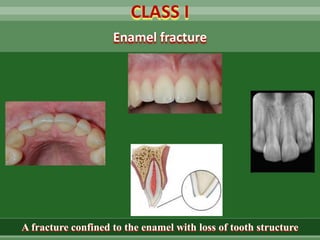
Class I: Enamel fracture
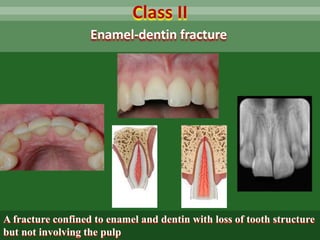
Class II: Enamel and dentin fracture without pulp exposure
Class III: Crown fracture with pulp exposure
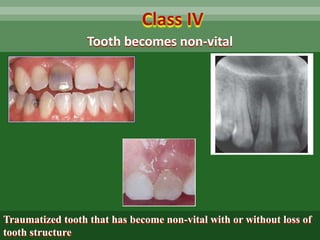
Class IV: Traumatized tooth that has become non-vital with or without loss of tooth
structure
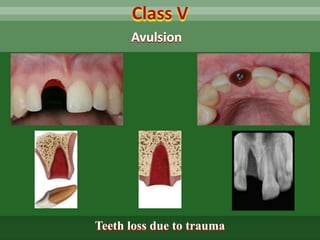
Class V: Teeth lost as a result of trauma (Avulsion)
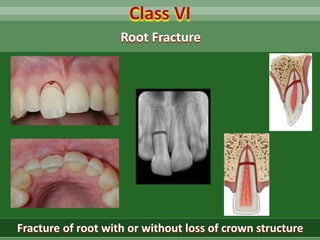
Class VI: Fracture of root with or without loss of crown structure
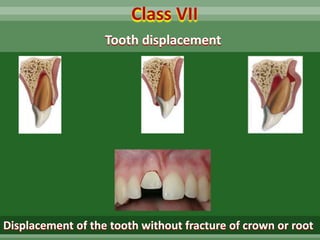
Class VII: Displacement of the tooth without fracture of crown or root
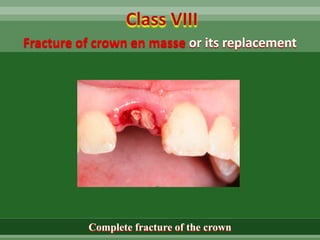
Class VIII: Fracture of the crown en masse and its replacement
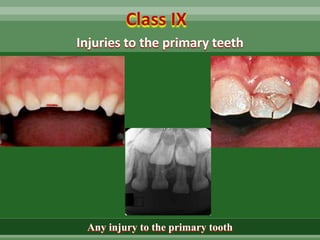
Class IX: Fracture of deciduous teeth
CLASS I
A fracture confined to the enamel with loss of tooth structure
Enamel fracture
Class II
A fracture confined to enamel and dentin with loss of tooth structure
but not involving the pulp
Enamel-dentin fracture
Class III
A fracture involving enamel and dentin with loss of tooth
structure and exposure of the pulp
Enamel-dentin-pulp fracture
Tooth becomes non-vital
Class IV
Traumatized tooth that has become non-vital with or without loss of
tooth structure
Class V
Teeth loss due to trauma
Avulsion
Class VI
Fracture of root with or without loss of crown structure
Root Fracture
Tooth displacement
Class VII
Displacement of the tooth without fracture of crown or root
Fracture of crown en masse or its replacement
Class VIII
Complete fracture of the crown
Class IX
Injuries to the primary teeth
Any injury to the primary tooth
Treatment of various dental fractures
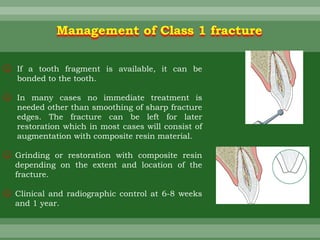
Management of Class 1 fracture
☺ If a tooth fragment is available, it can be
bonded to the tooth.
☺ In many cases no immediate treatment is
needed other than smoothing of sharp fracture
edges. The fracture can be left for later
restoration which in most cases will consist of
augmentation with composite resin material.
☺ Grinding or restoration with composite resin
depending on the extent and location of the
fracture.
☺ Clinical and radiographic control at 6-8 weeks
and 1 year.
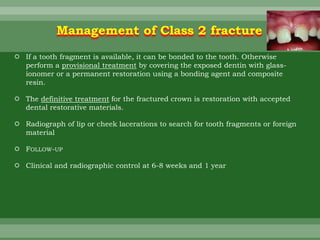
 If a tooth fragment is available, it can be bonded to the tooth. Otherwise
perform a provisional treatment by covering the exposed dentin with glass-
ionomer or a permanent restoration using a bonding agent and composite
resin.
 The definitive treatment for the fractured crown is restoration with accepted
dental restorative materials.
 Radiograph of lip or cheek lacerations to search for tooth fragments or foreign
material
 FOLLOW-UP
 Clinical and radiographic control at 6-8 weeks and 1 year
Management of Class 2 fracture
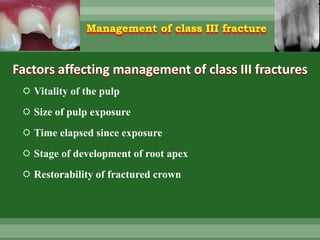
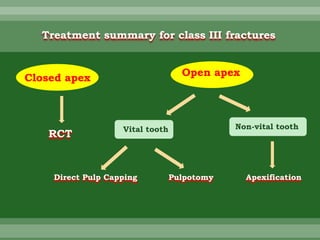
Management of class III fracture
Factors affecting management of class III fractures
 Vitality of the pulp
 Size of pulp exposure
 Time elapsed since exposure
 Stage of development of root apex
 Restorability of fractured crown
Closed apex
Open apex
RCT
Vital tooth Non-vital tooth
Direct Pulp Capping Pulpotomy Apexification
Treatment summary for class III fractures
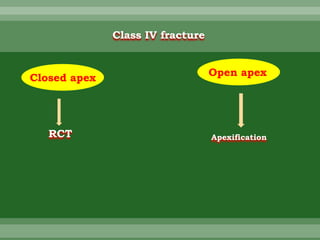
Closed apex
Open apex
RCT Apexification
Class IV fracture
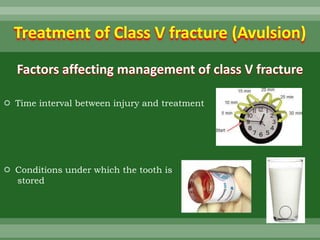
Treatment of Class V fracture (Avulsion)
Factors affecting management of class V fracture
 Time interval between injury and treatment
 Conditions under which the tooth is
stored
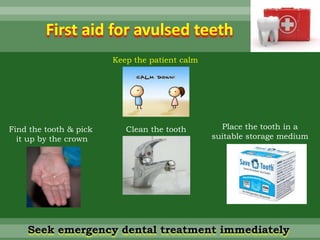
First aid for avulsed teeth
Keep the patient calm
Find the tooth & pick
it up by the crown
Clean the tooth Place the tooth in a
suitable storage medium
Seek emergency dental treatment immediately
Storage media for avulsed tooth
 Tissue or cell culture media like Hank’s Balanced
salt Solution (HBSS)
 Milk
 Isotonic Saline
 Contact lens solution
 Buccal vestibule or under the tongue
 Unsalted water
 Saliva
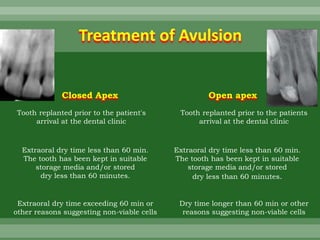
Treatment of Avulsion
Tooth replanted prior to the patient's
arrival at the dental clinic
Extraoral dry time less than 60 min.
The tooth has been kept in suitable
storage media and/or stored
dry less than 60 minutes.
Extraoral dry time exceeding 60 min or
other reasons suggesting non-viable cells
Tooth replanted prior to the patients
arrival at the dental clinic
Extraoral dry time less than 60 min.
The tooth has been kept in suitable
storage media and/or stored
dry less than 60 minutes.
Dry time longer than 60 min or other
reasons suggesting non-viable cells
Closed Apex Open apex
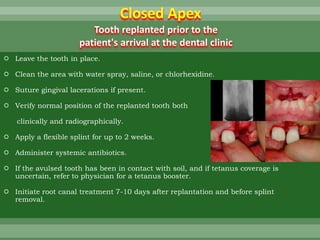
Closed Apex
 Leave the tooth in place.
 Clean the area with water spray, saline, or chlorhexidine.
 Suture gingival lacerations if present.
 Verify normal position of the replanted tooth both
clinically and radiographically.
 Apply a flexible splint for up to 2 weeks.
 Administer systemic antibiotics.
 If the avulsed tooth has been in contact with soil, and if tetanus coverage is
uncertain, refer to physician for a tetanus booster.
 Initiate root canal treatment 7-10 days after replantation and before splint
removal.
Tooth replanted prior to the
patient's arrival at the dental clinic
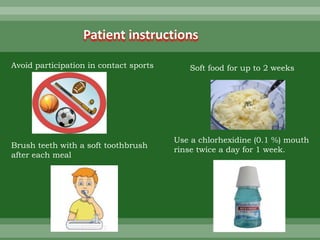
Patient instructions
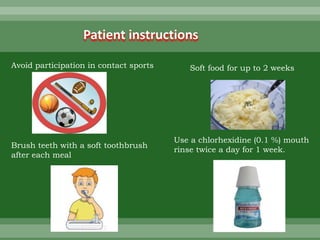
Avoid participation in contact sports Soft food for up to 2 weeks
Brush teeth with a soft toothbrush
after each meal
Use a chlorhexidine (0.1 %) mouth
rinse twice a day for 1 week.
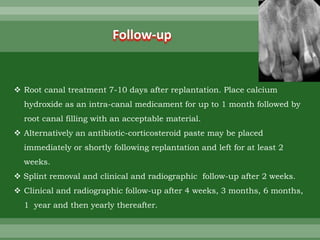
 Root canal treatment 7-10 days after replantation. Place calcium
hydroxide as an intra-canal medicament for up to 1 month followed by
root canal filling with an acceptable material.
 Alternatively an antibiotic-corticosteroid paste may be placed
immediately or shortly following replantation and left for at least 2
weeks.
 Splint removal and clinical and radiographic follow-up after 2 weeks.
 Clinical and radiographic follow-up after 4 weeks, 3 months, 6 months,
1 year and then yearly thereafter.
Follow-up
Extra-oral dry time less than 60 min. The tooth has been kept in suitable storage
media and/or stored dry less than 60 minutes
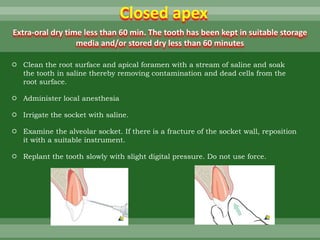
 Clean the root surface and apical foramen with a stream of saline and soak
the tooth in saline thereby removing contamination and dead cells from the
root surface.
 Administer local anesthesia
 Irrigate the socket with saline.
 Examine the alveolar socket. If there is a fracture of the socket wall, reposition
it with a suitable instrument.
 Replant the tooth slowly with slight digital pressure. Do not use force.
Closed apex
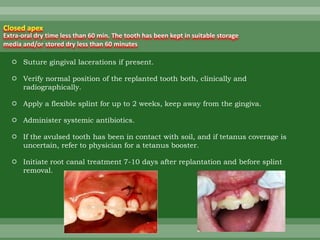
 Suture gingival lacerations if present.
 Verify normal position of the replanted tooth both, clinically and
radiographically.
 Apply a flexible splint for up to 2 weeks, keep away from the gingiva.
 Administer systemic antibiotics.
 If the avulsed tooth has been in contact with soil, and if tetanus coverage is
uncertain, refer to physician for a tetanus booster.
 Initiate root canal treatment 7-10 days after replantation and before splint
removal.
Closed apex
Extra-oral dry time less than 60 min. The tooth has been kept in suitable storage
media and/or stored dry less than 60 minutes
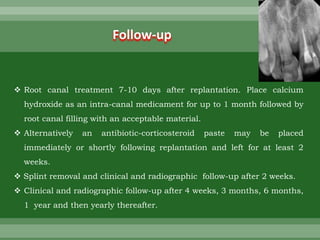
 Root canal treatment 7-10 days after replantation. Place calcium
hydroxide as an intra-canal medicament for up to 1 month followed by
root canal filling with an acceptable material.
 Alternatively an antibiotic-corticosteroid paste may be placed
immediately or shortly following replantation and left for at least 2
weeks.
 Splint removal and clinical and radiographic follow-up after 2 weeks.
 Clinical and radiographic follow-up after 4 weeks, 3 months, 6 months,
1 year and then yearly thereafter.
Follow-up
Extra-oral dry time exceeding 60 min or other
reasons suggesting non-viable cells
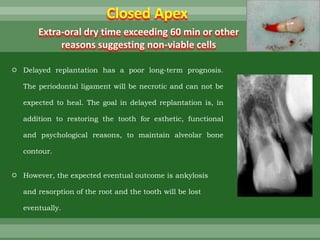
 Delayed replantation has a poor long-term prognosis.
The periodontal ligament will be necrotic and can not be
expected to heal. The goal in delayed replantation is, in
addition to restoring the tooth for esthetic, functional
and psychological reasons, to maintain alveolar bone
contour.
 However, the expected eventual outcome is ankylosis
and resorption of the root and the tooth will be lost
eventually.
Closed Apex
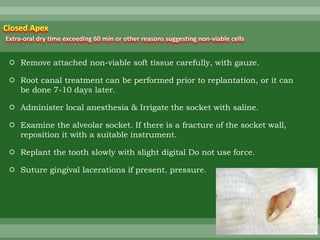
 Remove attached non-viable soft tissue carefully, with gauze.
 Root canal treatment can be performed prior to replantation, or it can
be done 7-10 days later.
 Administer local anesthesia & Irrigate the socket with saline.
 Examine the alveolar socket. If there is a fracture of the socket wall,
reposition it with a suitable instrument.
 Replant the tooth slowly with slight digital Do not use force.
 Suture gingival lacerations if present. pressure.
Closed Apex
Extra-oral dry time exceeding 60 min or other reasons suggesting non-viable cells
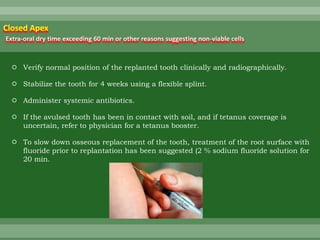
 Verify normal position of the replanted tooth clinically and radiographically.
 Stabilize the tooth for 4 weeks using a flexible splint.
 Administer systemic antibiotics.
 If the avulsed tooth has been in contact with soil, and if tetanus coverage is
uncertain, refer to physician for a tetanus booster.
 To slow down osseous replacement of the tooth, treatment of the root surface with
fluoride prior to replantation has been suggested (2 % sodium fluoride solution for
20 min.
Closed Apex
Extra-oral dry time exceeding 60 min or other reasons suggesting non-viable cells
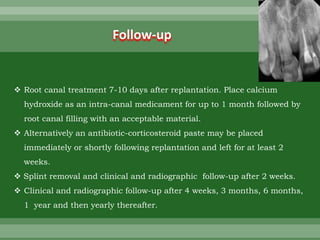
 Root canal treatment 7-10 days after replantation. Place calcium
hydroxide as an intra-canal medicament for up to 1 month followed by
root canal filling with an acceptable material.
 Alternatively an antibiotic-corticosteroid paste may be placed
immediately or shortly following replantation and left for at least 2
weeks.
 Splint removal and clinical and radiographic follow-up after 2 weeks.
 Clinical and radiographic follow-up after 4 weeks, 3 months, 6 months,
1 year and then yearly thereafter.
Follow-up
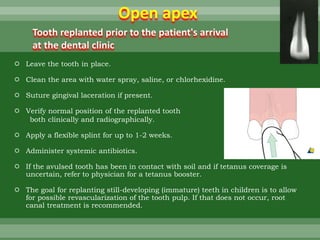
 Leave the tooth in place.
 Clean the area with water spray, saline, or chlorhexidine.
 Suture gingival laceration if present.
 Verify normal position of the replanted tooth
both clinically and radiographically.
 Apply a flexible splint for up to 1-2 weeks.
 Administer systemic antibiotics.
 If the avulsed tooth has been in contact with soil and if tetanus coverage is
uncertain, refer to physician for a tetanus booster.
 The goal for replanting still-developing (immature) teeth in children is to allow
for possible revascularization of the tooth pulp. If that does not occur, root
canal treatment is recommended.
Tooth replanted prior to the patient's arrival
at the dental clinic
Open apex
Patient instructions
Avoid participation in contact sports Soft food for up to 2 weeks
Brush teeth with a soft toothbrush
after each meal
Use a chlorhexidine (0.1 %) mouth
rinse twice a day for 1 week.
 For immature teeth, root canal treatment should be avoided unless there is clinical or
radiographic evidence of pulp necrosis.
 Splint removal and clinical and radiographic control after 2 weeks.
 Clinical and radiographic control after 4 weeks, 3 months, 6 months, 1 year and then
yearly thereafter.
Follow-up
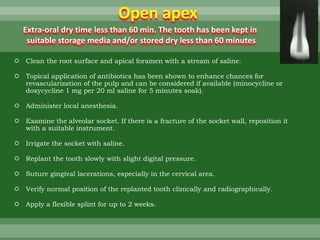
 Clean the root surface and apical foramen with a stream of saline.
 Topical application of antibiotics has been shown to enhance chances for
revascularization of the pulp and can be considered if available (minocycline or
doxycycline 1 mg per 20 ml saline for 5 minutes soak).
 Administer local anesthesia.
 Examine the alveolar socket. If there is a fracture of the socket wall, reposition it
with a suitable instrument.
 Irrigate the socket with saline.
 Replant the tooth slowly with slight digital pressure.
 Suture gingival lacerations, especially in the cervical area.
 Verify normal position of the replanted tooth clinically and radiographically.
 Apply a flexible splint for up to 2 weeks.
Open apex
Extra-oral dry time less than 60 min. The tooth has been kept in
suitable storage media and/or stored dry less than 60 minutes
 Administer systemic antibiotics.
 If the avulsed tooth has been in contact with soil and if tetanus coverage is
uncertain, refer to physician for a tetanus booster.
 The goal for replanting still-developing (immature) teeth in children is to allow
for possible revascularization of the pulp space. The risk of infection-related
root resorption should be weighed up against the chances of revascularization.
Such resorption is very rapid in children. If revascularization does not occur,
root canal treatment may be recommended.
Open apex
Extra-oral dry time less than 60 min. The tooth has been kept in suitable storage media and/or stored dry
less than 60 minutes
Dry time longer than 60 min or other reasons
suggesting non-viable cells
 Remove attached non-viable soft tissue with gauze.
 Root canal treatment can be carried out prior to replantation or later.
 Administer local anesthesia.
 Irrigate the socket with saline.
 Examine the alveolar socket. if there is a fracture of the socket wall, reposition it with a
suitable instrument.
 Replant the tooth slowly with slight digital pressure.
 Suture gingival lacerations if present.
Open apex
 Verify normal position of the replanted tooth clinically and radiographically.
 Stabilize the tooth for 4 weeks using a flexible splint.
 Administer systemic antibiotics.
 If the avulsed tooth has been in contact with soil or if tetanus coverage is uncertain,
refer to physician for evaluation of the need for a tetanus booster.
 To slow down osseous replacement of the tooth, treatment of the root surface with
fluoride prior to replantation has been suggested (2 % sodium fluoride solution for
20 min.
Open apex
Dry time longer than 60 min or other reasons suggesting non-viable cells
Dental Trauma.pptx

Dental Trauma.pptx

  • 1.
    Dental Trauma Zohaa Al-Shekhly NazimaAnsari Daria Gholamifard Danial Hashemimoghaddam
  • 2.
    Definitions Trauma a physicalinjury or wound to the body Traumatic relating to physical injuries or wounds to the body Traumatology the branch of medicine that deals with serious injuries and wounds and their long-term consequences
  • 3.
    Epidemiology Dental trauma iscommon in childhood & adolescent Incidence of dental trauma is 31-40% of boys & 16-30% of girls at 5 years of age Incidence of dental trauma is 12-33% of boys & 4-19% of girls at 12 years of age Boys are affected almost twice as often as girls in both the dentitions
  • 4.
    Etiology Most accident proneage is between 2 & 4 years for the primary dentition & 7 & 10 years for the permanent dentition Pre-School Child:  Fall injuries.  Child abuse.  Injury during play.  Seizures. School Age:  Athletic injuries.  Fighting.  Auto accidents.  Seizure disorders.
  • 5.
    Type of trauma Direct trauma : When the tooth itself is struck  Indirect trauma: When the lower dental arch is forcefully closed against the upper
  • 6.
    Ellis classification Class I:Enamel fracture Class II: Enamel and dentin fracture without pulp exposure Class III: Crown fracture with pulp exposure Class IV: Traumatized tooth that has become non-vital with or without loss of tooth structure Class V: Teeth lost as a result of trauma (Avulsion) Class VI: Fracture of root with or without loss of crown structure Class VII: Displacement of the tooth without fracture of crown or root Class VIII: Fracture of the crown en masse and its replacement Class IX: Fracture of deciduous teeth
  • 7.
    CLASS I A fractureconfined to the enamel with loss of tooth structure Enamel fracture
  • 8.
    Class II A fractureconfined to enamel and dentin with loss of tooth structure but not involving the pulp Enamel-dentin fracture
  • 9.
    Class III A fractureinvolving enamel and dentin with loss of tooth structure and exposure of the pulp Enamel-dentin-pulp fracture
  • 10.
    Tooth becomes non-vital ClassIV Traumatized tooth that has become non-vital with or without loss of tooth structure
  • 11.
    Class V Teeth lossdue to trauma Avulsion
  • 12.
    Class VI Fracture ofroot with or without loss of crown structure Root Fracture
  • 13.
    Tooth displacement Class VII Displacementof the tooth without fracture of crown or root
  • 14.
    Fracture of crownen masse or its replacement Class VIII Complete fracture of the crown
  • 15.
    Class IX Injuries tothe primary teeth Any injury to the primary tooth
  • 16.
    Treatment of variousdental fractures
  • 17.
    Management of Class1 fracture ☺ If a tooth fragment is available, it can be bonded to the tooth. ☺ In many cases no immediate treatment is needed other than smoothing of sharp fracture edges. The fracture can be left for later restoration which in most cases will consist of augmentation with composite resin material. ☺ Grinding or restoration with composite resin depending on the extent and location of the fracture. ☺ Clinical and radiographic control at 6-8 weeks and 1 year.
  • 18.
     If atooth fragment is available, it can be bonded to the tooth. Otherwise perform a provisional treatment by covering the exposed dentin with glass- ionomer or a permanent restoration using a bonding agent and composite resin.  The definitive treatment for the fractured crown is restoration with accepted dental restorative materials.  Radiograph of lip or cheek lacerations to search for tooth fragments or foreign material  FOLLOW-UP  Clinical and radiographic control at 6-8 weeks and 1 year Management of Class 2 fracture
  • 19.
    Management of classIII fracture Factors affecting management of class III fractures  Vitality of the pulp  Size of pulp exposure  Time elapsed since exposure  Stage of development of root apex  Restorability of fractured crown
  • 20.
    Closed apex Open apex RCT Vitaltooth Non-vital tooth Direct Pulp Capping Pulpotomy Apexification Treatment summary for class III fractures
  • 21.
    Closed apex Open apex RCTApexification Class IV fracture
  • 22.
    Treatment of ClassV fracture (Avulsion) Factors affecting management of class V fracture  Time interval between injury and treatment  Conditions under which the tooth is stored
  • 23.
    First aid foravulsed teeth Keep the patient calm Find the tooth & pick it up by the crown Clean the tooth Place the tooth in a suitable storage medium Seek emergency dental treatment immediately
  • 24.
    Storage media foravulsed tooth  Tissue or cell culture media like Hank’s Balanced salt Solution (HBSS)  Milk  Isotonic Saline  Contact lens solution  Buccal vestibule or under the tongue  Unsalted water  Saliva
  • 25.
    Treatment of Avulsion Toothreplanted prior to the patient's arrival at the dental clinic Extraoral dry time less than 60 min. The tooth has been kept in suitable storage media and/or stored dry less than 60 minutes. Extraoral dry time exceeding 60 min or other reasons suggesting non-viable cells Tooth replanted prior to the patients arrival at the dental clinic Extraoral dry time less than 60 min. The tooth has been kept in suitable storage media and/or stored dry less than 60 minutes. Dry time longer than 60 min or other reasons suggesting non-viable cells Closed Apex Open apex
  • 26.
    Closed Apex  Leavethe tooth in place.  Clean the area with water spray, saline, or chlorhexidine.  Suture gingival lacerations if present.  Verify normal position of the replanted tooth both clinically and radiographically.  Apply a flexible splint for up to 2 weeks.  Administer systemic antibiotics.  If the avulsed tooth has been in contact with soil, and if tetanus coverage is uncertain, refer to physician for a tetanus booster.  Initiate root canal treatment 7-10 days after replantation and before splint removal. Tooth replanted prior to the patient's arrival at the dental clinic
  • 27.
    Patient instructions Avoid participationin contact sports Soft food for up to 2 weeks Brush teeth with a soft toothbrush after each meal Use a chlorhexidine (0.1 %) mouth rinse twice a day for 1 week.
  • 28.
     Root canaltreatment 7-10 days after replantation. Place calcium hydroxide as an intra-canal medicament for up to 1 month followed by root canal filling with an acceptable material.  Alternatively an antibiotic-corticosteroid paste may be placed immediately or shortly following replantation and left for at least 2 weeks.  Splint removal and clinical and radiographic follow-up after 2 weeks.  Clinical and radiographic follow-up after 4 weeks, 3 months, 6 months, 1 year and then yearly thereafter. Follow-up
  • 29.
    Extra-oral dry timeless than 60 min. The tooth has been kept in suitable storage media and/or stored dry less than 60 minutes  Clean the root surface and apical foramen with a stream of saline and soak the tooth in saline thereby removing contamination and dead cells from the root surface.  Administer local anesthesia  Irrigate the socket with saline.  Examine the alveolar socket. If there is a fracture of the socket wall, reposition it with a suitable instrument.  Replant the tooth slowly with slight digital pressure. Do not use force. Closed apex
  • 30.
     Suture gingivallacerations if present.  Verify normal position of the replanted tooth both, clinically and radiographically.  Apply a flexible splint for up to 2 weeks, keep away from the gingiva.  Administer systemic antibiotics.  If the avulsed tooth has been in contact with soil, and if tetanus coverage is uncertain, refer to physician for a tetanus booster.  Initiate root canal treatment 7-10 days after replantation and before splint removal. Closed apex Extra-oral dry time less than 60 min. The tooth has been kept in suitable storage media and/or stored dry less than 60 minutes
  • 31.
     Root canaltreatment 7-10 days after replantation. Place calcium hydroxide as an intra-canal medicament for up to 1 month followed by root canal filling with an acceptable material.  Alternatively an antibiotic-corticosteroid paste may be placed immediately or shortly following replantation and left for at least 2 weeks.  Splint removal and clinical and radiographic follow-up after 2 weeks.  Clinical and radiographic follow-up after 4 weeks, 3 months, 6 months, 1 year and then yearly thereafter. Follow-up
  • 32.
    Extra-oral dry timeexceeding 60 min or other reasons suggesting non-viable cells  Delayed replantation has a poor long-term prognosis. The periodontal ligament will be necrotic and can not be expected to heal. The goal in delayed replantation is, in addition to restoring the tooth for esthetic, functional and psychological reasons, to maintain alveolar bone contour.  However, the expected eventual outcome is ankylosis and resorption of the root and the tooth will be lost eventually. Closed Apex
  • 33.
     Remove attachednon-viable soft tissue carefully, with gauze.  Root canal treatment can be performed prior to replantation, or it can be done 7-10 days later.  Administer local anesthesia & Irrigate the socket with saline.  Examine the alveolar socket. If there is a fracture of the socket wall, reposition it with a suitable instrument.  Replant the tooth slowly with slight digital Do not use force.  Suture gingival lacerations if present. pressure. Closed Apex Extra-oral dry time exceeding 60 min or other reasons suggesting non-viable cells
  • 34.
     Verify normalposition of the replanted tooth clinically and radiographically.  Stabilize the tooth for 4 weeks using a flexible splint.  Administer systemic antibiotics.  If the avulsed tooth has been in contact with soil, and if tetanus coverage is uncertain, refer to physician for a tetanus booster.  To slow down osseous replacement of the tooth, treatment of the root surface with fluoride prior to replantation has been suggested (2 % sodium fluoride solution for 20 min. Closed Apex Extra-oral dry time exceeding 60 min or other reasons suggesting non-viable cells
  • 35.
     Root canaltreatment 7-10 days after replantation. Place calcium hydroxide as an intra-canal medicament for up to 1 month followed by root canal filling with an acceptable material.  Alternatively an antibiotic-corticosteroid paste may be placed immediately or shortly following replantation and left for at least 2 weeks.  Splint removal and clinical and radiographic follow-up after 2 weeks.  Clinical and radiographic follow-up after 4 weeks, 3 months, 6 months, 1 year and then yearly thereafter. Follow-up
  • 36.
     Leave thetooth in place.  Clean the area with water spray, saline, or chlorhexidine.  Suture gingival laceration if present.  Verify normal position of the replanted tooth both clinically and radiographically.  Apply a flexible splint for up to 1-2 weeks.  Administer systemic antibiotics.  If the avulsed tooth has been in contact with soil and if tetanus coverage is uncertain, refer to physician for a tetanus booster.  The goal for replanting still-developing (immature) teeth in children is to allow for possible revascularization of the tooth pulp. If that does not occur, root canal treatment is recommended. Tooth replanted prior to the patient's arrival at the dental clinic Open apex
  • 37.
    Patient instructions Avoid participationin contact sports Soft food for up to 2 weeks Brush teeth with a soft toothbrush after each meal Use a chlorhexidine (0.1 %) mouth rinse twice a day for 1 week.
  • 38.
     For immatureteeth, root canal treatment should be avoided unless there is clinical or radiographic evidence of pulp necrosis.  Splint removal and clinical and radiographic control after 2 weeks.  Clinical and radiographic control after 4 weeks, 3 months, 6 months, 1 year and then yearly thereafter. Follow-up
  • 39.
     Clean theroot surface and apical foramen with a stream of saline.  Topical application of antibiotics has been shown to enhance chances for revascularization of the pulp and can be considered if available (minocycline or doxycycline 1 mg per 20 ml saline for 5 minutes soak).  Administer local anesthesia.  Examine the alveolar socket. If there is a fracture of the socket wall, reposition it with a suitable instrument.  Irrigate the socket with saline.  Replant the tooth slowly with slight digital pressure.  Suture gingival lacerations, especially in the cervical area.  Verify normal position of the replanted tooth clinically and radiographically.  Apply a flexible splint for up to 2 weeks. Open apex Extra-oral dry time less than 60 min. The tooth has been kept in suitable storage media and/or stored dry less than 60 minutes
  • 40.
     Administer systemicantibiotics.  If the avulsed tooth has been in contact with soil and if tetanus coverage is uncertain, refer to physician for a tetanus booster.  The goal for replanting still-developing (immature) teeth in children is to allow for possible revascularization of the pulp space. The risk of infection-related root resorption should be weighed up against the chances of revascularization. Such resorption is very rapid in children. If revascularization does not occur, root canal treatment may be recommended. Open apex Extra-oral dry time less than 60 min. The tooth has been kept in suitable storage media and/or stored dry less than 60 minutes
  • 41.
    Dry time longerthan 60 min or other reasons suggesting non-viable cells  Remove attached non-viable soft tissue with gauze.  Root canal treatment can be carried out prior to replantation or later.  Administer local anesthesia.  Irrigate the socket with saline.  Examine the alveolar socket. if there is a fracture of the socket wall, reposition it with a suitable instrument.  Replant the tooth slowly with slight digital pressure.  Suture gingival lacerations if present. Open apex
  • 42.
     Verify normalposition of the replanted tooth clinically and radiographically.  Stabilize the tooth for 4 weeks using a flexible splint.  Administer systemic antibiotics.  If the avulsed tooth has been in contact with soil or if tetanus coverage is uncertain, refer to physician for evaluation of the need for a tetanus booster.  To slow down osseous replacement of the tooth, treatment of the root surface with fluoride prior to replantation has been suggested (2 % sodium fluoride solution for 20 min. Open apex Dry time longer than 60 min or other reasons suggesting non-viable cells