SOCIETY AND CULTURE
   Concepts of society and culture are the “building blocks” of
    understanding and analyzing everyday life.

   Society refers to the totality of social organizations (ex.
    Corporations, schools, hospitals, and religious groups that
    share a common habitat or a territorially defined place and
    depend on each other for survival.

   Within the society are local networks or small groups
    characterized by a sense of belonging, intimacy and affection.
   Society has both structure and function:
     Social Structure – refers to patterns of relationships between
      units of a specified whole. (people’s behavior and their
      interrelation with one another)
     Function - refers to the purpose and effects, as well as the
      intended and actual consequences of particular beliefs and
      actions.

    With in the society there exist organized systems of social norms,
     beliefs, values and material culture formed around the social
     needs of people. These are known as Social Institutions.
   Types (4):
    1. Those that deal with the economy and property
       relations. (ex. Farms, banks, and markets)
    2. Those concerned with social control. (ex. Politics, law,
       and government)
    3. Those concerned with the supernatural (ex. Magic and
       religion)
    4. Those based on the principle of kinship created by
       descent and marriage. (ex. The Family)
   Major Theoretical Perspectives of Society
     Structuralism Functionalism or Functionalism
      ▪ Advocates of this theory are, Durkheim, Weber, Thomas,
        Pareto, Parsons, and Merton.

      ▪ Functionalist hold that society is a system made up of a set of
        elements or components that are interrelated in a more or
        less stable way through a period of time.

      ▪ Function refers to the “series of service activities carried on
        by an organized group of persons in a society for the benefit
        of its members.”
   Conflict Theory by Karl Marx

     Society can be best studied through conflict and
      power struggle.

     They point out that within a society , wealth, prestige
      and power are always scarce, it is always a constant
      conflict for these scarce resources and the inequalities
      in the economic system would bring about revolution.
   Culture is an encompassing concept which includes all the
    recipes for living, a blueprint for behavior and any social
    activity, the sum of human creations, and a way of life which
    serves as potential guide for behavior.

   From the standpoint of the anthropologists and sociologists,
    all people have culture. All humans participate in a culture in
    whatever statuses in life they have.


   Each society has its own distinctive systems therefore
    culture varies.
   Characteristics of Culture
     Culture is learned – Absorption of any habit , value, knowledge,
      skill     and taste of the group reflects the uniquely elaborate
      capacity of       humans to learn.

     Culture is transmitted orally and by writing       - through
      conditioning,   imitation, suggestion, identification, reward
      and punishment, formal instruction and mass communication.

     Culture is shared – the elements of culture result from living
      and         interacting with one another and emerge out of the
      social life of      people.
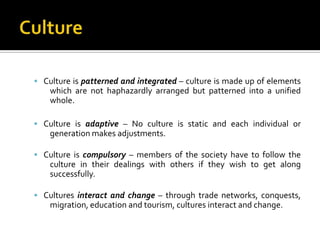
 Culture is patterned and integrated – culture is made up of elements
    which are not haphazardly arranged but patterned into a unified
    whole.

 Culture is adaptive – No culture is static and each individual or
    generation makes adjustments.

 Culture is compulsory – members of the society have to follow the
    culture in their dealings with others if they wish to get along
    successfully.

 Cultures interact and change – through trade networks, conquests,
    migration, education and tourism, cultures interact and change.
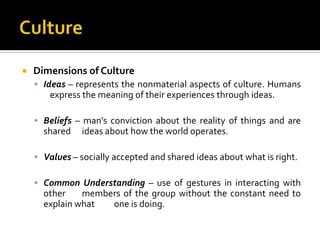
   Dimensions of Culture
     Ideas – represents the nonmaterial aspects of culture. Humans
        express the meaning of their experiences through ideas.

     Beliefs – man’s conviction about the reality of things and are
      shared    ideas about how the world operates.

     Values – socially accepted and shared ideas about what is right.

     Common Understanding – use of gestures in interacting with
      other    members of the group without the constant need to
      explain what  one is doing.
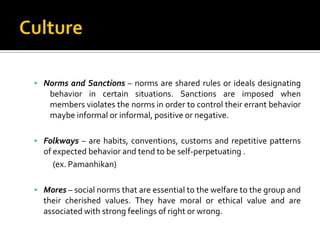
 Norms and Sanctions – norms are shared rules or ideals designating
    behavior in certain situations. Sanctions are imposed when
    members violates the norms in order to control their errant behavior
    maybe informal or informal, positive or negative.

 Folkways – are habits, conventions, customs and repetitive patterns
  of expected behavior and tend to be self-perpetuating .
     (ex. Pamanhikan)

 Mores – social norms that are essential to the welfare to the group and
  their cherished values. They have moral or ethical value and are
  associated with strong feelings of right or wrong.
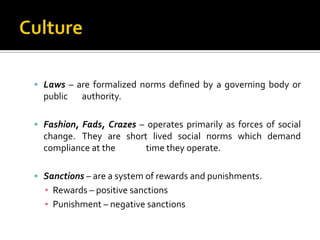
 Laws – are formalized norms defined by a governing body or
  public   authority.

 Fashion, Fads, Crazes – operates primarily as forces of social
  change. They are short lived social norms which demand
  compliance at the     time they operate.

 Sanctions – are a system of rewards and punishments.
  ▪ Rewards – positive sanctions
  ▪ Punishment – negative sanctions
 Material Culture and Technology – refers to all the physical, tangible,
   and concrete produced by people.
  ▪ Determines the physical options and opportunities of the society.

 Language and Culture – language is an integral part of culture and
   human culture cannot exist without it.
  ▪ Through the use of symbols, human have created ideas, organized
    and systemized them and passed them on to others.

 Ideology – refers to a meaningful system of doctrines, ideas and
   symbols, norms and values.
  ▪ They are organized into a system which moves its members to action.
   Culture Similarity and Culture Diversity
     Culture Similarity my be attributed to:
      ▪ Similarities in biological structures and drives (biological and
        psychological needs).
      ▪ Each society has to carry out certain functions necessary for social
        living.
      ▪ Human beings have a similar range of emotions, needs for security
        and response and possesses a symbolic language.
      ▪ The geographical environment .

     Diversity in culture is brought about by differences in the was people
        meet and respond to their biological and psychological needs and
        the manner by which people adapt to their environment.
   Subculture – smaller groups with a distinctive cultural pattern
       within the society.
     Arise from certain individual needs to obtain assurance and
       security from others for an inability to cope with the dominant
       culture.


   Culture Shock - the feeling of unpleasantness or disorientation
       experienced when one goes to an unfamiliar setting.
     Can also be experience in one’s country
      ▪ Urbanites going to rural areas
      ▪ Rural folks migrating to urban areas
   Ethnocentrism - the view to regard one’s culture as right and
        normal,         with a superior attitude.
     Literally means a belief that one’s group is the center of
        the universe and one scales and rates other cultures with
        reference to it.


   Cultural Relativism - culture must be understood in terms
        of its own values and beliefs and not by standards of the
        viewer’s culture. It assumes that no culture is better than
        any other.

Chapter ii

  • 1.
  • 2.
    Concepts of society and culture are the “building blocks” of understanding and analyzing everyday life.  Society refers to the totality of social organizations (ex. Corporations, schools, hospitals, and religious groups that share a common habitat or a territorially defined place and depend on each other for survival.  Within the society are local networks or small groups characterized by a sense of belonging, intimacy and affection.
  • 3.
    Society has both structure and function:  Social Structure – refers to patterns of relationships between units of a specified whole. (people’s behavior and their interrelation with one another)  Function - refers to the purpose and effects, as well as the intended and actual consequences of particular beliefs and actions. With in the society there exist organized systems of social norms, beliefs, values and material culture formed around the social needs of people. These are known as Social Institutions.
  • 4.
    Types (4): 1. Those that deal with the economy and property relations. (ex. Farms, banks, and markets) 2. Those concerned with social control. (ex. Politics, law, and government) 3. Those concerned with the supernatural (ex. Magic and religion) 4. Those based on the principle of kinship created by descent and marriage. (ex. The Family)
  • 5.
    Major Theoretical Perspectives of Society  Structuralism Functionalism or Functionalism ▪ Advocates of this theory are, Durkheim, Weber, Thomas, Pareto, Parsons, and Merton. ▪ Functionalist hold that society is a system made up of a set of elements or components that are interrelated in a more or less stable way through a period of time. ▪ Function refers to the “series of service activities carried on by an organized group of persons in a society for the benefit of its members.”
  • 6.
    Conflict Theory by Karl Marx  Society can be best studied through conflict and power struggle.  They point out that within a society , wealth, prestige and power are always scarce, it is always a constant conflict for these scarce resources and the inequalities in the economic system would bring about revolution.
  • 7.
    Culture is an encompassing concept which includes all the recipes for living, a blueprint for behavior and any social activity, the sum of human creations, and a way of life which serves as potential guide for behavior.  From the standpoint of the anthropologists and sociologists, all people have culture. All humans participate in a culture in whatever statuses in life they have.  Each society has its own distinctive systems therefore culture varies.
  • 8.
    Characteristics of Culture  Culture is learned – Absorption of any habit , value, knowledge, skill and taste of the group reflects the uniquely elaborate capacity of humans to learn.  Culture is transmitted orally and by writing - through conditioning, imitation, suggestion, identification, reward and punishment, formal instruction and mass communication.  Culture is shared – the elements of culture result from living and interacting with one another and emerge out of the social life of people.
  • 9.
     Culture ispatterned and integrated – culture is made up of elements which are not haphazardly arranged but patterned into a unified whole.  Culture is adaptive – No culture is static and each individual or generation makes adjustments.  Culture is compulsory – members of the society have to follow the culture in their dealings with others if they wish to get along successfully.  Cultures interact and change – through trade networks, conquests, migration, education and tourism, cultures interact and change.
  • 10.
    Dimensions of Culture  Ideas – represents the nonmaterial aspects of culture. Humans express the meaning of their experiences through ideas.  Beliefs – man’s conviction about the reality of things and are shared ideas about how the world operates.  Values – socially accepted and shared ideas about what is right.  Common Understanding – use of gestures in interacting with other members of the group without the constant need to explain what one is doing.
  • 11.
     Norms andSanctions – norms are shared rules or ideals designating behavior in certain situations. Sanctions are imposed when members violates the norms in order to control their errant behavior maybe informal or informal, positive or negative.  Folkways – are habits, conventions, customs and repetitive patterns of expected behavior and tend to be self-perpetuating . (ex. Pamanhikan)  Mores – social norms that are essential to the welfare to the group and their cherished values. They have moral or ethical value and are associated with strong feelings of right or wrong.
  • 12.
     Laws –are formalized norms defined by a governing body or public authority.  Fashion, Fads, Crazes – operates primarily as forces of social change. They are short lived social norms which demand compliance at the time they operate.  Sanctions – are a system of rewards and punishments. ▪ Rewards – positive sanctions ▪ Punishment – negative sanctions
  • 13.
     Material Cultureand Technology – refers to all the physical, tangible, and concrete produced by people. ▪ Determines the physical options and opportunities of the society.  Language and Culture – language is an integral part of culture and human culture cannot exist without it. ▪ Through the use of symbols, human have created ideas, organized and systemized them and passed them on to others.  Ideology – refers to a meaningful system of doctrines, ideas and symbols, norms and values. ▪ They are organized into a system which moves its members to action.
  • 14.
    Culture Similarity and Culture Diversity  Culture Similarity my be attributed to: ▪ Similarities in biological structures and drives (biological and psychological needs). ▪ Each society has to carry out certain functions necessary for social living. ▪ Human beings have a similar range of emotions, needs for security and response and possesses a symbolic language. ▪ The geographical environment .  Diversity in culture is brought about by differences in the was people meet and respond to their biological and psychological needs and the manner by which people adapt to their environment.
  • 15.
    Subculture – smaller groups with a distinctive cultural pattern within the society.  Arise from certain individual needs to obtain assurance and security from others for an inability to cope with the dominant culture.  Culture Shock - the feeling of unpleasantness or disorientation experienced when one goes to an unfamiliar setting.  Can also be experience in one’s country ▪ Urbanites going to rural areas ▪ Rural folks migrating to urban areas
  • 16.
    Ethnocentrism - the view to regard one’s culture as right and normal, with a superior attitude.  Literally means a belief that one’s group is the center of the universe and one scales and rates other cultures with reference to it.  Cultural Relativism - culture must be understood in terms of its own values and beliefs and not by standards of the viewer’s culture. It assumes that no culture is better than any other.