Knowledge Distillation for Federated
Learning: a Practical Guide
Alessio Mora, Irene Tenison, Paolo Bellavista, Irina Rish
Report: Xiachong Feng
Authors
Xiachong Feng 2
Alessio Mora
PhD Student
University of Bologna
Irene Tenison
Student M.Sc.,
Université de Montréal
Paolo Bellavista
Full Professor
University of Bologna
Irina Rish
Full Professor
Université de Montréal,
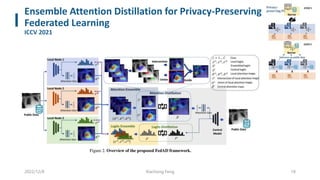
Canada CIFAR AI Chair
2022/12/8
2022/12/8 Xiachong Feng 3
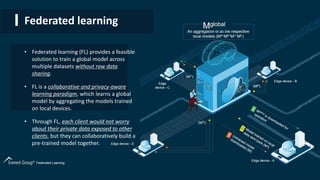
• Federated learning (FL) provides a feasible
solution to train a global model across
multiple datasets without raw data
sharing.
• FL is a collaborative and privacy-aware
learning paradigm, which learns a global
model by aggregating the models trained
on local devices.
• Through FL, each client would not worry
about their private data exposed to other
clients, but they can collaboratively build a
pre-trained model together.
Federated learning
Federated Averaging (FedAvg)
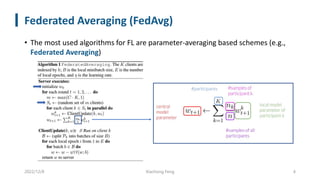
• The most used algorithms for FL are parameter-averaging based schemes (e.g.,
Federated Averaging)
2022/12/8 Xiachong Feng 4
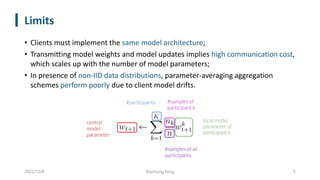
Limits
• Clients must implement the same model architecture;
• Transmitting model weights and model updates implies high communication cost,
which scales up with the number of model parameters;
• In presence of non-IID data distributions, parameter-averaging aggregation
schemes perform poorly due to client model drifts.
2022/12/8 Xiachong Feng 5
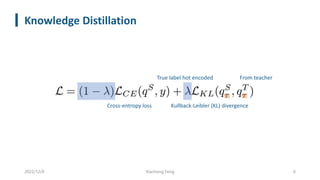
Knowledge Distillation
2022/12/8 Xiachong Feng 6
Cross-entropy loss
True label hot encoded
Kullback-Leibler (KL) divergence
From teacher
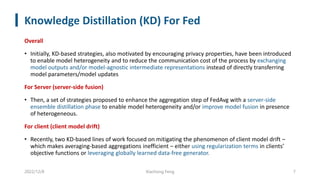
Knowledge Distillation (KD) For Fed
Overall
• Initially, KD-based strategies, also motivated by encouraging privacy properties, have been introduced
to enable model heterogeneity and to reduce the communication cost of the process by exchanging
model outputs and/or model-agnostic intermediate representations instead of directly transferring
model parameters/model updates
For Server (server-side fusion)
• Then, a set of strategies proposed to enhance the aggregation step of FedAvg with a server-side
ensemble distillation phase to enable model heterogeneity and/or improve model fusion in presence
of heterogeneous.
For client (client model drift)
• Recently, two KD-based lines of work focused on mitigating the phenomenon of client model drift –
which makes averaging-based aggregations inefficient – either using regularization terms in clients’
objective functions or leveraging globally learned data-free generator.
2022/12/8 Xiachong Feng 7
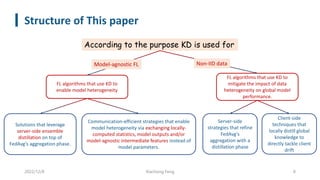
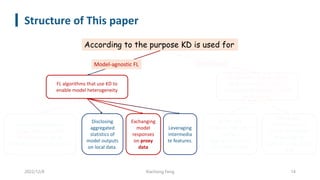
Structure of This paper
2022/12/8 Xiachong Feng 8
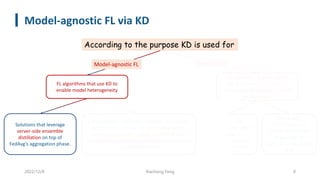
FL algorithms that use KD to
enable model heterogeneity
FL algorithms that use KD to
mitigate the impact of data
heterogeneity on global model
performance.
According to the purpose KD is used for
Solutions that leverage
server-side ensemble
distillation on top of
FedAvg’s aggregation phase.
Communication-efficient strategies that enable
model heterogeneity via exchanging locally-
computed statistics, model outputs and/or
model-agnostic intermediate features instead of
model parameters.
Server-side
strategies that refine
FedAvg’s
aggregation with a
distillation phase
Client-side
techniques that
locally distill global
knowledge to
directly tackle client
drift
Model-agnostic FL Non-IID data
Model-agnostic FL via KD
2022/12/8 Xiachong Feng 9
FL algorithms that use KD to
enable model heterogeneity
FL algorithms that use KD to
mitigate the impact of data
heterogeneity on global model
performance.
According to the purpose KD is used for
Solutions that leverage
server-side ensemble
distillation on top of
FedAvg’s aggregation phase.
Communication-efficient strategies that enable
model heterogeneity via exchanging locally-
computed statistics, model outputs and/or
model-agnostic intermediate features instead of
model parameters.
Server-side
strategies that refine
FedAvg’s
aggregation with a
distillation phase
Client-side
techniques that
locally distill global
knowledge to
directly tackle client
drift
Model-agnostic FL Non-IID data
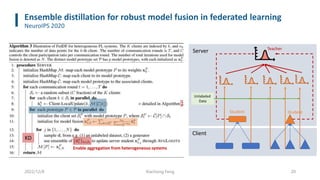
Server-side ensemble distillation
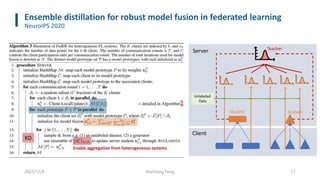
• FedAvg’s protocol can be enhanced to enable model heterogeneity by leveraging server-side ensemble distillation
on top of the aggregation step
• The server can maintain a set of prototypical models, with each prototype representing all learners with same
architecture. After collecting updates from clients, the server firstly performs a per-prototype aggregation and then
produces soft targets for each received client model either leveraging unlabeled data or synthetically generated
examples.
• Next, such soft targets are averaged and used to fine tune each aggregated model prototype, exchanging
knowledge among clients with different model architecture.
• [30] Tao Lin, Lingjing Kong, Sebastian U Stich, and Martin Jaggi. Ensemble distillation for robust model fusion in
federated learning. Advances in Neural Information Processing Systems, 33:2351–2363, 2020.
• [41] Felix Sattler, Tim Korjakow, Roman Rischke, and Wojciech Samek. Fedaux: Leveraging unlabeled auxiliary data
in federated learning. IEEE Transactions on Neural Networks and Learning Systems, 2021.
2022/12/8 Xiachong Feng 10
Ensemble distillation for robust model fusion in federated learning
NeuroIPS 2020
2022/12/8 Xiachong Feng 11
Enable aggregation from heterogeneous systems
KD
Unlabeled
Data
Client
Server Teacher
Student Student
Structure of This paper
2022/12/8 Xiachong Feng 12
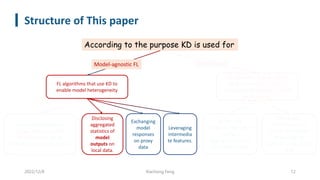
FL algorithms that use KD to
enable model heterogeneity
FL algorithms that use KD to
mitigate the impact of data
heterogeneity on global model
performance.
According to the purpose KD is used for
Solutions that leverage
server-side ensemble
distillation on top of
FedAvg’s aggregation phase.
Disclosing
aggregated
statistics of
model
outputs on
local data.
Server-side
strategies that refine
FedAvg’s
aggregation with a
distillation phase
Client-side
techniques that
locally distill global
knowledge to
directly tackle client
drift
Model-agnostic FL Non-IID data
Exchanging
model
responses
on proxy
data
Leveraging
intermedia
te features.
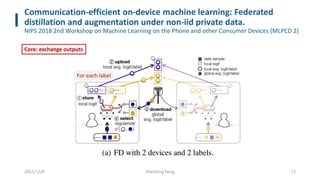
Communication-efficient on-device machine learning: Federated
distillation and augmentation under non-iid private data.
NIPS 2018 2nd Workshop on Machine Learning on the Phone and other Consumer Devices (MLPCD 2)
2022/12/8 Xiachong Feng 13
Core: exchange outputs
For each label
Structure of This paper
2022/12/8 Xiachong Feng 14
FL algorithms that use KD to
enable model heterogeneity
FL algorithms that use KD to
mitigate the impact of data
heterogeneity on global model
performance.
According to the purpose KD is used for
Solutions that leverage
server-side ensemble
distillation on top of
FedAvg’s aggregation phase.
Disclosing
aggregated
statistics of
model outputs
on local data.
Server-side
strategies that refine
FedAvg’s
aggregation with a
distillation phase
Client-side
techniques that
locally distill global
knowledge to
directly tackle client
drift
Model-agnostic FL Non-IID data
Exchanging
model
responses
on proxy
data
Leveraging
intermedia
te features.
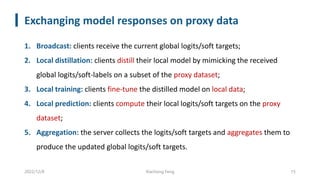
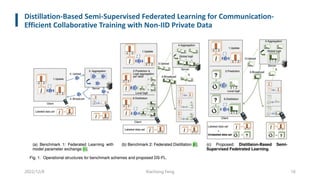
Exchanging model responses on proxy data
1. Broadcast: clients receive the current global logits/soft targets;
2. Local distillation: clients distill their local model by mimicking the received
global logits/soft-labels on a subset of the proxy dataset;
3. Local training: clients fine-tune the distilled model on local data;
4. Local prediction: clients compute their local logits/soft targets on the proxy
dataset;
5. Aggregation: the server collects the logits/soft targets and aggregates them to
produce the updated global logits/soft targets.
2022/12/8 Xiachong Feng 15
Distillation-Based Semi-Supervised Federated Learning for Communication-
Efficient Collaborative Training with Non-IID Private Data
2022/12/8 Xiachong Feng 16
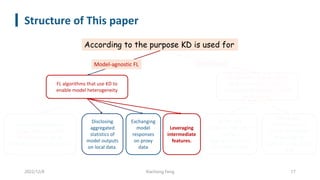
Structure of This paper
2022/12/8 Xiachong Feng 17
FL algorithms that use KD to
enable model heterogeneity
FL algorithms that use KD to
mitigate the impact of data
heterogeneity on global model
performance.
According to the purpose KD is used for
Solutions that leverage
server-side ensemble
distillation on top of
FedAvg’s aggregation phase.
Disclosing
aggregated
statistics of
model outputs
on local data.
Server-side
strategies that refine
FedAvg’s
aggregation with a
distillation phase
Client-side
techniques that
locally distill global
knowledge to
directly tackle client
drift
Model-agnostic FL Non-IID data
Exchanging
model
responses
on proxy
data
Leveraging
intermediate
features.
Ensemble Attention Distillation for Privacy-Preserving
Federated Learning
ICCV 2021
2022/12/8 Xiachong Feng 18
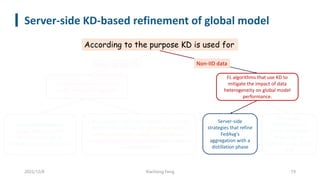
Server-side KD-based refinement of global model
2022/12/8 Xiachong Feng 19
FL algorithms that use KD to
enable model heterogeneity
FL algorithms that use KD to
mitigate the impact of data
heterogeneity on global model
performance.
According to the purpose KD is used for
Solutions that leverage
server-side ensemble
distillation on top of
FedAvg’s aggregation phase.
Communication-efficient strategies that enable
model heterogeneity via exchanging locally-
computed statistics, model outputs and/or
model-agnostic intermediate features instead of
model parameters.
Server-side
strategies that refine
FedAvg’s
aggregation with a
distillation phase
Client-side
techniques that
locally distill global
knowledge to
directly tackle client
drift
Model-agnostic FL Non-IID data
Ensemble distillation for robust model fusion in federated learning
NeuroIPS 2020
2022/12/8 Xiachong Feng 20
Enable aggregation from heterogeneous systems
KD
Unlabeled
Data
Client
Server Teacher
Student Student
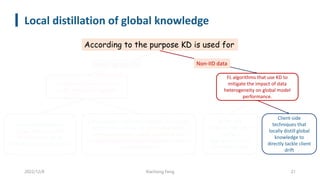
Local distillation of global knowledge
2022/12/8 Xiachong Feng 21
FL algorithms that use KD to
enable model heterogeneity
FL algorithms that use KD to
mitigate the impact of data
heterogeneity on global model
performance.
According to the purpose KD is used for
Solutions that leverage
server-side ensemble
distillation on top of
FedAvg’s aggregation phase.
Communication-efficient strategies that enable
model heterogeneity via exchanging locally-
computed statistics, model outputs and/or
model-agnostic intermediate features instead of
model parameters.
Server-side
strategies that refine
FedAvg’s
aggregation with a
distillation phase
Client-side
techniques that
locally distill global
knowledge to
directly tackle client
drift
Model-agnostic FL Non-IID data
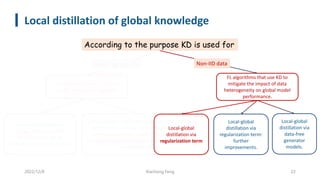
Local distillation of global knowledge
2022/12/8 Xiachong Feng 22
FL algorithms that use KD to
enable model heterogeneity
FL algorithms that use KD to
mitigate the impact of data
heterogeneity on global model
performance.
According to the purpose KD is used for
Solutions that leverage
server-side ensemble
distillation on top of
FedAvg’s aggregation phase.
Communication-efficient strategies that enable
model heterogeneity via exchanging locally-
computed statistics, model outputs and/or
model-agnostic intermediate features instead of
model parameters.
Local-global
distillation via
data-free
generator
models.
Model-agnostic FL Non-IID data
Local-global
distillation via
regularization term
Local-global
distillation via
regularization term:
further
improvements.
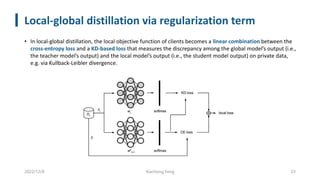
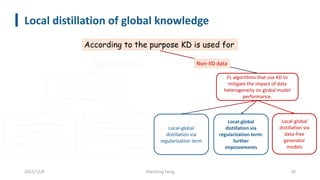
Local-global distillation via regularization term
• In local-global distillation, the local objective function of clients becomes a linear combination between the
cross-entropy loss and a KD-based loss that measures the discrepancy among the global model’s output (i.e.,
the teacher model’s output) and the local model’s output (i.e., the student model output) on private data,
e.g. via Kullback-Leibler divergence.
2022/12/8 Xiachong Feng 23
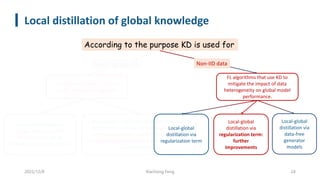
Local distillation of global knowledge
2022/12/8 Xiachong Feng 24
FL algorithms that use KD to
enable model heterogeneity
FL algorithms that use KD to
mitigate the impact of data
heterogeneity on global model
performance.
According to the purpose KD is used for
Solutions that leverage
server-side ensemble
distillation on top of
FedAvg’s aggregation phase.
Communication-efficient strategies that enable
model heterogeneity via exchanging locally-
computed statistics, model outputs and/or
model-agnostic intermediate features instead of
model parameters.
Local-global
distillation via
data-free
generator
models
Model-agnostic FL Non-IID data
Local-global
distillation via
regularization term
Local-global
distillation via
regularization term:
further
improvements
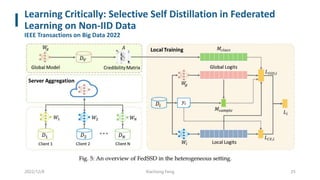
Learning Critically: Selective Self Distillation in Federated
Learning on Non-IID Data
IEEE Transactions on Big Data 2022
2022/12/8 Xiachong Feng 25
Local distillation of global knowledge
2022/12/8 Xiachong Feng 26
FL algorithms that use KD to
enable model heterogeneity
FL algorithms that use KD to
mitigate the impact of data
heterogeneity on global model
performance.
According to the purpose KD is used for
Solutions that leverage
server-side ensemble
distillation on top of
FedAvg’s aggregation phase.
Communication-efficient strategies that enable
model heterogeneity via exchanging locally-
computed statistics, model outputs and/or
model-agnostic intermediate features instead of
model parameters.
Local-global
distillation via
data-free
generator
models
Model-agnostic FL Non-IID data
Local-global
distillation via
regularization term
Local-global
distillation via
regularization term:
further
improvements
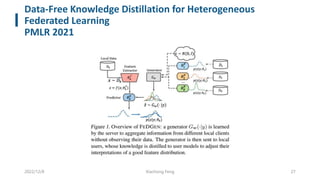
Data-Free Knowledge Distillation for Heterogeneous
Federated Learning
PMLR 2021
2022/12/8 Xiachong Feng 27
Thanks~

Knowledge Distillation for Federated Learning: a Practical Guide

  • 1.
    Knowledge Distillation forFederated Learning: a Practical Guide Alessio Mora, Irene Tenison, Paolo Bellavista, Irina Rish Report: Xiachong Feng
  • 2.
    Authors Xiachong Feng 2 AlessioMora PhD Student University of Bologna Irene Tenison Student M.Sc., Université de Montréal Paolo Bellavista Full Professor University of Bologna Irina Rish Full Professor Université de Montréal, Canada CIFAR AI Chair 2022/12/8
  • 3.
    2022/12/8 Xiachong Feng3 • Federated learning (FL) provides a feasible solution to train a global model across multiple datasets without raw data sharing. • FL is a collaborative and privacy-aware learning paradigm, which learns a global model by aggregating the models trained on local devices. • Through FL, each client would not worry about their private data exposed to other clients, but they can collaboratively build a pre-trained model together. Federated learning
  • 4.
    Federated Averaging (FedAvg) •The most used algorithms for FL are parameter-averaging based schemes (e.g., Federated Averaging) 2022/12/8 Xiachong Feng 4
  • 5.
    Limits • Clients mustimplement the same model architecture; • Transmitting model weights and model updates implies high communication cost, which scales up with the number of model parameters; • In presence of non-IID data distributions, parameter-averaging aggregation schemes perform poorly due to client model drifts. 2022/12/8 Xiachong Feng 5
  • 6.
    Knowledge Distillation 2022/12/8 XiachongFeng 6 Cross-entropy loss True label hot encoded Kullback-Leibler (KL) divergence From teacher
  • 7.
    Knowledge Distillation (KD)For Fed Overall • Initially, KD-based strategies, also motivated by encouraging privacy properties, have been introduced to enable model heterogeneity and to reduce the communication cost of the process by exchanging model outputs and/or model-agnostic intermediate representations instead of directly transferring model parameters/model updates For Server (server-side fusion) • Then, a set of strategies proposed to enhance the aggregation step of FedAvg with a server-side ensemble distillation phase to enable model heterogeneity and/or improve model fusion in presence of heterogeneous. For client (client model drift) • Recently, two KD-based lines of work focused on mitigating the phenomenon of client model drift – which makes averaging-based aggregations inefficient – either using regularization terms in clients’ objective functions or leveraging globally learned data-free generator. 2022/12/8 Xiachong Feng 7
  • 8.
    Structure of Thispaper 2022/12/8 Xiachong Feng 8 FL algorithms that use KD to enable model heterogeneity FL algorithms that use KD to mitigate the impact of data heterogeneity on global model performance. According to the purpose KD is used for Solutions that leverage server-side ensemble distillation on top of FedAvg’s aggregation phase. Communication-efficient strategies that enable model heterogeneity via exchanging locally- computed statistics, model outputs and/or model-agnostic intermediate features instead of model parameters. Server-side strategies that refine FedAvg’s aggregation with a distillation phase Client-side techniques that locally distill global knowledge to directly tackle client drift Model-agnostic FL Non-IID data
  • 9.
    Model-agnostic FL viaKD 2022/12/8 Xiachong Feng 9 FL algorithms that use KD to enable model heterogeneity FL algorithms that use KD to mitigate the impact of data heterogeneity on global model performance. According to the purpose KD is used for Solutions that leverage server-side ensemble distillation on top of FedAvg’s aggregation phase. Communication-efficient strategies that enable model heterogeneity via exchanging locally- computed statistics, model outputs and/or model-agnostic intermediate features instead of model parameters. Server-side strategies that refine FedAvg’s aggregation with a distillation phase Client-side techniques that locally distill global knowledge to directly tackle client drift Model-agnostic FL Non-IID data
  • 10.
    Server-side ensemble distillation •FedAvg’s protocol can be enhanced to enable model heterogeneity by leveraging server-side ensemble distillation on top of the aggregation step • The server can maintain a set of prototypical models, with each prototype representing all learners with same architecture. After collecting updates from clients, the server firstly performs a per-prototype aggregation and then produces soft targets for each received client model either leveraging unlabeled data or synthetically generated examples. • Next, such soft targets are averaged and used to fine tune each aggregated model prototype, exchanging knowledge among clients with different model architecture. • [30] Tao Lin, Lingjing Kong, Sebastian U Stich, and Martin Jaggi. Ensemble distillation for robust model fusion in federated learning. Advances in Neural Information Processing Systems, 33:2351–2363, 2020. • [41] Felix Sattler, Tim Korjakow, Roman Rischke, and Wojciech Samek. Fedaux: Leveraging unlabeled auxiliary data in federated learning. IEEE Transactions on Neural Networks and Learning Systems, 2021. 2022/12/8 Xiachong Feng 10
  • 11.
    Ensemble distillation forrobust model fusion in federated learning NeuroIPS 2020 2022/12/8 Xiachong Feng 11 Enable aggregation from heterogeneous systems KD Unlabeled Data Client Server Teacher Student Student
  • 12.
    Structure of Thispaper 2022/12/8 Xiachong Feng 12 FL algorithms that use KD to enable model heterogeneity FL algorithms that use KD to mitigate the impact of data heterogeneity on global model performance. According to the purpose KD is used for Solutions that leverage server-side ensemble distillation on top of FedAvg’s aggregation phase. Disclosing aggregated statistics of model outputs on local data. Server-side strategies that refine FedAvg’s aggregation with a distillation phase Client-side techniques that locally distill global knowledge to directly tackle client drift Model-agnostic FL Non-IID data Exchanging model responses on proxy data Leveraging intermedia te features.
  • 13.
    Communication-efficient on-device machinelearning: Federated distillation and augmentation under non-iid private data. NIPS 2018 2nd Workshop on Machine Learning on the Phone and other Consumer Devices (MLPCD 2) 2022/12/8 Xiachong Feng 13 Core: exchange outputs For each label
  • 14.
    Structure of Thispaper 2022/12/8 Xiachong Feng 14 FL algorithms that use KD to enable model heterogeneity FL algorithms that use KD to mitigate the impact of data heterogeneity on global model performance. According to the purpose KD is used for Solutions that leverage server-side ensemble distillation on top of FedAvg’s aggregation phase. Disclosing aggregated statistics of model outputs on local data. Server-side strategies that refine FedAvg’s aggregation with a distillation phase Client-side techniques that locally distill global knowledge to directly tackle client drift Model-agnostic FL Non-IID data Exchanging model responses on proxy data Leveraging intermedia te features.
  • 15.
    Exchanging model responseson proxy data 1. Broadcast: clients receive the current global logits/soft targets; 2. Local distillation: clients distill their local model by mimicking the received global logits/soft-labels on a subset of the proxy dataset; 3. Local training: clients fine-tune the distilled model on local data; 4. Local prediction: clients compute their local logits/soft targets on the proxy dataset; 5. Aggregation: the server collects the logits/soft targets and aggregates them to produce the updated global logits/soft targets. 2022/12/8 Xiachong Feng 15
  • 16.
    Distillation-Based Semi-Supervised FederatedLearning for Communication- Efficient Collaborative Training with Non-IID Private Data 2022/12/8 Xiachong Feng 16
  • 17.
    Structure of Thispaper 2022/12/8 Xiachong Feng 17 FL algorithms that use KD to enable model heterogeneity FL algorithms that use KD to mitigate the impact of data heterogeneity on global model performance. According to the purpose KD is used for Solutions that leverage server-side ensemble distillation on top of FedAvg’s aggregation phase. Disclosing aggregated statistics of model outputs on local data. Server-side strategies that refine FedAvg’s aggregation with a distillation phase Client-side techniques that locally distill global knowledge to directly tackle client drift Model-agnostic FL Non-IID data Exchanging model responses on proxy data Leveraging intermediate features.
  • 18.
    Ensemble Attention Distillationfor Privacy-Preserving Federated Learning ICCV 2021 2022/12/8 Xiachong Feng 18
  • 19.
    Server-side KD-based refinementof global model 2022/12/8 Xiachong Feng 19 FL algorithms that use KD to enable model heterogeneity FL algorithms that use KD to mitigate the impact of data heterogeneity on global model performance. According to the purpose KD is used for Solutions that leverage server-side ensemble distillation on top of FedAvg’s aggregation phase. Communication-efficient strategies that enable model heterogeneity via exchanging locally- computed statistics, model outputs and/or model-agnostic intermediate features instead of model parameters. Server-side strategies that refine FedAvg’s aggregation with a distillation phase Client-side techniques that locally distill global knowledge to directly tackle client drift Model-agnostic FL Non-IID data
  • 20.
    Ensemble distillation forrobust model fusion in federated learning NeuroIPS 2020 2022/12/8 Xiachong Feng 20 Enable aggregation from heterogeneous systems KD Unlabeled Data Client Server Teacher Student Student
  • 21.
    Local distillation ofglobal knowledge 2022/12/8 Xiachong Feng 21 FL algorithms that use KD to enable model heterogeneity FL algorithms that use KD to mitigate the impact of data heterogeneity on global model performance. According to the purpose KD is used for Solutions that leverage server-side ensemble distillation on top of FedAvg’s aggregation phase. Communication-efficient strategies that enable model heterogeneity via exchanging locally- computed statistics, model outputs and/or model-agnostic intermediate features instead of model parameters. Server-side strategies that refine FedAvg’s aggregation with a distillation phase Client-side techniques that locally distill global knowledge to directly tackle client drift Model-agnostic FL Non-IID data
  • 22.
    Local distillation ofglobal knowledge 2022/12/8 Xiachong Feng 22 FL algorithms that use KD to enable model heterogeneity FL algorithms that use KD to mitigate the impact of data heterogeneity on global model performance. According to the purpose KD is used for Solutions that leverage server-side ensemble distillation on top of FedAvg’s aggregation phase. Communication-efficient strategies that enable model heterogeneity via exchanging locally- computed statistics, model outputs and/or model-agnostic intermediate features instead of model parameters. Local-global distillation via data-free generator models. Model-agnostic FL Non-IID data Local-global distillation via regularization term Local-global distillation via regularization term: further improvements.
  • 23.
    Local-global distillation viaregularization term • In local-global distillation, the local objective function of clients becomes a linear combination between the cross-entropy loss and a KD-based loss that measures the discrepancy among the global model’s output (i.e., the teacher model’s output) and the local model’s output (i.e., the student model output) on private data, e.g. via Kullback-Leibler divergence. 2022/12/8 Xiachong Feng 23
  • 24.
    Local distillation ofglobal knowledge 2022/12/8 Xiachong Feng 24 FL algorithms that use KD to enable model heterogeneity FL algorithms that use KD to mitigate the impact of data heterogeneity on global model performance. According to the purpose KD is used for Solutions that leverage server-side ensemble distillation on top of FedAvg’s aggregation phase. Communication-efficient strategies that enable model heterogeneity via exchanging locally- computed statistics, model outputs and/or model-agnostic intermediate features instead of model parameters. Local-global distillation via data-free generator models Model-agnostic FL Non-IID data Local-global distillation via regularization term Local-global distillation via regularization term: further improvements
  • 25.
    Learning Critically: SelectiveSelf Distillation in Federated Learning on Non-IID Data IEEE Transactions on Big Data 2022 2022/12/8 Xiachong Feng 25
  • 26.
    Local distillation ofglobal knowledge 2022/12/8 Xiachong Feng 26 FL algorithms that use KD to enable model heterogeneity FL algorithms that use KD to mitigate the impact of data heterogeneity on global model performance. According to the purpose KD is used for Solutions that leverage server-side ensemble distillation on top of FedAvg’s aggregation phase. Communication-efficient strategies that enable model heterogeneity via exchanging locally- computed statistics, model outputs and/or model-agnostic intermediate features instead of model parameters. Local-global distillation via data-free generator models Model-agnostic FL Non-IID data Local-global distillation via regularization term Local-global distillation via regularization term: further improvements
  • 27.
    Data-Free Knowledge Distillationfor Heterogeneous Federated Learning PMLR 2021 2022/12/8 Xiachong Feng 27
  • 28.

Editor's Notes

  • #5 Question: W0在最开始如何分发?
  • #26 这里是可以改进的 首先他用了server端的数据 然后 他用的是分类 我们是生成 还是很不一样 , More specifically, Ak1,k2 denotes the probability that the global model predicts the class k1 as the class k2.