Federated Learning: Advanced
Trends
• Decentralized Machine Learning for Privacy
and Scalability
Introduction to Federated Learning
• What is Federated Learning?
• - A decentralized approach to training
machine learning models without centralizing
data.
• Core Concept:
• - Models are trained locally on devices; only
model updates are shared, not raw data.
• Applications:
• - Healthcare: Patient data privacy.
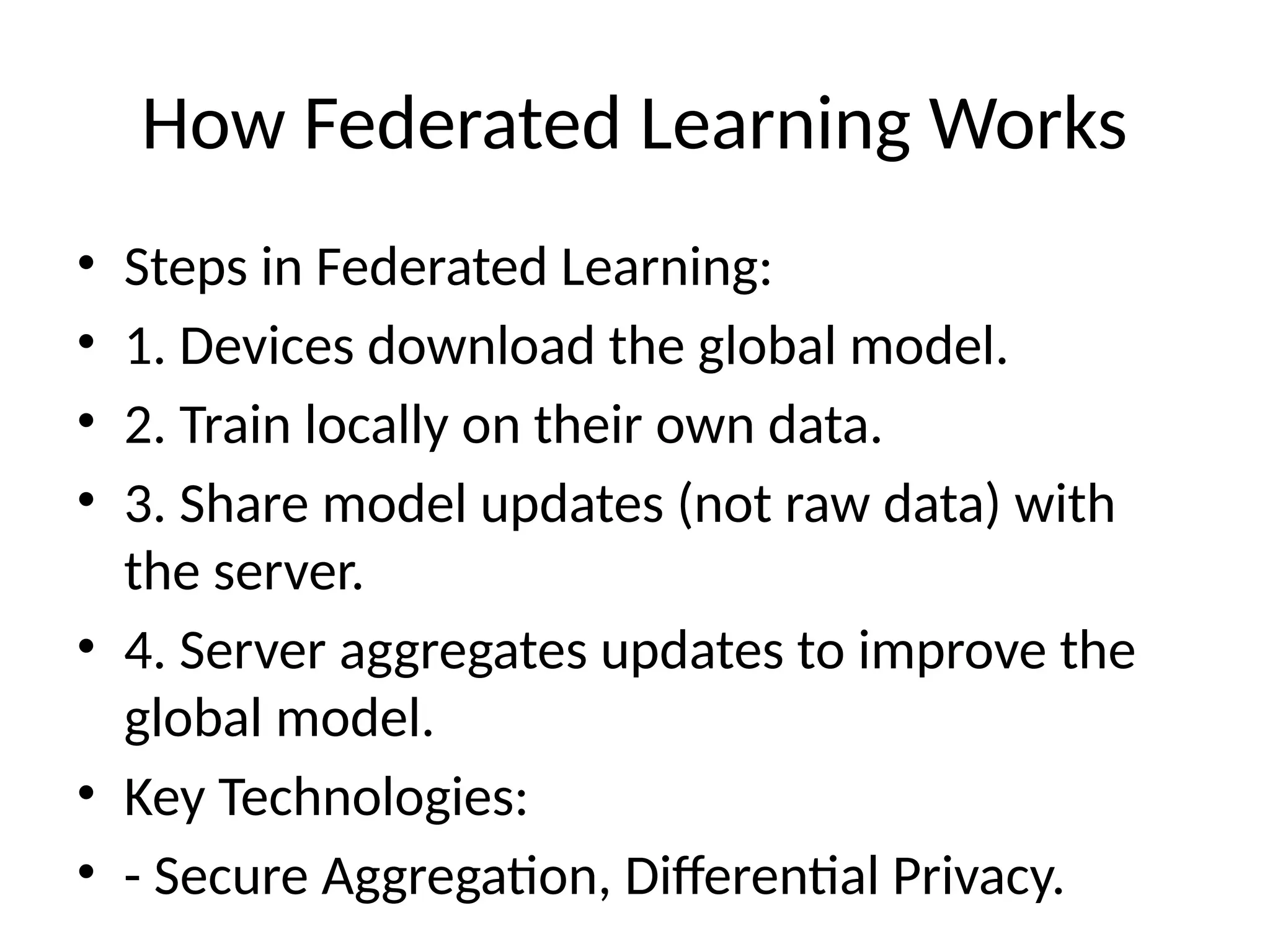
How Federated Learning Works
• Steps in Federated Learning:
• 1. Devices download the global model.
• 2. Train locally on their own data.
• 3. Share model updates (not raw data) with
the server.
• 4. Server aggregates updates to improve the
global model.
• Key Technologies:
• - Secure Aggregation, Differential Privacy.
Advantages of Federated Learning
• 1. Data Privacy:
• - No raw data leaves devices.
• 2. Scalability:
• - Trains on distributed devices or nodes.
• 3. Reduced Bandwidth:
• - Sharing updates instead of datasets reduces
data transfer costs.
• 4. Personalization:
• - Models can adapt to local data trends.
Challenges in Federated Learning
• 1. Communication Overhead:
• - Frequent updates can strain network
bandwidth.
• 2. System Heterogeneity:
• - Devices vary in computation power,
connectivity.
• 3. Data Heterogeneity:
• - Non-IID (non-independent, identically
distributed) data affects model performance.
Federated Learning Algorithms
• 1. Federated Averaging (FedAvg):
• - Aggregates local updates to form the global
model.
• 2. FedProx:
• - Addresses system heterogeneity by
regularizing local updates.
• 3. FedNova:
• - Normalized averaging to tackle imbalanced
updates.
Advanced Trends in Federated
Learning
• 1. Federated Learning with Differential
Privacy:
• - Ensures updates cannot reveal individual
data.
• 2. Federated Transfer Learning:
• - Enables collaboration across domains with
limited shared features.
• 3. Hierarchical Federated Learning:
• - Introduces intermediate aggregation layers
for efficiency.
Federated Learning and Edge AI
• Integration with Edge Computing:
• - Federated Learning complements edge
devices for real-time insights.
• Applications:
• - Autonomous vehicles, IoT devices, and
industrial systems.
• Future Trends:
• - Reduced latency, energy-efficient AI systems.
Real-World Use Cases
• 1. Healthcare:
• - Collaborative AI for diagnostics while
preserving patient privacy.
• 2. Mobile Devices:
• - Google’s Gboard: Federated Learning for
personalized suggestions.
• 3. Smart Grids:
• - Optimizing energy consumption across
distributed systems.
Future Directions and Conclusion
• Emerging Trends:
• - Integration with blockchain for secure
updates.
• - Advancements in communication-efficient
algorithms.
• Conclusion:
• - Federated Learning is reshaping AI by
balancing privacy, efficiency, and scalability.

Federated_Learning_Advanced_TrendsinAI.pptx

  • 1.
    Federated Learning: Advanced Trends •Decentralized Machine Learning for Privacy and Scalability
  • 2.
    Introduction to FederatedLearning • What is Federated Learning? • - A decentralized approach to training machine learning models without centralizing data. • Core Concept: • - Models are trained locally on devices; only model updates are shared, not raw data. • Applications: • - Healthcare: Patient data privacy.
  • 3.
    How Federated LearningWorks • Steps in Federated Learning: • 1. Devices download the global model. • 2. Train locally on their own data. • 3. Share model updates (not raw data) with the server. • 4. Server aggregates updates to improve the global model. • Key Technologies: • - Secure Aggregation, Differential Privacy.
  • 4.
    Advantages of FederatedLearning • 1. Data Privacy: • - No raw data leaves devices. • 2. Scalability: • - Trains on distributed devices or nodes. • 3. Reduced Bandwidth: • - Sharing updates instead of datasets reduces data transfer costs. • 4. Personalization: • - Models can adapt to local data trends.
  • 5.
    Challenges in FederatedLearning • 1. Communication Overhead: • - Frequent updates can strain network bandwidth. • 2. System Heterogeneity: • - Devices vary in computation power, connectivity. • 3. Data Heterogeneity: • - Non-IID (non-independent, identically distributed) data affects model performance.
  • 6.
    Federated Learning Algorithms •1. Federated Averaging (FedAvg): • - Aggregates local updates to form the global model. • 2. FedProx: • - Addresses system heterogeneity by regularizing local updates. • 3. FedNova: • - Normalized averaging to tackle imbalanced updates.
  • 7.
    Advanced Trends inFederated Learning • 1. Federated Learning with Differential Privacy: • - Ensures updates cannot reveal individual data. • 2. Federated Transfer Learning: • - Enables collaboration across domains with limited shared features. • 3. Hierarchical Federated Learning: • - Introduces intermediate aggregation layers for efficiency.
  • 8.
    Federated Learning andEdge AI • Integration with Edge Computing: • - Federated Learning complements edge devices for real-time insights. • Applications: • - Autonomous vehicles, IoT devices, and industrial systems. • Future Trends: • - Reduced latency, energy-efficient AI systems.
  • 9.
    Real-World Use Cases •1. Healthcare: • - Collaborative AI for diagnostics while preserving patient privacy. • 2. Mobile Devices: • - Google’s Gboard: Federated Learning for personalized suggestions. • 3. Smart Grids: • - Optimizing energy consumption across distributed systems.
  • 10.
    Future Directions andConclusion • Emerging Trends: • - Integration with blockchain for secure updates. • - Advancements in communication-efficient algorithms. • Conclusion: • - Federated Learning is reshaping AI by balancing privacy, efficiency, and scalability.